Category: USA

  • D.C. Memo: A salty problem for Trump’s ‘big, beautiful’ bill

    D.C. Memo: A salty problem for Trump’s ‘big, beautiful’ bill

    WASHINGTON – A decimated tax deduction most Americans never used (but many Minnesotans did) has become an obstacle as Congress tries to craft a $5 trillion extension of Donald Trump’s tax cuts.

    Trump’s tax cuts were implemented during his first term and are set to expire at the end of this year. To help pay for those tax cuts, the deductibility of state and local income taxes (SALT) on federal tax returns was capped at $10,000 for individuals and $20,000 for married couples filing jointly.

    That means taxpayers were limited in taking the deduction for state income taxes, property taxes and other local taxes. That hurt taxpayers in states with a high cost of living, high incomes and high taxes — mainly the nation’s “bluest” states.

    According to the Tax Foundation, California was the state most affected by the SALT cap, followed by New York. While most other  SALT cap-affected states were also coastal, Illinois came in at No. 3 and Minnesota was the other Midwestern state whose taxpayers were most disadvantaged by the cap, coming in 13th on the list.

    Now the fate of Trump’s tax breaks may rest on whether the GOP can find common ground on the SALT cap because Republican House members from New York, California and other predominantly Democratic high-income states are demanding the limitation be lifted.

    A hardcore group of these lawmakers nicknamed the “Salty Five,” who represent swing districts, say they won’t vote for Trump’s “big, beautiful (budget) bill” unless the cap is eliminated. That could scuttle the legislation in the narrowly divided U.S. House since no Democrat is expected to vote for the budget.

    In addition, Trump has told New Yorkers he’ll address the SALT cap, including it on a long list of campaign tax promises.

    Most American taxpayers don’t pay enough in state and local taxes to be bothered by the cap. And anti-SALT tax Republicans view them as a subsidy for high-tax states that encourage keeping local taxes high.

    There’s talk of a compromise. GOP House leaders who met often with the rebellious moderates this week say lifting the cap a little — to $30,000.

    But four New York Republicans said that was woefully inadequate, especially since New Yorkers pay more in taxes than they receive back from the federal government, as most higher income states do, including Minnesota.

    “We’ve negotiated in good faith on SALT from the start — fighting for the taxpayers we represent in New York,” Reps. Elise Stefanik, Andrew Garbarino, Nick LaLota and Mike Lawler said in a statement. “Yet with no notice or agreement, the Speaker and the House Ways and Means Committee unilaterally proposed a flat $30,000 SALT cap — an amount they already knew would fall short of earning our support.”

    The SALT cap prompted Gov. Tim Walz to do what other governors in blue states have done — approve a workaround that allowed some tax filers (partnerships, single proprietorships and S corporations) to fully deduct state taxes as a business expense.

    In any case, the SALT cap, coupled with the increase in the federal standard deduction that Trump implemented as part of his tax cut plan, has changed the way many Minnesotans file their federal taxes.

    Eric Willette, research director at the Minnesota Department of Revenue, said that before the 2017 tax bill took effect, 35% to 40% of Minnesota taxpayers itemized their deductions. Now, only about 6% to 10% do.

    If the SALT cap were lifted, those numbers could change, Willette said.

    “There are a lot of people who would go back to itemizing, but not as many as there used to be,” Willette predicted.

    Medicaid woes lead to blown deadline

    It’s likely House Speaker Mike Johnson, R-La., will miss his Memorial Day deadline to pass a mega-budget bill that would renew Trump tax cuts, and cut federal programs to help pay for them.

    The speaker’s biggest problem is the differences among Republican House members on the best way to cut money from Medicaid. Johnson met behind closed doors with groups of moderates and conservative hardliners this week to try to find common ground, and that largely eluded him.

    Cuts to the government health care program for the poor and the disabled were considered essential because the Energy and Commerce Committee, which has jurisdiction over Medicaid, was tasked with finding $880 billion in savings and other large programs the panel oversees — Social Security and Medicare — were considered off the table.

    But House GOP moderates are warning Republican leaders that they could lose their seats — costing the GOP its House majority — if there are deep cuts to Medicaid.

    Meanwhile, House conservatives are demanding that the program be dramatically shrunk.

    If either group withholds their support, they would derail GOP plans to present Trump with a budget bill that advances his agenda.

    House Republicans could only agree on one thing when it came to finding Medicaid savings — requiring beneficiaries who are not disabled or aren’t caretakers of small children or the elderly or a student to prove they are employed in order to keep their benefits.

    But those work requirements would not reduce spending on the program nearly enough.

    So, House GOP leaders are considering another way for the House Energy and Commerce Committee to meet its  obligation to cut hundreds of billions of dollars in health care costs: requiring pharmaceuticals to lower Medicaid drug prices, an idea Trump is promoting.

    House Republicans will continue to meet over the weekend to work on an Energy and Commerce bill the panel hopes to consider Tuesday afternoon.

    In case you missed it:

    -Speaking of Medicaid, state government reporter Matthew Blake wrote about Medicaid’s history in Minnesota and data reporter Shadi Bushra explained how the system works in the state.

    -Matthew Blake wrote a piece on how Republicans in the state Legislature are demonizing Minnesota’s decision to subsidize health care costs for undocumented residents, even though the program accounts for a tiny fraction of the state budget.

    -Winter Keefer had a story about how a downturn in new housing in St. Paul has forced the city to take a second look at its rent-control policies.

    -We also wrote about the House Committee on Natural Resources section of Donald Trump’s “big, beautiful (budget) bill,” which would remove a mining moratorium on the Boundary Waters watershed and expedite federal mining permits.

    -And in Community Voices, a professor emeritus argues for a close examination of how the Trump administration defines people and situations to its benefit.

    Your questions and comments

    A reader was kind to thank MinnPost for a story about legislation approved by the House Natural Resources Committee that boosted mining prospects in the watershed for the Boundary Waters.

    “Greetings from Billings, Montana!” the reader wrote. “I read your article in the Post from two days ago: concerning the revocation of protections of the Boundary Waters in Minnesota. Thank you for sounding the alarm! I am a Minnesota native, care deeply for my home state, and would like to notify my congressman in Montana, Troy Downing (R), to oppose this legislation.’’

    Another reader reacted to a story about the avalanche of lawsuits filed against the Trump administration in its first 100 days.

    “Most of the lawsuits that are going against Trump appear to violate his oath of office, particularly ignoring court orders” the reader wrote. “It would be interesting to consider what consequences he could or should experience for this. He was elected president, not dictator.”

    Please keep your comments, and any questions, coming. I’ll try my best to respond. Please contact me at aradelat@minnpost.com.

    The post D.C. Memo: A salty problem for Trump’s ‘big, beautiful’ bill appeared first on MinnPost.

  • Pete Hegseth’s Pentagon is moving trans troops out of the military

    Pete Hegseth’s Pentagon is moving trans troops out of the military

    WASHINGTON (AP) — The Pentagon will immediately begin moving as many as 1,000 openly identifying trans service members out of the military and give others 30 days to self-identify, under a new directive issued Thursday.

    Buoyed by Tuesday’s Supreme Court decision allowing the Trump administration to enforce a ban on transgender individuals in the military, the Defense Department will then begin going through medical records to identify others who haven’t come forward.

    Defense Secretary Pete Hegseth, who issued the latest memo, made his views clear after the court’s decision.

    “No More Trans @ DoD,” Hegseth wrote in a post on X. Earlier in the day, before the court acted, Hegseth was more blunt, telling a conference that his department is leaving wokeness and weakness behind. “No more pronouns,” he told a special operations forces conference in Tampa.

    Department officials have said it’s difficult to determine exactly how many transgender service members there are, but medical records will show those who have been diagnosed with gender dysphoria, who show symptoms or are being treated.

    Those troops would then be involuntarily forced out of the service.

    Officials have said that as of Dec. 9, 2024, there were 4,240 troops diagnosed with gender dysphoria in the active duty, National Guard and Reserve. But they acknowledge the number may be higher.

    The memo released on Thursday mirrors one sent out in February, but any action was stalled at that point by several lawsuits.


    The post Pete Hegseth’s Pentagon is moving trans troops out of the military appeared first on MinnPost.

  • U.S. House Republicans backing off some Medicaid cuts

    U.S. House Republicans backing off some Medicaid cuts

    WASHINGTON (AP) — House Republicans appear to be backing off some, but not all, of the steep reductions to the Medicaid program as part of their big tax breaks bill, as they run into resistance from more centrist GOP lawmakers opposed to ending nearly-free health care coverage for their constituents back home.

    This is as a new report out Wednesday from the nonpartisan Congressional Budget Office estimated that millions of Americans would lose Medicaid coverage under the various proposals being circulated by Republicans as cost-saving measures. House Republicans are scrounging to come up with as much as $1.5 trillion in cuts across federal government health, food stamp and other programs, to offset the revenue lost for some $4.5 trillion in tax breaks.

    “Under each of those options, Medicaid enrollment would decrease and the number of people without health insurance would increase,” the CBO report said.

    The findings touched off fresh uncertainty over House Speaker Mike Johnson’s ability to pass what President Donald Trump calls his “big, beautiful bill” by a self-made Memorial Day deadline.

    Lawmakers are increasingly uneasy, particularly amid growing economic anxiety over Trump’s own policies, including the trade war that is sparking risks of higher prices, empty shelves and job losses in communities nationwide. Central to the package is the GOP priority of extending tax breaks, first enacted in 2017, that are expiring later this year. But they want to impose program cuts elsewhere to help pay for them and limit the continued climb in the nation’s debt and deficits.

    Johnson has been huddling privately all week in the speaker’s office at the Capitol with groups of Republicans, particularly the more moderate GOP lawmakers in some of the most contested seats in the nation, who are warning off steep cuts that would slash through their districts.

    Democrats, who had requested the CBO report, pounced on the findings.

    “This non-partisan Congressional Budget Office analysis confirms what we’ve been saying all along: Republicans’ Medicaid proposals result in millions of people losing their health care,” said Rep. Frank Pallone, D-N.J., who sought the review with Sen. Ron Wyden, D-Ore.

    House Republican lawmakers exiting a meeting late Tuesday evening indicated that Johnson and the GOP leadership were walking away from some of the most debated Medicaid changes to the federal matching fund rates provided to the states.

    Rep. Jeff Van Drew, R-N.J., said those Medicaid changes “are dead.”

    Republican Rep. Nick LaLota of New York, reminded that Trump himself has said he would oppose Medicaid cuts. Instead, he said the growing consensus within the Republican ranks is to focus the Medicaid cuts on other provisions.

    Among the other ideas, LaLota said, are imposing work requirements for those receiving Medicaid coverage, requiring recipients to verify their eligibility twice a year instead of just once and ensuring no immigrants who are in the U.S. without legal standing are receiving aid.

    But the more conservative Republicans, including members of the House Freedom Caucus, are insisting on steeper cuts as they fight to prevent skyrocketing deficits from the tax breaks.

    Medicaid is a joint program run by states and the federal government, covering 71 million adults.

    Republicans are considering a menu of options to cut federal spending on the program, including reducing the share that the federal government pays for enrollees health care — in some cases it is as much as 90%.

    They are also considering and setting a cap on how much the federal government spends on each person enrolled in Medicaid, though that idea also appears to be losing support among lawmakers.

    While those changes would bring in billions of dollars in cost savings, they would also result in roughly 10 million people losing Medicaid coverage, the CBO said.

    They appear to be off the table.

    But other proposed Medicaid changes are still in the mix for Republicans, including imposing new limits on a state’s tax on health care providers that generate larger payments from the federal government. That would bring in billions in savings, but could also result in some 8 million people losing coverage, the report said.

    The post U.S. House Republicans backing off some Medicaid cuts appeared first on MinnPost.

  • U.S. House panel scraps Boundary Waters protection as it works on Trump’s ‘big beautiful bill’

    U.S. House panel scraps Boundary Waters protection as it works on Trump’s ‘big beautiful bill’


    Kekekabic Trail area, Boundary Waters Canoe Area Wilderness

    WASHINGTON – As it finished its work on President Donald Trump’s “big beautiful bill,” the House Natural Resources Committee approved legislation that would end a mining ban on Superior National Forest that protects the watershed for the Boundary Waters Canoe Area Wilderness.

    The legislation would also reestablish mineral leases sought by mining company Twin Metals that had been canceled and approve new leases for mineral extraction and helium production in the national forest.

    In a marathon session that ended early Wednesday, Democrats on the panel submitted about 120 amendments, including one that would strip out the legislation’s language reversing the mining moratorium and another that would scrap the approval of new leases.

    The wide-ranging budget bill would also open the Arctic National Wildlife Refuge to oil exploration. Moreover, it would allow companies to pay a fee in exchange for expedited permitting and give mining companies and the oil and natural gas industry certain exemptions from judicial review, limiting environmental lawsuits that have impeded copper-nickel mining efforts on Minnesota’s Iron Range.

    Taconite is mined in Superior National Forest, but environmentalists say mining for copper, cobalt, nickel and other metals in the forest would produce tailings that can be dangerous sources of toxic chemicals that would pollute the Rainy River Watershed — and the Boundary Waters.

    Rep. Jared Huffman of California, the highest-ranking Democrat on the panel, called the bill “the most extreme, anti-environment bill in American history.”

    “The vast majority of Americans hate all of this,” he said.

    The legislation was also condemned by environmental groups that have been fighting sulfide-ore mining on the Iron Range.

    Ingrid Lyons, Executive Director of Save the Boundary Waters, called the bill “a reckless giveaway of America’s most iconic public lands.”

    “And the Boundary Waters is squarely in the crosshairs,” she added.

    Even so, the panel’s Republican majority struck down every Democratic amendment.

    Twin Metals, which has been trying to mine copper, nickel and cobalt in Superior National Forest for decades, declined comment.

    But MiningMinnesota, which represents mining interests in the state, said in a statement that it applauded “the members of Congress who recognize what we’ve long known: Minnesota is home to one of the world’s largest undeveloped mineral resources including copper, nickel, cobalt, and more.”

    “Restoring cancelled federal mineral rights in northeast Minnesota is an important step forward in allowing current and future mining projects to undergo a fair and thorough regulatory process,” MiningMinnesota said.

    Rep. Pete Stauber, R-8th District, a senior member of the panel, introduced legislation that would end the moratorium and reestablish Twin Metals’ leases. But those bills failed to pass the U.S. Senate.

    Yet the bill reported out of the House Natural Resources Committee on Wednesday will be part of a budget reconciliation process that cannot be filibustered by the Senate. Stauber said the legislation “responsibly unleashes American resources.”

    As congressional committees work on a budget bill that would implement Trump’s agenda, impose massive cuts in federal programs and renew $5 trillion in tax cuts Trump implemented in his first term, the process has been slowed by GOP disagreements over how much to cut from Medicaid and other programs.

    Rep. Pete Stauber
    Rep. Pete Stauber

    And some provisions the House wants in the reconciliation bill may run afoul of the Senate parliamentarian because in the Senate reconciliation bills must focus on budget issues, not changes in federal policy.

    And, as far as the mining provisions approved by the House Natural Resources Committee, Minnesota’s mining industry is also regulated by the state and any new permits would have to be approved by the governor.

    “The state is a backstop,” Lyons said.

    ‘Critical minerals’ production

    Meanwhile, Trump’s National Energy Dominance Council last week designated a proposed open pit mine for copper, nickel, cobalt and other precious metals proposed by NewRange as a priority for federal permitting.

    Through an executive order signed in March, Trump directed federal agencies, in coordination with the council, to identify and expedite priority mineral production projects that can be “immediately approved” or immediately issued permits.

    NewRange proposes building a $1 billion open pit mine near Babbitt and Hoyt Lakes called the NorthMet Project. But the company had its federal permit from the U.S. Army Corps of Engineers revoked because of concerns over the mine’s potential impact on a federally protected wetland.

    NewRange says it will submit an updated Clean Water Act Section 404 permit application for the NorthMet Project to the Army Corps of Engineers later this year.

    Meanwhile, Trump has increased the impact on national security of the minerals that are below the surface of the Iron Range.

    The executive order Trump signed in March added copper and several other minerals to the nation’s list of critical minerals, which had already included nickel and cobalt.

    Trump is intent on boosting the nation’s production of critical minerals and is using his authority under the 1950 Defense Production Act to try to reduce U.S. reliance on critical minerals through imports from countries like China.

    The post U.S. House panel scraps Boundary Waters protection as it works on Trump’s ‘big beautiful bill’ appeared first on MinnPost.

  • Trump v. Rule of Law is a case that is riveting lawyers, judges and legal experts

    Trump v. Rule of Law is a case that is riveting lawyers, judges and legal experts


    People gather on a brick plaza

    WASHINGTON — A Trump-appointed federal judge recently ruled that the president can’t use an 18th century law that allows the removal of non-citizens in times of war or invasion.

    U.S. District Judge Fernando Rodriguez said President Trump’s use of the wartime Alien and Sedition Acts was “unlawful” and had been improperly invoked.

    It was just one of the latest Trump defeats in the nation’s courts. His administration has been sued nearly 200 times during the president’s first 100 days in office, and new lawsuits are being filed nearly every day.

    Judges — who have ruled against the Trump administration 70 times and left his policies in effect in 47 other instances, with 63 cases remaining to be resolved, according to an Associated Press tracker — are now nearly the only check on a president who has rapidly consolidated his power.

    According to the AP tracker, the largest number of lawsuits involved Trump’s immigration policies, and the second largest was his administration’s clawback of federal funding. After that, the actions of the Elon Musk-led Department of Government Efficiency (DOGE) actions have been the most challenged in court, as well as efforts to eradicate diversity, equity and inclusion (DEI) policies and transgender rights and impose voter restrictions.

    The frenetic legal activity has been unprecedented, as have the attacks Trump and his surrogates have leveled on judges who have not ruled in his favor. Trump and his administration have also ignored, or not fully complied with several court rulings. That has led legal experts to question the strength – and even the survival – of the nation’s rule of law.

    Peter Larsen, a law professor at Mitchell Hamline School of Law, said it all depends on how the U.S. Supreme Court rules in key cases making their way to the nation’s highest court and whether Trump respects decisions  that don’t go his way.

    Peter Larsen

    Cases making their way in federal courts to the Supreme Court involve several Minnesota has joined as part of a coalition of Democratic states. Lawsuits have also been filed by nonprofits, universities, Democratic political organizations and individuals, including federal workers who have been abruptly and unexpectedly fired.  

    Ultimately, it will be the Supreme Court with its three Trump appointees, that will decide whether the president’s sweeping actions on immigration, government spending and civil rights are constitutional.

    “Trump will continue to push against the court until the Supreme Court breaks or the court pushes back forcefully, at which point it will be up to Congress on how to respond,” Larsen said.

    The GOP-led Congress has been careful to not to cross Trump, fearful of the president’s ability to raise MAGA support for primary challengers and billionaire Elon Musk’s threats to spend millions of dollars to help those challengers.

    But there are tiny cracks in what’s been unwavering Republican support for Trump’s actions. Contempt for the rule of law could be a bridge too far, Larsen said, leading to congressional action.

    Those include investigative hearings on some of the dozens of executive actions Trump has issued to make radical changes in the federal government and the approval of legislation that would limit the president’s action. Some GOP lawmakers have sponsored bills that would take back Congress’s authority over tariff policy.

    Larsen also said another impeachment could also be on the table.

    The U.S. Supreme Court declined to block an order by a lower court to “facilitate” bringing back Kilmar Abrego Garcia, a Salvadoran immigrant sent to a maximum-security prison in El Salvador under Trump’s use of the Aliens and Seditions Act. It also upheld a lower court decision that required the release of frozen U.S. Agency for International Development Fund grants.

    But the conservative court’s majority has been limited in its pushback, Larsen said.

    “So far, the Supreme Court, when it disagreed with him, has been somewhat meek and temperate,” Larsen said.

    ‘Warning signs that we can’t ignore’ 

    Attorneys across the nation celebrate May 1 as Law Day, retaking their oaths at courthouses across the nation, including dozens at the Hennepin County Courthouse. There’s evidence more lawyers participated this year in the annual event that first took place in 1958 because many believe the rule of law faces threat.

    “The principles of judicial independence and the independence of the legal profession – cornerstones of American democracy – are facing unprecedented challenges across the country,” said a statement from the Minnesota Bar Association that heralded Law Day. “Attacks on judges for unpopular rulings, political pressure on legal professionals and law firms, and a growing distrust of the legal system threaten the very foundation of fairness and equal justice.”

    Minnesota Bar Association President Samuel Edmunds told lawyers gathered outside the Hennepin County courthouse that the threats were “warning signs and we cannot ignore them.”

    Hannah Dugan, a Milwaukee county judge, was arrested by the FBI last month after she obstructed federal authorities from detaining an undocumented immigrant in her courtroom. And a  former New Mexico judge was arrested for allegedly housing three undocumented Venezuelan immigrants.

    “What has happened to our judiciary is beyond me,” U.S. Attorney General Pam Bondi told Fox News in response to the arrests. “We are sending a very strong message today … we will come after you and we will prosecute you. We will find you.”

    Pam Bondi shown testifying at a Senate Judiciary Committee confirmation hearing on Jan. 15.
    Pam Bondi shown testifying at a Senate Judiciary Committee confirmation hearing on Jan. 15. Credit: REUTERS/Elizabeth Frantz

    Trump has also taken to Truth Social to insult and threaten judges who have ruled against his actions, calling them “communists” and “corrupt” although he appointed some of them in his first term.

    And Judge John Deacon Bates of the U.S. District Court for the District of Columbia, who directed the administration to restore health-related webpages that were removed to comply with an executive order on gender, is facing impeachment threats from GOP lawmakers.

    Last week, at a ceremonial unveiling of his portrait at his courthouse, Bates who was appointed by former President George W. Bush said “my colleagues on the bench do not practice judging as a partisan enterprise” to an audience that included Chief Justice John Roberts and three other members of the Supreme Court. 

    Trump has also attacked law firms that have taken action against his administration – prompting nine top international firms to make a deal with the president to provide a total of $1 billion in free legal work. Meanwhile, Trump has called other pro-bono cases – against him – “harmful” and admonished lawyers not to do the work.

    ‘More energy than I need to fight’

    Minnesota Attorney General Keith Ellison has joined other Democratic attorneys general in 20 cases against the Trump administration, including the first one that challenged the president’s attempt to abolish birthright citizenship for children of undocumented immigrants.

    Ellison and the Democratic attorneys general have won temporary orders  unblocking frozen federal funding and halting DOGE access to private individual information at the Treasury Department.

    And more lawsuits are pending. Those include one that would block the Trump administration from stripping money from K-12 schools that reject a new interpretation of 1964 Civil Rights Act to eliminate all mention of diversity and halting the dismantling AmeriCorps, a volunteer public service agency.

    Ellison said he may also join a suit to stop the layoffs of employees of the Social Security Administration. And he’s ready to file others.

    “I’ve got more energy than I need to fight this guy,” he said, referring to Trump. “Each of these cases affect a segment of the population in a significant way.”

    From left to right: Illinois Attorney General Kwame Raoul, New York Attorney General Letitia “Tish” James, Minnesota Attorney General Keith Ellison, Arizona Attorney General Kris Mayes, and New Jersey Attorney General Matthew Platkin.
    From left to right: Illinois Attorney General Kwame Raoul, New York Attorney General Letitia “Tish” James, Minnesota Attorney General Keith Ellison, Arizona Attorney General Kris Mayes, and New Jersey Attorney General Matthew Platkin. Credit: MinnPost photo by Tony Nelson

    Ellison said the problem is not that Trump is using executive power to effect change, but that he’s doing so in a “fundamentally unconstitutional way.”

    For instance, if he wanted to end birthright citizenship for some Americans, Ellison said Trump should seek changes to the U.S. Constitution. And instead of undermining Congress’ authority when it comes to government spending, he should work with lawmakers to approve bills.

    As far as ignoring the courts, Ellison said the Trump administration has “more or less” obeyed rulings that relate to lawsuits brought by the Democratic attorneys general.

    But he’s aware that a constitutional crisis is possible if Trump refuses to comply with adverse court rulings.

    Yet Trump administration lawyers may have learned lessons from experience, which could boost their chances of courtroom wins.

    Larsen of the Mitchell Hamline School of Law said that during his first term, when Trump signed far fewer executive orders, his administration lost ill-prepared cases and sometimes had to redraft those orders to pass legal muster.

    “He and his administration are much savvier this time around than in his first term when they stumbled and fumbled around,” Larsen said. “They are very forceful now and the executive actions are happening at a rapacious pace.”

    The post Trump v. Rule of Law is a case that is riveting lawyers, judges and legal experts appeared first on MinnPost.
  • D.C. Memo: State pension plans safe from market chaos, officials say

    D.C. Memo: State pension plans safe from market chaos, officials say

    WASHINGTON – As owners of 401(k) plans and Individual Retirement Accounts (IRAs) worry about the impact of President Donald Trump’s tariff policies on their retirement money, Minnesota’s state workers are fretting about their pensions. 

    Jill Schurtz, the chief investment officer for the Minnesota State Board of Investment, an independent agency tasked with trying to grow the $96 billion state fund that finances pensions for teachers and state employees, says she’s aware of concerns.

    But she said there is nothing to worry about.

    Schurtz said the state’s pension fund is “large enough to bear the brunt of a market crisis.”

    She also says the fund’s diversity has shielded it from sharp downturns. Schurtz said 50% of the fund is invested in equities, or stocks; 25% is invested in “fixed income” securities like bonds, certificates of deposit and Treasury bills; and the remaining 25% is used to fund private credit ventures.

    “We can pay benefits, no matter what the (economic) weather is,” Schurtz said.

    That said, the fund, which has averaged returns of about 5% a year, was flat — meaning it did not lose or make money — in the first three months of this year. 

    And Schurtz said there is no final, official accounting yet for how the fund performed in April, when the big dives in the market occurred after Trump announced his April 2 “Liberation Day” tariffs.

    Still, Schurtz is taking the long view, noting that the stock market always recovers from a slump and its historic trajectory is up.

    The fund pays $240 million-$250 million in benefits to retirees every month, above and beyond what it collects in contributions. So, it has to grow.

    And it did, by $23 billion in the past five years, Schurtz said.

    But Mike Haveman, executive director for the Minnesota Center for Fiscal Excellence, a nonprofit that conducts research on education and fiscal issues, said at least one of the state’s pension plans — the one for teachers — is underfunded and that a downturn in the market will only make things worse.

    “These plans are used to volatile markets and one bad year in itself would not be a problem,” Haveman said. “But if you are already underfunded, a bad year is going to hurt.”

    State Auditor Julie Blaha, a member of the State Board of Investments and a former middle school math teacher who will retire with teacher and public employee pensions, said the first thing a state employee asks her when they happen to meet is, “How are things with the pension plan?”

    Echoing Schurtz, Blaha tells them their retirement fund is fine because of its size, diversity and long-range planning. “That’s the benefit of having a pension instead of a personal retirement account,” Blaha said. “I feel lucky to have a pension right now.”

    Yet Blaha said she’s concerned about the majority of Americans who don’t. 

    According to the Congressional Research Service, about 12 million American workers had pensions in 2020, while more than 85 million depended on 401(k)s as their main retirement plan.

    She said these individual investors “can’t withstand the uncertainty (in the stock market) forever.”

    Klobuchar scores a win

    While the last Congress was considered a “do-nothing” legislature because extreme partisanship led to few accomplishments, this Congress has been even less productive.

    But that hasn’t stopped Sen. Amy Klobuchar, D-Minn., from notching another legislative win.

    In partnership with Sen. Ted Cruz, R-Texas, Klobuchar introduced a bill that criminalizes explicit deepfakes and revenge pornography.

    The “Take it Down Act” also requires social media platforms to implement procedures to remove this content.

    The Senate approved the bill in February and the House approved the bill this week. It now goes to the White House, where First Lady Melania Trump is a champion of the legislation.

    At a virtual press conference Thursday, Klobuchar said explicit deepfakes and revenge porn “ruins reputations and shatters lives” and that as many as one out of 12 Americans may fall victim to these online attacks.

    Klobuchar’s bill imposes three-year sentences for perpetrators of deepfake porn that involves minors and two-year sentences for those who produce deepfakes and revenge porn that involve adult victims. It also gives social media platforms two years to establish methods to take down deepfakes and revenge porn.

    Meanwhile, Molly Kelley of Otsego said she was one of 85 women victimized by deepfake porn by a family friend who captured her image on Facebook.

    “When people think of deepfake porn, they are thinking of celebrities like Taylor Swift,” Kelley said. “But it can happen to anyone.”

    She called the “Take it Down Act” a “lifeline” for victims of deepfake abuse.

    In other news:

    ▪️Matthew Blake wrote about partisan differences over an education funding bill that are threatening to unravel a power sharing agreement in the state Legislature.
    ▪️A story this week looks at behind-the-scenes efforts to press the University of Minnesota to join other colleges in defending themselves from and pushing back against Trump administration attacks on their schools.
    ▪️Winter Keefer wrote that the Minneapolis Police Department has implemented new, encrypted scanners that bar the public from listening on police calls.
    ▪️And Rep. Angie Craig, D-2nd District, finally announced her intent to run for retiring Sen. Tina Smith’s seat.

    Your questions and comments

    A reader weighed in on what’s becoming a very interesting Democratic primary race for retiring Sen. Tina Smith’s seat, with Rep. Angie Craig, Lt. Gov. Peggy Flanagan and former state Sen. Melisa López Franzen in the race.

    “May the best woman win,” the reader wrote. “I can support any of the three candidates in the general election. Progressives and moderates are going to disagree — so what. I am happy with the 90% of what they agree on. At this point, Walz getting in the race is unnecessary. Another term as governor works for me.”

    Please keep your comments, and any questions, coming. I’ll try my best to respond. Contact me at aradelat@minnpost.com.

    The post D.C. Memo: State pension plans safe from market chaos, officials say appeared first on MinnPost.
  • Fact-checking Trump’s rhetoric on 100-day accomplishments

    Fact-checking Trump’s rhetoric on 100-day accomplishments

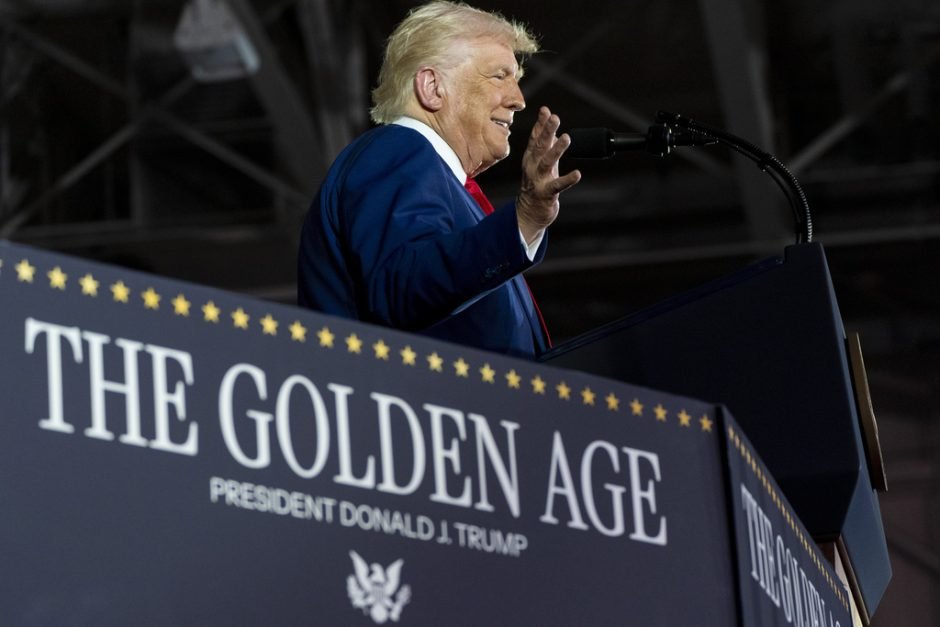
    In a visit Tuesday to Warren, Michigan, President Donald Trump celebrated his first 100 days back in office by touting his accomplishments, while embellishing some and misrepresenting others.

    The speech of about 90 minutes was reminiscent of a campaign rally and covered much of the same ground as he lobbed insults at the previous administration and detractors.

    In highlighting his accomplishments, he made a number of false and misleading statements on topics such as the state of the economy and the price of eggs.

    Here’s a look at the facts.Trump exaggerates drop in gas prices

    TRUMP: “Gasoline was almost $4 not so long ago. And now, Mike, we just hit $1.98 in a lot of states. Think of it.”

    THE FACTS: As of Tuesday, no state had an average gas price of $1.98. Mississippi had the lowest price, at $2.67 per gallon of regular gas. Trump previously made this claim about the level of gas prices on April 16, but they had not fallen as low as $1.98 that day either — or any day in the last two weeks. Mississippi and Tennessee were tied for the lowest average price on April 16, at $2.707 per gallon of regular gas.

    National average prices rose under former President Joe Biden to a high of $5.01 in June 2022 before falling to $3.09 in December of that year. Prices rose again to a high of $3.88 in September 2023, but were down to $3.139 in December 2024. They were at $3.13 nationally as of Tuesday. The last time prices surpassed $4 was in August 2022.Cost of eggs not as low as Trump says

    TRUMP: “Since I took office, the cost of eggs is down 87% now.”

    THE FACTS: The retail price of a dozen large eggs decreased in price to $2.07 in September 2023, but has been on the rise since October 2024. As of March, they were up to $6.23.

    Wholesale egg prices, on the other hand, fell significantly in March, but not by 87%. They were at a high of $8.17 for a dozen large eggs on March 3 and had dropped to $2.92 by March 26 — a decrease of approximately 64%.

    University of Arkansas agricultural economist Jada Thompson told the AP earlier this month that because the wholesale prices did not start dropping until mid-March, there may not have been enough time for the average price for the month to decline. And grocery stores may not have immediately passed on the lower prices.Inflation was already falling under Biden

    TRUMP: “We’re ending the inflation nightmare. The worst that we’ve had, probably in the history of our country.”

    THE FACTS: Inflation started falling long before Trump started his second term. Inflation peaked at 9.1% in June 2022 after rising steadily in the first 17 months of Biden’s presidency from a low of 0.1% in May 2020, during the COVID-19 pandemic. As of December, it had fallen to 2.9%. The most recent data shows that, as of March, it had fallen to 2.4%. Other historical periods have seen higher inflation, such as a more than 14% rate in 1980, according to the Federal Reserve.Coal production is cleaner, but it still creates emissions

    TRUMP: “We stopped their crusade on coal. Did you see what I did the other day? Clean, beautiful coal.”

    THE FACTS: The production of coal is cleaner now than it has been historically, but that doesn’t mean it’s clean.

    Planet-warming carbon dioxide emissions from the coal industry have decreased over the past 30 years, according to the U.S. Energy Information Administration. Energy lobbyist Scott Segal told the AP earlier this month that “the relative statement that coal-fired electricity is cleaner than ever before is true, particularly when emissions are measured per unit of electricity produced.”

    And yet, coal production worldwide still needs to be reduced sharply to address climate change, according to United Nations-backed research.

    Along with carbon dioxide, burning coal emits sulfur dioxide and nitrogen oxides that contribute to acid rain, smog and respiratory illnesses, according to the EIA.Trump misleads on Biden-era ‘electric vehicle mandate’

    TRUMP: “I terminated Joe Biden’s insane electric vehicle mandate where you were mandated to buy an electric vehicle. You were mandated within just a few years to buy an electric vehicle.”

    THE FACTS: It’s misleading to claim that the Biden administration implemented such a mandate. In April 2023, the Environmental Protection Agency announced strict limits on greenhouse gas emissions from passenger vehicles. The agency said these limits could be met if 67% of new-vehicle sales are electric by 2032.

    And yet, the new rule did not include a requirement for automakers to boost electric vehicle sales directly. It set emissions limits and allowed automakers to choose how to meet them.

    EPA Administrator Lee Zeldin announced on March 12 that the agency would reconsider the rule, but it has not yet been terminated.

    In 2019, Kamala Harris co-sponsored a bill as a U.S. senator called the Zero-Emission Vehicles Act that would have required 100% of new passenger vehicles sold to be zero-emission by 2040. The bill, which stalled in committee, did not ban ownership of vehicles that produce emissions. ___

    Find AP Fact Checks here: https://apnews.com/APFactCheck.

    The post Fact-checking Trump’s rhetoric on 100-day accomplishments appeared first on MinnPost.

  • As other schools band together against Trump threats, the University of Minnesota keeps a low profile

    As other schools band together against Trump threats, the University of Minnesota keeps a low profile


    Northrop Auditorium

    WASHINGTON – The University of Minnesota, swept up like other schools in the maelstrom of Trump administration policies they say erode academic freedom, is undergoing intense internal debate about what to do about it.

    The questions that have pitted students and faculty members against the university’s administration are whether and how the state’s largest institution of higher learning should fight back.

    Higher education quickly became one of President Trump’s prime targets after he was sworn in to his second term. His  administration cut off funding for schools that did not comply with its demands and launched investigations into dozens of schools, including the University of Minnesota, which is the target of probes into alleged antisemitism and race-based admission policies.

    Deciding there was strength in numbers, hundreds of college presidents and officials have signed an American Association of Colleges and Universities (AACU) letter that decried the “unprecedented government overreach and political interference.”

    The leaders of about a dozen Minnesota schools, including the presidents of Gustavus Adolphus College, Carleton College, the University of St. Thomas, Minneapolis College of Arts and Design and Mitchell Hamline School of Law signed on to the letter, which as of Tuesday had more than 550 signatures.

    Yet the University of Minnesota’s new president, Rebecca Cunningham, took a pass.  

    The university has not responded to several requests for information about the school’s decision to reject the AACU’s effort and on other initiatives in which the nation’s schools are trying to organize a defense to the Trump administration’s actions.

    For instance, during a Zoom call Thursday, the university senate voted overwhelmingly for a resolution to join a Big Ten effort, led by Rutgers University, that would establish a joint defense pact against Trump.

    !function(){“use strict”;window.addEventListener(“message”,(function(a){if(void 0!==a.data[“datawrapper-height”]){var e=document.querySelectorAll(“iframe”);for(var t in a.data[“datawrapper-height”])for(var r,i=0;r=e[i];i++)if(r.contentWindow===a.source){var d=a.data[“datawrapper-height”][t]+”px”;r.style.height=d}}}))}();

    Those who’ve spoken with Cunningham about the issue say she’s taken a “neutral” and “non-committal” stance on the Big Ten resolution and is, in general, trying to avoid conflict and involvement of the school in politics.

    On a recording of the Zoom call, Cunningham spoke of her general wariness toward making statements. “You will not tend to see me making statements, first of all, just to join on because other people are making them,” she said.

    ‘A lot of backchannel communication’

    The school’s Board of Regents has also taken a “keep your head down” approach.

    At its last meeting in March, the regents approved a resolution that said all official communications from the university must be approved by the president. The resolution also says the university will not comment on issues that address matters of public concern unless it affects the concerns of the university.

    Faculty and student members of the university senate who voted overwhelmingly for the Big Ten resolution last week said there must be more of an effort to combat Trump administration policies.

    The initiative would allow the Big 10 schools to pool resources for a NATO-like compact that would defend administration attacks on a school by funding lawsuits and information campaigns about the dangers posed by the administration on free speech, academic excellence and scientific and medical research.

    University senates at more than half a dozen schools — including the University of Nebraska, University of Michigan and University of Maryland — have approved similar resolutions asking their administrators to join the effort.

    “Something has to be done,” said Rachna Shah, a professor of supply chains and operations at the university’s Carlson School of Management. “What is happening with the Trump administration imposes extreme costs to the university.”

    Chase Krug

    Shah is concerned that the threat of losing federal funding is serious. More than $3.8 billion, or about 17.5% of the school’s revenue, came from the federal government in 2023.

    Shah said it is likely that “a lot of back-channel conversations are going on” with associations that represent higher education. But she said that if the Trump administration continues to target the nation’s universities and colleges — and she thinks that will happen — “more forceful and clearer statements may be needed.”

    Chase Krug, a 24-year old graduate student who is also a member of the university senate, said there are “behind-the-scene” efforts to lobby Cunningham to support the Big 10 initiative.

    “Why are we not leading in this space?” he asked. “Why are we having to push so hard when the administration should be protecting us?”

    Yet Krug has doubts Cunningham will allow the school to join the effort.

    “I think she believes it would put an extra target on the university,” he said.

    !function(){“use strict”;window.addEventListener(“message”,(function(a){if(void 0!==a.data[“datawrapper-height”]){var e=document.querySelectorAll(“iframe”);for(var t in a.data[“datawrapper-height”])for(var r,i=0;r=e[i];i++)if(r.contentWindow===a.source){var d=a.data[“datawrapper-height”][t]+”px”;r.style.height=d}}}))}();

    Senate member V.V. Ganeshananthan, an English professor who introduced the resolution, said it’s an opportunity for the new university administration to engage with its faculty and students in a meaningful way. 

    Ganeshananthan also said it’s worth debating whether the demands made by the Trump administration, which include eliminating diversity, equity and inclusion (DEI) policies and programs from campus, should be satisfied to safeguard federal funding.

    That’s because schools that band together are largely acknowledging they are not safe under Trump, regardless of whether institutions comply with administration demands, Ganeshananthan said. 

    The resolution asks Cunningham to assume a leadership role in the Big Ten effort.

    “Be it finally resolved that, this resolution be transmitted to the leadership of all Big Ten universities and their respective governing boards and shared governance bodies, and that the President of the University of Minnesota take a leading role in convening a summit of Big Ten academic and legal leadership to initiate the implementation of this Compact,” the resolution said.

    Law professor Matthew Bodie, one of the co-sponsors of the resolution, said he understood Cunningham’s hesitancy in getting involved in a very public pushback on the Trump administration.

    Rebecca Cunningham

    He said since Cunningham is a former doctor and former vice president for research at the University of Michigan, she is particularly sensitive to the threats of a cutoff of Department of Health and Human Service grants, which are now the subject to several lawsuits.

    “I understand her not getting into a fight if it can be avoided,” Bodie said. “But I certainly hope that after she considers the resolution, she’ll support it.”

    Harvard creates momentum

    AACU President Lynn Pasquerella said the idea for a statement against the political pressure Trump has placed on the nation’s colleges was born during a conversation she had with Laurie Patton, president of the American Association of Arts and Science, during a convention in Florida.

    “We wondered why more people weren’t speaking out,” Pasquerella said.

    She said she held two “listening sessions” with dozens of university presidents in April and drafted a statement to defend academic freedom.

    “Some people wanted it to be bolder, others wanted it to be more conservative,” she said. Several university presidents said they could not sign on “because of the politics of their states.”

    The resolution, which initially had a little over 100 signers, was made public last week, right after Harvard University, which was threatened with a cutoff of $2.2 billion in federal money, decided to sue the Trump administration instead of acceding to its demands.

    V.V. Ganeshananthan

    The demands included auditing Harvard’s professors for plagiarism and appointing an outside overseer to ensure the school’s faculty and departments were “viewpoint diverse.”

    Pasquerella said the AACU was not influenced by Harvard’s behavior, but “it certainly helped catalyze the effort and create momentum.”

    “When one university is attacked, we all are attacked,” she said.

    The post As other schools band together against Trump threats, the University of Minnesota keeps a low profile appeared first on MinnPost.

  • Rep. Angie Craig makes it official, announcing U.S. Senate bid

    Rep. Angie Craig makes it official, announcing U.S. Senate bid

    WASHINGTON – Rep. Angie Craig, who has been walking a political tightrope since she first ran for Congress, is taking another risk, plunging into the race for retiring Sen. Tina Smith’s seat.

    Craig announced her bid for the seat in a video that featured the jeans-jacketed lawmaker driving a black jeep across the state and interacting with Minnesotans who said they were concerned about the direction of the nation under President Donald Trump.

    The video, released on Trump’s 100th day in office, fiercely attacks the president, his tariff policy and the unleashing of Elon Musk on the federal agencies and their workers.

    “I’ve had to fight my whole life. And damn if we don’t have a fight going on right now,” Craig says in her video. “There’s chaos and corruption coming out of Washington, crashing down on all of us, every day … A president trampling our rights and freedoms, as he profits for personal gain.”

    She also says “a cowardly Republican Party” is “letting it all happen.”

    Craig will now run against Lt. Gov. Peggy Flanagan and former state legislator Melisa López Franzen, another DFLer who has declared her candidacy for Smith’s seat, in next year’s Democratic primary.

    Craig, 53, has represented a swing district since she won a rematch against Republican Jason Lewis in 2018. If stays in the Senate race, her 2nd congressional district would be up for grabs.

    She has bucked her party from time to time – voting for GOP measures that would enhance policing and border security — and is the most moderate Democrat vying for Smith’s seat.

    Craig says she has “pissed off” DFLers in the state for crossing the line to vote for GOP initiatives from time to time.

    Most recently, Craig voted for the Laken Riley Act, the first piece of legislation President Trump signed into law as he zeroed in on a major priority — immigration.

    The legislation, named after a 22-year-old nursing student who was murdered by an undocumented immigrant in Georgia, directs federal authorities to detain and deport immigrants who are accused — not yet convicted — of specific crimes if they are in the country illegally.

    Craig was also one of just 10 Democrats voting to censure Rep. Al Green after the Texas Democrat interrupted Trump’s joint address to Congress last month.

    Tim Lindberg, a political science professor at the University of Minnesota Morris, said Craig is in “a very tricky position” as a candidate.

    Lindberg said she, like Democratic Sen. Amy Klobuchar, has “been deemed not liberal enough” by progressives and not conservative enough by Republicans who might potentially vote for her.

    “I think her biggest problem is that she is a good general-election candidate but she could face trouble in the (Democratic) primary unless she goes to the left,” Lindberg said.

    That’s because party primaries largely attract the most activist voters; in the Democratic Party, that’s the progressives.

    The Republicans who have announced their intention to run for Smith’s seat include Royce White, a controversial former NBA player who lost to Klobuchar last year, and former Navy Seal Adam Schwarze.

    But a GOP candidate is likely to face headwinds in 2026, Lindberg said, as the nation weighs the wisdom of a White House and Congress controlled by Republicans.

    “When a party controls everything, voters like to balance that out,” he said.

    There’s also a traditional swing against the party that occupies the White House in midterm elections and the threat of a weakening economy that could sour voters on the GOP.

    From trailer park to Congress

    Craig has run, and won, tight races before with the help of relentless campaigning and a fundraising advantage, which she continues to hold against Flanagan and López Franzen, having raised more than $1.2 million in campaign cash as of the end of March.

    The video the Craig campaign released Tuesday introduces the lawmaker to Minnesota voters who may not know much about her. The video stresses her as the daughter of a single mom living in a trailer park in Arkansas who put herself through college and rose to become the top executive in two medical device companies.

    Before gay marriage was recognized, Craig won a major legal battle in Tennessee when a judge gave her custody of her son with her then-partner as the adoptive parent. Craig later married her wife, Cheryl, in Minnesota and has four children and three grandchildren.

    She’s already met voters outside the 2nd Congressional District, which includes the suburbs and rural areas south of the Twin Cities, by holding town halls in the districts of Minnesota’s four Republican U.S. representatives: Tom Emmer, Brad Finstad, Pete Stauber and Michele Fischbach.

    Craig said she ventured into the “reddest” parts of the state because the lawmakers representing those districts decided against holding in-person town halls after their GOP colleagues faced angry constituents at their events.

    “I’m here because Tom Emmer won’t show up and listen to you,” Craig said at a town hall in St. Cloud last week.

    Angered at Craig’s foray into their territory, Emmer and his Minnesota GOP colleagues have asked the House Ethics Committee to investigate whether the Democrat improperly used office account resources to publicize the town halls.                                                                                                                                                                                                                                                                                                                                                                                                                                                                                                                                                                                                                                                                                                                                                                                                                                                                                                                                                                                                                                                                                                                                                                                                                                                                                                                                                                                                                                                         

    The post Rep. Angie Craig makes it official, announcing U.S. Senate bid appeared first on MinnPost.

  • Ellison sues Trump over end to public school diversity programs

    Ellison sues Trump over end to public school diversity programs

    CONCORD, N.H. (AP) — Minnesota Attorney General Keith Ellison and 18 other state attorneys general that refused to comply with a Trump administration directive aimed at eliminating diversity, equity and inclusion programs in public schools went a step further Friday, filing a federal lawsuit challenging what they consider an illegal threat to cut federal funding.

    “Minnesotans believe that every child has the right to learn in an environment that is safe, supportive, and inclusive,” Ellison said in a news release. “These federal investments help fund programs that support students from poor families, assistance for students with special needs, early learning programs, transportation services, and so much more.”

    Ellison said the U.S. Department of Education provides Minnesota with roughly $530 million in financial support each year for a wide variety of needs and services related to children and education. 

    The lawsuit filed in Massachusetts by Democratic attorneys general seeks to block the Department of Education from withholding money based on its April 3 directive ordering states to certify their compliance with civil rights laws, including the rejection of what the federal government calls “illegal DEI practices.” States also were told to gather signatures from local school systems certifying their compliance by April 24.

    Instead, the plaintiffs informed the government that they stand by their prior certifications of compliance with the law but refuse to abandon policies that promote equal access to education.

    “Diversity, equity, and inclusion initiatives are legal efforts that help students feel safe, supported and respected. The Trump administration’s threats to withhold critical education funding due to the use of these initiatives are not only unlawful, but harmful to our children, families, and schools,” said Massachusetts Attorney General Andrea Joy Campbell.

    The new lawsuit comes a day after judges in three states ruled against the Trump administration in separate but related cases.

    A Maryland judge postponed the effective date of a Feb. 14 memo in which the education department told schools and colleges they needed to end any practice that differentiates people based on their race. A judge in Washington, D.C., granted a preliminary injunction against the April certification letter. And in New Hampshire, a judge ruled that the department can not enforce either document against the plaintiffs in that case, which includes one of the nation’s largest teachers’ unions.

    All three lawsuits argue that the guidance limits academic freedom and is so vague that it leaves schools and educators in limbo about what they may do, such as whether voluntary student groups for minority students are still allowed.

    The new lawsuit accuses the administration of imperiling more than $13.8 billion, including money used to serve students with disabilities.

    “Plaintiffs are left with an impossible choice: either certify compliance with an ambiguous and unconstitutional federal directive — threatening to chill polices, programs and speech – or risk losing indispensable funds that serve their most vulnerable student populations,” the lawsuit states.

    In addition to Campbell, the plaintiffs are the attorneys general of California, Colorado, Connecticut, Delaware, Hawaii, Illinois, Maryland, Michigan, Minnesota, Nevada, New Jersey, New Mexico, New York, Oregon, Rhode Island, Vermont, Washington, and Wisconsin.

    The education department did not respond to a request for comment Friday. President Donald Trump’s education secretary, Linda McMahon, has warned of potential funding cuts if states do not return the certification forms.

    In a Tuesday interview on the Fox Business Network, McMahon said that states that refuse to sign could “risk some defunding in their districts.” The purpose of the form is “to make sure there’s no discrimination that’s happening in any of the schools,” she said.

    MinnPost staff contributed to this report.


    The post Ellison sues Trump over end to public school diversity programs appeared first on MinnPost.