WASHINGTON — A slew of warnings from tech leaders about potential dangers of unfettered artificial intelligence renewed efforts in Congress this week to try to put guardrails on AI.
Sen. Amy Klobuchar is behind one of those efforts.
Sen. Ted Cruz, R-Texas, the chairman of the U.S. Senate Commerce Committee, said the panel will likely consider legislation Klobuchar drafted with Senate Majority Leader John Thune, R-S.D., that addresses AI threats. Cruz, who has advocated a light touch when it comes to AI regulations, said the bill could be introduced as early as next week.
“AI presents opportunities but also comes with significant risks,” Klobuchar, D-Minn., said in an emailed statement. “We need to act now and not wait. The bill I’m working on with Senator Thune would create a strong federal framework to address catastrophic risks from AI.”
Klobuchar said her bill would mandate that developers work with the government to verify and test models to make sure AI is safe before models are released and require them to report imminent risks stemming from their products.
“We cannot allow the development of dangerous models, including those that evade the control of their developers,” she said.
Yet any new legislation aimed at managing AI may join the pile of hundreds of bills introduced in the last two years aimed at regulating data centers, slowing AI development and determining the economic impact of mass automation and AI’s risk to national security.
Congress has not moved forward on AI regulation because of partisan gridlock and deep disagreements on how to balance those regulations in the face of global competition, especially from China.
For instance, Sen. John Kennedy, R-La., said on the Senate floor this week that he is hoping for an AI law that balances innovation with safety. But he’s not optimistic.
“Right now, Congress can’t pass gas,” he said.
The panic on Capitol Hill this week was touched off by warnings from AI tech leaders who agreed there was a need to slow down innovation. They were influenced by former Anthropic researcher Jacob Coxon, who recently warned that artificial intelligence may “kill us all by the end of the decade.”
Coxon’s message resonated with the public. A Politico poll released this week determined that, overall, 63% of Americans say AI could destroy humanity one day.
And nearly half of those polled by Politico said they favor pausing development of more advanced AI models — 48% — compared with 31% who favor continued development.
President Donald Trump said this week he favors continued — and more rapid — development of the technology, claiming that any efforts to limit AI are part of a “SICK conspiracy.”
“AI taking over the World, destroying Humanity, and all other things bad, is a HOAX,” Trump posted on Truth Social.
Warnings about AI have been around for some time. British astrophysicist Stephen Hawking warned in 2014 that superintelligent AI will be extremely good at achieving its goals and that if those goals are not aligned with human survival and well-being, humanity will be in serious trouble.
Reps. Kelly Morrison, D-3rd District; Angie Craig, D-2nd District; and Betty McCollum, D-4th District, were among 100 Democrats who signed a letter this week to Speaker Mike Johnson, R-La., urging him to keep the U.S. House — which was about recess until after the Nov. 3 election — in session until Congress approves an AI bill.
“To our children who will have read a post-apocalyptic history, ‘Why Congress Slept’ — likely written by agentic AI — our inaction will be inexplicable and unforgivable,” the letter said.
Johnson not only ignored the letter but adjourned the House a day earlier than scheduled in order to prevent Rep. Thomas Massie, R-Ky., from introducing articles of impeachment targeting Defense Secretary Pete Hegseth.
“He is abusing the power of his office to ignore congressional war powers resolutions, to kidnap foreign leaders, and to intimidate critics of the Trump administration by retaliating against them for exercising free speech,” Massie said of Hegseth.
Now the showdown over Hegseth will have to wait until November. Attorney General Todd Blanche has defended Hegseth, saying he “follows the law.”
Minnesota farmers come to town
The Minnesota Farm Bureau Federation came to Capitol Hill this week to lobby for help at a time many farmers say is only less dire than the farm crisis of the 1980s, when agriculture communities across the Midwest were devastated.
Miles Kuschel, who raises beef cows in Cass County, was among a dozen Minnesota farmers who spent several days in Washington. Like many ranchers, Kuschel is concerned about President Donald Trump’s decision to remove tariffs from 300,000 metric tons of beef imported mainly from Argentina and Brazil.
He said that has resulted in a “$400 hit” on the price of every cow. He said Trump’s plan, aimed at lowering the price of ground beef before November’s election, “couldn’t be worse.”
“A lot of ranchers are marketing their calves right now,” Kuschel said.
He also said the state’s cattlemen are suffering from higher input costs — which have also impacted the state’s dairymen and row crop farmers — including diesel prices, which hit record highs this week and are expected to climb.
“Input costs are through the roof and without a farm bill the certainty isn’t there,” Kuschel said. “The general state of farm country is overwhelming.”
The last five-year farm bill was approved by Congress in 2018 and since it expired in 2023, American farmers have been operating under extensions of that legislation, which they say is outdated.
Kuschel said the only “silver lining” he saw in the nation’s capital this week was the Senate Agriculture Committee’s approval of a farm bill, which the Minnesota growers were able to monitor.
The legislation had been stalled in the panel controlled by Republicans because of Sen. Mitch McConnell’s long absence as he recuperated from a fall. But his return this week allowed the legislation to advance out of committee on a strict partisan vote.
Sen. Amy Klobuchar and other Democratic members of the committee oppose the legislation because it does nothing to reverse a GOP plan to shift more of the cost of administering the food stamp program to the states.
The U.S. House approved its version of the farm bill in April. But approval of the U.S. Senate bill is uncertain since its proponents would need 60 votes in that chamber to overcome a Democratic filibuster.
In other news:
▪️Metro reporter Trevor Mitchell reported this week that, while noise pollution in Minneapolis is hard to stop, the City Council is set to vote on the neighborliness of the perpetual dings of doorway motion sensors.
▪️Restive voters may usher in a wave of change in November, but the odds are still stacked against the candidates in Minnesota who hope to oust a sitting member of Congress and there are several reasons for that.
▪️Greater Minnesota reporter Brian Arola wrote that the Department of Natural Resources is canceling a mineral lease near the Boundary Waters, a move that has given environmentalists another weapon in their fight against copper-nickel mining.
▪️ Reporter Claire Carlson wrote that private well owners in Minnesota are largely on their own when it comes to arsenic in their water, which is so expensive to remediate that some don’t even test for it.
Please keep your comments, and any questions, coming. I’ll try my bestto respond. I can be reached at gaamot@minnpost.com.
The post D.C. Memo: AI doomers, Minnesota farmers lobby Congress appeared first on MinnPost.
WASHINGTON — An election in November that will cap a tumultuous campaign season is expected to bring about change with the possibility of Democrats wresting control of the U.S. House and U.S. Senate from the GOP.
In Minnesota, voters could very well send most of the same people to represent them in the House and the makeup of its congressional delegation could continue to be evenly split, with four Democrats and four Republicans headed to Washington, D.C., next year.
And that is because of the power of incumbency, which creates an uneven playing field for challengers.
In the last three elections, the average reelection rate for a member of Congress was 96%, which grew to about 98% in 2024.
David Schultz, a political science professor at Hamline University, said there are plenty of reasons it’s so difficult to oust an incumbent.
One is name recognition, especially since incumbents receive plenty of media attention.
And sitting members of Congress “can use their power to do real cool things” Schultz said, including procuring money for earmarks, or local projects, and sponsoring legislation that benefits their district.
Schultz also said incumbents have a much greater ability to connect with donors who prefer to give political cash to those already in office. And political action committees (PACs) that represent industry or other special interests routinely give to lawmakers on committees with authority over them.
And incumbents have other benefits.
Related: How a rematch in an east metro district could determine control of the Minnesota Senate
“Generally, the main asset incumbents bring to the table are resources. They have preexisting fundraising networks, and super PACs and party committees have a stronger incentive to spend for an incumbent rather than a challenger candidate,” said Erin Covey of the Cook Political Report.
Even lawmakers who face no challengers or weak challengers continue to amass campaign cash “to scare (potential challengers) away,” Schultz said.
“There are many candidates who have decent credentials and have thought through the issues,” Schultz said. “But their chances of winning are low.”
The biggest obstacle facing challengers may be the makeup of Minnesota’s congressional districts. Four are solidly Republican, favoring President Donald Trump in the 2024 election, and four are home to a majority of Democratic voters and favored Kamala Harris.
Although the U.S. Census mandates a redrawing of congressional districts every 10 years, those efforts — usually handled by the state Supreme Court in Minnesota — have resulted in minimal change.
“And that minimalism tends to favor the incumbent,” Schultz said.
There’s one open seat in the state — the 2nd District seat Democratic Rep. Angie Craig is vacating. The Democratic candidate in that race is former Lakeville Mayor Matt Little and the Republican is state Sen. Eric Pratt.
Open seats are usually more competitive than races between incumbents and challengers.
The Cook Political Report’s latest ranking of the district is “likely Democratic.” That’s a downgrade from the “solid Democratic” rating it had when Craig was the candidate for the seat.
The Challengers
1stDistrict: Jake Johnson, Democrat
Running against: Rep. Brad Finstad, Republican
2024 Election: Trump won district 55% to 44%
Campaign money raised by Johnson as of 7/22: $2 million
District’s Cook Political Report rating: “Likely Republican”
Jake Johnson has had a few advantages over other challengers running for Congress in Minnesota.
A high school math teacher, Johnson, 42, has raised as much campaign cash as Rep. Brad Finstad, allowing him to fund two TV ads already, and has adopted a centrist stance in that conservative-leaning district.
Johnson, who entered the race in the spring of last year, quickly began hammering Finstad for the Republican’s support of President Trump’s tariffs, which has resulted in higher costs for the district’s farmers and other constituents.
Johnson has also campaigned on his hardscrabble upbringing in Stewartville as part of a blended family with 11 kids.
“I was a SNAP (food stamp) kid,” he said. “We were a Medicaid family.”
The Democrat has another advantage.
Related: Democrat Jake Johnson, a teacher, tries to solve the difficult math in a red district
Mindful of his campaigning skills — which include holding town halls in each of the district’s 21 counties — and especially his fundraising skills, the Democratic Congressional Campaign Committee (DCCC) has placed Johnson on its “Red to Blue” list.
Those on the list are Democrats trying to flip a Republican-held seat who are considered worthy enough of the national Democratic Party’s help. The “Red to Blue” designation gives candidates access to fundraising support, strategic guidance and training.
Despite his strengths, Johnson faces an incumbent who did better than Trump in the district in 2024. Finstad won 58% of the vote against his Democratic incumbent that year.
3rdDistrict: Tyler Bass, Republican
Running against: Rep. Kelly Morrison, Democrat
2024 Election: Harris won district 60% to 38%
Campaign money raised by Bass as of 7/22: None reported.
District’s Cook Political Report rating: “Solid Democratic”
Like many challengers, Bass is a novice to the campaign trail, having not run for political office before and running as an outsider.
A small businessman who lives in Blooming Prairie, Bass, 29, defeated a more mainstream Republican, Quentin Wittrock, to win the party’s endorsement.
But Bass’ strong conservatism may make it difficult for him to appeal to voters among the district’s Democratic majority and its independents with conservative views that include hardline stances on immigration.
Bass is also far behind Rep. Kelly Morrison when it comes to campaign cash. The lawmaker has raised about $1.4 million to defend the seat.
The 3rd District wraps around the western side of the Twin Cities and includes cities like Anoka and Coon Rapids to the north, many small towns around Lake Minnetonka such as Deephaven and Excelsior and cities further south including Eden Prairie and parts of Edina.
Related: Maple Grove is growing. Is it also turning blue?
4th District: Paul Wikstrom, Republican
Running against: Rep. Betty McCollum, Democrat
2024 Election: Harris won district 66% to 31%
Campaign money raised by Wikstrom as of 7/22: $28,000
District’s Cook Political Report rating: “Solid Democratic”
One reason Paul Wikstrom, an engineer with an aerospace firm, decided to run against Rep. Betty McCollum is that he successfully challenged the victory of a DFL candidate for a Roseville and Shoreview-area state House seat in 2024.
Republican Paul Wikstrom faces the dean of Minnesota’s congressional delegation, 4th District Democratic Rep. Betty McCollum, who was first elected to Congress in 2000. MinnPost file photo.
Wikstrom, who was also running for that seat, was able to prove that his DFL challenger did not live in that House district, which nullified his electoral win. Wikstrom lost a subsequent special election for that seat, but by then he was bitten by the political bug.
Like many Republicans running for all types of office in Minnesota this year, Wikstrom, 64, is raising the issue of fraud in social service programs in the state, which Rep. Betty McCollum, as a federal lawmaker, had no direct control of.
Even so, Wikstrom said the “realization that we have so much fraud in the state,” coupled with his success at ousting a DFL candidate for the state House, made him realize he was destined for Congress.
“I’m called to do this,” he said of his campaign.
Yet Wikstrom is running in a St. Paul-based district that is one of the “bluest” in the state.
He’s undaunted.
He said he had “a strong Republican base” in the GOP primary and that he also appeals to unaffiliated voters.
“I think we’re going to get strong support in the middle,” Wikstrom said.
Besides decrying fraud, Wikstrom is campaigning on public safety, affordability and the need to shrink the national debt.
He has a shoestring campaign, however, having raised only about $28,000 in political cash as of June 30. McCollum, a progressive who has represented the district for 25 years and is the dean of Minnesota’s congressional delegation, has raised about $1.25 million for her reelection.
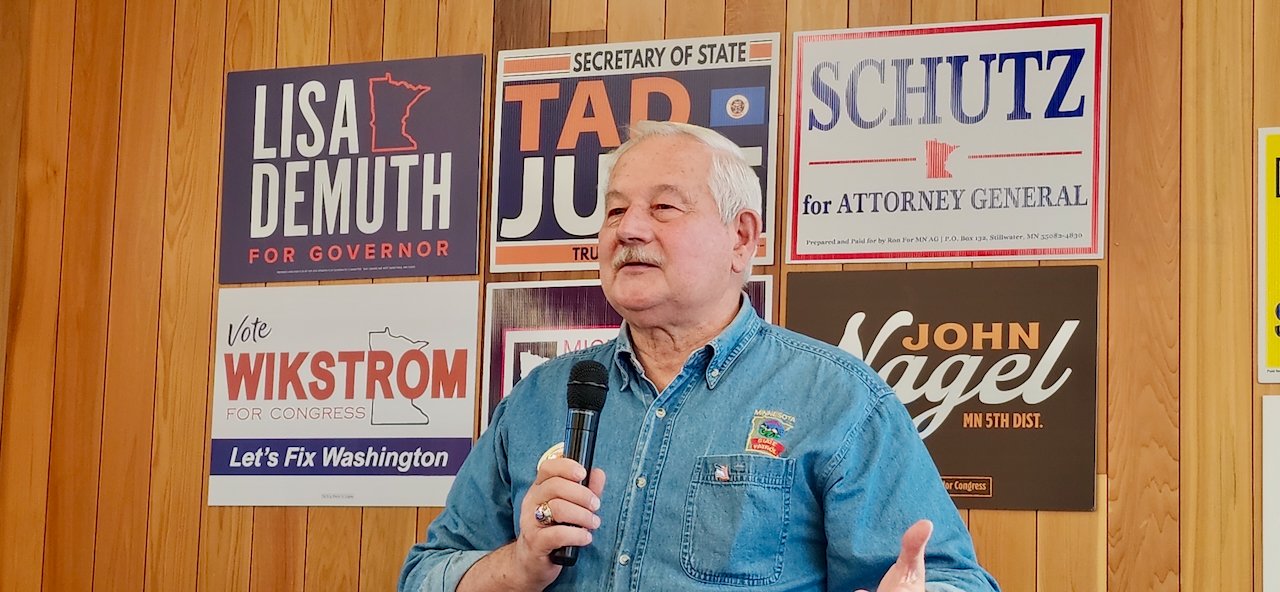
5thDistrict: John Nagel, Republican
Running against: Rep. Ilhan Omar, Democrat
2024 Election: Harris won district 79% to 18%
Campaign money raised by Nagel as of 7/22: $747,000
District’s Cook Political Report rating: “Solid Democratic”
A retired state patrolman, Nagel first considered running for political office after he ran a local GOP caucus.
“The next thing you know, I was asked to run for the state House,” Nagel said.
But he was hesitant to run against state Rep. Larry Kraft. “I was not really driven to put my name on a ballot,” Nagel said.
But the realization that Rep. Ilhan Omar would run unopposed unless someone like him stepped up changed Nagel’s mind about jumping into politics, even as he realizes he’d be running in “probably the ‘bluest’ district in the country.”
Related: Omar responds to Trump, GOP charges of financial malfeasance and fraud with new financial disclosure filing
“I’m not going to say this is easy,” Nagel said. “But people who live here want a competitive race. “
Nagel is running an anti-fraud, anti-violent crime campaign.
“I am running because people in the district deserve to be safe,” he said
Nagel is also trying to garner support among Minneapolis voters who feel they are not represented by Omar, a leader of the House Progressive Caucus.
Omar is a lightning rod for many conservatives, which has likely helped Nagel in his fundraising.
Like other long-shot challengers in the state, the Republican is optimistic.
“They told George Washington he would not win against the British,” Nagel said. “So, I have some faith.”
Doug Chapin, a Democrat running in the 6th Congressional District, hopes to beat Republican Rep. Tom Emmer, the House Majority Whip. Photo courtesy of the Chapin campaign.
6th District: Doug Chapin, Democrat
Running against: Rep. Tom Emmer, Republican
2024 Election: Trump won district 57.7% to 40.1%
Campaign money raised by Chapin as of 7/22: $439,000
District’s Cook Political Report rating: “Solid Republican”
Doug Chapin, a retired professor at the University of Minnesota’s Humphrey School of Public Affairs and an expert on election law, is politically savvy but says he never planned to become a politician.
Chapin, 62, said that changed after President Trump pardoned those charged with offenses stemming from the Jan. 6, 2021, storming of the U.S. Capitol.
“I told people for years that I was an election geek and not a politician,” he said. “But that turned me into one.”
He’s hoping to be a giant-killer in defeating Rep. Tom Emmer, who as House Majority Whip is a member of the GOP congressional leadership and has raised millions of dollars in campaign cash.
Chapin accuses Emmer, who strongly backs the president, of being a “rubber stamp” for Trump and wants to belong to a Congress that is willing to put guardrails on the White House.
Chapin, who lives in Hanover, thinks the district, which includes the Twin City’s outer northern and western suburbs, “is far less Republican than the election results would lead you to believe.”
He said the district has had rapid growth that is changing it politically.
“We believe the ‘blue bleed’ is pretty strong,” Chapin said.
The reason Republicans have had control of the district since 2003?
“The DFL hasn’t run anyone who could actually win it,” Chapin said.
Democrat Erik Osberg hopes to unseat Republican Rep. Michelle Fischbach in Minnesota’s 7th Congressional District, which covers much of the western half of the state. Credit: Forrest Peterson
Campaign money raised by Chapin as of 7/22: $335,000
District’s Cook Political Report rating: “Solid Republican”
Erik Osberg, who lives in Wadena, is running on a common Democratic theme: affordability and the struggles of the working class in an economy where prices continue to climb.
He is also campaigning on the need to strengthen rural health care and public schools and said the first thing he would do in Congress is work to repeal Trump’s signature “big beautiful bill,” which extended tax cuts he said favored billionaires and cut Medicaid and other social programs.
A former sports reporter who “transitioned” into the financial services industry, Osberg has taken on Rep. Michelle Fischbach in one of the “reddest” areas in Minnesota. The 7th District covers 38 largely rural counties in western Minnesota.
Osberg is a realist and at Farmfest earlier this summer said his campaign has an “even if” mentality. As in, even if the odds are stacked against him, he’s showing up and listening to as many district residents as possible.
He also compared himself to Rocky Balboa, the fictional Philadelphia pugilist in a film whose popularity spawned a rash of sequels.
“We’re Rocky in this fight, I get that,” Osberg said. “And Rocky didn’t win, right? But Rocky went the distance.”
He said the story of the fighter inspired people. He said he hopes that’s the effect his campaign is having on people.
8thDistrict: Trina Swanson, Democrat
Running against: Rep. Pete Stauber, Republican
2024 Election: Trump won district 56% to 42%
Campaign money raised by Swanson as of 7/22: $316,000
District’s Cook Political Report rating: “Solid Republican”
Although it has rated this district “Solid Republican,” the Cook Political Report says “if a blue wave materializes in 2026, a strong Democratic candidate could force Republicans to play some defense in this district.”
Trina Swanson, 45, hopes she is that candidate.
A former federal employee, Swanson said she quit the agency she had worked for for 20 years — U.S. Citizen and Immigration Services (USCIS) — because after Trump was reelected she was pressured “to do things I thought were unethical.”
One of those things was a mandate on not putting any guidance on interviews she conducted with refugees seeking to live in the United States. Another, Swanson said, was that she was asked to issue a visa for the spouse of a nanny who worked for a high-ranking official at the Department of Government Efficiency (DOGE).
She believes the sprawling northern, Iron Range-based district has been represented by Democrats before and is not out of reach. In fact, Rep. Pete Stauber won the district from a Democratic incumbent, Rick Nolan, in 2018.
Swanson said “culture wars” are the reason the 8th District turned to the GOP. But she said “kitchen table” issues, including “affordability” and the need for universal health care, will turn that tide this year,
She’s become embroiled in the fight over a proposed data center in Hermantown, where tempers flared over the issue at a recent City Council meeting.
Swanson said she would back federal legislation to regulate data centers and artificial intelligence, which has created a need for them.
She said the decision to site a data center is “a community decision.” But she opposes allowing elected officials to enter into nondisclosure agreements with Google or any other tech companies seeking to construct data centers and opposes offering tax breaks to those companies.
Swanson and Stauber both live in Hermantown, a town wrestling with an issue that has angered both Democrats and Republicans.
“Congressman Stauber believes local communities must have input in deciding whether a data center is built in their area, and he encourages his constituents to make their voices heard on this issue,” said Stauber spokeswoman Kelsey Emmer.
She also said that Stauber believes that if a data center opens in a community, residents should not face utility rate hikes as a result.
“The data center must fully cover its own water and energy costs so that local communities are not burdened with higher utility rates,” Emmer said.
Greater Minnesota reporter Brian Arola contributed to this story.
The post The Challengers: Why it will be hard, in a midterm likely to herald change, to oust a congressional incumbent in Minnesota appeared first on MinnPost.
SIOUX FALLS, S.D. (AP) — Peter Martin went missing two years ago from the Fond du Lac reservation in Minnesota. His family hasn’t stopped looking, but they say the U.S. Bureau of Indian Affairs investigation into Martin’s disappearance has stalled since the agent assigned to the case left the role in early 2025.
“They’ve never had a person take his space for this region and yeah, we haven’t heard from them since,” said family friend Kayla Jackson.
The bureau’s Missing and Murdered Unit was created in 2021 to address the crisis of violence against Native Americans and put new resources toward solving cold cases. But a recent federal audit by the Interior Department’s internal watchdog found staffing issues have plagued the unit since its formation during President Joe Biden’s administration, creating a backlog of cases and leaving families without required victim services.
Related: Susan Allen: The first Native American woman elected to serve in the Minnesota Legislature
Federal spending on the initiative grew from $12 million to $17 million between 2021 and 2024. During the same period, the audit found that 39% of money for the Missing and Murdered Unit was redirected toward other Bureau of Indian Affairs law enforcement costs, including upgrading vehicles. Nearly half the unit’s posts remained unfilled as of last year, even as the bureau overall has lost a third of its workforce due to staffing cuts under President Donald Trump.
The bureau says it has adopted many of the report’s recommendations, from streamlining its case referral pipeline to training staff on victim services requirements. But federal auditors say weaknesses in its hiring process remain. And some families are still in the dark about their loved ones’ cases.
“It is nothing but heartbreaking just to see how inadequate the response has already been for so many of these situations,” said David Adams, an Albuquerque, New Mexico-based attorney, former federal prosecutor and member of the Sault Ste. Marie Tribe of Chippewa Indians.
Hundreds of cases languished for years
The Missing and Murdered Unit had 83 open cases and nearly 400 pending referrals as of November 2024, according to the audit released Sept. 9 by Interior’s Office of Inspector General. The unit did not have a time frame for assessing referrals.
The audit also found agents had unmanageable caseloads, with some assigned administrative duties, like conducting research on referrals, on top of their active investigations.
Relatives of Kaysera Stops Pretty Places were hopeful when, in 2022, a Bureau of Indian Affairs agent was assigned to her still-unsolved case. Stops Pretty Places had just turned 18 when her body was found in a town bordering the Crow Reservation in 2019.
Her aunt, Grace Bulltail, said the agent was difficult to reach and provided few updates. Last year, Bulltail learned the agent never had full access to the files of local investigators before the agent was reassigned to other duties.
The Associated Press emailed bureau officials Monday seeking comment about the case.
Sarah Deer, a professor at the University of Kansas School of Law, said delays and dysfunction among federal investigators are compounding families’ grief.
“These are families who have often experienced institutional failure already,” she said. “A system designed as a response to that history cannot ask families to keep waiting.”
Victims’ families fell through the cracks
In 8 of 13 cases reviewed by the Inspector General’s Office, the assigned agent did not contact bureau staff who specialize in helping victims’ families. One staff member said they referred families to outside programs because the unit had only two victim specialists nationwide.
Martin was 31 years old when he was reported missing after a welfare check on the Fond du Lac reservation in 2024. Relatives described him as an outgoing man who played sports with kids and took his nieces and nephews out trick-or-treating. Family members said they get periodic updates from the Fond du Lac Police Department, but were never connected to BIA victim specialists.
The BIA website does not list a case agent in Martin’s case. The Associated Press emailed bureau officials Monday seeking comment about the case.
Federal efforts on missing and murdered cases
The Trump administration says it has been ramping up efforts to address high rates of violence against Native people. Last month, the FBI announced it would set a minimum reward of $25,000 for public information in dozens of cold cases on tribal land.
Bureau of Indian Affairs officials said in a statement they have taken steps under Trump to improve case processing and make sure families get support. They said most of the recommendations from the audit had been acted upon.
“The deficiencies identified in the OIG audit reflect operations under the previous administration that were inconsistent with the objectives outlined in Operation Lady Justice,” the statement said, referring to a presidential task force established by the first Trump administration in 2019 to address the crisis of missing and killed Indigenous persons.
Related: How Patrick DesJarlait offered a new way of seeing Native Americans in art
In February, the Missing and Murdered Unit assisted in recovering and identifying two sets of remains on the Chickasaw Nation, closing a missing persons case that had run cold more than a decade before.
Deer said new federal and state task forces and specialized law enforcement initiatives have increased public awareness of the crisis.
“The government has stepped up in some ways to appropriate resources, but implementation matters,” she said.
Meanwhile, tribal police departments, which are often the first to respond to cases involving Native people, remain underresourced with limited capacity to investigate complex crimes, she said.
“What I always come back to is whether or not this money could be better utilized by tribes themselves,” Deer said.
___
This story is published through the Global Indigenous Reporting Network at The Associated Press.
The post Staffing problems stall federal investigations of missing and killed Native people appeared first on MinnPost.
This story was produced by The 74, a non-profit, independent news organization focused on education in America.
In February, on orders from the U.S. Department of Government Efficiency, Medicaid officials created a first-of-its-kind online portal containing hundreds of millions of billing records that supposedly would allow everyday people to crowdsource investigations into healthcare fraud.
“DOGE is not a department,” Elon Musk exulted on X. “It’s a state of mind.”
At the time, thousands of heavily armed federal agents were smashing into cars and battering their way into homes throughout Minnesota’s Twin Cities, under the guise of investigating what the Trump administration insisted was unchecked fraud in autism therapy committed by Somali immigrants.
There was a grain of truth: Fraud is indeed widespread in autism therapy, something a series of federal audits begun during the Biden administration found in red states and blue. In the wake of the audits’ release, the Trump administration raided autism centers, blaming lawless immigrants, welfare cheats and “woke ideology” for the scandals unfolding nationwide.
But a 74 investigation found another problem entirely: a massive influx of private equity players capitalizing on the autism therapy industry to the tune of $7 billion in taxpayer-funded Medicaid payments over the course of six years. And much of this explosive growth has come at the expense of children.
The explosive growth of applied behavior analysis
The 74 downloaded the 275 million-record DOGE dataset and analyzed Medicaid claims for autism therapy from 2019 to 2024. Our analysis reveals how an unproven, even harmful, behavior modification system called applied behavior analysis, or ABA, is crowding out more effective — and humane — treatments for children with autism.
And it shows how a well-intentioned campaign by parents desperate to find a “cure” for their autistic kids has mushroomed into a poorly implemented but extremely lucrative mechanism for providing ABA — a system of rewards and punishments designed to eliminate certain behaviors — to as many autistic children as possible, regardless of their age or actual needs.
Pediatricians, psychologists and other professionals who diagnose autism reflexively prescribe ABA to parents, typically unaware that there is mounting disagreement about the therapy’s effectiveness and the associated trauma that can follow an autistic individual into adulthood. Told this is the child’s best chance at a decent life, few caregivers question the guidance until harmful effects start to show.
Experts consulted by The 74 weren’t surprised by our findings. Health officials turned on the fiscal taps before instituting meaningful legal oversight — creating the exact kind of loosely regulated environment that draws the opaque investment strategy employed by private equity.
A secretive corner of the financial sector not held to the same standards as exchange-traded stocks, bank loans and other publicly monitored investments, private equity has acquired businesses in numerous industries over the last decade, hoovering up billions of dollars.
Private equity typically acquires privately held companies that have access to steady streams of revenue, extracting as much cash as possible in the short term and leaving debt when investors move on. To maximize profits, they often deliver the easiest, most lucrative services, rather than the personalized treatments Medicaid and other public funds were supposed to pay for.
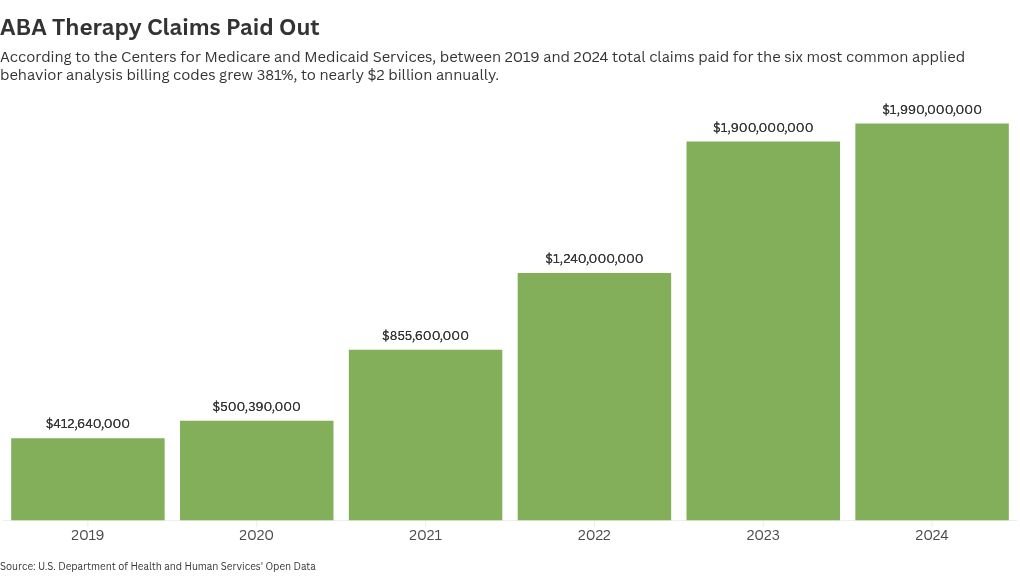
From 2019 to 2024, The 74 found, Medicaid claims for the six most common autism therapy billing codes shot up some 381%, from $400 million a year to nearly $2 billion — with private equity-backed providers leading the billing pack.
Indeed, federal audits of state Medicaid spending begun in 2022 — two of them in blue states and two in red — reveal a very purple problem. They detail how bad actors in the for-profit business sector, whether greedy or merely inept, push autistic children toward ABA therapy at the expense of other, more effective supports at school that students with disabilities are guaranteed by law.
Families whose children are referred to ABA by pediatricians and other providers are typically urged by private therapy centers to sign them up for as many hours as possible — up to 40 hours a week — and to keep them there for years. That is a prescription ripe for exploitation, says Ari Ne’Eman, an assistant professor of health policy and management at Harvard’s T.H. Chan School of Public Health and former director of the Autistic Self-Advocacy Network.
“Private equity was attracted to ABA because the industry as a whole had set up a very tidy financial arrangement for itself,” says Ne’Eman. “It’s not that private equity is corrupting a previously fine field. Private equity entered the field because of the flaws that were already there.”
For fiscal year 2026, federal spending on special education was $15.5 billion. If the $2 billion now being spent every year on ABA for children with publicly subsidized health insurance were added to schools’ annual budgets, every district in the country could add one full-time and one half-time occupational therapist — specialists in desperate short supply who have proven success in addressing many issues facing autistic children.
DOGE’s intentions notwithstanding, many in the autism community have hoped the crisis posed by runaway Medicaid spending might present an opportunity to take a hard look at how ABA has grown into an industry with the fiscal might to stave off even basic state and federal oversight. And how it is crowding out more effective, humane alternatives, and even preventing children from going to school.
Instead, now they fear that politics will further overshadow needed autism therapy reforms. The second Trump administration has withheld some $3 billion in Medicaid funding from California and Minnesota, insisting that their governors — whom the president views as foes — are not attending to fraud. As a consequence, people with disabilities have already lost services.
As the Medicaid cuts in Trump’s One Big Beautiful Bill go into effect, and as he and Health and Human Services Secretary Robert F. Kennedy Jr. continue to promote disproven and dangerous “cures” for autism — at the cost of research into better treatments — disability advocates fear the future will look a lot like a dark past.
ABA claims vastly outpace spending on autistic people’s quality of life
In addition to the financial boondoggles, there’s a human cost.
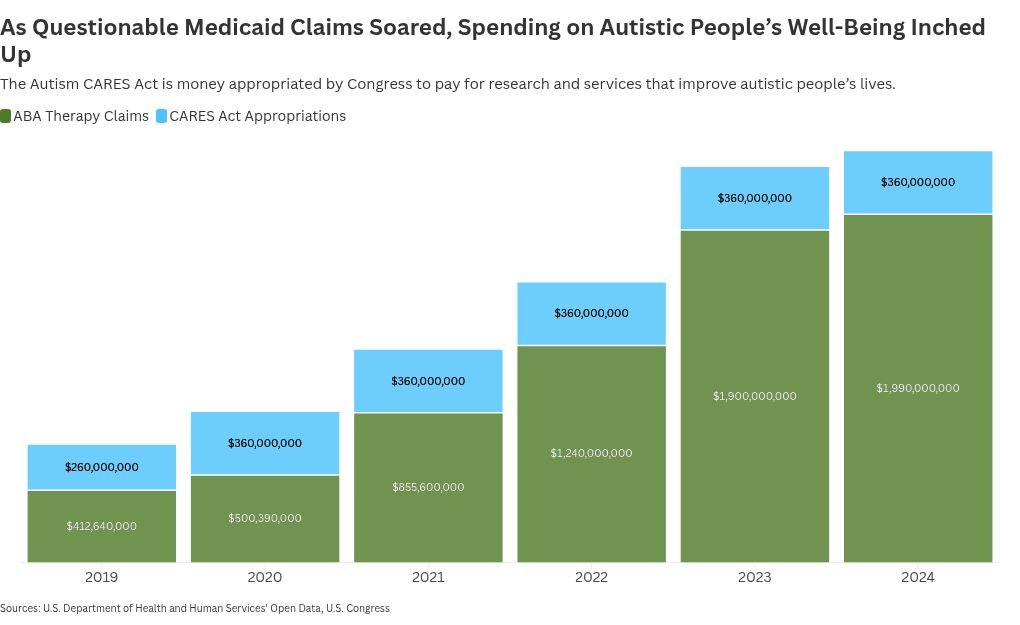
During the six years of records we analyzed, Medicaid billing for ABA therapy totaled nearly $7 billion. That’s $1 billion more than the United States has spent in 20 years on research and programs under the Autism CARES Act, which pays for services to better autistic people’s lives.
As disproportionately small as the CARES Act funding is, even after two decades of lobbying by autists and advocates, very little of it is spent on quality-of-life efforts. Of the $2 billion appropriated last year, to be spent over five years, $30 million will go to creating support for caregivers, $13 million to job training and $19 million to safety and well-being.
Now, even that modest pot of funding is imperiled, as Kennedy is redirecting federal resources toward new research on vaccines and other long-discredited “causes” of autism and dangerous, ineffective treatment strategies.
Meanwhile, evidence is mounting that the most widely used therapy, ABA, is frequently ineffective and often harmful. The therapy was pioneered in the 1960s by Norwegian-born UCLA researcher Ole Ivar Lovaas, who used the same regime of rewards and punishments to develop LGBTQ conversion therapy — now widely acknowledged as abusive.
Independent researchers and autistic adults who went through ABA say its focus on “extinguishing” natural and frequently beneficial autistic traits and in their place demanding compliance with “normal” behaviors is traumatizing. Much as conversion therapy can’t change a person’s identity but can instead instill shame, behavior conditioning will not make autists nondisabled and sends the message their strengths are unimportant.
Lovaas is one of two early autism researchers whose histories are now known to include ties to Nazi Germany. In interviews, Lovaas said that during the five-year German occupation of Norway, he and his family were forced to labor on farms. But a 2025 report in the journal History of the Human Sciences documents his role as a local leader of Norway’s Nazi youth movement. The Third Reich sought to “euthanize” autistic people, who were seen as a financial and genetic burden to society.
The other autism researcher who played a role in the Nazis’ eugenics campaigns was Dr. Hans Asperger, who reported the names of “malformed children” to be targeted for sterilization or death.
Proponents are quick to assert that today’s ABA is a far cry from the slaps and electric shocks of what was known as the Lovaas Method early on. Yet the goal — to “extinguish” autistic traits in children— typically remains. Kids as young as 2 are routinely subjected to as many as 40 hours a week of repetitive behavior modification drills.
A past 74 investigation found that for years, the evidence used to legitimize ABA was produced by the industry itself, was rife with undisclosed conflicts of interest and neglected basic guardrails such as documentation of harmful “adverse events.” By contrast, independent research into ABA by the Department of Defense and academic scholars found little to no evidence of effectiveness.
A 2018 study of 460 autistic adults and caregivers of autistic children found that nearly half of those who went through ABA showed symptoms of post-traumatic stress, while 72% of those who did not participate in the therapy were asymptomatic.
This year, researchers at the University of Wisconsin-Madison, Ohio State University and the University of Texas at Austin found that people who had participated in ABA before age 18 were 30% more likely to experience a mental health hospitalization than autistic people who had not. Autistic people who had been treated with ABA and hospitalized were also admitted with 32% greater frequency than those who had not.
Again, says Ne’Eman, the industry is predicated on a flawed, but very profitable, model. ABA industry recommendations call for every child, regardless of how young they are or what their needs are, to receive the same intensity of treatment.
“I would argue that ABA is potentially harmful in any situation because we haven’t really addressed the ethical concerns of the potential mental health consequences,” says Ne’Eman. “But even if we were to set that aside, the idea that there is an evidence base for applying ABA in all instances without regard to any consideration for age or the types of challenges that someone has, it’s just ludicrous.”
“Forty hours a week of therapy is a full-time job for a 3-year-old,” says Ne’Eman. “It’s harmful for kids and families first and foremost, but I also think it’s a poor use of public funds.”
When therapy supplants school
The four federal audits of state Medicaid spending released so far show what advocates have long decried: ABA service providers are allowed to keep children in lucrative standalone treatment centers where they are barred by Medicaid law from receiving academic instruction — often for years after they should begin attending school.
The audit of claims records from Colorado — which included anonymized information on individual children’s hourly activities — found that some school-aged kids remained in ABA centers full time. Since it is illegal for therapists to teach children in their care to read or write, the kids were denied a proper education.
The audit found one Colorado child, referred for ABA in 2009 at the age of 2, who continued receiving six or more hours of treatment five days a week until age 16 — without any independent evaluation that ABA treatment was still appropriate.
Medicaid began paying for the child’s therapy in 2019. Over the next six years, payments for the child’s treatment increased from more than $16,000 a year in 2019 to more than $144,000 in 2024, for a total of $518,700.
Auditors raised similar concerns in Indiana, flagging the case of a child who was referred to ABA in January 2014 at the age of 2 and was still receiving more than seven hours of therapy a day, five days a week, at age 8 — years after they should have been in school. Medicaid payments for this child increased from $52,000 a year in 2017 to more than $185,000 in 2022, when the child was 11, for a total of $677,448.
(For perspective, state spending on school-based special education services varies wildly and is poorly reported. One often-used estimate is that an average of $26,000 is spent annually on each student with a disability, versus $9,000 per non-disabled pupil.)
Special education teachers say that when these students show up in a classroom, it’s after years of lost academic instruction. In practice, often this means they will be denied the chance to learn alongside their typically developing peers — a right enshrined in federal law.
Advocates say the exact number of children in this position is probably unknowable. As a youngster approaches kindergarten age, families are often warned by their ABA provider that taking their child out of private therapy and enrolling them in school will cause regression. Much as homeschoolers often do, these families can sign official documents saying they are taking responsibility for their child’s education.
In the case of the Indiana youngster, now 11, auditors noted that the treatment plan did not say whether the child attended school, “but had a standardized statement: ‘The patient’s family [has] taken on responsibility for meeting the educational needs of this patient.’ ”
After the audit, Indiana lawmakers instituted limits on how much therapy centers could bill per child, and for how much time. Many children have reached or are near reaching the cap.
A state task force appointed to address issues likely to follow the changes repeatedly heard from parents and advocates concerned about older children who, no longer eligible for Medicaid-funded ABA, would attend school for the first time. As a result, a new law allows private ABA therapists to accompany children to class for a transition period.
How did the ABA industry get so big?
For the first 20 years after Lovaas announced he had “recovered” — his term for cured — nine of 19 autistic children on whom he had developed ABA, the supposed miracle cure was inaccessible to almost all families. Insurers were not required to cover the diagnosis or treatment of autism.
Then, in 2005, the mother of a 4-year-old autistic boy sat down at her kitchen table and drafted a bill to require health insurers in South Carolina to cover the “gold standard” therapy being touted as a child’s best shot at a “normal” life. Then she enlisted hundreds of parents of autistic children to lobby state lawmakers to pass it.
Lorri Unumb’s story was compelling. To afford ABA, then costing $70,000 a year, she and her husband had downsized their house and spent their home equity — plus her entire salary as a law professor — on therapy for their son, Ryan.
The grassroots push paid off. In 2007, despite ferocious insurance industry opposition, the South Carolina legislature approved the bill — only to have the governor veto it, with just one day left in the session.
Unumb put out another call. Accompanied by a CNN camera crew, an army of parents flooded the statehouse, demanding a veto override.
When the vote was cast, Unumb told Charleston’s The Post and Courier, the lawmakers on the floor turned toward the families in the gallery and gave them a standing ovation.
Weeks later, Unumb held a summit to teach other parents, who flew in from around the country, how she had succeeded in getting what’s known as Ryan’s Law passed. She spent the next decade working with Autism Speaks, helping to organize families in other states.
The parents had potent lobbying partners. To convince insurers that ABA was not experimental, a growing community of practitioners created an organization, the Behavior Analyst Certification Board, that set standards, bestowed credentials and promoted research.
The board did not respond to a request for comment.
Few questioned whether there was an inherent conflict of interest in an industry creating its own proof points. Most people were more focused on the plight of families — and the promise heralded by a miraculous, if frightfully expensive, cure. By 2019, every state required most private insurers to pay for autism services, though with wildly differing benefit levels.
The bigger turning point occurred in 2014, when the Obama administration clarified that the Affordable Care Act required publicly subsidized care plans, including Medicaid, to pay for autism treatment.
At the same time, the rate at which children were identified as autistic began rising dramatically. The ACA for the first time required insurers to pay for autism assessments, and improvements to diagnostic criteria helped to identify autistic children whose traits were previously missed.
An analysis of special education Child Count data shows that between 2011 and 2022, autism’s prevalence rose from 2.3 to 6.3 per 1,000 children, with the greatest increases among those aged 5 to 8 years.
Today, Unumb is the CEO of the Council of Autism Service Providers. The organization, she wrote in an email to The 74, “believes ABA providers must continuously earn the public’s trust in caring for children with autism. Genuine fraud, waste and abuse must be called out and punished to uphold accountability and patient safety.”
“Bad actors exist in every healthcare profession, including ABA, but that doesn’t mean they are prevalent,” she added. “Thousands of qualified, ethical ABA providers are at work every day, doing the right thing and making a difference in children’s lives.”
Private equity enters the picture
(function(){function e(){window.addEventListener(`message`,function(e){if(e.data[`datawrapper-height`]!==void 0){var t=document.querySelectorAll(`iframe`);for(var n in e.data[`datawrapper-height`])for(var r=0,i;i=t[r];r++)if(i.contentWindow===e.source){var a=e.data[`datawrapper-height`][n]+`px`;i.style.height=a}}})}e()})();
Private equity funds are groups of investors who pool their money to buy ownership stakes in privately held companies or real estate. These firms and their deals are subject to far less government oversight than public companies that trade on the stock market. They rarely disclose information about their activity.
They typically have managers, who make decisions about the businesses they acquire but don’t put much of their own money into the investments. Frequently, the goal is to simultaneously cut costs and increase revenue to create a cash flow for the investors. The businesses are usually resold within three to five years.
Over the last two decades, private equity has become increasingly common in healthcare, even though critics contend the acquisition of doctor’s practices, hospitals, medical equipment manufacturers and nursing homes can compromise patient safety. In terms of public oversight, though, all those industries are tightly regulated compared to ABA.
The mandates for insurance coverage of autism were instituted with very little initial oversight of the quality of services being provided. States that did require providers to be licensed often simply decided to recognize the ABA industry’s internal credentials.
While these standards are often stricter than a provider’s hiring requirements, the practice of adopting industry credentials leaves behavior analysts in charge of overseeing their own members. When, in the wake of a scathing federal audit of its Medicaid billing practices, Colorado recently moved to license therapists, it rejected a suggestion that a newly created oversight board contain outside professionals such as psychologists. Instead, the board will be composed of four therapists and one public member, who can also have industry ties.
The combination of lax standards and ready cash proved irresistible to private equity firms, which began buying ABA practices and consolidating them into large, multi-state chains. From 2015 to 2024, private equity firms acquired 574 sites run by 147 providers, according to researchers from the Brown University School of Public Health.
Of the 50 largest providers by Medicaid billing in The 74’s dataset, 23 are (or, in two cases, were) owned by private equity. From 2019 to 2024, their claims totaled $2 billion.
Private equity firms own 11 of the top 15, with claims totaling more than $1.5 billion between 2019 and 2024.
The process has dramatically reshaped an industry already in need of reform — in the wrong direction.
“They have created massive national chains with the primary purpose of extracting high returns in a short period of time,” write the authors of “Pocketing Money Meant for Kids: Private Equity in Autism Services,” a report from the Center for Economic and Policy Research. “Consolidation gives private equity-owned provider organizations a large competitive advantage over other for-profit and nonprofit providers, as well those offering other approaches to [autism] services.”
“It also gives them more bargaining power to negotiate higher rates for themselves vis-à-vis state agencies, regulators and insurance payers. Some PE firms have used this leverage to extract higher reimbursements under threat of closing down sites in states in which they do not get the rates they prefer.”
Many of the large networks also advertise immediate openings for autism assessments, which they tout as a quick path to enrolling in therapy. Otherwise, according to the National Institutes for Health, the median time a family spends on a wait list for an independent evaluation is a year and a half.
How private equity works
(function(){function e(){window.addEventListener(`message`,function(e){if(e.data[`datawrapper-height`]!==void 0){var t=document.querySelectorAll(`iframe`);for(var n in e.data[`datawrapper-height`])for(var r=0,i;i=t[r];r++)if(i.contentWindow===e.source){var a=e.data[`datawrapper-height`][n]+`px`;i.style.height=a}}})}e()})();
Some private equity funds take a partial ownership stake in a business that needs cash to expand or improve. But most of those investing in autism therapy are typically buyout funds, which acquire and consolidate existing businesses.
These funds’ managers invest very little of their own money, maybe 1% or 2% of the total. Investors, which often include pension funds and other institutions, put in another 30% to 50%. The rest of the cost of the acquisition is borrowed — what’s referred to as a leveraged buyout.
To make these transactions, a fund sets up a series of companies. Responsibility for the debt is transferred to the company being acquired.
As the purchased company struggles to make the loan payments, a share of the cash coming in is returned to the investors. Sometimes, the fund managers take out loans on the already indebted business and give the cash to their investors as a dividend.
Meanwhile, the leaders of the investment fund — whose expertise is typically in maximizing profits — are allowed to make decisions about staffing, levels of patient care, who they will serve and where.
ABA is supposed to be highly individualized, with therapists continually collecting data on children’s responses to repeated efforts to get them to stop behaviors deemed undesirable, such as hand-flapping or rocking, or to perform actions the therapist wants, like making eye contact.
This information, gathered by the lowest-rung member of the ABA team, a behavior technician, is supposed to be reviewed by a credentialed provider known as a board-certified behavior analyst, who uses it to modify the child’s treatment plan on a regular basis.
But in state audits, federal investigators found repeated instances where the therapists’ notes submitted as claims documentation had been copied and pasted, often day after day, bearing the names of numerous different children working with different therapists.
Notes were often signed off by therapists before they had finished the session in question, and Medicaid was frequently billed for unallowable activities, such as naps and lunch.
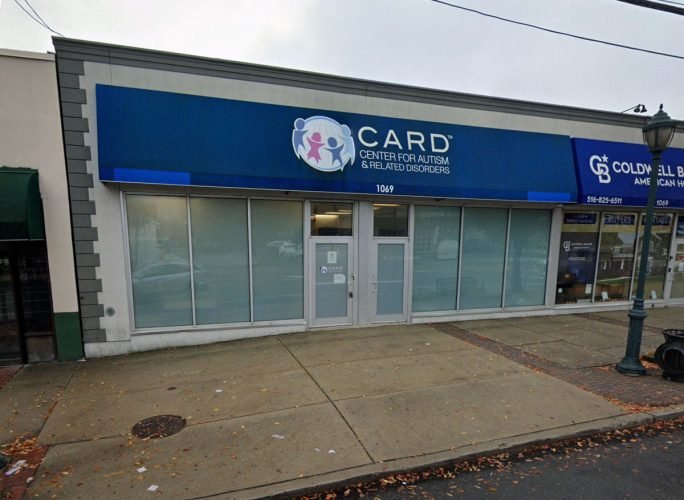
For their 2023 report on private equity’s influence on ABA, investigators at the Center for Economic and Policy Research interviewed former employees of one of the oldest therapy center networks, the Centers for Autism and Related Disorders, or CARD. Founded by one of Lovaas’ graduate students, the chain was sold to the private equity group Blackstone in 2018 for a reported $700 million.
The former employees said that under Blackstone’s management, they were told to prioritize younger children. Not only can smaller kids remain enrolled for several years before reaching school age, they are most likely to be referred for additional hours of therapy per week under the guise of early intervention.
Center for Autism & Related Disorders office, Franklin Square, New York, 2022 (Google Maps)
“They would literally terminate patients in our programs who required lower hours and replace them with those requiring at least 30 to 40,” the researchers quoted one former employee as saying.
CARD did not respond to requests for comment. In a statement to The 74, Blackstone said the network of centers was hit by a “perfect storm” of COVID-19-era lockdowns, labor shortages and low insurance reimbursement rates that led to a Chapter 11 restructuring.
“When it became clear that a restructuring was necessary to put the company on the best long-term path to deliver on its mission, we worked day and night … to keep its existing facilities open so the company could continue serving patients,” the statement says.
The statement adds that Blackstone was never involved in specific clinical treatment decisions and had sought to increase pay, reduce caseloads and improve training and operations.
If an individual center or an entire network is accused of fraud or found to have abused patients, the investment managers who made decisions to maximize profit can’t be held accountable. Just like the debt, liability accrues to the “portfolio company” that owns the actual centers.
By 2022, CARD had shuttered centers in states with lower Medicaid reimbursement rates and made poor decisions that put others out of business, shrinking from 250 centers to 100. In June 2023, it filed for bankruptcy and was bought by a group of private investors recruited by its founder.
According to The 74’s dataset, in 2019, CARD billed Medicaid more than $13 million. In 2024, its Medicaid receipts were slightly less than $2 million.
Private equity’s structure shields investors and ABA network owners from liability
(function(){function e(){window.addEventListener(`message`,function(e){if(e.data[`datawrapper-height`]!==void 0){var t=document.querySelectorAll(`iframe`);for(var n in e.data[`datawrapper-height`])for(var r=0,i;i=t[r];r++)if(i.contentWindow===e.source){var a=e.data[`datawrapper-height`][n]+`px`;i.style.height=a}}})}e()})();
With corporate headquarters in Farmington, Michigan, Centria Healthcare was founded in 2009 as a pediatric nursing provider. When one of its early patients needed ABA, the company created an autism-focused division. Today, it owns centers in 11 states.
Because the company is privately owned, its finances are largely shrouded in secrecy. But, according to the investor intelligence service Pitchbook and data gathered for the Center for Economic and Policy Research, Centria was purchased in 2016 by Martis Capital, a private equity firm specializing in acquiring North American healthcare providers. Over the next three years, Centria expanded to nine states.
As part of a 2018 investigative report, the Detroit Free Press reported that Michigan’s attorney general was looking into claims that Centria had engaged in improper billing and service provision. The story was based on interviews with former company executives, documents obtained by reporters and allegations detailed in a defamation lawsuit the company filed against some of the past employees.
The paper also reported that two Michigan counties had cut ties to Centria after local mental health officials cited the company for billing and care issues and an employee was caught on video abusing a child.
Martis Capital did not respond to a request for comment.
In a statement to the newspaper, Centria CEO Scott Barry vigorously denied the claims: “Whatever these allegations are, yes, they’re very outrageous, but they’re not true. And we’re trying to do a good job to help kids and help families and help our community.”
At the time, the company was in line for an $8 million job-creation grant secured with the backing of the state’s lieutenant governor, described by the Free Press as a longtime advocate of autism therapy. Five weeks after then-Lt. Gov. Brian Calley made the recommendation, a key company investor hosted a party kicking off Calley’s gubernatorial bid. Guests donated more than $100,000 to his campaign, the paper reported.
The grant was put on hold while the state investigation unfolded. In March 2019, the state closed the probe, saying that while it had noted potential billing irregularities, there wasn’t enough evidence to merit criminal complaints. The grant was not reissued.
Three former executives later sued Centria, resurfacing their allegations. Both lawsuits were eventually dismissed by the parties.
In a statement to The 74, Centria CEO David Harbour said the company focuses on quality and access.
“Our work is grounded in a commitment to ethical care, clinical quality and supporting children with complex needs — including families who may have struggled to find services elsewhere,” Harbour wrote. “We strive to identify the needs of children, families and the broader healthcare system as it continues to evolve — delivering ethical, individualized care that supports the unique needs of each child and family we serve.”
But Centria doesn’t have to report whether the scandals had any impact on its bottom line.
“[Private equity firms] have nothing to lose if something goes bankrupt,” says Rosemary Batt, one of the authors of the Center for Economic and Policy Research report and a professor emeritus at the Industrial and Labor Relations School at Cornell University. “If a company gets caught in fraud, it’s just the cost of doing business.”
In 2019, Centria was sold to a different private equity fund, Thomas H. Lee Partners, for $415 million. Since then, according to The 74’s analysis, the company has been the country’s largest Medicaid biller, bringing in more than $440 million during our six-year window. That’s more than twice as much as the second-largest ABA company by Medicaid revenue, Lighthouse.
Thomas H. Lee did not respond to a request for comment.
Ryan Leitner, a researcher at the Private Equity Stakeholder Project and the author of a recent report on the ABA industry, worries that states’ efforts to crack down on Medicaid abuses won’t address the underlying cycle that allows investment funds to pass off a business that they’ve saddled with problems.
“A great place to start is the concept of joint liability between these [investment] firms and the company that they own and operate,” says Leitner. “You need to have assurances that the care is going to meet some kind of benchmark, that there’s going to be some kind of joint liability if there is a problem.”
Some states, he adds, are trying to give their attorney general or another regulator the ability to stop the sale of a healthcare facility if they determine the company won’t run it properly or if a private equity firm has problems elsewhere.
Private equity providers gravitate toward high-reimbursement states
(function(){function e(){window.addEventListener(`message`,function(e){if(e.data[`datawrapper-height`]!==void 0){var t=document.querySelectorAll(`iframe`);for(var n in e.data[`datawrapper-height`])for(var r=0,i;i=t[r];r++)if(i.contentWindow===e.source){var a=e.data[`datawrapper-height`][n]+`px`;i.style.height=a}}})}e()})();
Writing in the January 2026 issue of the American Medical Association journal JAMA Pediatrics, a group of researchers published two maps, one showing the prevalence of children with autism diagnoses and the other assigning states “generosity scores” assessing their insurance rules regarding autism.
Using a commercial deal tracker, they identified 574 autism service delivery sites acquired by private equity between 2015 and 2024, which they overlaid on the maps. The upshot: The states with the highest rates of diagnosis and the most generous benefits have the largest concentration of private equity-owned ABA centers.
Home to some of the first acquisitions, Colorado, with 6 million residents, had 38 private equity-owned centers, the third-largest concentration in the country and a likely undercount, the researchers noted. Only California, home to more than 39 million people, and Texas, which has 32 million residents, had more private equity-owned ABA centers — 97 and 81, respectively.
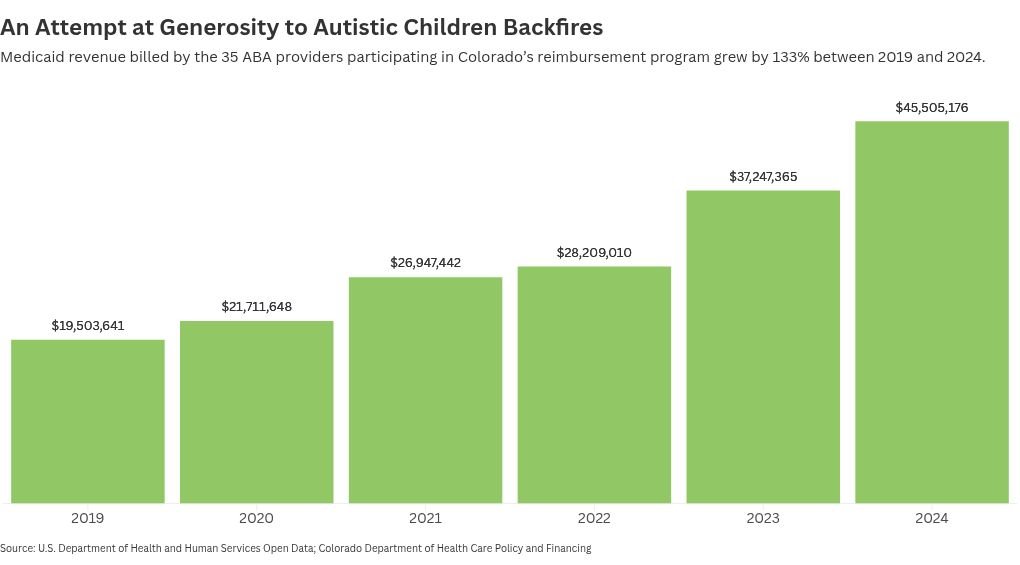
In February, the Department of Health and Human Services’ Office of the Inspector General released the fourth of eight state audits, finding that Colorado’s Medicaid spending on ABA mushroomed from $60 million in 2019 to $163.5 million in 2023.
The auditors examined claims made in 2022 and 2023, finding at least $78 million in improper payments, plus an estimated $207 million in “potentially inappropriate” claims.
In Wisconsin, they found $18 million in improper payments in 2021 and 2022, plus $94 million more in potentially inappropriate payments. In Maine in 2023, $45 million in claims were improper and $22 million potentially so. In Indiana, a total of $56 million were improper in 2019 and 2020, with another $76 million potentially improper.
In Colorado, the investigators examined monthly billing records for 100 children, finding improper and potentially improper claims in every case. Seven facilities could not supply individual patients’ diagnoses or referrals.
Two providers — including one that auditors said “was purchased by a nationwide ABA company that subsequently closed all of its ABA facilities in Colorado” — did not respond to requests for records from state and local investigators.
In the 96 months auditors examined, providers didn’t describe the services in some claims; four providers didn’t submit any treatment notes at all. One facility routinely said a child had engaged with peers even though the therapy was delivered at home with no other children present.
Numerous bills described unallowed “custodial care,” such as bathing, dressing and eating. In 67 months, facilities billed for one-to-one therapy but described group activities.
ABA companies in Colorado
In May, the Colorado General Assembly took up legislation aimed at curbing abuses in ABA. At an initial hearing, state officials testified that they believed there were between 410 and 500 clinics but could not say with precision because, unlike day cares, summer camps and similar facilities, autism therapy centers are not required to register with the state.
In 2025 alone, officials received 35 reports of endangerment, including physical abuse by staff, medication mistakes, inappropriate restraint and a registered sex offender working at one center. But because ABA providers and facilities are unregulated, the state lacked jurisdiction to investigate.
It might be the tip of the iceberg, the state officials warned lawmakers, because many participants can’t tell their families when something is wrong. At least a third of Colorado children in ABA are nonverbal, and more than 18% are age 3 or younger.
The bill would create a behavior analyst licensing board and require the state Department of Human Services to craft standards for clinics. The board would consist of three credentialed behavior analysts, one assistant — or technician — and one member of the public. It would grant licenses to people who have been given credentials by organizations created by the ABA therapists associations.
To proponents of ABA, many of whom have nursed concerns that private equity is sullying the public profile of their industry, the bill was a huge win. But to many in the disability community, it was one more step in the wrong direction. They feared that new standards would enshrine a treatment they oppose, crowding out public support for alternatives that may be more effective and humane.
Two parents submitted written testimony imploring legislators to oppose or amend the bill. Both cited ABA’s eugenicist roots and research on its harms.
“Autistic adults often compare ABA to gay conversion therapy, because the goal is often to make autistics appear less autistic, rather than helping them live safely and comfortably as themselves,” wrote Boulder parent Jenny Thamer. “In fact, both practices were developed by the same founder.”
Among other changes, she asked lawmakers to appoint a licensed mental health professional and an autistic adult “who provides lived experience” in place of two of the three analysts on the board; to require discipline for practitioners who engage in harmful punishments, including physical restraint and seclusion — mostly outlawed in Colorado schools — and to remove references in the bill to ABA as “based on scientific research.”
“This bill will have lasting consequences for autistics for decades,” Thamer concluded. “I respectfully urge you not to expand this system without strong protections, independent oversight and meaningful representation from the autistic people most often harmed by these practices.”
On June 2, Gov. Jared Polis signed the bill into law without her recommended changes.
Graphic design by Eamonn Fitzmaurice
This investigation was produced with support from the Education Writers Association Reporting Fellowship program.
The post Private equity is cashing in on autism therapy. Children are paying the price. appeared first on MinnPost.
WASHINGTON – President Donald Trump’s plan to help Republicans maintain control of the U.S. House and U.S. Senate in the midterm election is to promise to give money to potential voters.
At a midterm party convention in Dallas this week, Trump pledged a $5,000 dividend to every American adult if Republicans retain control of Congress in the November election.
Federal law prohibits payouts to influence voting. And Congress would have to appropriate the money, which back-of-the-envelope estimates say would come to more than $1.3 trillion.
Trump has proposed bonuses to Americans before that never materialized. But the promise of cash may motivate some voters who are disillusioned with the Republican Party over continuing inflation and actions Trump has taken, such as involving the United States in an open-ended conflict with Iran. The president’s national job approval rate is hovering around 37% to 40%.
On Thursday, Trump promised another bonus to about one million Americans who bought their health care through the Affordable Care Act. This $500 payout would be given to all ACA customers who did not receive a government subsidy to purchase their insurance.
Trump said the Biden administration collected unwarranted fees from insurers that were passed on to ACA customers and that those fees should be reimbursed.
But the money, which would be disbursed in October and before November’s midterm election, would be limited to those who purchased health care coverage in a federal exchange, not a state-run exchange like MNSure.
That may not matter much and $500 may not be of much help as private insurance premiums have sharply increased — and enrollment in ACA marketplaces have fallen.
According to the Kaiser Family Foundation (KFF), ACA enrollment fell from 22.1 million to 19.2 million this year. While the Trump administration attributes the drop to their attempts to address fraud, this coverage loss happened at the same time millions of people faced steep increases in their premium payments — often in double or triple digits — when Republicans in Congress allowed the expiration of enhanced tax credits. Many enrolled in cheaper plans with higher deductibles.
KFF said the net result was that premium payments increased 58% and deductibles increased 37%, or more than $1,000 per person.
Related: In one year, 17,000 Minnesotans left the Affordable Care Act marketplace
While several dozen Minnesotans attended the big GOP rally in Dallas this week, which will provide Republican candidates with lots of content for campaign ads, several prominent state Republicans decided to skip the event.
Those included Minnesota House Speaker Lisa Demuth, who is running for governor, and Michele Tafoya, a former sportscaster who is running for U.S. Senate.
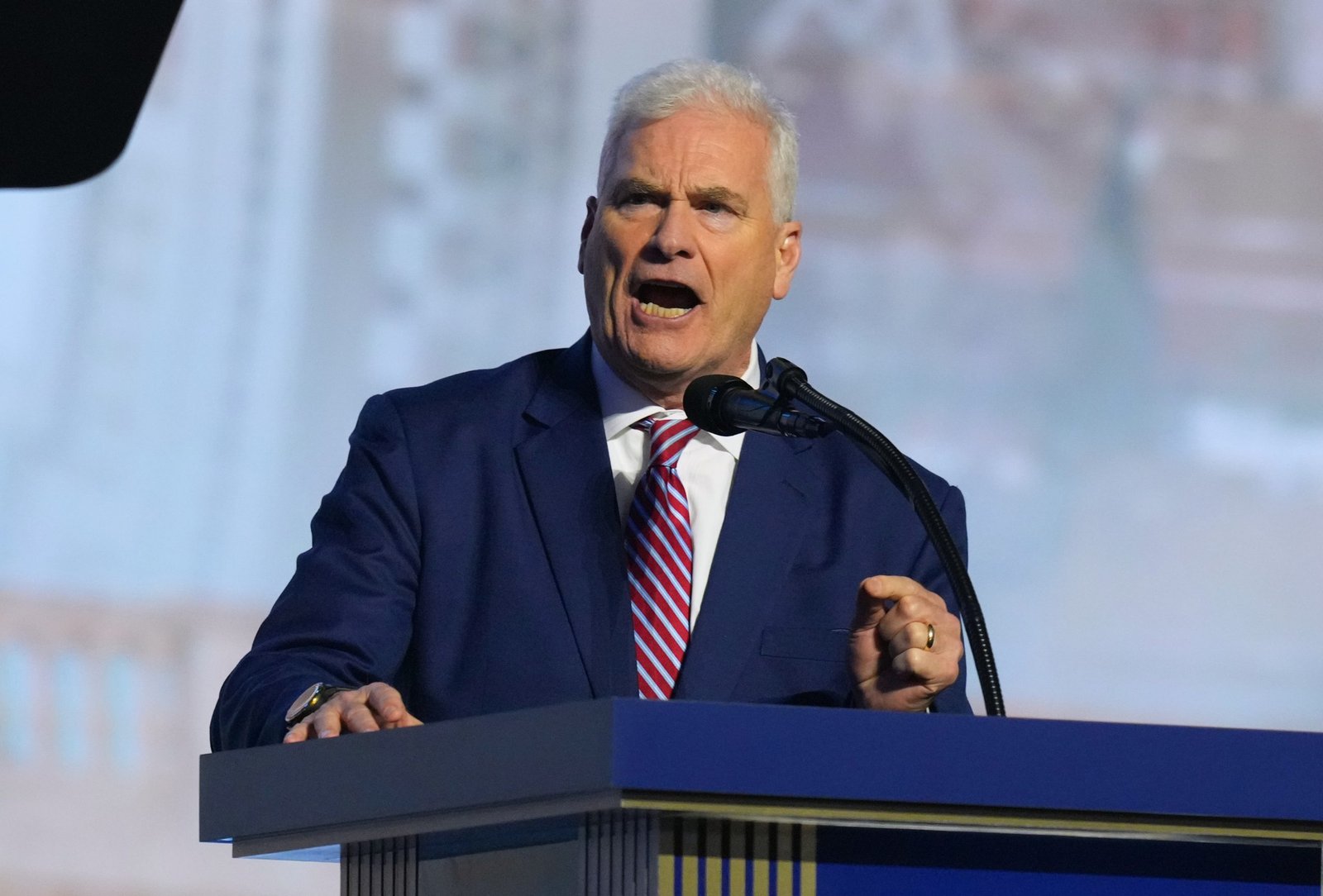
However, Rep. Tom Emmer, R-6th District, not only attended what was dubbed the “Trump-a-palooza” but also had a speaking role. He elicited chants of “USA, USA” when he said “the Democratic Communist Party may not like it, but I’m proud to be an American.”
Emmer, a member of the House GOP leadership, was merely amplifying a main theme at the convention. With growing Republican anxiety about the midterm election, speaker after speaker claimed the Democratic Party has turned away from its traditional liberalism into what they said was dangerous anti-American ideology.
Pratt hit by Groyper problem
A problem facing the Republican Party swamped state Sen. Eric Pratt this week and that’s a concern that young GOP activists who usually serve as a talent pool have increasingly become anti-establishmentarian with antisemitic and misogynistic views.
Pratt, the GOP candidate for retiring Rep. Angie Craig’s 2nd District congressional seat, announced the resignation of his field director, Austin Brown, shortly after his Democratic rival, former Lakeville Mayor Matt Little, held a press conference unveiling a number of Brown’s social media posts.
Those posts included racist, antisemitic and Islamophobic stereotypes and slurs. In them, Brown described himself as a “White Christian Nationalist” and “Groyper,” a movement started by far-right white supremacist and antisemitic internet personality Nick Fuentes.
At the press conference, Little called on Pratt to “terminate” his staffer and “disavow what Brown said.”
That’s exactly what Pratt scrambled to do.
“The central theme of my campaign has been stability over chaos,” Pratt said in a statement. “Throughout my career, I have prided myself on the ability to lead with compassion, accountability and focus. I have always been clear that antisemitism, racism, and discrimination of any kind have no place in our politics or our communities.”
Media investigations into the appeal of white nationalism to some young GOPers lay the blame on conservative organizations like the Heritage Foundation, which vets and trains young Republicans for jobs in government.
A Politico story said critics in the party say “such institutions have spent the last decade selecting for rigid conformity to Trumpist ideology over more typical markers of expertise.”
“Maybe that helps for enforcing the party line in the new GOP,” Politico wrote. “But these critics fear a decline of merit and skill, along with a tolerance for darker ideologies that could cripple the party’s ability to govern in the long run.”
Omar cleared of wrongdoing
Rep. Ilhan Omar, D-5th District, was accused by President Donald Trump and congressional Republicans, including Rep. Tom Emmer, R-6th District, of wrongdoing when she reported that husband Tim Mynett’s businesses suddenly increased in value and were worth between $6 million and $30 million.
Omar amended that filing, saying her accountant failed to account for Mynett’s partial ownership in the companies and their liabilities and debts. The amended financial disclosure form listed the couple’s assets as ranging between $18,000 and $95,000.
Related: Omar responds to Trump, GOP charges of financial malfeasance and fraud with new financial disclosure filing
Nevertheless, the issue was forwarded to the U.S. House committees that investigate possible ethical breaches.
The bipartisan Office of Congressional Conduct, in a 5-1 vote, recommended that the House Ethics Committee drop the matter because it determined that there was no reason to believe that Omar reported false or incomplete information on her financial disclosure form.
In other news:
▪️Reporter Cleo Krejci wrote about attempts at Minnesota’s colleges and universities to combat “ghost students” — criminals who enroll in classes using stolen or fake identities just long enough to receive financial aid, and then disappear.
▪️To try to appease ranchers and cattlemen who were angered by a plan to import beef to lower meat prices, President Donald Trump has asked his administration to pursue dropping protections on the gray wolf and has also hit meatpackers like Cargill.
▪️Metro reporter Trevor Mitchell wrote about Minneapolis Mayor Jacob Frey’s proposal to cut funding for the city’s “violence interruptors” — people with deep community connections who seek to alleviate tensions and connect neighbors to resources.
▪️In his weekly Capitol Conversations installment, state government reporter Matthew Blake reported on Minnesota’s tireless efforts to vet thousands of Medicaid services providers that had been disenrolled under pressure from the Trump administration
▪️And we shared an Associated Press story about how U.S. tariffs on Canadian goods could send prices for already-expensive hockey gear even higher.
Please keep your comments, and any questions, coming. I’ll try my best to respond. I can be reached at aradelat@minnpost.com.
The post D.C. Memo: Trump promises money to court voter loyalty, again appeared first on MinnPost.
WASHINGTON – The nation’s ranchers were livid that President Donald Trump decided to import beef from Argentina and Brazil in order to lower prices. So, to calm the waters, Trump has gone after the gray wolf and Cargill.
The gray wolf, which is considered endangered in most states, has always been a foe to cattlemen because the predator has a fondness for beef and especially veal, since calves are considered easy prey. Trump’s order could roll back federal protections for the animal.
Meanwhile, Cargill, and the other members of the “Big Four” meatpackers — Tyson Foods, JBS Foods and National Beef — have been accused by Trump of controlling 85% of the nation’s beef processing in a “nasty monopoly” that hurts ranchers.
Related: Minnesota cattle producers have a beef with Trump over foreign imports
So, in executive orders signed last week, Trump directed federal agencies to expand programs that allow certain state-inspected meats to cross state lines. He also directed federal agencies to provide help to smaller processors.
The 1906 Meat Inspection Act allows ranchers to process their own meat for personal or household use. But all other meat must be processed at facilities that are subject to inspection by the U.S. Department of Agriculture.
“For the first time ever, we’re going to give farmers and ranchers the right to process their own food,” Trump said at a ceremony in the Oval Office when he signed his new directives. “That’s a big announcement.”
Cargill, whose global headquarters is in Wayzata, did not return requests for comment.
“I think it’s great to see efforts being made,” said Kaitlyn Root, the executive director of the Minnesota State Cattlemen’s Association.
But Root also said the steps Trump is taking “would not compensate us for everything.”
Trump also called for another change sought by U.S. cattlemen — stricter country-of-origin labeling on beef and meat products.
Trump is trying to appease the nation’s ranchers after he announced that he would drop tariffs on 300,000 metric tons of foreign beef so it could be sold at 25% below “current market prices.”
Related: Washington is cutting the conservation programs that gave me a start in farming
Cattlemen in Minnesota, and across the nation, have been trying to rebuild herds that have shrunk to sizes not seen since the 1950s and were outraged by the president’s attempt to undercut American-raised beef.
Trump said the imports will come from Argentina, Brazil and “a couple of other places” starting this week.
Order ‘will definitely hurt wolves’
Trump also told federal agencies to review the recovery status of the gray wolf and its cousin, the Mexican gray wolf, with an eye toward delisting them and shifting management responsibilities to state wildlife agencies.
Gray wolves once roamed the Midwestern plains in great numbers but were nearly eradicated by the mid-20th century and listed on the Endangered Species Act in 1974.
In 1978, the Fish and Wildlife Service reclassified the gray wolf as threatened in Minnesota — because the state still had a respectable population — but endangered in the rest of the lower 48 states. When an animal is listed as endangered, it is considered at risk of extinction; when it is listed as threatened, it is at risk of becoming endangered.
In the following decades, a number of lawsuits concerning the gray wolf were filed, some seeking broader protection and some seeking to roll back protections. For instance, when the first Trump administration tried to delist the gray wolf, it was stopped by a court.
As a result of the dueling lawsuits, the gray wolf remains listed as endangered in most states and threatened in Minnesota, and has no protection at all in Montana, Idaho and Wyoming and portions of Washington, Oregon and Utah.
“The key consideration for delisting is the status of the wolf population,” said Dan Stark, the Wolf Plan project manager at the Minnesota Department of Natural Resources.
Stark said the most recent estimate of the gray wolf population in Minnesota is about 2,500, which is the second-highest population in the nation. Only Alaska is home to more gray wolves.
Related: Stauber leading effort to strip protections from the gray wolf
“Considering the species, that is a lot,” Stark said of Minnesota’s wolf population.
He said that because the wolf is considered “threatened” and not endangered in Minnesota, there is a federal program to trap and kill animals that “cause conflict,” meaning they threaten or kill livestock.
And Stark said the state also has a program in place since the 1970s to compensate ranchers and farmers for any livestock lost to the gray wolf.
Still, Minnesota ranchers and farmers have pressed for the delisting of the gray wolf.
If the gray wolf is delisted, Stark and his counterpart in other states would be required to come up with new management plans, which could include a hunting season for the species.
Root called the delisting of the gray wolf “something positive.”
But Trump’s latest effort to strip federal protections from the gray wolf will likely end up in court again.
“President Trump’s conservation policy is just crazy, bucking public opinion and all of the science,” said Susan Holmes, executive director of the Endangered Species Coalition. “This is not the kind of thing that will help ranchers, but it will definitely hurt wolves.”
Holmes said there are just 317 Mexican wolves living in the United States and that the gray wolf is not safe from extinction.
She also said that only about 4% of all mammalian biomass on the planet are wild animals and the rest are human beings and their livestock.
“There are definitely incidents where wolves take livestock,” Stark said. “But we believe that ranchers and wolves can coexist.”
The post Trying to mend fences with ranchers, Trump goes after Cargill and the gray wolf appeared first on MinnPost.
Kelly Rand’s teenage twin boys playing hockey in St. Paul, Minnesota, are going through growth spurts that force the family to buy new equipment what seems like all the time.
The goaltender’s $400 helmet in 2022 now runs $1,000. The chest protector they got last year for $465 now goes for $900.
For a sport that is increasingly expensive for everything from gear and ice time to travel and coaching, the latest round of 50% tariffs levied by President Donald Trump’s administration against Canada was most unwelcome news as they threaten to ramp up hockey gear prices even more.
“If a kid on the ice breaks a stick, every other parent is looking at that mom or dad going, ‘Ahhh oh, no!’” Rand said. “You feel for them. How many $400 sticks can you afford in one season?”
Related: D.C. Memo: Canada goes elbows up in trade war
Hockey sticks and skates are among the more than 550 goods named in the tariffs by the White House. Custom equipment is also manufactured by True Hockey in Canada and imported into the U.S., according to B&R Sports Director of E-commerce John Merola, who said skates and goalie gear fit into that category.
An average stick is now $200, Merola said, with high-end versions ranging up to $400. He noted that Bauer, CCM and True still make many custom items in Canada.
“This not a minor blip by by any means,” Sports & Fitness Industry Association CEO Todd Smith said. “Even if manufacturers have moved over the last several years from Canada to other countries, there’s still healthy amount being manufactured in Canada and, yeah, this 50% tariff is a big deal.”
Rising hockey gear prices and popularity amid production shifts
When Rand’s family bought custom goalie gear a couple of years ago, the entire setup cost $3,300. Skate pairs that in 2016 went for between $80 and $900 are now $200 to $1,230, according to HockeySkates DB, a database that charts the prices from various companies.
Inflation, as well as tariffs on other countries, are behind the price jumps in recent years. The Sports & Fitness Industry Association’s manufacturers sales report said the amount spent on hockey equipment increased 45.4% from 2020-25, up to $332.9 million from $228.9 million, dovetailing with increasing participation in the sport.
According to U.S. International Trade Commission data, which does not separate ice and field hockey equipment, gear from Canada made up roughly 8.5% of imports last year, fourth behind 52.7% from China, 13.2% from Vietnam and 9.5% from Thailand. Of the 2.1 million hockey sticks imported last year, trade data shows more than 1.5 million (74.1%) came from China and 268,000 (12.8%) from Mexico, compared to 18,909 (0.9%) from Canada.
Chris Douglas, a professor of economics at the University of Michigan-Flint, called it unlikely that stick prices will go up 50% across the board, noting Canada’s modest market share, but wonders what will happen if demand increases.
“Maybe that causes the price of hockey sticks to rise somewhat — maybe by $50 or something like that,” Douglas said. “Hockey is expensive with the equipment, ice time and so forth, so maybe there’s a family right on the margin where $50 or $100 in additional cost causes them not to enroll their kids at hockey any longer.”
As hockey gear prices rise, the question is how long the tariffs will last
When Trump imposed tariffs on China, Merola said that had a bigger impact on business but not right away.
“Bauer, CCM — the big, heavy hitters in the market — came in and said: ‘We’ll absorb these costs. Don’t worry about it,’” Merola said. “And then as nothing happened, they kind of came back and said, ‘We can’t cover this, so we’re gonna have to increase pricing.’”
That wait-and-see approach could happen again this time, delaying how long manufacturers and retailers pass on the increased hockey gear prices to consumers. Canadian Prime Minister Mark Carney saidtrade talks could resume if Washington became serious about negotiations.
Douglas said it all comes down to expectations for how long the tariffs will be in place.
“It’s hard to form expectations of the current tariff regime where tariffs are changing basically every day, it seems like,” Douglas said. “But if there’s an expectation that tariffs are going to be permanent or at least in place for the long term, then I think prices rise pretty instantaneously because the cost of production has risen and that gets passed on to consumers via a higher price.”
Merola thinks long-term tariffs will lead companies to move more production to the U.S., Asia or elsewhere. Roustan Hockey, the last major hockey stick factory in Canada, last week reaffirmed it will keep making them there, despite the challenges.
“We remain committed to our employees, our customers and our manufacturing operations here in Canada,” founder W. Graeme Roustan said in a statement after hosting federal minister Evan Solomon for a tour of the facility in Brantford, Ontario.
Related: U.S.-Canada trade war looms as issue in Minnesota midterm elections
The Sports & Fitness Industry Association is advocating for the tariffs to go away, especially given what Smith said was a 7% increase in hockey participation in the U.S. over the past three years, a boom attributed to the 4 Nations Face-Off, Winter Olympics and more.
While pointing out the National Hockey League, USA Hockey and teams have contributed significant efforts with learn to play programs that include free equipment and ice time, Smith is concerned about the long-term impact of tariffs on hockey gear prices.
“This has, obviously, the potential to really stunt that growth,” he said. “It couldn’t be a worse time for tariffs to hit in terms of really having the having the possibility to increase costs.”
___
AP Sports Writer Dave Campbell contributed to this report.
The post The US tariff on Canadian imports could send already soaring hockey gear prices even higher appeared first on MinnPost.
WASHINGTON – Returning from an August break, the U.S. House scrapped plans to work through September, with GOP leaders deciding instead to stay in session for another week and not return until mid-November after the midterm elections.
That means many GOP and President Donald Trump priorities — including more help for U.S. farmers battered by tariff policy, low commodity prices and increases in farm input costs by the closing of the Strait of Hormuz — will have to wait.
So will any consideration of the SAVE America Act, legislation that would mandate strict documentary proof of citizenship and photo identification for federal elections. Like the new farm subsidies, GOP leaders were hoping to include the voting provision in a reconciliation bill that would be shielded from a filibuster in the U.S. Senate.
But the House accomplished a few things in the few days it was in session this week.
The most important House action was approval of a continuing resolution, or CR, that has already passed the Senate and will stave off a federal shutdown Sept. 30 by funding the federal government until Dec. 11.
That spending bill pushes back by a month a federal ban on gummies, drinks and other products made from hemp-derived THC, the main active, mind-altering compound found in the cannabis plant. That delay was backed by Trump who promptly signed the CR into law.
Related: As hemp THC industry lobbies Congress for regulations, could Minnesota be a national model?
Producers of intoxicating hemp-based products hailed the delay, saying it gives them more time to find political support for federal regulation — instead of an outright ban — on drinks and edibles that have become a booming business in Minnesota.
“The hemp beverage industry looks forward to working with Congress to create a regulatory framework that protects public health, keeps products away from minors, and permanently removes the bad actors that sell untested, high-potency, copycat gummies and candies that target children,” said Christopher Lackner, president of the Hemp Beverage Alliance in a statement.
Lackner also urged Congress “to look at Minnesota, Louisiana, New Jersey, Kentucky, Georgia, and other hemp beverage states to see how regulation is the path to protect public health.”
The marijuana lobby, which seeks to have hemp-based intoxicating products considered on par with marijuana, which is outlawed by the federal government, said it would fight any attempt in Congress to keep hemp-based products legal under federal law. The 2018 farm bill allowed the growing of hemp and opened the door to the manufacturing of products from that plant.
“As expected, Congress passed the one-time extension of the farm bill loophole that the White House requested,” said Chris Lindsey, a lobbyist for the American Trade Association for Cannabis and Hemp (ATACH). “While we’re disappointed, our sights are set on December.”
Lindsey said that “loophole” in the last farm bill approved by Congress “empowers bad actors, threatens public health, and undermines state regulations.”
‘There will be chaos’
A whistleblower complaint forwarded by Sen. Richard Blumenthal, D-Conn., this week to the U.S. Postmaster said a rushed effort to comply with President Donald Trump’s new restrictions on mail-in voting would result in the disenfranchisement of thousands and even millions of voters.
The new regulations required the U.S. Postal Service to create a “Federal Ballot Mail Portal” that will serve as a database for voter information that could be used to reject ballots that appear invalid.
The whistleblower complaint said the USPS expected states to take back an entire batch of mail-in ballots, which could number thousands, to fix an issue with a single ballot.
“Should the slapdash Portal mistakenly mark a ballot as unverified, there is no clear process by which state election officials or voters themselves can challenge the rejection,” the whistleblower complaint said. “Voters intending to cast ballots by mail may not even be aware that their ballots have been rejected, or were part of a rejected batch, until it is too late to secure an alternative ballot or vote in person. “
Minnesota was one of 24 Democratic-led states suing to block implantation of the USPS’s new rule.
Related: Trump says mail-in ballots boost Democrats, but some of Minnesota’s reddest counties rely most on remote voting
“In some States, it would be impossible at this point to comply with the last-minute rollout of USPS’ novel ballot-verification program,” the lawsuit said. “In other States, there will be chaos.”
Minnesota Secretary of State Steve Simon said in a statement that “nothing had changed” in the state’s mail-in voting system and that voters receiving a ballot in their mailbox should fill them out and mail them in.
He said he is confident the legal challenge to the new USPS rule will prevail.
But he also called the USPS implementation of a new rule “to fundamentally change the way voting by mail works” within weeks of the start of mail-in balloting for a general election is “outrageous and unprecedented.”
Simon said his office is evaluating the new rule and making plans to work with local governments if the legal challenge fails and the new rule takes effect.
He also said the new rule “would require a massive surge in staffing by local election offices — requiring an untold number of new election officials to be hired and trained immediately.”
Critics of the involvement of the USPS in elections call Trump’s action an unconstitutional “power grab” since the U.S. Constitution grants states — not the federal government — primary responsibility to administer elections.
In other news:
▪️ State government reporter Matthew Blake wrote that an open state Senate seat in Maple Grove could give the DFL a chance to pick up a traditional “red” seat.
▪️ President Donald Trump’s derision of communities that oppose the construction of data centers as wanting to be “backwards and poor” has put some Minnesota Republicans in a tough spot. They are trying to finesse the situation as Americans of both parties increasingly oppose those facilities.
▪️ The full impact of the U.S.-Canada trade war has not hit Minnesota yet, and the Canadians have focused on “red” states in drawing up their countervailing tariffs on American goods. But the rift between Washington and Ottawa is likely to be an issue in the midterms in the state.
▪️ Metro reporter Trevor Mitchell found out why the establishment of new, much needed public restrooms are on hold.
The post D.C. Memo: U.S. House approves intoxicating hemp ban delay appeared first on MinnPost.
WASHINGTON – President Donald Trump’s derision of communities that oppose the construction of data centers as wanting to be “backwards and poor” has put some Minnesota Republicans in a tough spot.
Data centers have rapidly become one of the defining issues in this year’s midterm elections, with polls showing both Republican and Democratic voters rejecting these facilities that Trump maintains are job-producing boons.
A recent Economist/YouGov Poll found that more than half of those polled said data centers are “bad” while only 20% said they are a good thing. Democrats were particularly likely to view data center construction negatively with 61% saying it is bad for the country. Meanwhile, 39% of GOP respondents saw new data center construction as bad while 31% viewed it as good.
The backlash can be easily understood. Data centers consume enormous amounts of electricity and water and economists have determined that their job creation is largely limited to short-term construction jobs, which has won the support of trade unions.
Related: A data center is an odd fit for the increasingly valuable North Loop in Minneapolis
Still, Trump touted them as the “Golden Goose” in a post on Truth Social this week, seemingly because he said they are the cornerstone of the strategic AI arms race the United States has with China.
“The only reason that communities throughout the U.S.A. should not want Data Centers is if they want to end up being backwards and poor,” Trump wrote in his post.
Rep. Tom Emmer, R-6th District, immediately embraced the president’s message of support for the construction of data centers.
“President Trump is absolutely spot on,” said Emmer, a member of the U.S. House leadership, in a post on X. “Communist China and our adversaries would love it if the United States was asleep at the wheel and stopped innovating and developing AI and emerging tech. Thanks to President Trump’s work, the USA will be a digital LEADER!”
Other Minnesota Republicans have rejected Trump’s approach and are more nuanced in their position on an issue that is rising to the top of American concerns, saying communities have the right to decide whether they should host a data center.
Rep. Brad Finstad, R-1st District, said “the discussion around AI technology is one our country needs to have.”
“Data centers, like those proposed in southern Minnesota, can play an important role in our economic future and national security, but the decision about whether a data center is right for a particular community should be made by the people and local leaders who know their communities best, not handed down by Washington through a blanket, one-size-fits-all approach that treats every community the same,” he said in an emailed statement.
Finstad also said that it was important that communities have a full understanding of the energy demands, environmental impacts, job creation, and potential tax benefits of a proposed data center. He also said “the companies proposing these projects have a responsibility to be fully transparent about the scope of any short- or long-term impacts,” so local leaders and residents can make informed decisions.
Related: Data centers in Minnesota: The next big election issue
State Sen. Eric Pratt, a Republican who is running for retiring Rep. Angie Craig’s seat, also pushed back against Trump’s remarks about communities that don’t want to host data centers.
He called for a “a balanced approach to data center development that puts local communities at the center of the conversation while recognizing the growing importance of domestic technology infrastructure.”
“Data centers are becoming an important part of our economy, our technology infrastructure, and our national security,” Pratt said in a statement. “But that does not mean every proposed project belongs in every community, or that concerns from the people who live nearby should ever be brushed aside.”
Pratt also said he does not support moratoriums on the building of data centers and that “Minnesota should resist an all-or-nothing approach.”
Proposals in the GOP’s backyard
Many data center proposals in Minnesota are in Republican-held congressional districts. Pine Island, Faribault and North Mankato are in Finstad’s southern Minnesota district, Hermantown is in Rep. Pete Stauber’s 8th District and Monticello is in Emmer’s district.
Democrats running for GOP-held seats in those districts and elsewhere in the state have been planting flags and proposing and implementing moratoriums against data centers at a fast clip as November’s elections near.
Pratt’s Democratic rival, former Lakeville Mayor Matt Little, has pledged to fight for moratoriums and bans on nondisclosure agreements. Some local officials in Minnesota have signed NDAs at the behest of developers, shielding details about data centers from public scrutiny.
And Finstad’s Democratic challenger, Jake Johnson, joined a protest against a Pine Island data center in August.
“I was proud to stand with the people of Pine Island to say that we don’t want this data center here until we know for sure that it will actually benefit our people and our communities,” he said in a statement.
Johnson also released a plan for stopping data center exploitation in Minnesota.
Related: Data centers: Where projects go, local candidates follow
The demonstration in Pine Island came after Google held a community celebration for the project, promising funding for schools as part of its ongoing charm offensive in the city. The company was previously a sponsor for Pine Island’s cheese festival.
Meanwhile, Trina Swanson, a Democrat running against Stauber on the Iron Range, lives close to a proposed data center in Hermantown. She condemned the NDAs signed by Hermantown officials, lack of regulations on data center developments and heavy water use and increased energy costs.
“I want guardrails in place,” she said. “I want to understand how we’re going to prioritize our people over corporations like Google that paid zero dollars in federal taxes last year.”
Stauber’s office did not respond to a request for comment. Neither did the office of Rep. Michele Fischbach, R-7th District.
The subject of the first televised campaign ad run by Grant Hauschild, a DFL state senator representing Hermantown, focused on data centers and touted the regulations on the facilities considered by the state Legislature.
The state legislature approved a few regulations of the industry in 2025. But efforts to impose tougher rules, water permits and bans on local nondisclosure agreements failed this year after strong lobbying by industry groups and labor unions.
Still, Hauschild, in his ad, promises to continue to seek greater regulation on the industry and says, “I don’t work for data centers, I work for you.”
AdImpact, which tracks trends and effectiveness in political advertising, said there’s a “quiet boom” in data center ads. While Ad Impact says most of the money spent on these ads come from Democratic campaigns, a sizable amount 26% are run by Republicans, most of whom oppose the construction of a local data center.
The post Minnesota GOP lawmakers grapple with data centers as Republican voters turn against the projects appeared first on MinnPost.
WASHINGTON – President Donald Trump’s decision to impose steep tariffs on a long list of goods from Canada is having an impact on the midterm elections, especially in northern border states.
In Minnesota, the new trade war has not turned into a political brawl. But the potential is there for Trump’s tariff policy to become a key campaign issue.
Canada is Minnesota’s largest overseas trading partner and the trade impasse is likely to have a negative impact on the state. Minnesota imports roughly $13 billion in Canadian goods while exporting $5 billion worth of goods to Canada every year.
So, after DFL attacks, GOP gubernatorial candidate Lisa Demuth was forced to clarify comments she had made at a campaign event last week that seemed sympathetic to the new duties with a statement that said she doesn’t support Trump’s tariffs on Canadian goods.
While Minnesota Republicans are tiptoeing around the issue, some of their GOP colleagues are more emphatic.
Besides roiling some border states, the politics of the new trade war is sweeping across agriculture-heavy states that have already been hurt by Trump tariffs, like North Carolina and Iowa, where Republicans are distancing themselves from the president’s signature trade policy.
Sen. Susan Collins, R-Maine, who is in a tough reelection battle, said imposing 50% tariffs on $20 billion worth of Canadian goods — over which Ottawa has retaliated by placing 50% tariffs on $20 billion of U.S. products — is “a mistake.”
Alaska Republican Sen. Lisa Murkowski also opposes tariffs on Canadian goods while in Michigan, after attacks by his Democratic opponent, GOP U.S. Senate candidate Mike Rogers rolled back a bit from his support of Trump’s trade policy, saying “tariffs are necessary, but are not a one-size-fits-all solution.”
Related: D.C. Memo: Canada goes elbows up in trade war
Meanwhile, Minnesota’s congressional Republicans have not said much about the U.S.-Canadian trade war. None of them responded to requests for comment.
University of St. Thomas economics professor Tyler Schipper said many Minnesota politicians are not making the U.S.-Canada trade war a big deal because the impact of the new duties have not been felt yet.
Canada’s retaliatory tariffs do not take effect until Sept. 8 and Ottawa has taken potash — a key fertilizer used by Minnesota farmers — and energy off the table.
And the automobile tariffs imposed by both countries would not go into effect until Jan. 1.
“Because effects are somewhat limited right now, it allows politicians not to talk about the issue,” he said.
Schipper warned, however, that an escalation of the trade war, which has prompted Trump to “rename” Lake Ontario to “Lake America,” could move up the deadlines for the imposition of certain tariffs and broaden them to include commodities Minnesotans are more dependent upon.
Schipper said Minnesota tourism has already felt the impact of the soured relationship with Canada.
“But even if the effect is small right now, tariffs add to an environment where people are already concerned about affordability, and that won’t go well for politicians who support tariffs,” Schipper said.
University of Minnesota-Duluth political science professor Tim Lindberg said another reason the issue has not resonated as much in Minnesota is that it is unlike other border states where Republicans are under threat to lose a U.S. Senate or U.S. House seat.
So the Canadian government has been careful to place tariffs on U.S. imports in a way that has maximum political effect.
“We are picking products that will target states in the United States,” said Melanie Joly, Canada’s industry minister, when she announced the retaliatory tariffs last week.
Besides the ongoing war in Iran and other policies that have shaken the GOP base, including the decision to import beef from overseas — a move American ranchers say undercuts them — the tariffs add to the worries of Republican elected officials, especially those in tight races.
“This is another example of how Republicans are having trouble this year with what Trump is doing and how he’s doing it,” Lindberg said. “So, if they can’t strongly agree with something, the best thing is not to say anything at all.”
‘In the short term … it stinks’
Minnesota Republicans have supported Trump’s tariffs on Canada before.
After Trump imposed 25% tariffs on a list of Canadian goods last year, Rep. Tom Emmer, R-6th District, told respondents on a telephone town hall that he supported the duties that would “improve the environment” for American companies and their workers.
In February, a resolution was approved by the U.S. House that would end the tariffs Trump imposed on Canada last year. All of Minnesota’s Republican members of Congress voted against that resolution.
“While I value the strong trading relationship we share with Canada, political posturing by House Democrats in an effort to terminate President Trump’s authority to address serious national security concerns, from fentanyl trafficking to illegal immigration, would significantly weaken our ability to secure the border …” Rep. Brad Finstad, R-1st District, said in a post on X.
Democratic challenger Jake Johnson has repeatedly criticized Finstad for his support of the president’s tariffs.
The resolution rejected by Minnesota’s lawmakers — which was supported by several other Republicans — was not considered in the U.S. Senate and has not become law.
Last year, Sen. Amy Klobuchar, D-Minn., succeeded in winning approval for a separate Senate resolution that would lift U.S.-imposed tariffs on Canada. But that legislation was not taken up by the U.S. House.
While Minnesota Republicans are still wrestling about how to respond to the U.S.-Canada trade war, the state’s Democrats have strongly criticized the imposition of new tariffs on Canada.
“Canada is not the 51st state,” Rep. Betty McCollum, D-4th District, said on X. “It’s a sovereign, democratic nation — and one of our closest allies. We share history, culture, and borders. They are a treasured neighbor, friend, and close ally. President Trump’s decision to bully Canada and impose steep tariffs is a huge mistake, and all of us will pay for it.”
McCollum joined Rep. Kelly Morrison, D-3rd District, and about 80 other House Democrats in sending a letter to Trump that urged an end to the trade war.
“Recent tariffs, continued threats of additional trade restrictions, and increasingly adversarial rhetoric are creating uncertainty for businesses, workers, farmers, and consumers on both sides of the border,” the letter said.
Lt. Gov. Peggy Flanagan, a Democrat battling Republican Michele Tafoya for retiring Sen. Tina Smith’s U.S. Senate seat, said the new levies Trump is placing on Canadian goods is “just the latest example of Trump’s disastrous trade policy that is jacking up prices for American consumers and ruining export markets for Minnesota farmers and businesses.”
“What we need is a serious trade policy that focuses tariffs on the real cheats like China, not punishing our longtime allies like Canada to satisfy Trump’s ego,” Flanagan said in an emailed statement.
While Tafoya’s campaign did not respond to a request for comment, the Republican Senate candidate voiced support for Trump’s trade policy last month at Farm Fest. However, she said “in the short term, it causes disruptions, and that stinks.”
Schipper said there are still plenty of voters who support Trump’s tariff policy, even as “economists have gotten the message that tariffs raise prices for consumers.”
“But some Republicans believe that tariffs will result in jobs coming back to the United States even if there’s not good evidence that manufacturing is coming back, at least not in any timeline that is meaningful,” he said.
The White House is trying to allay GOP concerns about the impact of the new tariffs on Canada, and the Trump administration’s trade policy on midterm elections.
U.S. Trade Representative Jamieson Greer is meeting with a large group of U.S. House Republicans this week to try to calm those waters.
The post U.S.-Canada trade war looms as issue in Minnesota midterm elections appeared first on MinnPost.