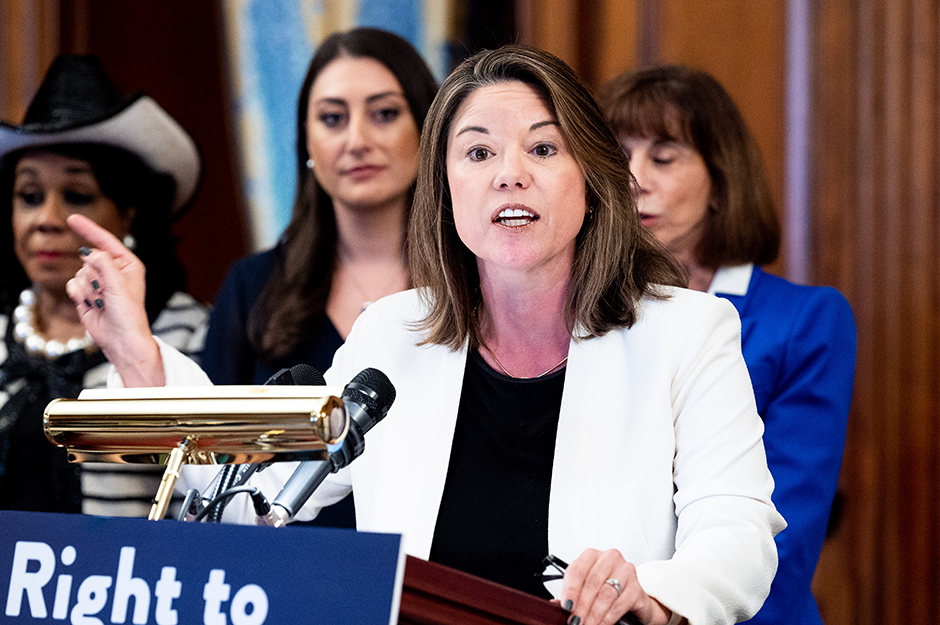
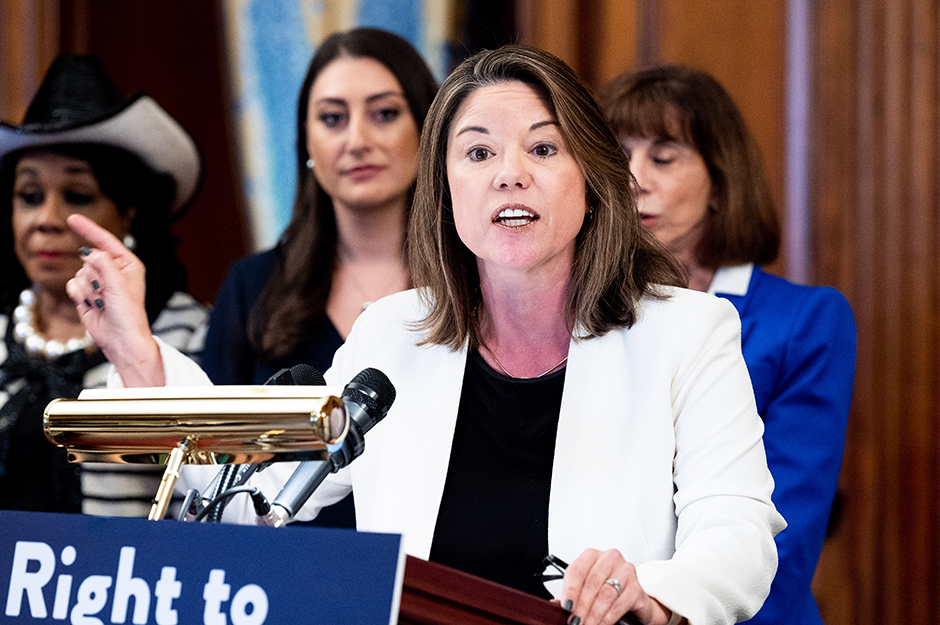
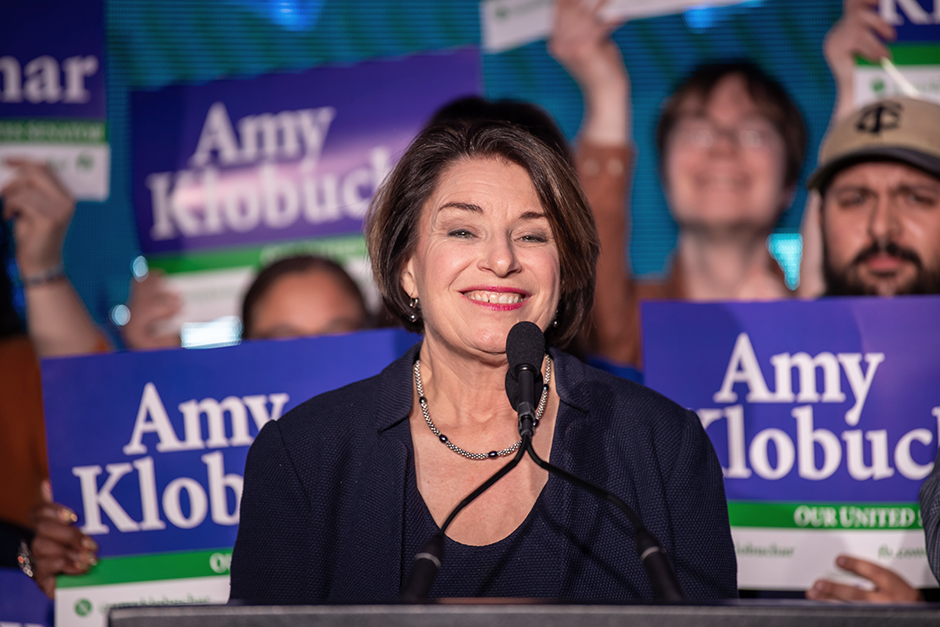
WASHINGTON — Rep. Angie Craig won her quest to become the highest-ranking member of the House Agriculture Committee as the nation’s farmers anxiously awaited negotiations in Congress concerning a massive farm bill.
Craig ran against the current ranking Democrat on the agriculture panel, Rep. David Scott of Georgia, and another challenger, Rep. Jim Costa of California.
Scott, who is 79 and in ill health, dropped out of the race Monday night after the Democratic Steering and Policy Committee voted to recommend Craig for the position.
That vote was followed by another Tuesday morning of the entire Democratic caucus, which voted 121-92 in favor of Craig over Costa, who had the support of former Speaker Nancy Pelosi and California Democrats.
With Sen. Amy Klobuchar expected to be the top Democrat on the Senate Agriculture Committee in the next Congress, when the GOP takes control of the chamber, Minnesota should have an outsized influence on farm policy.
Congress has failed to approve a new five-year farm bill and instead extended the one approved in 2018 for a year. But that extension, which allowed the U.S. Department of Agriculture to continue to fund all of its programs, is about to expire.
So, Congress is trying to forge an agreement on a short-term funding bill that would extend the farm bill for another year. Details of the agreement have not been released, but it will include an additional $10 billion for the nation’s farmers and ranchers who say they are hurt by Congress’ inability to approve a new farm bill.
The high-stakes negotiations over a short-term budget bill that would contain new money for farmers and ranchers — called a continuing resolution or CR — are aimed at preventing a federal government shutdown this weekend, when the current legislation funding the federal agencies expires.
Craig’s campaign to be the top Democrat on the House Agriculture Committee was aided by her relationship with members of the Democratic Steering and Policy Committee, a panel she belongs to that includes House Democratic leaders and committee chairmen. The steering committee helps determine committee assignments and advises party leaders on policy.
Rep. Betty McCollum, D-4th District, who is also a member of the steering committee, campaigned on Craig’s behalf.
“Minnesotans and our nation will benefit from Congresswoman Craig’s leadership in this new role, and I’m grateful for the vote of confidence that our colleagues placed in her,” McCollum said in a statement released after Tuesday’s vote.
Craig, 52, was also helped by the desire of many Democrats for a new generation of party leaders. In addition, her pitch as a Midwesterner and centrist Democrat who can speak to rural voters resonated with her colleagues.
The Minnesota Farm Bureau Federation and the Minnesota Farmers Union both endorsed Craig’s bid.
“Representative Craig has a proven track record of bringing people together around bipartisan solutions,” the farmers union said in a statement. “We’re glad that she will be joining Senator Klobuchar as a leading voice in farm bill discussions.”
Craig, who represents the “purple” 2nd District composed of Twin Cities suburbs and rural areas, said she was honored to be selected the top Democrat on a House panel that will try again to craft a new farm bill.
“I just won my D+1 district by nearly 14 points because my farmers and rural constituents know that I’ll meet them where they’re at, I’ll listen to their concerns and I’ll work with whoever I can to improve their lives,” she said in a statement.
Ana Radelat
Ana Radelat is MinnPost’s Washington, D.C. correspondent. You can reach her at aradelat@minnpost.com or follow her on Twitter at @radelat.
The post Craig elected top Democrat on House ag panel appeared first on MinnPost.
WASHINGTON (AP) — President-elect Donald Trump campaigned on the promise that his policies would reduce high borrowing costs and lighten the financial burden on American households.
But what if, as many economists expect, interest rates remain elevated, well above their pre-pandemic lows?
Trump could point a finger at the Federal Reserve, and in particular at its chair, Jerome Powell, whom Trump himself nominated to lead the Fed. During his first term, Trump repeatedly and publicly ridiculed the Powell Fed, complaining that it kept interest rates too high. Trump’s attacks on the Fed raised widespread concern about political interference in the Fed’s policymaking.
On Wednesday, Powell emphasized the importance of the Fed’s independence: “That gives us the ability to make decisions for the benefit of all Americans at all times, not for any particular political party or political outcome.”
Political clashes might be inevitable in the next four years. Trump’s proposals to cut taxes and impose steep and widespread tariffs are a recipe for high inflation in an economy operating at close to full capacity. And if inflation were to reaccelerate, the Fed would need to keep interest rates high.
Why is there so much concern that Trump will fight Powell?
Because Powell won’t necessarily cut rates as much as Trump will want. And even if Powell reduces the Fed’s benchmark rate, Trump’s own policies could keep other borrowing costs — like mortgage rates — elevated.
The sharply higher tariffs that Trump has vowed to impose could worsen inflation. And if tax cuts on things like tips and overtime pay — another Trump promise — quickened economic growth, that, too, could fan inflationary pressures. The Fed would likely respond by slowing or stopping its rate cuts, thereby thwarting Trump’s promises of lower borrowing rates. The central bank might even raise rates if inflation worsened.
“The risk of conflict between the Trump administration and the Fed is very high,” Olivier Blanchard, former top economist at the International Monetary Fund, said recently. If the Fed hikes rates, “it will stand in the way of what the Trump administration wants.”
But isn’t the Federal Reserve cutting rates?
Yes, but with the economy sturdier than expected, the Fed’s policymakers may cut rates only a few more times — fewer than had been anticipated just a month or two ago.
And those rate cuts might not reduce borrowing costs for consumers and businesses very much. The Fed’s key short-term rate can influence rates for credit cards, small businesses and some other loans. But it has no direct control over longer-term interest rates. These include the yield on the 10-year Treasury note, which affects mortgage rates. The 10-year Treasury yield is shaped by investors’ expectations of future inflation, economic growth and interest rates as well as by supply and demand for Treasuries.
An example occurred this year. The 10-year yield fell in late summer in anticipation of a Fed rate cut. Yet once the first rate cut occurred on Sept. 18, longer term rates didn’t fall. Instead, they began to rise again, partly in anticipation of faster economic growth.
Trump has also proposed a variety of tax cuts that could swell the deficit. Rates on Treasury securities might then have to rise to attract enough investors to buy the new debt.
“I honestly don’t think the Fed has a lot of control over the 10-year rate, which is probably the most important for mortgages,” said Kent Smetters, an economist and faculty director at the Penn Wharton Budget Model. “Deficits are going to play a much bigger role in that regard.”
OK, so Trump fights with Powell — so what?
Occasional or rare criticism of the Fed chair isn’t necessarily a problem for the economy, so long as the central bank continues to set policy as it sees fit.
But persistent attacks would tend to undermine the Fed’s political independence, which is critically important to keeping inflation in check. To fight inflation, a central bank often must take steps that can be highly unpopular, notably by raising interest rates to slow borrowing and spending.
Political leaders have typically wanted central banks to do the opposite: Keep rates low to support the economy and the job market, especially before an election. Research has found that countries with independent central banks generally enjoy lower inflation.
Even if Trump doesn’t technically force the Fed to do anything, his persistent criticism could still cause problems. If markets, economists and business leaders no longer think the Fed is operating independently and instead is being pushed around by the president, they’ll lose confidence in the Fed’s ability to control inflation.
And once consumers and businesses anticipate higher inflation, they usually act in ways that fuel higher prices — accelerating their purchases, for example, before prices rise further, or raising their own prices if they expect their expenses to increase.
“The markets need to feel confident that the Fed is responding to the data, not to political pressure,” said Scott Alvarez, a former general counsel at the Fed.
Could Trump just fire Powell?
He can try, but it would likely lead to a prolonged legal battle that could even end up at the Supreme Court. At a November news conference, Powell made clear that he believes the president doesn’t have legal authority to do so.
Most experts think Powell would prevail in the courts. And from the Trump administration’s perspective, such a fight might not be worth it. Powell’s term ends in May 2026, when the White House could nominate a new chair.
It is also likely that the stock market would tumble if Trump attempted such a brazen move. Bond yields would probably rise, too, sending mortgage rates and other borrowing costs up.
Financial markets might also react negatively if Trump is seen as appointing a loyalist as Fed chair to replace Powell in 2026.
Haven’t previous presidents criticized the Fed?
Yes, and in the most egregious cases, it led to stubbornly high inflation. Notably, President Richard Nixon pressured Fed Chair Arthur Burns to reduce interest rates in 1971, as Nixon sought re-election next year, which the Fed did. Economists blame Burns’ failure to keep rates sufficiently high for contributing to the entrenched inflation of the 1970s and early 1980s.
Thomas Drechsel, an economist at the University of Maryland, said that when presidents intrude on the Fed’s interest rate decisions, “it increases prices quite consistently and it increases expectations, and … that worries me because that means inflation might become quite entrenched.”
Since the mid-1980s, with the exception of Trump in his first term, presidents have scrupulously refrained from public criticism of the Fed.
“It’s amazing, how little manipulation for partisan ends we have seen of that policymaking apparatus,” said Peter Conti-Brown, a professor of financial regulation at the University of Pennsylvania’s Wharton School. “It really is a triumph of American governance.”
Do other countries have independent central banks?
Yes, most advanced economies do. But in some recent cases, as in Turkey and South Africa, governments have sought to dictate interest-rate policy to the central bank. And soaring inflation has typically followed.
Turkey’s president, Recep Tayyip Erdogan, for years pressured the country’s central bank to cut interest rates even as prices spiked. He even fired three central bankers who had refused to comply. In response, inflation skyrocketed to 72% in 2022, according to official measures.
Last year, Erdogan finally reversed course and allowed the central bank to raise rates.
The post Why Trump and the Federal Reserve could clash in the coming years appeared first on MinnPost.
WASHINGTON (AP) — President-elect Donald Trump has promised to end birthright citizenship as soon as he gets into office to make good on campaign promises aiming to restrict immigration and redefining what it means to be American.
But any efforts to halt the policy would face steep legal hurdles.
Birthright citizenship means anyone born in the United States automatically becomes an American citizen. It’s been in place for decades and applies to children born to someone in the country illegally or in the U.S. on a tourist or student visa who plans to return to their home country.
It’s not the practice of every country, and Trump and his supporters have argued that the system is being abused and that there should be tougher standards for becoming an American citizen.
But others say this is a right enshrined in the 14th Amendment to the Constitution, it would be extremely difficult to overturn and even if it’s possible, it’s a bad idea.
Here’s a look at birthright citizenship, what Trump has said about it and the prospects for ending it:
What Trump has said about birthright citizenship
During an interview Sunday on NBC’s “Meet the Press” Trump said he “absolutely” planned to halt birthright citizenship once in office.
“We’re going to end that because it’s ridiculous,” he said.
Trump and other opponents of birthright citizenship have argued that it creates an incentive for people to come to the U.S. illegally or take part in “birth tourism,” in which pregnant women enter the U.S. specifically to give birth so their children can have citizenship before returning to their home countries.
“Simply crossing the border and having a child should not entitle anyone to citizenship,” said Eric Ruark, director of research for NumbersUSA, which argues for reducing immigration. The organization supports changes that would require at least one parent to be a permanent legal resident or a U.S. citizen for their children to automatically get citizenship.
Others have argued that ending birthright citizenship would profoundly damage the country.
“One of our big benefits is that people born here are citizens, are not an illegal underclass. There’s better assimilation and integration of immigrants and their children because of birthright citizenship,” said Alex Nowrasteh, vice president for economic and social policy studies at the pro-immigration Cato Institute.
In 2019, the Migration Policy Institute estimated that 5.5 million children under age 18 lived with at least one parent in the country illegally in 2019, representing 7% of the U.S. child population. The vast majority of those children were U.S. citizens.
The nonpartisan think tank said during Trump’s campaign for president in 2015 that the number of people in the country illegally would “balloon” if birthright citizenship were repealed, creating “a self-perpetuating class that would be excluded from social membership for generations.”
What does the law say?
In the aftermath of the Civil War, Congress ratified the 14th Amendment in July 1868. That amendment assured citizenship for all, including Black people.
“All persons born or naturalized in the United States and subject to the jurisdiction thereof, are citizens of the United States and of the State wherein they reside,” the 14th Amendment says. “No State shall make or enforce any law which shall abridge the privileges or immunities of citizens of the United States.”
But the 14th Amendment didn’t always translate to everyone being afforded birthright citizenship. For example, it wasn’t until 1924 that Congress finally granted citizenship to all Native Americans born in the U.S.
A key case in the history of birthright citizenship came in 1898, when the U.S. Supreme Court ruled that Wong Kim Ark, born in San Francisco to Chinese immigrants, was a U.S. citizen because he was born in the states. The federal government had tried to deny him reentry into the county after a trip abroad on grounds he wasn’t a citizen under the Chinese Exclusion Act.
But some have argued that the 1898 case clearly applied to children born of parents who are both legal immigrants to America but that it’s less clear whether it applies to children born to parents without legal status or, for example, who come for a short-term like a tourist visa.
“That is the leading case on this. In fact, it’s the only case on this,” said Andrew Arthur, a fellow at the Center for Immigration Studies, which supports immigration restrictions. “It’s a lot more of an open legal question than most people think.”
Some proponents of immigration restrictions have argued the words “subject to the jurisdiction thereof” in the 14th Amendment allows the U.S. to deny citizenship to babies born to those in the country illegally. Trump himself used that language in his 2023 announcement that he would aim to end birthright citizenship if reelected.
So what could Trump do and would it be successful?
Trump wasn’t clear in his Sunday interview how he aims to end birthright citizenship.
Asked how he could get around the 14th Amendment with an executive action, Trump said: “Well, we’re going to have to get it changed. We’ll maybe have to go back to the people. But we have to end it.” Pressed further on whether he’d use an executive order, Trump said “if we can, through executive action.”
He gave a lot more details in a 2023 post on his campaign website. In it, he said he would issue an executive order the first day of his presidency, making it clear that federal agencies “require that at least one parent be a U.S. citizen or lawful permanent resident for their future children to become automatic U.S. citizens.”
Trump wrote that the executive order would make clear that children of people in the U.S. illegally “should not be issued passports, Social Security numbers, or be eligible for certain taxpayer funded welfare benefits.”
This would almost certainly end up in litigation.
Nowrasteh from the Cato Institute said the law is clear that birthright citizenship can’t be ended by executive order but that Trump may be inclined to take a shot anyway through the courts.
“I don’t take his statements very seriously. He has been saying things like this for almost a decade,” Nowrasteh said. “He didn’t do anything to further this agenda when he was president before. The law and judges are near uniformly opposed to his legal theory that the children of illegal immigrants born in the United States are not citizens.”
Trump could steer Congress to pass a law to end birthright citizenship but would still face a legal challenge that it violates the Constitution.
__
Associated Press reporter Elliot Spagat in San Diego contributed to this report.
The post Trump promises to end birthright citizenship: What is it and could he do it? appeared first on MinnPost.
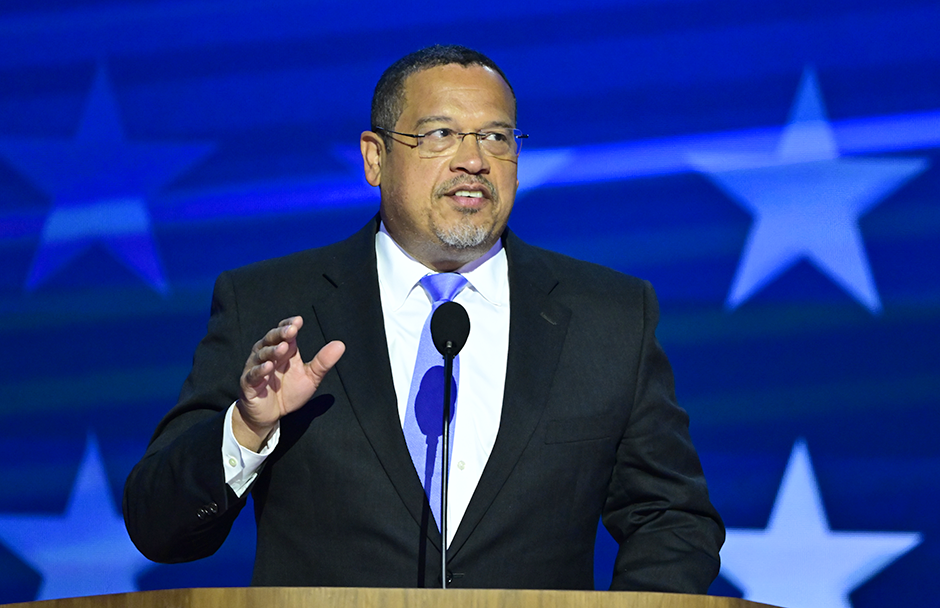
WASHINGTON — Minnesota Attorney General Keith Ellison is joining his Democratic colleagues across the nation in preparing to battle in court to try to stop Trump administration policies they deem unlawful.
For Ellison, and fellow Democratic attorneys general, the past is prologue. They banded together to sue the first Trump administration more than 130 times, with a win rate of 83%, according to a database compiled by Marquette University political scientist Paul Nolette.
This time, they are even more important to a Democratic Party that has been weakened by its electoral losses.
With Republican control of both chambers of Congress and a conservative majority on the Supreme Court, the nation’s Democratic attorneys general are now the strongest counterweight to the political power Trump will hold in his second administration.
Ellison said the 23 Democratic attorneys general who will serve when Donald Trump is inaugurated Jan. 20 have already been strategizing.
But he did not want to divulge many details of their plans, saying, “I’m not about to tell our potential rivals everything we are going to do.”
The rival camp will consist of GOP attorneys general, and most likely the U.S. Justice Department, as challenges to Trump policies play out in the nation’s federal courts.
The Democratic attorneys general were able to derail and stall some of Trump’s immigration initiatives in his first term, with lawsuits against the use of unappropriated government funds to build his wall along the border of the United States and Mexico, his travel ban on citizens from a number of Muslim countries — including Somalia — and his program to separate immigrant parents from their children at the border.
Ellison was elected the state’s attorney general two years after Trump first assumed the presidency. In the ensuing years, Ellison joined his Democratic colleagues in a number of lawsuits targeting Trump policies, including an attempt to leave undocumented migrants out of the 2020 U.S. Census Bureau count, and efforts to curtail environmental review of federal actions, cut food stamps to certain recipients and allow doctors to deny medical treatment based on personal and religious views.
Trump’s vow to declare a national emergency and begin mass deportations on his first day of his next term is now top of mind for many Democratic attorneys general.
Ellison predicted that campaign “would be bloody.”
“That’s not my word – bloody – Trump said ‘bloody,’” he said.
Ellison said legal challenges to the deportations would “depend on how they do it, who they pick up and who they leave behind.”
He said there has been outreach to immigrant communities that would be affected. “We’re building lines of communication and we’re ready to make sure the federal government obeys the law,” he said.
Delay, delay, delay
Besides pushing back on new Trump immigration initiatives, Ellison also alluded to possible lawsuits to counter “dramatic actions against public health” and rollbacks of federal education programs that give female athletes the right to equal opportunity in sports. He also said he’s “concerned about some of the trans things we see.”
“They’ve signaled a lot of things,” Ellison said of Trump and the nominees for his Cabinet and advisers. “There’s a lot of good reason to believe they’ll do what they said.”
In his first term, Trump also tried to withhold federal funds from “blue states” that resisted his initiatives. Ellison said he expected that effort, which was largely unsuccessful, to be attempted again.
He also indicated he does not fully embrace his new role.
“I did not run for re-election to fight with Trump,” he said.
Ellison is not the only Democratic attorney general to say he’s ready to take on Trump administration policies in the courts. So have New Jersey Attorney General Matthew Platkin, Connecticut Attorney General William Tong, California Attorney General Rob Bonta and others say they are prepared to take Trump on, too.
Marquette professor Nolette said the tactic will be to win lawsuits outright, or halt Trump administration proposals until the mid-term elections, which traditionally have favored the party that’s out of power.
“One lesson about parties that have full control of government is that it doesn’t last,” Nolette said.
Meanwhile, the Democratic AGs will play defense. “Even if they can’t succeed in overturning a particular law, they can delay its implementation for some time.”
In fact, Nolette’s database’s “win rate” for Democratic attorneys general during Trump’s first term in office includes both cases that were won and those that successfully delayed initiatives.
Nolette predicted that district courts that are favorable to the Democrats will issue nationwide injunctions against some Trump policies.
Meanwhile, the strategy of Republican attorneys general will be to rush appeals to the U.S. Supreme Court in the hopes of favorable rulings.
Besides having a friendlier Supreme Court in place, Trump may also benefit from the success in his first term in confirming conservative judges to the federal bench.
President Biden — who is trying to rush as many judicial nominees through the Senate as possible before the chamber changes hands to the GOP — also won confirmation for many judges. But Biden’s judges tended to replace sitting Democratic-appointed judges, while Trump was able to bring ideological shifts to several federal courts.
“Overall, the Biden administration has not been able to make the headway Trump did in his first term,” Nolette said.
Ana Radelat
Ana Radelat is MinnPost’s Washington, D.C. correspondent. You can reach her at aradelat@minnpost.com or follow her on Twitter at @radelat.
The post Ellison, other Democratic AGs prepare for first line of defense against Trump policies appeared first on MinnPost.
ST. LOUIS, Mo. — Early on Election Day, highways in the St. Louis area were inundated with water. Over several days, intense storms battered Missouri, bringing six to 10 inches of rain—record-breaking amounts for November.
The flash flooding killed at least five people, including two elderly poll workers whose vehicle was swept from a state highway.
Mayors along the Mississippi River have watched for years as intensifying rain storms and flooding wreak havoc on their communities.
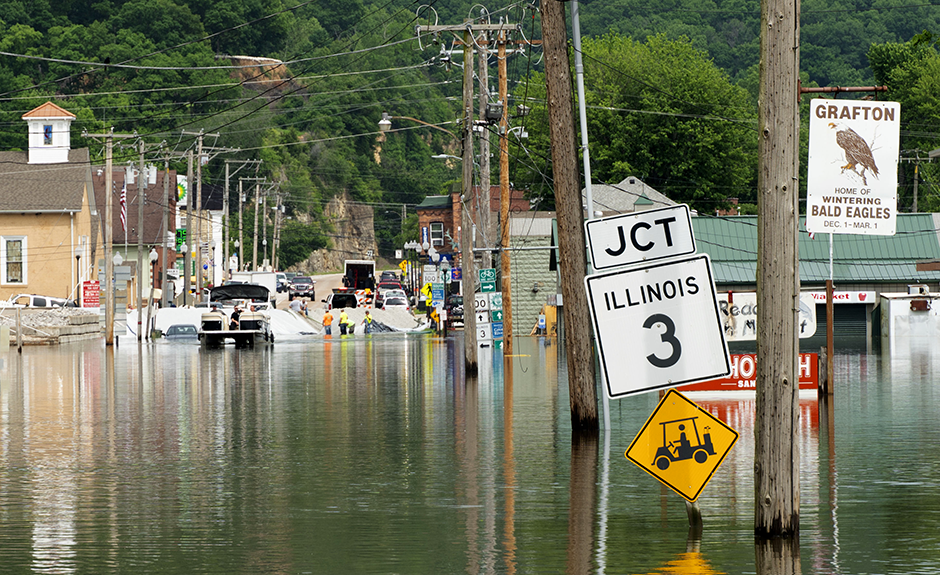
Take Grafton, Illinois, which escaped Election Day flash flooding but suffered $160,000 to $170,000 in damages from a heavy rain event in July. The town’s main intersection was blocked with logs and debris, and the storm blew out a water line and left streets in need of repair.
But Grafton never received a federal disaster declaration and was not eligible for assistance from the Federal Emergency Management Agency (FEMA). Instead, it paid for road and water-line repairs through its Department of Public Works’ annual budget. As a result, the city could no longer purchase new trucks for snow plowing this year, as it had planned.
“What it means is that we’ll limp through another year, keep the vehicles running,” said Grafton Mayor Michael Morrow, who oversees the $1.2 million annual budget for the small riverfront city of about 600.
River communities have suffered repeated losses. But federal disaster funding can take weeks, months or even years to pay out. Traditional insurance programs are tied to property and require proof of loss for a payout, which can be burdensome and lengthy to assemble.
So this fall, the Mississippi River Cities and Towns Initiative (MRCTI) announced a new insurance pilot, with hopes of better helping river towns recover.
MRCTI, which represents 105 cities along the 10 mainstem states of the Mississippi River Basin, is working with Munich Re, a German multinational insurance company, to create the insurance product.
The resulting pilot will test a novel type of insurance pool—called parametric insurance—that is designed to rapidly fund emergency response after natural disasters, such as flooding.
Pilot will test usefulness of new “parametric” insurance policies
The likely cause of intensifying rainfall and floods is human-caused climate change, according to the Fifth National Climate Assessment, a scientific report created every four years for the United States Congress and the President, to help explain the impacts, risks and vulnerabilities associated with a changing global climate.
In 2019, communities in the Basin saw months of flooding, spanning across the Mississippi, Missouri and Arkansas rivers. Reported losses totaled almost $25 billion across at least 17 states, according to the National Oceanic and Atmospheric Administration.
The central U.S. is emerging as a new flash flooding hotspot, according to research published in Nature’s Communications Earth & Environment journal. With its new role as a hotspot comes more disaster damage – and need for insurance that addresses that.
While conventional indemnity insurance requires insured owners to prove specific losses by amassing evidence and presenting pre-storm documentation, parametric insurance pays out quickly after agreed-upon “triggers” – such as wind speeds or river heights – reach a certain level.
For the MRCTI pilot, Munich Re has suggested using watershed data from the U.S. Geological Survey to determine the best gauges along the river to measure flood depth. Once the river flooding reaches a certain depth, the payout would be triggered.
Getting that trigger right is key, said Kathy Baughman McLeod, chief executive officer of Climate Resilience for All, a nonprofit focused on climate adaptation.
“You want to have sufficient understanding of how you set the triggers at a certain place and why,” she said. “There’s a lot of engagement necessary to get everybody on the same page about what the product is, how it works, what the trigger should be.”
The goal of Munich Re’s pilot program is to demonstrate in real-time how a parametric insurance payout policy would function in current insurance-market conditions and how swift payouts could better assist a city’s disaster response in the immediate days following a flood.
First, Munich Re will develop a mock-up of the insurance policy for one hazard – flooding – with the understanding that multiple hazards, like intense heat, or drought, could be added later, said Colin Wellenkamp, executive director of MRCTI, and, as of November 6, a newly elected state representative for Missouri District 105.
The mock-up would calculate a range of premium costs and theoretical payout options that would be available for cities of varying sizes along the river. But the pilot won’t cost the cities a cent – and it won’t pay them anything either, until the pilot moves into implementation. It’s unclear which entities will ultimately foot the bill of the pilot and eventual product because it’s so early in development.
When Munich Re moves into implementation, individual city governments would hold the policies and receive payouts. Wellenkamp hopes to convince larger corporations that rely on a healthy and functioning Mississippi River hydrology to pick up the tab on the premiums, he said.
Quick payouts could take burdens off cities
“In the first 24 to 72 hours after a disaster event, very little money can help a whole heck of a lot,” Wellenkamp said. “We use that time for evacuations and to move people out of additional harm’s way in the aftermath.”
But soon after the initial emergency response, municipalities start to look for funds for longer-term cleanup and repair. Under the current paradigm, that money can be hard to tap.
In the spring of 2019, major flooding on the Mississippi inundated many communities, including Grafton, where the downtown partially closed and people were forced to evacuate.
The Trump administration didn’t declare a major disaster until September of that year, months after flood waters had receded. It took until 2022 for federal money to reach Grafton, Morrow said.
“The former administration went through that flood,” Morrow said. “I’m the mayor now and I was getting some of the money that they had put in years ago.”
That wait places stress on a city’s finances, especially smaller ones like Grafton, Morrow added.
Traditional insurance doesn’t always help either. Grafton has a flood policy but it only covers property owned by the city. Residents and businesses in the community would need to take out their own flood protection. The National Flood Insurance Program (NFIP), which underwrites many flood insurance policies, has various coverage restrictions. For example, NFIP doesn’t cover roads or wastewater infrastructure.
The policies also require proof of loss before issuing a check because they cover specific damage, like to a particular building or its contents. This “proof” can take days to document, and longer to process, which delays how fast a local government can begin repairs. Without proper pre-storm documentation, damage can sometimes be nearly impossible to prove.
Parametric insurance – which works with measurable triggers and isn’t tied to documentable losses – could ease the process.
Cities from the headwaters to the mouth of the Mississippi could buy into the policy, creating a pool that spreads out the risk that any individual community faces.
“Not every city is going to flood every year, but the flooding will impact at least one section of the river,” said Raghuveer Vinukollu, head of climate insights and advisory for Munich Re in the U.S.
The insurance pool would protect a town from the risk of ruin, and a more timely payout would increase the town’s resiliency through swift reinvestment in its infrastructure, he added.
Parametric insurance in the Mississippi Delta and beyond
For flooding on rivers, this kind of insurance risk pool is new territory, Vinukollu said. As climate risks become more extreme, the insurance industry is working with a number of communities to address their evolving needs, he said.
While parametric insurance is still developing, one early example stands out to Vinukollu—the Caribbean Catastrophe Risk Insurance Facility (CCRIF).
CCRIF pools risk for Caribbean countries, which face hurricane risks each year. By pooling risk together each island can receive a larger payout than if it had taken out an individual policy.
In July, a mere 14 days after Hurricane Beryl devastated 90% of buildings and agriculture on the islands of Carriacou and Petite Martinique, the government of Grenada received its first payout from CCRIF to fund disaster recovery.
The tropical cyclone policy paid more than $42 million to Grenada, the largest single payout from CCRIF since its inception in 2007.
In the Mississippi River Basin, Vinukollu hopes to apply this kind of shared risk pool to insure cities at risk for inland flooding.
“The triggers are different, the perils are different, but the concept is the same,” said Vinukollu.
Given its position near the end of the Mississippi River, New Orleans is no stranger to the devastating impacts of extreme weather. Several city-run institutions, such as NOLA Public Schools, have taken out parametric insurance policies to protect important infrastructure.
One of the first tests of these policies came in September when Hurricane Francine‘s storm surge, rain and winds pelted southern Louisiana.
But NOLA Public Schools did not receive a payout from its policy with Swiss Re.
While wind speeds were high, they were not high enough to meet the policy’s triggers of more than 100 miles per hour for one minute.
New Orleans is more likely to experience repetitive, severe losses from named storms than a city in the upper Basin, such as Minneapolis, so cities closer to the Gulf Coast may end up paying higher premiums once the policy officially rolls out, said Wellenkamp, of MRCTI.
Cities that choose to cover more hazards or lower-level disasters may pay higher premiums, because it could result in more frequent payouts, Wellenkamp said. Ultimately, municipalities could still end up footing the bill for events like the July flooding in Grafton or the Election Day storms in St. Louis.
McLeod argues communities shouldn’t expect payouts from parametric insurance all that often. “Just by the nature of the product it shouldn’t [pay every year],” she said. “Insurance is for the worst of the worst.”
Munich Re advises that parametric insurance works best to complement – not replace – traditional insurance policies. But company officials believe that these new policies offer the chance for insurance to adapt to changing risk landscapes, as weather events become more extreme.
Despite its potential to facilitate faster disaster response, parametric insurance is no silver bullet, said McLeod, of Climate Resilience for All.
The best solution to her is reducing the underlying risk from climate change.
“The big picture is it’s a really important tool in financing and managing the risks of climate change, and we need every tool,” she said.
But more than any new financial tool, McLeod said, the most effective financial step would be addressing the root causes of climate change, and building – or rebuilding – more natural protections, like wetlands.
“You’ve got to reduce the risk [or] you won’t be able to afford the insurance on it,” she said. “It’s not insurance if you know this thing is going to happen.”
Correction: An earlier version of this story stated Munich Re will cover the cost of the pilot. The article has been updated to reflect that it’s unclear who will ultimately pay for it.
The Lens’ Marta Jewson contributed reporting to this story.This story is a product of the Mississippi River Basin Ag & Water Desk, an independent reporting network based at the University of Missouri. Disclosure: both the Desk and MRCTI receive funding from the Walton Family Foundation. Support our independent reporting network with a donation.
The post Mississippi River towns pilot new insurance model to help with disaster response appeared first on MinnPost.
WASHINGTON – Senate Democrats gave Sen. Amy Klobuchar a promotion Tuesday as they boosted the Minnesota lawmaker to the No. 3 leadership position in the next Congress.
Klobuchar, who was first elected in 2006, will succeed retiring Sen. Debbie Stabenow of Michigan as chairman of the party’s Policy and Communications Committee and will be taking a lead on Senate Democratic priorities after the party lost its Senate majority in November’s elections.
Klobuchar currently holds the No. 4 position in Senate leadership, that of chairman of the Democratic steering committee.
Senate Democrats also voted unanimously behind closed doors to retain their two top leaders, Sens. Charles Schumer of New York and Richard Durbin of Illinois. Schumer has led Senate Democrats since 2017 while Durbin is the party’s longtime whip.
With the GOP poised to control the Senate and to keep a slim majority in the U.S. House, the role of Senate Democrats will be to use whatever legislative tools are at their disposal — especially the filibuster — to block what they consider onerous initiatives.
But the selection of Klobuchar, a Senate workhorse and consensus-oriented pragmatist, to the key post of shaping the party’s policy and messaging indicated Democrats also want to be able to find agreement with their Republican colleagues whenever possible.
“This is the time to find common ground when we can, and stand our ground where we must,” Klobuchar said after Democrats held their election.
In a statement, Schumer said Senate Democrats would look to work with Republicans but that his conference would “continue to fight for what’s best for America’s working class.”
“As I have long said, our preference is to secure bipartisan solutions wherever possible and look for ways to collaborate with our Republican colleagues to help working families,” he said. “However, our Republican colleagues should make no mistake about it, we will always stand up for our values.”
Klobuchar is also expected to receive another promotion when Senate Democrats rejigger committee assignments to adjust to their new role in the minority.
She is expected to be the top Democrat on the Senate Agriculture Committee and would be positioned to negotiate with Republicans on the next farm bill if efforts to approve the massive legislation fail, as expected, in the current lame duck session of Congress.
Klobuchar is also expected to stay as a senior member of the Senate Rules Committee and Senate Commerce, Science and Transportation Committee.
The senator initially had competition for her new leadership job – Sen. Cory Booker, D-N.J. But Schumer, to maintain peace in his ranks, created a new position that is ranked No. 4 in the Democratic Senate leadership. That position was chairman of a new Strategic Communications Committee, and Booker was elected to that job Tuesday.
Republicans will start the 119th Congress with 53 seats in the Senate, compared with 47 for Democrats and independents who caucus with them.
Ana Radelat
Ana Radelat is MinnPost’s Washington, D.C. correspondent. You can reach her at aradelat@minnpost.com or follow her on Twitter at @radelat.
The post Democrats in the U.S. Senate give Klobuchar a promotion appeared first on MinnPost.
This article originally appeared on Inside Climate News, a nonprofit, non-partisan news organization that covers climate, energy and the environment. Sign up for their newsletter here.
When a rare tornado swept through the north side of Minneapolis, Michelle Neal scrambled for cover at a fast-food restaurant. “It was unreal—we could have died,” she told Minnesota Public Radio. “McDonald’s saved me.”
It’s the kind of scenario that Julia Nerbonne, executive director of Minnesota Interfaith Power and Light, wants to make sure communities are better prepared for as climate change increases the frequency and severity of extreme weather. The faith-based nonprofit hopes to transform churches and other congregations into emergency shelters with solar power and battery storage to withstand power outages—especially in historically disadvantaged communities, like north Minneapolis, which have long been overburdened by pollution and underinvestment.
“We want to have a building,” she said, “in which they can have a cooling place, in which they can refrigerate their medication—a place where they can be with the community in the midst of a crisis.”
Around the country, nonprofits and other community organizations like Minnesota Interfaith Power and Light were hoping these sorts of projects would receive funding from the U.S. Environmental Protection Agency, which has $3 billion to spend on environmental justice community grants through Sept. 30, 2026. But the Biden administration has only been able to award about half the money so far, and experts say the unspent 50 percent can most likely be clawed back by President-elect Donald Trump—a blow to communities of color and poor rural communities that had long waited for help like this.
Among the threatened initiatives is the EPA’s Environmental Justice Thriving Communities Grantmaking Program, which dedicated $600 million in block grants for projects aimed at tackling climate and environmental justice issues in disadvantaged communities. The money has been hailed by advocates as one of the most important federal investments ever made in closing the nation’s long-standing socioeconomic and racial gaps.
The Biden administration has so far awarded nearly $266 million, according to an EPA database, leaving more than half—or just over $334 million—vulnerable to reversal efforts from Trump officials or Republican lawmakers. “EPA continues to work through its rigorous process to obligate the funds under the Inflation Reduction Act, including the Thriving Communities Grantmakers program,” said Nick Conger, the EPA’s communications director.
Last week, the EPA opened up the first round of applications for the Thriving Communities program, giving hopeful applicants like Nerbonne less than two months to navigate the complicated federal grantmaking process before Trump is sworn in. In fact, several EPA regions have yet to open their application processes, leaving some groups worried they won’t be able to complete their applications on time.
“It just seems like an incredibly missed opportunity. I’d feel disappointed about that,” Nerbonne said, when asked how she would feel if the program’s funding was rescinded under Trump. “Congregations aren’t talking about politics. They’re ready to get to work serving their community and they’re tired of politics, especially after this election.”
Republicans Target Environmental Justice Funding
The IRA’s idea for addressing historic environmental injustice through a community grant program was taken from the sprawling Environmental Justice for All legislation originally introduced in 2020 by Rep. Raúl Grijalva (D-Ariz) and the late Rep. A. Donald McEachin (D-Va.).
“We approached it with the fundamental belief that communities know what communities need best,” said Grijalva in an email.
But Congressional Republicans have been vocal about their intention to cut or limit the environmental justice grant program, characterizing it as a form of cronyism, providing support to political allies of Democrats and opponents of fossil fuels.
“The EPA is awarding taxpayer dollars to special interest groups committed to a radical energy agenda,” wrote U.S. Rep. Cathy McMorris Rodgers (R-Wash.) in a House Energy and Commerce Committee report, released just before Election Day. “Enriching nonprofit organizations to spread radical, left-leaning ideology is an inappropriate use of taxpayer dollars. These programs demand rigorous scrutiny and meticulous oversight.”
Trump himself suggested in a 2023 campaign video that he could “simply choke off the money” allocated under the Inflation Reduction Act.
Typically, Congress would have to pass new “rescission” legislation to take away unspent money that Congress previously appropriated. Republicans could use the appropriations bill for Fiscal Year 2025, which began in October and now appears likely to be in the hands of the newly elected Congress and Trump, to do so. But in order to avoid the threat of a filibuster in the Senate, they instead could use a budget reconciliation bill that only needs a simple majority—the approach Democrats used to pass the IRA. Republicans are aiming to embark on a reconciliation bill soon after taking office in order to extend and expand Trump’s 2017 tax cuts.
Ending environmental justice grantmaking is also part of the vision laid out in Project 2025, the policy roadmap that conservative groups drew up for Trump’s second term. Although Trump professed no familiarity with Project 2025 during the campaign, he has named authors of the plan to key positions in his new administration, including tapping Russell Vought, his former budget chief, to head the Office of Management and Budget again. Project 2025 called for pausing and reviewing all environmental justice grants in light of the Supreme Court’s recent decisions against affirmative action.
The Thriving Communities grant program has become a particular target of Republicans, who singled out one of its recipients and accused it of being “radical” and “anti-American.” The Climate Justice Alliance, a California-based organization, is one of 11 regional grantmaker organizations that were initially awarded $50 million each from the Thriving Communities program. Those groups would then disseminate $40 million of their funds as subgrants to community organizations in their regions.
The Climate Justice Alliance is the only regional grantmaker that has not received any of its funding, sparking speculation that GOP rancor could be to blame. In May, Sen. Shelley Moore Capito (R-W.Va.), the highest ranking Republican on the Senate Environment and Public Works Committee, criticized the group for its support of Palestinians in Gaza and its opposition to Israel, calling its members “radical,” “anti-American,” and “antisemitic.”
Conger, the EPA spokesperson, said the “EPA continues to review the grant for the Climate Justice Alliance,” but provided no further details.
KD Chavez, the Climate Justice Alliance’s executive director, said that the group’s pro-Gaza advocacy is constitutionally protected speech that is separate from the work it would fund under the Thriving Communities program. “This grant money would only be used as intended by Congress, going towards things like air quality and asthma, water quality and lead, asbestos contamination,” she said.
If the group’s political views are the reason for the holdup in funding, Chavez said it could put at risk any social justice or progressive work that receives federal funding. “This could really be setting up a horrific First Amendment precedent moving forward for any type of organization across civil society,” Chavez said.
Other groups involved in the EPA grant program pushed back against the GOP attacks as well. In addition to the 11 regional grantmaker organizations, another 18 institutions were chosen to act as technical assistance centers—known officially as Thriving Communities Technical Assistance Centers, or TCTACs—to help community organizations navigate the often complicated federal grant application process.
Bonnie Keeler, a University of Minnesota public affairs associate professor who runs the Midwest region’s TCTAC, said it’s a misrepresentation of her center’s work to say it channels federal funding to “left-leaning activist or extremist organizations,” adding that the program deserves broad bipartisan support.
“The TCTACs do not advance a particular policy agenda, we respond to requests for assistance wherever they come from,” Keeler said. “To date, we have responded to over 400 requests for technical assistance from urban, rural and tribal communities seeking assistance with everything from energy efficiency goals, to cleaning up brownfields, to managing hazardous waste, to reducing indoor air pollution.”
How Far Will Trump Go?
In the early 1970s, then-President Richard Nixon had a problem. A Democratic-controlled Congress wanted to fund highway improvements, drug rehabilitation and a number of other initiatives that the Republican president believed were “undisciplined” and “fiscally irresponsible.”
So Nixon decided to withhold funds in the budget that he didn’t agree with, sparking a constitutional struggle that resulted in the passage of the Congressional Budget and Impoundment Control Act. That law, which is still in effect today, prohibits a president or other government officials from refusing to release congressionally appropriated funds and essentially substituting their own funding decisions for those of Congress.
The legislation also defines when federal funding has been “obligated,” a legal term for when a contract has been signed between a federal agency and the recipient of federal funds, such as an organization applying for a grant, said Jeremy Kalin, a finance attorney for the law firm Avisen Legal. That means the $266 million dedicated to environmental justice under the Inflation Reduction Act, which Congress passed in 2022, and already obligated is protected from being rescinded, Kalin said.
But legal experts, including Kalin, aren’t sure if Trump and his officials will respect that federal law and refrain from trying to seize or rescind obligated funds, pointing to statements made by Trump and Vought.
Vought and members of right-wing think tanks he is associated with have argued that the Congressional Budget and Impoundment Control Act of 1974 is unconstitutional, saying that Article II of the Constitution, which obligates the president to “faithfully execute” the law, also allows a president to forbid enforcement of the law.
Trump appears to agree with that interpretation. In a statement announcing Vought’s nomination last week, Trump bragged about Vought’s experience as a deregulator, saying, “Russ knows exactly how to dismantle the Deep State and end Weaponized Government.”
“Russell Vought,” Kalin said, “may stretch the bounds of the Impoundment Control Act … and just force people to stop it through the courts.”
If that’s the case, Kalin said, some funds—even those protected as “obligated” funds under the Impoundment Control Act—may be subject to reversals by the Trump administration, and only funds that get fully dispersed to organizations before Trump takes office may be safe from those efforts.
Trump has already tested this theory. During his first term in office, he withheld nearly $400 million in military aid to Ukraine while pressuring President Volodymyr Zelenskyy to open a corruption investigation into Joe Biden and his family. The U.S. Government Accountability Office, or GAO, later ruled that Trump’s actions violated the Impoundment Control Act.
Trump will have an opportunity to appoint a new head of GAO next year when the 15-year term of the current Comptroller General ends, giving him a chance to choose who will have direct oversight of any decisions he makes to withhold funding.
If Trump decides to withhold funds, it will most certainly trigger legal fights that could go all the way to the Supreme Court. The high court has never directly weighed in on the subject, however, but the court’s conservative majority has indicated it is willing to take an expansive view on presidential power.
“Time Is Just Not on the Side of the Grantees”
The short amount of time, roughly seven weeks, before Trump takes office, could also be discouraging some community groups from applying for federal environmental justice grants at all. In some cases, nonprofits see it as a reason to rely less on federal support to do their work.
Caleb Roberts applied for a $1.5 million grant earlier in November from another IRA-funded environmental justice program. He hoped to use the money to hire more employees at his nonprofit, Dallas-based Downwinders at Risk, to conduct door-to-door screenings to check residents’ homes for conditions that cause asthma. But now he’s unsure he’ll ever see that money.
“We think we’ll definitely run into some funding issues,” he said. “Starting day one after inauguration, those things are probably under fire.”
Another nonprofit, Alabama-based We Matter Community Association, said it plans to apply for a Thriving Communities grant to purchase 1,200 acres of land in the city of Prichard, on which it plans to build community amenities, including a community center, athletic fields, commercial space and affordable housing. But Carletta Davis, the group’s president, said the organization will likely rely less on federal support in the future.
“[The election] is the reason why We Matter is really solely focused on trying to create a way to sustain itself without having to go through governmental grants,” she said. “I think that our model is probably going to be the model going forward for EJ organizations.”
Some organizations aren’t sure if applying for a federal environmental justice grant is worth the effort at all. Applications for the Thriving Communities grant program, the largest single program of federal environmental justice block grants, haven’t even opened in the EPA-designated area that includes Texas and Louisiana, home to the nation’s largest petrochemical complexes and environmental justice communities.
“At this time, the groups we know of that may be interested still need more time to understand the grant program and whether they will apply,” said Vanessa Toro Barragán, a senior program officer at the Houston-based Hive Fund for Climate and Gender Justice, which isn’t involved with the grant program.
But time may not be a luxury community groups can afford at the moment, should Trump officials and Republican lawmakers follow through with their threats.
Employees of organizations that work closely with the Thriving Communities program, also expressed concern that community groups would struggle to complete a complicated federal grant application before Trump takes office in just seven weeks, agreeing to comment anonymously to safeguard their prospects as potential grantees.
“Time is just not on the side of the grantees,” one employee told Inside Climate News.
Still, organizations involved with the federal grant programs are encouraging community groups to apply and hope to see a big turnout.
“The fact is that this program, it still exists, and it doesn’t make sense to turn away from an opportunity that is still there while it is still there,” said Chandra Taylor-Sawyer, senior attorney at the Southern Environmental Law Center, one of the partner organizations helping to recruit applicants to the Thriving Communities program.
Keeler, who runs the Midwest technical assistance center at the University of Minnesota, expressed a similar sentiment. “The future of these programs is uncertain,” she said. “That said, all we can do is continue the work we’ve started. We get new requests for support every week and we’ll keep responding to those requests for technical assistance as long as we are able.”
The post Aspiring applicants worry EPA environmental justice grant funding will be rescinded before it’s awarded appeared first on MinnPost.
In our news wrap Sunday, dozens of people were killed in Gaza as the war between Israel and Hamas rages on, Israel said it wants to double the population of Israeli settlers in the Golan Heights along the border with Syria, and Trump named long-time foreign policy adviser Richard Grenell as his next envoy for special missions.
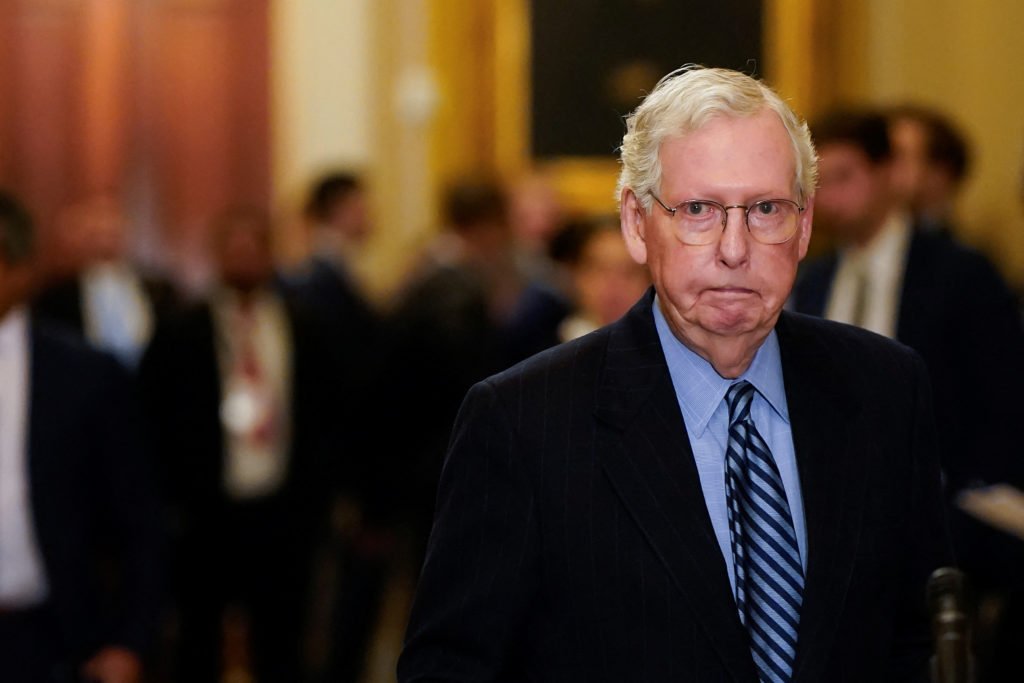
WASHINGTON (AP) — Senate Republican leader Mitch McConnell, who had polio as a child, says any of President-elect Donald Trump’s nominees seeking Senate confirmation should “steer clear” of efforts to discredit the polio vaccine.
“Efforts to undermine public confidence in proven cures are not just uninformed — they’re dangerous,” McConnell said in a statement Friday. “Anyone seeking the Senate’s consent to serve in the incoming Administration would do well to steer clear of even the appearance of association with such efforts.”
The 82-year-old lawmaker’s statement appeared to be directed at Trump’s pick for health secretary, Robert F. Kennedy Jr., after a report that one of his advisers filed a petition to revoke approval for the polio vaccine in 2022. That vaccine is widely considered to have halted the disease in most parts of the world.
McConnell’s words were a sign that Kennedy, who has long advanced the debunked idea that vaccines cause autism, could face some resistance in the soon-to-be GOP-controlled Senate.
WATCH: The controversial changes RFK Jr. could make to vaccine policy as HHS chief
“Mr. Kennedy believes the Polio Vaccine should be available to the public and thoroughly and properly studied,” said Katie Miller, the transition spokeswoman for Kennedy, in response to questions.
The New York Times reported that the petition was filed by a lawyer now helping Kennedy select candidates for federal health positions in the incoming administration.
Any individual or company can file a petition with the Food and Drug Administration, which typically fields hundreds of requests at any time relating to various food, drug and medical issues. Most petitions are denied, but the FDA is required to respond to each one in writing.
Vaccines have been proven to be safe and effective in laboratory testing and in real-world use in hundreds of millions of people over decades — they are considered among the most effective public health measures in history.
McConnell contracted polio at 2 years old but survived because of “the miraculous combination of modern medicine and a mother’s love,” according to the statement. He praised the “saving power” of the polio vaccine for the “millions who came after me.”
Senate Majority Leader Chuck Schumer, D-N.Y., said in a post on X that it was “outrageous and dangerous for people in the Trump Transition to try and get rid of the polio vaccine that has virtually eradicated polio in America and saved millions of lives.
He said Kennedy should clarify his own position on it.
Trump announced last month his selection of Kennedy, saying Kennedy would work to protect Americans “from harmful chemicals, pollutants, pesticides, pharmaceutical products, and food additives.”
But that pick was met with alarm from scientists and public health officials, who fear Kennedy would unwind lifesaving public health initiatives such as vaccines.
Kennedy has pushed other conspiracy theories regarding vaccines, such as that COVID-19 could have been “ethnically targeted” to spare Ashkenazi Jews and Chinese people, comments he later said were taken out of context. He has repeatedly brought up the Holocaust when discussing vaccines and public health mandates.
Kennedy said he plans to remake the Department of Health and Human Services, an agency with sprawling reach and a $1.3 trillion budget, if he is approved. He has suggested the FDA is beholden to “big pharma,” and his anti-vaccine nonprofit has called on it to stop using COVID-19 vaccines.
During the COVID-19 epidemic, his nonprofit group, Children’s Health Defense, petitioned the FDA to halt the use of all COVID vaccines. The group has alleged that the FDA is beholden to “big pharma” because it receives much of its budget from industry fees and some employees who have departed the agency have gone on to work for drugmakers.
Children’s Health Defense currently has a lawsuit pending against a number of news organizations, among them The Associated Press, accusing them of violating antitrust laws by taking action to identify misinformation, including about COVID-19 and COVID-19 vaccines. Kennedy took leave from the group when he announced his run for president but is listed as one of its attorneys in the lawsuit.
Signs of normalcy are starting to return a week after life inside Syria was upended as rebels toppled President Bashar al-Assad’s regime. As the country’s new leaders begin to chart a path forward, the UN envoy to Syria called for a quick end to sanctions imposed by the West. Special correspondent Leila Molana-Allen reports from Aleppo.