Category: USA

  • What happens now that a government shutdown is underway

    What happens now that a government shutdown is underway

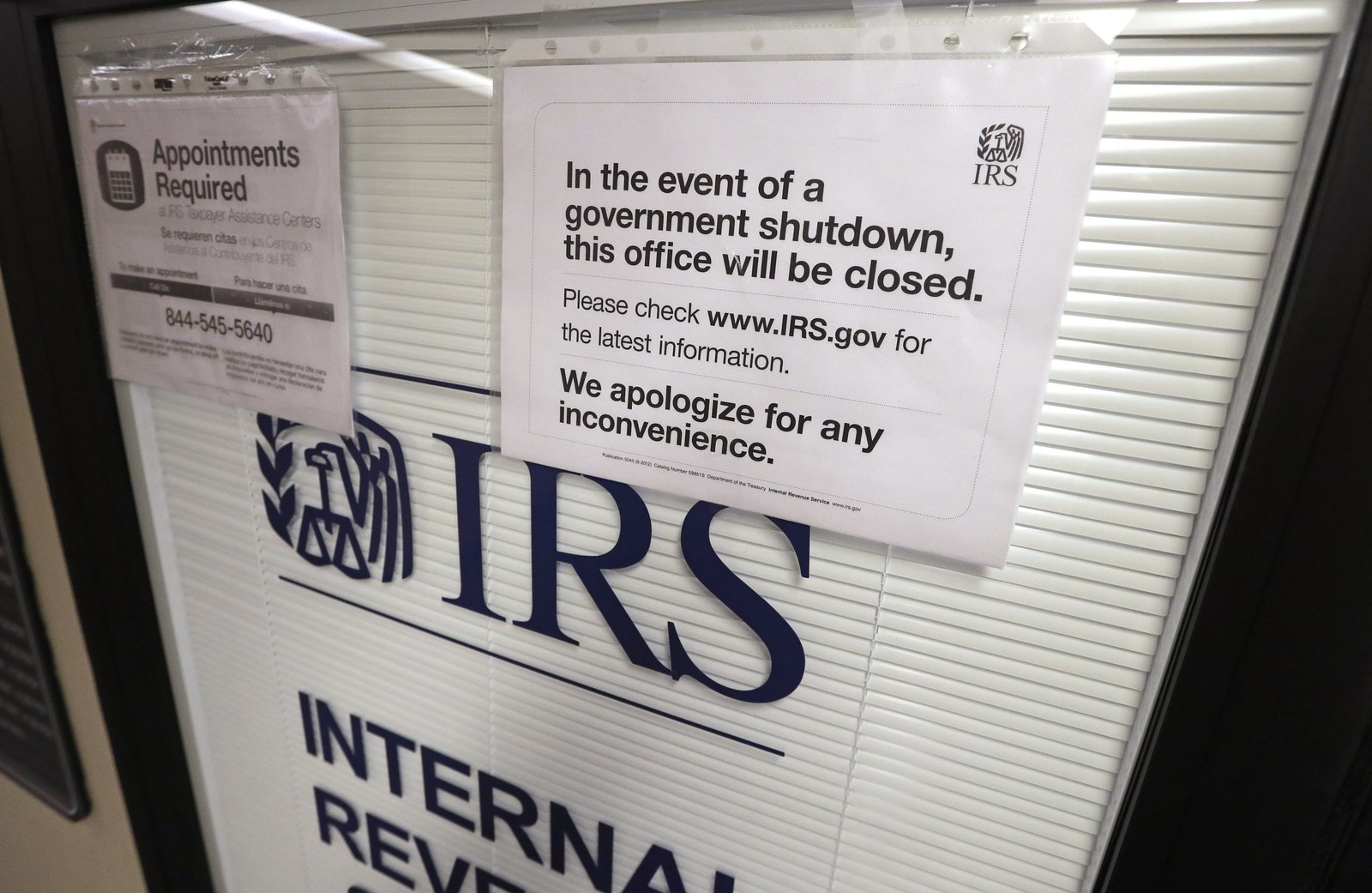
    WASHINGTON (AP) — Washington is bracing for what could be a prolonged federal shutdown after lawmakers deadlocked and missed the deadline for funding the government.

    Republicans supported a short-term measure to fund the government generally at current levels through Nov. 21, but Democrats blocked it, insisting the measure address their concerns on health care. They want to reverse the Medicaid cuts in President Donald Trump’s mega-bill passed this summer and extend tax credits that make health insurance premiums more affordable for millions of people who purchase through the marketplaces established by the Affordable Care Act.

    Republicans called the Democratic proposal a nonstarter that would cost taxpayers more than $1 trillion.

    Neither side shows any signs of budging.

    Here’s what to know about the shutdown that began Wednesday:

    What happens in the shutdown?

    Now that a lapse in funding has occurred, the law requires agencies to furlough their “non-excepted” employees. Excepted employees, who include those who work to protect life and property, stay on the job but don’t get paid until after the shutdown ends.

    The White House Office of Management and Budget begins the process with instructions to agencies that a lapse in appropriations has occurred and they should initiate orderly shutdown activities. That memo went out Tuesday evening.

    The Congressional Budget Office estimates roughly 750,000 federal employees could be furloughed each day of the shutdown, with the total daily cost of their compensation at roughly $400 million.

    What government work continues during a shutdown?

    A great deal, actually.

    FBI investigators, CIA officers, air traffic controllers and agents operating airport checkpoints keep working. So do members of the Armed Forces.

    Those programs that rely on mandatory spending generally continue during a shutdown. Social Security payments still go out. Seniors relying on Medicare coverage can still see their doctors and health care providers can be reimbursed.

    Veteran health care also continues during a shutdown. Veterans Affairs medical centers and outpatient clinics will be open, and VA benefits will be processed and delivered. Burials will continue at VA national cemeteries.

    Will furloughed federal workers get paid?

    Yes. In 2019, Congress passed a bill enshrining into law the requirement that furloughed employees get retroactive pay once operations resume.

    While they’ll eventually get paid, the furloughed workers and those who remain on the job may have to go without one or more of their regular paychecks, depending upon how long the shutdown lasts.

    Service members would also receive back pay for missed paychecks once federal funding resumes.

    Will I still get mail?

    Yes. The U.S. Postal Service is unaffected by a government shutdown. It’s an independent entity funded through the sale of its products and services, not by tax dollars.

    What closes during a shutdown?

    All administrations get some leeway to choose which services to freeze or maintain in a shutdown.

    The first Trump administration worked to blunt the impact of what became the country’s longest partial shutdown in 2018 and 2019. But on Tuesday, Trump threatened the possibility of increasing the pain that comes with a shutdown.

    “We can do things during the shutdown that are irreversible, that are bad for them and irreversible by them,” Trump said of Democrats. “Like cutting vast numbers of people out, cutting things that they like, cutting programs that they like.”

    Each federal agency develops its own shutdown plan. The plans outline which workers would stay on the job during a shutdown and which would be furloughed.

    In a provocative move, the Office of Management and Budget has threatened the mass firing of federal workers in a shutdown. An OMB memo said those programs that didn’t get funding through Trump’s mega-bill this summer would bear the brunt of a shutdown.

    Agencies should consider issuing reduction-in-force notices for those programs whose funding expires, that don’t have alternative funding sources and are “not consistent with the President’s priorities,” the memo said.

    That would be a much more aggressive step than in previous shutdowns, when furloughed federal workers returned to their jobs once the shutdown was over. A reduction in force would not only lay off employees but eliminate their positions, which would trigger another massive upheaval in a federal workforce that’s already faced major rounds of cuts due to efforts from the Department of Government Efficiency and elsewhere in Trump’s Republican administration.

    What agencies are planning

    — Health and Human Services will furlough about 41% of its staff out of nearly 80,000 employees, according to a contingency plan posted on its website.

    As part of that plan, the Atlanta-based Centers for Disease Control and Prevention would continue to monitor disease outbreaks, while activities that will stop include research into health risks and ways to prevent illness.

    Meanwhile, research and patient care at the National Institutes of Health would be upended. Patients currently enrolled in studies at the research-only hospital nicknamed the House of Hope will continue to receive care. Additional sick patients hoping for access to experimental therapies can’t enroll except in special circumstances, and no new studies will begin.

    At the Food and Drug Administration, its “ability to protect and promote public health and safety would be significantly impacted, with many activities delayed or paused.” For example, the agency would not accept new drug applications or medical device submissions that require payment of a user fee.

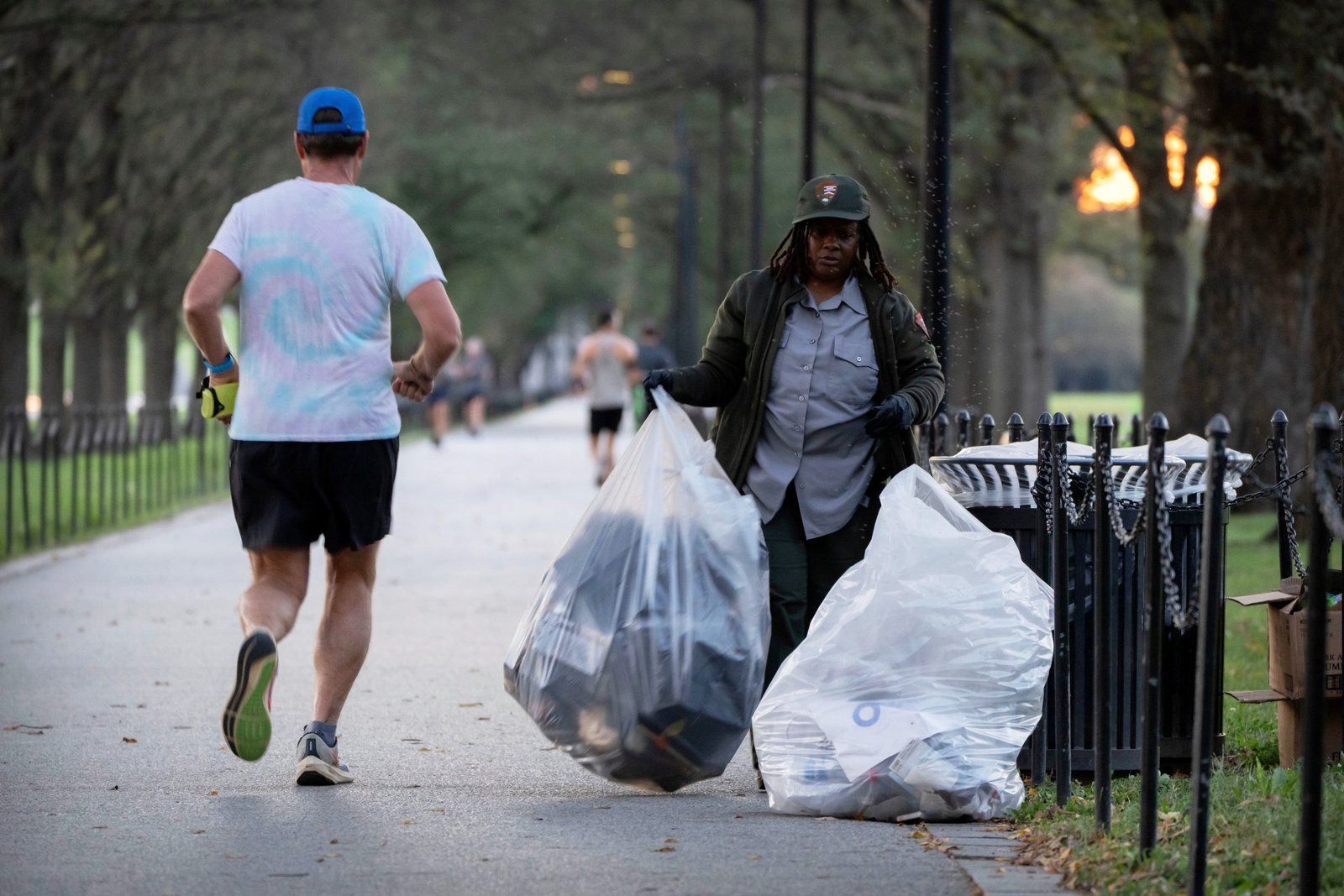
    — The National Park Service plans to furlough about two-thirds of its employees while keeping parks largely open to visitors during the federal shutdown, according to a contingency plan released Tuesday night. The plan says “park roads, lookouts, trails, and open-air memorials will generally remain accessible to visitors.”

    The plan also allows parks to enter into agreements with states, tribes or local governments willing to make donations to keep national park sites open. The park service has more than 400 sites, including large national parks such as Yellowstone and Grand Canyon, national battlefields and historic sites.

    Sites could close if damage is being done to park resources or garbage is building up.

    Many national parks including Yellowstone and Yosemite stayed open during a 35-day shutdown during Trump’s first term. Limited staffing led to vandalism, gates being pried open and other problems including an off-roader mowing down one of the namesake trees at Joshua Tree National Park in California.

    — Smithsonian Institution: Museums, research centers and the National Zoo will remain open through at least Monday.

    Impact on the economy

    Phillip Swagel, director of the Congressional Budget Office, said a short shutdown doesn’t have a huge impact on the economy, especially since federal workers, by law, are paid retroactively. But “if a shutdown continues, then that can give rise to uncertainties about what is the role of government in our society, and what’s the financial impact on all the programs that the government funds.”

    “The impact is not immediate, but over time, there is a negative impact of a shutdown on the economy,” he added.

    Markets haven’t reacted strongly to past shutdowns, according to Goldman Sachs Research. At the close of the three prolonged shutdowns since the early 1990s, equity markets finished flat or up even after dipping initially.

    A governmentwide shutdown would directly reduce growth by around 0.15 percentage points for each week it lasted, or about 0.2 percentage points per week once private-sector effects were included, and growth would rise by the same cumulative amount in the quarter following reopening, writes Alec Phillips, chief U.S. political economist at Goldman Sachs.


    Associated Press writer Ali Swenson, Fatima Hussein, Matthew Brown and Annie Ma contributed to this report.

    The post What happens now that a government shutdown is underway appeared first on MinnPost.

  • Industry, environmental groups spar over state bans on PFAS in cookware; Minnesota is among those with a law

    Industry, environmental groups spar over state bans on PFAS in cookware; Minnesota is among those with a law

    This story was originally published by The New Lede.

    As U.S. states increasingly pass laws to limit PFAS chemicals in consumer products, a debate is heating up over a California bill that proposes banning the sale of cookware with intentionally added “forever chemicals” beginning in 2030.

    The bill, SB 682, would also prohibit the sale of cleaning products, dental floss, food packaging and other products with intentionally added PFAS beginning in January 2028.

    Nonstick cookware is often coated with polytetrafluoroethylene (PTFE), a fluoropolymer also called Teflon and one of thousands of chemicals that belong to the class of per- and polyfluoroalkyl substances (PFAS), some of which have been linked to health impacts including cancers, immune system problems and reproductive issues. PFAS are often called forever chemicals for their persistence in the environment.

    The bill’s supporters argue that PTFE from cookware adds to the flow of forever chemicals in household waste, adding to the costly public burden of treating PFAS-tainted wastewater. Further, they point to recent research on possible reproductive health harms from exposure and suggest ongoing PTFE production continues a decades-long legacy of polluting communities where Teflon is made.

    A coalition of cookware industry leaders, however, is pushing back against similar proposed bans across the country, insists PTFE is safe and warns that California’s food service industry — and beyond — would take a hit if the bill is enacted.

    “It’s way, way more than a nonstick frying pan on top of someone’s stove,” said Steve Burns, the president of the nonprofit Cookware Sustainability Alliance (CSA), which has been actively opposing proposed bans on PFAS in cookware in multiple states. “The way that California’s bill is drafted, it will include every coffeemaker, every Dunkin’ Donuts or 7-Eleven, it will be every walk-in refrigerator.”

    Susan Little, the California legislative director for the Environmental Working Group (EWG), one of the bill’s co-sponsors, said the bill would apply only to cookware sold or distributed after 2030, so those already in homes or restaurants would not be banned, and that the bill targets only the surfaces of cookware. 

    “Inaccessible electronic components of devices, like refrigerators or coffeemakers, are not covered by this law,” she said. 

    If the California bill becomes law, it would send a strong signal to the marketplace nationwide, Little said.

    “Since California has the fourth largest economy in the world, the SB 682 bans will apply to a very large market share of products, and should drive PFAS removal from … products nationwide,” she said. 

    The bill reached Gov. Gavin Newsom’s desk last week. The governor is expected to either sign or veto the bill by Oct. 12, after which it would otherwise simply become law if he chooses not to act.

    Opposition gains momentum

    Almost 100 health and environmental groups are registered supporters of SB 682, including the Natural Resources Defense Council, Breast Cancer Prevention Partners, Clean Water Action and the California Association of Sanitation Agencies, which co-sponsored the bill with EWG.

    Ten groups oppose the bill, including CSA, a partnership between four major cookware companies launched last year that includes the Meyer Corporation, which has a long-standing partnership with celebrity chef and television host Rachael Ray. Other opponents to the California bill include the California Chamber of Commerce, the California Manufacturers and Technology Association and the kitchenware retail company Sur La Table. 

    Rachael Ray, David Chang and other well-known California chefs submitted letters urging the state to reject SB 682.

    “I respect and share the desire to protect Californians and our planet, but I urge you to look closely at the science before moving forward with legislation that could unintentionally do more harm than good,” wrote Ray, arguing that PTFE offers families across the country easy-to-clean cookware for making healthy meals without the need to add extra oils or fats to a pan’s surface.

    Minnesota first to ban PFAS in cookware

    In January 2025, Minnesota became the first state to ban PFAS in cookware, including Teflon, along with PFAS in carpets or rugs, upholstered furniture, tampons and various other products. Colorado and Maine are set to ban PFAS in cookware beginning in January 2026, while Connecticut passed legislation to do the same starting in January 2028. 

    Vermont recently revised a law that would have prohibited PFAS in cookware starting in 2026, pushing back the ban to 2028. Vermont decided to postpone its ban after meeting with CSA, Burns said.

    “Since we started engaging last June, there hasn’t been a single state … that has banned cookware, because people are listening,” Burns said. “Different states are taking a ‘wait and see, let’s be more cautious’ approach.”

    Illinois lawmakers approved a bill last spring that would ban the sale of various products containing PFAS by 2032, ultimately passing the bill with a carveout for cookware and food packaging advocated for by CSA. The bill requires the state’s Environmental Protection Agency to prepare a report on the health and environmental safety of fluoropolymers used in consumer products.

    Last month, a Minnesota federal judge threw out a lawsuit by CSA challenging the state’s ban on PFAS in cookware, which argued the ban discriminates against out-of-state commerce.

    Is PTFE safe?

    The U.S. Food and Drug Administration (FDA) has authorized the use of PTFE in food processing equipment (including nonstick pans) since the 1960s, noting on its website that the process of manufacturing the coating vaporizes “virtually all” the smaller PFAS molecules that would migrate from the cookware. “Studies show negligible amounts of PFAS in this coating can migrate to food,” according to the agency.

    Chemours, a spinoff of the chemical company DuPont and the nonstick coating’s manufacturer, warns on its website not to use Teflon-coated cookware to broil food, which requires heating it to at least 500°F, or to preheat empty nonstick pans at high heat, since the coating can deteriorate. Overheated nonstick pans can release harmful fumes, which can cause “Teflon flu” in those exposed. More than 265 suspected cases of Teflon flu — which causes a fever, chills and headache — were reported in 2023, the highest number since the year 2000. 

    Fumes from nonstick pans also can cause sudden death in pet birds, which have highly sensitive respiratory systems.

    Bits of Teflon pan coatings can also flake off over time from normal wear and tear. According to Chemours, these PTFE flakes are “non-toxic and would pass through the body without being absorbed” if someone accidentally ingested them. But David Andrews, the acting chief science officer for EWG, isn’t so sure.

    “The bulk plastic material will likely largely pass through the body, but it’s a matter of how many small fragments will break off in the body,” Andrews said. “I’ve seen no studies looking at that, specifically.”

    Since some PFAS have been shown to have impacts at very low concentrations, it would not take very much of a byproduct or impurity from a PTFE product to potentially have harmful effects, he added.

    A study published in July raised questions about possible impacts of PTFE exposure on male reproductive health. Researchers analyzed semen and urine samples from 133 men in China, detecting the chemical in almost half of the samples. The authors found a “severe reduction” in sperm count in those exposed to PTFE.

    Protecting communities

    For decades, Teflon was manufactured using the chemical processing aid perfluorooctanoic acid (PFOA), a type of PFAS found in the blood of almost the entire U.S. population and classified by an international cancer research group as “carcinogenic to humans.” Chemours stopped using PFOA in 2015, switching to another type of PFAS processing aid called GenX. In a 2021 health assessment, the EPA concluded that GenX, like the chemical it replaced, is highly toxic at small doses.

    Chemours and DuPont dumped GenX and other PFAS chemicals into the Cape Fear River for decades, leading to a drinking water crisis for hundreds of thousands of people that rely on the river for their water.

    The Biden administration set the first legally enforceable limits on six PFAS in drinking water in 2024, including PFOA and GenX. However, the EPA under the Trump administration announced in May 2025 that the agency intends to roll back limits on some of the chemicals, including GenX. Earlier this month, the EPA announced it would no longer defend the drinking water rule in a lawsuit by the American Water Works Association, filing a motion that requests the court to vacate the rule for some PFAS chemicals in drinking water.

    The ongoing use of nonstick cookware products would likely perpetuate the contamination of communities near facilities that make them, said Rainer Lohmann, the director of a PFAS research center based at the University of Rhode Island.

    “I don’t see manufacturers being able to produce [Teflon pans] without adding contamination to the environment,” Lohmann said.

    PFAS from nonstick pans and other products can also add to the burden of chemicals water systems are faced with treating under the Biden-era limits as they still stand, since the chemicals may ultimately be flushed down the sink, entering the wastewater stream.

    “Acting boldly to turn off the spigot of PFAS in consumer products is the only meaningful and cost-effective way to potentially avoid further PFAS contamination and avert the need for expensive treatment systems,” wrote the Los Angeles County Sanitation Districts in a letter expressing support for SB 682.

    The post Industry, environmental groups spar over state bans on PFAS in cookware; Minnesota is among those with a law appeared first on MinnPost.

  • How a federal government shutdown would affect Minnesotans

    How a federal government shutdown would affect Minnesotans

    WASHINGTON — The nation is barreling toward a government shutdown next week that would disrupt federal services, delay benefits and payments and create economic uncertainty for many Minnesotans.

    The prospects of a shutdown increased Tuesday as President Donald Trump abruptly canceled a meeting he had agreed to with Democratic leaders in Congress who were seeking concessions in return for their support. 

    Trump posted on Truth Social that “after reviewing the details of the unserious and ridiculous demands being made by the Minority Radical Left Democrats in return for their Votes to keep our thriving Country open, I have decided that no meeting with their Congressional Leaders could possibly be productive.”

    A shutdown occurs when Congress fails to pass all 12 annual appropriations bills or pass a temporary “continuing resolution,” or CR, to fund the government by the start of the new federal fiscal year on October 1.

    Since Congress failed to pass any of the appropriations bills and Republicans and Democrats failed to agree on a short-term funding spending bill, a shutdown appeared imminent Tuesday. Unless there is a last-minute deal, all federal workers who are not deemed essential will be furloughed without pay. That would result in delays and disruptions of many services.

    The impact will be felt in Minnesota and all other states. And the disruptions will grow the longer it takes for the federal government to reopen. Here’s how:

    • While air traffic controllers and Transportation Security Administration (TSA) agents are usually deemed essential and continue to work, understaffing can lead to longer lines and travel delays.
    • New applications for Social Security benefits for seniors will not be processed, although payments to existing recipients will continue. Social Security recipients with questions about benefits will find that no one answers their phone calls.
    • Medicare applicants seeking information about benefits under the program also won’t be able to reach anyone.  
    • Minnesota companies with federal contracts — which account for billions of dollars in revenue every year — will find applications for new contracts on hold. Some with existing contracts may find payments have stopped until the federal government reopens.
    • Federal courts would remain open, at least for a while, because they would be funded by court fees. But that revenue would eventually be exhausted and those courts may put off hearing civil cases. 
    • National parks and museums may or may not remain open, but restrooms and other facilities could be closed.
    • Those seeking mortgages backed by the federal government, such as FHA and veteran’s loans, would see delays. So would businesses seeking loans from the Small Business Administration and investors seeking information from the Securities and Exchange Commission and other government agencies that routinely report on the nation’s economy. 
    • Farmers might lack the data they need from the U.S. Department of Agriculture to plan for next year’s planting season or to get technical assistance if Farm Service Agency offices are closed.
    • And Minnesotans living on tribal lands could lack funding needed for health care, law enforcement and other services.

    A political game of chicken

    Perhaps the most severely impacted would be the state’s federal workers, who, if deemed essential, would work with no pay. If not considered essential, they would be furloughed with no pay. According to the state Department of Management and Budget, there were 18,183 federal civilian employees in Minnesota as of Sept. 12.

    Those workers would eventually receive back pay, but for many a shutdown that lasts even just a couple of weeks could hurt their ability to pay mortgages and other bills.  

    Some recent shutdowns have only lasted a day. Others have lasted longer. The last one began at the end of 2018 and lasted 35 days. That shutdown, the longest in history, was a result of a dispute over Pres. Trump’s border wall funding and was considered a partial shutdown because Congress had approved five spending bills.

    Minnesota’s state agencies would also be impacted, especially if the government is shut down for weeks or months.

    Due to concern that the federal government might shutter, Department of Management and Budget spokesman Patrick Hogan said state agencies were asked in early September to provide information about the status of their federal funding.

    Hogan said most agencies already have funds that were appropriated in this fiscal year that would allow them to operate normally for a while.

    “We can withstand a short shutdown,” he said.

    But he said some agencies may be affected right away, although its not yet clear which ones those would be.

    “We’re in the information-gathering stage,” Hogan said.

    There’s a high risk of a shutdown, which would begin one minute after midnight Tuesday, Sept. 30, because Republicans have drafted a stopgap bill without the input of Democrats, who insist that the legislation extend enhanced Affordable Care Act subsidies that are set to expire at the end of the year and perhaps even a reversal of Trump-backed Medicaid cuts.

    The subsidies makes health insurance more affordable for 90,000 Minnesotans who use them to purchase insurance policies through MNsure, the state’s ACA exchange.

    Last week, Speaker Mike Johnson, R-La., managed to get the CR passed through the U.S. House, which, like the U.S. Senate, is controlled by Republicans. 

    But the stopgap measure failed in the Senate, where the GOP needed seven Democratic votes for approval. The only Democrat to vote for the measure was Sen. John Fetterman, D-Pa. 

    The politics of this shutdown have been reversed. It’s usually Democrats who push for a short-term extension of the budget without strings and Republicans who refuse to support a CR without their priorities, which, besides demands for the funding of Trump’s border wall, have also included the reversal of the ACA.

    But this time it’s the GOP, which has been successful in implementing many Trump priorities, including tax cuts, border wall and immigration funding, an increase in military spending and a $5 trillion debt ceiling hike. And it’s Democrats who are demanding concessions.

    Both Republicans and Democrats will blame each other for the shutdown in this political game of chicken.

    The post How a federal government shutdown would affect Minnesotans appeared first on MinnPost.

  • D.C. Memo: Dems insist on health care funding as shutdown looms

    D.C. Memo: Dems insist on health care funding as shutdown looms

    WASHINGTON — The nation inched closer to a government shutdown this week after Democratic leaders in the U.S. House and Senate rejected a stopgap funding proposal released by House Speaker Mike Johnson because the measure does not contain any Democratic priorities.

    If Congress does not pass a funding bill, the government will close down after Sept. 30 when the legislation currently funding the federal government expires.

    But as the clock ticks toward that deadline, there is no agreement on how to avoid the shuttering of the federal government.

    Johnson has scheduled a Friday vote for the stop-gap measure, called a continuing resolution, or CR. But there’s no guarantee it will pass since he can only lose three Republican votes and Democrats are united in opposition.

    Democrats want an extension of subsidies that were boosted during the pandemic to help people purchase health insurance policies under the Affordable Care Act. Those subsidies lowered insurance premiums for 90,000 Minnesotans. But they expire at the end of the year.

    Related: 90,000 Minnesotans face big health insurance premium hikes without congressional action

    They are also seeking other increases in funding for health care, an issue that Democrats plan to run on as they hope to make gains in midterm elections next year.

    “The House Republicans-only spending bill fails to meet the needs of the American people and does nothing to stop the looming healthcare crisis,” said Senate Minority Leader Chuck Schumer and House Minority Leader Hakeem Jeffries in a joint statement.

    Sen. Amy Klobuchar also chided her GOP colleagues.

    “Because the president and Republicans are allowing health care tax credits for working Americans to expire, millions of people are about to be told that their health insurance premiums will increase by hundreds of dollars a month,” Klobuchar said. 

    On Wednesday, Democrats in the U.S. House and Senate introduced legislation that would extend the ACA subsidies and reverse cuts to Medicaid imposed by President Donald Trump’s One Big Beautiful Bill Act.

    The Democratic bill, which isn’t expected to pass, would keep the federal government running until Oct. 1 and limit Trump’s ability to claw back funding that has been appropriated by Congress.

    Meanwhile, Johnson’s short-term funding bill, which would keep the government funded until Nov. 21, does not include an extension of the ACA subsidies or any increase in funding levels, other than providing $88 million to bolster security for lawmakers and federal officials following the assassination of activist Charlie Kirk.

    Although about a dozen Republican House members, most of them in “purple” districts, support extending the ACA subsidies, they are under extreme pressure to vote for Johnson’s continuing resolution.

    If the CR passes the House, the drama will shift to the U.S. Senate, where Republicans would need seven Democratic votes to approve the spending bill. So far only one Democrat — Sen. John Fetterman of Pennsylvania — has said he will buck his party to back the GOP funding bill.

    Schumer enraged Democrats in March, when Congress last voted for a short-term bill to keep the government running that gave Trump more discretion over spending than is allowed under the Constitution.

    But this time Schumer is digging in. And, since Congress and the White House are under GOP control, Schumer said he is confident Democrats will not be blamed for a shutdown of government, citing Trump’s comments during an interview with Fox News that urged fellow Republicans not to “bother dealing” with Democrats.

    St. Paul and ‘hate speech’

    In the aftermath of the assassination of right-wing activist Charlie Kirk, U.S. Attorney General Pam Bondi created a stir this week by targeting “hate speech” with vague threats of prosecution.

    Bondi made a distinction between “hate speech” and “free speech.” But that runs afoul of a landmark U.S. Supreme Court case decided in 1992 that centered on a St. Paul resolution.

    The unanimous decision in R.A.V. v. City of St. Paul made clear that what some might view as “hate speech” is protected by the First Amendment.

    The City of St. Paul had passed an ordinance that made it a crime to display a symbol, object or graffiti that one knew or had reason to know would arouse anger, alarm or resentment based on race, color, creed, religion or gender. 

    Then several teenagers allegedly burned a crudely fashioned cross on a Black family’s lawn.

    Related: D.C. Memo: Kirk shooting ignites partisan rancor in Washington

    The high court held that St. Paul’s ordinance was invalid because it was overly broad and “impermissibly content based” in violation of the First Amendment’s free speech clause.

    The police charged one of the teens under St. Paul’s ordinance. A trial court dismissed the charges. The State Supreme Court reversed that court’s decision and appealed to the U.S. Supreme Court.

    The First Amendment prevents the government from punishing speech and expressive conduct because it disapproves of the ideas expressed, the justices said.

    The opinion, which united conservative and liberal justices, said the government has no authority “to license one side of a debate to fight freestyle while requiring the other to follow the Marquis of Queensbury Rules.”

    After her remarks drew criticism from across the political spectrum, Bondi walked them back.

    She said her intent was “to speak about threats of violence that individuals incite against others.”

    However, in an interview with Fox News, Bondi said the U.S. Justice Department might prosecute Office Depot workers in Michigan for unlawful discrimination because they refused to print posters for a Kirk memorial. One of those workers was fired.

    “Businesses cannot discriminate,” Bondi said. “If you wanna go in and print posters with Charlie’s pictures on them for a vigil, you have to let them do that. We can prosecute you for that,” Bondi said.

    Meanwhile, Rep. Ilhan Omar, D-5th District, was also swept up in the Republican furor over criticism of Kirk when GOP lawmakers, unsuccessfully, tried to censure the progressive Democrat for comments she made about Kirk. 

    In case you missed it:

    –State government reporter Matthew Blake revealed that Minnesota  “appears light years away from passing stricter gun laws.” The reason?  Republicans on a Senate Gun Violence Prevention Working Group made clear that they do not want to work with DFL lawmakers on gun legislation, Blake wrote.

    –Meanwhile, reporter Brian Arola wrote about a new report that determined that — perhaps outside the issue of guns — bipartisanship grew in the closely divided state Legislature this year.

    –And we looked at how Minneapolis Mayor Jacob Frey and St. Paul Mayor Melvin Carter are getting ready in case their cities are targeted for a Trump-led federal incursion like the one threatening other Democratic cities.

    Your questions and comments

    A reader noted that Charlie Kirk’s tragic death has served as a “rallying cry” for the nation’s conservatives.

    “In my limited knowledge of the political stage and its minor actors, I like most Americans knew little of this Kirk. And certainly, he was not (part of the) mainstream media conversation or reporting until this assassination. Kirk was apparently very popular within certain MAGA or conservative circles but was little known otherwise,” the reader wrote. “However, (Kirk’s assassination) serves as not only a distraction from President Trump’s failed policies and Epstein files but as a rallying cry for MAGA to continue its authoritarian agenda with increased vigor and impunity all in the name of retribution and safety. “

    Please keep your comments, and any questions, coming. I’ll try my best to respond. Please contact me at aradelat@minnpost.com.

    The post D.C. Memo: Dems insist on health care funding as shutdown looms appeared first on MinnPost.

  • Frey, Carter prepare for National Guard deployment they hope will not come

    Frey, Carter prepare for National Guard deployment they hope will not come


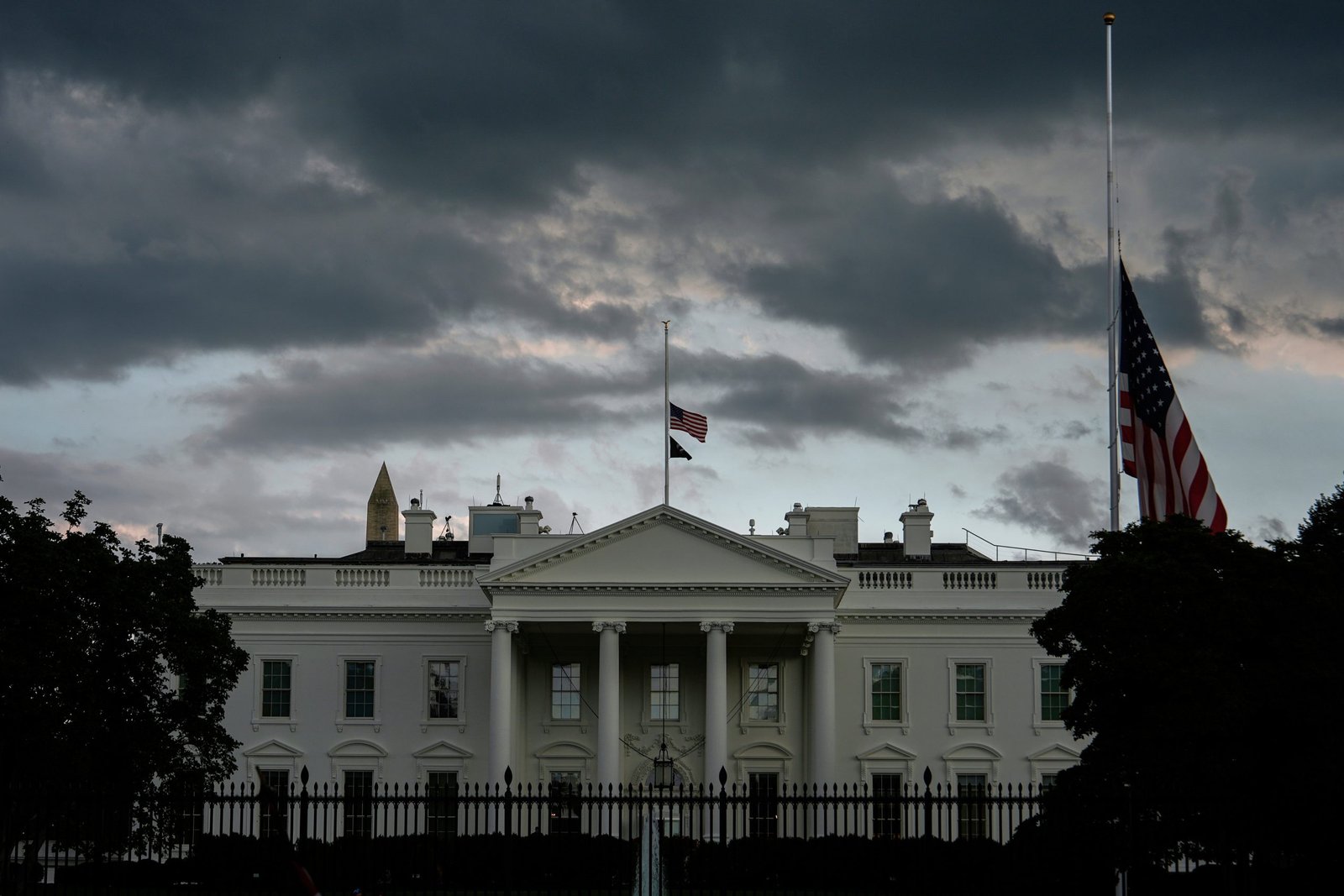
    Three people in uniform walk along a sidewalk. Behind them a row of half-staff American flags wave in the breeze.

    WASHINGTON – Minneapolis Mayor Jacob Frey says the city is ready with legal and emergency response plans in the event that President Donald Trump tries to deploy the National Guard in the city. 

    “You have to be prepared,” Frey told MinnPost in an interview, calling Trump’s recent military interventions in U.S. cities a dangerous “game.”

    St. Paul Mayor Melvin Carter is also steeling for the possibility of a federal incursion. 

    “Sending National Guard troops to occupy American cities oversteps federal authority, undermines local control and turns our military into a political prop,” Carter said in a statement.

    Trump has said he’s preparing to send National Guard troops into Democrat-run cities because of what he says is out-of-control crime. He’s described Baltimore and Chicago as “hellholes” and also called out New Orleans, New York and Philadelphia, among others.

    The president has not specifically mentioned Minneapolis, but a rash of gun violence — including the Aug. 27 mass shooting at Annunciation Catholic School and a mass shooting at a homeless encampment this week — has stoked public fears and speculation that the city may be on the president’s list.

    Frey said his office is coordinating with those of Mayor Carter and Minnesota Gov. Tim Walz on potential responses, and that he is also involved in a text chain organized by the Democratic Mayors Association, which has held strategy calls. He said he’s prepared to fight a federal incursion in the courts and would use the city’s emergency management department to keep residents informed and coordinate city departments.

    If Trump really wanted to address crime and homelessness, Frey said the president would take steps to address the roots of the problem, like increasing federal funding for public housing and local police. “Instead, he is abusing his power and spreading disinformation about Minneapolis,” Frey said.

    The risk of an unwanted National Guard deployment is buffered by the state’s Democratic Gov. Walz. The president can only call up the National Guard without a state’s consent under narrow legal circumstances. Trump has yet to follow through on threats to send the National Guard to Chicago amid opposition from Illinois’ Democratic Gov. JB Pritzker. 

    On Monday, Trump signed an executive order creating and authorizing the use of the National Guard to crack down on crime in Memphis, a city with a Democratic mayor under a Republican governor, who unlike Pritzker has been receptive to Trump’s requests.

    Memphis’ Democratic Mayor Paul Young says he didn’t ask for Trump’s intervention but that he will “work strategically” to align the National Guard with local policing priorities. 

    People clap surrounding a man sitting at a large desk holding up two pieces of paper.
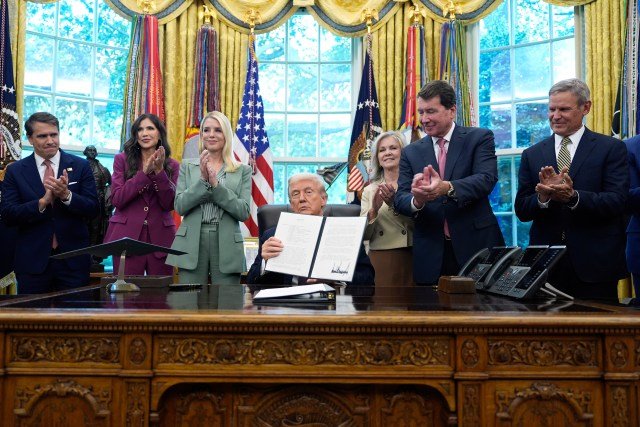
    President Donald Trump holds a signed memorandum titled “Restoring Law and Order in Memphis” as, from left, Deputy Attorney General Todd Blanche, Homeland Security Secretary Kristi Noem, Attorney General Pam Bondi, Sen. Marsha Blackburn, R-Tenn., Sen. Bill Hagerty, R-Tenn., and Tennessee Gov. Bill Lee look on in the Oval Office of the White House, Monday, Sept. 15, 2025, in Washington. Credit: Alex Brandon / AP

    Trump faces more resistance elsewhere. Washington, D.C., Attorney General Brian Schwalb has sued, arguing Trump’s takeover of the U.S. capital is an illegal “military occupation” that violates the city’s self-governance under the Home Rule Act.

    But it is the Home Rule Act – which gives Congress control of the city’s budget and authority to review legislation — that the  Trump administration cited for its takeover of the D.C. police department because it allows for temporary federal control of the city in emergency situations. 

    Frey said an attempt to take over the police in Minneapolis would be “a “blatant, illegal usurpation of legal control.”

    “The police report to me,” he said.

    Frey also said he’s not opposed to federal help to solve Minneapolis’ problems. “But I’m opposed to federal chaos,” he said. “We are responsible for fighting crime.” 

    Carter cited declining crime rates in St. Paul, saying homicides in the city have decreased by 50% and assaults have fallen by 30% this year. He also said partnerships between state and local government have been effective at reducing violent crime.

    “If the president wants a serious conversation about public safety, local communities like ours stand ready to show the way,” Carter said.  

    The legal and political risks

    Democrats’ opposition is not without political risk. With tough talk about violent crime an election issue, Trump said he would usher in GOP victories in next year’s midterms. The president has made Democratic mayors who protest his actions vulnerable to charges that they are soft on crime.

    Trump’s militarized response to crime faced a setback this month when a federal judge ruled his sending of the National Guard to Los Angeles in June — ostensibly to protect federal buildings and employees from street protests amid an immigration crack down — was illegal.

    That ruling may be an impediment to plans Trump may have for sending troops to cities in blue states, including Chicago and the Twin Cities. But the ruling is paused pending an appeal by the federal government. Trump continues to draft plans to send federal troops into Chicago and other cities despite the judge’s ruling. 

    The National Guard deployments in Los Angeles and Washington, D.C., happened alongside a surge of other federal forces, including agents from the FBI, Immigration and Customs Enforcement (ICE), and the Bureau of Alcohol, Tobacco, Firearms & Explosives. The result was an escalation of immigrant detentions.

    The federal court ruling from Los Angeles doesn’t affect the federal government’s authority over enforcement of immigration law. So, the president could deploy federal forces to “blue” cities to crack down on immigration, as he did last week to Boston. The White House simultaneously sued Boston officials over alleged interference with federal efforts.

    Frey, who is in a tough race for reelection, indicated that the Minneapolis Police Department won’t be involved in efforts to detain immigrants (though he faces questions and criticism over the police role in a high-profile June 3 search of a South Minneapolis restaurant).

    “I don’t want our officers to spend a single second picking up a father who is dropping off his kids at day care after going to work a 12-hour shift,” the mayor said.

    Frey said residents of Minneapolis would reject a federal presence.

    “Our community here in Minneapolis does not trust the Trump administration,” he said.

    The post Frey, Carter prepare for National Guard deployment they hope will not come appeared first on MinnPost.
  • Omar escapes House censure over comments about Charlie Kirk

    Omar escapes House censure over comments about Charlie Kirk

    WASHINGTON — Rep. Ilhan Omar narrowly avoided censure late Wednesday as she fell victim to an aggressive GOP campaign that seeks to punish those who criticize hard-right activist Charlie Kirk, the victim of an assassination last week.

    The U.S. House rejected a measure on a 214-213 vote that would have stripped Omar of her committee assignments because of comments she made soon after Kirk was fatally shot at Utah Valley University last week.

    Four Republicans joined all Democrats in rejecting the effort to censure Omar, so the 5th District Democrat will continue to sit on the Education and Workforce Committee and the Budget Committee. Those four Republicans were Reps. Mike Flood, R-Neb.; Tom McClintock, R-Calif.; Jeff Hurd, R-Colo.; and Cory Mills, R-Fla.

    “Thank you to my colleagues for having my back and not furthering lies on the House floor,” Omar posted on X after the vote. “Appreciate them safeguarding first amendment protections and the usage of the censure.”

    Omar’s troubles began because of an interview with British broadcaster Mehdi Hasan the day after Kirk’s shooting. In that interview, Omar was empathetic  and said the assassination was “mortifying.”

    “All I could think about was his wife, his children,” Omar said. “My heart does break for those babies.”

    But Omar also criticized those who said Kirk was a champion of civil debate, saying Kirk’s divisive comments about gun violence, slavery and the killing of George Floyd “belie this.”

    That was enough for Rep. Nancy Mace, R-South Carolina, who is running for governor. She sponsored the censure resolution and called Omar’s comments “vile” and “disgraceful.” Omar argued Mace was trying to censure her for comments she never said.

    Mace’s resolution also condemned Omar’s reposting of videos and other social media comments about Kirk. Most of those posts criticized those who condemned political violence while having been supporters and propagators of Kirk’s divisive comments. One anonymous post called Kirk a “reprehensible human being.”

    Things deteriorated quickly as Omar was at the center of a heated debate about free speech and Kirk. 

    In an online fight on X, Omar called Mace “crazy” and accused her of pushing “a false story so she can fundraise and boost her run for governor.”

    Mace, in turn, called for Omar’s deportation to the nation of her birth, Somalia. And her effort caught the attention of President Donald Trump, who called Omar a “disgusting person” because of her criticisms of Kirk.

    Meanwhile, Rep. Angie Craig, D-2nd District, slapped back at Mace with a post on X that said “this attack on our colleague @illhan does nothing to turn down the temperature in our politics at a time when we desperately need it. It’s time to stop playing political games… .”

    Related: House votes to oust Rep. Ilhan Omar from Foreign Affairs Committee

    The attempt to censure Omar is part of an effort by Republican lawmakers, Kirk’s hard-right supporters and even Vice President JD Vance to punish those who have criticized Kirk after his death. 

    Some make little distinction between those who condemned the assassination but are critical of Kirk and those who are jubilant about Kirk’s death, accusing all of supporting political violence.

    Rep. Derrick Van Orden, R-Wisconsin, has introduced a bill that would block federal funds to entities that employ people “who condone and employ political violence”; other GOP lawmakers want to form a new House committee devoted to investigating “the radical left’s assault on the rule of law.”

    And when he guest-hosted an episode of the Charlie Kirk Show this week, Vance said people who celebrated Kirk’s killing should be held accountable. “Call them out, and hell, call their employer,” Vance said.

    An increasing number of people, including a journalist and a doctor as well as teachers and government employees, have been suspended or fired for comments that were deemed inappropriate about Kirk’s death. And Long Island, New York, tabloid Newsday was forced to apologize for running a syndicated political cartoon that Kirk supporters deemed offensive.  

    While Omar escaped punishment Wednesday, she has been censured before. She lost her seat on the House Foreign Affairs Committee in 2023 after the U.S. House voted along party lines on a GOP resolution that accused the lawmaker of antisemitic remarks.

    The post Omar escapes House censure over comments about Charlie Kirk appeared first on MinnPost.

  • 90,000 Minnesotans face big health insurance premium hikes without congressional action

    90,000 Minnesotans face big health insurance premium hikes without congressional action

    WASHINGTON — For 90,000 Minnesotans, the Affordable Care Act may soon become unaffordable.

    That’s because a COVID-era policy by the Biden administration that has lowered the cost of an insurance policy in the ACA marketplace, called MNsure in Minnesota, will end on Dec. 31 unless Congress acts.

    The ACA helps people pay insurance premiums on a sliding scale according to their income. The subsidies, or tax credits, were boosted and extended to higher-income people in 2021 through the American Rescue Plan. 

    That made health insurance effectively free for many Americans close to the poverty line and offered new financial assistance to individuals earning about $60,000 and a family of four with an income of more than $128,600 in 2025.

    The Kaiser Family Foundation estimates that an end to the enhanced credits would result in huge increases in premiums for enrollees, especially those in rural areas, and about 4 million more Americans being uninsured.

    Most Minnesotans get their health care coverage through their employers or through government plans like Medicare and Medicaid.

    But more than 167,000 Minnesota obtained private health care coverage through MNsure this year, mostly students, younger retirees, contractors and the self-employed, including farmers. A majority of those those enrollees — 90,000 — benefited from the Biden-era enhanced subsidies.

    “I’m sure there’s going to be a lot of resentment,” said Anthony Wilkerson, a broker who helps people enroll in MNsure, if Congress fails to extend the program. Wilkerson also said that “if that (federal help) is not there, it’s going to cause a lot of pain.”

    MNsure Chief Executive Officer Libby Caulum warned of what many are calling a “premium cliff.”

    “If Congress doesn’t act quickly, farmers, small-business owners and other Minnesotans who get federal tax credits through MNsure will see their monthly premiums go up by 54%, on average, and over 19,500 will lose access to all financial help next year,” Caulum said.

    The upheaval and “hard choices” would begin when Minnesotans begin to consider their 2026 coverage options in November, she said. “Some could decide to drop coverage, with negative impacts for their personal health and for Minnesota’s first-class health care system,” Caulum said.

    Yet voting to extend the program, at a cost of more than $30 billion a year, is difficult for Republicans who have opposed the ACA and the American Rescue Plan that created the enhanced subsidies.

    They now say the enhanced tax credits were needed to help people get health coverage during the pandemic and are not needed anymore.  

    Still, a group of vulnerable Republicans in “purple” districts are nervous about the end of the subsidies and have sponsored legislation to extend them, at least temporarily.

    According to Politico, Republicans on the Ways and Means Committee — a panel that has jurisdiction over the ACA credits and whose members include Rep. Michelle Fischbach, R-7th District — had a “tense” meeting last Wednesday over the politically divisive issue.

    Democrats may insist that an extension of the credits be part of a short-term budget bill that would avert a federal government shutdown after Sept. 30.

    “Republicans have to come to meet with us in a true bipartisan negotiation to satisfy the American people’s needs on health care or they won’t get our votes, plain and simple,” Senate Minority Leader Chuck Schumer warned at a press conference last week.

    ‘Catastrophic damage’

    Rep. Kelly Morrison, D-3rd District, an OB-GYN, has, with other Democratic lawmakers who are doctors, pressed for the extension of the enhanced ACA credits. “We are set to face enormous increases in health insurance premiums for tens of millions of Americans,” she said.

    Morrison said the One Big Beautiful Bill Act that set President Donald Trump’s legislative agenda has already “ripped health care away for millions of Americans” through its cuts to Medicaid.

    “Now they are threatening even further catastrophic damage by raising health insurance premiums for tens of millions of Americans,” she said.

    The OBBB also banned DACA recipients – immigrant youth who have been given temporary protection from deportation and work authorization through the Deferred Action for Childhood Arrivals program — from purchasing insurance in the ACA marketplace and shortened the ACA’s annual enrollment period.

    Those changes, and others, including new restrictions that will end the ACA’s financial help for lawfully present immigrants, will mean that more than 62,000 Minnesotans — or about 45% of MNsure enrollees — will drop their private health plan coverage,” Caulum said.

    Rep. Angie Craig, D-2nd District, was part of a news conference held by Democrats at the U.S. Capitol last week to introduce a bill that would reverse the OBBB’s health care cuts and extend the ACA credits. That legislation has slim chances of passing, but advances the Democratic aim of making health care an issue in next year’s midterm elections.

    “By slashing Medicaid and allowing the Affordable Care Act tax credits to expire, congressional Republicans have moved to rip health care away from 17 million Americans in order to fund massive tax breaks for billionaires and wealthy corporations,” said Craig, who is running for the U.S. Senate.

    The Kaiser Family Foundation identified those who would be most affected by the “premium cliff.”

    A KFF analysis said that, nationally, about 51% of the higher-income enrollees (measured as income that’s four times the federal poverty level, or about $62,600) who would lose assistance are between the ages of 50-64, a group that is faced with the highest health insurance rates.

    And KFF said that based on 2025 premiums, a 60-year-old couple earning $85,000 annually (416% of the federal poverty level in the contiguous 48 states) would see their monthly premium payments increase by $1,507 a month, or more than $18,000 a year.

    Self-employed individuals would also be hard hit, with about 38% of them losing their ACA subsidy eligibility, the KFF study said. 

    The post 90,000 Minnesotans face big health insurance premium hikes without congressional action appeared first on MinnPost.

  • D.C. Memo: Kirk shooting ignites partisan rancor in Washington

    D.C. Memo: Kirk shooting ignites partisan rancor in Washington

    WASHINGTON — The nation’s capital reeled this week following the death of Charlie Kirk, which unleashed a partisan clash over the shooting of the conservative activist.

    Kirk, 31, headlined a well-attended event at an outdoor mall at Utah Valley University on Wednesday when he was felled by a single shot, apparently from the roof of a nearby building. Friday morning, Utah authorities and the FBI announced that a suspect was in custody — 22-year-old Tyler Robinson.

    According to videos and accountings of the scene, Kirk was answering a question from the audience that referenced mass shootings involving transgender people when the shot rang out.

    That exchange came two weeks after the shooting at Annunciation Catholic Church by Robin Westman, whose mother said in court documents identified as female.

    “Do you know how many transgender Americans have been mass shooters over the last 10 years?” an audience member asked.

    “Too many,” Kirk replied.

    The questioner then said there had been five in 10 years and asked Kirk how many mass shooters there had been in the last decade.

    “Counting or not counting gang violence?” Kirk replied as the shot that felled him rang out.

    Kirk’s death shocked the nation’s lawmakers, but it was seen through a partisan prism.

    When House Speaker Mike Johnson asked for a moment of silence on Wednesday, the entire U.S. House obliged.

    But afterward, the chamber erupted into a fracas.

    Rep. Lauren Boebert, R-Colorado, called out that there should be a public prayer for Kirk. “I believe silent prayers get silent results,” she said.

    Democrats jeered loudly. Some noted that congressional Republicans had all but ignored a school shooting in Colorado earlier that day. Others called out for Congress to pass stricter gun laws.

    As a huge wave of political violence has been unleashed across the nation, so has the partisan finger pointing.

    Rep. Nancy Mace, R-S.C., told reporters, “Democrats own what happened today.”

    And President Donald Trump blamed “the radical left” for Kirk’s assassination.

    “For years, those on the radical left have compared wonderful Americans like Charlie to Nazis and the world’s worst mass murderers and criminals,” Trump said in a video posted on Truth Social. “This kind of rhetoric is directly responsible for the terrorism that we’re seeing in our country today, and it must stop right now. My administration will find each and every one of those who contributed to this atrocity, and to other political violence — including the organizations that fund it and support it.”

    Meanwhile, Democrats pointed to violence perpetrated by right-wing extremists, including the shooting in Minnesota of state Rep. Melissa Hortman and state Sen. John Hoffman, both Democrats. They decried Trump’s order to fly flags at half-staff for Kirk, but not Hortman, who unlike Hoffman did not survive the shooting.

    Minnesota’s House members steered clear of the vitriol. The state’s Republican lawmakers called for prayers.

    “Let’s not allow evil to win by letting his work die with him, but instead pray that those who have heard him will use their faith and reason to be beacons of hope, common sense, and courage … out of darkness will come light,” Rep. Brad Finstad of the 1st District posted on X.

    And Minnesota’s Democratic lawmakers condemned the escalating political violence and asked the nation to come together.

    “We must come together as a nation and condemn any and all political violence,” Rep. Angie Craig, D-2nd District, said in her post on X. “It is going to take all of us to begin to change the tone of our political discourse and bring civility back to our nation.”

    Another government shutdown threat

    It’s brinksmanship time again as Congress faces a Sept. 30 deadline to pass a spending package to avoid a federal government shutdown.

    Chances of a shutdown grew this week as House Minority Leader Hakeem Jeffries, D-N.Y., said Wednesday that House Democrats are likely to reject a short-term bill that would keep spending at current levels.

    Democrats are not opposed to a stopgap measure, known as a continuing resolution or CR. 

    But Senate Majority Leader Chuck Schumer, D-N.Y., echoed Jeffries in saying the legislation must contain some Democratic priorities — including perhaps an extension of a boost in Affordable Care Act subsidies that will end without congressional action at the end of the year.

    Schumer was vilified by liberals in the Democratic base for helping the GOP pass an earlier spending bill without any concessions.

    The shutdown blame game has already begun, with House Speaker Mike Johnson, R-La., accusing Democrats of “beginning to apply their government shutdown pressure” and “rejecting commonsense solutions to fund the government.”

    Not so fast, say Democrats, pointing out that the GOP has control of the White House and both chambers of Congress and shouldn’t need Democratic support to pass a budget.

    “I hope there isn’t a shutdown and there shouldn’t be a shutdown,” said Rep. Betty McCollum, D-4th District, a senior member of the House Appropriations Committee.

    But she said this about her Republican colleagues if there is a shutdown: “They own it.”

    A ‘nuclear’ strike in the U.S. Senate 

    Daniel Rosen, President Donald Trump’s choice to be the new U.S. attorney in Minnesota, was nominated in May and has waited a long time for the U.S. Senate to confirm him.

    But he may not have to wait much longer.

    House Majority Leader John Thune took the first steps this week to change U.S. Senate rules to expedite votes on nominees, excepting Cabinet officials and those with lifetime judicial appointments.

    Rosen’s candidacy was approved by the Senate Judiciary Committee on a bipartisan basis in July. But Senate Democrats have insisted on adhering to rules that draw out the confirmation process, creating a backlog of nominees and many unfilled positions in the Trump administration.

    So Thune planned a vote Thursday to allow slates of nominees to be confirmed in a single vote by a simple majority.

    A partisan rules change like that is considered a “nuclear option” since it threatens to disrupt the Senate.  

    Biden-appointee U.S. Attorney Andrew Luger resigned about a week before Trump returned to the White House this year. So until Rosen is confirmed, the job has fallen on acting U.S. Attorney Joe Thompson, who has had to handle the shootings of state Rep. Melissa Hortman and state Sen. John Hoffman and their spouses, and the shooting at Annunciation Catholic Church.

    Rep. Tom Emmer, R-6th District, who recommended Rosen’s candidacy to the White House, blamed the Senate Democrats’ slow-down policy for impeding the federal investigations in Minnesota. 

    “It hasn’t even been two weeks since the Annunciation shooting and Senate Dems are blocking the confirmation of Daniel Rosen, the nominee for U.S. Attorney for Minnesota,” Emmer posted on X. “Senate Dems must STOP playing political games with these nonpartisan positions! Law and order should never be a partisan issue.”

    In case you missed it

    – Even as Health and Human Services Secretary Robert F. Kennedy restricts the availability of COVID vaccines, they continue to be widely available in Minnesota, writes reporter Shadi Bushra.  

    – State government reporter Matthew Blake profiled Rep. Zack Stephenson, DFL-Coon Rapids, and his rise to lead the DFL in the state House.

    – Nicole Hockley, the mother of a six-year old victim of the Sandy Hook Elementary School shooting, spoke with MinnPost about long-term trauma and the advice Sandy Hook victims are offering Minnesota lawmakers to prevent another tragedy.

    Please keep your comments, and any questions, coming. I’ll try my best to respond. Please contact me at aradelat@minnpost.com.

    The post D.C. Memo: Kirk shooting ignites partisan rancor in Washington appeared first on MinnPost.

  • Sandy Hook parents offer community support, policy advice after Annunciation shooting

    Sandy Hook parents offer community support, policy advice after Annunciation shooting


    several portraits of a murdered six year old

    WASHINGTON — Nicole Hockley’s 6-year-old son Dylan was one of 20 first graders killed in the Sandy Hook Elementary School shooting that horrified the nation and ushered in the grim realization that America’s children might not be safe in their classrooms.  

    Hockley and other Sandy Hook parents turned their grief into activism to try to prevent the violence that claimed the lives of their loved ones. Hockley helped establish and is the CEO of Sandy Hook Promise, which breathed life into a movement spearheaded by victims of gun violence. The organization not only seeks to strengthen gun regulations, but it also lobbies for effective school safety policies and mental health and crisis intervention resources.

    There have been dozens of school shootings since that massacre in Newtown, Conn., which also claimed the lives of six adults. They have occurred most notably in Parkland, Florida; Uvalde and Santa Fe, Texas; and Oxford Township, Michigan. But Hockley said Sandy Hook Promise policies have prevented other shootings and saved the lives of many people contemplating suicide.

    Hockley, who provides support for the families of shooting victims, has already spoken with a parent of one of the victims of the Annunciation Catholic Church shooting in Minneapolis and her team at Sandy Hook Promise is in contact with state legislators who will consider new gun and school safety measures at a special session called by Gov. Tim Walz, who has said he wants an assault weapons ban.

    Hockley spoke to MinnPost about the steps Minnesota could take in the wake of the Annunciation shooting and the long-term impact of a school shooting on a community. The following conversation has been edited for length and clarity:

    MinnPost: Did you know what you were getting into when you became a gun safety advocate?

    Nicole Hockley: I am very honest when I speak to parents in other school shootings or mass shootings across the country, including Minnesota two weeks ago, that when I first helped launch this I did not know what I wanted Sandy Hook Promise to be or what exactly we were going to do. I just know that if you want to advocate for change, this is something that you can do.

    Then it became a lesson for me. We started off down in D.C., advocating for [expanded FBI] background checks because everyone was saying that that was the thing to do at that point. And then when that failed four or five months after the shooting, in April 2013, that could have been a moment when we said “this is too frustrating, change isn’t going to happen.” But instead we decided to think differently because there is always more than one way to solve a problem.

    MP: And what were those other ways?

    NH: We really focused on the causes of violence and prevention and the long pathway that someone could take, including giving off signs before they commit an act of violence. So we developed our program and our policy approach. We began in 2014, and since then Sandy Hook Promise has grown at a phenomenal rate in terms of programs in schools across the country. We teach young people and adults around them how to recognize the signs of someone who might be at risk of hurting themselves or someone else, and how to say something and how to create connection – because disconnection is how this pathway to violence starts.

    MP: But you try to change laws too, don’t you?

    NH: We advocate for policy on a state and federal level. We write model legislation. And we passed our model legislation under three presidents and in numerous states across the country that are mandating access to mental health, support for school safety, support for gun safety.

    Women with blonde hair wearing a pink suite.
    Nicole Hockley Credit: Courtesy of Sandy Hook Promise

    MP: And you have been in touch with the parent of a victim in the Annunciation shooting?

    NH: We rarely reach out, knowing what it’s like right after a shooting, and how you know people and groups will be crawling all over you. We often wait to be reached out to. So there have been instances such as Uvalde, where I think I waited about six months before I reached out to any of the parents there. [Sandy Hook parent] Mark [Barden] and I have both spoken to one of the parents who reached out to us a few days after the [Annunciation] shooting. We’re just there as a resource as families find their way forward. In these early days, it’s just about listening and being there for someone without any expectations.

    MP: Gov. Walz wants to convene a special session of the Legislature to deal with the shooting. Is Sandy Hook Promise suggesting anything?

    NH: I can’t share the details because we’re still formulating our plans and are in early discussions with different legislators, but everyone wants to do something, which is great. So we’re going to, as we always do, give our best advice and support on what would be meaningful and what could be implemented in a way that would help prevent these types of shootings.

    For example, Minnesota has an extreme risk protection order on the books already. Considering how many signs the Annunciation shooter gave off, there could have been an opportunity for that extreme risk protection order to be enacted so that the shooter was separated from firearms, or access to firearms. What we don’t know yet is how many Minnesotans know that the state has an extreme risk protection order (red flag) law and how it works, so that if they see the signs, they know how to report it in a lawful way. So it could be as simple as creating more education and awareness.

    MP: Some Minnesota lawmakers want to make sure there are school resource officers at every school.

    NH: School resource officers are perfect for creating relationships with students, but not for punitive measures. The Annunciation school shooter shot from outside the building, right? So, it’s hard to know how an SRO would have helped. Same with the Sandy Hook shooter. He shot his way into the school, you know, he shot his way through the locked doors. And some people say, if an SRO had been there, they would have been able to stop him. Others say [the SRO] would have been the first person shot. Or you’ve also seen, in places like Uvalde, the SROs were completely ineffective and ran away from the shooting rather than going towards it.

    It’s a mixed bag… So I don’t have an opinion either way on SROs. I think it all depends on the circumstance. They can be a deterrent, but they’re not going to prevent violence.

    MP: What else could be done?

    NH: Basic prevention training in schools so that youth and adults know how to recognize signs and then report them, either through something like a red flag law or through an anonymous reporting system. That’s important, because people need to be able to recognize signs and know what to do when you see them. That’s what we do every single day.

    There are also opportunities for secure storage laws because we know, unfortunately, most school shootings involve guns within the home. I know that this shooter had obtained guns legally. That’s not always the case. It’s quite often a younger shooter who takes the guns from their home where their parents have not securely stored them. So secure storage is also an option. But I think as we learn more about the case itself, and what legislators are thinking, we’ll be able to help them craft appropriate legislation.

    MP: It’s been a tough path for you and the others at Sandy Hook Promise, Mark Barden and Bill Sherlach, whose wife Mary died holding Dylan in her arms. (Mary Sherlach was the school’s psychologist.)

    NH: Advocacy is a very difficult life to choose. I’m very upfront about that. It’s around 13 years after Sandy Hook and it’s exhausting to constantly retraumatize yourself. It’s exhausting to continue to fight for something that is so sensible and normal – keeping kids safe – and still to have barriers.

    But there’s a lot of success. We have passed so many laws, we have accelerated a new movement. And we have saved a lot of lives. Over a thousand imminent suicides have been stopped because of our training so far. At last count there were 18 validated school shootings that did not happen because of our training and our reporting system. So we know what works and that’s what keeps me going. But that is a difficult choice to make, especially when you are grieving and still traumatized.

    MP: You also said a school shooting also leaves a community traumatized.

    NH: This is a long journey. Almost 13 years out, we are still dealing with the aftereffects, the mental health issues, support needed for young people, the support needed for first responders, the support needed for families. The ripple effects of trauma are huge and everlasting.

    So I think the community is going to need a lot of support, a lot of grace as they get through this, because this is incredibly difficult. And you just can’t understand how hard it is until you’ve experienced something like that, and how fracturing it can be within a community as well. Whatever works for you, give yourself compassion, model compassion to others, and also know that there’s no getting over this, but there is going to be a pathway through it and everyone is going to find their own way.

    The post Sandy Hook parents offer community support, policy advice after Annunciation shooting appeared first on MinnPost.

  • D.C. Memo: Congress is back — so is the Epstein saga

    D.C. Memo: Congress is back — so is the Epstein saga

    WASHINGTON – Congress returned from its summer recess this week and lawmakers immediately resumed their fight over how best to comply with public demands for more information about Jeffrey Epstein.

    Democrats lined up to sign a “discharge petition” sponsored by Reps. Thomas Massie, R-Ky., and Ro Khanna, D-Calif., that would force the consideration of a bill mandating the release of all files in the case of the disgraced financier and convicted sex offender.

    Minnesota’s Republican lawmakers have not signed the petition, which, thanks to the support of three House Republicans, is just two votes shy of the 218 needed to compel a vote on the House floor.

    Rep. Pete Stauber, R-8th District, said he backed the efforts of the Trump administration and GOP congressional leaders instead.

    Stauber said he wants “maximum transparency” in the Epstein case.

    He and all other Minnesota Republicans voted late Wednesday on a symbolic measure that would affirm the GOP-led House Oversight Committee’s investigation into the matter.

    House GOP leaders have touted that investigation as a better alternative to the discharge petition, which would compel the release of materials in the Epstein case within 30 days.

    Stauber said that investigation is “much more aggressive” than what the discharge petition would uncover, since the committee has a “timeline and subpoena powers.”

    On Tuesday, the Oversight Committee released the first files it had received from the Justice Department on the sex trafficking investigations into Epstein and Ghislaine Maxwell, a former girlfriend of Epstein’s who was convicted of sex trafficking and other crimes. But the files mostly contained information that was already publicly known.

    A group of Epstein accusers who told harrowing tales of abuse at a news conference Wednesday at the U.S. Capitol disagreed with Stauber and the majority of House Republicans who prefer that the Oversight Committee handle the issues. 

    They pressed lawmakers to sign the discharge petition, saying it would result in the most complete release of information.

    “Let the public know the truth,” said accuser Chauntae Davies. “We cannot heal without justice. We cannot protect the future if we refuse to confront the past.”

    Jena-Lisa Jones said that after her encounter with Epstein, she cried “the entire way home, thinking about how I couldn’t ever tell anyone about what actually happened in that house.”

    “This guy was so rich and had so many pictures with so many famous people and no one would have ever believed me if I told them,” Jones said.

    Minnesota’s Democratic lawmakers have signed the discharge petition.

    “It feels like there’s a cover up,” said Rep. Betty McCollum, D-4th District, referring to what she said was insufficient material released by the Justice Department.

    In a post Tuesday on social media, Rep. Angie Craig, D-2nd District, said “President Trump called Jeffrey Epstein’s abuse of women a ‘hoax.’ My message to him: these survivors are real, and I will not let them be silenced. Today, I signed on to (the discharge petition).”

    Calling it a “hostile act,” the White House has pressured GOP lawmakers who said they might sign the discharge petition.

    And on Thursday, House Speaker Mike Johnson, R-La., said the effort to force a House vote compelling the release of Epstein-related documents won’t succeed because it will lack the support of enough Republican lawmakers.

    During Congress’ August recess, Trump asked the Justice Department to interview Maxwell, who is serving a 20-year prison sentence. Justice Department transcripts of that interview show that Maxwell, who was subsequently transferred to a low-security prison, said she knew nothing of Epstein’s sex trafficking yet was sure Trump was not involved in any untoward activity.

    Smith scorches RFK, Jr. 

    Sen. Tina Smith tussled with Department of Health and Human Services Secretary Robert F. Kennedy Jr., during a rough-and-tumble Senate hearing Thursday.

    “You have led the charge in the Trump administration to destroy what is best in the U.S. health care system,” Smith told Kennedy.

    The Democratic senator also told Kennedy that he is “trafficking in fringe ideas, discredited ideas” and “seems willing to say anything in the moment even if it’s untrue.”

    Kennedy was the sole witness at the hearing before the Senate Finance Committee, of which Smith is a member.

    The hearing was convened following upheaval at the Centers for Disease Control and Prevention and frustration with his policies toward vaccines.

    Smith said Kennedy claimed to not to be “anti-vax,” yet also said no vaccine was safe. Smith said “that sounds anti-vax to me.”

    “When were you lying?” Smith asked.

    “Both things are true,” Kennedy responded.

    During an interview with Fox News after the Annunciation Catholic Church shooting last week, Kennedy was asked if he would look into the pharmaceuticals shooter Robin Westman may have been using.

    He said he was interested in “the potential contribution of some of the (antidepressant) drugs and some of the other psychiatric drugs that might be contributing to violence.”

    Kennedy also said the “black box” warning on many psychiatric drugs, which include antidepressants, warn of “suicidal and homicidal ideation.”

    Smith, who has been candid about her experience with depression as a college student and a young mother, excoriated Kennedy for blaming  school shootings on antidepressants.

    Kennedy denied saying that. “You are just making stuff up,” he said.

    The White House last month fired Susan Monarez as director of the CDC after she refused to resign amid pressure to change vaccine policy. That sparked the resignation of other senior CDC officials.

    At Thursday’s hearing, Kennedy claimed that he asked Monarez to resign because she admitted she was not “trustworthy.”

    Sen. Elizabeth Warren, D-Mass., pointed out that Kennedy had praised Monarez as “unimpeachable” a month ago.

    “And in a month, she became a liar?” Warren asked.

    During the acrimonious hearing, Kennedy said he did not know how many Americans died of COVID-19.

    The HHS chief also asserted “there are no cuts to Medicaid” in a recently approved Republican budget plan. Yet the Congressional Budget Office has estimated that Medicaid provisions in the new law would increase the number of people without health insurance by 7.8 million.

    Related: Do Pediatricians Recommend Vaccines To Make a Profit? There’s Not Much Money in It

    Kennedy said lawmakers and doctors were beholden to pharmaceutical companies who enrich themselves from vaccines. He also kept up his criticism of the coronavirus vaccine during the hearing. 

    Kennedy was asked by both Democrats and Republicans how that gels with his belief that President Donald Trump deserves a Nobel Prize for Operation Warp Speed, the federal  government’s rush to create an effective vaccine for what was previously an unknown virus.

    Meanwhile, Sen. John Barrasso, R-Wyo., told Kennedy, “I am a doctor. Vaccines work.”

    After the hearing, Democratic Rep. Kelly Morrison of Minnesota’s 3rd District joined a group of House Democratic lawmakers — who, like her, are also doctors — at a news conference calling for Kennedy’s resignation.

    “We cannot be complicit in letting political ideologues take over our scientific and public health institution,” Morrison said.

    In other news:

    • Was the shooting that killed two children at Annunciation Catholic Church a religious hate crime? FBI director Kash Patel says so, but we took a closer look that suggests it might not be that clear.
    • Matthew Blake wrote about Gov. Tim Walz’s ideas for a special session to address gun violence — and what lawmakers in a divided Legislature actually want.
    • Meanwhile, Brian Arola went north to talk with U.S. and Canadian mayors at a time when border crossings are dropping amid U.S.-Canada trade tensions.

    Please keep your comments, and any questions, coming. I’ll try my best to respond. Please contact me at aradelat@minnpost.com.

    The post D.C. Memo: Congress is back — so is the Epstein saga appeared first on MinnPost.