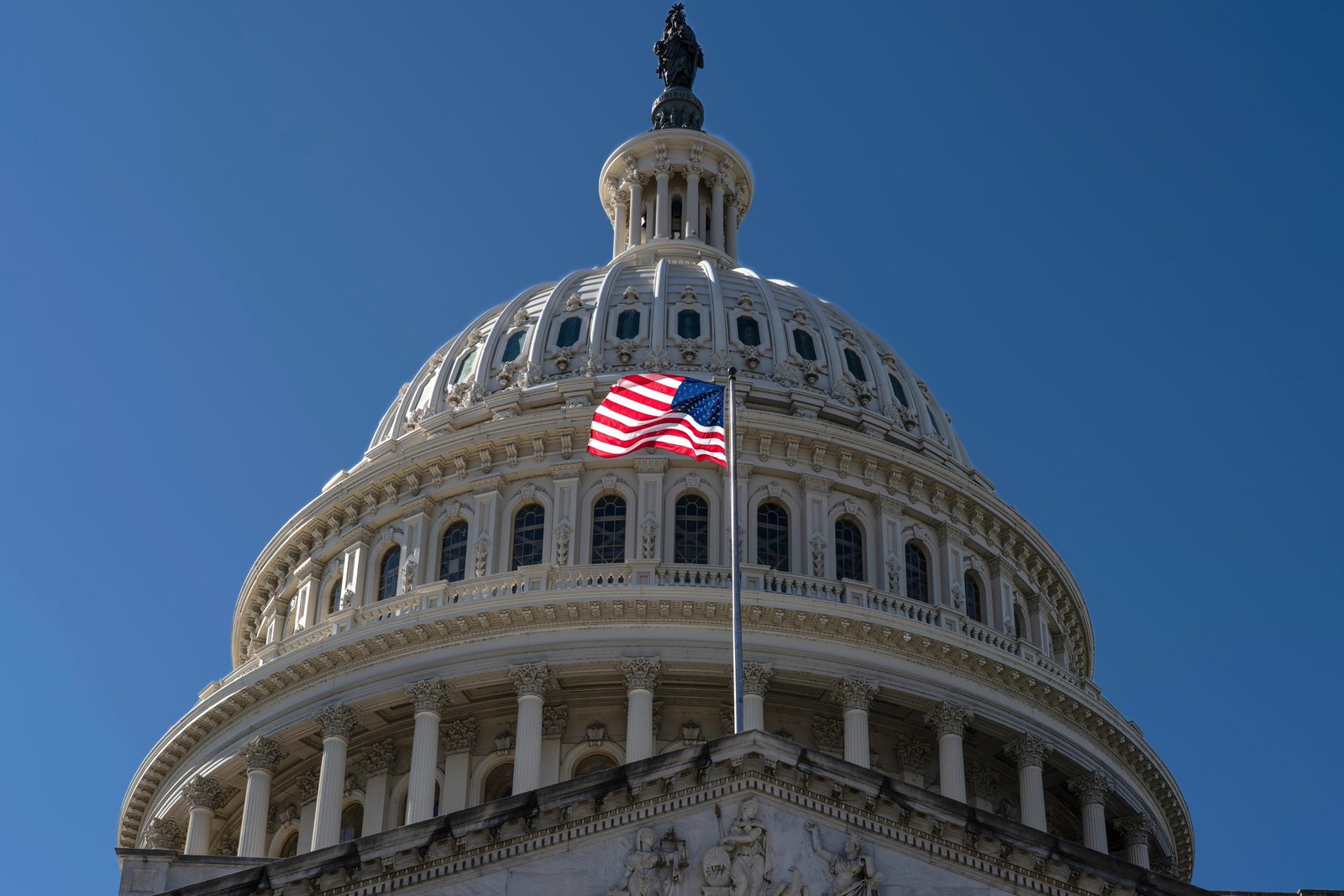
(Oct. 14) The shutdown entered its 14th day with the Senate returning from its holiday break, Republican House Speaker Mike Johnson refusing to call lawmakers back to Washington and President Donald Trump’s budget director vowing to keep firing federal workers.
Democrats have focused on trying to keep Affordable Care Act subsidies from expiring for millions of Americans who purchase insurance on Obamacare exchanges. Without this federal support, costs are expected to soar across the health care economy. Republican House Speaker Mike Johnson said he “won’t negotiate” unless Democrats first agree to reopen the government, losing their leverage for any deal.
The post No end in sight to government shutdown as House speaker refuses to negotiate appeared first on MinnPost.
The office led by budget director Russ Vought also said in a social media post that it will continue implementing reduction-in-force plans to fire federal workers.
The post said the office would “pay the troops, pay law enforcement, continue the RIFs, and wait.”
OMB is making every preparation to batten down the hatches and ride out the Democrats’ intransigence.
Pay the troops, pay law enforcement, continue the RIFs, and wait.
(Oct. 13) WASHINGTON – The first program in Minnesota to feel the impact of the federal government shutdown is one that helps enroll people in the food stamp program.
Funding for the Supplemental Nutrition Assistance Program (SNAP) Outreach Program ended Oct. 1, the first day of the shutdown.
The program, run largely by non-profits, helps eligible individuals and families access SNAP benefits by providing information, assistance with applications and support throughout the enrollment process.
The Trump administration had asked Minnesota for a revised SNAP outreach plan and the U.S. Department of Agriculture, which funds the food stamp program, did not approve it before the government shuttered, said Patrick Hogan, a spokesman for Minnesota Management and Budget.
“Therefore, we have no access to fund it,” Hogan said.
Funding for SNAP benefits, which serve more than 440,000 Minnesotans, was paid out just before the Oct. 1 shutdown, so states can continue to provide those benefits through the end of the month, and maybe even into November. But if the shutdown stretches into next month, the food stamp program could be frozen until the federal government reopens.
“We are continuing to do SNAP outreach, but with the state’s plan not having been approved before the shutdown began, it is unclear how much – if any – of that will be reimbursed retroactively,” said Zack Rodvold, a spokesman for Second Harvest Heartland, a major food bank serving Minnesota and Wisconsin.
The post Agencies that help the poor beginning to feel shutdown’s impact appeared first on MinnPost.
WASHINGTON (Oct. 13) — Republican Speaker Mike Johnson predicts the federal government shutdown may become the longest in history. He says he “won’t negotiate” with Democrats until they hit pause on their health care demands and reopen the government. It’s the 13th day of the shutdown and the closures are taking a toll nationwide, halting routine government operations, shuttering the Smithsonian museums and other landmark cultural institutions and leaving airports scrambling with flight disruptions. It’s all injecting more uncertainty into an already precarious economy. The White House ensured military troops are paid this week. But the Trump administration is firing other federal workers.
This article is part of our Shutdown Blog, tracking the federal government shutdown and its impact on Minnesota.
The post Government shutdown could be the longest ever, Speaker Johnson warns appeared first on MinnPost.
(Oct. 13) Minneapolis-St. Paul International Airport continues to operate smoothly despite the federal government shutdown, the agency that runs the airport said, but it faces a test with a busy travel week.
The Metropolitan Airports Commission, which owns and operates the airport, said in a statement that MSP airlines and the MAC have increased staffing levels for the heavy travel expected this week, when many families will be travelling with students out of school beginning Wednesday due to the annual Minnesota Educator Academy conference.
“MSP airlines and the MAC have increased staffing levels to assist travelers and reduce wait times for check-in and security processes,” MAC said in a statement. It expected 50,000 travelers to pass through TSA security checkpoints Wednesday and 52,000 Thursday.
The commission also said that during the government shutdown the airport’s “federal partners have worked to maintain passenger security and air traffic control at normal operational levels.”
Reached for comment on MSP staffing levels last week, the local offices of the federal Transportation Security Administration said no one was available to speak “due to the funding lapse.”
A TSA spokesperson said that as of last week it had “not experienced any delay in operations due to callouts, and remains fully capable of facilitating safe and secure travel for passengers.”
“Callouts” or “sickouts” are when an employee does not show up for a scheduled shift. About 61,000 of its 64,000 workers nationwide are considered essential workers and must work through the shutdown.
TSA employees received a partial paycheck Oct. 10 but will not receive their salary again until federal funds begin to flow.
During the 2018 partial government shutdown, 10% of TSA screeners were calling in sick in the final days of the shutdown.
“We’re grateful for the thousands of federal workers who are continuing to support air transportation at MSP and across the country during the government shutdown,” MAC Chief Executive Brian Ryks said. “While there have been minimal impacts so far at MSP, passengers may experience delays and longer wait times wherever they fly in the days ahead.”
The post Minneapolis-St. Paul airport to boost staffing to handle MEA weekend traffic appeared first on MinnPost.
WASHINGTON – Minnesota’s hospitals thought they had a great idea to increase the money they receive for treating Medicaid patients by leveraging federal dollars.
But the One Big Beautiful Bill Act threatens to shred that plan and is even likely to kill it outright. The at-risk proposal was approved by the state Legislature in June and hospitals hoped it would bring them $1 billion in increased revenues every year.
The Minnesota Hospital Association developed the plan to boost hospital revenues because they lose money on every Medicaid patient they treat. A study by the American Hospital Association found that hospitals were paid just 88 cents for every dollar spent caring for Medicaid patients, who qualify for the program because they have low incomes.
“It’s a difficult situation for hospitals because Medicaid pays us below cost,” said Joe Schindler, vice president of finance policy at MHA. So, the association came up with a proposal to increase those payments.
About 40 states have similar programs — called provider taxes or directed payments — to leverage federal dollars to increase money received from treating Medicaid patients.
Related: ‘Seismic’ Medicaid changes will be rough on rural hospitals
“We were trying to fund our way out of a financial mess,” Schindler said.
The cost of the Medicaid program, known as Medical Assistance in Minnesota, is shared between the state and federal governments. That means the federal government is required to contribute a percentage of the cost of Medicaid. In Minnesota, it averages at about 62%.
Boosting the cost of Medicaid payments to hospitals and other medical providers forces the federal government to pay more for Medicaid services. Under one provider tax scenario, states recoup their part of the cost share by taxing those hospitals and medical providers for the state’s share of the cost.
Currently, Minnesota implements a 1.56% hospital surcharge that applies to outpatient and inpatient services. Another provider tax, in the amount of 1.8%, applies to both hospitals and a long list of other medical services. That tax funds the MinnesotaCare program, a state health care program for Minnesotans with low incomes, but whose incomes are too high to qualify for Medical Assistance.
The new hospital provider tax, approved by the Legislature earlier this year, would raise the total surcharge to hospitals to 5.75%.
Yet the plan to raise hospital provider taxes ran into trouble when the One Big Beautiful Bill Act banned new provider taxes and capped existing provider taxes at 3.5% for states like Minnesota that expanded Medicaid services under the Affordable Care Act.
The previous caps on provider taxes for states like Minnesota was 6%.
A ‘rip off’’ of taxpayers?
Although permissible by law, some say provider taxes are a way to game the system. The conservative Paragon Health Institute argues that these provider taxes are a taxpayer “rip off” that create loopholes and a lack of transparency.
Minnesota was hoping to collect about $800 million annually in taxes from hospitals and use the money — and the 62% federal match — to increase the payments hospitals receive from treating Medicaid patients. So the new $800 million hospital tax would raise $1.8 billion in federal reimbursements to hospitals.
But the plan had not been approved by the Centers for Medicare and Medicaid Services (CMS) by July 4 of this year, when the federal budget bill was signed by President Donald Trump into law, banning new provider taxes and directed payment plans, which are similar ways to leverage federal dollars.
The Minnesota Department of Health said it advised CMS of its intent to levy the new provider tax on July 3, a day before the deadline.
The new cap on provider taxes does not go into effect until 2032. But states like Minnesota are required to start bringing them down in 2028.
The Minnesota Hospital Association hoped the new 5.75% tax could be implemented, both fully or in part, until 2032. But CMS has not given the state a go ahead.
“If the state is permitted to implement new taxes that were authorized in the 2025 session, those taxes may need to be reduced (starting in 2028) according to the schedule described in federal statute” the Minnesota Department of Health said in a statement.
The Department of Health also said the state “has not yet determined how that process would work because additional guidance is expected from CMS.”
Schindler said rural hospitals and others with large percentages of Medicaid patients are going to feel the most pain and that Minnesota hospitals may have to curtail services, including eliminating labor and delivery and mental health services.
Hospitals are also stressed by inflation and escalating labor costs that are rising faster than Medicare and Medicaid reimbursement rates.
The OBBBA established a $50 billion Rural Health Transformation Program to stabilize rural hospitals by providing funding for workforce shortages and infrastructure. But Schindler said the program will provide “a token amount of money” to solve rural hospital woes.
The only chance Minnesota’s hospitals have to leverage more money from the federal government is for Republicans in Congress to agree to repeal all of the Medicaid-related provisions in the OBBBA, something Democrats want in return for support of a GOP stopgap bill that would reopen the shuttered federal government. But that’s not likely to happen.
So, for now, Minnesota’s hospitals, and hospitals across the nation, are waiting for CMS to finalize the new regulations on provider taxes mandated by the federal budget bill.
“A lot of people and states don’t know how this is going to work out,” said Alice Burns, associate director of the Kaiser Family Foundation’s program on Medicaid and the Uninsured.
Coupled with the OBBBA’s Medicaid cuts, which are expected to result in an increase of uninsured patients at hospital emergency departments and other federal cuts to health care, the crackdown on provider taxes are expected to shake the financial stability of many American hospitals.
“The effect will be big,” Burns predicted. “But we don’t know when and where we’ll start to feel them.”
‘Couldn’t take the risk’
One of the most financially vulnerable hospitals in the state is Hennepin Healthcare in Minneapolis.
It is considered a safety net hospital that serves many low-income and uninsured patients. About 45% of its patients are covered by Medicaid.
Yet Hennepin Healthcare decided it would be the only one of the state’s 140 hospitals to not participate in the Minnesota Hospital Association’s new provider tax plan.
“We wanted to but couldn’t take the risk,” said Charles Ester, the hospital’s vice president of finance.
The reason? Hennepin Healthcare already had its own plan, which has been to leverage more Medicaid money from the federal government which has been given the green light by CMS since its inception in 2021.
Related: Emmer spins Dems’ Medicaid position in casting blame for shutdown
Ester said the hospital was loath to give up its plan in favor of a new one that might not pass muster with the Trump administration — especially since the implementation of the OBBBA.
All of Minnesota’s Medical Assistance patients have managed care plans. That means they get their health care through privately run plans that contract with specific networks of doctors and hospitals to provide services at reduced rates.
But Hennepin Healthcare pays the state a 1.8% tax every month on its Medical Assistance revenues, money that is boosted by the federal match and is paid in the form of higher premiums to managed care companies. In turn, hospitals receive higher payments from managed care companies for their treatment of Medicaid patients.
Ester said he hopes Hennepin Healthcare made the right choice in keeping its current plan to increase Medicaid reimbursements. But, since that plan must be approved every year by CMS, he has some doubts.
“The one thing that we don’t have is certainty,” Ester said.
The post Minnesota hospitals hoped for a $1 billion windfall, but the OBBBA has killed their plan appeared first on MinnPost.
(Oct. 13) Vice President JD Vance is warning of deeper cuts to the federal workforce the longer the government shutdown goes on. Vance spoke Sunday as the shutdown entered its 12th day. He warned that the new cuts would be “painful,” even as he said the Trump administration is working to ensure that the military would be paid and some services would be preserved for low-income Americans, including food assistance. Hundreds of thousands of workers have been furloughed in recent days. In a court filing on Friday, the White House said well over 4,000 employees would soon be fired. Vance said the new cuts would be “painful.”
The post Vance warns ‘deeper’ cuts ahead for federal workers as shutdown enters 12th day appeared first on MinnPost.
As essential employees, federal prison workers in Minnesota are working through the shutdown without pay.
Minnesota has four Bureau of Prisons (BOP) facilities, all located in Greater Minnesota: Rochester, Duluth, Waseca and Sandstone. At least 619 federal employees worked at the facilities as of 2024, according to federal data.
In an already stressful workplace, morale drops fast during a shutdown, said Sandy Parr, who served as a local and national union leader during her 26-year career at Rochester’s federal medical center for BOP inmates.
“If you’re an essential worker you show up to work and you’ll get backpay, but that doesn’t help when a mortgage is due and you have to put formula in your baby’s mouth,” she said.
Parr, who retired in April, was president of the Local 3947 union during the 35-day shutdown in 2018-2019. On top of household budgets, lapsed paychecks strain local economies, she said.
Young families struggle to pay daycare costs. Workers scale back grocery runs and cut out discretionary spending at restaurants. Supplemental income streams are limited because these workers are still required to work full time.
She urged community members to “call on their congressmen and senators to end this shutdown so people can live their lives and get paid.”
As a retired federal employee, Parr can speak out in ways current workers can’t. Federal prison workers lost union protections in September when the BOP terminated its collective bargaining agreement with the American Federation of Government Employees (AFGE) Council of Prison Locals.
BOP Director William Marshall III described the union as an “obstacle to progress” in his announcement on the termination.
“It’s time for change,” he stated. “And today, thanks to President Donald J. Trump and Attorney General Pamela Bondi, we’re making that change.”
Trump in March issued an executive order enabling federal agencies to cancel union contracts. The AFGE sued the Trump administration, arguing that the order was unlawful. The case is ongoing.
Unless an injunction restores union rights, benefits like sick days are no longer straightforward, Parr said.
The shutdown “is really hard on morale, and then this year it’s more hostile because they don’t have their union,” she said. Federal actions “stripped rights [workers] were used to, and now there are threats of discipline if you call in sick.”
The post Minnesota’s federal prison workers are working – unpaid – through the shutdown appeared first on MinnPost.
WASHINGTON (Oct. 10) –The U.S. Senate adjourned and members left town late Thursday, guaranteeing that all federal workers will miss their first paycheck – including 1.3 members of the U.S. military – because of the Pentagon’s paycheck processing process.
And it’s becoming more evident that the shutdown is going to last much longer than GOP leaders had anticipated.
At a Friday morning press conference, a frustrated House Speaker Mike Johnson bristled as reporters asked him why he would not call back U.S. House members to vote for a bill – which Democrats would support. Johnson has disbanded the U.S. House for more than two weeks and says he won’t reconvene the chamber until Senate Democrats vote for his stopgap bill.
“If you’re a service member who’s lacking a paycheck, it’s because Chuck Schumer has to appease the Marxists. Plain and simple,” Johnson said. “Shame on you Chuck. Every Senate Democrat is going along with this. You lack the moral fortitude to do the right thing.”
If all active-duty troops are not paid on time, it would be a first in U.S. history since the military’s payroll has been guaranteed in previous shutdowns.
Trump, meanwhile, has said he will find a way to pay the military. The president could shift money around to do that, but there’s a question of the legality of that during a shut down.
The post Frustration mounts as military pay lapse looms, with no end in sight for government shutdown appeared first on MinnPost.
WASHINGTON (Oct. 10) – It’s Day 10 of the federal government shutdown and Rep. Tom Emmer, R-6th District, is blaming President Donald Trump’s decision to cancel millions of dollars in energy grants to his district to Senate Minority Leader Chuck Schumer – and Sen. Tina Smith.
Trump’s Energy Department recently terminated $7.5 billion in grants for U.S. energy projects – including more than $500 million that was earmarked for Minnesota.
The Energy Department said it made its decision to roll back the grants because they “failed to meet the standards required to justify continued taxpayer investment and would have led to less reliable, more expensive energy.”
But when asked by a reporter at Friday morning’s GOP leadership press conference about the loss of $7 million in grants to Emmer’s 6th District, the lawmaker said Trump was forced to make “difficult decisions” about spending because of the government shutdown, which he blamed on Schumer and Smith.
There was no mention that Sen. Amy Klobuchar has also consistently voted against a GOP stopgap measure that would fund the federal government until Nov. 21, but does not contain increases in health care spending Democrats demand.
“Call Tina Smith and ask her to reopen the government,” Emmer demanded.
The post Trump canceled $500 million in energy grants for Minnesota. Emmer blames Democrats. appeared first on MinnPost.