Category: USA

  • Trump hosts Senate Republicans at renovated White House as the shutdown drags into fourth week

    Trump hosts Senate Republicans at renovated White House as the shutdown drags into fourth week

    WASHINGTON (Oct. 21) — As the government shutdown enters its fourth week, President Donald Trump is welcoming Senate Republicans for lunch at the White House. It’s not for urgent talks on how to end the shutdown, but a celebratory display of unity as they refuse to negotiate on Democratic demands for health care funds. Trump is praising GOP leaders by name. But Senate Democrats are also expressing confidence in their strategy to keep voting against a House-passed bill that would reopen the government until Trump and other Republicans engage them. Democrats want to extend health care subsidies that are expiring. Trump says he’ll discuss health care, but only after the government reopens.

    Head Start programs for preschoolers are scrambling for federal funds. The federal agency tasked with overseeing the U.S. nuclear stockpile has begun furloughing its 1,400 employees. Thousands more federal workers are going without paychecks.

    But as President Donald Trump welcomed Republican senators for lunch in the newly renovated Rose Garden Club — with the boom-boom of construction underway on the new White House ballroom — he portrayed a different vision of America, as a unified GOP refuses to yield to Democratic demands for health care funds, and the government shutdown drags on.

    “We have the hottest country anywhere in the world, which tells you about leadership,” Trump said in opening remarks, extolling the renovations underway as senators took their seats in the newly paved over garden-turned-patio.

    It was a festive atmosphere under crisp, but sunny autumn skies as senators settled in for cheeseburgers, fries and chocolates, and Trump’s favored songs — “YMCA” and “You Can’t Always Get What You Want” — played over the new sound system.

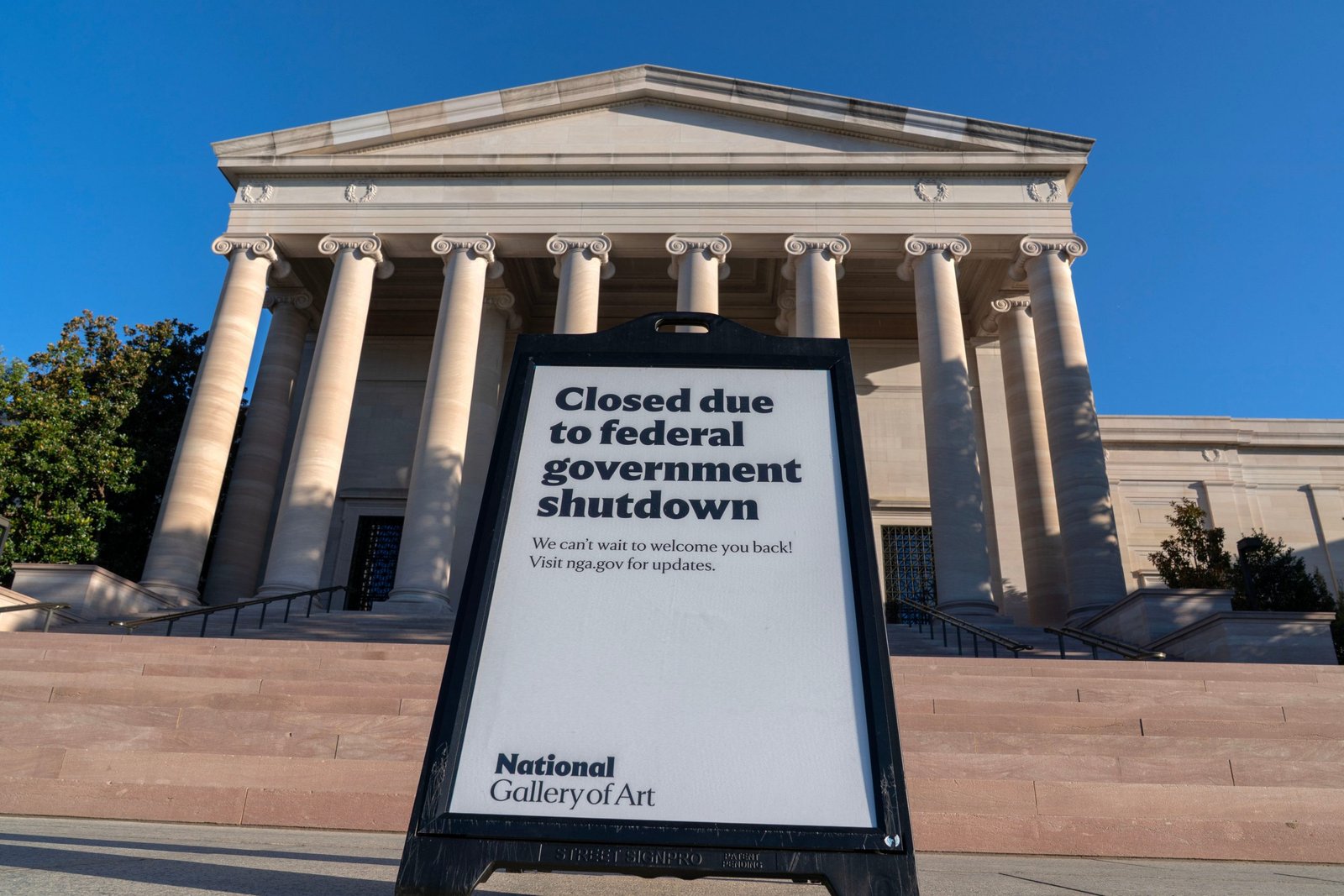
    And while Trump said the shutdown must come to an end — and suggested maybe Smithsonian museums could reopen — he signaled no quick compromise with Democrats over the expiring health care funds.

    Later at another White House event, Trump said he’s happy to talk with Democrats about health care once the shutdown is over. “The government has to be open,” he said.

    Shutdown drags into record books

    As the government shutdown enters its fourth week — on track to become one of the longest in U.S. history — millions of Americans are bracing for health care sticker shock, while others are feeling the financial impact. Economists have warned that the federal closure, with many of the nearly 2.3 million employees working without pay, will shave economic growth by 0.1 to 0.2 percentage points per week.

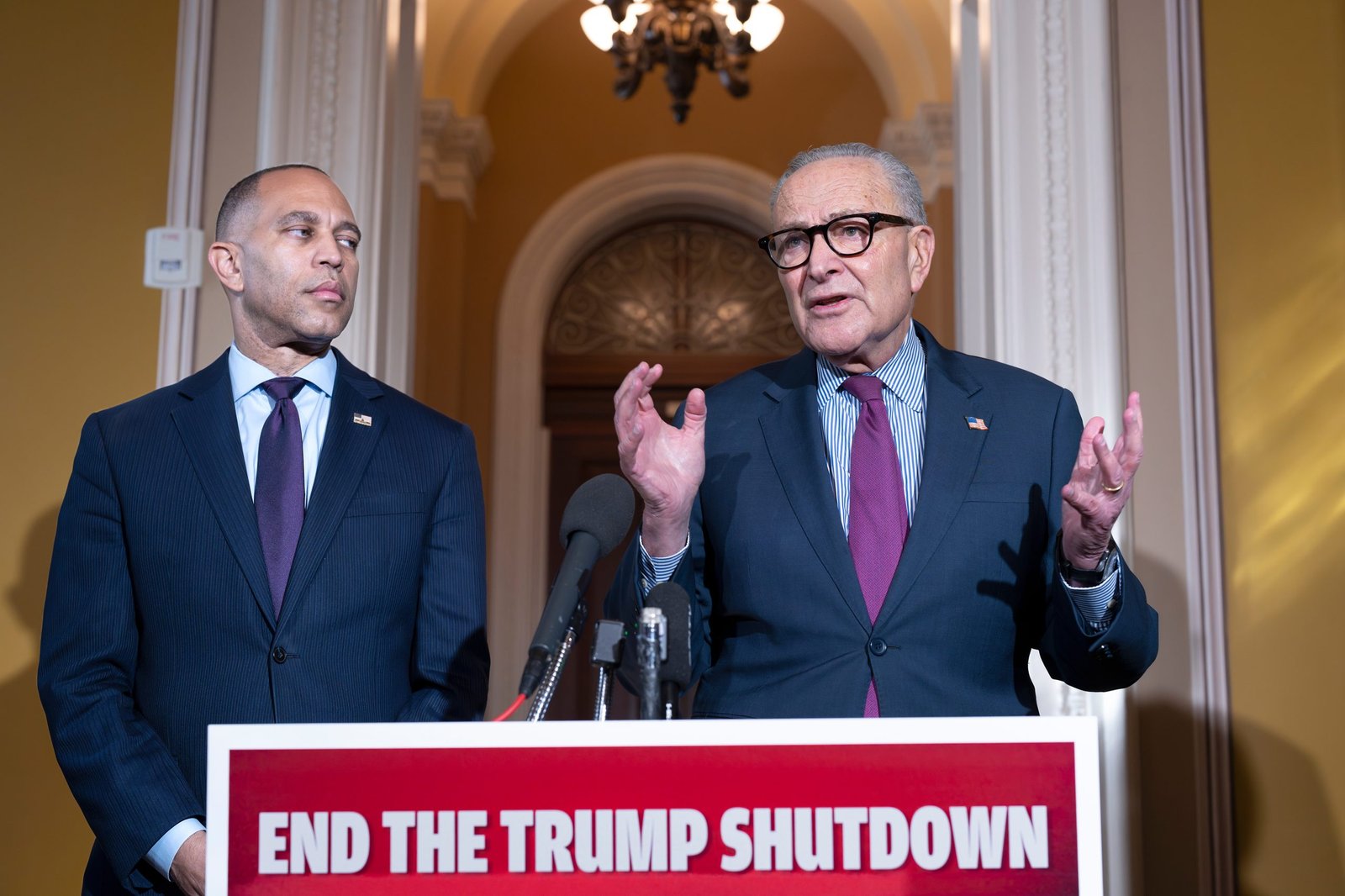
    The Democratic leaders Sen. Chuck Schumer and Rep. Hakeem Jeffries had outreached to the White House on Tuesday, seeking a meeting with Trump before the president departs for his next overseas trip, to Asia.

    “We said we’ll set up an appointment with him anytime, anyplace before he leaves,” Schumer said.

    With Republicans in control of Congress, the Democrats have few options. They are planning to keep the Senate in session late into the night Wednesday in protest. The House has been closed for weeks.

    The Republican senators, departing the White House lunch with gifts of Trump caps and medallions, said there is nothing to negotiate with Democrats over the health care funds until the government reopens.

    “People keep saying ‘negotiate’ — negotiate what?” Senate Majority Leader John Thune said after the hour-long meeting. He said Republicans and the president are willing to consider discussions over health care, “but open up the government first.”

    Missed paychecks and programs running out of money

    While Capitol Hill remains at a standstill, the effects of the shutdown are worsening.

    Federal workers are set to miss additional paychecks amid total uncertainty about when they might eventually get paid. Government services like the Special Supplemental Nutrition Program for Women, Infants and Children, known as WIC, and Head Start preschool programs that serve needy families are facing potential cutoffs in funding. On Monday, Energy Secretary Chris Wright said the National Nuclear Security Administration is furloughing its federal workers. The Federal Aviation Administration has reported air traffic controller shortages and flight delays in cities across the United States.

    At the same time, economists, including Goldman Sachs and the nonpartisan CBO, have warned that the federal government’s closure will ripple through the economy. More recently, Oxford Economics said a shutdown reduces economic growth by 0.1 to 0.2 percentage points per week.

    The U.S. Chamber of Commerce noted that the Small Business Administration supports loans totaling about $860 million a week for 1,600 small businesses. Those programs will close to new loans during the shutdown. The shutdown also has halted the issuance and renewal of flood insurance policies, delaying mortgage closings and real estate transactions.

    Rising health care costs

    And without action, future health costs are expected to skyrocket for millions of Americans as the enhanced federal subsidies that help people buy private insurance under the Affordable Care Act, come to an end.

    Those subsidies, in the form of tax credits that were bolstered during the COVID-19 crisis, expire Dec. 31, and insurance companies are sending out information ahead of open enrollment periods about the new rates for the coming year.

    Most U.S. adults are worried about health care becoming more expensive, according to a new Associated Press-NORC Center for Public Affairs Research poll, as they make decisions about next year’s health coverage.

    Members of both parties acknowledge that time is running out to fix the looming health insurance price hikes, even as talks are quietly underway over possible extensions or changes to the ACA funding.

    Democrats are focused on Nov. 1, when next year’s enrollment period for the ACA coverage begins and millions of people will sign up for their coverage without the expanded subsidy help. Once those sign-ups begin, they say, it would be much harder to restore the subsidies even if they did have a bipartisan compromise.

    What about Trump?

    Tuesday’s White House meeting offered a chance for Republican senators to engage with the president on the shutdown after he had been more involved in foreign policy and other issues.

    But senators left the meeting, some saying it was more of a luncheon than a substantial conversation. They said they could hear, but not see, the ballroom construction nearby.

    Trump had previously indicated early on during the shutdown that he may be willing to discuss the health care issue, and Democrats have been counting on turning the president’s attention their way. But the president later clarified that he would only do so once the government reopens.

    ___

    Associated Press writers Kevin Freking, Stephen Groves, Matt Brown, Will Weissert and Joey Cappelletti contributed to this report.

    The post Trump hosts Senate Republicans at renovated White House as the shutdown drags into fourth week appeared first on MinnPost.


  • The shutdown threatened to close dozens of Head Start centers. Then the state stepped in.

    The shutdown threatened to close dozens of Head Start centers. Then the state stepped in.

    WASHINGTON – The federal shutdown threatened the operation of 30 Head Start centers run by West Central Community Action, a non-profit headquartered in Elbow Lake.

    West Central and three other nonprofits that run Head Start programs in the state that serve more than 1,300 pre-school children face a Nov. 1 deadline to receive federal funding that would allow them to continue operations for a year. But as the shutdown dragged on, those payments were in danger.

    “We were nervous,” said Missy Becker-Cook, CEO of West Central Community Action, whose Head Start centers serve 370 children.

    But on Friday, the state came to the rescue. Minnesota’s Department of Children, Youth and Families advised West Central, and the three other nonprofits that run dozens of Head Start centers with Nov. 1 deadlines, that they are allowed to use state Head Start money to fund their November operations.

    “It’s just barely enough for November, and November only,” Becker-Cook said of the approximately $400,000 that West Central was allocated by the state on July 1.

    Although the federal government provides about 89% of the funding for the Head Start program in Minnesota, the state also chips in to fund centers that expand their operations.

    “Head Start state funds are designated ‘to expand services and serve additional low-income children,’” said Patrick Hogan, spokesperson for Minnesota Management and Budget. “Using these funds to sustain operations during a federal funding disruption aligns with the intent of the state allocation and supports continuity of care for children and families.” 

    Kraig Gratke, executive director for the Minnesota Head Start Association, said the state has allowed the nonprofits at risk of losing their federal Head Start money on Nov. 1 to draw down the state funds aimed at expanding enrollment in the program “at an accelerated rate.”

    “We have just heard this and are waiting for the state to let us know what the process will be,” Gratke said. “This is really about keeping kids and families safe and keeping staff on. It is the best short-term solution we could have in hopes the shutdown doesn’t last.”

    The scramble to keep centers that provide early education, meals and even infant care for low-income families from closing shows the widening impact of the federal government’s shutdown and its cutoff of federal monies.

    The lengthening federal shutdown has already affected the federal heating assistance program and could soon derail the federal food stamp program known as the Supplemental Nutrition Assistance Program (SNAP), as well as WIC, another federal nutrition program.

    The other nonprofits in the state that faced a looming Nov. 1 deadline for Head Start funding were the Rochester-based Families First of Southern Minnesota, Anoka Community Action and the Grand Portage Band of Lake Superior Chippewa. These agencies fund dozens of Head Start centers.

    Anoka Community Action and the Grand Portage Band did not return calls requesting information.

    But Families First said it would spend state funds to keep its centers open.

    “Five hundred children and their parents would be impacted if we have to shut down,” said Kristin Quenzer, the executive director of Families First. “But we are able to draw (state) funds down until there is an agreement.”

    Quenzer said Families First has been threatened with a loss of Head Start funding before, but “it has never been as tenuous as it has been this year.”

    Besides the threat posed by the shutdown, the Trump administration froze Head Start funding at the beginning of the year and the president failed to include funding for the program in his 2026 budget.

    Hundreds of employees working in the Administration for Children and Families (ACF), which administers Head Start, were laid off by the Trump administration this year. And five of the program’s regional offices – including the one that served Minnesota centers in Chicago – were abruptly closed. Minnesota centers must now correspond with a center in Rapid City.

    “It would be really bad for children and families,” Gratke said of the possible shuttering of centers.

    “If they shut down, there’s nowhere else for the children to go,” he said, citing the high cost of day care and even higher cost of infant care. “Their parents won’t be able to work or go to school and do the things that lift them out of poverty.”

    The post The shutdown threatened to close dozens of Head Start centers. Then the state stepped in. appeared first on MinnPost.

  • Applications for food stamps halted due to shutdown

    Applications for food stamps halted due to shutdown

    (Oct. 15) The Minnesota Department of Children, Youth and Families (DCYF) has instructed all counties to stop taking new applications for food stamps effective Wednesday.

    Why? Because while the state received money from the U.S. Department of Agriculture to fund the program through October, the shutdown may prevent another payment Minnesota needs to process Supplemental Nutrition Assistance Program (SNAP) benefits in November.

    The DCYF said it received notice from the USDA that without renewed federal support, there are insufficient funds to pay for SNAP benefits in November. 

    The agency also told the counties, which administer SNAP, that – barring change – on Tuesday, Oct. 21, food stamp recipients will be notified that they will not receive November benefits.  

    There are about 440,000 food stamp recipients in Minnesota. Other federal nutrition programs, including WIC – which provides food assistance to mothers, infants and children – are also on the brink of running out of money.

    State Democrats blamed President Trump and congressional Republicans for the stalemate in Washington, D.C., over funding the U.S. government, which does not appear anywhere close to resolution.

    “We are at the start of the third week of the Republicans’ government shutdown, and already it’s starting to have real effects on the lives of Minnesotans in need,” Senate Majority Leader Erin Murphy, DFL-St. Paul, said in a release. “Pausing even a single day of applications for SNAP benefits could delay approval for hungry kids and families who don’t have a day to spare.”

    Republicans, however, say its Democratic demands for a reversal of GOP cuts to Medicaid and the expansion of Affordable Care Act premium subsidies that are to blame for the continued shuttering of government.

    The post Applications for food stamps halted due to shutdown appeared first on MinnPost.

  • WATCH: How the Democrats Lost America with Tyler Pager at MinnPost Festival 2025

    WATCH: How the Democrats Lost America with Tyler Pager at MinnPost Festival 2025


    MinnPost Washington Correspondent Ana Radelat in conversation with New York Times White House Correspondent Tyler Pager at MinnPost Festival 2025. Credit: Sarah Morreim

    We’re highlighting conversations from MinnPost Festival 2025, including one between New York Times White House Correspondent Tyler Pager and MinnPost Washington Correspondent Ana Radelat. The pair discussed Pager’s book, “2024: How Trump Retook the White House and the Democrats Lost America.”

    You can see recordings of all of the MinnPost Festival 2025 sessions on our YouTube page.

    Thank you to our speakers, sponsors and volunteers for making the Festival possible!


    The post WATCH: How the Democrats Lost America with Tyler Pager at MinnPost Festival 2025 appeared first on MinnPost.

  • Federal workers endure financial strain and fear layoffs as the government shutdown drags on

    Federal workers endure financial strain and fear layoffs as the government shutdown drags on

    WASHINGTON (AP) — With every passing day of the government shutdown, hundreds of thousands of federal employees furloughed or working without pay face mounting financial strain. And now they are confronting new uncertainty with the Trump administration’s promised layoffs.

    Little progress has been made to end the shutdown as it enters its third week, with Republicans and Democrats digging in and convinced their messaging is resonating with voters. The fate of the federal workers is among several pressure points that could eventually push the sides to agree to resolve the stalemate.

    “Luckily I was able to pay rent this month,” said Peter Farruggia, a furloughed federal worker. “But for sure I am going to have bills that are going to go unpaid this month, and I really don’t have many options.”

    The shutdown has a familiar feel for many federal employees who endured past stalemates — including during President Donald Trump’s first term — but this time, the stakes are higher. The Republican White House is leveraging federal workers’ jobs to pressure Democrats to soften their demands.

    The shutdown began on Oct. 1 after Democrats rejected a short-term funding fix and demanded that the bill include an extension of federal subsidies for health insurance under the Affordable Care Act. Trump and other Republican leaders have said the government must reopen before they will negotiate with Democrats on the health subsidies.

    Trump administration launches wave of layoffs

    Farruggia is the head of the American Federation of Government Employees local representing employees at the Centers for Disease Control and Prevention, an agency that faced a wave of layoffs over the weekend. Like 8,000 other CDC employees who have been furloughed from the agency, he was already living paycheck to paycheck, and the partial pay that arrived Friday was his last until the government comes back online.

    With the agency’s leadership in turmoil and still rattled from a shooting, the shutdown and new firings mean “people are scared, nervous, anxious, but also really just exasperated,” Farruggia said.

    After Russ Vought, the director of the Office of Management and Budget, said last week on social media that the “RIFs have begun,” referring to reduction-in-force plans aimed at reducing the size of the federal government, Vice President JD Vance doubled down on the threat Sunday, saying “the longer this goes on, the deeper the cuts are going to be.”

    The layoffs have begun across federal agencies. Labor unions have already filed a lawsuit to stop the move by Trump’s budget office.

    In a court filing on Friday, the Office of Management and Budget said well over 4,000 federal employees from eight departments and agencies would be fired in conjunction with the shutdown.

    Jessica Sweet, an Albany, New York, Social Security claims specialist who is a union steward of AFGE Local 3343 in New York, said, “I, myself, have a backup plan” in case she is fired during the shutdown, “but I know most people don’t.”

    She says the Social Security Administration is already so short-staffed from layoffs earlier this year brought on by the Department of Government Efficiency, she doesn’t fear a massive layoff during the shutdown.

    “The one thing this administration has taught me is that nothing is ever for certain, even if it’s codified into law,” she said.

    Having received a partial payment in her last paycheck, Sweet has begun reaching out to her local power companies to request that she not get charged late fees, since “my bills won’t wait for me to eventually get paid.”

    Shutdown drags on, and frustration grows

    For some federal workers, this isn’t their first shutdown — the last one, during Trump’s first term in 2019, stretched a record 34 days. But this time, federal employees are being used more directly as leverage in the political fight over government funding.

    The Republican administration last week warned that there would be no guaranteed back pay for federal workers during a shutdown — a reversal of long-standing policy affecting roughly 750,000 furloughed employees, according to a White House memo. The move, which Trump later backtracked on, was widely seen as a strong-arm tactic.

    Adam Pelletier, a National Labor Relations Board field examiner whose agency furloughed nearly all of its workforce on Oct. 1, going from roughly 1,100 workers to fewer than a dozen people, said he wouldn’t mind if the shutdown continued if it meant meaningful progress toward gaining health care protections for Americans across the country — a key demand by Democrats for ending the stalemate.

    Pelletier, a union leader for NLRB local 3, said “right now, nothing is being investigated at the NLRB. There’s no elections for unions or elections for decertifications. Basically nothing is happening.”

    As for the financial strain on workers, he said workers can’t even find alternate employment to weather the shutdown because “the ethics office that would approve of those requests is not staffed now.”

    Workers used as ‘political pawns’

    National Treasury Employees Union President Doreen Greenwald, which represents workers across dozens of federal agencies, said several of the union’s members had been laid off as of Friday. The Treasury Department would lose 1,446 workers, according to the filing.

    Greenwald said it was unfortunate that the Trump administration was using “federal employees as political pawns by furloughing and proposing to fire them all to try to cause pressure in a political game of chicken.”

    “This isn’t about one party or the other. It’s about real people,” said Everett Kelley, president of the American Federation of Government Employees.

    “The correction officer worrying about his next paycheck. The TSA officer who still shows up to work because he or she loves their country, even though they’re not getting paid. No American should ever have to choose between serving their country and feeding their family,” Kelley said.

    Kelley and other major federal worker union leaders gathered blocks from the Capitol last week, urging congressional leaders to find a solution and put “people over politics.” The event grew emotional at times, with union heads outlining the difficulties facing their members and the stakes growing daily.

    Randy Erwin, president of the National Federation of Federal Employees, which represents 110,000 workers nationwide, called on both sides of Congress to find a resolution. He said Trump appeared to aim to “degrade, frighten, antagonize hardworking federal employees.”

    Chris Bartley, political program coordinator for the International Association of Fire Fighters, said thousands of firefighters were showing up for work without pay out of a sense of devotion but stressed that could have broader consequences.

    “Families go without income,” Bartley said. “Morale and retention suffer. Public safety is compromised.”

    ___

    Bedayn reported from Denver, and Riddle reported from Montgomery, Ala.

    The post Federal workers endure financial strain and fear layoffs as the government shutdown drags on appeared first on MinnPost.
  • Social Security cost-of-living increase announcement delayed by government shutdown

    Social Security cost-of-living increase announcement delayed by government shutdown

    WASHINGTON (AP) — The ongoing government shutdown is delaying the announcement of the annual Social Security cost-of-living adjustment for tens of millions of beneficiaries.

    Originally scheduled for Wednesday, the 2024 Social Security COLA announcement will now be Oct. 24. It is timed to the September Consumer Price Index, which also has not yet been released.

    The agency adjusts its benefits every year based on inflation. The postponement of the announcement is the most recent example of how the government shutdown, entering its third week and with little progress made toward a resolution, has made it more difficult for people to plan out their finances.

    Projections by Senior Citizens League and the AARP anticipate a COLA increase of roughly 2.7%. About 70.6 million people, including retirees, disabled people and children, get Social Security benefits.

    Social Security Administration beneficiaries have voiced concerns that next year’s increase will not be enough to counter rising costs.

    Sue Conard, a 75-year-old retired nurse from La Crosse, Wisconsin, and SSA recipient, recently traveled to the U.S. Capitol with other retiree members of the American Federation of State, County and Municipal Employees union to lobby for meaningful progress towards gaining health care protections to end the shutdown, as well as changes to Social Security benefits.

    She said she wants lawmakers to change the calculation on how the COLA is determined since the standard CPI gauge, which includes a market basket of consumer goods and services, doesn’t take into account many costs typical for older Americans.

    “The issue of how the COLA is determined is flat-out wrong because health care is not factored into the CPI,” said Conard, speaking on the front steps of the Longworth House Office Building.

    Some lawmakers have proposed legislation that would make SSA use a different index, called the Consumer Price Index for the Elderly (CPI-E), to calculate the cost-of-living increase that measures price changes based on the spending patterns of older people on things such as health care, food and medicine.

    A collection of Democratic lawmakers has proposed legislation to change the CPI calculation for COLA benefits to the CPI-E. Last session, Sen. Bob Casey, D-Pa., proposed a law that would change the COLA calculation, but that never got a hearing in the Senate Finance committee.

    AARP CEO Myechia Minter-Jordan said the COLA “isn’t just a source of income — it’s a lifeline of independence and dignity, for tens of millions of older Americans.” But even with an adjusted COLA, a majority of Americans still face challenges covering basic expenses, she said.

    Vanessa Fields, a 70-year-old former social worker and AFSCME member from Philadelphia, said she pays roughly $1,000 per month for groceries, more than in previous years. The COLA doesn’t keep up with rising costs, she said, “and we’re going to be in bad shape if lawmakers don’t act.”

    The agency is expected to begin notifying recipients about their new benefit amount starting in early December. A spokesperson for Social Security who spoke on the condition of anonymity to preview the COLA said retirement and Supplemental Security Income benefits would be adjusted beginning Jan. 1, 2026, without any delay despite the current government lapse in appropriations.

    The delayed COLA announcement comes as the national social insurance plan faces a severe financial shortfall in the coming years and as the agency has seen substantial workforce cuts.

    The annual Social Security and Medicare trustees report released in June said the program’s trust fund will be unable to pay full benefits beginning in 2034, instead of last year’s estimate of 2035. If the trust fund is depleted, the government will be able to pay only 81% of scheduled benefits, the report said.

    In addition, the agency laid off at least 7,000 people from its workforce of 60,000 earlier this year, putting pressure on the remaining workers to handle claims and answer inquiries from a rising number of recipients.

    The post Social Security cost-of-living increase announcement delayed by government shutdown appeared first on MinnPost.

  • Trump budget office plans to ‘batten the hatches’

    Trump budget office plans to ‘batten the hatches’

    The Trump administration continued its hard line regarding the shutdown on Tuesday, with the Office of Management and Budget threatening to continue the firings of federal workers, or “reductions in force” (RIF), even as it scrambled to shift money to pay the nation’s military members.

    “OMB is making every preparation to batten down the hatches and ride out the Democrats’ intransigence,” the Office of Management and Budget posted on X. “Pay the troops, pay law enforcement, continue the RIFs, and wait.”

    OMB issued its first round of firings Friday, terminating the jobs of  more than 4,000 federal workers. That resulted in an escalation of the standoff with Democrats.

    While tens of thousands of government workers are usually furloughed during a government shutdown, this is the first time a government shuttering has been used to execute a large-scale firing of those workers.

    The post Trump budget office plans to ‘batten the hatches’ appeared first on MinnPost.

  • WIC gets a reprieve – for now

    WIC gets a reprieve – for now

    (Oct. 14) The supplemental nutrition program for women, infants and children known as WIC received temporary help from the U.S. Department of Agriculture this week. But that aid is only temporary.

    Due to the ongoing federal government shutdown, the program was slated to run out of money in many states, including Minnesota. But the USDA has shifted about $300 million from other child nutrition programs that had a surplus at the end of the federal fiscal year, Sept. 30.

    So, the program that provides food aid, infant formula and breastfeeding support to more than 101,000 low-income Minnesota moms and babies can continue until the end of the month. But only until the end of the month.

    “MN WIC has funds to continue services through the end of October,” said the Minnesota Department of Health in an emailed statement. “MN WIC received additional USDA funding to cover food costs during the federal government shutdown.”

    The post WIC gets a reprieve – for now appeared first on MinnPost.

  • MSP among airports asked to show Noem shutdown video

    MSP among airports asked to show Noem shutdown video

    Fort Lauderdale, Fla. (AP) — Some airports around the country are refusing to play a video with a message from Homeland Security Secretary Kristi Noem in which she blames Democrats for the federal government shutdown and its impacts on TSA operations because of its political content.

    Airports in Las Vegas, Charlotte, Atlanta, Phoenix, Seattle and more say the video goes against their airport policy or regulations which prohibit political messaging in their facilities.

    Minneapolis-St. Paul International Airport has received a request to allow TSA to air the video, but the Metropolitan Airports Commission “is evaluating this request under applicable legal requirements,” an airport spokesperson said in an email.

    Various government agencies, in emails to workers and on websites, have adopted language that blames Democrats for the shutdown, with some experts arguing it could be in violation of the 1939 Hatch Act, which restricts certain political activities by federal employees.

    The shutdown has halted routine operations and left airports scrambling with flight disruptions. Democrats say any deal to reopen the government has to address their health care demands, and Republicans say they won’t negotiate until they agree to fund the government. Insurance premiums would double if Congress fails to renew the subsidy payments that expire Dec. 31.

    In the video, Noem says that TSA’s “top priority” is to help make travel pleasant and efficient while keeping passengers safe.

    “However, Democrats in Congress refuse to fund the federal government, and because of this, many of our operations are impacted, and most of our TSA employees are working without pay,” she continues.

    The Transportation Security Administration falls under the Department of Homeland Security. Roughly 61,000 of the agency’s 64,130 employees are required to continue working during the shutdown. The Department said Friday that the video is being rolled out to airports across the country.

    A DHS spokeswoman responded to a request for comment restating some of the message from Noem’s video.

    “It’s unfortunate our workforce has been put in this position due to political gamesmanship. Our hope is that Democrats will soon recognize the importance of opening the government,” spokeswoman Tricia McLaughlin said.

    The Harry Reid International Airport, in Las Vegas, said it had to “remain mindful of the Hatch Act’s restrictions.”

    “Per airport regulations, the terminals and surrounding areas are not designated public forums, and the airport’s intent is to avoid the use of the facility for political or religious advocacy,” the statement said.

    Westchester County Executive Ken Jenkins said the county north of New York City won’t play the video at its local airport. In a statement, he called the video “inappropriate, unacceptable, and inconsistent with the values we expect from our nation’s top public officials,” and said its tone is “unnecessarily alarmist” as it relates to operations at Westchester County Airport.

    “At a time when we should be focused on ensuring stability, collaboration and preparedness, this type of messaging only distracts from the real issues, and undermines public trust,” he said.

    Even in red states, airports weren’t showing the video for various reasons. Salt Lake City International Airport wasn’t playing the video because state law prohibits using city-owned property for political purposes, said airport spokesperson Nancy Volmer.

    The airport in Billings, Montana, “politely declined” even though it has screens that could show the video with audio, assistant aviation director Paul Khera said Tuesday.

    “We don’t want to get in the middle of partisan politics,” Khera said. “We like to stay middle of the road, we didn’t want to play that video.” ___

    MinnPost staff and Associated Press writers Rio Yamat in Las Vegas and Mead Gruver in Fort Collins, Colo. contributed to this report.

    The post MSP among airports asked to show Noem shutdown video appeared first on MinnPost.

  • Heating assistance for low-income Minnesotans on hold during shutdown

    Heating assistance for low-income Minnesotans on hold during shutdown

    (Oct. 14) WASHINGTON – Federal heating assistance, which helps more than 133,000 Minnesotans keep warm in the winter, has fallen prey to the federal shutdown.

    The Minnesota Department of Commerce, which administers the Low-Income Home Energy Assistance Program, known as LIHEAP, said it has enough money to keep processing applications for the program that helps subsidize heating bills.

    But the shutdown has left the state without any money for the program and there may not be any funding until late November or even December.

    “We need our annual federal LIHEAP award to be able to start making payments on applicant energy accounts,” an emailed statement from the Department of Commerce said. “Our annual award typically arrives about a month after a budget or continuing resolution is decided. The shutdown will likely delay our funding by about a month after it is resolved.”

    Minnesota was slated to receive about $114 million in LIHEAP funds.

    But on Tuesday, the 14th day of the federal shutdown, there was no resolution in sight. Democrats continued to reject a GOP stopgap bill, or continuing resolution, that would fund the federal government until Nov. 21 but does not contain restoration of GOP Medicaid cuts or an extension.

    Both  renters and homeowners can qualify for the program and eligibility is based on income and household size. A family of four, for example, could earn up to $71,999 annually and qualify for LIHEAP and the energy subsidies range from $550 to $1,400 a household.

    Those payments are sent directly to energy companies and utilities or fuel providers, including companies that sell propane, oil and even wood.

    The shutdown’s impact on heating assistance funding was evident when applicants called non-profits like the Community Action Partnership of Hennepin County to sign up for the program this week.

    “It is uncertain when funding will be available,” the partnership said in a phone message to prospective applicants.

    The post Heating assistance for low-income Minnesotans on hold during shutdown appeared first on MinnPost.