Category: Uncategorized

  • Rivian adds Apple Watch app to control EVs from your wrist

    Rivian adds Apple Watch app to control EVs from your wrist

    Electric vehicle maker Rivian has rolled out a major software upgrade that brings a dedicated Apple Watch companion app to its ecosystem, giving owners a new way to interact with their vehicles right from their wrist. The Apple Watch app arrives as part of Rivian’s 2026.03 software update, the company’s first major update of the year, and extends its connected vehicle strategy beyond smartphones and in-car interfaces.

    Vehicle control moves to your wrist

    Until now, Rivian owners have primarily used the company’s iPhone app to check vehicle status, manage charging and adjust settings. With the new Apple Watch app, that control power moves onto your smartwatch, making it easier to handle everyday tasks without needing to reach for your phone. Owners can now lock and unlock doors, vent windows, trigger the alarm, adjust cabin temperature using the watch’s digital crown, and view battery charge status directly on their Apple Watch face.

    A key convenience feature is the ability to set a target charging level straight from the watch – something that previously required specific steps on the phone app. The app also lets users customize up to four quick controls, ensuring the most-used functions are always within a single tap on the watch screen.

    For owners of earlier Rivian vehicles (Gen 1 models), the Apple Watch app additionally enables digital key support when the Rivian app is updated, turning the watch itself into a secure means of accessing the vehicle. For later-generation EVs that already support digital keys via Apple Wallet, passive entry – where the vehicle unlocks automatically when you approach – is also compatible with the new app.

    Why this matters in the age of connected cars

    As modern vehicles become more like smart connected devices, the way drivers interact with their cars is evolving. A dedicated Apple Watch app reflects a broader trend of streamlining vehicle control by integrating it with personal tech many drivers already carry. This approach reduces friction and makes key functions accessible with minimal effort – whether you’re loading gear, walking toward your vehicle, or simply want to check status at a glance.

    The update also underscores how Rivian – which does not support mainstream sync standards like Apple CarPlay or Android Auto – is building its own connected ecosystem instead, focusing on tools tailored specifically for Rivian owners.

    What you’ll notice practically

    For everyday drivers, the Apple Watch app can make routine tasks more convenient. Instead of digging in pockets or bags for a phone, drivers can perform essential functions from their wrist. The glanceable battery readout – available as a watch complication – keeps range and charging info visible alongside watch faces and fitness data.

    Setting climate preferences while approaching your vehicle on a cold morning or tweaking the charging target before a trip are now easier and faster than ever. For families or shared vehicles, quick access controls can also streamline key hand-offs or pre-trip checks.

    What’s next for Rivian software

    Rivian’s implementation of the Apple Watch app is part of a larger software-centric strategy that has seen regular over-the-air updates improve vehicle functionality since launch. The 2026.03 update also includes other enhancements like Sport Mode availability across all R1 AWD models and cold-weather range indicators, showing Rivian’s focus on practical features as well as advanced connectivity.

    Looking ahead, more refined integrations with wearable tech and expanded on-wrist controls could become differentiators in the EV market, especially for brands like Rivian that build their own app infrastructure instead of relying on platform-level standards. As smartwatches become even more powerful, apps like Rivian’s may signal the future of how drivers control and interact with their vehicles.


  • Xbox Free Play Days Brings Battlefield 6, Jujutsu Kaisen Cursed Clash and More This Weekend

    Xbox Free Play Days Brings Battlefield 6, Jujutsu Kaisen Cursed Clash and More This Weekend

    Add Techlomedia as a preferred source on Google. Preferred Source

    Microsoft has announced a new Free Play Days event for Xbox players. This weekend, five games will be available to try at no extra cost for eligible members. The offer is live from Thursday, February 19, to Sunday, February 22, for Xbox Game Pass Ultimate, Premium, and Essential members.

    Battlefield 6 leads this weekend’s lineup. The game delivers large-scale warfare with infantry combat, tanks, and fighter jets. Players can destroy parts of the environment to gain a tactical advantage. The game is optimized for Xbox Series X|S.

    Chip ‘n Clawz vs. The Brainioids is an action strategy game that mixes base building with combat. Players collect Brainium, build their base, and command an army of bots to fight alien enemies known as Brains in Jars.

    Sunderfolk is a tactical co-op RPG built around shared play. One copy of the game supports the entire group. Players use a free mobile app that works as a controller and guidebook. The game focuses on party-based strategy and teamwork.

    Polterguys: Possession Party offers multiplayer chaos for up to eight players. You play as a ghost and possess everyday objects to gain special powers. Sabotage your friends and avoid getting caught by a monster.

    Jujutsu Kaisen Cursed Clash is based on the popular anime series. It is a 2 vs 2 action fighting game. Players team up and use different Cursed Techniques to defeat opponents.

    Players can visit the Xbox Store online and sign in with an eligible membership to see the install option. On console, go to the Subscriptions tab in the Xbox Store and find the Free Play Days collection.

    All progress, achievements, and Gamerscore earned during the weekend will carry over if you decide to purchase the game.

    Follow Techlomedia on Google News to stay updated. Follow on Google NewsFollow on Google News

    Affiliate Disclosure:

    This article may contain affiliate links. We may earn a commission on purchases made through these links at no extra cost to you.

  • Sonos’ first headphones are finally priced closer to where they should be

    Sonos’ first headphones are finally priced closer to where they should be

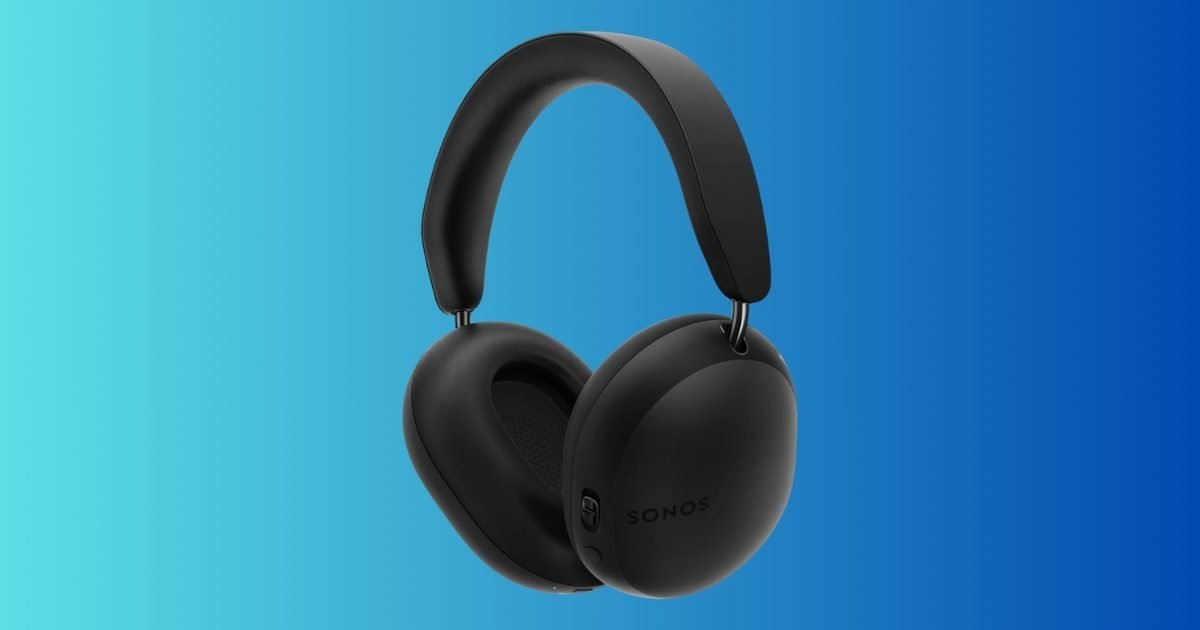
    Headphones are one of those purchases you feel immediately. Commute gets quieter, focus gets easier, and travel becomes less tiring. The Sonos Ace are positioned as a premium over-ear option with active noise cancellation, and right now they’re $319.00, down from a $399.00 compared value, saving you $80. If you’ve been curious about Sonos’ take on high-end headphones but didn’t want to pay full price, this discount lands in the “finally reasonable” range.

    What you’re getting

    These are wireless over-ear headphones with active noise cancellation, built for everyday listening and long sessions. The core appeal of this category is simple: comfort, consistent sound, and the ability to tune out noise when you need to concentrate or relax.

    Sonos also tends to design products for people who care about an easy, polished experience. So if you like tech that feels straightforward, not fiddly, that’s part of the value proposition here.

    Why it’s worth it

    The Ace headphones make sense for a specific type of buyer: someone who wants premium noise-cancelling headphones but also wants something a little different from the usual default picks. The $80 discount helps because it reduces the “new product tax” you often pay when you buy into a brand’s first-generation hardware.

    This is also a practical deal if you wear headphones for hours at a time. In the real world, comfort and noise reduction matter as much as sound quality. The best headphones are the ones you actually want to keep on, whether you’re working, traveling, or just trying to carve out a quiet pocket of the day.

    The bottom line

    At $319, the Sonos Ace are a solid buy if you want premium over-ears with ANC and you’ve been waiting for the price to drop from the original $399 level. If you’re shopping the category right now, this discount makes the Ace a more compelling alternative to the usual flagship suspects, especially if you value comfort and an easy day-to-day experience.

  • Google Launches Gemini 3.1 Pro With Stronger Reasoning and Wider Availability

    Google Launches Gemini 3.1 Pro With Stronger Reasoning and Wider Availability

    Add Techlomedia as a preferred source on Google. Preferred Source

    Google has announced Gemini 3.1 Pro, a new upgrade to its Gemini 3 series of AI models. The company says this version brings improved core intelligence and better reasoning for complex tasks.

    The launch follows last week’s update to Gemini 3 Deep Think, which focused on solving challenges in science, research, and engineering. With Gemini 3.1 Pro, Google is now rolling out the upgraded intelligence layer across consumer and developer products.

    Gemini 3.1 Pro is available in preview for developers through the Gemini API in Google AI Studio, Gemini CLI, Google Antigravity, and Android Studio. Enterprises can access it through Vertex AI and Gemini Enterprise. Consumers will see it inside the Gemini app and NotebookLM.

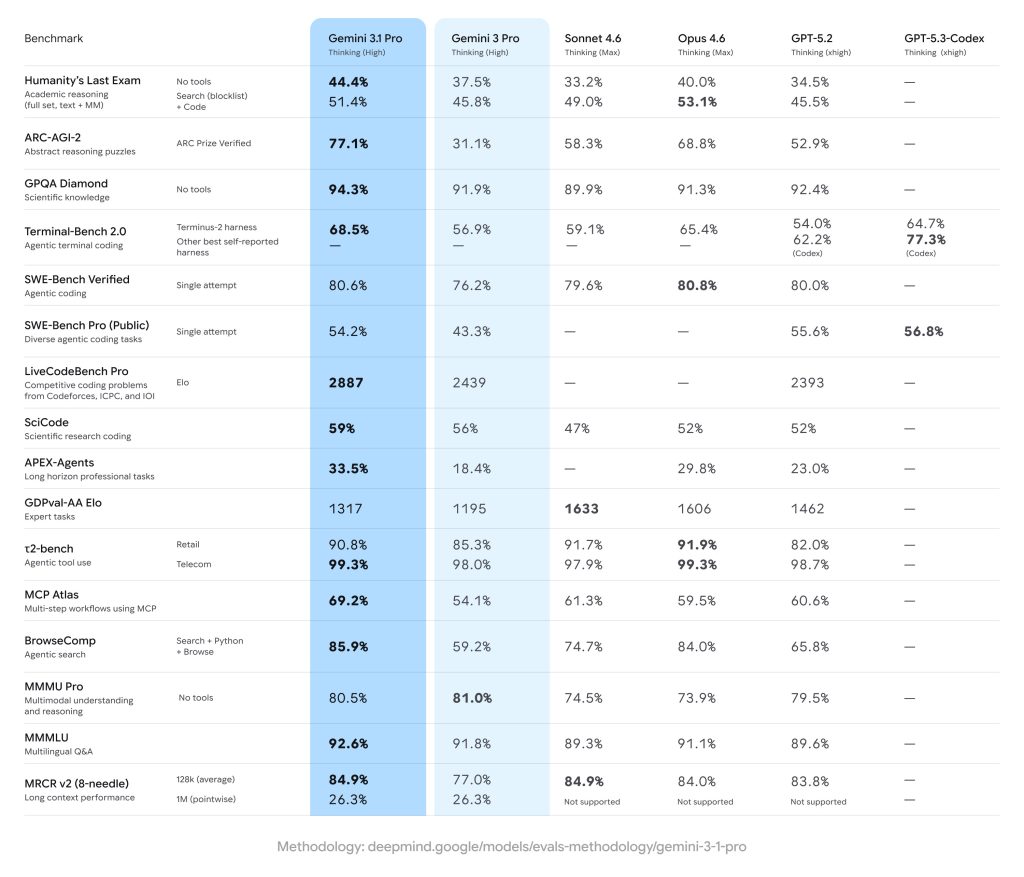
    Google says Gemini 3.1 Pro delivers a major improvement in reasoning compared to Gemini 3 Pro. On the ARC-AGI-2 benchmark, which tests how well a model can solve new and unfamiliar logic problems, Gemini 3.1 Pro achieved a verified score of 77.1 percent. According to Google, this is more than double the reasoning performance of the previous 3 Pro model.

    Gemini 3.1 ProGemini 3.1 Pro

    The company positions Gemini 3.1 Pro as a stronger base model for advanced problem solving. It is designed for tasks that need deeper thinking instead of simple answers. Google says the model can help users create clear visual explanations of complex topics, combine data into a single view, and support creative projects.

    Google also shared an example of code-based animation. It shows how Gemini 3.1 Pro can generate animated SVG files directly from a text prompt. Since these animations are built in pure code, they remain sharp at any size and have smaller file sizes compared to traditional video.

    Gemini 3.1 Pro is now rolling out in the Gemini app with higher usage limits for Google AI Pro and Ultra subscribers. It is also available in NotebookLM for Pro and Ultra users. Developers and enterprises can test the model in preview through AI Studio, Antigravity, Vertex AI, Gemini Enterprise, Gemini CLI, and Android Studio.

    Follow Techlomedia on Google News to stay updated. Follow on Google NewsFollow on Google News

    Affiliate Disclosure:

    This article may contain affiliate links. We may earn a commission on purchases made through these links at no extra cost to you.

  • Researchers find Tesla Model 3 and Cybertruck are hackable machines on wheels

    Researchers find Tesla Model 3 and Cybertruck are hackable machines on wheels

    Security researchers have uncovered major vulnerabilities in two of Tesla’s most popular vehicles, revealing that the Tesla Model 3 and Cybertruck can be transformed into remotely controlled, highly compromised “machines on wheels.” The findings highlight new concerns around the growing complexity of connected cars – and how deeply embedded software systems can introduce risks most drivers never consider.

    Researchers demonstrate deep access inside Tesla’s system software

    A research team from Northeastern University has shown that they could manipulate core systems inside the Tesla operating environment by exploiting vulnerabilities in the vehicle’s internal networking architecture. Rather than breaking into the car from a distance, researchers focused on what happens once an attacker gains physical access – a scenario they argue is far more realistic than fully remote Hollywood-style car hacks.

    Their work demonstrated that plugging a compromised device into Tesla’s internal network could unlock access to subsystems responsible for power steering, braking behavior, acceleration logic, and even driver-assistance features. By reverse-engineering protocols and communication pathways inside the vehicles, researchers created proof-of-concept attacks capable of altering vehicle behavior in ways the driver would not immediately detect.

    Why the findings matter for connected vehicles

    Modern vehicles rely heavily on a network of microcontrollers, sensors, and software layers – more than 100 million lines of code in some cases. This complexity increases the potential attack surface dramatically. The research underscores that today’s EVs and smart cars function much like rolling computers, and that traditional automotive safety assumptions don’t fully account for systemic software vulnerabilities.

    Critically, the team notes that an attacker wouldn’t need to be a nation-state actor or elite hacker. With basic technical skills and short-term physical access – for example during valet parking, routine servicing, or rental car use – a malicious device could be introduced to modify internal communications on the vehicle’s CAN bus.

    These are not remote takeover attacks, but they show that internal system protections are not robust enough to prevent malicious code execution once an intruder reaches the car’s physical ports.

    Implications for drivers and the industry

    For everyday drivers, the research brings attention to the importance of treating modern cars as digital devices with their own cybersecurity risks. Features like keyless entry, over-the-air updates, and extensive onboard sensors dramatically improve convenience – but they also create more potential failure points.

    The findings also highlight a broader industry challenge: car manufacturers are racing to add autonomous features, AI-driven systems, and always-connected infotainment platforms, but security frameworks have not evolved at the same pace. With EV adoption rising and cars becoming increasingly software-dependent, security researchers warn that vulnerabilities could become more common unless cybersecurity becomes a core design priority.

    What’s next for Tesla, regulators, and automakers

    Researchers disclosed their findings to Tesla before publication, and while the company acknowledged the report, it noted that the tests involved devices plugged directly into the vehicle – a scenario it considers lower-risk than remote compromise. Still, the research community argues that physical-access hacks remain critical threats in real-world contexts.

    Going forward, academics expect more attention on automotive cybersecurity standards, including stronger encryption of internal communications, authenticated software messaging, and redesigned access ports that minimize the risk of malicious injections.

    Regulators may also revisit standards around connected vehicle safety as cars increasingly resemble complex cloud-connected computing platforms.

    As connected vehicles become the norm, the automotive industry is likely to face increasing pressure to harden systems, adopt zero-trust architectures, and treat cybersecurity as seriously as crash safety.

  • Gemini 3.1 Pro just got a major AI intelligence boost

    Gemini 3.1 Pro just got a major AI intelligence boost

    Google has introduced Gemini 3.1 Pro, the latest milestone in its flagship generative AI model lineup, promising significantly improved reasoning and complex problem-solving capabilities for developers, enterprises and everyday users. This upgrade builds on the foundation of the Gemini 3 series – which already set new expectations for multimodal intelligence – and pushes Google closer to its goal of delivering AI that can tackle sophisticated, real-world tasks.

    A powerful upgrade to AI reasoning

    Gemini 3.1 Pro is designed to be smarter at parsing difficult, multi-step problems that go beyond simple question-and-answer tasks. According to Google, the model more than doubled its reasoning performance compared with the previous Gemini 3 Pro when evaluated on the ARC-AGI-2 benchmark – a test that measures logic and reasoning on new, unseen problems. The new version achieved a score of 77.1%, a substantial leap that demonstrates its enhanced ability to understand and generate complex reasoning chains.

    This improvement, built on updates introduced with Gemini 3 Deep Think, is not just about longer answers – it reflects deeper cognitive capabilities that enable the model to synthesize large amounts of data, draw connections across domains and offer more insightful responses for technical, scientific, and creative workflows.

    The expanded reasoning power of Gemini 3.1 Pro could make AI more useful across a broad range of applications. For developers and researchers, the model’s ability to handle multi-step logic and nuanced questions may improve everything from code generation and debugging to data analysis and scientific research. In productivity settings, the upgraded AI could help users draft complex documents, generate detailed explanations, or explore topics that require deeper understanding.

    For enterprises, more advanced reasoning expands the scope of what AI can automate or support. Teams working on financial modeling, legal analysis, technical documentation, or customer support workflows may benefit from a model that can follow intricate instructions and maintain context over longer tasks.

    Integration across Google platforms

    Gemini 3.1 Pro is rolling out across several Google services, including the Gemini app, NotebookLM, developer platforms such as Vertex AI and Google AI Studio, and will also power features in Google Search Labs. This phased availability ensures that both individual users and organizations can gradually adopt the new model based on their needs.

    Beyond direct access, Gemini’s upgrades tie into broader Google AI ecosystem strategies like enhanced integrations with Gmail, Docs and other productivity tools, where more intelligent assistance is expected to streamline workflows and reduce friction in everyday digital tasks.

    Why this matters amid the AI arms race

    The announcement of Gemini 3.1 Pro comes amid intense competition among generative AI platforms from companies such as OpenAI, Anthropic and Meta. Models that deliver strong reasoning, deep contextual understanding and multimodal input handling are increasingly viewed as the frontier of AI capability. Google’s improved scores on complex benchmarks signal its intent to lead not just in scale, but in cognitive sophistication.

    From a strategic perspective, this upgrade reinforces Google’s commitment to embedding advanced AI across products and services, while also encouraging developers to build richer applications on its platforms. As AI becomes more embedded in tools used for work, learning and creativity, enhancements like Gemini 3.1 Pro may accelerate adoption and improve real-world utility.

    Looking ahead, Google is expected to continue refining the Gemini family

    Which is basically further expansions in reasoning, multimodality and agentic capabilities – where AI can perform complex workflows with minimal human guidance. Continued integration with emerging tools and deeper support for professional and enterprise use cases will likely follow as adoption grows.

    As users and developers explore Gemini 3.1 Pro, its early feedback and real-world performance will help shape future iterations and competitive positioning, underlining the evolving role of AI as a more capable partner in tackling complex problems.

  • Chrome just fixed some of its biggest daily annoyances

    Chrome just fixed some of its biggest daily annoyances

    Google has quietly rolled out a trio of Chrome features designed to make everyday browsing feel less like juggling tabs and more like getting work done. The update focuses on productivity, adding tools that help you multitask, manage documents, and move files into Google Drive without leaving the browser.

    According to Google’s announcement, the update introduces split view, built-in PDF annotations, and a new “Save to Google Drive” option. The company says these features are meant to help users “focus, collaborate and get things done more quickly.”

    Your browser is turning into a workspace

    Split view is arguably the headline feature. Chrome can now display two tabs side by side in the same window, turning the browser into something closer to a lightweight workspace. This makes it easier to compare documents, research while writing, or keep a reference page open without constantly switching tabs.

    The second upgrade targets one of the web’s most stubborn productivity pain points: PDFs. Chrome already lets you open them, but now you can annotate them directly in the browser. That includes highlighting text, adding comments, and marking up files before sharing them with others. Instead of downloading a PDF, opening another app, and then re-uploading the file, the entire workflow can now happen in Chrome.

    The third feature connects Chrome more deeply with Google Drive. A new built-in option lets you save files and screenshots directly to Drive without extra steps or extensions. It sounds small, but it removes one of those repetitive tasks that quietly eat away at your day.

    Taken together, these updates show how Chrome is evolving beyond a simple web browser. With competitors experimenting with AI-powered browsing and new browser concepts emerging, Google appears focused on making Chrome feel more like a central productivity hub. Considering that for many people, most of the work is done when switching between Chrome tabs, this makes sense. By adding multitasking and document editing features directly into Chrome, Google is trying to reduce the need to bounce between apps and downloads. If Chrome is already where most of your work happens, these updates might make it even harder to leave.

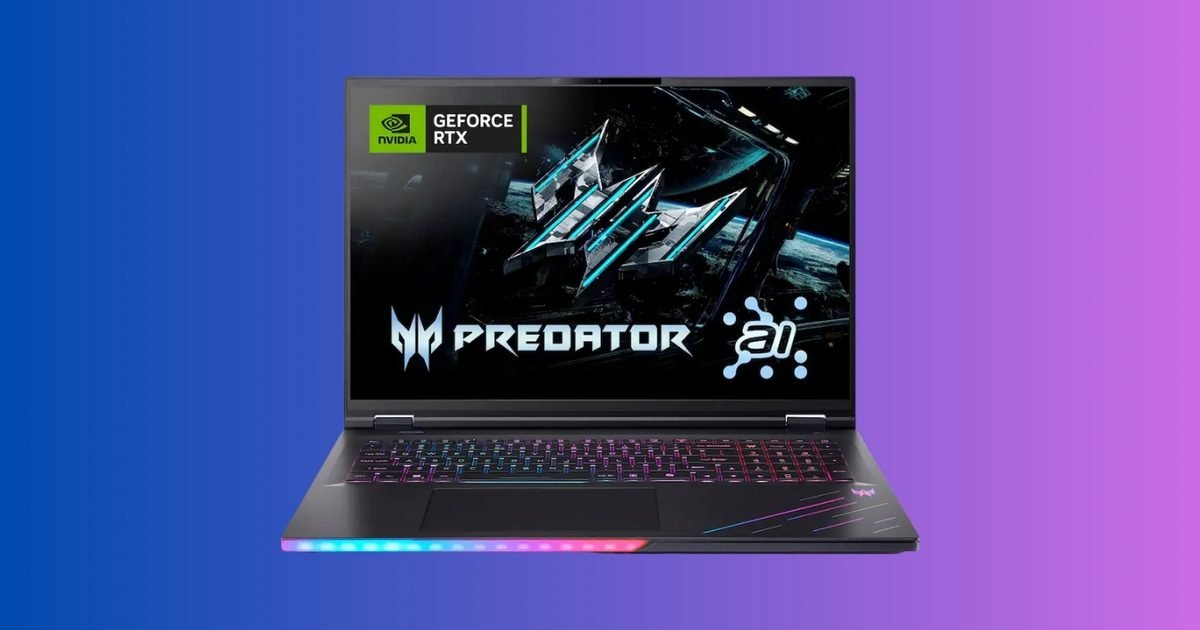
  • A big-screen RTX 5080 gaming laptop deal that makes desktop-class power feel portable

    A big-screen RTX 5080 gaming laptop deal that makes desktop-class power feel portable

    There are gaming laptops, and then there are “this could replace my desktop” machines. The Acer Predator Helios 18 AI sits firmly in that second camp, and the current discount makes it a lot easier to justify. It’s $2,499.99, down from a $3,099.99 compared value, saving you $600. If you want top-tier GPU performance but still need the flexibility to move your setup between rooms, offices, or travel, this is one of the rare deals where the price finally matches the ambition of the hardware.

    What you’re getting

    This configuration is built for high-refresh gaming, heavy multitasking, and creative workloads that lean on GPU power:

    • 18-inch display with a 2560 x 1600 resolution
    • 250Hz refresh rate for fast, smooth motion in competitive titles
    • Intel Core Ultra 9 processor
    • NVIDIA GeForce RTX 5080 graphics
    • 32GB memory to keep everything responsive under load
    • 1TB SSD for big game libraries and fast project storage

    The combination of a roomy 18-inch panel and 250Hz refresh is the vibe here. You get a display that feels immersive for single-player games, but it can still play in the “I care about frames” category.

    Why it’s worth it

    Think of this laptop as a performance-first workstation that happens to game extremely well. The RTX 5080 is the star, but the rest of the build is what keeps it from feeling lopsided: 32GB memory means fewer compromises when you’re juggling a game, Discord, browser tabs, and recordings, and the 1TB SSD is the minimum threshold where you stop micromanaging installs.

    The other reason this deal stands out is the screen-to-performance pairing. 2560 x 1600 is a sweet spot for an 18-inch display because it looks sharp without forcing you into the constant “4K settings tug-of-war.” You can chase high frame rates with sane settings and still get a crisp picture.

    The bottom line

    At $2,499.99, the Acer Predator Helios 18 AI is a compelling pick for anyone who wants big-screen immersion, very high refresh gameplay, and RTX 5080-level graphics in a single portable setup. If you’ve been eyeing a top-end gaming laptop but waiting for a discount that actually feels meaningful, the $600 drop is the kind of pricing shift that changes the decision.

  • Afghanistan crush Canada by 82 runs to bow out on a high

    Afghanistan crush Canada by 82 runs to bow out on a high


    Afghanistan's players celebrate after winning an ICC Men's T20 World Cup 2026 cricket match against Canada in Chennai on Thursday (PTI Photo/R SenthilKumar)

    Chennai: Ibrahim Zadran struck a fluent unbeaten 95 while Mohammed Nabi took four wickets for just seven runs as Afghanistan signed off from the T20 World Cup with a comprehensive 82-run victory over Canada, here Thursday.

    Canada signed off without a win from the tournament, while Afghanistan had their second win. The Rashid-Khan-led side was clearly the better team and had it won the cliffhanger against South Africa, the side would have avoided an early elimination.

    In a battle of pride between two already-eliminated sides, Afghanistan rode on a blazing unbeaten knock from Zadran to post a formidable 200 for four and then restricted Canada to 118 for 8 to seal an emphatic win.

    With both teams aiming to return home on a high, Afghanistan produced a commanding batting effort after being sent in to bat.

    Canada’s chase never really gathered momentum after captain Dilpreet Bajwa’s brief 13 off seven ended in the third over.

     Afghanistan’s Mohammad Nabi throws the ball during an ICC Men’s T20 World Cup 2026 cricket match between Afghanistan and Canada. (PTI Photo/R SenthilKumar)
    An Afghan cricketer batting during the match against Canada, with a Canadian player in the background, in.
    Canada’s Saad Bin Zafar plays a shot during an ICC Men’s T20 World Cup 2026 cricket match between Afghanistan and Canada
    Afghan cricket player catches the ball during a match, with fans cheering in the background.
    Afghanistan’s Ibrahim Zadran takes the catch of Canada’s Nicholas Kirton
    Afghan cricketers celebrating a win, one player is airborne, with a digital scoreboard in the background.
    AI generation disabled
    Afghan cricket player celebrating after winning match against Canada at the cricket stadium.
    Canada’s Jaskaran Singh celebrates the wicket of Afghanistan’s Sediqullah Atal 

    They slipped to 33 for three inside six overs, with Mohammad Nabi striking crucial blows, including the wickets of Yuvraj Samra (17) and Nicholas Kirton (10).

    Off-spinner Mujeeb Ur Rahman removed Bajwa, while Azmatullah Omarzai accounted for Navneet Dhaliwal as Afghanistan tightened the screws early.

    Harsh Thaker (30) and Saad Bin Zafar (28) attempted a repair job with a 53-run stand for the sixth wicket, but Afghanistan’s spin duo ensured there was no comeback.

    Nabi returned remarkable figures of 4 for 7 in four overs, while skipper Rashid Khan chipped in with two wickets.

    With wickets falling at regular intervals and the required run rate soaring, Canada folded meekly to hand Afghanistan a comprehensive win to close their campaign.

    Earlier, Zadran rode on a spilled catch to punish the Canada bowlers with seven fours and five sixes, leading Afghanistan to a big total.

    Rahmanullah Gurbaz began cautiously but survived an early scare when he was dropped by wicketkeeper Shreyas Movva off pacer Dilon Heyliger in the second over.

    It took Gurbaz (30 off 20) a few deliveries to measure the surface before he unfurled a flurry of crisp boundaries. However, just when he looked set, Jaskaran Singh had him caught at deep point in the sixth over.

    Jaskaran struck again three balls later, trapping the dangerous Gulbadin Naib lbw for one, briefly pegging Afghanistan back at 49 for two.

    Thereafter, Zadran took charge.

    The right-hander ensured the run-rate never dipped, striking freely against both pace and spin. Alongside Sediqullah Atal (44 off 32), he stitched a fluent 95-run stand for the third wicket, with the duo particularly severe on the spinners.

    Zadran was fortunate on 54 when Kaleem Sana spilled a chance off left-arm spinner Ansh Patel. Canada’s fielding lapses hurt them dearly, and Afghanistan capitalised with sharp running between the wickets.

    Jaskaran eventually broke the stand, inducing Atal to hole out in the deep, but Zadran carried on unfazed. He struck seven fours and five sixes in his 56-ball knock, narrowly missing out on a deserved hundred.

    Late cameos from Azmatullah Omarzai (13 off 7) and Darwish Rasooli (4 not out) helped Afghanistan finish strongly at exactly 10 runs per over.

    For Canada, Jaskaran (3/52) was the lone bright spot with the ball, but their indifferent fielding and inability to contain Zadran meant they faced a stiff chase in a match that offered little beyond pride but plenty of competitive intent.


    Get the latest updates in Hyderabad City News, Technology, Entertainment, Sports, Politics and Top Stories on WhatsApp & Telegram by subscribing to our channels. You can also download our app for Android and iOS.

  • People gather for first iftar of Ramzan 2026 at  Hyderabad’s Makkah Masjid

    People gather for first iftar of Ramzan 2026 at Hyderabad’s Makkah Masjid


    First iftaar served at Makkah Masjid, Hyderabad on February 19.

    Hyderabad: The Makkah Masjid in Hyderabad hosted a massive iftar spread on Thursday, February 19, marking the end of the first fast of Ramzan 2026.

    Every year, Makkah Masjid serves iftar to devotees to break their first fast of the holy month, bringing together a large number of people.

    People gathered for the first iftar at Makkah Masjid, with community members sharing a meal to mark the b.
    First iftar served at Makkah Masjid on February 19.
    Community gathering for Iftaari at Makkah Masjid during Ramadan.
    First iftar served at Makkah Masjid on February 19.
    Iftaari gathering at Makkah Masjid with community members breaking fast together.
    Children gathered around the seating arrangement to open their first fast at Makkah Masjid.
    People gathered for Iftaari prayer during Ramadan at Makkah Masjid.
    Man serving dates during Iftaari at Makkah Masjid with community members gathered.
    Volunteer serves dates to people at Makkah Masjid.
    Iftaari gathering at Makkah Masjid with community members breaking fast together.
    An overview of the people ready to break their fast on the first of Ramzan at Makkah Masjid.

    On Wednesday, February 18, after the crescent moon was sighted, Taraweeh prayers had commenced at one of the most well-known mosques in Hyderabad. Several residents from neighbouring areas attended the prayers. To make more room, the government set up a shaded area outside and put down new prayer mats inside.


    Get the latest updates in Hyderabad City News, Technology, Entertainment, Sports, Politics and Top Stories on WhatsApp & Telegram by subscribing to our channels. You can also download our app for Android and iOS.