Category: BUSINESS

  • Everything you need to know about GST on sale of used cars

    Everything you need to know about GST on sale of used cars

    The 18 percent Goods and Services Tax (GST) on the sale of old cars has recently caught public attention.

    It has left many potential car sellers confused about how the tax will impact them.

    18 percent GST payable only on margins

    The 18 percent GST is applicable only on the margin which is the difference between the purchase price and the resale price of the vehicle.

    This will ensure that the tax is levied only on the profit made by sellers and not on the entire resale amount.

    For example, if a car was purchased for Rs 14 lakh and sold for Rs 11 lakh, the margin is negative, and no GST would be payable. However, if the selling price exceeds the purchased price, GST will be applied to the positive margin.

    When does GST apply?

    The GST is applicable when the selling price is more than the depreciated value.

    If the seller does not claim depreciation under Section 32 of the Income Tax Act 1961, GST is appliable on the difference of selling price and the purchase price.

    Examples to clarify

    • Scenario 1: A car was originally purchased for Rs 20 lakh and is sold for Rs 10 lakh. If the depreciation claimed is Rs 8 lakh, the depreciated value is Rs 12 lakh. Since the selling price (Rs 10 lakh) is lower than the depreciated value (Rs 12 lakh), the margin is negative, and no GST is payable.
    • Scenario 2: If the same car is sold for Rs 15 lakh instead, the margin becomes Rs 3 lakh (Rs 15 lakh – Rs 12 lakh). In this case, 18 percent GST will be applied to the Rs 3 lakh margin.

  • Mutual fund industry saw meteoric rise in 2024

    Mutual fund industry saw meteoric rise in 2024

    New Delhi: The Indian mutual fund industry saw a meteoric rise in 2024, as the assets under management (AUM) of all MF schemes increased by more than Rs 17 lakh crore this year.

    According to data from the Association of Mutual Funds in India (Amfi), the mutual fund industry’s AUM was Rs 68 lakh crore at the end of November 2024, which is Rs 17.22 lakh crore or 33 per cent more than the December 2023 figure of Rs 50.78 lakh crore.

    The mutual fund industry’s AUM has increased by more than Rs 37 lakh crore in the last four years.

    AUM increased by Rs 11 lakh crore in 2023, Rs 2.65 lakh crore in 2022, and about Rs 7 lakh crore in 2021.

    The AUM of the mutual fund industry was Rs 50.78 lakh crore in December 2023, Rs 40 lakh crore in December 2022, Rs 37.72 lakh crore in December 2021 and Rs 31 lakh crore in December 2020.

    Apart from this, the number of folios at the end of November 2024 was 22.02 crore, which was 16.89 crore in January. This shows an increase of 5.13 crore in the number of folios.

    The figures for December 2024 have not been added to this, as they will be released in the first week of January 2025.

    According to AMFI data, about 174 open-ended schemes were added in 2024. The total number of schemes was 1,552 in November. It was 1,378 in January.

    This year, the highest number of 3.76 crore new folios were added to equity mutual fund schemes. Followed by 1.17 crore folios were added to the Fund of Funds investing in index funds, gold ETFs, other ETFs, and foreign funds.

    Apart from this, 19.42 lakh folios were added to hybrid mutual funds in 2024. At the same time, 1.87 lakh folios were added to solution-oriented mutual funds.

    Meanwhile, during this period, the number of folios in debt mutual funds declined by 3.11 lakh.

  • Indian telecom industry’s revenue doubled in 5 years

    Indian telecom industry’s revenue doubled in 5 years

    New Delhi: The revenue of India’s telecom industry increased 8 per cent (quarter-on-quarter) to Rs 674 billion (13 per cent growth year-on-year) in the second quarter of FY25, mainly driven by tariff hikes, according to a new report.

    Driven by three rounds of smartphone tariff hikes, India’s quarterly telecom revenue has almost doubled (up 96 per cent) since September 2019, implying 14 per cent five-year industry revenue CAGR, according to the report by Motilal Oswal Financial Services Ltd.

    Given the consolidated market structure in the Indian telecom industry, higher data consumption, lower ARPU, and inadequate returns generated by telcos, “we expect tariff hikes to be more frequent. We build in 15 per cent tariff hike in December 2025.”

    The telecom industry’s average revenue per unit (ARPU) has almost doubled from Rs 98 in September 2019 to Rs 193 in September 2024, driven by tariff hikes.

    However, as a result of sharp tariff hikes, the industry’s subscriber base at 1.15 trillion in September 2024 is lower than September 2019 levels (1.17 trillion).

    Among telcos, Bharti Airtel has been the biggest beneficiary of tariff hikes with a 2.2 times increase in implied ARPU, registering a 17 per cent five-year CAGR.

    “We believe the significant improvement in the data subs proportion has also been a key driver for Bharti’s industry-leading ARPU,” said the report.

    Over the reporting period from 2019-2024, Bharti’s revenue has increased 2.6 times, implying 21 per cent five-year revenue CAGR, with incremental revenue market share significantly higher at 48 per cent.

    “With Vi’s (Vodafone Idea) large capex plans, we believe the pace of market share gains may slow down. However, RJio and Bharti are still likely to continue gaining market share at Vi’s expense, in our view,” the report noted.

  • NRI remittances surge to record USD 11.9 billion in April-Oct: RBI

    NRI remittances surge to record USD 11.9 billion in April-Oct: RBI

    New Delhi: Inflows into in non-resident Indian (NRI) deposit accounts surged to $11.9 billion in April-October during the current financial year, which is nearly twice the corresponding figure of $6.1 billion for the same period last year, the latest figures compiled by the Reserve Bank of India (RBI) showed.

    The total outstanding NRI deposits as of October 2024 has now gone up to $162.7 billion, compared to $143.5 billion during the same period last year.

    The NRI deposit schemes include foreign currency non-resident (FCNR) deposits, non-resident external (NRE) deposits, and non-resident ordinary (NRO) deposits.

    The figures also show that FCNR (B) deposits attracted the highest flows to the tune of $6.1 billion which is close to thrice the amount of $2.1 billion deposited in the same period last year. The total amount in these accounts stood at $31.87 billion.

    These accounts are preferred by Indians working overseas as they can maintain fixed deposits from one to five years that enables them to earn higher interest. Since these accounts are in foreign currency these deposits are safeguarded against fluctuations in the rupee.

    The RBI had raised the interest rate ceilings on FCNR (B) accounts in its monetary policy review earlier this month to attract more flows to increase the country’s foreign exchange reserves.

    An increase in the foreign exchange reserves reflects strong fundamentals of the economy and gives the RBI more headroom to stabilise the rupee when it turns volatile.

    A strong forex kitty enables the RBI to intervene in the spot and forward currency markets by releasing more dollars to prevent the rupee from going into a free fall. Conversely, a declining forex kitty leaves the RBI less space to intervene in the market to prop up the rupee.

    The RBI figures also show that NRE deposits saw an inflow of $3.09 billion during this period, up from $1.95 billion in the same period last year.. NRE deposits are a high-interest earning rupee deposit option for NRI remittances.

    NRO deposits rose to $2.66 billion during April-October compared to $2 billion during the corresponding period of the previous year.

    India tops the list of recipient countries for remittances in 2024 with an estimated inflow of $129 billion, according to the latest figures compiled by World Bank economists.

    The growth rate of remittances this year is estimated to be 5.8 per cent, compared to 1.2 per cent registered in 2023, according to a World Bank blog post

    “The recovery of the job markets in the high-income countries of the Organisation for Economic Co-operation and Development (OECD), following the onset of the COVID-19 pandemic, has been the key driver of remittances. This is especially true for the United States where the employment of foreign-born workers has recovered steadily and is 11 percent higher than the pre-pandemic level seen in February 2020,” the report said.

  • Indian markets to deliver positive returns for 9th year in a row, outperform US

    Indian markets to deliver positive returns for 9th year in a row, outperform US

    New Delhi: Driven by strong fundamental and robust economic growth, the domestic benchmark indices are set to give positive returns in 2024 for the ninth consecutive year.

    As per a report by Standard Chartered bank, 2024 was a year of two distinct halves for Indian equities and bonds. While the first half saw strong growth, supported by robust economic activity and corporate earnings, second half was marked by volatility amid consolidation.

    “2024 was a year of two halves with H1 seeing strong performance of Indian equities and bonds on strong economic growth and corporate earnings delivery. However, H2 witnessed a surge in volatility,” according to the report.

    Despite this, Nifty 50 index has gained 9.21 per cent while the Sensex index rose by 8.62 per cent.

    Another report by Motilal Oswal said that Indian equities have outperformed US markets over the past 35 years, as investments in the Indian equity markets growing by nearly 95 times since 1990.

    If someone had invested Rs 100 in Indian stock markets in 1990, it would have grown to Rs 9,500 by November 2024. In comparison, Rs 100 invested in US stock markets during the same period would have grown to Rs 8,400, according to the report.

    Moreover, gold delivered a return of 32 times during the same period.

    According to another report by Motilal Oswal Wealth Management, after a subdued earnings performance in the first half of FY25, earnings are expected to recover in H2, driven by increased rural spending, a buoyant wedding season, and pickup in government spending.

    “We further expect earnings to gain momentum, delivering a 16 per cent CAGR over FY25-27E. Moreover, the recent market correction and the moderation in valuations offer an opportunity to add selective bottom-up stock ideas,” it mentioned.

    “We remain optimistic about the long-term trend, given the strength of corporate India’s balance sheets and the prospects for robust, profitable growth,” the report noted.

  • Economy recovering from slowdown witnessed in Q2, says RBI

    Economy recovering from slowdown witnessed in Q2, says RBI

    Mumbai: The Indian economy is recovering from the slowdown in momentum witnessed in the September quarter, driven by strong festival activity and a sustained upswing in rural demand, according to a Reserve Bank of India (RBI) bulletin released on Tuesday.

    An article on the ‘State of the Economy’ in the December bulletin noted that the global economy continues to exhibit resilience with steady growth and moderating inflation.

    “High frequency indicators (HFIs) for the third quarter of 2024-25 indicate that the Indian economy is recovering from the slowdown in momentum witnessed in Q2, driven by strong festival activity and a sustained upswing in rural demand,” it said.

    The article further said the growth trajectory is poised to lift in the second half of 2024-25, driven mainly by resilient domestic private consumption demand.

    “Supported by record level foodgrains production, rural demand, in particular, is gaining momentum. Sustained government spending on infrastructure is expected to further stimulate economic activity and investment,” the authors said.

    Global headwinds, however, pose risks to the evolving outlook for growth and inflation, said the article authored by a team led by RBI Deputy Governor Michael Debabrata Patra.

    India’s GDP growth slowed to a seven-quarter low of 5.4 per cent during the July-September period of the current fiscal year.

    The article said that from the expenditure side, the major factor contributing to the decline in the growth rate of the economy is fixed capital formation and from the production side, the main concern is manufacturing.

    “Undermining both is inflation. The erosion of purchasing power due to repeated inflation shocks and persisting price pressures is starkly reflected in weakening sales growth of listed non-financial nongovernment corporations,” it said.

    Their outlook on demand conditions also remains subdued as no let-up in the incidence of price shocks seems to be in sight; they will increasingly be inclined to pass on input costs to selling prices.

    Consequently, there is no robust capacity creation by investing in fixed assets. Instead, corporations are churning and utilising existing capacity to meet the inflation-dented consumer demand, the article said.

    “The result is lacklustre private investment. The slowdown in consumer demand seems to be associated with slower corporate wage growth,” it said.

    The authors further said another headwind emerging is the slowing rate of nominal GDP growth, which could hinder fiscal spending, including on capex, to achieve budgetary deficit and debt targets.

    The article also noted that as per the projections based on the in-house Dynamic Stochastic General Equilibrium (DSGE), real GDP growth is likely to recover to 6.8 per cent and 6.5 per cent in Q3 and Q4 of 2024-25, respectively.

    Growth for 2025-26 is projected at 6.7 per cent while headline CPI inflation (retail) is projected to average 3.8 per cent in 2025-26.

    In the December monetary policy, the RBI had projected the GDP growth for 2024-25 at 6.6 per cent with Q3 at 6.8 per cent; and Q4 at 7.2 per cent. GDP growth for the April quarter of 2025-26 was projected at 6.9 per cent; and Q2 at 7.3 per cent.

    The RBI said the views expressed in the bulletin are of the authors and do not represent the views of the central bank.

  • Explainer: All you need to know about the GST on EVs

    Explainer: All you need to know about the GST on EVs

    New Delhi: Finance Minister Nirmala Sitharaman has clarified that the increase in GST from 12 per cent to 18 per cent on the sale of second-hand EVs will apply only to business entities involved in the resale of used electric vehicles. This increase in GST does not apply to individuals selling second-hand electric vehicles.

    During the 55th GST Council meeting press conference on Saturday, the panel approved an increase in the GST rate on used EVs sold by businesses to 18 per cent from 12 per cent earlier.

    Also Read

    Economy recovering from slowdown witnessed in Q2, says RBI

    While clarifying that the tax even for business entities would not be on the entire resale amount and only the margin value, Sitharaman said, “When the discussions happened, it was on that margin value. The 18 per cent GST will be levied only on the margin value between purchased product price and resale price.”

    For example, if a used car dealer purchases an EV for Rs 9 lakh and resells it for Rs 10 lakh, the tax will apply only to the Rs 1 lakh profit margin. However, direct transactions between individuals do not come under this tax.

    The GST has been increased to bring uniformity in the GST rate charged for businesses on the sale of used EVs with that of used petrol and diesel vehicles with larger engine capacities, which are already taxed at 18 per cent.

    This clarification came alongside the Council’s official release, which detailed that the decision was aimed at standardising the tax treatment for all vehicles, including used petrol, diesel, and electric vehicles.

    The Finance Minister also made it clear that the GST on new EVs remains at 5 per cent as the Government’s policy is still aimed at promoting the use of electric vehicles in order to reduce pollution.

    The GST council has recommended an increase to 18 per cent in the GST rate on the margin value of used car sales for specified petrol vehicles with 1200 cc or more and diesel vehicles with 1500 cc or more, and all EVs sold by business entities to bring uniformity among the second-hand sales, senior officials clarified.


    Get the latest updates in Hyderabad City News, Technology, Entertainment, Sports, Politics and Top Stories on WhatsApp & Telegram by subscribing to our channels. You can also download our app for Android and iOS.

  • Telangana govt’s major deliverables for 2025: Indiramma houses, 2BHKs

    Telangana govt’s major deliverables for 2025: Indiramma houses, 2BHKs

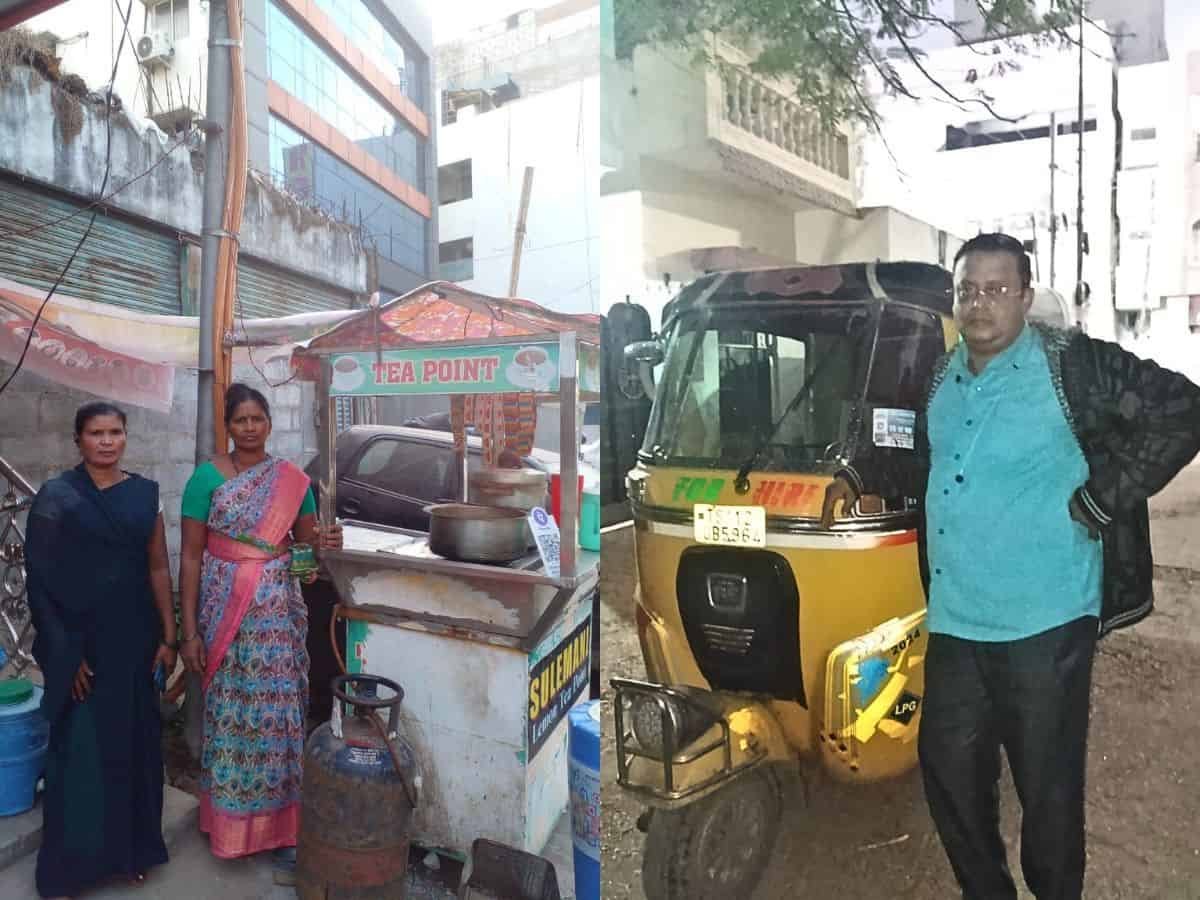
    Hyderabad: K Jamuna (38) and P Padma (40) are both sisters who migrated to Hyderabad from Munagala several years ago. Both have one thing in common. Their husbands had deserted them long ago, and they are hardworking Dalit single women.

    Refusing to be victimised, they have been working odd jobs in Hyderabad to earn a living and feed their children. For several months Jamuna has been running a tea stall and Padma has been selling coconuts on a footpath close to Moosarambagh bus stop.

    During the Greater Hyderabad Municipal Corporation’s (GHMC) special drive to clear footpaths recently as part of ‘Operation Rope’, their make-shift stalls (encroachments) were shut down.

    They don’t have a shelter in their native village in Suryapet district, as their brothers have been claiming ownership of their parents’ property. In Hyderabad, it is a struggle for survival, with Jamuna suffering heavy loss due to theft, when both her commercial cylinders and heavy utensils were stolen during the night by an unknown person and Padma becoming a victim of policy enforcement.

    They both live in small rented rooms close to where they were running their micro businesses.

    Mohd Ismail (45), an auto driver from Zeba Bagh, Asif Nagar, has 40% locomotor disability due to spinal fusion performed on his lower back (a rod inserted to support his spine). He pays Rs 300 per day for his rented auto rickshaw and feeds his family of five (including two daughters and a son) with whatever he earns.

    All these three individuals are connected with a single dream- to have their own house.

    Dream of owning a house

    While Padma and Jamuna applied for the Indiramma Illu housing scheme during the ‘Praja Palana’ special drive held to enroll beneficiaries of various state government schemes after Congress came to power; Ismail lost hope after applying for the 2BHK scheme in 2016 and 2018.

    “Both times the officials came to my house, and enquired about our socio-economic condition, but I couldn’t get a 2BHK allotment. Having lost hope, I didn’t apply for the Indiramma Illu scheme,” he tells Siasat.com.

    80.54L applications received for Indiramma Illu

    There are lakhs of people who share their plight, which has been reflected in the number of applications received for houses during the Praja Palana drive- 80.54 lakh prospective beneficiaries, which explains the seriousness of the housing crisis among the people living below the poverty line.

    According to revenue and housing minister Ponguleti Srinivas Reddy, during the BRS government, 1,52,000 2BHK houses were supposed to be built, among which 63,000 houses were constructed and given to the beneficiaries.

    Among the rest, 36,000 houses were built, but beneficiaries were not identified. There were around 52,000 houses among which even tenders were called for 40,000-odd houses, but works had not started, and for the rest of the 12,000-odd houses, no tenders were called.

    While this was the performance of the BRS government, on coming to power after the 2023 assembly elections, the Congress government announced the Indiramma Illu scheme for the poor as part of its six guarantees.

    Indiramma Illu specifics

    The scheme envisions giving Rs 5 lakh per house to beneficiaries owning land and also intends to build Indiramma housing colonies in villages and mandals for those who didn’t own any land.

    The major difference between the earlier 2BHK scheme and the Indiramma Illu scheme is that in the latter, the beneficiaries are given money by the government in four phases, during the four stages of the construction of houses.

    The beneficiaries have the liberty to model their houses as per their wishes, but the minimum extent of land for Indiramma Illu is 400 sq ft area, with a kitchen and bathroom/toilet made mandatory.

    What the Indiramma Illu survey says so far

    The Indiramma Illu mobile App that was launched on December 5 holds the key to the identification of beneficiaries.

    As of December 23, out of 80.54 lakh applications, the information of 32 lakh beneficiaries has been recorded in the Indiramma Illu app. The housing minister told the media that by the first week of January, all the applications will be registered, after which scrutiny of the applications will happen.

    Among the 32 lakh applications surveyed, 9,19,676 applications were of those having house sites, 1,22,438 were of those having RCC (concrete reinforced cement) constructions, 2,17,096 having asbestos roofs, 41,971 have either plastic or tarpaulin roofs, and 2,17,096 have a tiled roof.

    The 4-step check in identifying beneficiaries

    The state government plans 4 step check process to ensure that only the poorest of the poor beneficiaries are selected for the first phase of the project, which is to build 4.5 lakh houses in one year, and a total of 20 lakh houses in 4 years. The state government plans to construct 500 houses in each mandal headquarters, for which 474 sites have been identified.

    Construction works in mandal headquarters began in Adilabad, Bhadradri-Kothagudem, Mahabubabad, Asifabad, Khammam, Nagarkurnool, Nizamabad, and Vikarabad districts.

    The Indiramma Illu committees will hold gram sabhas in villages and ward sabhas in the municipalities/municipal corporations, and determine who will be the beneficiaries under the first phase.

    The Mandal Parishad Development Officer (MPDO)/ Municipal Commissioner will conduct a random check of 5% of the data captured in the mobile app.

    A district-level officer appointed by the district collector would be the third layer of checking the beneficiaries, and finally, a 360-degree system check will be done using artificial intelligence (AI).

    Website and toll-free number for lodging complaints

    The housing corporation plans to open a website where prospective beneficiaries can lodge complaints regarding any aspect of the scheme, and soon a toll-free number will be launched for the same purpose.

    Telangana Housing Corporation Ltd comes alive again

    The BRS government had shut down Telangana State Housing Corporation Ltd during its second term and deputed all the engineers in the department in other departments. After assuming power, the Congress government reopened the department and brought together the same engineers, to work on its flagship Indiramma Illu project.

    On Tuesday, December 24, Ponguleti Srinivas Reddy held an orientation/review meeting with the housing officials and gave promotion orders to some of them.

    The state government also deputed an executive engineer as project officer for the project in each district, to oversee its implementation.

    Zero tolerance towards corruption, minister warns officials

    Srinivas Reddy has made it amply clear to the housing officials to ensure that there is no scope for any corruption in the identification of the beneficiaries.

    He even went on to say that there would be zero tolerance if any official deviated from his direction of identifying the “poorest of the poor” beneficiaries under the scheme.

    He said that single women, widows, persons with disabilities, and those living in huts needed to be top priority.

    He asked the officials to first construct Indiramma Illu model houses near MPDO offices in every Mandal by the end of January.

    Status of incomplete 2BHKs

    Now, the issue remains as to what the state government plans to do with the 2BHK houses left incompletely constructed during the BRS government.

    Though there is no final decision taken on that subject, Ponguleti stressed the need to involve the beneficiaries in the completion of those houses, by removing the contractor system.

    Power to the beneficiaries

    He divided the 2BHK houses into three categories- the ones that are ready but beneficiaries haven’t been finalised, the ones that are nearing completion but beneficiaries haven’t been finalised, and the ones which are still in the early stages of construction, but contractors have deserted them midway.

    To finish the houses in the first category, the state government released Rs 196.46 crore on November 25, to provide all basic amenities that were not provided previously. However, according to officials, tenders were called for these works only in 7 districts out of 31 districts for which these works were intended.

    In the second category of houses left incomplete, Ponguleti asked the officials to finalise the beneficiaries and allot them houses so that they could be paid the residual amount of the work yet to be completed, which the beneficiaries could complete.

    “If we involve the beneficiaries the amount will not be misused, and they will add some more money to complete it if it falls short” he told the officials.

    Deliberations on multi-storeyed 2BHK towers in GHMC areas

    However, the complication here is with the multi-storeyed dignity housing (2BHK) complexes built during the BRS government, especially those where slabs have been laid but walls and other fixtures weren’t completed, and those buildings where foundations were laid but slabs weren’t constructed.

    The state government is deliberating the option of first convincing the earlier contractors to complete them and claim the bills, which the minister assured, would be paid between the 5th and 7th of every month.

    If the contractors are not ready to go ahead, the second option of letting the beneficiaries construct the walls, windows, and other fixtures is being considered.

    However, the total construction amount would have to be within Rs 5 lakh per unit limit, and there is no scope for further escalation of cost, which has clearly been communicated by the minister to the officials.

    One challenge here would be to empower the beneficiaries in G+9 2bhk dignity houses in GHMC areas, where 108 houses are supposed to be built in a single tower.

    Some officials are suggesting forming a committee of those beneficiaries, and releasing the residual funds to them directly; so that they can source the raw materials locally, which would also be cost-effective for them.

    In smaller municipalities, a 2BHK tower would have 25 houses, in a medium municipality it would be 50 houses in a tower, and in areas like GHMC, it would be over 100 houses in a tower.

    The minister has asked the officials to come up with a report with their suggestions about how the incomplete constructions could be completed and handed over to the beneficiaries who have been waiting for years.

    Plans for 4 LIG, MIG, HIG colonies around Hyderabad

    Ponguleti also announced that the state government was planning to construct housing colonies in four directions of the city, with houses to be constructed on a sprawling 100 acres in each of those colonies.

    In these housing colonies, Indiramma houses will be constructed for low-income, medium-income, and high-income groups, and they will be sold at a set price to those interested in owning them- on a no-loss-no-profit basis.

    Regarding Gruha Jyothi scheme

    On the question of what happened to the Gruha Jyothi scheme that was launched by the BRS government just before the 2023 Assembly elections where the beneficiaries were to be given Rs 3 lakh per house if they owned land, he alleged that only 600-700 houses were given under Gruha Jyothi, that too to those wearing “pink shirts” (BRS party leaders).

    “We have no problem in giving houses to those wearing pink shirts, but they will have to fall under the poorest of the poor category,” he added.

    The last hope for lakhs of beneficiaries

    The successful completion of the Indiramma Illu project and 2BHK houses would be the major deliverables of the Congress government in 2025 and for the poorest of the poor like Padma, Jamuna, Ismail, and lakhs of deserving beneficiaries like them, this Congress’ guarantee is the last glimmer of hope to live a life of dignity.

  • Indian share market opens flat, Nifty above 23,700

    Indian share market opens flat, Nifty above 23,700

    Mumbai: The Indian stock market opened flat on Tuesday amid positive global cues.

    At around 9:28 am, Sensex was trading at 78,588.23 after gaining 48.06 points or 0.06 per cent, while the Nifty was trading at 23,766.30 after gaining 12.85 points or 0.05 per cent.

    The market trend remained positive. On the National Stock Exchange (NSE), 1,302 stocks were trading in green, while 877 stocks were in red.

    According to experts, the relief rally witnessed yesterday is unlikely to have a free run up in the coming days.

    “Two sets of factors- external and internal- will restrain a sustained rally. Externally, the strong dollar and high bond yields in the US will prompt the FIIs to sell on rallies. Internally, the growth and earnings slowdown will be near-term negatives that will restrain the bulls.” They noted.

    Nifty Bank was down 80.55 points or 0.16 per cent at 51,237.05. Nifty Midcap 100 index was trading at 57,016.10 after dropping 76.80 points or 0.13 per cent. Nifty Smallcap 100 index was at 18,660.65 after dropping 27.15 points or 0.15 per cent.

    On the sectoral front, buying was seen in the auto, IT, FMCG and PSU bank sectors. Whereas, selling was seen in the financial services, pharma, metal and energy sectors.

    In the Sensex pack, Bharti Airtel, Tata Motors, TCS, Bajaj Finance, HDFC Bank, Infosys, ICICI Bank, L&T, Asian Paints, Maruti and SBI were the top gainers. Whereas, Zomato, Power Grid, Titan, NTPC, UltraTech Cement and IndusInd Bank were the top losers.

    The Dow Jones closed in the last trading session at 42,906.95 after gaining 0.16 per cent. The S&P 500 added 0.73 per cent to 5,974.07 and the Nasdaq gained 0.98 per cent to close at 19,764.88.

    In the Asian markets, except Seoul and Japan the markets of Hong Kong, China, Jakarta and Bangkok were trading in green.

    Foreign institutional investors (FIIs) sold equities worth Rs 168.71 crore on December 23, while domestic institutional investors bought equities worth Rs 2,227.68 crore on the same day.

  • Online pharmacy sector in India to see steady revenue growth next fiscal

    Online pharmacy sector in India to see steady revenue growth next fiscal

    New Delhi: The online pharmacy sector in the country will see steady revenue growth next fiscal, reducing operating losses to below 10 per cent from over 30 per cent in fiscal 2023, by sharpening focus on high-margin product segments and operational efficiencies, a report showed on Tuesday.

    E-pharmacies are eyeing sustainable growth by diversifying into high-margin segments such as wellness products and medical equipments, which are expected to comprise 40 per cent of sales next fiscal, up from about 30 percent now and under 15 per cent in fiscal 2023.

    “Players are also moving away from aggressive discounting to reduce key operating costs (discounting, delivery, distribution and employee — or DDDE) from around 65 percent in fiscal 2023 to below 35 percent next fiscal, which should help narrow losses and accelerate the move to profitability,” said Poonam Upadhyay, Director, CRISIL Ratings.

    While the sector will see steady revenue growth, securing timely equity funding will be essential for two key reasons: one, to secure the capital needed to maximise growth opportunities arising from under-penetration; and two, to effectively manage cash burn while supporting credit profiles during the expansion phase.

    According to the report, the e-pharmacy sector is in the early growth stage and faces significant operating losses due to high initial investments in technology, large inventory and supply chain inefficiencies.

    Attracting customers in a fragmented market also entails substantial spending on marketing and discounts, leading to high customer acquisition cost.

    Naren Kartic K, Associate Director, CRISIL Ratings, said that ongoing operating losses highlight the need for continued support from promoters, private equity investors and venture capitalists, as bank funding will be limited to working capital.

    “As e-pharmacies expand operations and aim to reduce losses, they will still incur cash losses and likely require additional equity funds of Rs 2,300 crore over this and next fiscals, following over Rs 9,200 crore already secured since fiscal 2020,” he mentioned.