I think, in the history of time right now, there’s always been the case where there have been rivalries. And I think that rivalries fuel leagues.
Now, when everybody has an opinion and an ability to express their opinion in social media and in Twitter, I think that it is our job, especially within the WNBA, to make sure that we regulate it. And it is a difficult balance of welcoming rivalry and all that comes with it, but also stopping the other discussions.
Let’s just be honest. Women in sports, it’s never just been about sports. It’s been about what you look like. It’s been about who you love. It’s been about how much money you make. It’s been about all of these other things other than just putting a ball in a hoop. And so I think that this has brought even more light onto that.
But, at the end of the day, I think that rivalries can be great. And within the league, it’s just about how you cultivate it and making sure that we’re holding the fans responsible.
I have no idea. To be honest, even when I was there, it was unclear who was in charge. At the end of the day, I guess Trump is in charge.
But I think DOGE will continue to do what it was doing, which, frankly, to me wasn’t that exciting. We were sitting in on a lot of meetings around contract review, making sure that we weren’t overspending on these big federal I.T. contracts. I think that should continue and will continue.
I guess there is this reduction in force that’s taking place over the federal government that the VA has said that they’re going to participate in. It was moving incredibly slow. I think, at VA specifically, more people were hired than fired during my tenure. I hope DOGE ships a lot of software.
Unfortunately, I think the admin appetite for shipping software, instead of just cutting things, is relatively low. Maybe that’s partly why Elon and co. are parted ways in the last week or so. So I assume that won’t really happen, but I would be very gracious as an American if paying taxes became easier, if the sort of broad experience of dealing with Social Security improved, et cetera.
So I wish them the best of luck, but they just don’t have a lot of resources to do what they set out to do in the beginning.
Sure. I think we see that everywhere. We refer to them as NIMBYs, not in my backyard. I have got the BANANAs as well, to build absolutely nothing or anything anywhere.
They exist, but they don’t understand. There are ways to build housing and have it be dignified. And that is crucial to this situation, is to build housing that isn’t your standard tract housing, isn’t your standard affordable, we will call it deeply affordable, that we all view as, oh, that’s the low-income stuff.
We just finished a development in Clearfield that’s about 400 units of both apartments and townhomes. And I toured people through there, through the various new developments within the city and said, pick the one that’s low-income. And not one of them could pick this out. So we went back and toured it, and they said, I cannot believe that this is low-income housing.
It was affordable. It’s the right place, and it’s done right. And it allows people to live with that dignity that they need to without saying, oh, yes, I live in the ghetto or in this deeply affordable housing.
In our news wrap Tuesday, South Korea’s liberal opposition leader Lee Jae-myung won the country’s presidential race, Russian rockets blasted the Ukrainian city of Sumy killing at least four, the White House sent the first recessions package to Congress and Newark’s mayor sued New Jersey’s top federal prosecutor over his arrest outside of an immigration detention center last month.
This morning in Gaza, they set out to end their hunger. They died hungry, more than two dozen killed before they could pick up food. Some died anonymously, their body bags marked “Name Unknown” next to the time of death.
For others, irreplaceable loss. Ahmed Zadan will never again see his mother. “Mom, please come back to me,” he says. “Please come back.”
Relatives say Reem Ahmed was killed trying to feed her family. Another son lays his head on his mother’s body one last time.
For Gazans, accessing the barest of necessities, beans, pasta, rice, has become a daily gamble with their lives. Often for crumbs.
Rasha Al-Nahal shows what little she managed to collect.
One of the strongest condemnations of Israel’s ongoing offensive in Gaza has come from its own former prime minister, Ehud Olmert, who served from 2006 to 2009. Last week, he wrote a scathing op-ed in the Israeli newspaper Haaretz with the headline “Enough Is Enough. Israel Is Committing War Crimes.” Geoff Bennett spoke with Olmert to discuss more.
SAN JUAN, Puerto Rico (AP) — A record amount of sargassum piled up across the Caribbean and nearby areas in May, and more is expected this month, according to a new report.
The brown prickly algae is suffocating shorelines from Puerto Rico to Guyana and beyond, disrupting tourism, killing wildlife and even releasing toxic gases that forced one school in the French Caribbean island of Martinique to temporarily close.
WATCH: Farmers turn to seaweed in attempt to reduce methane emissions from livestock
The amount — 38 million metric tons — is the biggest quantity of algae observed across the Caribbean Sea, the western and eastern Atlantic and the Gulf of Mexico since scientists began studying the Great Atlantic Sargassum Belt in 2011, said Brian Barnes, an assistant research professor at the University of South Florida who worked on the report published on Monday by the University of South Florida’s Optical Oceanography Lab.
The previous record was set in June 2022, with some 22 million metric tons.
“The peaks just seem to keep getting bigger and bigger year after year,” he said.
But scientists don’t know why yet.
“It’s the million-dollar question,” he said. “I don’t have a supremely satisfying answer.”
Three different types of sargassum exist in the Caribbean and nearby areas, reproducing asexually as they remain afloat thanks to tiny air sacs. They thrive in different ways depending on sunlight, nutrients and water temperature, factors that scientists are currently studying, Barnes said.
Experts also have said that agricultural runoff, warming waters and changes in wind, current and rain could have an effect.
While large clumps of algae in the open ocean are what Barnes called a “healthy, happy ecosystem” for creatures ranging from tiny shrimp to endangered sea turtles, sargassum near or on shore can wreak havoc.
It can block sunlight that coral reefs need to survive, and if the algae sinks, it can smother reefs and sea grasses. Once it reaches shore, the creatures living in the algae die or are picked off by birds, Barnes said.
Huge piles of stinky seaweed also are a headache for the Caribbean, where tourism often generates big money for small islands.
“It is a challenge, but it’s certainly not affecting every single inch of the Caribbean,” said Frank Comito, special adviser to the Caribbean Hotel and Tourism Association.
In the popular tourist spot of Punta Cana in the Dominican Republic, officials have invested in barriers to prevent sargassum from reaching the shore, he said.
In the Dutch Caribbean territory of St. Maarten, crews with backhoes were dispatched in late May as part of an emergency clean-up after residents complained of strong smells of ammonia and hydrogen sulfide, which can affect a person’s respiratory system.
“The smell is quite terrible,” Barnes said.
Meanwhile, in the French Caribbean, officials expect to soon use storage barges and an upgraded special vessel that can collect several tons of seaweed a day.
The sargassum “disfigures our coasts, prevents swimming and makes life impossible for local residents,” French Prime Minister François Bayrou recently told reporters.
But Comito said such vessels are “massively expensive” and not a popular option, noting that another option — using heavy equipment —- is labor-intensive.
“You have to be careful because there could be sea turtle eggs affected,” he said. “It’s not like you can go in there and massively rake and scrape the whole thing.”
Some Caribbean islands struggle financially, so most of the cleanup is done by hotels, with some offering guests refunds or a free shuttle to unaffected beaches.
Every year, the amount of sargassum expands in late spring, peaks around summer and starts to decline in the late fall or early winter, Barnes said.
The new record set is hardly stationary — experts said they expect even more sargassum for June.
Support PBS News Hour
Your donation makes a difference in these uncertain times.
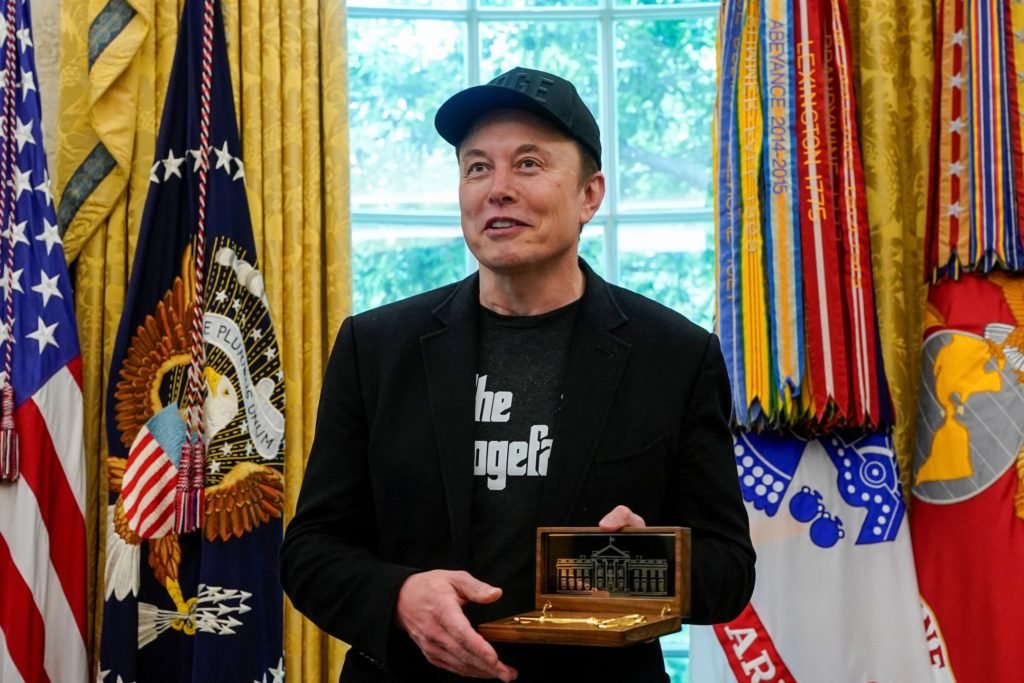
WASHINGTON (AP) — The White House on Tuesday officially asked Congress to claw back $9.4 billion in already approved spending, taking funding away from programs targeted by Elon Musk’s Department of Government Efficiency.
It’s a process known as “rescission,” which requires President Donald Trump to get approval from Congress to return money that had previously been appropriated. Trump’s aides say the funding cuts target programs that promote liberal ideologies.
READ MORE: What you need to know about impoundment, and how Trump vows to use it
The request, if it passes the House and Senate, would formally enshrine many of the spending cuts and freezes sought by DOGE. It comes at a time when Musk is extremely unhappy with the tax cut and spending plan making its way through Congress, calling it on Tuesday a “disgusting abomination” for increasing the federal deficit.
White House budget director Russ Vought said more rescission packages and other efforts to cut spending could follow if the current effort succeeds.
“We are certainly willing and able to send up additional packages if the congressional will is there,” Vought told reporters.
Read the full memo asking for recissions by Trump here:
Support PBS News Hour
Your donation makes a difference in these uncertain times.
WASHINGTON (AP) — The White House on Tuesday officially asked Congress to claw back $9.4 billion in already approved spending, taking funding away from programs targeted by Elon Musk’s Department of Government Efficiency.
It’s a process known as “rescission,” which requires President Donald Trump to get approval from Congress to return money that had previously been appropriated. Trump’s aides say the funding cuts target programs that promote liberal ideologies.
The request, if it passes the House and Senate, would formally enshrine many of the spending cuts and freezes sought by DOGE. It comes at a time when Musk is extremely unhappy with the tax cut and spending plan making its way through Congress, calling it on Tuesday a “disgusting abomination” for increasing the federal deficit.
Here’s what to know about the rescissions request:
Will the rescissions make a dent in the national debt?
The request to Congress is unlikely to meaningfully change the troublesome increase in the U.S. national debt. Tax revenues have been insufficient to cover the growing costs of Social Security, Medicare and other programs. The Congressional Budget Office estimates the government is on track to spend roughly $7 trillion this year, with the rescission request equaling just 0.1% of that total.
READ MORE: What you need to know about impoundment, and how Trump vows to use it
White House press secretary Karoline Leavitt told reporters at Tuesday’s briefing that White House budget director Russ Vought — a “well-respected fiscal hawk,” she called him — would continue to cut spending, hinting that there could be additional efforts to return funds.
“He has tools at his disposal to produce even more savings,” Leavitt said.
What programs are targeted by the rescissions?
A spokesperson for the White House Office of Management and Budget, speaking on condition of anonymity to preview some of the items that would lose funding, said that $8.3 billion was being cut from the State Department and the U.S. Agency for International Development. NPR and PBS would also lose federal funding.
The spokesperson listed specific programs that the Trump administration considered wasteful, including $750,000 to reduce xenophobia in Venezuela, $67,000 for feeding insect powder to children in Madagascar and $3 million for circumcision, vasectomies and condoms in Zambia.
Is the rescissions package likely to get passed?
Members of the House Freedom Caucus, among the chamber’s most conservative lawmakers, are calling on House Speaker Mike Johnson, R-La., to immediately bring the rescissions package to the floor “for swift passage.”
“We will support as many more rescissions packages the White House can send us in the coming weeks and months,” the group said in a press release. “Passing this rescissions package will be an important demonstration of Congress’s willingness to deliver on DOGE and the Trump agenda.”
Why does the administration need Congress’ approval?
The White House’s request to return appropriated funds is meant to comply with the 1974 Impoundment Control Act. That law created the process by which the president can formally disclose to Congress the appropriated money it intends to not spend. Congress then has 45 days to review and approve the request.
Bobby Kogan, senior director of federal budget policy at the Center for American Progress, a liberal think tank, said in an emailed statement that the Trump administration was already “illegally impounding additional funds,” as withholding money has “always been illegal without explicit Congressional approval.”
On CNN on Sunday, Vought insisted that the Trump administration was complying with the law, but it simply had a different view of the law relative to some Democrats.
“We’re not breaking the law,” Vought said. “Every part of the federal government, each branch, has to look at the Constitution themselves and uphold it, and there’s tension between the branches.”
Support PBS News Hour
Your donation makes a difference in these uncertain times.
Meta’s deal to help revive an Illinois nuclear power plant was one way of signaling that the parent company of Facebook and Instagram is preparing for a future built with artificial intelligence.
Meta’s 20-year deal with Constellation Energy follows similar maneuvers from Amazon, Google and Microsoft, but it will take years before nuclear energy can meet the tech industry’s insatiable demand for new sources of electricity.
WATCH: How artificial intelligence impacted our lives in 2024 and what’s next
AI uses vast amounts of energy, much of which comes from burning fossil fuels, which causes climate change. The unexpected popularity of generative AI products over the past few years has disrupted many tech companies’ carefully laid plans to supply their technology with energy sources that don’t contribute to climate change.
Even as Meta anticipates more nuclear in the future, its more immediate plans rely on natural gas. Entergy, one of the nation’s largest utility providers, has been fast-tracking plans to build gas-fired power plants in Louisiana to prepare for a massive Meta data center complex.
Is the U.S. ready for nuclear-powered AI?
France has touted its ample nuclear power — which produces about 75% of the nation’s electricity, the highest level in the world — as a key element in its pitch to be an AI leader. Hosting an AI summit in Paris earlier this year, French President Emmanuel Macron cited President Donald Trump’s “drill baby drill” slogan and offered another: “Here there’s no need to drill, it’s just plug baby plug.”
READ MORE: China says U.S. violating tariffs truce with moves on AI chips and student visas
In the U.S., however, most of the electricity consumed by data centers relies on fossil fuels — burning natural gas and sometimes coal — according to an April report from the International Energy Agency. As AI demand rises, the main source of new supply over the coming years is expected to be from gas-fired plants, a cheap and reliable source of power but one that produces planet-warming emissions.
Renewable energy sources such as solar and wind account for about 24% of data center power in the U.S., while nuclear comprises about 15%, according to the IEA. It will take years before enough climate-friendlier power sources, including nuclear, could start slowing the expansion of fossil fuel power generation.
A report released by the U.S. Department of Energy late last year estimated that the electricity needed for data centers in the U.S. tripled over the past decade and is projected to double or triple again by 2028 when it could consume up to 12% of the nation’s electricity.
Why does AI need so much energy?
It takes a lot of computing power to make an AI chatbot and the systems they’re built on, such as Meta’s Llama. It starts with a process called training or pretraining — the “P” in ChatGPT — that involves AI systems “learning” from the patterns of huge troves of data. To do that, they need specialized computer chips — usually graphics processors, or GPUs — that can run many calculations at a time on a network of devices in communication with each other.
Once trained, a generative AI tool still needs electricity to do the work, such as when you ask a chatbot to compose a document or generate an image. That process is called inferencing. A trained AI model must take in new information and make inferences from what it already knows to produce a response.
All of that computing takes a lot of electricity and generates a lot of heat. To keep it cool enough to work properly, data centers need air conditioning. That can require even more electricity, so most data center operators look for other cooling techniques that usually involve pumping in water.
Support PBS News Hour
Your donation makes a difference in these uncertain times.