
An extraordinary feud erupted into public view between President Trump and his one-time ally, Elon Musk. Trump said he was very disappointed in Musk for criticizing the GOP’s massive domestic policy bill. It came as the president also defended his sweeping new travel ban on citizens from 12 countries and restricted entry from seven more. White House correspondent Laura Barrón-López reports.
Category: World
-

Fans line up for the highly anticipated Nintendo Switch 2 around the world
TOKYO (AP) — Throngs of gamers stood in long lines outside of stores hours before they opened Thursday from Tokyo to New York City in hopes of snaring a long-awaited Nintendo Switch 2 video game console.
Enthusiasts have been clamoring for an upgrade to Nintendo’s eight-year-old predecessor for years. Nintendo, which is counting on the Switch 2 to boost sagging sales, has added new social features meant to lure players into online gaming.
READ MORE: ‘Overwhelming demand’ for Nintendo Switch 2 preorders creates frustrations for hopeful buyers
The much anticipated Switch 2, being released around the world Thursday, is an upgrade to its eight-year-old predecessor with new social features meant to draw players into online gaming. Nintendo is counting on the Switch 2 to boost sagging sales.
In the U.S., a chaotic pre-order process in April left some fans frustrated after the consoles quickly sold out. People lined up early Thursday at stores in hopes of buying one.
“I’m just rolling the dice here,” said Edgar Huo, who was in a line of about 25 outside of a Target in the Tribeca neighborhood of Manhattan, New York. Many of those waiting for the store to open had ordered online, but a few like Huo hoped for a chance at purchasing any extra inventory the store had.
READ MORE: 8 things you didn’t know about Super Mario Bros.
In Japan, the new consoles were sold through a competitive lottery system that Nintendo said got about 2.2 million applications.
Outside the official draw, some retailers offered their own lotteries to pre-order the devices.
Koji Takahashi was among those who missed out on the official draw but he was selected in the second round of a lottery held by a major electronics retailer in Japan.
He was first in line waiting outside the store, arriving four hours ahead of its opening. He hoped to secure a limited supply of Nintendo accessories to buy along with his pre-ordered Switch 2.
WATCH: The real-world influence of Nintendo’s newest hit ‘Legend of Zelda’ game
“I feel very sorry for those who weren’t successful in the lottery. But I also had tough time getting this far, so I hope they forgive me!” Takahashi said.
Nintendo of America President Doug Bowser told CBS Morning Plus today that the company is aware of the demand for its newest system and is working to get units into the hands of customers.
“We have a steady supply of manufacturing that will be coming in, and we believe we’ll be able to meet that demand all the way through the summer, through Father’s Day and then on into the holiday period also,” Bowser said.
The new console comes with a larger and higher resolution screen than its predecessor, with improved processing power, offering smoother and more vivid graphics. Central to its updated system is a new “C” button on its controller, which will launch a “GameChat” feature that requires a subscription to Nintendo’s Switch online service. It allows players to “communicate with friends and family while playing a game,” and lets them share their game screen with others. A built-in microphone will also allow chatting with other gamers.
Nintendo has said it expects to sell 15 million Switch 2 consoles for the fiscal year through March 2026.
The company also rolled out new Switch 2 editions for two of its popular “Legend of Zelda” games. A Pokemon title and a Kirby game are also coming, as well as offerings from outside video game publishers.
The Switch 2’s rollout arrives at an uncertain time for much of the gaming industry due to new tariffs implemented by U.S. President Donald Trump.
In the U.S., the Switch 2’s baseline launch price is $449.99 — significantly higher than the original Switch’s $299 price tag.
U.S. preorders for the Switch 2 were delayed for several weeks so the company could assess the potential impact of tariffs.
Support PBS News Hour
Your donation makes a difference in these uncertain times.
-
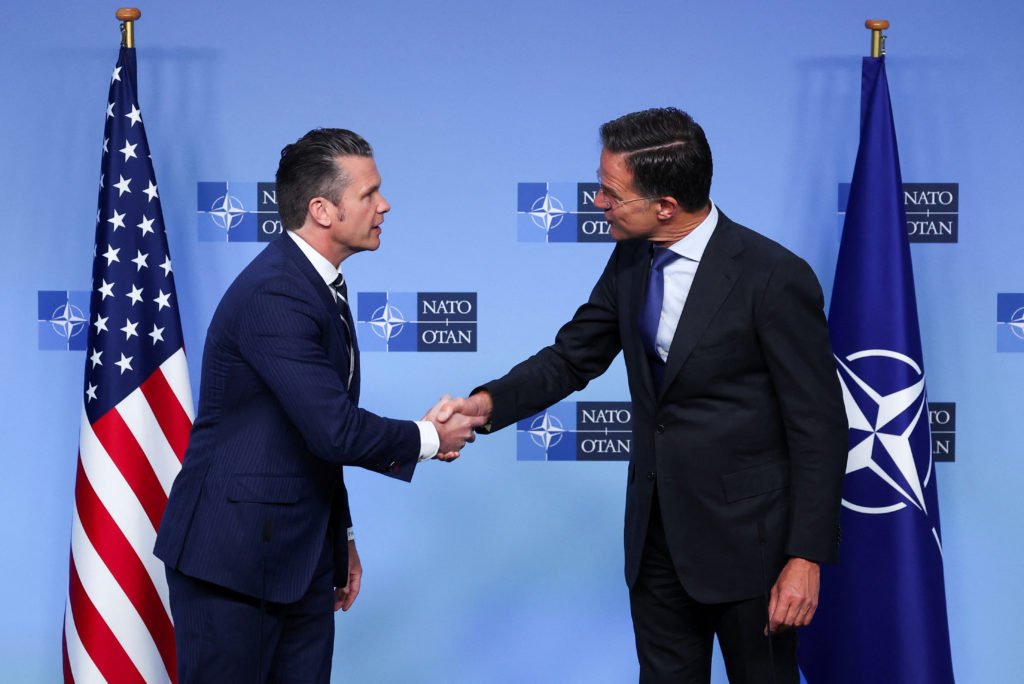
NATO chief says alliance is ‘really close’ to accepting Trump’s 5% defense investment demand
BRUSSELS (AP) — Most U.S. allies at NATO endorse President Donald Trump’s demand that they invest 5% of gross domestic product on their defense needs and are ready to ramp up security spending even more, NATO Secretary-General Mark Rutte said Thursday.
“There’s broad support,” Rutte told reporters after chairing a meeting of NATO defense ministers at the alliance’s Brussels headquarters. “We are really close,” he said, and added that he has “total confidence that we will get there” by the next NATO summit in three weeks.
WATCH: In Merz meeting, Trump says it might be better to let Ukraine and Russia ‘fight for a while’
European allies and Canada have already been investing heavily in their armed forces, as well as on weapons and ammunition, since Russia launched a full-scale invasion of Ukraine in 2022.
At the same time, some have balked at U.S. demands to invest 5% of GDP on defense — 3.5% on core military spending and 1.5% on the roads, bridges, airfields and sea ports needed to deploy armies more quickly.
Still struggling to meet the old goal
In 2023, as Russia’s full-scale war on Ukraine entered its second year, NATO leaders agreed to spend at least 2% of GDP on national defense budgets. So far, 22 of the 32 member countries have done so, and others still struggle to do so.
Trump and his NATO counterparts appear likely to endorse the new goal at a summit in The Hague on June 24-25. Trump insists that U.S. allies should spend at least 5% so America can focus on security priorities elsewhere, mostly in the Indo-Pacific and its own borders.
READ MORE: NATO weighs a US demand to massively hike defense spending as some struggle to meet the current goal
He has gained important leverage over the other NATO countries by casting doubt over whether the United States would defend allies that spend too little. At the same time, Trump has imposed tariffs on ally and foe alike, citing U.S. security concerns.
The new goal would involve a 1.5% increase over the current 2% goal for defense budgets. It means that all 32 countries would be investing the same percentage.
The United States spends by far more than any other ally in dollar terms.
But according to NATO’s most recent figures, it was estimated to have spent 3.19% of GDP in 2024, down from 3.68% a decade ago. It’s the only ally whose spending has dropped since 2014.
While the two new figures do add up to 5%, factoring in improvements to civilian infrastructure so that armies can deploy more quickly significantly changes the basis on which NATO traditionally calculates defense spending.
The seven-year time frame is also short by the alliance’s usual standards. The far more modest 2% target – set after Russia annexed Ukraine’s Crimean Peninsula in 2014 – was meant to be reached over a decade.
U.S. leadership at NATO
According to U.S. Defense Secretary Pete Hegseth, Trump has done nothing less than save NATO.
He told reporters that European allies around the table on Thursday had said: “We hear you. We all need increased capabilities. We all need to spend more. Thank you, President Trump, for reviving this alliance. It was an alliance that was sleepwalking to irrelevance.”
The extra spending will also be needed should the Trump administration announce a force draw down in Europe, where around 84,000 U.S. troops are based, leaving European allies to plug any security gaps.
READ MORE: Zelenskyy asks Western allies to boost air defense deliveries as Hegseth skips Ukraine meeting
Asked what the Pentagon’s plans are, Hegseth did not explain but he said: “It would only be responsible for the United States to continually assess our force posture, which is precisely what we’ve done.”
“America can’t be everywhere all the time, nor should we be, and so there are reasons why we have troops in certain places,” he said, offering the assurance that any review would be done “alongside our allies and partners to make sure it’s the right size.”
Endorsing “capability targets”
During the meeting, Hegseth and his defense counterparts also approved purchasing targets for stocking up on weapons and military equipment to better defend Europe, the Arctic and the North Atlantic, as part of the U.S. push to ramp up security spending.
The “capability targets” lay out goals for each of the 32 nations to purchase priority equipment like air defense systems, long-range missiles, artillery, ammunition, drones and “strategic enablers” such as air-to-air refueling, heavy air transport and logistics. Each nation’s plan is classified, so details are scarce.
The new targets are assigned by NATO based on a blueprint agreed upon in 2023 — the military organization’s biggest planning shakeup since the Cold War — to defend its territory from an attack by Russia or another major adversary.
Under those plans, NATO would aim to have up to 300,000 troops ready to move to its eastern flank within 30 days, although experts suggest the allies would struggle to muster those kinds of numbers.
The member countries are assigned roles in defending NATO territory across three major zones — the high north and Atlantic area, a zone north of the Alps, and another in southern Europe.
NATO planners believe that the targets must be met within 5-10 years, given the speed at which Russia is building its armed forces now, and which would accelerate were any peace agreement reached to end its war on Ukraine.
Support PBS News Hour
Your donation makes a difference in these uncertain times.
-
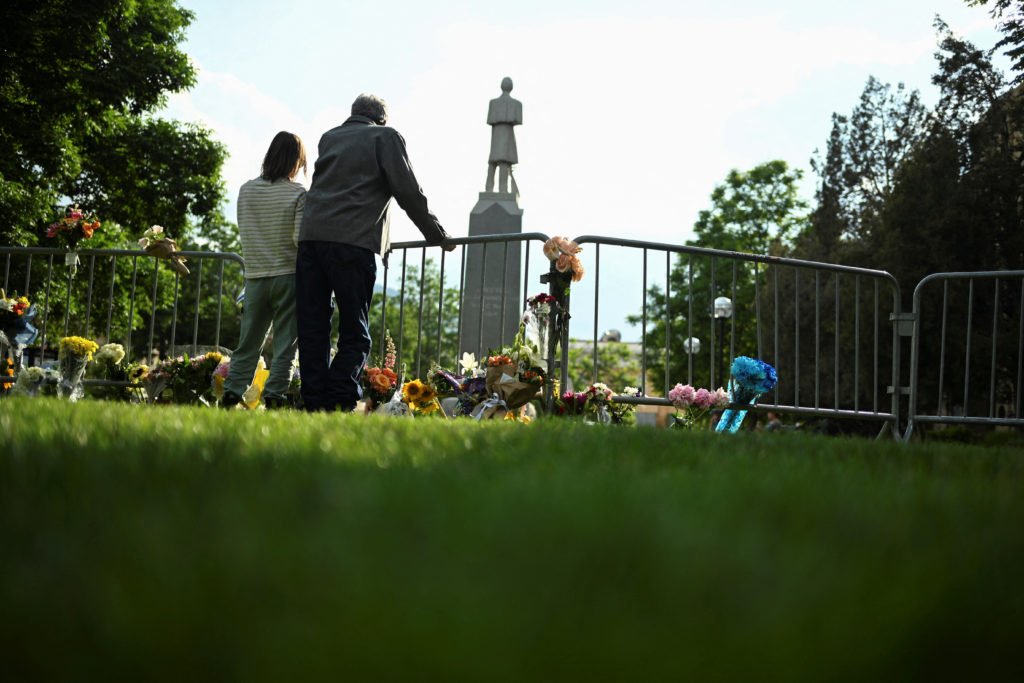
Victims of Boulder firebombing attack honored with vigil as suspect’s family fights deportation
BOULDER, Colo. (AP) — Hundreds of people squeezed into the Jewish Community Center in Boulder, Colorado, for a vigil that featured prayer, singing and emotional testimony from a victim and witnesses of the firebombing attack in the city’s downtown, after a federal judge blocked the deportation of the suspect’s family.
Mohamed Sabry Soliman, 45, has been charged with a federal hate crime and state counts of attempted murder in Sunday’s attack on a group demonstrating for the release of Israeli hostages in Gaza. He is being held in a county jail on a $10 million cash bond and is scheduled to make an appearance in state court on Thursday afternoon.
READ MORE: Immigration authorities detain family of man charged in Boulder attack
Witnesses say Soliman threw two Molotov cocktails at the group and yelled “Free Palestine,” while authorities say he confessed to the attack that injured 15 people.
Rachelle Halpern, who has been walking with the group since 2023, said during Wednesday evening’s vigil that she remembers thinking it was strange to see a man with a canister looking like he was going to spray pesticide on the grass. Then she heard a crash and screams and saw flames around her feet.
“A woman stood one foot behind me, engulfed in flames from head to toe, lying on the ground with her husband,” she said. “People immediately, three or four men immediately rushed to her to smother the flames.”
Her description prompted murmurs from the audience members. One woman’s head dropped into her hands.
“I heard a loud noise, and the back of my legs burning, and don’t remember those next few moments,” said a victim, who didn’t want to be identified and spoke off camera, over the event’s speakers. “Even as I was watching it unfold before my eyes, even then, it didn’t seem real.”
The attack unfolded against the backdrop of the Israel-Hamas war, which has contributed to a spike in antisemitic violence in the United States. It happened at the beginning of the Jewish holiday of Shavuot and barely a week after a man who also yelled “Free Palestine” was charged with fatally shooting two Israeli Embassy staffers outside a Jewish museum in Washington.
Defendant’s family investigated
U.S. District Judge Gordon P. Gallagher on Wednesday granted a request to block the deportation of Soliman’s wife and five children, who like Soliman are Egyptian. U.S. immigration officials took them into custody Tuesday, but they have not been charged in the attack.
Federal authorities have said Soliman has been living in the U.S. illegally, and U.S. Secretary of Homeland Security Kristi Noem said Wednesday that the family was being processed for removal. It’s rare that a criminal suspect’s family members are detained and threatened with deportation.
READ MORE: What we know about the man charged in the attack in Boulder, Colorado
“It is patently unlawful to punish individuals for the crimes of their relatives,” attorneys for the family wrote in a lawsuit filed Wednesday afternoon.
A placard saying “Boulder strong” is displayed on a makeshift memorial outside the Boulder Courthouse, days after an attack that injured multiple people in Boulder, Colorado, June 4, 2025. Photo by Mark Makela/ Reuters
Department of Homeland Security Assistant Secretary Tricia McLaughlin described the plaintiff’s claims as “absurd” and “an attempt to delay justice.” She said the entire family was in the country illegally.
Soliman’s wife, Hayam El Gamal, a 17-year-old daughter, two minor sons and two minor daughters were being held at an immigration detention center in Texas, said Eric Lee, one of the attorney’s representing the family.
Soliman told authorities that no one, including his family, knew he was planning an attack, according to court documents. El Gamal said she was “shocked” to learn her husband had been arrested in the attack, according to her lawsuit.
Victims increase to 15 people and a dog
On Wednesday, authorities raised the number of people injured in the attack to 15 from 12, plus a dog.
Boulder County officials said in a news release that the victims include eight women and seven men ranging in age from 25 to 88. Details about how the victims were impacted would be explained in criminal charges set to be filed Thursday, according to Boulder County District Attorney’s office spokesperson Shannon Carbone.
Soliman had planned to kill all of the roughly 20 participants in Sunday’s demonstration at the popular Pearl Street pedestrian mall, but he threw just two of his 18 Molotov cocktails while yelling “Free Palestine,” police said.
According to an FBI affidavit, Soliman told police he was driven by a desire “to kill all Zionist people” — a reference to the movement to establish and protect a Jewish state in Israel. Authorities said he expressed no remorse about the attack.
The family’s immigration status
Before moving to Colorado Springs three years ago, Soliman spent 17 years in Kuwait, according to court documents.
He arrived in the U.S. in August 2022 on a tourist visa that expired in February 2023, McLaughlin said in a post on X. She said Soliman filed for asylum in September 2022 and was granted a work authorization in March 2023, but that has also expired.
Hundreds of thousands of people overstay their visas each year in the United States, according to Department of Homeland Security reports.
Soliman’s wife is an Egyptian national, according to her lawsuit. She is a network engineer and has a pending EB-2 visa, which is available to professionals with advanced degrees, the suit said. She and her children all are listed as dependents on Soliman’s asylum application.
Golden reported from Seattle. Associated Press reporters Eric Tucker in Washington, Heather Hollingsworth in Kansas City, Missouri, Samy Magdy in Cairo, Hannah Schoenbaum in Salt Lake City, Sean Murphy in Oklahoma City contributed to this report.
Support PBS News Hour
Your donation makes a difference in these uncertain times.
-

Massachusetts student arrested by ICE on his way to volleyball practice has been released
CHELMSFORD, Mass. (AP) — A Massachusetts high school student who was arrested by immigration agents on his way to volleyball practice has been released from custody after a judge granted him bond Thursday.
Marcelo Gomes da Silva, 18, who came to the U.S. from Brazil at age 7, was detained by U.S. Immigration and Customs Enforcement agents Saturday. Authorities have said the agents were looking for the Milford High School teenager’s father, who owns the car Gomes da Silva was driving at the time and had parked in a friend’s driveway.
“It shouldn’t have happened in the first place. This is all a waste,” his lawyer, Robin Nice, told reporters after a hearing in Chelmsford. Gomes da Silva, who was expected to be released Thursday afternoon on $2,000 bond, appeared via video from elsewhere in Massachusetts.
READ MORE: Immigration authorities detain family of man charged in Boulder attack
“We disrupted a kid’s life. We just disrupted a community’s life,” Nice said. “These kids should be celebrating graduation and prom, I assume? They should be doing kid stuff, and it is a travesty and a waste of our judicial process to have to go through this.”
She said Gomes da Silva slept on the cement floor of a room holding 25 to 35 men, many twice his age, most of the time he was detained, with no windows, no time outside and no permission to shower. He was able to brush his teeth twice. Nice said that at one point Gomes da Silva asked for a Bible and was denied.
He went to the hospital Wednesday because he had concerns about a concussion he received before he was detained and was suffering from a bad cold, Nice said.
READ MORE: Top immigration official defends tactics as arrests rise nationwide
“He’s looking forward to eating Snickers and chicken nuggets when he is released,” she said.
Not ICE’s target, but detained anyway
U.S. Department of Homeland Security spokesperson Tricia McLaughlin said earlier this week that ICE officers were targeting a “known public safety threat” and that Gomes da Silva’s father “has a habit of reckless driving at speeds in excess of 100 miles per hour through residential areas.”
“While ICE officers never intended to apprehend Gomes da Silva, he was found to be in the United States illegally and subject to removal proceedings, so officers made the arrest,” she said in a statement.
Acting ICE Director Todd Lyons said Monday that “like any local law enforcement officer, if you encounter someone that has a warrant or … he’s here illegally, we will take action on it.”
Gomes da Silva initially entered the country on a visitor visa and was later issued a student visa that has since lapsed, Nice said. She described him as deeply rooted in his community and a dedicated member of both the school marching band and a band at his church.
The immigration judge set a placeholder hearing date for a couple of weeks from Thursday, but it might take place months from that, Nice said.
“We’re optimistic that he’ll have a future in the United States,” she said.
A federal judge considering Gomes da Silva’s request to be released while his immigration case proceeds has given the government until June 16 to respond and ordered that Gomes da Silva not be moved out of Massachusetts without 48 hours’ notice given to the court. The government sought permission Wednesday to move Gomes da Silva to a detention facility in a different New England state, Nice said. A judge quickly denied the request.
A shaken community
“I love my son. We need Marcelo back home. It’s no family without him,” João Paulo Gomes Pereira said in a video released Wednesday. “We love America. Please, bring my son back.”
The video showed the family in the teen’s bedroom. Gomes da Silva’s sister describes watching movies with her brother and enjoying food he cooks for her: “I miss everything about him.”
Students at Milford High staged a walkout Monday to protest his detainment. Other supporters wore white and packed the stands of the high school gymnasium Tuesday night, when the volleyball team dedicated a match to their missing teammate.
Hanna Ghannan, who graduated from the school the day after Gomes de Silva was detained, was among those cheering outside the courthouse as the news came that her classmate would be let out on bond.
“I’m just happy that everyone’s coming to together as a community because there is a lot of hate — and I mean a lot of hate,” she said.
Amani Jack, also a recent Milford High graduate, said her classmate’s absence loomed large over the graduation ceremony, where he was supposed to play in the band. She said if she had a chance to speak with the president, she’d ask him to ‘just put yourself in our shoes.’
“He did say he was going to deport criminals,” she said. “Marcelo is not a criminal. He’s a student. I really want him to take a step in our shoes, witnessing this. Try and understand how we feel. We’re just trying to graduate high school.”
Veronica Hernandez, a family advocate from Medford who said she works in a largely Hispanic community where ICE has had an active presence, said cases like Gomes da Silva’s show immigration enforcement is serious about taking “anybody” without legal status, not just those accused of crimes.
“I think seeing that something so simple as a child driving themselves and their friends to volleyball practice at risk struck a chord,” she said.
Associated Press reporter Kathy McCormack in Concord, New Hampshire, contributed to this story.
Support PBS News Hour
Your donation makes a difference in these uncertain times.
-

Ukrainian drone attack on Russian air bases is lesson for West on vulnerabilities
The targets were Russian warplanes, including strategic bombers and command-and-control aircraft, worth hundreds of millions of dollars. The weapons were Ukrainian drones, each costing under $1,000 and launched from wooden containers carried on trucks.
“Operation Spiderweb,” which Ukraine said destroyed or damaged over 40 aircraft parked near air bases across Russia on Sunday, wasn’t just a blow to the Kremlin’s prestige. It was also a wake-up call for the West to bolster its air defense systems against such hybrid tactics, military experts said.
Ukraine took advantage of inexpensive drone technology that has advanced rapidly in the last decade and combined it with outside-the-box thinking to score a morale-boosting win in the 3-year-old war that lately has turned in Moscow’s favor.
How deeply the attack will impact Russian military operations is unclear. Although officials in Kyiv estimated it caused $7 billion in damage, the Russian Foreign Ministry disputed that, and there have been no independent assessments. Moscow still has more aircraft to launch its bombs and cruise missiles against Ukraine.
Still, the operation showed what “modern war really looks like and why it’s so important to stay ahead with technology,” said Ukrainian President Volodymyr Zelenskyy.
Where the West is vulnerable
For Western governments, it’s a warning that “the spectrum of threats they’re going to have to take into consideration only gets broader,” said Douglas Barrie, senior fellow for military aerospace at the International Institute of Strategic Studies in London.
In the past decade, European countries have accused Russia of carrying out a sabotage campaign against the West, with targets ranging from defense executives and logistics companies to businesses linked to Ukraine. Unidentified drones have been seen in the past year flying near military bases in the U.S., the U.K and Germany, as well as above weapons factories in Norway.
High-value weapons and other technology at those sites are “big, juicy targets for both state and non-state actors,” said Caitlin Lee, a drone warfare expert at RAND in Washington.
“The time is now” to invest in anti-drone defenses, she said.
Low-cost options to protect aircraft include using hardened shelters, dispersing the targets to different bases and camouflaging them or even building decoys.
U.S. President Donald Trump last month announced a $175 billion “Golden Dome” program using space-based weapons to protect the country from long-range missiles.
WATCH: As delegations meet for ceasefire talks, Russia reels from Ukrainian drone attacks
Not mentioned were defenses against drones, which Lee said can be challenging because they fly low and slow, and on radar can look like birds. They also can be launched inside national borders, unlike a supersonic missile fired from abroad.
Drones “dramatically increase” the capacity by a hostile state or group for significant sabotage, said Fabian Hinz, a missile expert and research fellow at IISS.
“How many targets are there in a country? How well can you defend every single one of them against a threat like that?” he said.
A satellite image shows destroyed aircrafts in the aftermath of a drone strike at the Olenya air base, Murmansk region, Russia, June 4, 2025, Maxar Technologies/Handout via REUTERS
Ukraine’s resourceful, outside-the-box thinking
In “Operation Spiderweb,” Ukraine said it smuggled the first-person view, or FPV, drones into Russia, where they were placed in the wooden containers and eventually driven by truck close to the airfields in the Irkutsk region in Siberia, the Murmansk region in the Arctic, and the Amur region in the Far East, as well as to two bases in western Russia.
Ukraine’s Security Service, or SBU, said the drones had highly automated capabilities and were partly piloted by an operator and partly by using artificial intelligence, which flew them along a pre-planned route in the event the drones lost signal. Such AI technology almost certainly would have been unavailable to Ukraine five years ago.
SBU video showed drones swooping over and under Russian aircraft, some of which were covered by tires. Experts suggested the tires could have been used to confuse an automatic targeting system by breaking up the plane’s silhouette or to offer primitive protection.
“The way in which the Ukrainians brought this together is creative and obviously caught the Russians completely off guard,” Barrie said.
Satellite photos analyzed by The Associated Press showed seven destroyed bombers on the tarmac at Irkutsk’s Belaya Air Base, a major installation for Russia’s long-range bomber force. At least three Tu-95 four-engine turboprop bombers and four Tu-22M twin-engine supersonic bombers appear to be destroyed.
Since the beginning of Russia’s full-scale invasion in 2022, the outgunned and outnumbered Ukrainian military has adopted a creative approach to warfare. Its forces deployed wooden decoys of expensive U.S. HIMARS air defense systems to draw Russia’s missile fire, created anti-drone units that operate on pickup trucks, and repurposed captured weapons.
Experts compared Sunday’s attack to Israel’s operation last year in which pagers used by members of the militant group Hezbollah exploded almost simultaneously in Lebanon and Syria. Israel also has used small, exploding drones to attack targets in Lebanon and Iran.
The U.S. used Predator drones more than a decade ago to kill insurgents in Afghanistan from thousands of miles away. Developments in technology have made those capabilities available in smaller drones.
Hinz compared the state of drone warfare to that of the development of the tank, which made its debut in 1916 in World War I. Engineers sought to work out how to best integrate tanks into a working battlefield scenario — contemplating everything from a tiny vehicle to a giant one “with 18 turrets” before settling on the version used in World War II.
With drones, “we are in the phase of figuring that out, and things are changing so rapidly that what works today might not work tomorrow,” he said.
How the attack affects Russian operations in Ukraine
The Tu-95 bombers hit by Ukraine are “effectively irreplaceable” because they’re no longer in production, said Hinz, the IISS expert. Ukraine said it also hit an A-50 early warning and control aircraft, similar to the West’s AWACS planes, that coordinate aerial attacks. Russia has even fewer of these.
“Whichever way you cut the cake for Russia, this requires expense,” said Thomas Withington of the Royal United Services Institute in London. “You can see the billions of dollars mounting up,”
Russia must repair the damaged planes, better protect its remaining aircraft and improve its ability to disrupt such operations, he said. Experts also suggested the strikes could force Moscow to speed up its program to replace the Tu-95.
While underscoring Russian vulnerabilities, it’s not clear if it will mean reduced airstrikes on Ukraine.
Russia has focused on trying to overwhelm Ukraine’s air defenses with drones throughout the war, including the use of decoys without payloads. On some nights last month, Moscow launched over 300 drones.
“Even if Ukraine was able to damage a significant portion of the Russian bomber force, it’s not entirely clear that the bomber force was playing a linchpin role in the war at this point,” Lee said.
Ukrainian air force data analyzed by AP shows that from July 2024 through December 2024, Russia used Tu-22M3s and Tu-95s 14 times against Ukraine but used drones almost every night.
Sunday’s operation might temporarily reduce Russia’s ability to launch strategic missile attacks but it will probably find ways to compensate, Lee said.
Associated Press writer Hanna Arhirova in Kyiv, Ukraine, contributed.
Support PBS News Hour
Your donation makes a difference in these uncertain times.
-

Should you use a buy now, pay later loan? Here’s what to know
Buy now, pay later programs are everywhere.
Unlike layaway programs, buy now, pay later programs let you purchase goods immediately, paying them off over time through a loan from a third party company, like Klarna, Afterpay or Affirm.
More than one in five consumers with a credit record in 2022 used buy now, pay later programs, according to a report released this year by the Consumer Financial Protection Bureau.
But reports from Klarna and other financial services companies show that over the past year, a growing number of users are falling behind on their payments.
Here’s a look at why these loans have become so popular and what consumers should keep in mind to protect themselves.
How do buy now, pay later programs work?
Buy now, pay later programs are loans that can either be repaid in a series of interest-free payments, typically due every two weeks, or in longer-term plans that can stretch over a year or more.
These programs have grown in popularity among younger consumers, who might be starting out at a new job, or stretching an entry-level paycheck, said Michelle Singletary, a personal finance expert and columnist for the Washington Post. “But we are seeing more and more customers using it, not just young customers, but lots of times they’re people who are strapped for money, who are struggling.”
For someone temporarily short on funds or a consumer who has a low credit score and without a credit card, an interest-free loan can help bridge the gap between paychecks. Buy now, pay later loans may not involve a credit check at all, or only require a soft credit check, which won’t affect your score.
“If you know that you’ve got money coming in, and you need to buy something, and you just need a little bit of room to make the payments over time, then I can see that it would be a good choice for you,” Singletary said.
What are the risks of buy now, pay later loans?
The promise of buy now, pay later is enticing. But, an interest-free loan is not free if you miss a payment. If you select a plan that does accrue interest, rates can climb as high as 36%.
And, buy now, pay later companies like Affirm have begun reporting loans to credit rating agencies.
“We really don’t want that to happen,” Singletary said. “That could have long-term consequences for those who are looking for, say a mortgage or auto loan, or even your car insurance.”While taking out these loans can be as easy as one click, they can quickly add up. An estimated 60% of BNPL users had taken out multiple such
loans, according to figures from the Consumer Financial Protection Bureau.This comes as the Federal Reserve Bank of New York saw total consumer debt reach a record $18.2 trillion in the first quarter of 2025.
“While BNPL provides credit to financially vulnerable consumers, these same consumers may be overextending themselves,” the Federal Reserve said in a 2024 study. The study also confirmed previous findings that “BNPL use leads to an increase in overdraft fees and credit card interest payments and fees.”
How are buy now, pay later programs different from credit cards?
One major difference between buy now, pay later programs and credit cards lies in how each is regulated.
Under the Biden administration, buy now, pay later came under the same regulations as credit cards, which means consumers can demand refunds, dispute transitions and be protected from being charged multiple fees for the same missed payment. However, the CFPB under the Trump administration said it does not plan to enforce that rule.
“I was encouraged when the CFPB was looking at this, making sure that [BNPL programs] are going to be affordable for consumers,” Singletary said. “However, under the Trump administration, a lot of that has been pulled back. There isn’t the strong consumer watchdog that was there under the Biden administration. And that concerns me greatly because we need to protect consumers,” she said.
“It seems so easy and it seems so affordable when you break it up,” Singletary said. It could be a good way to bridge paychecks or fill in gaps, especially if you don’t have a credit card. “But if you’ve got 100 here, 200 there, 300 there, next thing you know your paycheck comes in and you’re like, where’s all my money going?”
Singletary’s caution: “If you do this repeatedly, you’ll dig yourself in a hole that you might not be able to come out of.”
Support PBS News Hour
Your donation makes a difference in these uncertain times.
-

WATCH: Trump says he’s ‘very disappointed’ in Elon Musk after criticism of president’s budget bill
President Donald Trump said Thursday that he was “very disappointed” in Elon Musk after the billionaire criticized the administration’s spending bill making its way through Congress.
Watch in our video player above.
The president said he was surprised after Musk said earlier this week that the so-called Trump “big, beautiful” bill was a “disgusting abomination.”
WATCH: In Merz meeting, Trump says it might be better to let Ukraine and Russia ‘fight for a while’
Musk appeared on the campaign trail with Trump and also spent over $250 million during last year’s presidential election. Until last week, he led a Trump administration initiative that purported to clean up waste, fraud and abuse in the federal government.
“Elon and I had a great relationship. I don’t know if we will anymore,” the president said during an Oval Office meeting with German Chancellor Friedrich Merz that was opened up to reporters.
The president said that Musk “knew the inner workings” of the bill better than many in his administration and “had no problem with it.” Following the meeting and in response, Musk called the president’s comments “false” and said the bill “was never shown to me even once.”
WATCH: House Speaker Johnson says Musk did ‘a 180’ in publicly opposing tax bill
The president said Musk, who is also the co-founder and CEO of Tesla Motors, was unhappy about the action the administration has taken to reverse a goal set by former President Joe Biden to increase the number of electric vehicles in the United States. Trump also noted that he pulled the nomination of Jared Isaacman, someone Musk recommended, to lead NASA.
“He said the most beautiful things about me. He hasn’t said bad about me personally, but I’m sure that’ll be next,” the president said of Musk. “But, I’m very disappointed in Elon. I’ve helped Elon a lot.”
Support PBS News Hour
Your donation makes a difference in these uncertain times.
-

Israel recovers bodies of 2 Israeli-American hostages from Gaza Strip
TEL AVIV, Israel (AP) — Israel has recovered the bodies of two Israeli-American hostages taken in Hamas’ Oct. 7, 2023, attack that ignited the war in the Gaza Strip.
Israeli strikes overnight and into Thursday meanwhile killed at least 13 people, including three local journalists who were in the courtyard of a hospital, according to health officials in the territory. The military said it targeted a militant in that strike.
Prime Minister Benjamin Netanyahu said the remains of Judih Weinstein and Gad Haggai were recovered and returned to Israel in a special operation by the army and the Shin Bet internal security agency.
“Together with all the citizens of Israel, my wife and I extend our heartfelt condolences to the dear families. Our hearts ache for the most terrible loss. May their memory be blessed,” he said in a statement.
Kibbutz Nir Oz announced the deaths of Weinstein, 70, and Haggai, 72, both of whom had Israeli and U.S. citizenship, in December 2023. Weinstein was also a Canadian citizen.
The military said they were killed in the Oct. 7 attack and taken into Gaza by the Mujahideen Brigades, the small armed group that it said had also abducted and killed Shiri Bibas and her two small children. The army said it recovered the remains of Weinstein and Haggai overnight into Thursday from the southern Gaza city of Khan Younis.
A teacher who helped children and a chef who played jazz
The couple were taking an early morning walk near their home in Kibbutz Nir Oz on the morning of Oct. 7 when Hamas militants stormed across the border and rampaged through several army bases and farming communities.
In the early hours of the morning, Weinstein was able to call emergency services and let them know that both she and her husband had been shot, and send a message to her family.
Weinstein was born in New York and taught English to children with special needs at Kibbutz Nir Oz, a small community near the Gaza border. The kibbutz said she also taught meditation techniques to children and teenagers who suffered from anxiety as a result of rocket fire from Gaza. Haggai was a retired chef and jazz musician.
“My beautiful parents have been freed. We have certainty,” their daughter, Iris Haggai Liniado, wrote in a Facebook post. She thanked the Israeli military, the FBI and the Israeli and U.S. governments and called for the release of all the remaining hostages.
The couple were survived by two sons, two daughters and seven grandchildren, the kibbutz said.
Reporters among 13 killed in Israeli strikes
At least 10 Palestinians were killed in Israeli strikes in Khan Younis overnight, according to Nasser Hospital, which received the bodies. It was not immediately clear if the strikes were related to the recovery mission.
WATCH: Israeli attack survivor describes moment Hamas militants kidnapped her husband
In Gaza City, three local reporters were killed and six people were wounded in a strike on the courtyard of the al-Ahli Hospital, according to Gaza’s Health Ministry. It did not immediately identify the journalists or say which outlets they worked for.
The Israeli military said it struck an Islamic Jihad militant operating in the courtyard. The army says it only targets militants and blames civilian deaths on Hamas because it is embedded in populated areas.
Over 180 journalists and media workers have been killed since the start of the Israel-Hamas war, the vast majority of them in Gaza, according to the New York-based Committee to Protect Journalists. Israel has said many of those killed in its strikes were militants posing as reporters.
Hamas-led militants killed some 1,200 people, mostly civilians, in the Oct. 7 attack and abducted 251 hostages. They are still holding 56 hostages, around a third of them believed to be alive, after most of the rest were released in ceasefire agreements or other deals. Israeli forces have rescued eight living hostages from Gaza and recovered dozens of bodies.
Israel’s military campaign has killed more than 54,000 Palestinians, mostly women and children, according to the Gaza Health Ministry, which does not say how many of the dead were civilians or combatants. The offensive has destroyed large parts of Gaza and displaced around 90% of its population of roughly 2 million Palestinians.
Ceasefire talks deadlocked
The United States, Egypt and Qatar have been trying to broker another ceasefire and hostage release after Israel ended an earlier truce in March and imposed a blockade that has raised fears of famine, despite being eased in recent weeks. But the talks appear to be deadlocked.
Hamas says it will only release the remaining hostages in return for more Palestinian prisoners, a lasting ceasefire and an Israeli withdrawal from Gaza. It has offered to hand over power to a politically independent Palestinian committee.
Netanyahu has rejected those terms, saying Israel will only agree to temporary ceasefires to facilitate the return of hostages. He has vowed to continue the war until all the hostages are returned and Hamas is defeated or disarmed and sent into exile.
He has said Israel will maintain control over Gaza indefinitely and will facilitate what he refers to as the voluntary emigration of much of its population to other countries. The Palestinians and much of the international community have rejected such plans, viewing them as forcible expulsion that could violate international law.
Melzer reported from Nahariya, Israel and Shurafa from Deir al-Balah, Gaza Strip. Associated Press writer Kareem Chehayeb in Beirut contributed.
Support PBS News Hour
Your donation makes a difference in these uncertain times.
-

Supreme Court sides with Catholic Charities in unemployment taxes and religious-rights case
WASHINGTON (AP) — The Supreme Court decided Thursday that a Catholic charity doesn’t have to pay Wisconsin unemployment taxes, one of a set of religious-rights cases the justices are considering this term.
The unanimous ruling comes in a case filed by the Catholic Charities Bureau, which says the state violated the First Amendment’s religious freedom guarantee when it required the organization to pay the tax while exempting other faith groups.
Wisconsin argues the organization has paid the tax for over 50 years and doesn’t qualify for an exemption because its day-to-day work doesn’t involve religious teachings. Much of the groups’ funding is from public money, and neither employees nor people receiving services have to belong to any faith, according to court papers.
Catholic Charities, though, says it qualifies because its disability services are motivated by religious beliefs and the state shouldn’t be making determinations about what work qualifies as religious. It appealed to the Supreme Court after Wisconsin’s highest court ruled against it. President Donald Trump’s administration weighed in on behalf of Catholic Charites.
READ MORE: Supreme Court sides with Ohio woman in making it easier to claim ‘reverse’ workplace discrimination
Wisconsin has said that a decision in favor of the charity could open the door to big employers like religiously affiliated hospitals pulling out of the state unemployment system as well.
The conservative-majority court has issued a string of decisions siding with churches and religious plaintiffs in recent years. This term, though, a plan to establish a publicly funded Catholic charter school lost after when the justices deadlocked after Amy Coney Barrett recused herself.
The nine-member court is also considering a case over religious objections to books read in public schools. In those arguments, the majority appeared sympathetic to the religious rights of parents in Maryland who want to remove their children from elementary school classes using storybooks with LGBTQ characters.
Support PBS News Hour
Your donation makes a difference in these uncertain times.