Category: World

  • Japanese private lunar lander falls silent while attempting moon touchdown

    Japanese private lunar lander falls silent while attempting moon touchdown

    A private lunar lander from Japan descended toward a touchdown on the moon Friday, but flight controllers lost contact with the spacecraft and were unsure of its fate.

    The Tokyo-based company ispace said its lander dropped out of lunar orbit as planned. But there was no immediate word on the outcome, following the hourlong descent.

    As the tension mounted, the company’s livestream of the attempted landing came to an abrupt end. “We haven’t been able to confirm,” one of the commentators said in Japanese, but Mission Control “will continuously attempt to communicate with the lander.”

    READ MORE: SpaceX Starship rocket tumbles out of control after launch

    The encore came two years after the company’s first moonshot ended in a crash landing, giving rise to the name Resilience for its successor lander. Resilience holds a rover with a shovel to gather lunar dirt as well as a Swedish artist’s toy-size red house for placement on the moon’s dusty surface.

    Long the province of governments, the moon became a target of private outfits in 2019, with more flops than wins along the way.

    Launched in January from Florida on a long, roundabout journey, Resilience entered lunar orbit last month. It shared a SpaceX ride with Firefly Aerospace’s Blue Ghost, which reached the moon faster and became the first private entity to successfully land there in March.

    Another U.S. company, Intuitive Machines, arrived at the moon a few days after Firefly. But the tall, spindly lander face-planted in a crater near the moon’s south pole and was declared dead within hours.

    Resilience was targeting the top of the moon, a less forbidding place than the shadowy bottom. The ispace team chose a flat area with few boulders in Mare Frigoris or Sea of Cold, a long and narrow region full of craters and ancient lava flows that stretches across the near side’s northern tier.

    Plans had called for the 7.5-foot (2.3-meter) Resilience to beam back pictures within hours and for the lander to lower the piggybacking rover onto the lunar surface.

    Made of carbon fiber-reinforced plastic with four wheels, ispace’s European-built rover — named Tenacious — sports a high-definition camera to scout out the area and a shovel to scoop up some lunar dirt for NASA.

    READ MORE: Amazon launches its first internet satellites to compete against SpaceX’s thousands of Starlinks

    The rover, weighing just 11 pounds (5 kilograms), will stick close to the lander, going in circles at a speed of less than one inch (a couple centimeters) per second. It’s capable of venturing up to two-thirds of a mile (1 kilometer) from the lander and should be operational throughout the two-week mission, the period of daylight.

    Besides science and tech experiments, there’s an artistic touch.

    The rover holds a tiny, Swedish-style red cottage with white trim and a green door, dubbed the Moonhouse by creator Mikael Genberg, for placement on the lunar surface.

    Takeshi Hakamada, CEO and founder of ispace, considers the latest moonshot “merely a steppingstone,” with its next, much bigger lander launching by 2027 with NASA involvement, and even more to follow.

    Minutes before the attempted landing, Hakamada assured everyone that ispace had learned from its first failed mission. “Engineers did everything they possibly could” to ensure success this time, he said.

    Chief financial officer Jumpei Nozaki promised to continue the lunar quest regardless of what happens. A third lander is already in work for a 2027 launch, he said.

    READ MORE: Private lunar lander declared dead after landing sideways in a crater near moon’s south pole

    Ispace, like other businesses, does not have “infinite funds” and cannot afford repeated failures, Jeremy Fix, chief engineer for ispace’s U.S. subsidiary, said at a conference last month.

    While not divulging the cost of the current mission, company officials said it’s less than the first one which exceeded $100 million.

    Two other U.S. companies are aiming for moon landings by year’s end: Jeff Bezos’ Blue Origin and Astrobotic Technology. Astrobotic’s first lunar lander missed the moon altogether in 2024 and came crashing back through Earth’s atmosphere.

    For decades, governments competed to get to the moon. Only five countries have pulled off successful robotic lunar landings: Russia, the U.S., China, India and Japan. Of those, only the U.S. has landed people on the moon: 12 NASA astronauts from 1969 through 1972.

    NASA expects to send four astronauts around the moon next year. That would be followed a year or more later by the first lunar landing by a crew in more than a half-century, with SpaceX’s Starship providing the lift from lunar orbit all the way down to the surface. China also has moon landing plans for its own astronauts by 2030.

    Support PBS News Hour

    Your donation makes a difference in these uncertain times.


  • 3 Māori Party lawmakers who performed haka protest suspended from parliament

    3 Māori Party lawmakers who performed haka protest suspended from parliament

    WELLINGTON, New Zealand (AP) — New Zealand legislators voted Thursday to enact record suspensions from Parliament for three lawmakers who performed a Māori haka to protest a proposed law.

    Hana-Rāwhiti Maipi-Clarke received a seven-day ban and the leaders of her political party, Debbie Ngarewa-Packer and Rawiri Waititi, were barred for 21 days. Three days had been the longest ban for a lawmaker from New Zealand’s Parliament before.

    The lawmakers from Te Pāti Māori, the Māori Party, performed the haka, a chanting dance of challenge, in November to oppose a widely unpopular bill, now defeated, that they said would reverse Indigenous rights.

    WATCH: New Zealand’s rightward shift ignites mass protests from Indigenous Māori people

    The protest drew global headlines and provoked months of fraught debate among lawmakers about what the consequences for the lawmakers’ actions should be and the place of Māori culture in Parliament.

    Why the punishment was so strict

    A committee of the lawmakers’ peers in April recommended the lengthy bans. It said the lawmakers were not being punished for the haka, but for striding across the floor of the debating chamber toward their opponents while doing it.

    Judith Collins, the committee chair, said the lawmakers’ behavior was egregious, disruptive and potentially intimidating.

    Maipi-Clarke, 22, rejected that description Thursday, citing other instances when legislators have left their seats and approached opponents without sanction. The suspended legislators said they are being treated more harshly than others because they are Māori.

    READ MORE: Proposed law threatening Māori rights sparks massive protests in New Zealand

    “I came into this house to give a voice to the voiceless. Is that the real issue here?” Maipi-Clarke asked Parliament. “Is that the real intimidation here? Are our voices too loud for this house?”

    Why this haka was controversial

    Inside and outside Parliament, the haka has increasingly been welcomed as an important part of New Zealand life. The sacred chant can be a challenge to the viewer but is not violent.

    As Māori language and culture have become part of mainstream New Zealand in recent years, haka appear in a range of cultural, somber and celebratory settings. They also have rung out in Parliament to welcome the passage of high-profile laws.

    Some who decried the protest haka in Parliament cited its timing, with Maipi-Clarke beginning the chant as votes were being tallied and causing a brief suspension of proceedings. She has privately apologized for the disruption to Parliament’s Speaker, she said Thursday.

    A few lawmakers urged their peers to consider rewriting rules about what lawmakers could do in Parliament to recognize Māori cultural protocols as accepted forms of protest. One cited changes to allow breastfeeding in the debating chamber as evidence the institution had amended rules before.

    Who approved the suspensions

    Normally the parliamentary committee that decides on punishments for errant lawmakers is in agreement on what should happen to them. But panel members were sharply divided over the haka protest and the lengthy punishments were advanced only because the government has more legislators in Parliament than the opposition.

    One party in the government bloc wanted even longer suspensions and had asked the committee if the Māori party lawmakers could be jailed. Most in opposition rejected any punishment beyond the one-day ban Maipi-Clarke already served.

    Speaker Gerry Brownlee urged lawmakers last month to negotiate a consensus and ordered a free-ranging debate that would continue until all agreed to put the sanctions to a vote. But no such accord was reached after hours of occasionally emotional speeches in which opposition lawmakers accused the government of undermining democracy by passing such a severe punishment on its opponents.

    While the bans were certain to pass, even as the debate began Thursday it remained unclear whether opposition lawmakers would filibuster to prevent the suspensions from reaching a vote. By evening, with no one’s mind changed, all lawmakers agreed the debate should end.

    Every government lawmaker voted for the punishments, while all opposition members voted against them.

    The law that prompted the protest

    Thursday’s debate capped a fraught episode for race relations in New Zealand, beginning with the controversial bill that the Māori Party lawmakers opposed.

    The measures would have rewritten principles in the country’s founding document, a treaty between Māori tribal leaders and representatives of the British Crown signed at the time New Zealand was colonized.

    The bill’s authors were chagrined by moves from Parliament and the courts in recent decades to enshrine the Treaty of Waitangi’s promises. Opponents warned of constitutional crisis if the law was passed and tens of thousands of people marched to Parliament last November to oppose it.

    Despite growing recognition for the treaty, Māori remain disadvantaged on most social and economic metrics compared to non-Māori New Zealanders.

    Support PBS News Hour

    Your donation makes a difference in these uncertain times.
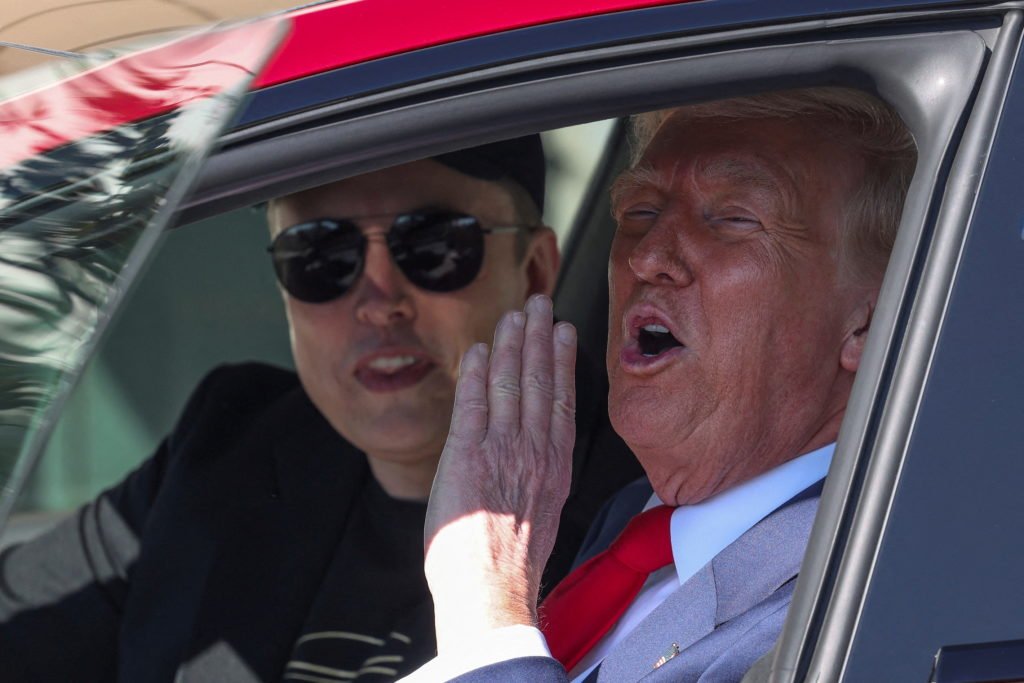

  • How Trump and Musk’s relationship flamed out

    How Trump and Musk’s relationship flamed out

    WASHINGTON (AP) — Donald Trump and Elon Musk’s alliance took off like one of SpaceX’s rockets. It was supercharged and soared high. And then it blew up.

    The spectacular flameout Thursday peaked as Trump threatened to cut Musk’s government contracts and Musk claimed that Trump’s administration hasn’t released all the records related to sex abuser Jeffrey Epstein because Trump is mentioned in them.

    READ MORE: In escalating public feud, Trump threatens to cut Musk’s government contracts

    The tech entrepreneur even shared a post on social media calling for Trump’s impeachment and skewered the president’s signature tariffs, predicting a recession this year.

    The messy blow-up between the president of the United States and the world’s richest man played out on their respective social media platforms after Trump was asked during a White House meeting with Germany’s new leader about Musk’s criticism of his spending bill.

    Trump had largely remained silent as Musk stewed over the last few days on his social media platform X, condemning the president’s so-called “Big Beautiful Bill.” But Trump clapped back Thursday in the Oval Office, saying he was “very disappointed in Musk.”

    Musk responded on social media in real time. Trump, who was supposed to be spending Thursday discussing an end to the Russia-Ukraine war with German Chancellor Friedrich Merz, ratcheted up the stakes when he turned to his own social media network, Truth Social, and threatened to use the U.S. government to hurt Musk’s bottom line by going after contracts held by his internet company Starlink and rocket company SpaceX.

    “The easiest way to save money in our Budget, Billions and Billions of Dollars, is to terminate Elon’s Governmental Subsidies and Contracts,” Trump wrote on his social media network.

    WATCH: Trump says he’s ‘very disappointed’ in Elon Musk after criticism of president’s budget bill

    “Go ahead, make my day,” Musk quickly replied on X.

    Hours later, Musk announced SpaceX would begin decommissioning the spacecraft it used to carry astronauts and cargo to the International Space Station for NASA.

    Musk also said, without offering evidence of how he might know the information, that Trump was “in the Epstein files. That is the real reason they have not been made public. Have a nice day, DJT!”

    The deepening rift unfurled much like their relationship started — rapidly, intensely and very publicly. And it quickly hit Musk financially.

    READ MORE: Musk says he will cut back on political spending after paying at least $250M backing Trump in 2024

    After Trump started criticizing Musk, shares of his electric vehicle company Tesla plunged more than 14%, knocking about $150 billion off Tesla’s market valuation. Musk lost about $20 billion on his personal holding of Tesla.

    Politicians and their donor patrons rarely see eye to eye. But the magnitude of Musk’s support for Trump, spending at least $250 million backing his campaign, and the scope of free rein the president gave him to slash and delve into the government with the Department of Government Efficiency is eclipsed only by the speed of their falling-out.

    Musk offered up an especially stinging insult to a president sensitive about his standing among voters: “Without me, Trump would have lost the election,” Musk retorted. “Such ingratitude,” Musk added in a follow-up post.

    Musk first announced his support for Trump shortly after the then-candidate was nearly assassinated on stage at a Pennsylvania rally last July. News of Musk’s political action committee in support of Trump’s election came days later.

    Musk soon became a close adviser and frequent companion, memorably leaping in the air behind Trump on stage at a rally in October. Once Trump was elected, the tech billionaire stood behind him as he took the oath of office, flew on Air Force One for weekend stays at Mar-a-Lago, slept in the Lincoln Bedroom and joined Cabinet meetings wearing a MAGA hat — sometimes more than one.

    Three months ago, Trump purchased a red Tesla from Musk as a public show of support for his business as it faced blowback.

    Musk bid farewell to Trump last week in a somewhat somber news conference in the Oval Office, where he sported a black eye that he said came from his young son but that seemed to be a metaphor for his messy time in government service.

    WATCH: Trump praises Musk for delivering ‘colossal change’ to Washington

    Trump, who rarely misses an opportunity to zing his critics on appearance, brought it up Thursday.

    “I said, ‘Do you want a little makeup? We’ll get you a little makeup.’ Which is interesting,” Trump said.

    The Republican president’s comments came as Musk has griped for days on social media about Trump’s spending bill, warning that it will increase the federal deficit. Musk has called the bill a “disgusting abomination.”

    “He hasn’t said bad about me personally, but I’m sure that will be next,” Trump said Thursday in the Oval Office, presaging the rest of his day. “But I’m very disappointed in Elon. I’ve helped Elon a lot.”

    Observers had long wondered if the friendship between the two brash billionaires known for lobbing insults online would combust in dramatic fashion. It did, in less than a year.

    White House aides were closely following the drama playing out on dueling platforms Thursday with bemusement, sharing the latest twists and turns from the feud between their boss and former co-worker, as well as the social media reaction and memes. Officials in the extremely online administration privately expressed the belief that like the other digital scuffles that have defined Trump’s political career, this would also work out in his favor.

    Trump said Thursday in the Oval Office that he and Musk had had a great relationship but mused: “I don’t know if we will anymore.”

    He said some people who leave his administration “miss it so badly” and “actually become hostile.”

    “It’s sort of Trump derangement syndrome, I guess they call it,” he said.

    He brushed aside the billionaire’s efforts to get him elected last year, including a $1 million-a-day voter sweepstakes in Pennsylvania. The surge of cash Musk showed he was willing to spend seemed to set him up as a highly coveted ally for Republicans going forward, but his split with Trump, the party’s leader, raises questions about whether they or any others will see such a campaign windfall in the future.

    Trump said Musk “only developed a problem” with the bill because it rolls back tax credits for electric vehicles.

    “False,” Musk fired back on his social media platform as the president continued speaking. “This bill was never shown to me even once and was passed in the dead of night so fast that almost no one in Congress could even read it!”

    In another post, he said Trump could keep the spending cuts but “ditch the MOUNTAIN of DISGUSTING PORK in the bill.”

    Besides Musk being “disturbed” by the electric vehicle tax credits, Trump said another point of contention was Musk’s promotion of Jared Isaacman to run NASA. Trump withdrew Isaacman’s nomination over the weekend and on Thursday called him “totally a Democrat.”

    Musk continued slinging his responses on social media. He shared some posts Trump made over a decade ago criticizing Republicans for their spending, musings made when he, too, was just a billionaire lobbing his thoughts on social media.

    “Where is the man who wrote these words?” Musk wrote. “Was he replaced by a body double!?”

    On the White House grounds Thursday afternoon, Trump’s red Tesla still sat in a parking lot.

    Associated Press writers Chris Megerian, Zeke Miller and Eric Tucker in Washington and Bernard Condon and Paul Harloff in New York contributed to this report.

    Support PBS News Hour

    Your donation makes a difference in these uncertain times.


  • Commencement speakers share advice with the Class of 2025

    Commencement speakers share advice with the Class of 2025

    A.J. Brown, Philadelphia Eagles:

    If you remember nothing else I say today, remember these three things, please. Number one, run your own route. Everybody’s path is different. Stay focused on yours. Comparison kills potential faster than failure ever could.

    Number two, watch the film on yourself. Be real about your flaws. Own them. Grow from them. Self-awareness is a form of leadership. And, number three, think bigger than today. Everybody wants quick wins. Everybody wants to go viral. I’m sorry to tell you, social media is not real.

    Class of 2025, this is your kickoff. You’re stepping into a new season. You’re holding the ball. Ole Miss gave you the playbook. Now it’s your job to call the plays and lead the drive. So whatever you’re chasing, chase it with humility.

  • GOP Sen. Ron Johnson explains why he opposes Trump’s budget in its current form

    GOP Sen. Ron Johnson explains why he opposes Trump’s budget in its current form

    Sen. Ron Johnson:

    Well, first of all, I met with the president at the White House yesterday with his economic advisers. They know I have my facts straight. We have got a lot of respect for each other.

    Now, I thought it was kind of interesting, in that White House meeting, one of the things that President Trump pointed out was, the Democrats are always unified. They’re always united. And I pointed out to them, well, that’s because they’re doing the easy things. They’re spending money we don’t have. They’re mortgaging our children’s future.

    We’re trying to do something hard. And I think the good news is that those of us who are trying to do something hard, we do respect each other. Listen, I’m a big supporter President Trump. I respect Speaker Johnson and leader Thune and Chairman Crapo.

    But we are trying to do something very hard. We have had an unprecedented level of spending increase since the start of COVID from $4.4 trillion to $7 trillion. Our deficits under Biden and the Democrats averaged $1.9 trillion per year. It’s very difficult to dial that back.

    But, again, we’re trying to do it. I recognize and I sympathize how difficult this is in the House, even in the Senate. I realize I’m kind of not one of the easiest gets here. But, again, my loyalty is to my children and grandchildren. And I believe that’s — that is shared by the president and by the other leaders who are working on this enormously challenging problem.

  • Breaking down Trump’s ‘Big Beautiful Bill’ and its impact on the deficit and national debt

    Breaking down Trump’s ‘Big Beautiful Bill’ and its impact on the deficit and national debt

    Lisa Desjardins:

    Right.

    For Republicans, this is part of answering what they see as a potential crisis, the end of the Trump tax cuts. The question is, is this something that adds to a different potential crisis, an American debt crisis?

    So let’s look at the money flow in this bill, and let’s start with the tax cuts. First of all, Republicans are in fact adding some new tax cuts here. Those are the no taxes on tips, overtime, some benefits for seniors. These tax cuts are significant. However, they pale in comparison to the biggest cost in the bill. That is extending those Trump tax cuts.

    All together, the Congressional Budget Office says, the tax cuts in this bill add up to $3.7 trillion. That’s good news, in that that’s money taxpayers could keep, but it’s also bad news because it comes out of the federal budget and potentially could add to deficits.

    So did Republicans pay for this in the bill? According to CBO, no. The money saved in this bill from the cuts, the spending cuts, is $1.3 trillion. Now, this is a significant, historically large number of spending cuts, health care cuts, we have been talking about Medicaid, green energy, student loans. This is a big number, but it is much smaller than the amount being spent here.

    So, overall, Congressional Budget Office says, this bill would add $2.4 trillion to the deficit, and that is even before you consider interest costs.

  • Explaining the national debt, how we got here and what it means for future generations

    Explaining the national debt, how we got here and what it means for future generations

    Paul Solman:

    To cover the gap between what the government spends and what it collects, we sell IOUs, call them bonds. About a fifth of our debt is held by different parts of the government itself, while the rest is held by the public, which includes foreign governments, investors and folks like you and me.

    We rely on this debt to help fund the government. In 2024, that included about $4 trillion on benefit programs like Social Security, Medicare and Medicaid, and nearly $2 trillion defense and basically everything else. In all, the U.S. spent $1.8 trillion more than it took in, contributing to a national debt that we have been building on and off since the country’s founding.

  • News Wrap: Supreme Court blocks Mexico’s $10 billion suit against U.S. gun manufacturers

    News Wrap: Supreme Court blocks Mexico’s $10 billion suit against U.S. gun manufacturers

    In our news wrap Thursday, the Supreme Court ruled that Mexico cannot pursue a $10 billion lawsuit against U.S. gun manufacturers for allegedly fueling cartel violence, President Trump says trade talks with China will resume following weeks of rising tensions and a Massachusetts high school student who was arrested by immigration officials while on his way to Volleyball practice is now free.

  • Germany’s chancellor visits Trump as Europe’s alliance with U.S. is fracturing

    Germany’s chancellor visits Trump as Europe’s alliance with U.S. is fracturing

    President Trump met with German Chancellor Merz in the Oval Office on Thursday. Merz urged Trump to increase pressure on Russia, but the president made no commitments and instead compared Ukraine and Russia to two fighting children who needed to work out their differences. Nick Schifrin reports.

  • Afghan girl accepted to U.S. colleges faces uncertain future after Trump’s travel ban

    Afghan girl accepted to U.S. colleges faces uncertain future after Trump’s travel ban

    Laura Barron-Lopez:

    This ban potentially affects thousands of people, including a young girl from Afghanistan. And we’re calling her Saira, blurring her face and altering her voice to protect her identity for her safety.

    She spoke to producer Zeba Warsi from Peshawar in neighboring Pakistan, where she traveled from — for her U.S. visa appointment. And now she doesn’t know where to go.

    Saira, Student from Afghanistan: As an Afghan student, we cannot study in our country. I waited for one year to complete this process. The applying for a university in the United States is not easy.