KYIV, Ukraine (AP) — Russia bombarded six regions of Ukraine in one of its largest aerial attacks of the three-year war, Ukrainian officials said Friday. The nighttime assault lasted for hours and killed three emergency responders in the capital Kyiv, according to authorities.
The barrage included 407 drones and 44 ballistic and cruise missiles, Ukrainian air force spokesperson Yurii Ihnat said. Ukrainian forces said they shot down about 30 of the cruise missiles and up to 200 of the drones.
The latest Russian attack came hours after U.S. President Donald Trump said it might be better to let Ukraine and Russia “fight for a while” before pulling them apart and pursuing peace. Trump’s comments were a remarkable detour from his often-stated appeals to stop the war and signaled he may be giving up on recent peace efforts.
Ukrainian cities have come under regular bombardment since Russia invaded its neighbor in February 2022. The attacks have killed more than 12,000 civilians, according to the United Nations. “Russia doesn`t change its stripes,” Ukrainian President Volodymyr Zelenskyy said.
Zelenskyy, as well as the Ukrainian Interior Ministry and the general prosecutor’s office, said three emergency workers were killed in Kyiv while responding to the Russian strikes. “They were working under fire to help people,” the Interior Ministry said in a statement.
The war has continued unabated even as a U.S.-led diplomatic push for a settlement has brought two rounds of direct peace talks between delegations from Russia and Ukraine. The negotiations delivered no significant breakthroughs, however, and the sides remain far apart on their terms for an end to the fighting.
Ukraine has offered an unconditional 30-day ceasefire and a meeting between Zelenskyy and Russian leader Vladimir Putin to break the deadlock. But the Kremlin has effectively rejected a truce and hasn’t budged from its demands.
“The Kremlin continues efforts to falsely portray Russia as willing to engage in good-faith negotiations to end the war in Ukraine, despite Russia’s repeated refusal to offer any concessions,” the Institute for the Study of War, a Washington-based think tank, said late Thursday.
Putin said in a phone call with Trump earlier this week that he would respond to Ukraine’s daring long-range attack on Russian air bases on Sunday.
Russia’s Defense Ministry claimed it had aimed at Ukrainian military targets with “long-range precision weapons” and successfully struck arms depots, drone factories and repair facilities, among other targets.
Ukrainian Foreign Minister Andrii Sybiha said the attacks demonstrated key differences between Russia and Ukraine.
“The difference … is that Ukraine hits legitimate military targets—such as aircraft equipped to bomb our children. Russia targets residential areas, civilians, and critical infrastructure,” Sybiha wrote on X. “Putting Ukraine and Russia on equal footing is unacceptable.”
Russia also reports drone attacks
In Russia, air defenses shot down 10 Ukrainian drones heading toward the capital early Friday, Moscow Mayor Sergei Sobyanin said. Flights at Moscow airports were temporarily suspended during the night as a precaution.
Ukrainian drones also targeted three other regions of Russia, authorities said, damaging apartment buildings and industrial plants. Three people were injured, officials said.
Russia’s Defense Ministry said that air defenses downed 174 Ukrainian drones over 13 regions early Friday. It added that three Ukrainian Neptune missiles were also shot down over the Black Sea.
Ukraine struck airfields and other military targets in Russia, such as fuel storage tanks and transport hubs, the Ukrainian General Staff said.
Also, a locomotive derailed early Friday in the Belgorod region after the track was blown up, Belgorod Gov. Vyacheslav Gladkov said. Russia has recently accused Ukraine of sabotaging the rail network.
Ukrainian air defenses are strained
In Kyiv, multiple explosions were heard for hours as falling drone debris sparked fires across several districts, said Tymur Tkachenko, head of the Kyiv City Administration. He urged people to seek shelter.
Fourteen-year-old Kyiv resident Vitalina Vasylchenko sheltered in a parking garage with her 6-year-old sister and their mother after an explosion blew one of their windows off its hinges.
“I heard a buzzing sound, then my dad ran to me and covered me with his hand, then there was a very loud explosion,” she said. “My whole life flashed before my eyes, I already thought that was it. I started having a panic attack … I’m shocked that I’m alive.”
Ukraine’s human rights chief, Dmytro Lubinets, called for a strong international response to Russia’s latest overnight attack, saying the assault violated basic human rights. “Russia is acting like a terrorist, systematically targeting civilian infrastructure,” Lubinets wrote on Telegram. “The world must respond clearly and take concrete steps, including condemning the aggressor’s actions.”
Several districts of Kyiv are hit
Authorities reported damage in several districts in Kyiv, and rescue workers responded to damage and fires at multiple locations.
In Solomyanskyi district, a fire broke out on the 11th floor of a 16-story residential building. Emergency services evacuated three people from the apartment.
The attack caused a blackout in some areas, and more than 2,000 households on Kyiv’s eastern bank were without power, the Kyiv City Administration said.
Elsewhere, 10 people were injured by an aerial attack on the western city of Ternopil, regional governor Viacheslav Nehoda said. The strike damaged industrial and infrastructure facilities, left parts of the city without electricity, and disrupted water supplies.
Three people were also injured in Ukraine’s central Poltava region. Russia also targeted the western Lviv and Khmelnytskyi regions, and the northern Chernihiv region.
Support PBS News Hour
Your donation makes a difference in these uncertain times.
Pakistan’s foreign ministry confirmed that no decision has been made to cancel any bilateral agreements with India, including the historic 1972 Simla Agreement, just a day after defence minister Khawaja Asif called the agreement “a dead document.” A senior foreign office official stated that although recent events have prompted internal deliberations in Islamabad, no formal steps have been taken to revoke current accords with New Delhi.
“At present, there is no formal decision to terminate any bilateral accord,” an official conveyed. He stated that all treaties, including the Simla Agreement, continue to be in effect. The defense minister claimed in a televised interview on 3rd June that the Simla Agreement was no longer relevant due to India’s “unilateral actions,” including the withdrawal of Article 370 in Jammu and Kashmir in 2019.
“The Simla Agreement is now a dead document. We are back to the 1948 position, when the United Nations declared the Line of Control a ceasefire line,” he alleged relating it to the initial conflict between India and Pakistan. He added that the agreement’s intended bilateral framework has broken down, making multilateral or international institutions necessary to resolve future conflicts. He also raised concerns regarding the feasibility of alternative agreements such as the Indus Waters Treaty which was suspended by India, implying that “Simla is already over.”
This clarification is provided in light of the rising tensions that have emerged after the Pahalgam terror attack on 22nd April, along with the Indian strikes on terror infrastructure in Pakistan and Pakistan-occupied Kashmir on May 7th, as well as the following attacks on critical military installations in the Islamic Republic in response to the assaults on civilian areas in the border states, especially Jammu and Kashmir.
Khawaja Asif recently grabbed eyeballs when he made a mockery of hismelf on CNN as he attributed his nation’s claims of having downed five Indian fighter jets, including Rafales during “Operation Sindoor” to ‘social media posts.’ Pakistan has been relentless in its propaganda in light of the rising tensions between the two countries.
“It is all on social media, and Indian social media, not our social media. The debris of the jets fell on their side. It is all over the Indian media,” he replied when CNN interviewer Becky Anderson asked him for any concrete evidence to back the claims. “You’re the defence minister, sir. The reason to talk to you today, is not to talk about content all over social media,” she interjected and pointed out that he was not summoned to talk about social media content but rather to present genuine proof.
When she again urged him to substantiate his statement with evidence, inquiring whether any Chinese equipment was utilized to bring down the Rafael jets, he denied and then continued to stumble over his words.
DEIR AL-BALAH, Gaza Strip (AP) — Palestinians across the war-ravaged Gaza Strip marked the start of one of Islam’s most important holidays with prayers outside destroyed mosques and homes early Friday, with little hope the war with Israel will end soon.
With much of Gaza in rubble, men and children were forced to hold the traditional Eid al-Adha prayers in the open air and with food supplies dwindling, families were having to make do with what they could scrape together for the three-day feast.
“This is the worst feast that the Palestinian people have experienced because of the unjust war against the Palestinian people,” said Kamel Emran after attending prayers in the southern city of Khan Younis. “There is no food, no flour, no shelter, no mosques, no homes, no mattresses … The conditions are very, very harsh.”
The Islamic holiday begins on the 10th day of the Islamic lunar month of Dhul-Hijja, during the Hajj season in Saudi Arabia. For the second year, Muslims in Gaza were not able to travel to Saudi Arabia to perform the traditional pilgrimage.
The war broke out on Oct. 7, 2023, when Hamas-led militants launched a surprise attack on Israel, killing some 1,200 people, mostly civilians, and abducted 251 hostages. They are still holding 56 hostages, around a third of them believed to be alive, after most of the rest were released in ceasefire agreements or other deals. Israeli forces have rescued eight living hostages from Gaza and recovered dozens of bodies.
Since then, Israel has killed more than 54,000 Palestinians in its military campaign, primarily women and children, according to the Gaza Health Ministry which does not distinguish between civilians or combatants in its figures.
The offensive has destroyed large parts of Gaza and displaced around 90% of its population of roughly 2 million Palestinians.
After blocking all food and aid from entering Gaza for more than two months, Israel began allowing a trickle of supplies to enter for the U.N. several weeks ago. But the U.N says it has been unable to distribute much of the aid because of Israeli military restrictions on movements and because roads that the military designates for its trucks to use are unsafe and vulnerable to looters.
The U.N.’s Food and Agriculture Organization in Rome said Thursday that Gaza’s people are projected to fall into acute food insecurity by September, with nearly 500,000 people experiencing extreme food deprivation, leading to malnutrition and starvation.
“This means the risk of famine is really touching the whole of the Gaza Strip,” Rein Paulson, director of the FAO office of emergencies and resilience, said in an interview.
Over the past two weeks, shootings have erupted nearly daily in the Gaza Strip in the vicinity of new hubs where desperate Palestinians are being directed to collect food. Witnesses say nearby Israeli troops have opened fire, and more than 80 people have been killed according to Gaza hospital officials.
Israel has accused Hamas of stealing aid and trying to block it from reaching Palestinians, and has said soldiers fired warning shots or at individuals approaching its troops in some cases.
The Gaza Humanitarian Foundation, a newly formed group of mainly American contractors that Israel wants to use to replace humanitarian groups in Gaza that distribute aid in coordination with the U.N., said Friday that all its distribution centers were closed for the day due to the ongoing violence.
It urged people to stay away for their own safety, and said it would make an announcement later as to when they would resume distributing humanitarian aid.
Support PBS News Hour
Your donation makes a difference in these uncertain times.
BOSTON (AP) — Democratic state attorneys general on Friday will seek to block President Donald Trump’s proposal for a sweeping overhaul of U.S. elections in a case that tests a constitutional bedrock — the separation of powers.
The top law enforcement officials from 19 states filed a federal lawsuit after the Republican president signed the executive order in March, arguing that its provisions would step on states’ power to set their own election rules and that the executive branch had no such authority.
In a filing supporting that argument, a bipartisan group of former secretaries of state said Trump’s directive would upend the system established by the Constitution’s Elections Clause, which gives states and Congress control over how elections are run. They said the order seeks to “unilaterally coronate the President as the country’s chief election policymaker and administrator.”
If the court does not halt the order, they argued, “the snowball of executive overreach will grow swiftly and exponentially.”
Trump’s election directive was part of a flurry of executive orders he has issued in the opening months of his second term, many of which have drawn swift legal challenges. It follows years of him falsely claiming that his loss to Democrat Joe Biden in the 2020 presidential election was due to widespread fraud and an election year in which he and other Republicans promoted the notion that large numbers of noncitizens threatened the integrity of U.S. elections. In fact, voting by noncitizens is rare and, when caught, can lead to felony charges and deportation.
Trump’s executive order would require voters to show proof of U.S. citizenship when registering to vote in federal elections, prohibit mail or absentee ballots from being counted if they are received after Election Day, set new rules for voting equipment and prohibit non-U.S. citizens from being able to donate in certain elections. It also would condition federal election grant funding on states adhering to the strict ballot deadline.
The hearing Friday in U.S. District Court in Boston comes in one of three lawsuits filed against the executive order. One is from Oregon and Washington, where elections are conducted almost entirely by mail and ballots received after Election Day are counted as long as they are postmarked by then.
The provision that would create a proof-of-citizenship requirement for federal elections already has been halted in a lawsuit filed by voting and civil rights groups and national Democratic organizations.
In that case, filed in federal court in the District of Columbia, the judge said the president’s attempt to use a federal agency to enact a proof-of-citizenship requirement for voting usurped the power of states and Congress, which at the time was considering legislation that would do just that.
That bill, called the SAVE Act, passed the U.S. House but faces an uncertain future in the Senate.
Trump’s executive order said its intent was to ensure “free, fair and honest elections unmarred by fraud, errors, or suspicion.” The Justice Department, in arguing against the motion by the attorneys general for a preliminary injunction, said the president is within his rights to direct agencies to carry out federal voting laws.
The order tasks the U.S. Election Assistance Commission with updating the federal voter registration form to require people to submit documentation proving they are U.S. citizens. Similar provisions enacted previously in a handful of states have raised concerns about disenfranchising otherwise eligible voters who can’t readily access those documents. That includes married women, who would need both a birth certificate and a marriage license if they had changed their last name.
A state proof-of-citizenship law enacted in Kansas more than a decade ago blocked the registrations of 31,000 people later found to be eligible to vote.
The two sides will argue over whether the president has the authority to direct the election commission, which was created by Congress as an independent agency after the Florida ballot debacle during the 2000 presidential election.
In its filing, the Justice Department said Trump’s executive order falls within his authority to direct officials “to carry out their statutory duties,” adding that “the only potential voters it disenfranchises are noncitizens who are ineligible to vote anyway.”
Support PBS News Hour
Your donation makes a difference in these uncertain times.
TOKYO (AP) — World shares were mixed Friday ahead of an update on the U.S. job market that will offer insights into how the economy is faring.
The future for the S&P 500 gained 0.4% while that for the Dow Jones Industrial Average was up 0.5%. Germany’s DAX lost 0.3% to 24,258.74, while the CAC 40 in Paris edged 0.1% lower, to 7,785.19. Britain’s FTSE 100 edged 0.2% higher to 8,825.82.
In Asian trading, Tokyo’s Nikkei 225 index rose 0.5% to 37,741.61, while the Kospi in South Korea jumped 1.5% to 2,812.05.
Hong Kong’s Hang Seng lost 0.2% to 23,859.52 and the Shanghai Composite index edged less than 0.1% higher, to 3,385.36.
Australia’s S&P/ASX 200 shed 0.3% to 8,515.70.
India’s Sensex gained 0.8% after the Reserve Bank cut its key interest rate by a half a percentage point to 5.50%.
On Thursday, the S&P 500 fell 0.5% for its first drop in four days. After sprinting through May and rallying within a couple good days’ worth of gains of its all-time high, the index at the center of many 401(k) accounts has lost momentum.
The Dow dropped 0.3%, and the Nasdaq composite sank 0.8%.
The U.S. Labor Department is due to report how many more jobs U.S. employers created than destroyed during May. The expectation on Wall Street is for a slowdown in hiring from April.
A resilient job market has been one of the linchpins that’s propped up the U.S. economy, and the worry is that all the uncertainty created by President Donald Trump’s on-and-off tariffs could push businesses to freeze their hiring.
A report on Thursday said more U.S. workers applied for unemployment benefits last week than economists expected. The number remains relatively low compared with history, but it still hit its highest level in eight months.
The data came as Procter & Gamble, the giant behind such brands as Pampers diapers and Cascade dish detergent, said it will cut up to 7,000 jobs over the next two years. Its stock fell 1.9%.
The day’s heaviest weight on the market was Tesla, which tumbled 14.3%. It’s lost nearly 30% of its value so far this year as CEO Elon Musk’s relationship with Trump sours amid a disagreement over the president’s signature bill of tax cuts and spending. In after-hours trading Tesla gained 0.8%.
Hopes that Trump will lower his tariffs after reaching trade deals with other countries have been among the main reasons the S&P 500 has rallied back so furiously since dropping roughly 20% from its record two months ago. It’s now back within 3.3% of its all-time high.
Trump boosted such hopes Thursday after saying he had “a very good phone call” with China’s leader, Xi Jinping, about trade and that “their respective teams will be meeting shortly at a location to be determined.”
China’s assessment of the call, as reported in state media, was less enthusiastic.
Still, it’s an easing of tensions after the world’s two largest economies had earlier accused each other of violating the agreement that had paused their stiff tariffs against each other, which threatened to drag the economy into a recession.
Markets took the latest signs of detente with Beijing coolly, given that nothing is assured in Trump’s on-and-off rollout of tariffs.
Among Wall Street’s winners was MongoDB, which jumped 12.8% after the database company likewise delivered a stronger profit than analysts expected.
Circle Internet Group, the U.S.-based issuer of one of the most popular cryptocurrencies, surged 168.5% in its first day of trading on the New York Stock Exchange.
The yield on the 10-year Treasury held steady at 4.38%, up from 4.37% late Wednesday after tumbling from 4.46% the day before.
Yields dropped so sharply on Wednesday as expectations built that the Federal Reserve will need to cut interest rates later this year to prop up an economy potentially weakened by tariffs.
In other dealings early Friday, U.S. benchmark crude oil lost 34 cents to $63.03 per barrel. Brent crude, the international standard, fell 28 cents to $65.06 per barrel.
The U.S. dollar rose to 143.90 Japanese yen from 143.49 yen. The euro fell to $1.1424 from $1.1448.
Support PBS News Hour
Your donation makes a difference in these uncertain times.
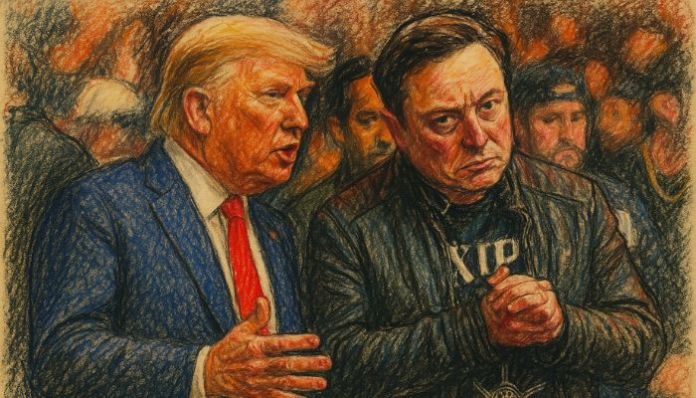
It is not uncommon for allies to become adversaries, especially in the realm of politics. Nevertheless, what might the implications be if the richest individual and the most powerful politician were to engage in a fierce confrontation? In a surprising turn of events and shifting allegiances, former buddies, United States President Donald Trump and billionaire Elon Musk, have begun to publicly attack each other, as their disagreement has escalated into a bitter verbal conflict.
Meanwhile, these war of words although occurring on media, social media and other platforms could have tangible repercussions. Trump issued a warning to revoke the governmental subsidies and contracts associated with Musk to conserve ‘billions of dollars in the budget’. As expected, the SpaceX CEO (Chief Executive Officer) also fired back.
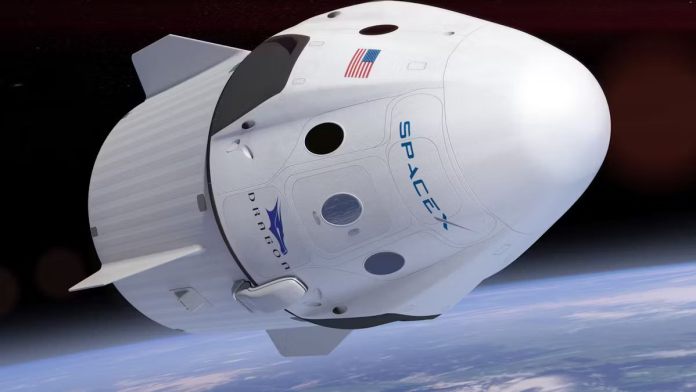
Dragon spacecraft (Source: Inverse)
He demanded the president’s impeachment, challenged him to withdraw funding for his companies and responded by declaring that he was hastening the “decommissioning” of his Dragon spacecraft. Notably, the National Aeronautics and Space Administration (NASA) depends on it to transport their astronauts and supplies to the International Space Station (ISS) as part of a contract estimated at around $4.9 billion. The capsule is the country’s only spacecraft that can fly humans in orbit.
In light of the President’s statement about cancellation of my government contracts, @SpaceX will begin decommissioning its Dragon spacecraft immediately pic.twitter.com/NG9sijjkgW
However, Musk only made the statement to retract it a few hours later after a random user, named “Alaska” intervened to make peace between the two giants. The user described their altercation as “shameful” and told them to “cool off and take a step back for a couple of days,” alleging that they were above such behavior.
His remarks surprisingly seem to impact the owner of X, who labeled it as “Good advice” and conveyed that he will not move forward with his earlier declaration. He subsequently reshared a photo of the United States flag set against the backdrop of the Dragon, accompanied by the caption “Team America.”
Demissioning the Dragon: What it would mean
Interestingly, the decommissioning of Dragon would cause considerable disruption to the ISS program, which includes a multitude of countries participating in an international accord signed over twenty years ago. The only other crewed spacecraft capable of sending astronauts to the ISS is Russia’s Soyuz system.
On 22nd April, a Dragon craft brought 6,700 pounds of equipment, science studies and crew supplies to the ISS. Aleksey Ovchinin, a Russian cosmonaut, is currently leading a team of seven persons on a mission onboard the ISS. The crew consists of three NASA astronauts.
“NASA will continue to execute upon the president’s vision for the future of space,” posted Bethany Stevens, press secretary of the space agency after Musk’s threat. She added that NASA will maintain its collaboration with industry partners to ensure that the president’s goals in space are accomplished.
NASA will continue to execute upon the President’s vision for the future of space. We will continue to work with our industry partners to ensure the President’s objectives in space are met.
It is notable here that it was SpaceX Dragon that brought Sunita Williams and Butch Wilmore back to Earth, after all efforts, especially Boeing’s Starliner failed to do so. The NASA astronauts were stuck in the ISS for over 9 months.
SpaceX enters the rocket industry
Elon Musk established Space Exploration Technologies Corporation (SpaceX), a tiny and obscure enterprise in 2002 with a lofty objective of sending humans to Mars in the future. It was awarded a NASA contract in 2006 to transport supplies and cargo to the International Space Station.
SpaceX had not yet sent anything into orbit at that time and it did not until two years later with its small Falcon 1 rocket. However, the company which was started by Elon Musk has since grown to be the foundation of all American spaceflight, both military and civilian.
It began in 2010 when the first Falcon 9 rocket was launched. The rocket began delivering supplies to the space station in 2012. The Falcon 9 was developed with funding from NASA and SpaceX. It used the NASA seal of approval to attract customers to launch their satellites with SpaceX. It offered launches and satellites in orbit at a lower cost than the majority of other rockets at the time and became the first priority.
SpaceX secured a contract to transport humans to the space station under the Obama administration. It undertook its first mission to the space station in May 2020 during Trump’s first term. While addressing an audience at Kennedy Space Center in Florida on 30th May of that year, he showered Musk with praise and celebrated the “groundbreaking partnership” between NASA and SpaceX.
Five years ago, @NASA_Astronauts Robert Behnken and Douglas Hurley launched to the @Space_Station aboard a @SpaceX Dragon spacecraft and Falcon 9 rocket. Our Demo-2 mission was the first time American astronauts launched on an American rocket from the U.S. in nearly 10 years. pic.twitter.com/V4C3ZG9ucm
He announced that the two has “given our nation the gift of an unmatched power a state-of-the-art spaceship to put our astronauts into orbit at a fraction of the cost of the space shuttle.”
President Trump: "Congratulations, Elon Musk."
"Today the groundbreaking partnership between NASA and SpaceX has given our nation the gift of an unmatched power, a state-of-the-art spaceship to put our astronauts into orbit at a fraction of the cost of the Space Shuttle."
SpaceX’s success caused its rivals to falter and now it dominates the space sector. The federal government currently depends largely on the company and its founder. There aren’t many alternatives available to the government for carrying people and cargo into orbit and beyond in the near future.
NASA and SpaceX: An interdependent relationship
Although SpaceX plays a major role in NASA’s space exploration and operations, the two organizations have a mutually beneficial relationship. SpaceX ranks among the largest federal contractors. NASA, the Air Force, and other organizations have awarded SpaceX more than $20 billion in contracts since 2008.
NASA Administrator Bill Nelson, the agency’s head and a former senator from Florida, stressed that “NASA is really committed” to commercial cooperation, reported CNBC. He noted that SpaceX received a key role in the agency’s Artemis plan, a proposal for using Starship to transport men to the moon’s surface.
It was the sole name check among the other NASA initiatives he highlighted that involve corporations, including private space stations and lunar cargo spacecraft. “You sit down with Elon Musk and he’ll tell you he would not be where he is if it were not for NASA,” Nelson asserted.
Starship will be used to land astronauts on the lunar surface on NASA's Artemis III mission, which will put the first humans on the Moon since 1972 pic.twitter.com/qLiRp0PSAp
SpaceX is the second-highest-paid vendor for the agency in fiscal year 2022, after Caltech which oversees NASA’s JPL (Jet Propulsion Laboratory). SpaceX is the only route for NASA astronauts to travel to and from orbit right now. Nelson emphasized, however, that the relationship is reciprocal.
“Elon will tell you also, in a moment of truth, that he had a lot of technical problems, as do all of them. And who do they come running to, to help them? NASA,” he pointed out. A representative for the business cited a 2017 remark made by Musk to illustrate SpaceX’s perspective. “I’m a big fan of NASA, in fact, at one point my password was ‘I love NASA.’ It does a lot of good things for which it doesn’t get enough credit,” the latter had expressed.
Today’s private spaceflight would look considerably different without NASA’s investment. SpaceX was close to going bankrupt and probably wouldn’t have had any money left without it. While the business now makes money from a wide range of clients, launching NASA science probes and transporting personnel and cargo to the ISS account for a sizable amount of its funding. The US Department of Defense also uses SpaceX to fly payloads.
How crucial is SpaceX for NASA and US Defense Department
NASA uses SpaceX Crew Dragon spacecraft to transport people and supplies to the ISS. It relied on Russia’s Soyuz for crew transportation when the Space Shuttle program terminated in 2011 until Crew Dragon went into service in 2020. SpaceX is one of two providers (with Boeing’s Starliner) for NASA’s Commercial Crew Program and has since carried out multiple crewed missions (such as Crew-1 through Crew-11).
Additionally, SpaceX manages a considerable portion of the Commercial Resupply Services (CRS) contracts for ISS cargo resupply via Cargo Dragon. SpaceX’s 30th CRS mission was completed in 2024 and the company has contracts that run through 2026.
Commercial Crew Program (Source: NASA)
NASA contracted other firms to deliver those services, allowing for an alternative in case of any complications. Boeing, the other company it authorized to launch men into orbit, has not yet finished repairs for its Starliner capsule following a test flight that left two NASA astronauts in orbit. After nine months in space, Sunita Williams and Butch Wilmore finally made it to Earth on a SpaceX Crew Dragon.
The next Starliner’s launch date has not yet been disclosed by Boeing or NASA, but it is expected to take place within the next year. Northrop Grumman, an aerospace and defence tech corporation, also has a contract to use its Cygnus spacecraft to transport cargo to the space station, however, the most recent Cygnus had to be discarded due to damage sustained during its shipping to Florida for launch. Sierra Space, based in Louisville of Colorado, has been contracted by NASA to deliver cargo but it has not yet launched its Dream Chaser spacecraft.
International Space Station (Source: Space)
Hence, the future of the troubled and aging space station would be even more uncertain if SpaceX decided to decommission Dragon spacecraft. The likelihood that the company would at least return the Crew Dragon, which is presently docked at the space station and the four astronauts who depend on it for the journey home is very high. However, it would be unable to launch the upcoming crew of astronauts.
SpaceX critical for smooth operations at space station
“The Dragon spacecraft is capable of carrying up to 7 passengers to and from Earth orbit, and beyond,” according to SpaceX’s official website. However, in its absence the space station’s crew could be trimmed to three members, which is the maximum number of astronauts that a Russian Soyuz capsule can hold.
NASA will have to purchase seats for Soyuz from Russia, as it did from the time the space shuttles were retired until the start of Crew Dragon flights. Additionally, SpaceX has been contracted by NASA to construct the spacecraft that will return the space station to the atmosphere, allowing it to safely burn up over the Pacific Ocean when it is retired in 2030.
SpaceX even appears to have tapped on the growing need for affordable launch services and satellite-based communications to propel revenue growth, even as NASA continues to support scientific and deep space exploration missions. Launch costs have been drastically reduced by SpaceX’s reusable Falcon 9 and Falcon Heavy rockets, which have allowed the business to take a commanding lead in the worldwide launch industry.
Falcon 9 (Source: Everyday Astronaut)
NASA makes use of its own Space Launch System (SLS) for Artemis deep-space missions, nonetheless it is more expensive (up to $2 billion per launch) and is employed less frequently. On the other hand, Falcon 9 launches reportedly cost between $60 to $90 million per launch, which is far less than the cost of ULA’s (United Launch Alliance) Delta IV Heavy or SLS.
NASA has utilized Falcon Heavy for projects like Europa Clipper (launched in October 2024) and Falcon 9 for science missions including TESS, DART and Psyche. SpaceX became the most active launch operator globally in 2024 after completing 134 Falcon launches, a record-breaking accomplishment. The firm wants to meet the growing demand for satellite deployment by surpassing this milestone with 170 launches by the end of the year.
SpaceX’s significant part in mission to put humans on moon
NASA’s Artemis program leans heavily on SpaceX’s Starship to serve as the Human Landing System (HLS) for Artemis III and IV, which would land humans on the moon. In 2022, the company was presented with a $1.15 billion contract by NASA to build an improved Starship lunar lander and conduct a second crewed flight.
One year prior, the space agency declared that SpaceX’s Starship had defeated the other two bidders to secure the $2.9 billion contract for the construction of the Artemis lunar lander. The development of Starship is crucial because SpaceX’s capacity to produce a workable, reusable spacecraft is essential to the space agnecy’s current lunar landing timeframe of 2026.
SLS launches the Artemis 1 Moon Mission (Source: WIRED)
“We have awarded SpaceX to continue the development of our integrated human landing system. We’re confident in NASA’s partnership with SpaceX to help us achieve the Artemis mission and look forward to continuing our work toward landing astronauts on the moon, to prepare for the next giant leap towards Mars,” informed Lisa Watson-Morgan, HLS program manager.
The goal of NASA’s Artemis program is to send the first woman and person of color to the moon. This will be the first time a human has set foot on the moon since the Apollo program’s last lunar landing mission in 1972. Blue Origin, the aerospace firm founded by Jeff Bezos, has secured a NASA contract for a lunar lander intended for astronauts.
However, this is scheduled for several years later, coinciding with the Artemis V mission. Therefore, the present program to send NASA astronauts to the moon in a few years also fails without SpaceX.
SpaceX’s role in security satellites and space exploration
Trump’s threat to cancel all of SpaceX’s contracts could render numerous federal government payloads stranded on the ground. NASA has granted contracts to the company to launch science missions, such as Dragonfly, a drone powered by nuclear that will circle Titan, Saturn’s moon. Furthermore, it frequently places secret American military and intelligence satellites in orbit around the planet.
SpaceX has been contracted by the Department of Defence to develop a more secure version of its Starlink internet satellites for military communications. Falcon 9 and Falcon Heavy rockets are facing competition from new contenders for these government missions. Both Blue Origin’s New Glenn rocket and United Launch Alliance’s Vulcan rocket had their debut launches earlier this year and last year, respectively. However, they are more expensive and don’t have the same track record of achievements as SpaceX.
Conclusion
There is no doubt that Musk’s SpaceX has played a crucial role in the space exploration and defence sectors of the United States. It also stands as one of the primary contenders for the construction of the ambitious “Golden Dome” project. However, it is also undeniable that this partnership has allowed the company to not only acquire billions of dollars but also to receive validation for its technological capabilities, which has significantly aided its success.
NASA is presently heavily dependent on SpaceX and is attempting to diversify and reduce their reliance on one company. However, this will take considerable time, as the company is significantly ahead of its competitors and is a distinctly dominant force in the field, despite its fluctuations and setbacks.
As the United Nations pushes aggressively for a so-called “humanitarian corridor” into Myanmar’s Arakan State, its real objective appears to be establishing a military foothold – turning Bangladesh into the latest battleground for the US Deep State’s proxy wars.
This move not only threatens to destabilise the region but also poses a grave threat to Bangladesh’s sovereignty. Simultaneously, the UN is shamelessly extending undue support to Muhammad Yunus and his Islamist-jihadist cabal.
During a meeting with Yunus on 3rd June this year, United Nations Resident Coordinator Gwyn Lewis expressed her organization’s “unwavering solidarity with Bangladesh’s reform and transition process”, emphasizing the UN’s commitment to “supporting the nation’s path towards sustainable development and prosperity”.
UN resident coordinator calls on Chief Adviser
Dhaka, June 3, 2025: Chief Adviser Professor Muhammad Yunus met with the United Nations Resident Coordinator, Gwyn Lewis, at the State Guest House Jamuna on Tuesday.
— Chief Adviser of the Government of Bangladesh (@ChiefAdviserGoB) June 3, 2025
Shockingly, she also expressed support for the recent ban on the Awami League imposed by the Yunus regime, stating that “inclusive elections” in Bangladesh are possible without the party – despite its massive support base of over 45 million out of 120 million registered voters.
This indicates the UN’s willingness to support the illegal entrenchment of Yunus and his Islamist-jihadist allies in power – at the cost of democracy and democratic institutions in Bangladesh.
It is worth noting that just weeks ago, Volker Türk, the UN High Commissioner for Human Rights, raised eyebrows by publicly addressing concerns about the UN’s involvement in last year’s jihadist coup, which has since plunged Bangladesh into the hands of radical Islamist groups, including Al-Qaeda, Islamic State (ISIS), Hizb ut-Tahrir, and Lashkar-e-Taiba.
In a revealing interview with the BBC, Türk admitted that the UN actively discouraged the Bangladesh Armed Forces from intervening during the anti-government protests, which were in fact orchestrated by extremist groups.
His statements suggest that the UN not only enabled but played a pivotal role in facilitating the jihadist coup that toppled the Sheikh Hasina government on August 5, 2024.
Questions are now swirling around Türk’s deep ties with controversial figures like Muhammad Yunus and George Soros – and whether key UN human rights officials have been complicit in the destabilization of Bangladesh.
Appearing on BBC’s HardTalk on March 5, 2025, Türk was asked about the UN’s failures in handling conflicts in Gaza, Sudan, and Ukraine. He pivoted to Bangladesh, stating, “I am giving you an example of Bangladesh last year. During July-August, there were massive demonstrations by students. They had had enough of the previous government under Sheikh Hasina; there was massive repression happening”.
He continued, “The big hope for them was actually our voice – my voice – and what we were able to do. We put the spotlight on the situation. And we actually gave the warning to the army that if they got involved, they might no longer be allowed to contribute troops to peacekeeping missions. As a result, we saw changes”.
Türk added, “When Muhammad Yunus took over as the new chief adviser of the interim administration, he asked me immediately, ‘Can you send us a fact-finding mission to put a spotlight on the situation and investigate what was happening?’ – which is what we did, and it actually helped. I went to Bangladesh last year. The students were so grateful for us taking a stand, for us speaking out, and for supporting them”.
But here, Türk blatantly lied. He has long been on the payroll of George Soros and maintains close ties with Hillary Clinton and Muhammad Yunus. As the Islamists and jihadists ramped up their violent protests in preparation for the coup, Yunus – while in France – contacted Türk directly, urging him to exert pressure on the Bangladesh Armed Forces. Yunus reportedly asked Türk to warn the army that any intervention would result in their expulsion from UN peacekeeping missions – thereby removing one of Bangladesh’s key global roles and sources of prestige and revenue.
Another deeply concerning aspect of Türk’s role was his orchestration of a so-called “fact-finding mission” aimed at documenting alleged repression by the Awami League government. Prior to this, Türk visited Bangladesh, held confidential meetings with Yunus and his jihadist allies, and later published a report that is now being used by the regime to justify its brutal crackdown and terrorist activities.
The February 12, 2025 report issued by the United Nations Human Rights Office (OHCHR) is now being used extensively by the Yunus regime to portray the Sheikh Hasina government as a perpetrator of human rights abuses and crimes against humanity. Backed by significant financial resources, the regime has launched aggressive media and public relations campaigns to legitimize its rule. Simultaneously, it is doing everything in its power to suppress Chapter 6 of the report – a section Türk failed to omit – that contains damning evidence against the current regime. The contents of this chapter are critical in understanding why the Yunus regime is so desperate to keep it hidden from both local and international audiences.
Chapter 6 of the OHCHR report contains chilling details of mob lynchings, targeted killings of police officers, and orchestrated assassinations of political opponents by Islamist-jihadist groups. It outlines how these extremist forces – working in collaboration with Yunus – carried out violent operations to paralyze the state and engineer a political takeover. By silencing this chapter, the regime aims to whitewash the brutality that paved its way to power.
This disturbing attempt to bury the truth further underscores the broader question: why is the international community – including the United Nations – so invested in protecting and legitimizing an illegal, Islamist-driven regime in Bangladesh?
Volker Türk’s own admissions make it clear that the UN has played an active and destructive role in enabling terrorism and jihadism – not just in Gaza, but now also in Bangladesh.
Commenting on Türk’s tenure, Foreign Policy wrote, “Volker Türk lacks the temperament to be the United Nations human rights chief”. Similarly, Devex noted, “Türk, a close, trusted confidant of [UN Secretary-General] António Guterres, beat out a field of about a dozen potential candidates from Europe, Asia, and Africa for the top UN human rights job. The Biden administration, which did not formally back any candidate, has generally responded favorably to Türk. ‘We like him,’ said one US official”.
Meanwhile, on March 25, 2025, Muhammad Yunus openly acknowledged in a televised national address that he had requested UN Secretary-General António Guterres to help “prevent the spread of rumors and false information” targeting his regime. Yunus stated, “Everyone knows who is behind the rumors and why. We have sought the cooperation of the United Nations to prevent the spread of these rumors and false information. The UN Secretary-General has assured us of his cooperation in dealing with this”.
Doesn’t this statement unequivocally prove that the United Nations, including its Secretary-General António Guterres, is complicit in empowering an illegal regime – one that is not only compromising Bangladesh’s sovereignty and national security but also actively destabilizing the region? This regime has also been linked to the export of terrorism and coordination with insurgent groups targeting neighboring India.
The critical question now is this: given Volker Türk’s public admission that he obstructed the Bangladesh Armed Forces from acting against Islamist terrorists – who murdered hundreds of police officers, and persecuted Hindus, Christians, and other minorities, while causing property damage worth hundreds of millions – shouldn’t Türk and his collaborators at the UN face international trial for aiding and abetting crimes against humanity?
Similarly, shouldn’t United Nations Resident Coordinator Gwyn Lewis be declared persona non grata in Bangladesh for brazenly interfering in the country’s internal affairs and openly supporting an Islamofascist regime led by Muhammad Yunus and his network of jihadists and terrorists?
The time has come to call things by their name: the United Nations, under the guise of diplomacy and human rights, has become a willing accomplice in legitimizing an Islamist-jihadist coup in Bangladesh. Volker Türk, Gwyn Lewis, and even António Guterres have crossed every line of ethical and diplomatic conduct by empowering a regime that thrives on terror, suppression, and betrayal of national interests.
Their actions have not only aided the rise of a dangerous theocratic tyranny but also dealt a severe blow to the democratic aspirations of 170 million people. The global community must no longer tolerate this treachery. These individuals must face international prosecution for aiding crimes against humanity. If Bangladesh is to survive this onslaught on its sovereignty, its people must rise with unrelenting resolve, and the world must stand with them – not with the traitors in suits and the terrorists in power.
The feud between U.S. President Donald Trump and Tesla CEO Elon Musk is now in the public eye. The two key figures in American politics are making outrageous claims against each other on their respective social media platforms, namely X (formerly Twitter) and Truth Social.
The camaraderie that once existed between Trump and Musk has faded, and they have fallen out of favour. While many are led to believe that the public spat began on Wednesday (4th June), in reality, it started 2 weeks ago on 22nd May 2025.
At the heart of the controversy lies the ambitious ‘Big Beautiful Act (BBA)’ of the Trump administration. The Republican Party succeeded in passing the Bill in the US House of Representatives by a margin of 215-214.
The legislation aims to introduce multi-million dollar tax cuts, enhance government spending and thereby increase the country’s national debt ceiling.
Elon Musk, who was heading the Department of Government Efficiency (DOGE) under the Trump administration, felt that the ‘Big Beautiful Act (BBA)’ was counter-productive to the work that he was doing at the federal agency.
In an interview with CBS News on 28th May this year, he remarked, “So, I was like disappointed to see the massive spending bill frankly…which increases the budget deficit. And I am reminded of the work that the DOGE team is doing. I think a bill can be big or it could be beautiful. But I don’t know if it could be both.“
Soon after, news stories emerged that Elon Musk was leaving the Department of Government Efficiency (DOGE). The Tesla CEO confirmed the development in a tweet on 28th May 2025.
As my scheduled time as a Special Government Employee comes to an end, I would like to thank President @realDonaldTrump for the opportunity to reduce wasteful spending.
The @DOGE mission will only strengthen over time as it becomes a way of life throughout the government.
“I would like to thank President @realDonaldTrump for the opportunity to reduce wasteful spending,” he tweeted, adding that the mission of DOGE would continue nonetheless.
In the meantime, Democrats and their supporters began campaigning on social media for legislators to shoot down the ‘Big Beautiful Act’ in the Senate, which now has Republican Majority.
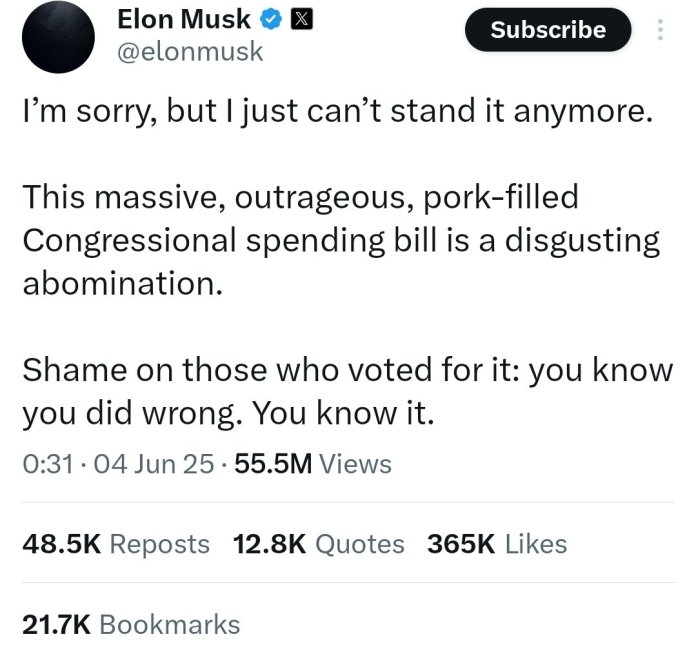
On Wednesday (4th June), Elon Musk fired off a tweet labelling Trump’s ambitious legislation as ‘outrageous, pork filled Congressional spending bill.’
“I’m sorry, but I just can’t stand it anymore. This massive, outrageous, pork-filled Congressional spending bill is a disgusting abomination. Shame on those who voted for it: you know you did wrong. You know it,” he tweeted.
Screengrab of the tweet by Elon Musk
US President Donald Trump hit back at Elon Musk soon after during a White House Press briefing.
He claimed, “I’m very disappointed with Elon. I’ve helped him a lot. He knew the inner workings of the bill better than anybody sitting here. He had no problem with it. All of a sudden, he had a problem & he only developed the problem when he found out we’re going to cut the EV mandate.”
Donald Trump emphasised that he would have won from Pennsylvania even without the support extended by Elon Musk.
“I have helped Elon a lot…Elon worked hard at DOGE and I think he misses the place…I think he got out there and he’s no longer in this beautiful Oval Office…it’s not just Elon, I think when some people leave they miss it so badly they develop a type of TDS…some embrace it and some become hostile,” he further claimed.
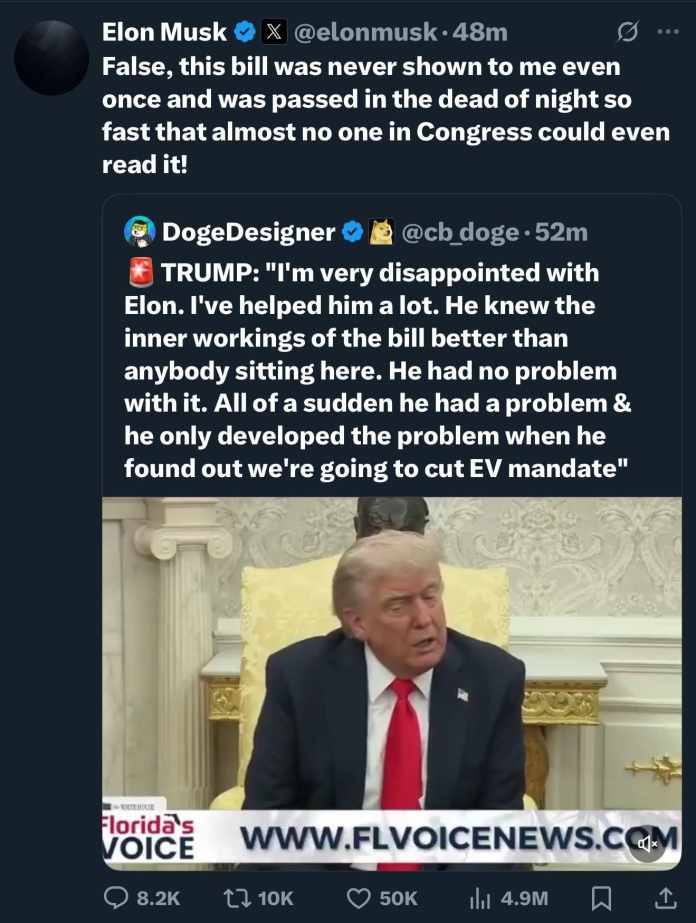
The remarks made by the US President further riled up Tesla CEO, who stated in no uncertain words that he he had no prior knowledge about the Big Beautiful Act.
“False, this bill was never shown to me even once and was passed in the dead of night so fast that almost no one in Congress could even read it!” Elon Musk slammed Donald Trump.
Screengrab of the tweet by Elon Musk
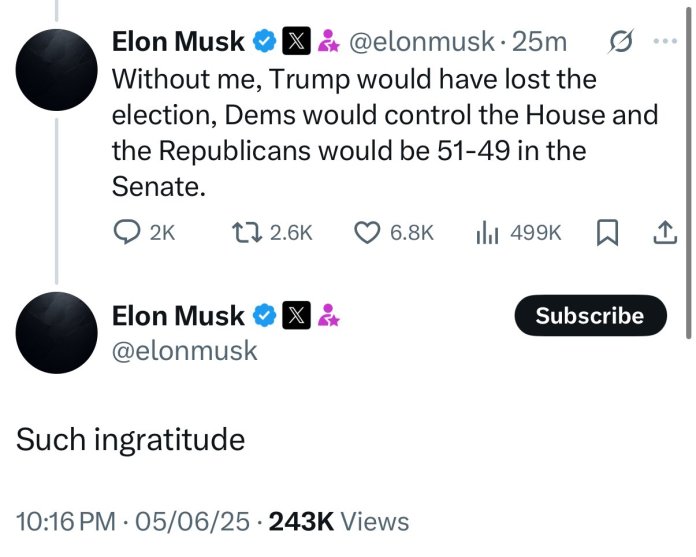
In another set of tweets, he highlighted, “Without me, Trump would have lost the election, Democrats would control the House, and the Republicans would be 51-49 in the Senate. Such ingratitude.”
Screengrab of the tweets by Elon Musk
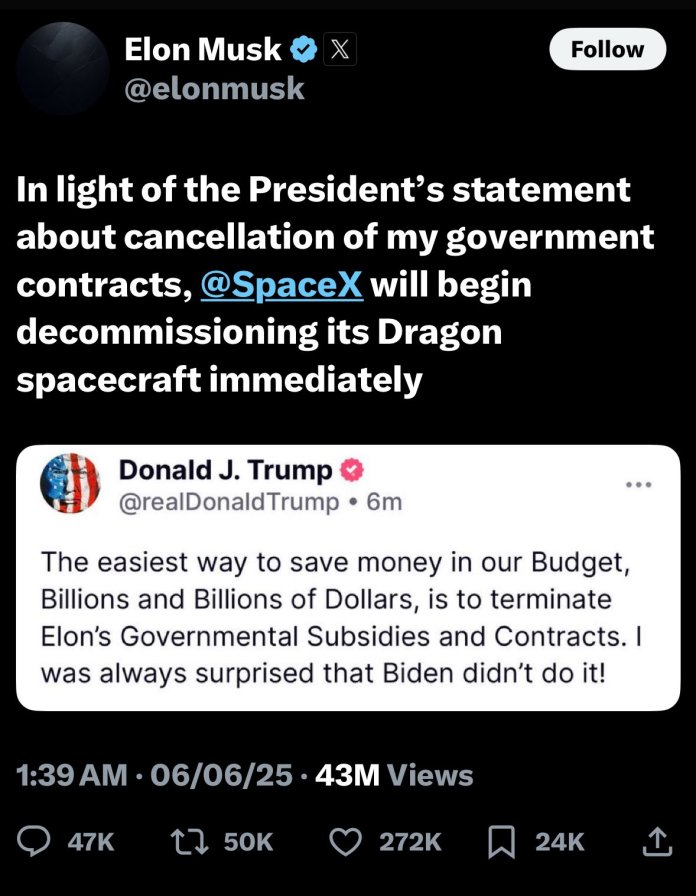
The public feud got uglier when Donald Trump vowed to cancel government contracts of SpaceX, a space exploration company run by Elon Musk.
In a post on Truth Social, the US President stated, “The easiest way to save money in our Budget, Billions and Billions of Dollars, is to terminate Elon’s Governmental Subsidies and Contracts. I was always surprised that Biden didn’t do it!”
In response, Elon Musk made it clear that SpaceX will immediately begin the process of decommissioning of the Dragon spacecraft.
Screengrab of the tweet by Elon Musk and post on Truth Social by Donald Trump
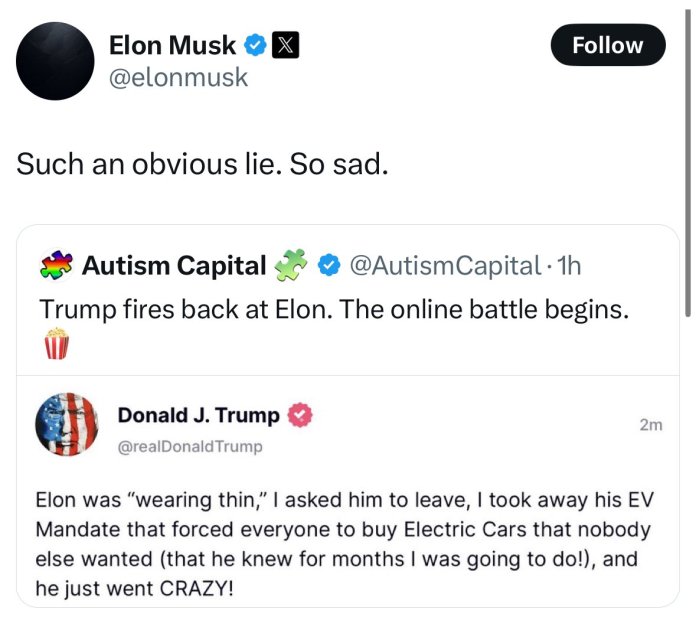
Donald Trump continued, “Elon was “wearing thin,” I asked him to leave, I took away his EV Mandate that forced everyone to buy Electric Cars that nobody else wanted (that he knew for months I was going to do!), and he just went CRAZY!”
Elon Musk was quick to label it a an ‘obvious lie.’
Screengrab of the tweet by Elon Musk and post on Truth Social by Donald Trump
In the meantime, the Tesla CEO floated the idea of a ‘new political party’ in the US.
Is it time to create a new political party in America that actually represents the 80% in the middle?
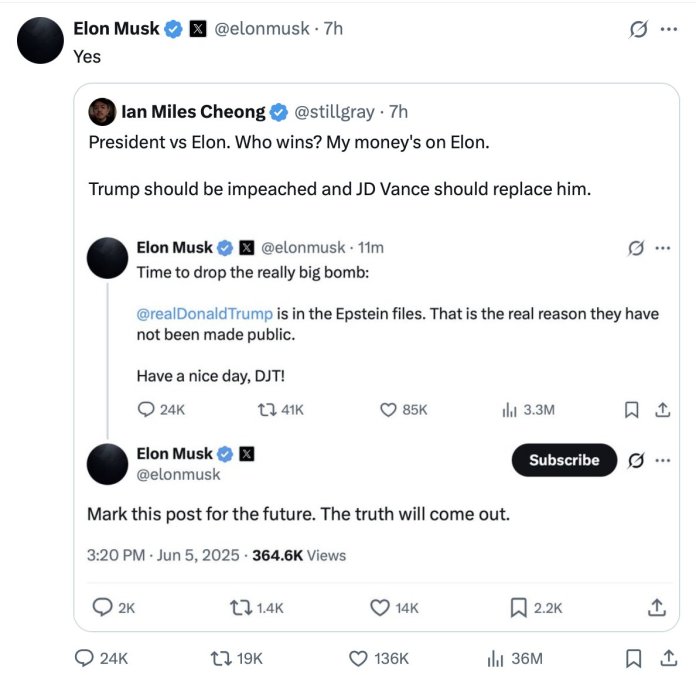
He even endorsed the idea of ‘impeachment’ of Donald Trump as the President of the United States and the latter’s replacement with Vice President JD Vance.
Screengrab of the tweets by Elon Musk
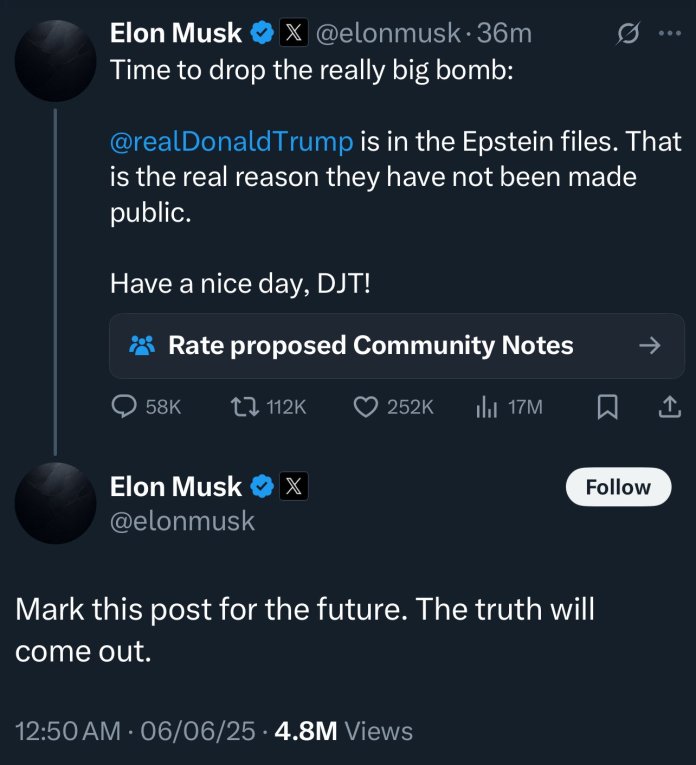
Things took a drastic turn when Elon Musk labelled Donald Trump a close confidante of the deceased child sex offender, Jeffrey Epstein.
Screengrab of the tweets by Elon Musk
In a set of tweets on Thursday (5th June), the Tesla CEO declared, “Time to drop the really big bomb: Donald Trump is in the Epstein files. That is the real reason they have not been made public. Have a nice day, DJT! Mark this post for the future. The truth will come out.”
This tweet gave further ammunition to Democratic party leaders to target Donald Trump. Republicans who have supported Elon Musk and Donald Trump throughout the entirety of the campaign are left hanging in the balance and are forced to pick one side.
WASHINGTON (AP) — President Donald Trump on Thursday threatened to cut Elon Musk’s government contracts as their fractured alliance rapidly escalated into a public feud with Trump suggesting he would use the U.S. government to hurt his fellow billionaire financially.
The spectacular blow-up between the president of the United States and the world’s richest man played out on their respective social media platforms after Trump first broached the topic in a White House meeting with Germany’s new leader.
WATCH: Trump says he’s ‘very disappointed’ in Elon Musk after criticism of president’s budget bill
The rancorous breakup happened less than a week after they appeared together at the White House and Trump thanked Musk for his brief but tumultuous time in the U.S. government.
Trump had largely remained silent as Musk stewed over the last few days on his social media platform X, condemning the president’s signature tax cuts and spending bill. But Trump clapped back Thursday in the Oval Office, lamented their frayed relationship and said he was “very disappointed in Musk.”
Musk responded on social media in real time. Trump ratcheted up the stakes when he turned to his own social media network, Truth Social, and threatened to use the U.S. government to hurt Musk’s bottom line with his internet company Starlink and rocket company SpaceX.
WATCH: House Speaker Johnson says Musk did ‘a 180’ in publicly opposing tax bill
“The easiest way to save money in our Budget, Billions and Billions of Dollars, is to terminate Elon’s Governmental Subsidies and Contracts,” Trump wrote on his social media network. “I was always surprised that Biden didn’t do it!”
“This just gets better and better,” Musk quickly replied on X. “Go ahead, make my day.”
The deepening rift unfurled much like their relationship started — rapidly, intensely and very publicly.
It also quickly hit Musk financially, even before Trump’s threat.
READ MORE: Musk slams Trump’s ‘big, beautiful’ bill as GOP senators race to meet July 4th deadline
After Trump started speaking about Musk, shares of his electric vehicle company Tesla fell 9%, their latest notable move since the election. The shares doubled in the weeks after Trump was elected, gave back those gains and more during Musk’s time at DOGE and then rallied after he vowed in April to focus much more on Tesla and his other companies.
Musk later offered up an especially stinging insult to a president sensitive about his standing among voters: “Without me, Trump would have lost the election,” Musk retorted. “Such ingratitude,” Musk said in a follow-up post.
Politicians and their donor patrons rarely see eye to eye. But the magnitude of Musk’s support for Trump, spending at least $250 million backing his campaign, and the scope of free reign the president gave him to slash and delve into the government with the Department of Government Efficiency is eclipsed only by the speed of their falling out.
Musk announced his support for Trump shortly after the then-candidate was nearly assassinated on stage at a Butler, Pennsylvania, rally last July. News of Musk’s political action committee in support of Trump’s election came days later.
Musk soon became a close adviser and frequent companion, memorably leaping in the air behind Trump on stage at a rally in October. Once Trump was elected, the tech billionaire stood behind him as he took the oath of office, flew with him on Air Force One for weekend stays at Trump’s Mar-a-Lago club in Palm Beach, Florida, slept in the White House’s Lincoln Bedroom at the president’s invitation and joined his Cabinet meetings wearing a MAGA hat (sometimes more than one).
“I’ll be honest, I think he missed the place,” Trump said Thursday. “He got out there, and all of a sudden he wasn’t in this beautiful Oval Office.”
Musk bid farewell to Trump last week in a subdued news conference in the Oval Office, where he sported a black eye that he said came from his young son but that seemed to be a metaphor for his messy time in government service.
Trump, who rarely misses an opportunity to zing his critics on appearance, brought it up Thursday.
“I said, ‘Do you want a little makeup? We’ll get you a little makeup.’ Which is interesting,” Trump said.
The Republican president’s comments came as Musk has stewed for days on social media about Trump’s “Big Beautiful Bill,” warning that it will increase the federal deficit. Musk has called the bill a “disgusting abomination.”
“He hasn’t said bad about me personally, but I’m sure that will be next,” Trump said Thursday in the Oval Office. “But I’m very disappointed in Elon. I’ve helped Elon a lot.”
Observers had long wondered if the friendship between the two brash billionaires known for lobbing insults online would flame out in spectacular fashion. It did, in less than a year.
“Look, Elon and I had a great relationship. I don’t know if we will anymore,” Trump said.
The president said some people who leave his administration “miss it so badly” and “actually become hostile.”
“It’s sort of Trump derangement syndrome, I guess they call it,” he said.
He brushed aside the billionaire’s efforts to get him elected last year, including a $1 million-a-day voter sweepstakes in Pennsylvania. The surge of cash Musk showed he was willing to spend seemed to set him up as a highly coveted ally for Republicans going forward, but his split with Trump, the party’s leader, raises questions about whether they or any others will see such a campaign windfall in the future.
Trump said Musk, the CEO and founder of Tesla, “only developed a problem” with the bill because it rolls back tax credits for electric vehicles.
“False,” Musk fired back on his social media platform as the president continued speaking. “This bill was never shown to me even once and was passed in the dead of night so fast that almost no one in Congress could even read it!”
In another post, he said Trump could keep the spending cuts but “ditch the MOUNTAIN of DISGUSTING PORK in the bill.”
The bill would unleash trillions of dollars in tax cuts and slash spending but also spike deficits by $2.4 trillion over a decade and leave some 10.9 million more people without health insurance, according to an analysis by the Congressional Budget Office, which for decades has served as the official scorekeeper of legislation in Congress.
Besides Musk being “disturbed” by the electric vehicle tax credits, Trump said another point of contention was Musk’s promotion of Jared Isaacman to run NASA.
Trump withdrew Isaacman’s nomination over the weekend, days after Musk left his government role.
“I didn’t think it was appropriate,” Trump said, calling Isaacman “totally a Democrat.”
Musk, reverting to his main form of political activity before he joined forces with Trump, continued slinging his responses on social media.
He shared some posts Trump made over a decade ago criticizing Republicans for their spending, musings made when he, too, was just a billionaire lobbing his thoughts on social media.
“Where is the man who wrote these words?” Musk wrote. “Was he replaced by a body double!?”
Chris Megerian and Paul Harloff in New York contributed to this report.
Support PBS News Hour
Your donation makes a difference in these uncertain times.
For more politics coverage and analysis, sign up for Here’s the Deal, our weekly politics newsletter, here.
Presidential budget proposals are usually seen as symbolic. But President Donald Trump is running the Republican Party and asserting presidential power in ways unseen in American history. At the least, the outline he has presented to Congress this year will influence lawmakers’ decisions.
From the White House and Republican perspective, his plan to eliminate some programs underscores that he is pushing for action that others have avoided. Looking at his initial or “skinny” budget proposal, along with an “appendix” the White House released last Friday, Trump’s budget would eliminate at least 46 programs and agencies.
Many of these programs have vocal advocates who say that without them, critical oversight, protections and functions will be gone.
At the same time, as you’ll see, this target list is composed mostly of programs with relatively small budgets. Eliminating them saves a sum barely worth mentioning relative to the federal deficit. Not the scale many fiscal conservatives hope to see.
For example, the largest proposed elimination is the Low-Income Home Energy Assistance Program, or LIHEAP, a national program that helps people afford heating and energy bills. Its roughly $4 billion in funding is just .06 percent of the discretionary budget Congress controls.
What programs does Trump want to cut?
Here are programs and agencies Trump proposes to eliminate in his budget.
For perspective, we are including the estimated funding amount for the current year, fiscal year 2025, when the budget provides them.
Economic and jobs programs
Economic development assistance programs. This provides some $2 billion in grants to economically struggling communities.
Economic Development Administration. $113 million.
Job Corps. More than $1.7 billion.
AmeriCorps (officially known as the Corporation for National and Community Service). $976 million.
Minority Business Development Agency. $68 million.
Community Service Employment for Older Americans. $405 million.
The Department of Labor’s Women’s Bureau.
NASA’s Office of Science, Tech, Engineering and Math Engagement. $143 million.
Oversight
Office of Federal Contract Compliance Programs. This office is a watchdog, tasked with making sure there is no discrimination in contracting. $111 million.
Chemical Safety and Hazard Investigation Board. $14 million.
Health and living programs
Administration for Community Living, which supports older and disabled Americans’ ability to live independently. More than $2.4 billion.
U.S. Interagency Council on Homelessness. $4 million.
The Department of Health and Human Services’ Prevention and Public Health Fund. $1.4 billion in funds planned for FY 2026.
Patient-Centered Outcomes Research Trust Fund. $338 million.
Assistance programs
LIHEAP, the Low-Income Home Energy Assistance Program. More than $4.1 billion.
Northeast Home Heating Oil Reserve. $7 million.
Refugees and asylees. Cash, medical and other social service assistance is eliminated. No summary figure given.
Legal and labor programs
The Department of Justice’s Community Relations Service. This division works to mediate and confront community tension. $24 million.
Federal Mediation and Conciliation Service, which mediates labor disputes. $54 million.
Legal Services Corporation, one of the nation’s largest funders of civil legal aid. $560 million.
Media and communications
U.S. Agency for Global Media, which includes Voice of America, Radio Free Asia, Radio Free Europe. $857 million.
Corporation for Public Broadcasting, a private nonprofit that distributes federal funding to public media organizations, including to NPR and PBS. This would affect local stations and programs like the PBS News Hour. $595 million.
Democracy and international development
Inter-American Foundation, funding community development in Latin America and the Caribbean. $47 million.
Educational and Cultural Exchange Programs (former part of USAID). $741 million.
Woodrow Wilson Center. $15 million.
U.S. Institute of Peace. $55 million.
African Development Foundation. $45 million.
Arts
National Endowment for the Arts. $207 million.
National Endowment for the Humanities. $207 million.
Institute of Museum and Library Services, a small federal agency that supports museums and libraries around the country. $295 million.
Regional authorities
Delta Regional Authority. $41 million.
Denali Commission in Alaska. $38 million.
D.C. Tuition Assistance Grant program. $40 million.
Cooperative Endangered Species Conservation Fund. $23 million in discretionary funding.
Marine Mammal Commission. $5 million.
What happens next?
Congress must pass the next funding bill by Sept. 30 to avoid a government shutdown.
Appropriators in both the House and Senate will go over this list, and make their own version of what stays and what goes.
It is not typical for Congress to eliminate many agencies or programs, but we are not in a typical year. Fiscal conservatives and Trump are pushing to show that they are slimming the government.
Support PBS News Hour
Your donation makes a difference in these uncertain times.