Category: USA

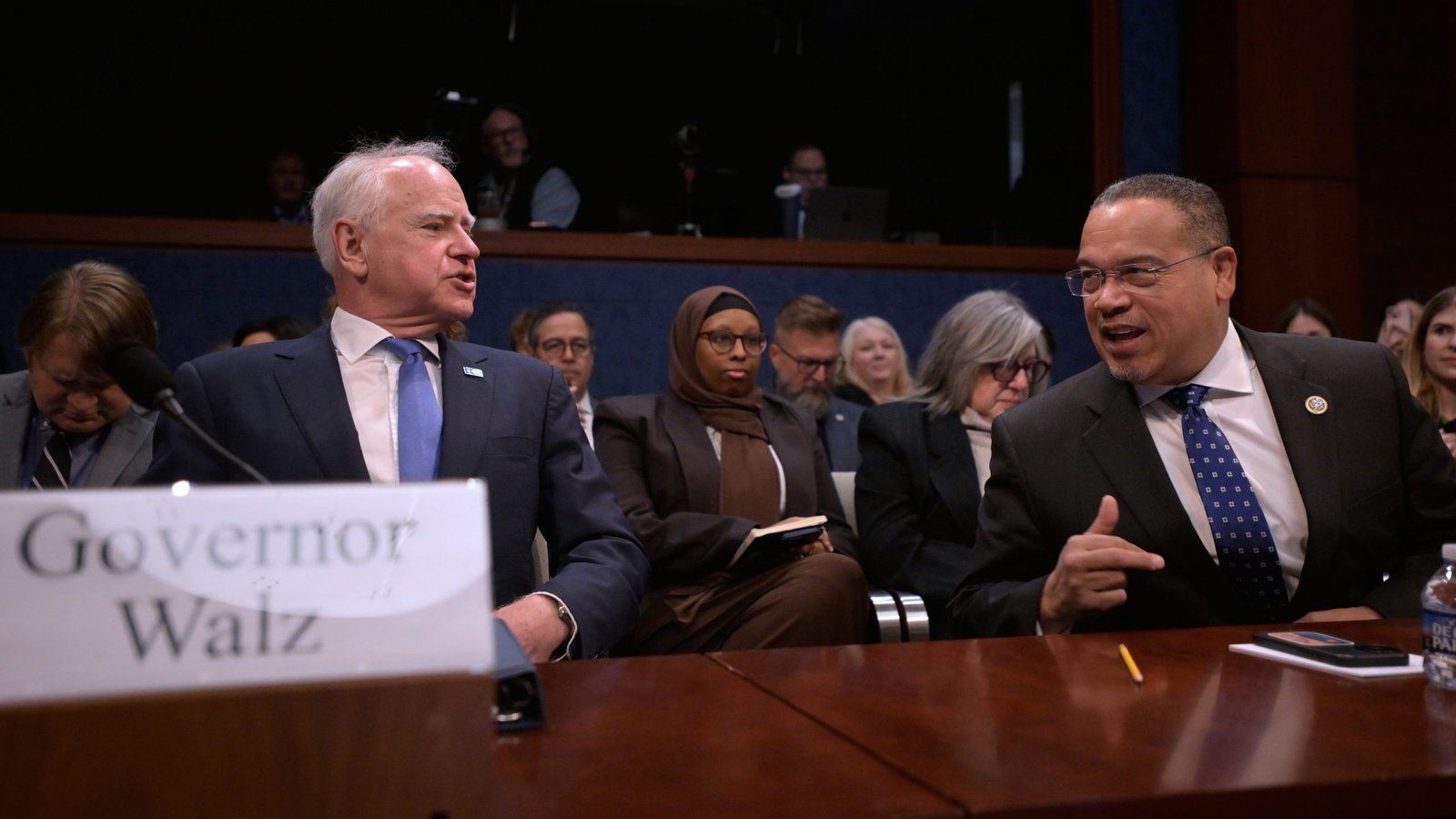
  • Walz, Ellison defend efforts to fight fraud and decry Operation Metro Surge at contentious U.S. House hearing

    Walz, Ellison defend efforts to fight fraud and decry Operation Metro Surge at contentious U.S. House hearing

    WASHINGTON – Gov. Tim Walz fended off GOP attacks on Wednesday, pivoting often to the Trump administration’s immigration crackdown during a U.S. House hearing on fraud in Minnesota.

    “The people of Minnesota have been singled out and targeted for political retribution at an unparalleled scale,” Walz said in his opening remarks. “Under the guise of combating fraud, the federal government has flooded Minnesota with masked, untrained, and unaccountable agents who are wreaking havoc in our communities.”

    Along with Walz, Minnesota Attorney General Keith Ellison was brought to testify before the House Oversight and Government Reform Committee by its chairman, Rep. James Comer, R-Ky., to testify about the Feeding Our Future scandal and other allegations of fraud in Minnesota’s social service programs.

    Comer asked why Walz did not order the stop or suspend payments to the Feeding Our Future program, a pandemic era program aimed at feeding children, despite warnings of fraud.

    “We’re not going to stop payments to feed children until we have the proof that things happen,” Walz said.

    Related: What Trump’s war on fraud actually looks like

    Comer accused Walz of failing to stop the payments “because you didn’t want to rock the boat.”

    Walz also pushed back on GOP charges that the federal government has lost $9 billion due to fraud.

    “Do you have a spreadsheet?” the governor asked at one point. None of the Republican lawmakers said they could identify the sourcing of that figure.

    Joe Thompson, a former prosecutor at the Minnesota U.S. attorney’s office said in December that as much as half of the $18 billion spent over seven years on 14 Medicaid programs could have been fraudulent. But that is considered an estimate and Feed our Future prosecutions to date have identified far less than that.

    At one point, Walz told Rep. Emily Randall, D-Wash., that Minnesota had become a target of the Trump administration “because I think the president does not like me personally.”

    Walz also pushed back on attacks on the state’s Somali community who were accused by some GOP lawmakers of being responsible for Minnesota’s problems with fraud. 

    When accused that immigrants were attracted to the state because of its “sanctuary” policies, Walz retorted that people move to Minnesota “because it’s a good place to live.”

    The Feeding Our Future scandal opened the door for the Trump administration to take drastic, punitive measures, including the freezing of childcare funding, the clawback of nearly $260 million in Medicaid money and threats to defund other programs, including food stamps.

    The fraud issue was also cited by Trump as a reason to send federal agents, including 3,000 Immigration and Customs Enforcement (ICE) and Border Patrol agents, to the state.

    Democrats on the panel invited Mariah Tollgaard, pastor of Hamline Church United Methodist in St. Paul, to testify about the human cost of the massive immigration enforcement operation in Minnesota called “Operation Metro Surge.”

    “In my church, members have stopped coming to service and have even postponed funerals,” said Tollgaard, who was one of about 100 religious leaders who were arrested when they protested the deportations of immigrants at the Minneapolis-St. Paul International Airport.

    During the often-contentious hearing, Tollgaard was taken to task by a GOP lawmaker who accused her of failing to correctly interpret a Bible verse.

    A sympathetic Democratic congresswoman followed up by asking Tollgaard if Jesus Christ and his parents, as refugees, would be given any leniency during Operation Metro Surge, in which children were separated from their parents. .

    “Jesus would be treated the same way,” Tollgaard responded.

    Meanwhile, Ellison pushed back against allegations that he was willfully blind to the scamming in the Feeding Our Future program. Rep. Andy Biggs, R-Ariz., played a video of Ellison offering help to some of the Feeding Our Future’s fraudsters.

    Ellison responded that he was merely taking a meeting from constituents who had complaints about the state’s bureaucracy and only found out later that they were “scammers and liars.”

    Like Walz, he also used the platform offered by the hearing to condemn the Trump administration for its massive immigration enforcement campaign in the state.

    “Operation Metro Surge did nothing to address fraud in our state. It decimated our economy, it hurt and scarred our people, and it dealt a severe blow to fraud enforcement efforts in Minnesota,” Ellison said.

    ‘The Cost of Doing Nothing’ 

    Just before the hearing convened Wednesday, committee Republicans released an interim investigation into Minnesota fraud, which included a previous hearing featuring GOP state legislators and the behind-closed door depositions of nine former and current state agency officials.

    The report, titled “The Cost of Doing Nothing: How Tim Walz and Keith Ellision fueled Minnesota’s Fraud,” said it uncovered evidence that the Democrats knew about the fraud in federal programs administered by the State of Minnesota much earlier than they told the American people.

    “While the Committee’s investigation remains ongoing, testimony and documents obtained to date establish a consistent pattern: fraud warnings were elevated to senior levels of the Minnesota state government, meaningful corrective action was delayed or avoided, and payments continued long after credible red flags emerged,” the report said.

    But there is no “smoking gun” and few new revelations in the report.

    It included a transcript of a portion of the deposition of Minnesota Department of Education Assistant Commissioner Daron Korte, who was asked about complaints about fraud in the Feeding Our Future program.

    “So, the complaints were coming from Partners in Nutrition,” Korte responded. “There wasn’t any real evidence or substance to the allegations. It was just complaints. When we asked for more information – or when our staff asked for more information – my understanding is it really wasn’t provided to them. So there really wasn’t anything actionable there other than just accusations.”

    Wednesday’s hearing was the second by the panel on the issue of fraud. The first one featured GOP state lawmakers.

    As in that first hearing, Democrats on the panel insisted the Oversight Committee should investigate President Donald Trump if they wanted to fight fraud.

    “You don’t fight fraud by issuing presidential pardons to fraudsters,” said Rep. Robert Garcia, D-Calif., referring to some individuals who have received pardons by Trump. 

    There was one amicable exchange between Walz and a Republican member of the panel, Rep. Pete Sessions, R-Texas, who had worked with the governor when he was a member of the U.S. House. 

    The former colleagues agreed that the use of AI technology could be helpful in combating fraud. Walz told Sessions, ‘I’m not proud of it,” referring to fraud in the state.

    “I think there’s more work to be done,” Walz said.

    Editor’s note: This story has been updated throughout.

    The post Walz, Ellison defend efforts to fight fraud and decry Operation Metro Surge at contentious U.S. House hearing appeared first on MinnPost.


  • ‘She was almost home’: Minnesota soldier who died in Iran war remembered as devoted parent, reservist

    ‘She was almost home’: Minnesota soldier who died in Iran war remembered as devoted parent, reservist

    WEST DES MOINES, Iowa (AP) — Sgt. 1st Class Nicole Amor was just days away from returning home to her husband and two children when a drone strike at a command center in Kuwait killed her and five other U.S. service members.

    “She was almost home,” her husband, Joey Amor, said from their home in White Bear Lake, Minnesota, on Tuesday. “You don’t go to Kuwait thinking something’s going to happen, and for her to be one of the first – it hurts.”

    Amor was one of four U.S. soldiers killed in the Iran war on Sunday and identified Tuesday by the Pentagon; two soldiers haven’t yet been publicly identified. The members of the Army Reserve worked in logistics and kept troops supplied with food and equipment.

    They died just one day after the U.S. and Israel launched its military campaign against Iran. Iran responded by launching missiles and drones against Israel and several Gulf Arab states that host U.S. armed forces.

    Those killed also included Capt. Cody Khork, 35, of Winter Haven, Florida; Sgt. 1st Class Noah Tietjens, 42, of Bellevue, Nebraska; and Sgt. Declan Coady, 20, of West Des Moines, lowa, who was posthumously promoted from specialist. No other names were released.

    “These men and women all bravely volunteered to defend our country, and their sacrifice will never be forgotten,” Army Secretary Daniel Driscoll said.

    All were assigned to the 103rd Sustainment Command, which provides food, fuel, water and ammunition, transport equipment and supplies.

    “Sadly, there will likely be more, before it ends. That’s the way it is,” President Donald Trump said of deaths.

    One of the youngest in his class

    Coady had just told his father last week that he had been recommended for a promotion from specialist to sergeant, a rank he received posthumously.

    He was one of the youngest people in his class but seemed to impress his instructors, his father Andrew Coady said Tuesday.

    “He was very good at what he did,” he said.

    Coady trained as an information technology specialist with the Army Reserves and was studying cybersecurity at Drake University in Des Moines. He was taking online classes while in Kuwait and wanted to become an officer.

    “I still don’t fully think it’s real,” his sister Keira Coady said. “I just remember all of our conversations about what he was going to do when he came back.”

    A mother of two who loved gardening

    Amor, 39, was an avid gardener who enjoyed making salsa from the peppers and tomatoes in her garden with her son, a senior in high school. She also enjoyed rollerblading and bicycling with her fourth-grade daughter.

    A week before the drone attack, Amor was moved off-base to a shipping container-style building that had no defenses, Joey Amor said.

    “They were dispersing because they were in fear that the base they were on was going to get attacked and they felt it was safer in smaller groups in separate places,” he said.

    He last spoke to her about two hours before she was killed. He said she was working long shifts and they had been messaging about her tripping and falling the night before.

    “She just never responded in the morning,” he said.

    A calling to serve his country

    Khork was very patriotic and drawn from a young age to serving the U.S., his family said in a statement Tuesday.

    He enlisted in the Army Reserve and joined Florida Southern College’s ROTC program.

    “That commitment helped shape the course of his life and reflected the deep sense of duty that was always at the core of who he was,” said his mother, Donna Burhans, father, James Khork, and stepmother, Stacey Khork, in a statement.

    Khork also loved history and had a degree in political science.

    His family described him as “the life of the party, known for his infectious spirit, generous heart, and deep care for those who served alongside him and for everyone blessed to know him.”

    One of Khork’s friends, Abbas Jaffer, posted on Facebook on Monday that he had lost the best person he had ever known.

    “My best friend, best man, and brother gave his life defending our country overseas,” Jaffer said. Khork and Jaffer had been friends for more than 16 years.

    A loving father and husband

    Tietjens lived with his family in the Washington Terrace mobile home park in the Omaha suburb of Bellevue, Nebraska. He was married with a son, according to a Facebook page.

    Tietjens earned a black belt in Philippine Combatives and Taekwondo and was “an instructor who gave his time, discipline, and leadership to others,” the Philippine Martial Arts Alliance said in a Facebook post.

    On the mat and as a soldier, “he carried the same values: honor, discipline, service, and commitment to others,” the organization said.

    Nebraska Gov. Gov. Pillen paid tribute to the family Tuesday.

    “Noah stepped up to serve and defend the American people from foreign enemies around the world — a sacrifice we must never forget,” he wrote.

    “We are holding the Tietjens family close in our hearts during this unbelievably difficult time and will keep them in our prayers,” he said.

    ___

    Boone contributed from Boise, Idaho, and Toropin from Washington. Associated Press reporters Sarah Raza in Sioux Falls, South Dakota; Ed White in Detroit; Josh Funk in Omaha, Nebraska; David Fischer in Miami and Hallie Golden in Seattle contributed to this report.

    The post ‘She was almost home’: Minnesota soldier who died in Iran war remembered as devoted parent, reservist appeared first on MinnPost.
  • Reps. Finstad, Craig spar over farm bill politics in marathon House Agriculture committee 

    Reps. Finstad, Craig spar over farm bill politics in marathon House Agriculture committee 

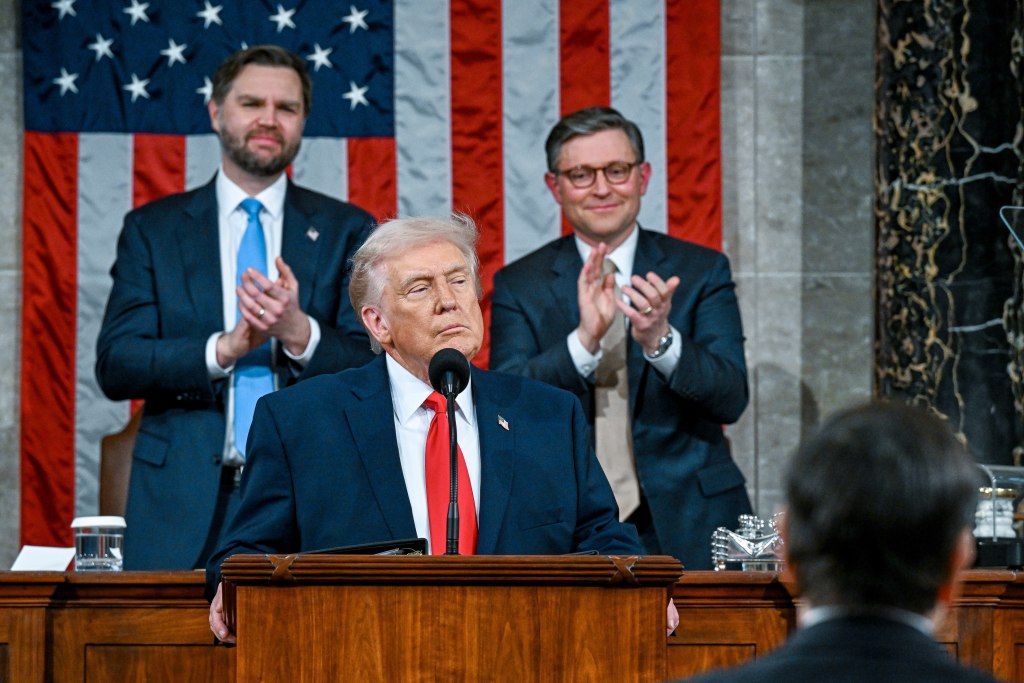
    WASHINGTON – Rep. Brad Finstad, R-1st District, slammed Rep. Angie Craig, D-2nd District, during a marathon meeting of the House Agriculture Committee this week, saying the Democrat was playing politics with farm policy because she is running for a U.S. Senate seat.

    “The fact is we have a ranking member who is running for higher office who is ignoring the fact that her fingerprints are on a lot of things in (the legislation,)” Finstad said. “Now she is running away from that. This is political theater and it’s unfortunate it’s crept into a committee hearing where we have a really good product.”

    The purpose of the House Agriculture Committee meeting was to consider amendments to a new GOP-crafted farm bill and vote the legislation out of committee so it could be considered by the full House. 

    But Craig, the top Democrat on the Agriculture Committee, panned the bill for failing to reverse some of the “big, beautiful” bill’s restrictions on the food stamp program and because of her opposition to other provisions.

    “This was not a bipartisan effort,” she said.   

    Craig, who is running for retiring Sen. Tina Smith’s seat, also condemned Republicans on panel who backed President Donald Trump’s tariff policy, which she said has been ruinous for the nation’s farmers.

    Despite Craig’s misgivings, the farm bill was voted out of committee. It focuses largely on policy issues because last year’s “big, beautiful” reconciliation bill funded the farm subsidies, crop insurance and other programs that are normally found in a 5-year farm bill.

    Craig criticized that process. saying what was left for Democrats to consider was a “skinny farm bill” that was grossly flawed.

    “This bill does not lower input costs or stabilize our export markets. It does not help make food more affordable,” Craig said. “And it is going to have challenges getting broad bipartisan support on the floor.”

    Related: After failed resolution, Democrats’ last leverage over Iran war may be Pentagon budget

    Craig said the bill was improved with the adoption of several Democratic amendments, but still “did not meet the moment.” She said she hoped he Senate would produce a better bill and that negotiations over a final bill would result in a farm bill she could support.

    Finstad, meanwhile, followed up his comments during the hearing with a post on X.

    “Our job is to govern, to be the adults in the room and figure out ways to come together to deliver meaningful ag policy for Minnesotans,” Finstad said. “It’s unfortunate that Ranking Member Craig is more concerned with political theatrics than supporting what’s good for farmers, families, and the American people.”

    The GOP farm bill would bar states or localities from requiring pesticide labels to carry health warnings and limit their use if those restrictions go beyond those of the federal government.

    Republicans on the panel argued that farmers in their state need to use the weed killer glyphosate – which has been tied to cancer – to keep crop yields high and enable those farmers to meet the nation’s food demands.

    The bill would also prevent states like California from continuing to ban the import of pork and poultry from animals that are not raised under humane conditions. The farm bill says states can establish regulations within their own borders but cannot impose conditions on farmers from other states.

    Minnesota Farm Bureau President Dan Glessing said that “80 percent of (farm bill) spending was pretty much done” in last summer’s reconciliation bill. But he also said the new farm bill would fund important rural development and conservation programs that were not included in last year’s bill. 

    “It would address a lot of concerns,” Glessing said of the “skinny” farm bill. “It’s time to get it done.”

    The last five-year farm bill was approved by Congress in 2018 and has been extended several times since lawmakers have been unable to agree on farm policy. 

    The post Reps. Finstad, Craig spar over farm bill politics in marathon House Agriculture committee  appeared first on MinnPost.

  • After failed resolution, Democrats’ last leverage over Iran war may be Pentagon budget

    After failed resolution, Democrats’ last leverage over Iran war may be Pentagon budget

    WASHINGTON – Congress failed to rein in President Donald Trump’s authority to conduct war on Iran this week, but it will have another chance to try to influence the course of those escalating military strikes.

    The “big beautiful” bill Congress approved last summer boosted the Pentagon’s budget to nearly $1 trillion. However, the Defense Department is burning through its stocks of precision weapons at a record clip in a war that some defense industry analysts say is costing $1 billion a day.

    So, the White House is expected to soon ask Congress for another $50 billion or so to continue to prosecute the war. And that might cost Trump some concessions – or at the very least require the White House to inform lawmakers of the strategy, goals and duration of the war.

    “We have the power of the purse,” said Rep. Betty McCollum, D-4th District, the top Democrat on the House Appropriations Subcommittee on Defense. “And maybe by the power of the purse we could get to the negotiating table.”

    The need for more money to conduct the war is likely the only way Congress can have any influence over the Iran war. Attempts in the U.S. House and Senate to approve resolutions that would rein in Trump’s authority to carry out the war failed this week, largely along party lines.

    Related: Reps. Finstad, Craig spar over farm bill politics in marathon House Agriculture committee

    But to pass any new military funding measure through the Senate, the support of at least seven Democrats will be needed to overcome the filibuster.

    Senate Minority Leader Charles Schumer, D-N.Y., said Monday that Americans “don’t want a war that leads to lost American lives and that costs billions and billions of taxpayer dollars.”

    The request for more war funds could also run into trouble in the closely divided U.S. House.

    Procuring additional funds for an escalating war effort, which Defense Secretary Pete Hegseth said Wednesday could last eight weeks, would require cuts in other sections of the federal budget.

    “(The war) is going to affect every single person in this country, it will affect economic security as well as national security,” McCollum predicted.

    The post After failed resolution, Democrats’ last leverage over Iran war may be Pentagon budget appeared first on MinnPost.

  • St. Paul church protest over ICE draws charges against 30 more

    St. Paul church protest over ICE draws charges against 30 more

    Attorney General Pam Bondi announced federal charges Friday against 30 more people who are accused of civil rights violations in a January church protest in Minnesota where a pastor works for Immigration and Customs Enforcement.

    Bondi said on social media that 25 people were in custody and more arrests would follow. The new indictment comes a month after independent journalists Don Lemon and Georgia Fort and prominent local activist Nekima Levy Armstrong were charged for their alleged roles in a protest at Cities Church in St. Paul.

    Bondi accused the group of attacking a house of worship.

    “If you do so, you cannot hide from us — we will find you, arrest you, and prosecute you,” she wrote on social media.

    A livestreamed video posted on Facebook shows people interrupting services at Cities Church on Jan. 18 by chanting “ICE out” and “Justice for Renee Good,” a reference to the woman who was fatally shot by an ICE officer in Minneapolis on Jan. 7.

    Protesters targeted church over its pastor

    Protesters descended on Cities Church after learning that one of the church’s pastors also serves as an ICE official. The protest drew swift condemnation from Trump administration officials and conservative leaders for disrupting a Sunday service.

    In total, 39 people now face charges of conspiracy against religious freedom and interfering with the right of religious freedom. The new defendants had initial court appearances and were released.

    Lemon and Fort said they were at the church as journalists covering news. Levy Armstrong was the subject of a doctored photo posted by the White House showing her crying during her arrest. The three have pleaded not guilty.

    The indictment says the “agitators” entered the church in a “coordinated takeover-style attack” and engaged in acts of intimidation and obstruction.

    “Young children were left to wonder, as one child put it, if their parents were going to die,” the indictment says.

    Congregation welcomes more arrests in church protest

    A lawyer for the church praised the Justice Department for charging more people.

    “The First Amendment does not give anyone — regardless of profession, prominence, or politics — license to storm a church and intimidate, threaten, and terrorize families and children worshipping inside,” Doug Wardlow said in a statement.

    The revised indictment adds new allegations when compared to the original filed in January.

    It says two people “conducted reconnaissance” outside the church a day before the protest and recorded their visit on video, with one saying, “My thoughts are to be able to close up this whole alleyway right here.”

    The court filing quotes one protester as chanting in the church, “This ain’t God’s house. This is the house of the devil.”

    Trahern Crews, who was charged in January and is lead organizer of Black Lives Matter Minnesota, said the latest arrests were a “waste of time.”

    “It’s a shame that the people who have killed Alex Pretti and Renee Good or Keith Porter have not been arrested but peaceful protesters have,” Crews said. Porter was fatally shot in Los Angeles by an off-duty ICE officer.

    Minnesota was hotbed for immigration blitz

    Levy Armstrong defended the protest shortly after it occurred. She said critics needed to “check their hearts” if they were more concerned about a disruption than the “atrocities that we are experiencing in our community.”

    The protest came at a tense time in Minnesota, where the Trump administration sent thousands of federal officers for Operation Metro Surge after a series of public fraud cases where the majority of defendants had Somali roots. Officers frequently deployed tear gas for crowd control in neighborhood clashes with residents, often detaining them along with immigrants.

    Good, 37, was shot in Minneapolis. In another fatal shooting a week after the church protest, a federal officer killed Pretti, a 37-year-old nurse, in the same city.

    Nationwide demonstrations erupted in response, followed by a change in Operation Metro Surge’s leadership and the eventual wind-down of the immigration enforcement operation. Roughly 400 ICE officers and Homeland Security agents were expected to remain in Minneapolis by early March, down from roughly 3,000 at the peak, according to a court filing.

    Since then, the Twin Cities have grappled with the impact to communities and the local economy. Minneapolis said it suffered an impact of $203 million due to the operation, with tens of thousands of residents in need of urgent relief assistance.

    Separately, a woman who was at the church service has filed a lawsuit against some people who were charged, alleging emotional trauma and an inability to exercise her religion that day.

    ___

    Associated Press writer Ed White in Detroit contributed to this report.

    The post St. Paul church protest over ICE draws charges against 30 more appeared first on MinnPost.

  • D.C. Memo: What to make of Trump’s ‘war on fraud?’

    D.C. Memo: What to make of Trump’s ‘war on fraud?’

    WASHINGTON – Vice President JD Vance wasted no time after he was appointed to lead a “war on fraud” by President Donald Trump during Tuesday’s State of the Union address to the nation.

    Yes, the first target of the new campaign is Minnesota, no surprise since Trump accused the state of $19 billion in fraud, without evidence, in his address.

    Vance and Mehmet Oz, administrator for the Centers for Medicare & Medicaid Services (CMS), made a surprise announcement that the Trump administration was holding back nearly $260 million in Medicaid money each quarter until Minnesota submits “a comprehensive action plan” detailing how it would combat fraud.

    Oz visited Minnesota in January, calling the trip a “fact-finding mission,” after Nick Shirley, a conservative activist, disseminated a video that alleged Somali-run day care centers were bilking the government.

    But the Trump administration’s new initiative is much broader.

    “(Minnesota) is not the only state that’s floundering,” Oz said at a Wednesday news conference with Vance. “Minnesota is not alone, although it is the first to receive this action.”

    So, the withholding of Medicaid money to other states is expected, likely those that are led by Democrats, like California, and have also been asked to submit information related to Medicaid fraud.

    But a surprise is Oz’s announcement that the administration is also targeting Medicare fraud. While Medicaid, known as Medical Assistance, provides health care coverage for the poor, Medicare is the government health plan for seniors 65 and older.

    Unlike Medicaid, whose costs are shared between the federal government and the state, the cost of Medicare is paid by a trust fund held by the federal government. And Medicare fraud is rampant.

    A favorite scam is when fraudsters, using stolen Medicare policy numbers, set up fake medical supply companies and bill Medicare for everything from catheters to medical beds that are never delivered to any patient.

    So, Oz has placed a six-month moratorium on payments to new medical equipment companies, including those that provide prosthetics, orthotics and medical supplies. He also said CMS would make use of AI to combat fraudulent billings.

    To date, the federal government has been losing the war on medical fraud as scammers find new ways to defraud. A major weapon used by the federal government to combat fraud is the False Claims Act, which imposes significant penalties on individuals or entities that knowingly submit false claims for payment. The act allows whistleblowers to file qui tam lawsuits on behalf of the government, rewarding them – if successful – with up to 30% of the recovered funds.

    As far as the “deferred” Medicaid payments to Minnesota, Gov. Tim Walz at a Thursday news conference called the Trump administration’s demands “a ransom note.”

    He also said the withholding of money “is a targeted retribution against a state the president doesn’t like.”

    “If there is fraud, we need evidence so we can stop payments to bad actors,” Walz said.

    Minnesota has already spent the Medicaid money that has been withheld. The $260 million is what the state should have received in reimbursements to cover the federal government’s share of the program for the last quarter of 2025.

    Oz said Minnesota’s rainy-day fund could handle any potential lapse in payments, “so we are very confident that people will not be hurt in Minnesota.”

    But this is not the first time CMS has threatened to cut off Minnesota’s Medicaid money.

    CMS warned the state in January that it would withhold up to $2 billion in Medicaid funds, but Minnesota has appealed that decision.

    “This is a new threat,” state Medicaid Director John Connolly said. “Our concern is that this could go on for many quarters, which would be catastrophic.”

    Republicans in Congress are eager to help Trump in his efforts to portray Minnesota as a fraud-drenched state and have established their own investigations.

    The most prominent is led by Rep. James Comer, R-Ky., the head of the House Investigation and Government Reform Committee, which has demanded Walz and Attorney General Keith Ellision testify before his panel on Wednesday.

    “They requested I go there and I will go there,” said Walz. “It gives me the opportunity to talk about what we’ve done.”

    Walz also questioned why Comer’s committee is not investigating the “aggressive tactics” of the federal immigration agents who killed Renee Good and Alex Pretti in Minneapolis.

    “Where is the investigation into the deaths of these two Minnesotans?” he asked.

    Blue states want their tariff money back

    Since the Supreme Court ruled that President Donald Trump overstepped his authority in imposing certain steep tariffs on a number of nations, Democrats have come up with a new campaign, asking the Trump administration for the money back.

    The Supreme Court’s decision did not mandate a return of the money collected by the U.S. Treasury from those unauthorized tariffs, which total more than $130 billion. The tariffs are paid by the nation’s importers, who usually pass the cost along to consumers.

    At a press conference with other state financial officials Thursday, Minnesota State Auditor Julie Blaha said she generally agreed with estimates that the tariffs have cost the average consumer more than $1,700.

    But she said she did not have “a hard number” of the tariffs’ cost on businesses and individuals in Minnesota because of the confusion and lack of transparency about the imposition and collection of those import levies.

    “I am deeply concerned as the auditor I can’t confidently say” how much the tariffs have cost Minnesota, Blaha said.

    So, it’s unclear if Minnesota is going to join a growing list of states who want a refund.

    Maryland State Comptroller Brooke Lierman has come up with a figure – $4 billion – that she said “unlawfully collected” tariffs have cost her state’s consumers and businesses.

    “We demand transparency and restitution,” Lierman said.

    Meanwhile, New York Gov. Kathy Hochul on Tuesday called on the Trump administration to issue $13.5 billion in tariff refunds to residents of her state. California and Illinois have also demanded refunds.

    Trump is likely to ignore those demands.

    But he may not be able to ignore a court order.

    More than 1,000 American companies have filed lawsuits seeking a return of the money they paid in tariffs.

    ICYMI:

    ▪️ We wrote about the candidates in the 1st District congressional race: incumbent Rep. Brad Finstad, a Republican who has served since 2022, and challenger Jake Johnson, a Democrat who appears to be gaining some traction.

    ▪️ Shadi Bushra reviewed a plan in the Legislature to expand the type of nonprofits that can write eviction-blocking letters to landlords to assure them that struggling tenants will pay their rent.

    ▪️ We also covered President Donald Trump’s State of the Union address, which included more criticism of Minnesota for alleged fraud. The president pointed the finger at the Somali community, saying members have committed $19 billion of fraud.

    ▪️ Speaking of fraud claims, Matt Blake previewed his Capitol Conversations newsletter with a primer on fraud probes in Minnesota, including wildly exaggerated estimates of how much money has allegedly been stolen (see above) and more plausible ones.

    ▪️ And Brian Arola and Ellen Schmidt visited St. Cloud, where they talked with Somali Americans who were caught up in ICE’s immigration enforcement and worry about its long-term impact on their community.

    This and that

    A reader commented on a story about the 1st District congressional race, in which Republican Rep. Brad Finstad is seeking reelection.

    “What exactly has Finstad and House Republicans done that benefits the district?” the reader wrote. “One can create a long list of harmful actions they have taken against rural America. Destroyed markets for American agriculture, instituted tariffs that are a tax on the middle class, taken away immigrant workforce that are filling essential jobs are just a few examples.”

    Please keep your comments, and any questions, coming. I’ll try my best to respond. Please contact me at aradelat@minnpost.com.

    The post D.C. Memo: What to make of Trump’s ‘war on fraud?’ appeared first on MinnPost.
  • In a tough election year for House Republicans, Brad Finstad faces a serious challenge

    In a tough election year for House Republicans, Brad Finstad faces a serious challenge


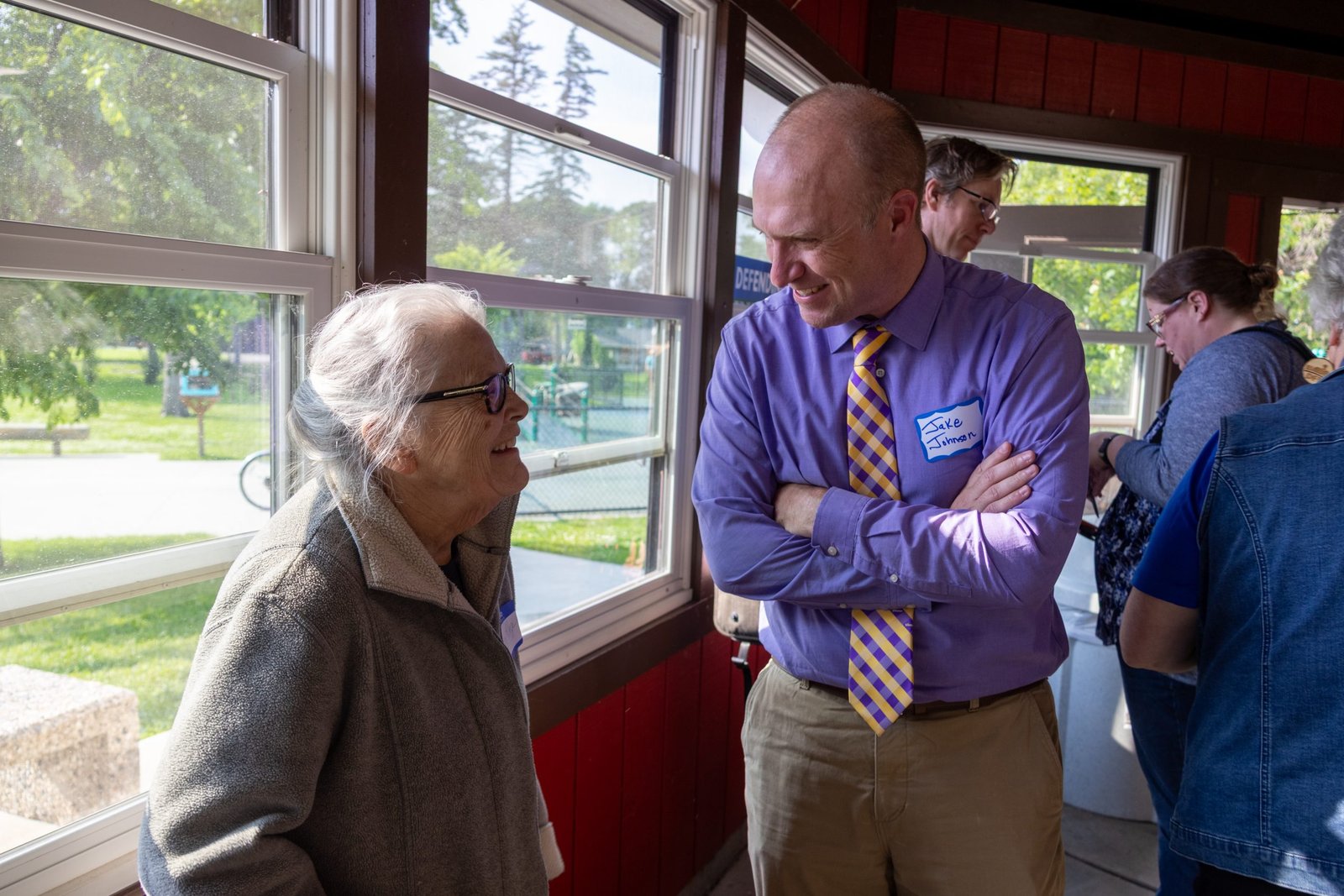
    a main in a blue shirt and yellow ties has his arms folded as he speaks with a woman

    WASHINGTON – After he decisively won his last election, it looked like Rep. Brad Finstad had a lock on southern Minnesota’s sprawling 1st Congressional District.

    A conservative Republican who served as the U.S. Department of Agriculture’s Rural Development director in the state during President Donald Trump’s first term and the operator of a family farm, Finstad reflected the ideology of a growing number of southern Minnesota voters who had steadily marched toward the Republican Party.

    Living in New Ulm with his wife and seven children, Finstad has deep roots in the district and looked like a shoo-in for reelection.

    But he’s attracted a stronger-than-expected challenge this year from high school math teacher Jake Johnson, who grew up in Stewartville and still lives only about 10 miles away. Running as a centrist Democrat, Johnson has the backing of politically powerful teachers unions and has caught the attention of the national Democratic Party.

    a politician in a blue suit and red tie poses for a portrait
    Rep. Brad Finstad, a Republican, has represented Minnesota’s 1st Congressional District since he won a special election in 2022. Credit: Courtesy of U.S. Rep. Brad Finstad's campaign

    With its largest population center in Rochester, the largely rural 1st District stretches along the Iowa border from Wisconsin to South Dakota.

    Trump won that district by just 1 percentage point in 2020. But the president’s margin of victory rose to more than 12 percentage points in 2024. And Finstad defeated his Democratic rival, Rachel Bohman, by 17 percentage points that year.

    While Democrats are in the minority in the district, Johnson’s bid for office has been aided by political serendipity.

    Trump’s favorability ratings have dropped, the U.S. economy is showing signs of weakness and the president’s signature domestic and foreign policy issue – tariffs – have pinched the district’s farmers by raising the price of inputs and prompting retaliation from some of the nations that purchased their exports.

    “I’m running on affordability and tariffs,” Johnson, 42, said. “Our rural communities are hurting right now.”

    Carleton College political science professor Ryan Dawkins said Trump had made gains in the 1st District in the 2024 election as part of a “generalized shift” toward the president by an electorate that was angered by high inflation. 

    But now, continued inflation, dropping consumer confidence levels and doubts about the strength of the economy are working against Trump, Dawkins said. That’s why he said Johnson’s call for “affordability,” a mantra widely used by Democrats this election, is likely to resonate.

    “(Voters) view Trump as, at best, aloof to the problem, or at worst, complicit,” Dawkins said.

    He also said “Operation Metro Surge,” the Trump administration’s massive immigration crackdown in Minnesota, may also have an impact on the race by depressing GOP voter turnout.

    “But you might not see it as much in rural areas,” Dawkins added. 

    Finstad prefers to focus on the popular things Trump has accomplished — often with the help of Republicans in Congress.

    “We have ended lawlessness on our formerly open southern border. We have delivered tax relief that Americans are starting to see this year. Most crime is on the decline,” he said in a written response to questions.

    Johnson has also been able to raise a respectable amount of campaign cash — a little more than $750,000 last year — so there’s not a huge fundraising gap between his campaign and Finstad’s, which has raised a little over $1 million.

    Another advantage for the Democrat is that midterm elections historically favor the party that does not control the White House. The GOP majority in the House has shrunk due to Democratic wins in several special elections and Democrats are favored to retake the chamber in November’s midterms. 

    “It’s not going to be whether the Democrats have a good year, but how good a year are the Democrats having,” Dawkins said.

    That fight over control of the U.S. House has made the 1st District race more competitive, even as Johnson is still the underdog in the contest.

    To win control of the House, Democrats need to only flip three seats. But the Democratic Congressional Campaign Committee has targeted 44 districts, including Finstad’s. That means Johnson’s campaign could be eligible for campaign cash and other types of help from the national Democratic Party. 

    ‘Every campaign … is a little different’ 

    Finstad, 49, has represented the 1st District since 2022, when a special election was held to fill the seat of former Republican Rep. Jim Hagedorn, who died in office.

    Finstad has positioned himself well in Congress, securing a seat on the House Agriculture Committee that allows him to be at the table when issues that affect his farmers are considered. He also has seats on the House Small Business and Armed Services committees.

    He has the advantages of incumbency, including name recognition and an ability to raise money from political action committees. And he has a powerful ally in Rep. Tom Emmer, R-6th District, who has a leadership position as the House Majority Whip and was a former head of the National Republican Congressional Committee.

    But Finstad is also still a relatively junior member of the House, where the ability to get things done is largely based on seniority.

    He’s introduced 24 bills in this term of Congress. They include a bill that would streamline the U.S. Department of Agriculture loan process and legislation that would remove a Medicaid restriction on coverage for mental health services in facilities with more than 16 beds.

    While most of Finstad’s bills have not become law, his FARMER Act, which enhances crop insurance, was included in the “big, beautiful” bill.

    Finstad said his campaign messaging focuses on “economic growth and lowering the cost of living, law and order on our streets and borders, security against threats from foreign nations and terrorists.” 

    With a focus on agricultural issues, including a long-overdue farm bill, Finstad recently founded a bipartisan “Congressional Soil Caucus” with a California Democrat.

    “The soil under our feet is our nation’s most valuable resource,” Finstad said. “It grows the food we eat, the fiber we wear, and the fuel that runs our vehicles.”

    As far as this year’s campaign, Finstad seemed unconcerned.

    “Every campaign, every year, is a little different,” he said. But, he added “the fundamentals are the same.”

    Not running against Trump

    Although they are both sons of the 1st Congressional District, the candidates who want to represent southern Minnesota in the next Congress have widely different backgrounds.

    Johnson had a hardscrabble childhood. One of 10 children in a blended family that struggled financially, Johnson said the household was dependent on food stamps and Medicaid – the government health program for the poor. He said his dad collected garbage and his mom went door-to-door reading meters. 

    Johnson said the family survived with the help of neighbors and fellow church members who allowed him and his siblings to pick vegetables from their garden, overpaid them for chores and even stepped in and helped repair their dilapidated home and clean it of mold.

    “I honestly did not know as a kid we were poor” because of the help the community gave the family, Johnson said. “Later, I realized how many people wrapped their arms around us.”

    He’s never run for elected office and says his bid for Congress comes from a desire to repay some of the kindness.

    Perhaps because of Trump’s popularity in the district, he does not attack the president – at least not directly. “I’m not running against President Trump; I’m running against Brad Finstad,” he said.

    He also said that while “there are definitely areas I do not agree with the president,” to secure the 1st District seat his campaign “needs to win some of the people who voted for Brad.”

    Johnson has repeatedly attacked Finstad for his support of Trump’s signature issue – tariffs. Those levies on imports have raised the cost of inputs for the district’s farmers and retaliation by other nations against U.S. tariffs have cut off important overseas markets for their goods.

    While the Supreme Court ruled last week that Trump had overstepped his authority by imposing certain tariffs, the president said he will continue to impose tariffs under the authority that he lawfully has.

    Dawkins of Carleton College said farmers, who have strongly supported Trump, may be somewhat disillusioned by his tariffs. “But I’m dubious this is going to filter down to congressional races,” he said.

    Juggling his job as a math teacher at Mayo High School in Rochester with campaigning, Johnson said he’s visited all 21 of the districts to meet and greet as many voters as he can at picnics, bars, government offices and all types of public places. His only campaign ad is a billboard that a supporter put up in St. James.  

    He has a moderate message. “I’m willing to work with anyone,” he said.

    His platform includes term limits for members of Congress and the U.S. Supreme Court, a ban on the trading of stocks by lawmakers, and limiting the president’s pardon powers.

    While he’s a political neophyte, Johnson has had plenty of experience with organizing, long serving as the faculty representative of his school for Education Minnesota, the state’s teachers union.

    The Democrat has taken a populist approach to get his name on the ballot, preferring to collect 6,000 signatures than paying a $300 filing fee.

    Supporting Trump’s agenda 

    Finstad, meanwhile, is a fourth-generation Minnesotan who continues to help operate the Brown County family farm on which he grew up.

    Unlike Johnson, Finstad has plenty of political experience, serving in the state House before becoming the director of USDA Rural Development.

    Finstad said his closest friends in Congress are Emmer and Reps. Pete Stauber, R-8th District, and Michelle Fischbach, R-7th District.

    “I like to find issues where I have common ground with others and use that to connect us,” he said. “At the end of the day, we still need to govern and I believe that is what most of my colleagues are here to do.”

    Even so, Finstad has also faithfully joined other GOP members of the state’s congressional delegation in supporting Trump’s agenda in the state.

    For instance, he signed on to a bill sponsored by Emmer that would require the state to provide information on voting records the Trump administration has sought from Minnesota and other “blue” states or lose federal funding.

    Minnesota Secretary of State Steve Simon called the legislation “an irresponsible stunt” that would “actively damage the security of our elections by threatening to starve Minnesota of critical federal funds that help protect our election infrastructure from harm or attack.”

    Finstad also joined Emmer and his other Minnesota GOP colleagues in issuing a raft of letters alleging fraud in the state’s social services program. One demanded Gov. Tim Walz turn over information about the state’s food stamp program. Others were sent to Trump administration officials, demanding investigations into other Walz administration programs.

    Heeding the advice of House Speaker Mike Johnson, who told GOP lawmakers to avoid in-person town halls because of the threat of protesters, Finstad has held eight virtual town halls this year.

    To Finstad, the big wins came through the Republican majority in the House, which passed Trump’s “big beautiful” bill that included an extension of the president’s first term tax cuts – and a few new ones.

    Those included the limited lifting of federal taxes on tips and raising the federal tax exemption on inheritances to those valued at $15 million, helping farmers and small businesses in the district pass their operations down to the next generation, Finstad said.

    But even if he wins reelection, Finstad may find himself in the minority in the next Congress.

    The post In a tough election year for House Republicans, Brad Finstad faces a serious challenge appeared first on MinnPost.
  • Trump blasts ‘fraud’ in Minnesota in State of the Union address focused on the economy and immigration

    Trump blasts ‘fraud’ in Minnesota in State of the Union address focused on the economy and immigration


    President Trump in the House chamber giving the State of the Union address.

    WASHINGTON – President Donald Trump returned to the theme of purported fraud in Minnesota in his State of the Union address to the nation Tuesday night. 

    Trump boasted of great accomplishments during his first year in office, including lowered inflation, tax breaks, fewer  government regulations and a stock market boom that fattened 401Ks. 

    “But when it comes to the corruption that is plundering America, there has been no more stunning example than Minnesota — where members of the Somali community have pillaged an estimated $19 billion dollars from the American taxpayer,” Trump said. He also said that the total of that fraud likely exceeded that amount.

    While some Somalis have been convicted in the pandemic-era Feeding Our Future scandal, there is no evidence Somalis, whom Trump called “pirates,” have committed $19 billion of fraud in Minnesota.

    Trump also said he had a new job for Vice President JD Vance – the leader of a “war on fraud.”

    Trump said he had inherited “a nation in crisis” that included high inflation, “rampant crime” and “wars and chaos all over the world.” He said he had engineered “a turnaround for the ages.”

    He also had plenty of red meat for his MAGA base, besides his attacks on Minnesota’s Somalis. “We ended DEI in America,” he said to Republican cheers.

    Trump also invited guests to the gallery who had been harmed by and even lost family members because of undocumented immigrants and returned to the depiction of immigrants as criminals. 

    He asked lawmakers to stand up if they believe “the first duty of the American government is to protect American citizens, not illegal aliens.”

    Republicans stood and cheered, but Democrats stayed glum and seated. Trump called out the Democrats for remaining in their seats. 

    “You should be ashamed for not standing,” he said.

    That resulted in pandemonium on the Democratic side.

    “No, you should be ashamed of yourself,” shouted Rep. Ilhan Omar, D-5th District. She also yelled “you have killed Americans” at Trump, a likely reference to the shooting deaths of Renee Good and Alex Pretti by federal immigration agents in Minneapolis.  

    Rep. Ilhan Omar, D-Minn., reacts as President Donald Trump gives his State of the Union address to a joint session of Congress, at the Capitol in Washington, Tuesday, Feb. 24, 2026. Kenny Holston / The New York Times via AP, Pool Credit: AP

    Trump gave his address to the nation as polls show his popularity has fallen, the Supreme Court has ruled that he exceeded his authority in imposing certain tariffs and his constantly shifting agenda appears to have stalled.

    Polls also show the American public doesn’t think Trump is paying enough attention to their problems, especially stubbornly persistent inflation and concerns over a weakening economy.

    The first guest Trump introduced was the U.S. Olympic men’s hockey team – winners over Canada in the gold medal game – which elicited a rare moment of bipartisan applause and cheers of “U.S.A., U.S.A.”  

    Trump announced that Connor Hellebuyck, the U.S. hockey team goalie, would receive the Presidential Medal of Freedom.

    Minnesota lawmakers have their own message

    Lawmakers usually bring guests from their states and districts who personify their priorities. But after Trump’s attacks on Minnesota and the chaos of Operation Metro Surge, most of the guests of the state’s congressional delegation were invited to bolster political messages.

    Omar invited four Minnesotans who were harmed by Operation Metro Surge, including Aliya Rahman, who is disabled and was on her way to a doctor’s appointment when she was roughly pulled from her car by Immigration and Customs Enforcement (ICE) agents, and Mubashir Hussen, a Somali American and U.S. citizen who was detained by ICE.

    Rahman told MinnPost she hoped her visit to the U.S. Capitol would give her the opportunity to speak to lawmakers about the excesses of ICE and the treatment of detainees.

    “There’s power in that,” she said.

    Rahman, a U.S. citizen, said she did not know why she was targeted or treated so violently that she was seriously injured. “And I don’t even know the names or faces of those who did this to me,” she said.

    Omar also invited Gerardo Orozco Guzman, the son of a labor organizer who was arrested by ICE and taken to a detention center in New Mexico.

    Rep. Angie Craig, D-2nd District, invited Angel Silva, whose mother has permission to work and live in the United States and was apprehended by ICE at her immigration hearing and decided to self-deport, leaving her family, including a 10-year-old son, behind in Rosemount.

    To address the issue of political violence, Reps. Betty McCollum, D-4th District, and Kelly Morrison, D-3rd District, brought as a guest Colin Hortman, the son of the late Minnesota House Speaker Melissa Hortman and Mark Hortman, who were fatally shot in their Brooklyn Park home last June. Colin Hortman’s wife Alina was also invited.

    Meanwhile, Democratic Sen. Amy Klobuchar, a chief Senate critic of Trump’s tariff policies, brought Sean Syverson of Swing Barrel Brewing in Moorhead, whose business has suffered from an increase in the price of aluminum due to the president’s import levies.

    Syverson said the uncertainty wrought by the changeable tariff policy “makes it really hard for a business of our size to plan because we do not have a surplus of money to gamble with.”

    Minnesota’s other Democratic senator, Tina Smith, skipped the State of the Union speech and gave her own speech instead at a “People’s State of the Union” counter-programming event just outside the Capitol on the National Mall.

    She appeared with her guest, Fridley school superintendent Brenda Lewis, who spoke about the impact of Trump’s immigration raids on the state’s schools.

    “I don’t want to see another school district in our state or in any other state go through what we went through,” Lewis told MinnPost.

    Smith said her goal was to publicize how Minnesota had suffered because of Operation Metro Surge, but also “highlight how amazing Minnesotans have been.”

    On stage at the mall, Smith said that inside the Capitol the president was “lying.” She also condemned Operation Metro Surge and said it has wrought “suffering and damage that will last a very long time.”

    Craig said she respected the choice of Democrats like Smith who boycotted Trump’s speech.

    “But I would rather stick a fork in my eyes than listen to Donald Trump,” Craig said at a press conference Tuesday morning with Omar and McCollum.

    Craig and fellow Democrats said they felt the U.S. House chamber was their home and the Capitol was the “People’s House” and they were loath to abandon it.

    Another Minnesota Democrat, Minneapolis Mayor Jacob Frey, also protested Trump’s speech at a “State of the Swamp” rebuttal at the National Press Club that also featured actor Robert DeNiro and other Trump critics from Hollywood and the nation’s capital.

    Frey praised the success of his city’s resistance to Operation Metro Surge. “Minneapolis did not bow. We did not break. We did not betray our neighbors,” he said.

    He also urged any Republicans who didn’t like what they were seeing to speak out.

    “It is not liberal or conservative to think you should be able to walk down the street without being questioned because of the color of your skin,” Frey said.

    He closed defiant and intense, bringing the crowd to their feet as he said, “Minneapolis has shown the world that the forces of terror and division can never conquer a city that loves its neighbors more than it fears retribution. That spirit does not belong to one city. It belongs to America.”

    Minnesota Republicans also used State of the Union guests to amplify a political message.

    Rep. Pete Stauber, R-8th District, for instance, invited conservative YouTubers Nick Shirley and David Hoch, who produced videos alleging widespread fraud in Somali-run childcare centers in Minnesota that caught Trump’s attention, even as many of the allegations in those videos have been contested.

    And Rep. Tom Emmer, R-6th District, sought to promote the Trump tax breaks the president has heralded as one of his major accomplishments through his invitation of Dean Dally, the board chair of the Blaine Brothers trucking company. Emmer also invited Blaine Police Chief Brian Podany.

    Metro reporter Trevor Mitchell contributed to this story.

    The post Trump blasts ‘fraud’ in Minnesota in State of the Union address focused on the economy and immigration appeared first on MinnPost.

  • Why an ICE plan to turn warehouses in Shakopee and Woodbury into detention centers has failed in Minnesota — and other states

    Why an ICE plan to turn warehouses in Shakopee and Woodbury into detention centers has failed in Minnesota — and other states


    a bald man in glasses and a blue suit speaks

    WASHINGTON — Minnesotans have been fighting President Donald Trump’s massive crackdown on undocumented immigrants in other ways besides street protests and rapid action deployments.

    A major component of the Trump administration’s deportation plan has run into trouble as towns across the nation, including Woodbury and Shakopee in the Twin Cities suburbs, have pushed back against plans to purchase warehouses to store detainees.

    According to a recent memo from the agency, Immigration and Customs Enforcement (ICE) hopes to implement what it calls “a new detention model” called the “ICE Detention Reengineering Initiative” by the end of the year.

    According to the memo, this new model, funded by $38.3 billion the agency received from President Donald Trump’s “One Big Beautiful Bill” last year, aims to “meet the growing demand for bedspace” and speed deportations.

    To do so, the agency determined it must acquire “non-traditional facilities,” such as warehouses, to be developed into 16 new regional processing sites.

    These processing centers would house a daily average of between 1,000 and 1,500 detainees for up to a week. Then detainees would be sent to one of eight large-scale centers that would hold 7,000 to 10,000 detainees and serve as the primary site for deportations.

    But the plans to purchase industrial sites and convert them to hold newly apprehended immigrants has hit hurdles as communities and local politicians have opposed ICE’s plans on humanitarian and logistical grounds.

    Proposals to sell industrial space to ICE have been rejected in Byhalia, Mississippi; Oklahoma City; Kansas City; and Ashland, Va. — as well as in Shakopee and Woodbury.

    In Virginia, county officials cited environmental concerns and “community disruption” as reasons behind their campaign to persuade the owner of the warehouse in Ashland to back out of a deal with ICE.

    In Mississippi, influential GOP Sen. Roger Wicker wrote to Secretary of Homeland Security Kristi Noem earlier this month, saying the site ICE had eyed in the tiny town of Byhalia was destined for economic development.

    “The proposed conversion also raises serious feasibility concerns,” Wicker wrote. “Detention facilities impose substantial and specialized infrastructure demands — including transportation access, water, sewer and energy costs, staffing, medical care, and emergency services. … Establishing a detention center at this site would place significant strain on local resources.”

    ICE has had better luck in other locations, successfully entering into contracts with the owners of industrial properties in Arizona, Maryland and other states.

    The facility in Williamsport, Md., was purchased before local leaders and the town’s congressional representative, Rep. April McClain Delaney, D-Md., were aware that ICE had plans for the property.

    “I am in contact with the Governor’s office and Team Maryland’s Congressional Delegation and local leaders to demand answers from the Department of Homeland Security,” McClain said in a statement. “Let me be clear: planning a detention facility behind closed doors is not governance – it is intimidation.”

    ‘They heard us loud and clear’

    In Minnesota, early warning and strong opposition to the Trump administration’s plan to conduct mass deportations helped derail ICE’s plans.

    State Rep. Brad Tabke, DFL-Shakopee, said he started to mobilize to stop plans to use the warehouse in his hometown after he became aware of a document that listed it, and 15 other industrial sites across the country, as sites ICE wanted to purchase.

    “We got it killed,” Tabke said. “Our community pushed back really hard.”

    The property in question, a warehouse on Emery Way, is owned by Opus, a large real estate developer based in Minnetonka.

    Tabke said there was an “all-out assault” that began on the morning of Jan. 22 to target Opus.

    a low-slung modern warehouse with a wet parking lot
    This warehouse in Shakopee was part of a federal plan to house undocumented immigrants prior to their deportation. The site was dropped from consideration after the community complained to Opus, the real estate developer that owns the building in the Twin Cities suburb. Credit: MinnPost photo by Gregg Aamot

    Community members burned up the developer’s phone lines and panned the proposed sale to ICE on social media. Tabke said he took to Instagram and TikTok to condemn the plan himself.

    Just hours later, at about 11:30 a.m., Tabke said, Opus CEO Srini Rajamani phoned him to say the project would not move forward. “They heard us loud and clear,” Tabke said.

    Opus responded to requests for comment with a statement.

    “Consistent with historical business practices, Opus does not disclose details regarding prospective transactions,” the statement said. “We can confirm that we are not under contract nor are we in active negotiations concerning the sale or lease of any of our existing properties with or involving any federal agency.”

    Tabke said that by purchasing the building instead of leasing it, the federal government would be exempt from all state and local ordinances.

    In a letter to Noem, Rep. Angie Craig, D-2nd District, cited another reason to object to ICE’s plan.

    “Given that the Trump administration has repeatedly wrongfully detained and deported legal immigrants and even U.S. citizens, I am concerned that this facility will only exacerbate fear in our communities and allow further disregard for due process,” Craig wrote.

    Some of the same dynamics played out in Woodbury, where ICE sought to purchase an industrial building on Hudson Road.

    After the city learned of ICE’s plans, 600 residents turned up at a Jan. 14 council meeting. Most of them protested the proposal.

    “We definitely heard from our community about concerns,” said Eric Searles, Woodbury’s assistant community development director.

    Meanwhile, the Washington County Board of Commissioners sought help from the state’s congressional delegation, writing to Sens. Amy Klobuchar and Tina Smith and Reps. Craig; Betty McCollum, D-4th District; and Pete Stauber, R-8th District; to list their objections.

    The commissioners said that “beyond local safety and compatibility concerns, such a facility would place substantial additional strain on county services and funding, including law enforcement, public health, transportation, and other departments, at a time when resources are already stretched to meet state and federal mandates.”

    The commissioners also detailed community concerns, including the reports of ICE agents detaining U.S. citizens and residents with no criminal background; alleged human, civil and constitutional rights violations by ICE and a lack of “meaningful communication from the federal government” — including communication with local law enforcement.

    The proposed ICE site in Woodbury is owned by Bloomington-based NAI Legacy and several other investors.

    Searles said city leaders were notified by the federal government that they “were no longer pursuing” the Woodbury option. He also said the city was notified by the building’s owners “that they were not moving forward.”

    ICE has also shown an interest in Prairie Correctional Facility, a 1,600-bed private prison in Appleton in western Minnesota’s Swift County that has been shuttered since 2010, as a site that could be repurposed to hold detained immigrants.

    CoreCivic, the owner of the facility, has been aggressively pursuing a contract with ICE and spent months updating the prison. 

    The post Why an ICE plan to turn warehouses in Shakopee and Woodbury into detention centers has failed in Minnesota — and other states appeared first on MinnPost.

  • Minnesota lawmakers are tapping campaign funds to bolster their security 

    Minnesota lawmakers are tapping campaign funds to bolster their security 


    A woman walking surrounded by people on either side.

    WASHINGTON – After the murders of state lawmaker Melissa Hortman and her husband last summer, members of Congress received a boost in the amount of money they can use for security. 

    That amount was increased again last summer. Now, U.S. House members have access to $140,000 each year to pay for personal security details, security systems on their homes and other forms of protection.

    But with escalating threats and increased dangers of physical attacks, that’s not enough money for some lawmakers, including Rep. Angie Craig, D-2nd District, and Rep. Ilhan Omar, D-5th District. So these Minnesota lawmakers, and others, are tapping their campaign accounts in efforts to bolster their safety.

    A recent report by the Bridging Divides Initiative at Princeton University, which monitors political violence, shows just how freighted the political environment has become.

    The BDI report said “the past year saw a dangerous escalation in the political violence risk environment in the United States, from high-profile assassinations to aggressive federal immigration operations.”

    “Threats and harassment spiked, and leading community safety practitioners reported that the demand for de-escalation support surged to new heights,” the report said. 

    An ‘unfortunate’ need

    According to a MinnPost analysis of Federal Election Commission filings, Craig spent the most campaign money on security last year, $47,612, among Minnesota lawmakers. She is running for retiring Sen. Tina Smith’s seat and held many public events in 2025.

    The lawmaker was also the victim of an assault. In 2023, Craig was attacked by a homeless man with previous assault charges in the elevator of the apartment building she lives in when she’s in Washington, D.C. She managed to escape, and call 911, after throwing hot coffee on her attacker. 

    “Over the past several years, we have seen an increase in the need for security both on the campaign side and when performing official duties,” Craig said in an email. “And of course, recently, we’ve seen tragic acts of political violence in Minnesota and across the country. It’s unfortunate that public officials need security to keep themselves and their families safe.”

    Omar, who is a lightning rod for political attacks and one of President Donald Trump’s favorite targets, spent $25,320 for security out of her campaign funds last year. 

    Omar was assaulted at a town hall last month by 55-year-old Anthony Kazmierczak, who used a syringe to spray what was later identified as apple cider vinegar on the congresswoman. Security officials wrestled Kazmierczak to the ground. 

    A syringe lying on carpet.
    A syringe is on the floor after an agitator in the audience sprayed U.S. Rep. Ilhan Omar, D-Minn., with apple cider vinegar during town hall on Jan. 27, 2026. Credit: Ellen Schmidt/MinnPost/CatchLight Local/Report for America

    At a press conference the day after that incident, Omar said the number of threats she receives rises sharply every time Trump focuses his ire on her. Trump has called Omar and fellow Somali Americans “garbage” and most recently insinuated the lawmaker is linked to Islamic terrorists, has committed fraud, and should be jailed.

    “Blame is very interesting, but facts are more important, and what the facts have shown since I’ve gotten into elected office is that every time the president of the United States has chosen to use hateful rhetoric to talk about me and the community that I represent, my death threats skyrocket,” Omar said.

    Because of the attack and concerns there could be others, House Speaker Mike Johnson agreed to give Omar a U.S. Capitol Police detail for the time being. 

    And Omar’s campaign sent out a fund-raising appeal to help her afford the private security that is often with her when she appears in public.

    Broader concerns for the safety of members of Congress have prompted other steps. 

    The Federal Election Commission changed its rules as of Jan. 1, 2025, to allow “a federal candidate or officeholder or their family and staff” to address “ongoing dangers or threats” through the use of their campaign funds.

    window.addEventListener(“message”,function(a){if(void 0!==a.data[“datawrapper-height”]){var e=document.querySelectorAll(“iframe”);for(var t in a.data[“datawrapper-height”])for(var r,i=0;r=e[i];i++)if(r.contentWindow===a.source){var d=a.data[“datawrapper-height”][t]+”px”;r.style.height=d}}});

    The MinnPost analysis determined that Smith spent $10,020 on security from her campaign account, Sen. Amy Klobuchar spent $635 and Rep. Kelly Morrison, D-3rd District, spent $12,912.

    The campaign money the Democratic lawmakers spent for protection was, in every case, paid to a company called Relative Intel, which is headquartered in St. Paul.

    A spokeswoman for Smith said the company provided security for events the senator held in Minnesota.

    Relative Intel did not respond to requests for comment.

    While some Minnesota lawmakers boosted their security protocols by tapping campaign accounts, others did not. 

    Rep. Betty McCollum, D-4th District, and Minnesota’s Republican members of Congress – Reps. Tom Emmer, Pete Stauber, Michelle Fischbach and Brad Finstad – did not use campaign cash to bolster their personal security.

    Like other members of the U.S. House leadership, Emmer, who is House Majority Whip, is entitled to a full-time Capitol Police detail, but it’s unclear if he uses one. His office did not return requests for comment.

    GOP members of Congress from Minnesota have followed a trend among Republican congressmen and congresswomen in limiting the number of in-person town halls they hold, favoring instead public appearances where the audience is vetted or virtual meetings with constituents.

    Last spring, Johnson encouraged Republican lawmakers to skip in-person town halls because they frequently were disrupted by protests over Trump policies. 

    ‘A self-fullfiling prophecy’ 

    The amount of money for security that members of the House receive in the accounts they use for travel and other work-related expenses was raised twice last year.

    Congress gave House members a $20,000 allotment to pay for the security of their homes after Hortman and her husband were killed and state Sen. Mark Hoffman and his wife were critically shot last June. Authorities said those shootings, by Vance Luther Boelter, were politically motivated.

    House members were also given $5,000 a month to pay for personal security. That amount was doubled, to $10,000, after conservative activist Charlie Kirk was assassinated in September and the issue of political violence moved to the forefront again. 

    Senators were not given a special allotment for security but were instead allowed greater flexibility to use their office accounts for protective services.

    The push to give federal lawmakers more money for security comes after a spike in threats to lawmakers.

    The U.S. Capitol Police recently reported that its threat assessment section investigated 14,938 “concerning statements, behaviors, and communications directed against members of Congress, their families, staff and the Capitol Complex” in 2025.

    That marks a dramatic increase from 2024, when Capitol Police investigated 9,474 threats.

    Capitol Police also said it strengthened its partnerships with local law enforcement agencies in efforts to protect members of Congress when they are at home.

    Threats to lawmakers come in many forms — on social media, in writing and in phone calls.

    After Craig was assaulted, her office voice mail system was flooded with hate-filled messages.

    The audio of one of the least obscene calls released by Craig’s office said:

    “Yes, Representative, Craig. I was just calling because I wanted to say I am so glad that you were attacked. I really am. I mean, I hate it in one way, but I’ve been saying probably for the last two years, at least year and a half, and until our Congress people and politicians are getting attacked, nothing is going to change. Nothing was going to happen.”

    Other messages were far more menacing, using racist epithets and wishing sexual violence upon Craig.

    “It will take all of us — working together — to change the tone of our political discourse and bring civility back to our nation,” Craig said.

    According to a Pew Research Center poll, 85% of Americans surveyed said politically motivated violence is increasing. This includes nearly identical shares of Republicans and Republican leaners (86%) and Democrats and Democratic leaners (85%).

    Richard Painter, a University of Minnesota law professor and expert on government ethics, said the increasingly violent, belligerent and abusive language on social media and from high-profile politicians, including Trump, is “a self-fullfilling prophecy.”

    “The more people talk about violence, the more likely someone is going to do something crazy,” he said.

    He said there have been times in the United States when violent language led to violent actions, including the turbulent 1960s during which Martin Luther King, Jr., John F. Kennedy and Robert Kennedy were assassinated.

    “We have to tone down the rhetoric,” Painter said.

    As far as spending campaign funds on security?

    “I think it’s a necessary expense of the campaign,” he said, noting that one or two able security guards could have saved Robert Kennedy from being shot at a campaign event in California.

    According to the Bridging Divides Initiative, it is not only federal officials who are feeling pressure to watch out for their safety. BDI documented multiple spikes in threats against local officials, with the year’s largest spike coming in September following the Kirk assassination.

    Survey results for the third quarter of 2025 show that 75% of local officials are now less willing to engage in key political activities due to concerns about hostility.

    The post Minnesota lawmakers are tapping campaign funds to bolster their security  appeared first on MinnPost.