MINNEAPOLIS (AP) — The Trump administration sued Minnesota and its school athletics governing body on Monday, carrying out a threat to punish the state for allowing transgender athletes to compete in girls sports.
The lawsuit is part of a broader fight over the rights of transgender youth. More than two dozen states have laws prohibiting transgender women and girls from participating in certain sports and some have barred gender-affirming surgeries for minors. Courts have blocked some of those policies.
In the lawsuit filed Monday, the Justice Department alleges the state Department of Education and the Minnesota State High School League are violating Title IX, a federal law against sex discrimination in educational programs that receive federal money.
“The Trump Administration does not tolerate flawed state policies that ignore biological reality and unfairly undermine girls on the playing field,” Attorney General Pamela Bondi said in a statement.
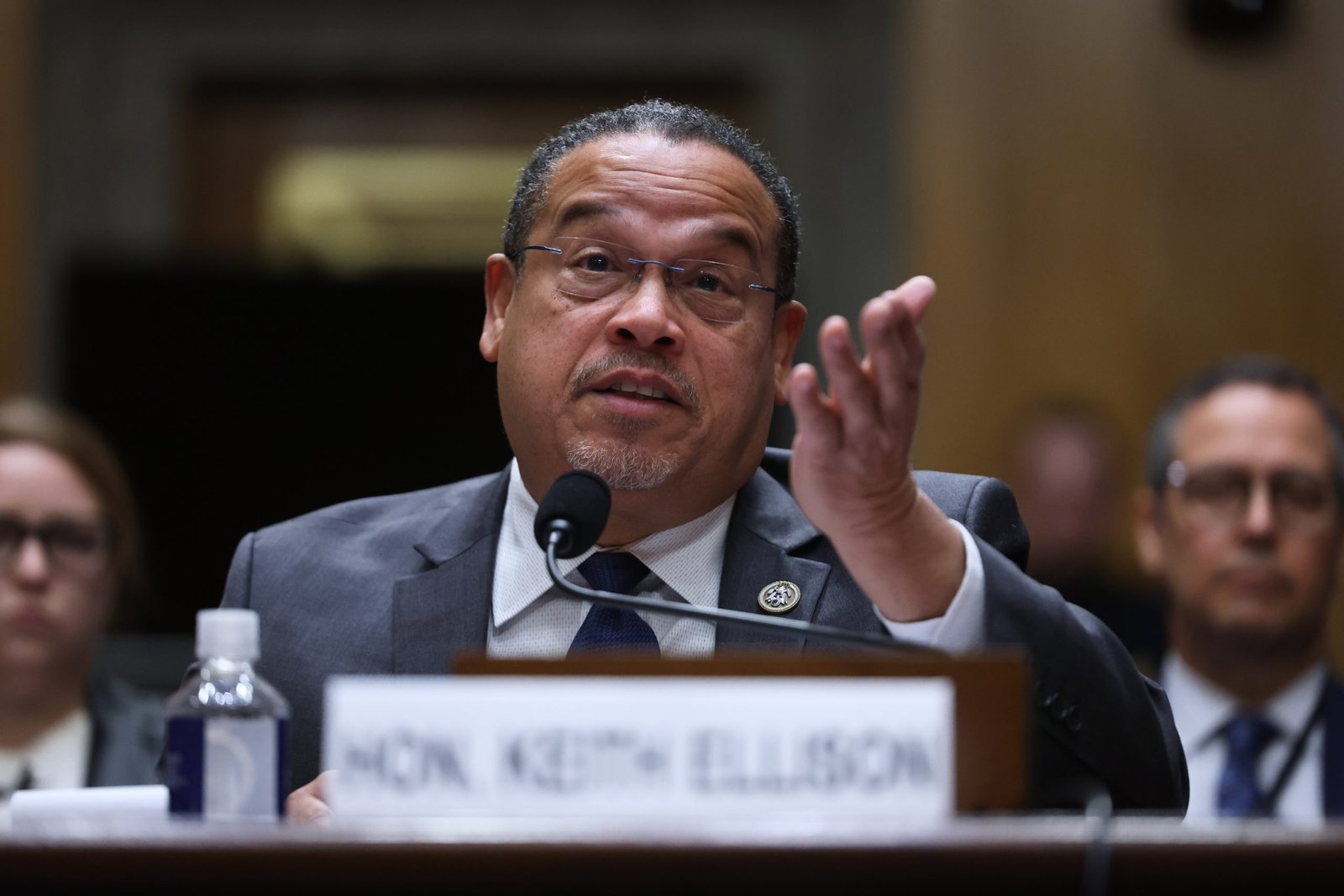
Democratic Minnesota Attorney General Keith Ellison called the lawsuit “a sad attempt to get attention” over an issue that has already been in litigation for months. He said he’ll keep fighting.
“It is astonishing that any president would try to target, shame, and harass children just trying to be themselves, let alone a president with so many actual problems to address,” Ellison said in a statement.
The League does not comment on threatened or pending lawsuits, spokesman Tim Leighton said.
Related: Minnesota’s legal protections make it a magnet for transgender adults, families
The administration has filed similar lawsuits against Maine and California, and has threatened the federal funding of some universities over transgender athletes, including San Jose State in California and the University of Pennsylvania.
Minnesota officials have long resisted the federal push to ban trans athletes from girls sports. Ellison filed a preemptive lawsuit last April, saying Minnesota’s human rights act supersedes executive orders issued by President Donald Trump last year. The lawsuit also says the state is already in compliance with Title IX. A ruling is pending on the federal government’s motion to dismiss that case.
The Justice Department said in a statement that Minnesota violates Title IX “by requiring girls to compete against boys in athletic competitions that are designated exclusively for girls and allowing boys to invade intimate spaces designated exclusively for girls, such as multi-person locker rooms and bathrooms.”
To buttress its claims that trans athletes have an unfair advantage, the lawsuit highlights the case of a trans pitcher on the Champlin Park High School girls varsity fastpitch softball team who helped lead the school to a 6-0 victory in a state championship game in 2025.
The Trump administration also reversed the Biden administration’s interpretation of Title IX, which held that its provisions prohibiting discrimination on the basis of sex also extended to gender identity.
According to the Justice Department, Minnesota’s Department of Education receives more than $3 billion annually in federal funding from the U.S. departments of Education and Health and Human Services. It says that funding is contingent on compliance with Title IX.
The lawsuit asks a federal court in Minnesota to declare the state in violation of Title IX and order it to prohibit transgender girls from competing in girls’ prep sports.
The civil rights offices at the Education and Health and Human Services put the state and league on notice last September that they faced legal action if they didn’t stop violating the federal law.
The post Trump administration sues Minnesota over transgender athletes in girls sports appeared first on MinnPost.
WASHINGTON – Nationally, the price of a gallon of gasoline averaged more than $4 this week, brought on by the disruption to global oil supplies caused by the war in Iran. But motorists in Minnesota are feeling less pain at the pump.
According to the American Automobile Association (AAA), which closely monitors the cost of gasoline, prices were only a little more than $3.50 a gallon in Minnesota this week, a considerable discount from the national average.
Two main factors contribute to Minnesota’s prices being among the lowest in the nation. One is that most of the oil that’s converted to gasoline, diesel, jet fuel and other petroleum-based products in the state is imported from Canada, with a lesser amount coming from North Dakota.
Those nearby, dependable sources of oil are delivered to two refineries in the state through a series of pipelines that feed what’s called the “Minnesota pipeline.” It begins in Clearbrook in the northwestern part of the state and transports crude oil south to two refineries near the Twin Cities.
“Pipelines are the most effective way to transport oil,” said Jake Reint, spokesman for the Flint Hills Resources refinery in Rosemount, which refines about 385,000 barrels of oil each year.
The other refinery in the state is the Marathon facility in St. Paul Park that refines about 100,000 barrels of oil a year.
Reint said it was more “competitive” economically to use pipelines, rather than tanker trucks or rail, to transport oil.
He said “the proximity to fuel supply and a robust pipeline and refining structure” in the state has kept Minnesota from facing the worst of the oil price shocks that began as soon as the conflict in Iran shook global markets a month ago.
“We are able to meet demands when there are significant disruptions,” Reint said.
Minnesota also maximizes the use of ethanol in gasoline produced at 18 biofuel refineries in the state, which may moderate a price spike.
The state’s gas tax, about 28 cents a gallon, is comparatively moderate when compared to many other states. California’s state gasoline tax, for instance, is nearly 60 cents a gallon, Pennsylvania’s is nearly 58 cents a gallon and Maryland and Illinois have 47-cent-a gallon gasoline taxes.
Still, Minnesota raised about $880 million in fuel taxes from the sale of 2.5 billion gallons of gasoline and diesel in the state last year. The state also raised additional revenue from taxes on jet fuel.
window.addEventListener(“message”,function(a){if(void 0!==a.data[“datawrapper-height”]){var e=document.querySelectorAll(“iframe”);for(var t in a.data[“datawrapper-height”])for(var r,i=0;r=e[i];i++)if(r.contentWindow===a.source){var d=a.data[“datawrapper-height”][t]+”px”;r.style.height=d}}});
Oil shock may last a while
Iran’s dominance over the Strait of Hormuz, the only maritime route into the Persian Gulf, has become a major weapon for that nation.
One-fifth of the world’s supply of both oil and liquified natural gas usually flows through the strait on its way to markets around the world, particularly to Asia.
Since the United States attacked the nation a month ago, those energy supplies – as well as cargoes of fertilizer, food and other products – have been unable to get through the Strait of Hormuz to their destinations as Iran has threatened those vessels with drones and attack boats.
Iran, which struck a Qatari tanker in a missile attack on Wednesday, is also seeking more leverage by attacking its petroleum-rich neighbors’ oil and gas infrastructure. That could take a while to rebuild.
The conflict has left oil markets reeling and resulted in a dollar-a-gallon climb in the average price of a gallon of gasoline.
Oil prices retreated a bit this week in the wake of President Donald Trump’s declaration that a peace deal is at hand. But they rose sharply again after the president told the nation Wednesday evening that the United States is ready to hit Iran “extremely hard” in the coming weeks.
Some analysts have predicted that the full brunt of the market shock has yet to be felt in the United States.
That means gasoline prices could continue to climb, even in states that are able to blunt the impact, like Minnesota.
And, although AAA said the average price of gasoline per gallon in Minnesota was about $3.50 this week, that price varied from county to county.
According to AAA, the most expensive gasoline was found in Waseca, Blue Earth, Steele and other southern Minnesota counties, where it cost $3.60 or more to fill up.
Gasoline was also more expensive than the state average in the Twin Cities counties of Hennepin and Ramsey and those that surround them.
Meanwhile, AAA said the cheapest gas could be found in the counties of Polk, St. Louis, Marshall and other areas in the northern part of the state, where gasoline could be purchased for little more than $3.30 a gallon.
window.addEventListener(“message”,function(a){if(void 0!==a.data[“datawrapper-height”]){var e=document.querySelectorAll(“iframe”);for(var t in a.data[“datawrapper-height”])for(var r,i=0;r=e[i];i++)if(r.contentWindow===a.source){var d=a.data[“datawrapper-height”][t]+”px”;r.style.height=d}}});
There could be many reasons for the discrepancies.
Reint said there are always price variations at the retail and wholesale levels, meaning some gas stations may charge more than others. He also said “street level competition” among stations could bring the price of fuel down in some areas.
Reint also said proximity to terminals where gasoline is refined and the cost of getting 18-wheelers to deliver fuel to retail gas stations could be another factor. Another variable is the proximity of Minnesota gas stations to markets in other states that have higher or lower prices for fuel.
That may mean that stations in northern Minnesota that are close to oil-producing Canada and North Dakota may be influenced by the lower prices of fuel across the border.
Data reporter Shadi Bushra contributed to this story.
The post Yes, gas prices have spiked during the Iran war, though Minnesota has been spared from the worst appeared first on MinnPost.
This story about Air Wisconsin providing charter services for federal immigration enforcement authoritiesafter it was sold to CSI Aviation was originally published by Wisconsin Watch.You can find an interactive version of it here.
Air Wisconsin Airlines has not been spared by the nationwide decline of regional air service. The 60-year-old carrier laid off hundreds of employees in Appleton and Milwaukee last year after terminating a contract to provide aircraft, crews and services to American Airlines in January 2025. The airline’s planned pivot to charter service and federally subsidized connections to underserved airports didn’t pan out, prompting another round of layoffs by the spring.
But the company’s troubles didn’t entirely ground its fleet. Flight tracking data indicate that Air Wisconsin continued to provide regional air service through the end of 2025, primarily connecting its Wisconsin hubs to mid-sized Midwestern airports as it had for decades.
The sale of Air Wisconsin
In January, Harbor Diversified Inc., the Appleton-based parent company of Air Wisconsin, sold the company’s operations and 13 of its jets to CSI Aviation, a New Mexico-based air charter company and longtime federal contractor owned by former New Mexico Republican Party chair Allen Weh.
Air Wisconsin sent recall notices to the company’s furloughed flight attendants after the sale to CSI Aviation, and the Association of Flight Attendants — the union representing the furloughed workers — negotiated an immediate raise for returning members. In a January press release announcing the recall notices, the union noted that only a third of the furloughed flight attendants opted to return.
Neither CSI nor Harbor Diversified responded to requests for comment.
CSI is central to the Trump administration’s ongoing immigration crackdown.
It has provided charter services for ICE since 2024, transporting detainees and deportees both directly and through subcontractors.
The company entered its current $1.5 billion contract with the Department of Homeland Security in November of last year.
Demand for private charters surged after 2010, when the Obama administration moved away from relying solely on the U.S. Marshals Service.
Air Wisconsin isn’t alone. Avelo Airlines began deportation flights last spring, but backed out last month following intense public backlash.
A transformed network
CSI’s acquisition of Air Wisconsin transformed the airline’s flight patterns within a matter of weeks. The airline’s website no longer lists passenger routes, but flight data collected between Jan. 9 and mid-February indicates that the airline has largely ceded its role as a Midwestern regional carrier.
Instead, the airline increasingly looks south: Destinations in Louisiana and Texas replaced the mid-sized Midwestern airports that were, until recently, the airline’s most frequent destinations.
Flight data indicates Air Wisconsin planes made at least 125 trips in January 2026, up from roughly 60 in December 2025. Thicker lines on the map indicate more frequent routes.
Many of Air Wisconsin’s new destinations are within easy reach of ICE detention facilities in Texas and Louisiana, including some of the agency’s largest.
The Minnesota operation
Minneapolis-St. Paul International Airport is among the busiest in the country, but Air Wisconsin rarely provided service to the Twin Cities in the final months of 2025.
That changed in January, just weeks after the Trump administration dispatched thousands of federal agents to Minnesota for an immigration enforcement offensive dubbed Operation Metro Surge.
Hundreds of immigrants detained in the operation have since departed the airport in shackles, loaded onto charter flights bound for ICE detention facilities farther south.
Alexandria, Louisiana
The modest airport in Alexandria, Louisiana, is now the epicenter of ICE’s deportation flight operations. Air Wisconsin has flown to or from Alexandria at least 30 times since the airline’s acquisition by CSI, on par with the airline’s service to Madison and outpacing service to Appleton, home to the airline’s corporate headquarters.
The GEO Group, an international private prison operator, runs an ICE detention facility on the airport’s tarmac. A dozen other ICE facilities sit within easy reach. Among them is the Adams County Correctional Center in Natchez, Mississippi, where Delvin Francisco Rodriguez, a 39-year-old Nicaraguan national, died in custody on Dec. 14, 2025. ICE acknowledged the incident in a press release four days later, though the agency did not specify the cause of Rodriguez’s death.
El Paso, Texas
Camp East Montana, ICE’s largest detention facility, sits just east of El Paso International Airport. Air Wisconsin flights took off from or landed in El Paso at least 32 times in January and early February, second only to Milwaukee’s Mitchell International Airport.
The camp drew national attention in early January after Geraldo Lunas Campos, a 55-year-old Cuban national, died by asphyxiation after guards pinned him to the floor of a cell. The El Paso County Medical Examiner’s Office later ruled the death a homicide.
Lunas Campos’ death came a month after Francisco Gaspar-Andres, a 48-year-old from Guatemala and detained at Camp East Montana, died in an El Paso hospital; ICE attributed Gaspar-Andres’ death to liver and kidney failure.
Another detainee, 36-year-old Victor Manuel Diaz of Nicaragua, died at the camp on Jan. 14 in what ICE described as a “presumed suicide” — an explanation his family questions. ICE agents detained Diaz in Minneapolis only days before his death.
Back at home in Wisconsin
Air Wisconsin hasn’t entirely withdrawn from its home state hubs. Many of the airline’s remaining pilots, flight attendants and ground crew are still Wisconsin-based, and Milwaukee remains the airline’s primary hub.
The airline is now hiring for more than a dozen Wisconsin-based positions — including legal counsel.
About the data
Wisconsin Watch used FlightAware AeroAPI data (Sept 2025 – Feb 2026) to reconstruct patterns before and after the Jan. 9 sale to CSI Aviation.
Hubs on these maps represent the 10 airports most frequently used. While the routes align with ICE operations, the data does not confirm if specific flights carried detainees.
This story about a regional Wisconsin airline providing charter services for federal immigration enforcement authorities was originally published by Wisconsin Watch.
The post Tracking the regional Wisconsin airline that chartered flights for ICE appeared first on MinnPost.
WASHINGTON – Even before the Iran war was launched, Minnesota’s defense industry benefited from the Trump administration’s boost in military spending and was on track to make more money from the Pentagon than it did last year.
Now, the defense industry, which has a robust presence in Minnesota, is scrambling to meet the demands of a nation at war.
According to a MinnPost analysis of government contracts, Minnesota’s defense industry had about $24.5 billion worth of contracts with the Pentagon in fiscal year 2025, which ended Sept. 30 of last year.
Just about six months into the 2026 federal fiscal year, Minnesota’s defense contractors had more than $17.4 billion worth of military contracts and were well on their way to exceeding their performance in 2025.
Related: What’s one of Minnesota’s biggest sources of revenue? The federal government of course
Most of those contracts were signed before the United States attacked Iran at the end of February, which is leading to a further escalation in Pentagon spending.
The United States, Israel and Iran had agreed to a temporary cease-fire late Tuesday and President Donald Trump backed off of a threat to escalate a war that had raged in the Middle East since the end of February. But the accord is fragile, and the U.S. military said on Sunday that it would blockade any ships “entering or departing Iranian ports and coastal areas.”
In any case, military spending, which has ramped up significantly since Trump assumed office for the second time, is expected to continue to increase as missiles, ammunition and other weapon stockpiles and systems need to be refurbished.
The “big beautiful” bill that funded Trump’s priorities last summer boosted Pentagon spending by $150 billion over the military’s $840 million annual budget in fiscal 2026.
That budget is about to grow again. The cost of war in Iran has prompted the White House to ask Congress for another large increase in military spending, about $200 billion.
The MinnPost analysis of the state’s defense contractors show that they provide the U.S. military with a wide range of goods — from medical supplies and hospital equipment to ammunition and explosives.
One of the state’s largest contractors is Northrop Grumman, a leader in aerospace. The company, which has a facility in Plymouth, has more than $2.7 billion worth of multi-year military contracts.
“At Northrop Grumman, we have a highly skilled workforce and take great pride in supporting local employment in Minnesota,” the company said in a statement.
In February, company CEO Kathy Warden told investors at a Citibank conference that higher international military spending, as well as ramped up domestic spending and greater need for missiles, interceptors and unmanned systems, were trends affecting her company.
“We are in an unprecedented demand cycle within defense, not just within the United States, but globally,” Warden said. “And it appears that this is going to be a sustaining demand signal.”
Warden was correct in predicting the “demand signal” would be sustained, with the Iran war costing the U.S. government between $1 billion and $2 billion a day.
BAE Systems is also among the state’s large defense contractors, with nearly $45 million worth of Pentagon contracts.
“We’re proud of the role our Minnesota team plays in supporting national security, the growing local economy, and the strength of the defense industrial base,” the company said in a statement. “We continue to see strong demand across the industry and remain focused on rapidly and reliably providing next-generation capabilities warfighters need on today and tomorrow’s battlefields.”
BAE opened a new 247,000 square-foot engineering and product development facility in Maple Grove in September.
The new site will support work on new naval guns, launching systems, advanced munitions, submarine components and combat vehicles, the company said. The company began its work in the state during World War II, when its facility in Fridley produced naval guns.
Making more – and faster
The Trump administration’s largess to the nation’s defense industry did not come without strings.
The president signed an executive order in January because he said he was committed to “ensuring that the United States military possesses the most lethal warfighting capabilities in the world.”
Trump said the United States “makes the most lethal military equipment in the world” but that “we do not make enough of it quickly enough to meet the needs of our military and our partners.”
Trump prohibited the nation’s defense contractors from offering stock buybacks and dividends to shareholders unless they are able to produce a “superior product, on time and on budget.”
“After years of misplaced priorities, traditional defense contractors have been incentivized to prioritize investor returns over the Nation’s warfighters,” Trump said.
So, the Trump administration pressed the nation’s defense industry to expand and speed up production shortly before it launched “Operation Epic Fury” at the end of February.
window.addEventListener(“message”,function(a){if(void 0!==a.data[“datawrapper-height”]){var e=document.querySelectorAll(“iframe”);for(var t in a.data[“datawrapper-height”])for(var r,i=0;r=e[i];i++)if(r.contentWindow===a.source){var d=a.data[“datawrapper-height”][t]+”px”;r.style.height=d}}});
The billions of dollars spent by the Pentagon in Minnesota may not be readily apparent. Other than National Guard facilities, Minnesota does not have a military base, nor is it home to the headquarters of a major defense contractor.
But defense contractors like to spread their facilities across the United States in efforts to increase the number of their political allies in Congress. So they have a presence in Minnesota. And the Pentagon, which has the largest budget of any federal agency, needs to buy a lot of things besides weaponry to support its bases and fleets of planes, tanks and ships and soldiers, sailors and airmen.
That’s why the thousands of contracts the U.S. military entered into with Minnesota companies went to companies of all sizes, not just the subsidiaries of large defense companies.
For example, Polaris, a Medina-based company known for its snowmobiles and all-terrain vehicles, has entered into more than $7 million in contracts to make construction machinery and light trucks for the military.
Meanwhile, the Minnesota Wild Hockey Club has a multi-year advertising contract that is worth about $464,000. A spokesman for the Wild said the team has had contracts with the Minnesota Army National Guard since 2008 to promote recruitment.
Related: D.C. Memo: Trump suggests states should cover Medicare, other programs to free up funds for military
Not all Defense Department spending in the state funds warmaking efforts.
According to the Treasury Department’s USASpending.gov, the largest contract the Pentagon signed, worth more than $13 billion, is with UnitedHealth Group, Inc., to provide health services to military members and veterans.
And the Pentagon is purchasing all kinds of other goods and services from Minnesota companies.
For instance, Duluth Lawn Care, a landscaping company, has a multi-year contract worth more than $57,000 to do work for the Army Corps of Engineers.
And All Washed Up, a laundromat in North Minneapolis, has a contract this year worth $27,000 to provide laundry and dry cleaning services to the Minnesota Army National Guard and the 934th Airlift Wing, an Air Force Reserve unit stationed at Minneapolis-St. Paul International Airport.
The Pentagon also spends millions of dollars each year on research and development at the University of Minnesota, the Mayo Clinic and other colleges and research facilities in the state.
The post Ramped up Pentagon spending boosts fortunes of Minnesota companies appeared first on MinnPost.
WASHINGTON – Despite hours of impassioned arguments from Sen. Tina Smith, the U.S. Senate ended a Biden-era moratorium on mining in the Boundary Waters Canoe Area Wilderness watershed.
The vote on Thursday removed a major hurdle for Twin Metals, which has battled to extract nickel, copper and other metals in Superior National Forest.
Twin Metals, which has tried to establish a mine in that area since 2019, will soon be able to request federal permits to restart work on that project after President Donald Trump, as expected, signs into law the resolution that would lift the 20-year moratorium.
The moratorium was put in place by the U.S. Forest Service in 2023 because of concerns over the environmental dangers of sulfide mining and the possible contamination of a favored destination for canoers and sportsmen.
But Twin Metals still has to clear a number of federal and state hurdles – including the reinstatement of federal leases cancelled by the Biden administration in 2022.
Related: Opponents hope clock runs out on bill to lift sulfide mining ban in Boundary Waters watershed
Smith began a talking filibuster Wednesday in opposition of the resolution and spoke for hours.
“If they want to go against the will of Minnesotans, then I am going to hold the Senate floor for hours to give them every opportunity to change their minds and do the right thing,” Smith said.
She said the use of the Congressional Review Act (CRA) to repeal the mining ban was “a dangerous precedent” that would allow Congress to undo any action taken by an administration.
“Future Congresses will be able to undo any order, even seven years later,” removing protections from public lands dear to both Democrats and Republicans in the Senate, Smith said.
She warned her fellow senators “what goes around, comes around.”
A CRA can overturn federal agency rules and regulations through a joint resolution of approval in both the House and Senate and a president’s signature. That means it is not bound by the filibuster rule, which requires 60 votes to pass most legislation.
Sen. Amy Klobuchar, who is the granddaughter of an Iron Range miner, also warned that the unprecedented use of a CRA to repeal a public land order would endanger all protected lands.
“The CRA threatens the protective status of the Grand Canyon,” she said.
Minnesota’s Democratic senators also warned of the devastating environmental impact of the copper-sulfide mining near the 3 million acre Boundary Waters.
“In 100% of the instances (these mines) have always caused pollution,” Smith said.
Smith also said removal of the moratorium was opposed by Minnesota tribes that have treaty rights to hunt, fish and harvest wild rice in the Superior National Forest and other tribes across the nation.
Michael Fairbanks, chairman of White Earth Nation, said tribes will continue partnering with environmental, sporting and other groups to stop mining projects that “cross our boundary when it comes to our treaty rights.”
“We’re going to put up a good fight and prevail,” he said. “We’re going to dig in now.”
Smith also argued that Twin Metals, a subsidiary of Chilean mining company Antofagasta, would send any ore extracted from the Superior National Forest to smelters in China.
But among Senate Republicans who hold a majority, the arguments of Minnesota’s Democratic senators did not win the day.
Stauber scores a win
The resolution was approved on a 50-49 largely partisan vote on Thursday. It would not only lift the moratorium on sulfide mining in the Boundary Waters watershed, but it would also prohibit another president from re-establishing such a ban.
Yet a different Congress – with the backing of a future president – could always approve a new prohibition on mining in the Superior National Forest.
The Senate vote was a big victory for Rep. Pete Stauber, R-8th District, who sponsored the resolution that won approval in the U.S. House in January.
“A major victory for America and Minnesota’s 8th Congressional District was secured today,” a jubilant Stauber posted on X shortly after the vote. “The Senate just passed my bill to reverse Biden’s illegal mining ban in the Superior National Forest – it’s now headed to the President’s desk! Mining is our past, our present, and our future – and the future looks bright!”
The filibuster, which gives minority Democrats leverage in the U.S. Senate, had always prevented Stauber from winning approval of his mining initiatives in that chamber.
So, Stauber turned to the CRA. Approved in 1996, the act was aimed at making federal agencies more accountable.
Related: House Republicans vote to lift 20-year ban on mining near pristine Boundary Waters Canoe Area
Congress passed the CRA to prevent a lame duck president from pushing through massive policy changes right before a new president is inaugurated. It mandates a resolution of disapproval to be considered 60 days after a rules change. But the mineral withdrawal was implemented on Jan. 26, 2023, which prompted the resolution’s opponents to call foul.
“(This) opens a scary Pandora’s box,” said Ingrid Lyons, executive director of Save the Boundary Waters. “And so this is a dark day for the Boundary Waters, no doubt, but also a dark day for public lands across the country.”
While environmentalists, conservation, sporting and tribal groups lobbied to defeat the resolution, the nation’s mining industry worked to secure its approval.
“Today we need action to reverse prior and guard against future unwarranted land grabs. We urge the Senate to pass the Congressional Review Act resolution from @RepPeteStauber reversing the improper Biden-era Minnesota land withdrawal, which blocked responsible mining on more than 220,000 acres of mineral rich land,” the National Mining Association said in a post on X Thursday. “Securing access to domestic minerals has never been more important; this CRA is a key step for national and economic security.”
Julie Lucas, MiningMinnesota’s executive director, called the vote an important step for workers, Iron Range communities and domestic mineral supply chains.
“This vote does not open a mine. It opens the door for a transparent, science-based review. Mining and environmental protections can co-exist, and our industry is committed to making sure that happens,” she said in a statement.
Reporter Brian Arola contributed to this report.
Editor’s note: This story has been updated to add comments from Michael Fairbanks and Ingrid Lyons.
The post Big win for mining as Senate votes to remove moratorium on Boundary Waters watershed appeared first on MinnPost.
WASHINGTON – The money chase in the most competitive Democratic primary race for a U.S. House seat in Minnesota is nearly a tie.
According to filings with the Federal Election Commission, former state Sen. Matthew Little raised nearly $717,000 as of March 31 in his bid to represent the 2nd District. That seat will be vacated by Rep. Angie Craig, who is running for the U.S. Senate. But $155,000 of that money was raised as a personal loan by Little to his campaign.
Meanwhile, rival state Sen. Matthew Klein, who raised nearly $700,000, says he’s actually the top fundraiser in the race since Little raised some of his campaign cash from his own pocket.
There’s another DFLer in the race, too. That’s state Rep. Kaela Berg, who has raised about $245,000 to challenge the two Matts.
Related: Flanagan, Craig take fight to precinct caucuses roiled by ICE operation while Tafoya campaign makes debut
On the Republican side, former Marine Tyler Kistner, who was vying for Craig’s seat for the second time, was the top fundraiser with nearly $416,000 in his war chest as of March 31. But Kistner dropped out of the race this week, saying he has been activated from the Marine reserves to redeploy to the Middle East.
“This is where I am called to be right now,” Kistner said in a statement. “Perhaps someday I will be called to serve in the halls of Congress, but now is not that time.”
That leaves state Sen. Eric Pratt, whose campaign raised about $260,000, as the only Republican in the race.
Emmer is the fundraising king
In an increasingly competitive general election matchup, the race for the 1st District seat, Rep. Brad Finstad has raised about $1.25 million for his bid for reelection, $340,000 of that money in the first quarter of this year.
Meanwhile, Democratic challenger Jake Johnson, a math teacher, has raised $1.21 million, more than $461,000 in the first quarter of this year.
Johnson said the surge in recent donations may show he is gaining traction in a mostly rural district that stretches along the Iowa border from Wisconsin to South Dakota.
“These numbers are proof that our first-time campaign can take on a lifelong politician and win,” Johnson said in a statement.
In the bruising fight for the Democratic endorsement for retiring Sen. Tina Smith’s seat, Rep. Angie Craig, a prodigious fundraiser, has raised about $7.8 million for her campaign, about $2.2 million in the first quarter of 2026.
Meanwhile, rival DFLer Peggy Flanagan, the lieutenant governor, has raised nearly $4.6 million, about $1.4 million in the first quarter.
In the crowded field of Republicans running for the open U.S. Senate seat, former sports broadcaster Michele Tafoya has the lead as far as fundraising, with about $2 million raised as of March 31.
Former Navy SEAL Adam Schwarze raised $1.1 million, the filings show, former NBA player Royce White about $566,000, former Minnesota Republican Party Chairman David Hann about $130,000 and Navy veteran Tom Weiler about $105,000.
While campaign spending in the race for Smith’s seat is going to swamp all of the Senate congressional races, it is a U.S. House member with little opposition who has raised the most money.
Rep. Tom Emmer, R-6th District, has leveraged his position as House Majority Whip to raise about $8.3 million in his main campaign account – and additional money in his leadership PACs. His campaign says the total amount of money Emmer has raised in this campaign cycle, which includes joint fundraising with the National Republican Congressional Committee, is $38 million.
Related: In a tough election year for House Republicans, Brad Finstad campaign faces a serious challenge
Emmer’s main challenger is DFLer Doug Chapin, who has raised about $239,000.
Emmer’s massive war chest allowed him to spend $5.4 million from his primary campaign account, most of it in an effort to help the Republican Party hold on to its majority in the U.S. House in a difficult year for the party.
According to his FEC filings, Emmer donated $1 million to the NRCC, which he once headed, and gave contributions to dozens of GOP lawmakers and GOP challengers.
His campaign says the total amount Emmer has donated to try to keep the House in GOP hands is $13.3 million.
“Americans across the country are all in on ensuring House Republicans maintain our majority,” Emmer said in a statement about his fundraising. “Thank you to the tens of thousands of grassroots donors who made this success possible. House Republicans have the message, the candidates, and the resources necessary to make history in November.”
In other news:
▪️ Pentagon spending in the Trump administration was on the rise even before the cost of the Iran war began pressuring Congress to provide the armed services with more money, and Minnesota’s defense contractors are benefitting.
▪️ Congress is deadlocked over reforms of federal immigration agencies, but reporter Cleo Krejci writes that the Minnesota Legislature is tackling the issue.
▪️ Congress’ rollback on protections from sulfide mining in the Boundary Waters was expected for months and finally happened this week, even as Sen. Tina Smith spent hours on the Senate floor trying to persuade Republicans to keep a mining moratorium in Superior National Forest in place.
▪️ Matthew Blake writes that months after the Annunciation Catholic School shooting, lawmakers are still not close to coming to an agreement on school safety legislation.
This and that
A reader commented on a story about the rising fortunes of Minnesota’s defense industry as the Trump administration ramps up Pentagon spending.
“Nice we are getting our share of this spending, but shredding our safety net, particularly with Trump’s civil war against Minnesota, is a very big price to pay,” the reader said. “Not so many bombs and bullets, more money for hospitals and healthcare is my preference.”
Please keep your comments, and any questions, coming. I’ll try my best to respond.Please contact me at aradelat@minnpost.com.
The post D.C. Memo: As the midterm races heat up, so does the campaign fundraising appeared first on MinnPost.
WASHINGTON – Democrats are grappling with their support of Israel, with many rejecting campaign money from pro-Israel groups and Rep. Angie Craig is among the lawmakers who have been caught up in the shifting attitudes of her party.
Since she first ran for Congress in 2018, Craig’s campaign has received more than $800,000 in money linked to the American Israel Political Action Committee (AIPAC).
A MinnPost analysis of Federal Election Commission (FEC) filings showed that of that money, $400,400 was raised through the pro-Israel group in the months before she announced her bid for retiring Sen. Tina Smith’s seat a year ago.
Yet AIPAC continued to help Craig, hosting about a dozen fundraisers for the lawmaker after she announced she was running for Senate last April. One was held at the Los Angeles office of the organization’s president, Michael Tuchin, in October.
Related: AIPAC funnels more than $200,000 to Angie Craig’s campaign
Meanwhile, Lt. Gov. Peggy Flanagan, Craig’s Democratic rival for Smith’s seat, is a progressive who has never had the support of AIPAC and has vowed not to take any money from the pro-Israel group.
Craig’s history of support from AIPAC could hurt her as she vies for the nomination of her party at the state Democratic convention at the end of May, at which the delegates will trend progressive and more critical of Israel than other members of the Democratic Party.
Craig is the only Democrat from Minnesota’s congressional delegation featured on an AIPAC webpage promoting incumbent lawmakers.
AIPAC did not respond to a request for comment on this story but in the past has told MinnPost that “our grassroots members strongly support Rep. Craig as she has demonstrated a solid commitment to advancing the US-Israel relationship.”
As President Donald Trump’s poll numbers slump and the opposition dominated key special elections, the Democratic Party appears to be in ascendancy.
But the party still has the problem that bedeviled it in 2024 – a divide when it comes to the U.S. relationship with Israel.
The Iran war has brought the issue into greater focus, with an increasing number of Democrats distancing themselves from AIPAC and like-minded pro-Israel organizations.
They cite AIPAC’s deep-seated support for Israeli Prime Minister Benjamin Netanyahu — whom many Democrats blame for the Iran war — and the organization’s opposition to even the most modest of policy shifts, including the conditioning of U.S. military aid and the closer monitoring of humanitarian aid into Gaza.
House Minority Leader Hakeem Jeffries broke ranks with AIPAC last year. Instead, he accepted the endorsement of a rival organization, J Street, that is much more critical of the Israeli government.
And Illinois Gov. JB Pritzker, who was once a major AIPAC donor, washed his hands of the group last month after it spent millions trying to influence the results of Democratic primaries in his state.
“AIPAC really is not an organization that I think today I would want any part of,” Pritzker told the Associated Press.
In past campaign cycles, AIPAC spent heavily on Democratic challengers to Rep. Ilhan Omar, D-5th District.
Last week, legislation sponsored by Sen. Bernie Sanders, I-Vt., that would block the sale of bulldozers to Israel won the votes of 40 Democrats in the Senate, including some traditionally pro-Israel lawmakers. There are 46 Democrats in the Senate and two independents like Sanders who caucus with Democrats.
A second Sanders-backed resolution that would block the sales of thousands of 1,000-pound bombs to Israel won the votes of 36 Democrats.
Democratic Sens. Amy Klobuchar and Tina Smith voted for both resolutions.
‘A very complex issue’
A spokesman for the Craig campaign said the lawmaker’s Senate campaign “has not received any donations from the AIPAC PAC and does not plan to.” Those donations are capped by the FEC at $10,000 so the financial loss to the campaign is minimal.
In fact, most of the help AIPAC has given Craig, D-2nd District, has come through “bundled” contributions. That means AIPAC collects multiple individual contributions – capped by the FEC at $3,500 for a primary and another $3,500 for a general election — and delivers them to a candidate in a single package.
So, the fundraisers AIPAC hosted for Craig brought in additional money that was not directly linked to the pro-Israel organization.
A Craig campaign spokesman said if the issue is “that the congresswoman is supported by Jewish donors who also support Israel, then it should be pointed out that all Americans have the individual right to support a candidate.”
“The congresswoman has been clear and vocal in opposition to Trump’s war with Iran and said Trump should be removed from office,” the spokesman said.
The Democratic Party grappled with the issue of Israel earlier this month at the Democratic National Committee’s convention in New Orleans.
The party rejected a resolution that rebuked AIPAC for its involvement in Democratic primaries. Another resolution that would place conditions on U.S. military aid to Israel was deferred to an Israel working group that was established last August, when the party met in Minneapolis.
The group was established after a key DNC committee voted down a symbolic resolution calling for an arms embargo and suspension of military aid to Israel.
“Every day, something is changing. It’s a very complex issue that, again, we need to bring all sides together to come up with what the solution is,” said DNC official Jorge Neri. “Us passing a resolution isn’t going to stop a war, but us coming together as a working group to figure out how our party moves forward, I think, is an approach that we need to take.”
Related: Flanagan, Craig take fight to precinct caucuses roiled by ICE operation while Tafoya makes her political debut
Meanwhile, DNC chair Ken Martin, who is the former head of Minnesota’s DFL Party, argued in a post on X that a resolution approved by the DNC that addressed concerns about “dark money,” instead of going “one-by-one,” addressed all concerns about outside spending.
Dark money is political spending where the donor is undisclosed and used to help or hurt a certain candidate through the funding of political ads — most commonly attack ads — independent of a candidate campaign. AIPAC-linked groups spent tens of millions of dollars of “dark money” in the 2024 election.
Craig is by no means the only Minnesota member of Congress to have had substantial help from AIPAC.
Rep. Tom Emmer, R-6th District, whose ability to raise political money is boosted by his position as House Majority Whip, has raised more than $1.24 million with the help of AIPAC since 2013. About $640,000 of that money was raised in 2025 alone. And Emmer and Reps. Brad Finstad, D-1st District, Michelle Fischbach, D-7th District — as well as Craig — are featured on AIPACs website of “Pro-Israel Members of Congress,” which features a link that allows individuals to donate to their campaigns.
The post As Democrats debate their relationship with Israel, AIPAC donations to Angie Craig complicate her campaign appeared first on MinnPost.
WASHINGTON – President Donald Trump has repeatedly accused Rep. Ilhan Omar of financial wrongdoing, but the Democratic lawmaker has amended her financial disclosure filings to show that she and husband hold only modest financial assets.
The new filing shows that Omar, D-5th District, and her husband, former political consultant Tim Mynett, have assets worth between $18,000 and $95,000. The new filing also shows the lawmaker continues to be burdened by a student debt that ranges from about $15,000 and $50,000.
Omar’s financial disclosure filing for 2024, filed last year, showed that Mynett’s businesses were valued at between $6 million and $30 million.
That touched off a series of attacks from Trump and his supporters because the values of Mynett’s companies were sharply increased from what they were valued in the lawmaker’s 2023 disclosure.
Related: Trump’s GOP allies in Congress seek to turn up heat on Ilhan Omar with ethics probe
Trump suggested that Omar profited from Minnesota’s social services fraud scandals and said the Justice Department was investigating her because of what appeared to be a significant jump in the lawmaker’s financial assets.
But Omar’s office says the valuations of Mynett’s companies, one a winery in California and another a venture capital firm, were made in error because they did not include the companies’ liabilities and debts.
The values of the companies were further distorted because disclosure forms — which also require the disclosure of a spouse’s assets — report investment holdings and liabilities in wide ranges, so only a broad view of assets and debts are made public.
A 2025 email between Mynett and his accountant showed the venture capital management firm valued at $7.9 million and the winery at $1.5 million. But Mynett owns only about a third of each business.
Omar’s amended return shows that Mynett received between $2,500 and $5,000 from the winery and between $100,000 and $1 million from the venture capital management firm. Amended returns are not uncommon.
“The amended disclosure shows what we have been saying all along – the congresswoman is not a millionaire,” said Omar spokeswoman Jacklyn Rogers in a text. “The original filing was based on incomplete information from Mr. Mynett’s businesses’ accountants in good faith and in deference to professional judgment. It listed assets without liabilities and significantly overstated her husband’s net worth.”
Rogers said the “accounting error created a misleading picture of far greater wealth.”
That “picture of greater wealth” not only prompted Trump’s attacks on Omar’s finances but also provoked House Oversight and Government Reform Chairman James Comer to begin his own investigation of the progressive lawmaker’s finances and to seek documents from Mynette’s businesses.
Comer also made a referral to the House Ethics Committee over Omar’s personal finances. She amended her filing after her office was contacted by the House Office of Congressional Conduct, an independent, non-partisan entity that reviews allegations of misconduct against lawmakers and refers them to the House Ethics Committee if they are found to be credible.
“The congresswoman amended her disclosures voluntarily as soon as the discrepancy was identified,” Rogers said. “The amended disclosure is not complete and accurate.”
Some Republicans, however, including Rep. Tom Emmer, R-6th District, don’t want to let the matter rest. In a post on X and on an appearance on Fox News on Monday, Emmer continued his attacks on his Democratic colleague, calling her “a complete fraud.”
“She went from $65,000 in net worth that she was reporting on her disclosure to reporting more than $30 million,” Emmer said on Fox News. “And guess what? Now she comes out and says, ‘Oh, that was a mistake on our disclosure. I just took a quick look at our disclosure and missed it.’ Not only should her accountant be fired but that girl should be fired. She does not deserve to be in Congress.”
Members of Congress have a May 15 deadline to file their 2025 disclosure reports.
The post Omar responds to Trump, GOP charges of financial malfeasance and fraud with new financial disclosure filing appeared first on MinnPost.
WASHINGTON – The day before the Supreme Court decided that many of President Donald Trump’s tariffs were unconstitutional, Austin-based Hormel Foods sued to get back the money it paid for those import levies.
With its lawsuit in New York’s Court of International Trade, Hormel joined about 2,000 American companies that have sued to recuperate their share of the billions of dollars paid when the tariffs sharply increased the cost of goods they imported.
The Trump administration estimates that it has collected about $166 billion from more than 330,000 businesses in tariffs that the Supreme Court has found unconstitutional.
But there are plenty of questions about the return of the levies, which is unprecedented. And the method the Trump administration would use to make those payments is murky.
But the biggest issue might be that the Trump administration is resistant to reimbursing all American companies impacted by the levies.
The Supreme Court ruled on Feb. 20 that President Donald Trump did not have the authority under a 1977 emergency economic powers law to impose import tariffs on all U.S. trading partners.
Hormel’s lawsuit, filed on Feb. 19, made that same argument. It asked the court to have the U.S. Customs and Border Protection “return all duties collected from (Hormel) with interest as provided by law.”
Hormel is an exporter and importer
While Hormel is primarily an exporter, it also imports many products, including Brazilian-made corned beef and various Mexican food products. Hormel also owns a global network of facilities and suppliers with subsidiaries in China, Australia, Singapore, the Netherlands and other countries.
Hormel declined to comment on the lawsuit and efforts to claw back the tariffs it paid, saying it does not comment on pending litigation.
On March 4, the Court of International Trade ordered the Trump administration to refund money collected from the types of tariffs invalidated by the Supreme Court.
“The law is clear,” said Judge Richard Eaton. “The duties were unlawful from the moment they were imposed. And that means that every single cent must be returned to the importer.”
U.S. Customs and Border Patrol, the agency that collected the tariffs, told Eaton it needed time to set up a new computer system to be able to refund tariff money. Eaton set an April 20 deadline.
Alan Sykes, a Stanford University law professor who specializes in international economic laws, said Eaton’s order “may be appealed, but there is not much basis for it.”
Irina Vodenska, director of finance programs at Boston University’s Metropolitan College, said the lawsuits filed by Hormel and hundreds of other U.S. businesses were considered almost like a class action suit by Eaton, who ruled that all U.S. companies, and not just the ones who filed lawsuits, were due refunds of the tariffs they paid.
“Even if you didn’t sue, you get to file a claim,” she said.
Still, the Trump administration’s threat to continue to litigate the issue has caused uncertainty.
Consumers left out in the cold
Many small business owners are worried that they would have to file individual lawsuits to get their refunds. Their fears may not be unfounded.
Ashley Akers, a partner at the Holland & Knight law firm who specializes in trade litigation, said the Trump administration is expected to challenge Eaton’s order to refund all tariffs.
“So far, the position of the federal government is that only those who filed claims at the Court of International Trade will be compensated,” Akers said.
Akers said cutting off thousands of American businesses who did not file a lawsuit at the Court of International Trade is “unjust,” especially since many small businesses can’t afford the legal fees that Hormel and other large companies – including Costco, FedEx and Revlon – have paid to make their claims.
“(The Trump administration) is trying to limit refunds,” Akers said. “They want to keep as much money as possible. It’s so mind-blowing.”
While reimbursements to some U.S. importers are in doubt, one thing is certain – consumers who paid higher prices as companies raised the cost of goods to help pay for the tariffs won’t get a refund.
“Only the importer of record gets a refund, consumers no,” said Sykes of Stanford University.
Vodenska said “there is no legal requirement that importers have to reimburse consumers.”
“And prices are not going to be reduced,” she said. “It’s a can of worms.”
Robbie Soskin, who owns yum! Kitchen and Bakery in Minnetonka and three other locations, held an event Tuesday at his eatery with Rep. Kelly Morrison, D-3rd District, to highlight the impact of tariffs.
Soskin, who said his kitchen prepares all recipes “from scratch,” said he uses imported foods to prepare the dishes on his menus, including avocados and limes from Mexico and coconut milk from Indonesia. Paper products used by his restaurant were also imported.
While Soskin said he has “great supply partners,” costs rose for the goods he needed. And he said there were few alternatives.
“The domestic sources were not necessarily cheaper because there was more demand for them,” Soskin said. “There were very few things that we couldn’t get but everything got more expensive.”
So the restaurateur said he reluctantly raised the price of some of his dishes and baked goods.
He said he hoped his suppliers, if they are refunded for the cost of the tariffs they paid, will “pass along” some of the savings “in good faith.”
Morrison, who sits on the House Small Business Committee and has introduced legislation that would exempt small businesses from tariffs, acknowledged the return of tariff money will be convoluted.
“The unwinding of the tariffs sounds like a complicated, tall order,” she said.
And even if the Supreme Court invalidated some of Trump’s tariffs, others are still standing and the president has said he may increase one of them, a 10% global tariff, to 15%.
On Monday, two small businesses sued the Trump administration over its latest round of tariffs, saying that the president cannot simply use a different law to reimpose a global 10% tax on imported goods after the Supreme Court struck down the administration’s previous tariffs.
The post Hormel wants its tariff money back, but the ‘how’ is anyone’s guess appeared first on MinnPost.
Minnesota on Monday sued President Donald Trump’s administration in an attempt to stop it from withholding $243 million in Medicaid spending, warning it may have to cut health care for low-income families if the funding is held back.
The lawsuit asked a U.S. court in Minneapolis to issue a temporary restraining order to block the withholding for Medicaid, which is the health care safety net for low-income Americans.
The move came after Vice President JD Vance said last week the administration would “temporarily halt” some Medicaid funding to Minnesota over fraud concerns, as part of what he described as an aggressive crackdown on misuse of public funds.
Minnesota Attorney General Keith Ellison said his office has a strong track record of fighting Medicaid fraud and has won more than 300 convictions and $80 million in judgments and restitutions during his time in office.
Related: What to make of Trump’s ‘war on fraud?’
“Trump’s attempts to look like he’s fighting fraud only punish the people and families who most need the high-quality, affordable healthcare that all Minnesotans deserve,” Ellison said in a statement. “As long as I am attorney general, I will do everything in my power to defend our tax dollars, both from fraudsters and from the Trump administration’s cruelty.”
The lawsuit names the Department of Health and Human Services and the Centers for Medicare and Medicaid Services as well as Dr. Mehmet Oz, in his official capacity as CMS administrator, and Robert F. Kennedy Jr. in his official capacity as HHS secretary.
The Department of Health and Human Services, which includes CMS, didn’t immediately return messages seeking comment late Monday.
The threatened cuts amount to roughly 7% of Minnesota’s quarterly Medicaid funding, Ellison’s office said in a news release. Minnesota could be required to significantly cut health care services for low-income families or other government services if the cuts take effect, it said.
Medicaid, which is known as Medical Assistance in Minnesota, provides health insurance to 1.2 million Minnesotans who would otherwise be unable to afford it. A family of four may qualify for Medical Assistance with an income at or under $42,759, the attorney general’s office said.
The lawsuit said the administration violated due process procedures because it was taking hundreds of millions of dollars without proving Minnesota’s noncompliance with Medicaid regulations through discovery and an evidentiary hearing.
It alleged the administration failed to provide Minnesota with details about its decision, in violation of federal law. It cited legal precedents, including one that said Congress may impose conditions on states’ acceptance of federal funds, but “‘the conditions must be set out unambiguously.’”
Related: Trump plans to illegally stop over $2 billion in Medicaid payments, state says, in latest twist to fraud saga
Minnesota’s complaint further charged the administration violated the Constitution because the withholding imposed retroactive conditions on Minnesota’s Medicaid funding.
It said withholding the funds was arbitrary, capricious and part of a pattern of political punishment of Minnesota.
The administration said it would hold off on paying $259.5 million to Minnesota for Medicaid spending in the fourth quarter of 2025. Minnesota’s lawsuit challenges the withholding of $243 million of this money.
The post Minnesota sues to block Trump administration’s withholding of Medicaid funds appeared first on MinnPost.