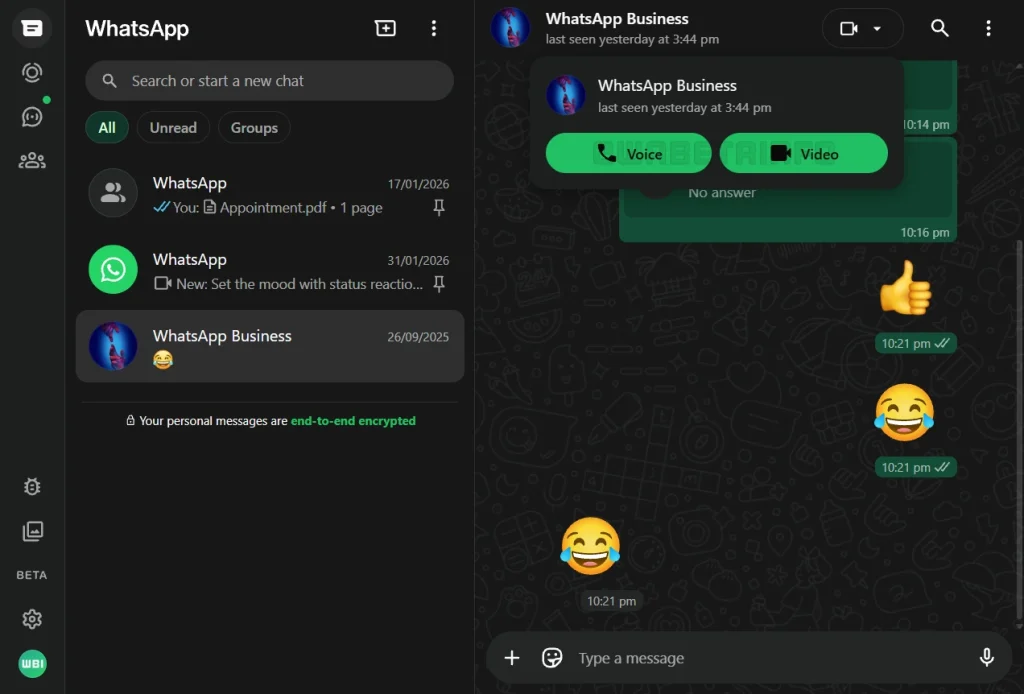
WhatsApp is working on a big update for its web app. The company plans to add voice and video calling support to WhatsApp Web. This change will allow users to make calls directly from their browser without installing the desktop app.
So far, WhatsApp Web has been limited to text chats and media sharing. With this update, it will start working more like the native WhatsApp apps on Windows and Mac. Users on Windows, Mac, and Linux will be able to place voice and video calls directly from the web.
Video calls on WhatsApp Web will also support screen sharing. This will be useful for quick demos or casual discussions. However, this feature is not meant to replace full conference tools like Zoom or Google Meet. It is more of a convenience feature for regular users.
All calls made through WhatsApp Web will be end-to-end encrypted. This means only the people on the call can access the conversation. WhatsApp itself will not be able to listen in. Users will not need to enable anything manually, as encryption will be turned on by default.
This update is especially important for Linux users. WhatsApp does not offer an official Linux app. Because of this, Linux users have mostly depended on their phones or the web version for basic messaging. Voice and video calls on the web will finally close this gap.
There is no confirmed release date yet. According to WABetainfo, the calling feature is still under development. Meta is testing it to make sure the experience is stable and free of major bugs before a wider rollout.
News Source
Follow Techlomedia on Google News to stay updated.
Affiliate Disclosure:
This article may contain affiliate links. We may earn a commission on purchases made through these links at no extra cost to you.
Truke has launched the Bass S2, its first earphones made specially for sleep. The company says sleep-focused earphones are becoming popular across the world. Rising stress, sleep problems, and screen fatigue are driving this demand.
According to Truke, regular earphones are not designed for long hours of use during sleep. They often cause pressure and discomfort, especially when used while lying down. The Bass S2 aims to solve this problem with an ultra-compact and secure design that stays comfortable throughout the night.
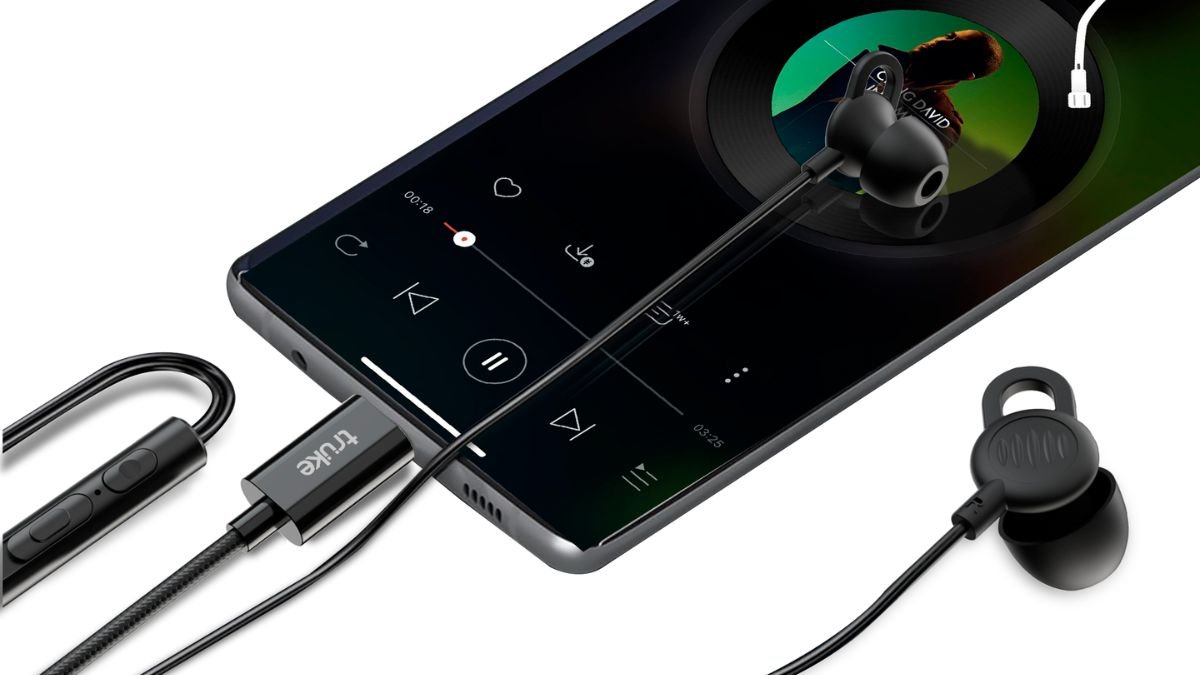
The Truke Bass S2 is made using soft, skin-friendly silicone. This helps reduce ear pressure and makes it suitable for extended use. The earphones feature a 13mm driver that delivers clear and balanced audio.
These earphones support white noise, calming music, podcasts, and guided sleep content. Users can also access voice assistants and control playback using inline controls. The Bass S2 comes with an IPX5 rating, which means it can handle sweat and light splashes.
Truke has used a high-flex TPE cable for better durability. This design allows the earphones to adjust to different sleeping positions without damage. The Bass S2 is also lightweight and easy to carry, making it useful both at home and while traveling.
The Truke Bass S2 will be available on Truke.in starting 10 February 2026 at an introductory price of Rs. 499. The regular price is Rs. 799. The earphones will also go on sale on Amazon.in and Flipkart from 18 February 2026. The Black color variant is available at launch, while the Blue variant will be released later.
Follow Techlomedia on Google News to stay updated.
Affiliate Disclosure:
This article may contain affiliate links. We may earn a commission on purchases made through these links at no extra cost to you.
Meta is reportedly working on a new app called Instants. The app is still under internal testing and is not available to the public yet. As per the information available, Instants is focused on sharing disappearing photos and videos with close friends.
Alessandro Paluzzi (@alex193a) shared a screenshot on X showing a reference to Instants in the Instagram app.
After the news broke, a Meta spokesperson confirmed that the internal prototype of Instants exists, but they are not testing it publicly. This means the project could still change or even get cancelled.
At the same time, Meta is testing a similar feature inside Instagram. This feature was earlier called Shots. It allows users to send unedited photos that disappear after being opened. These photos also expire after 24 hours if they are not viewed. This shows that Meta is experimenting with the same idea across multiple products.
This move is not surprising. Meta has a long history of adopting features that already work well elsewhere. Instagram Stories is the biggest example. It borrowed heavily from Snapchat and later became more popular than the original feature.
Instants also fits into Meta’s recent interest in private sharing. Over the past few years, Meta has pushed features like Vanish Mode, view-once media, and close friends lists. Public feeds are slowing down, while private and small group interactions are growing. Instants seems designed for this exact behavior.
This is also because the younger generation prefers sharing content privately. Meta likely sees this as a way to stay relevant with Gen Z users who are drifting away from traditional social feeds.
However, there are still open questions. It is unclear why Meta needs a separate app instead of improving Instagram’s existing features. There is also no clarity on how Instants will be moderated or how privacy will be handled, especially given Meta’s past criticism around data and user trust.
For now, Instants remains a rumor-backed project with strong signals but no launch timeline. It could become Meta’s next big experiment in private social sharing. Or it could quietly fade away like many internal prototypes before it.
Follow Techlomedia on Google News to stay updated.
Affiliate Disclosure:
This article may contain affiliate links. We may earn a commission on purchases made through these links at no extra cost to you.
ElevenLabs has announced the launch of Expressive Mode for Eleven Agents. It brings emotional intelligence and real-time voice quality to AI voice assistants used in customer conversations.
Expressive Mode aims to make automated voice agents sound more like humans. It adds greater emotional awareness, better timing, and control over tone. The new system uses Eleven v3 Conversational, the company’s most advanced text-to-speech model, alongside a smarter turn-taking system that helps agents pause and respond naturally, just like a person in a real conversation.
Unlike traditional automated voice systems, these expressive agents can adapt their tone based on the context. They can speak calmly, sound empathetic, or respond directly depending on the situation. This level of emotional control now works across more than 70 languages, including key Indian languages such as Hindi, Tamil, Telugu, Bengali, and Urdu, helping businesses engage effectively with diverse multilingual audiences. ElevenLabs says this will improve customer experience in areas such as retail, finance, mobility, and customer support.
Expressive Mode also uses Scribe v2 Realtime, ElevenLabs’ transcription system, to detect not just spoken words but emotional cues and speech patterns. This allows the AI to react based on how something is said, not only what is said.
This announcement comes at a time when voice AI agents are becoming a growing market trend. According to industry estimates, the global voice AI agents market is expected to grow rapidly, reaching around USD 47.5 billion by 2034, driven by the rising adoption of conversational AI in enterprises and customer support operations.
Sarvam AI, a Bengaluru-based company building multilingual conversational AI, also recently released Bulbul V3 that promises natural-sounding voices for Indian languages. The company created buzz around its OCR model, which outperformed Gemini and ChatGPT in benchmarks.
Follow Techlomedia on Google News to stay updated.
Affiliate Disclosure:
This article may contain affiliate links. We may earn a commission on purchases made through these links at no extra cost to you.
Mumbai: Skipper Shai Hope led the way with an unbeaten 61 with Shimron Hetmyer in tow with 46 not out as the West Indies registered a nine-wicket victory against an insipid Nepal, becoming the first team to qualify for the Super Eights stage of the T20 World Cup, here on Sunday, February 15.
After Jason Holder returned fine figures of 4/27 to restrict Nepal to a modest 133 for 8 on the back of Dipendra Singh Airee’s valiant 58 not out, West Indies cruised to 134 for 1 in 15.2 overs to win the match with 28 balls to spare in their Group C clash.
With three wins from as many matches, West Indies are at the top of the Group C and made it to the Super 8s.
West Indies captain Hope bounced back to form with 61 not out from 44 balls, studded with five fours and three sixes. On the other hand, the in-form Hetmyer remained unbeaten on 46 (32 balls; 4 fours, 2 sixes) in another significant contribution.
Airee’s first-innings heroics was the only bright spot for the Rhinos and their fans who once against filled up the Wankhede Stadium’s stands in large numbers, but returned disappointed with another massive defeat.
Brandon King (22) appeared to be hitting his strides when he smacked three fours off Sompal Kami in the fifth over of the chase but fell soon after, mis-hitting one to mid-on where Nandan Yadav had him caught by Kushal Bhurtel.
But that was the only success that came Nepal’s way with the ball as once again their passionate crowd went silent as West Indies went about comfortably in the chase of a modest total.
Mumbai: West Indies’ captain Shai Hope plays a shot during the ICC Men’s T20 World Cup 2026 cricket match between Nepal and West Indies, at Wankhede Stadium, in Mumbai, Sunday, Feb. 15, 2026. (PTI Photo/Kunal Patil)(PTI02_15_2026_000101A)
Hope’s half-century included a delightful drive down the ground early on, whereas Hetmyer began with a couple of fours in the seventh over but was left stranded four runs short of what would have been his second fifty of this T20 World Cup. Together, they put on an unbeaten 91 runs for the second wicket.
Mumbai: West Indies’ Shimron Hetmyer plays a shot during the ICC Men’s T20 World Cup 2026 cricket match between Nepal and West Indies, at Wankhede Stadium, in Mumbai, Sunday, Feb. 15, 2026. (PTI Photo/Kunal Patil)(PTI02_15_2026_000100A)
On their part, Nepal bowlers simply failed to apply any pressure as West Indies enjoyed another successful outing with the bat.
Earlier, Airee (58) and Sompal Kami (26 not out) found a late surge to lift a struggling Nepal to 133 for 8.
Barring Airee, who struck three sixes and as many fours for his 47-ball 58, Nepal batters cut a sorry figure on a fresh Wankhede Stadium’s deck which did not assist spin much nor was two-paced.
Mumbai: Nepal’s Dipendra Singh Airee during the ICC Men’s T20 World Cup 2026 cricket match between Nepal and West Indies, at Wankhede Stadium, in Mumbai, Sunday, Feb. 15, 2026. (PTI Photo/Kunal Patil)(PTI02_15_2026_000095B)
If not for Airee’s dogged knock and Kami’s late strikes, including three consecutive fours in the 18th over, Nepal would have finished at a far lesser total owing to an insipid show from their specialist batters earlier.
Unperturbed with ordinary cricket from others around him, Airee gave a fine display of application and aggression, punishing any loose delivery in his hitting arc while his running between the wickets was sharp.
Nepal had slipped to 46 for 5 in the 11th over, failing to find any momentum whatsoever on a batting-friendly track, with poor shots and lack of application continuing to haunt them.
The slide began for Nepal as early as the first over when Kushal Bhurtel (1) was cleaned up by Akeal Hosein. Hosein’s arm ball kept angling into the big-hitting right-hander who was cramped for room, playing a totally wrong line.
Nepal skipper Rohit Paudel (5) had only himself to blame when he missed connecting with a leg-side flick, with Matthew Forde’s ball that was angled in crashed into his pads.
Paudel reviewed the on-field decision against him but the replays showed the ball would have grazed the leg-stump.
But perhaps the worst shot came from Nepal No. 5 Aarif Sheikh, who guided an outside leg-stump delivery from Jason Holder (4/27) straight to fine-leg, giving the former West Indies captain a first-ball wicket.
From the other end, Forde continued to test Nepal batters outside the off stump but to his misfortune, he could not find an edge despite being persistent with his line and length.
At 22 for three after the end of the sixth over, Nepal had recorded the lowest powerplay score for this T20 World Cup.
Forde did, however, bowl a wicket-maiden fourth over and took a fine catch at midwicket to dismiss Aarif Sheikh (2) off Holder with the sun in his eyes.
Nepal’s hero in the clash against England, Lokesh Bam (13) fell cheaply again and Gulsan Jha (11) flopped as well. But a 54-run stand between Airee and Kami gave Nepal much-needed impetus, albeit late in the innings.
Get the latest updates in Hyderabad City News, Technology, Entertainment, Sports, Politics and Top Stories on WhatsApp & Telegram by subscribing to our channels. You can also download our app for Android and iOS.
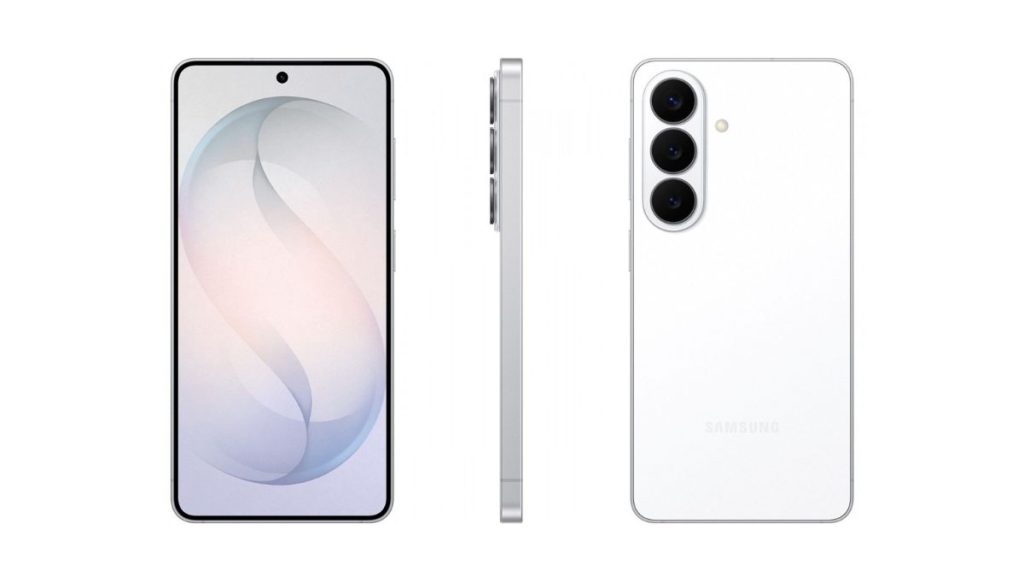
After weeks of rumours, Samsung has officially confirmed that its Galaxy Unpacked 2026 event will take place on February 25 in San Francisco. The event will be held in person, and the company is expected to unveil its next flagship smartphones, the Galaxy S26, Galaxy S26+, and Galaxy S26 Ultra.
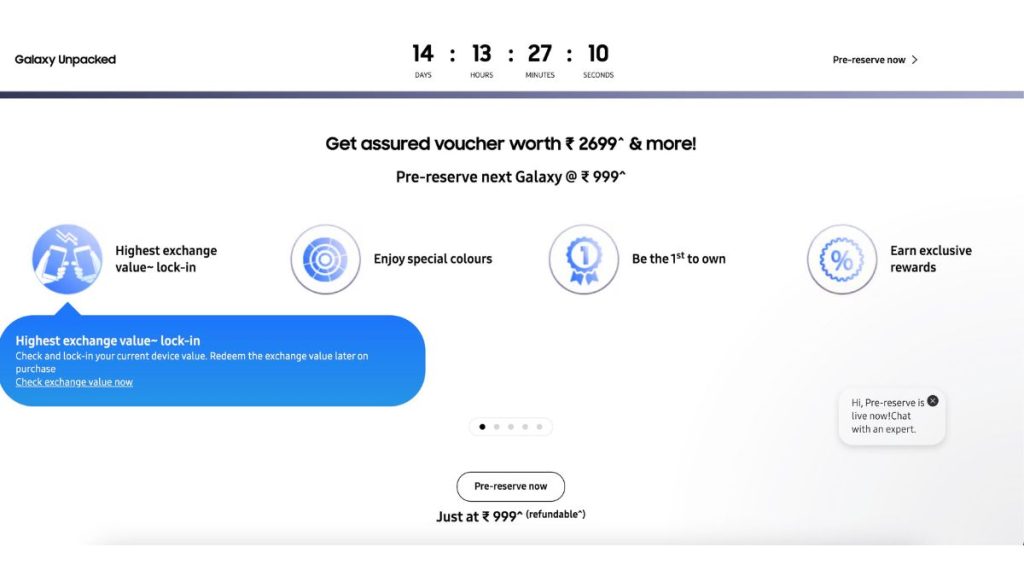
Samsung has already opened pre-reservations for the upcoming Galaxy phones in India through the Samsung India Store. Users can pay Rs. 999 to reserve the device. As part of this offer, Samsung is providing an assured voucher worth Rs. 2,699 for those who pre-book. According to the company, the pre-reservation amount of Rs. 999 will be adjusted against the final purchase price when the phone is bought.
While Samsung has not yet announced the official launch date or pricing for India, it has confirmed that pre-reservations will remain open until February 25, 2025, at 11:30 PM. If a user does not use the pre-reserve coupon during the pre-booking period, the coupon will be cancelled automatically and the amount will be refunded to the original payment method.
To pre-reserve the next Galaxy smartphone, users need to visit the Samsung India website and click on the Pre-reserve option. After paying Rs. 999 using a prepaid payment method, users will receive a Galaxy Pre-reserve VIP Pass via email and SMS. Samsung will also send a welcome email explaining all the pre-reserve benefits. During the final purchase, the Rs. 999 amount will be deducted from the total price.
Samsung has also confirmed that these are only pre-reserve offers. Additional sale offers are expected to be revealed after the official launch. As seen in previous years, the company is likely to host Samsung Live sessions, which usually include extra discounts, bundled offers, and early delivery options.
Galaxy S26 and Galaxy S26+ are expected to use Samsung’s new Exynos 2600 chipset built on a 2nm process in most markets. The Galaxy S26 Ultra is expected to run exclusively on the Qualcomm Snapdragon 8 Elite Gen 5 for Galaxy processor. All models are expected to offer a familiar camera setup, with the Ultra variant going up to 16GB of RAM for the 1TB storage option.
Galaxy S26
Wireless charging is also expected to see an upgrade this year. The Galaxy S26 series is said to support Qi2 wireless charging through a magnetic case. The Galaxy S26 Ultra is expected to support up to 25W wireless charging and 60W wired charging, which would be a first for Samsung’s Ultra lineup. Battery sizes are rumoured to be 4,300mAh for the S26 and 4,900mAh for the S26+, with support for fast wired charging, Qi2 wireless charging, and Wireless PowerShare.
The Galaxy S26 is rumoured to feature a 6.3-inch Full HD+ Dynamic AMOLED 2X display with a 1 to 120Hz adaptive refresh rate. The Galaxy S26+ is expected to get a larger 6.7-inch Quad HD+ display with similar features. Both phones are expected to come with 12GB RAM and storage options of 256GB and 512GB. They are likely to run Android 16 with One UI 8 and offer IP68 dust and water resistance.
Both the Galaxy S26 and S26+ are expected to feature a 50MP main sensor with optical image stabilisation, a 12MP ultra-wide camera, and a 10MP telephoto lens with 3x optical zoom. A 12MP front camera is also expected.
The Galaxy S26 Ultra is expected to feature a 6.9-inch Quad HD+ AMOLED display with Gorilla Armor 2 protection. It is likely to come with up to 16GB RAM and storage options going up to 1TB. The camera setup is expected to include a 200MP main sensor, a 50MP ultra-wide camera, a 10MP telephoto lens with 3x zoom, and a 50MP periscope telephoto lens offering up to 5x optical zoom and 100x Space Zoom. The Ultra model is also expected to pack a 5,000mAh battery with 60W fast charging and 25W Qi2 wireless charging.
Apart from smartphones, Samsung is also expected to introduce the Galaxy Tab S12 series, Galaxy Watch 9, and Galaxy Watch Ultra 2 at the event. The Samsung Galaxy Unpacked 2026 event will begin at 10 AM PT on February 25. In India, the live stream will start at 11:30 PM IST. Samsung will stream the event live on its official website and YouTube channel.
Follow Techlomedia on Google News to stay updated.
Affiliate Disclosure:
This article may contain affiliate links. We may earn a commission on purchases made through these links at no extra cost to you.
Infinix has officially confirmed a major change with its upcoming Note 60 series. For the first time in many years, the company will use Qualcomm Snapdragon chipsets in its smartphones. Until now, almost all recent Infinix phones have relied on MediaTek processors, which also makes this move an important change in strategy.
According to Infinix, only select models in the Note 60 lineup will feature Snapdragon chips. Early pre-order listings and teasers have already confirmed that the Infinix Note 60 Pro will be powered by the Qualcomm Snapdragon 7s Gen 4 processor. This places the phone firmly in the upper mid-range segment and shows a clear focus on performance stability and long-term efficiency.
Infinix says it is working closely with Qualcomm to achieve deeper system-level integration. The goal is to better use chipset capabilities to deliver smoother performance, improved power efficiency, stronger gaming output, better imaging, and more refined AI features. The company believes this partnership will help offer a more consistent and reliable user experience across daily tasks.
The Infinix Note 60 Pro will be the highlight of the series. Leaks and teasers suggest it could feature a large 6.78-inch AMOLED display with a sharp 1.5K resolution and a 144Hz refresh rate. It is rumoured to pack a 6,500mAh battery with support for 90W fast charging. Infinix has also hinted at battery protection or self-healing technology, which is designed to reduce long term battery degradation and maintain health over time.
Another notable feature is the Matrix-style display placed next to the rear camera module. This secondary display may show notifications, time, or system alerts without turning on the main screen. This is not something groundbreaking, but it adds a distinctive visual touch to help the phone stand out in a crowded market.
Reports suggest that the standard Infinix Note 60 may continue to use a MediaTek processor, while higher models like the Note 60 Pro and a possible Note 60 Ultra will push premium features. The Ultra variant is rumoured to feature a more refined design, possibly in collaboration with Pininfarina, along with higher-end hardware.
Infinix has not yet announced launch dates. However, industry reports suggest the Note 60 series could be unveiled globally in early 2026, possibly around major tech events like MWC.
Follow Techlomedia on Google News to stay updated.
Affiliate Disclosure:
This article may contain affiliate links. We may earn a commission on purchases made through these links at no extra cost to you.
Everstone Studio has announced that the Hexi expansion for Where Winds Meet will launch on March 6 (UTC). The update will be available as a free expansion for all players.
Hexi is a brand new region that expands the world of the open world action adventure RPG. According to the developer, the update will take players across different landscapes inspired by ancient Chinese regions.
The new area includes the flying sands of Jade Gate, the snowy fields of Liangzhou, and the historic trails of Qinchuan. Each location is expected to offer new quests, exploration paths, and story elements. The studio has described the expansion as a journey filled with emotion and a strong sense of returning home.
Where Winds Meet is currently available on PlayStation 5 and PC via Steam and Epic Games Store. The game is also available on iOS through the App Store and on Android through Google Play.
The Hexi expansion will be free, which makes it an important update for existing players. With a new region and fresh content, the update could bring more attention to the game and increase player activity across platforms.
A new trailer has also been released, showing glimpses of the desert landscapes, snowy mountains, and peaceful trails that players will explore starting March 6.
Follow Techlomedia on Google News to stay updated.
Affiliate Disclosure:
This article may contain affiliate links. We may earn a commission on purchases made through these links at no extra cost to you.
Google has started rolling out the first beta version of Android 17. The update arrives even as Android 16 is still expanding to more devices. This shows that Google is moving ahead with a faster and more structured release cycle.
The new beta brings both system-level upgrades and visible user interface improvements. While many changes focus on developers, regular users will also notice small refinements across the system.
Last year, Google replaced the old Developer Preview program with a new Canary channel. This channel delivers continuous over-the-air updates. Developers no longer need to manually flash system images. It also allows quicker access to new builds and better stability during testing.
With this first beta, Google is aiming to reach Platform Stability in March. This is the stage where APIs and app-related behaviors are finalized. Developers then get time to update their apps before the public rollout.
Android 17 will follow a quarterly release pattern. However, the upcoming 26Q2 build will be the only one with breaking changes for apps. Android 17, which carries API level 37, removes the option for developers to ignore orientation and resizability limits on large screen devices. This means apps must properly support different screen sizes and orientations, including tablets and foldables.
There are several backend upgrades as well. These include a lock-free MessageQueue, generational garbage collection, stricter handling of static final fields, and restrictions on custom notification views. Google has also added new performance debugging tools, dynamic camera session updates, logical multi-camera metadata, and support for Versatile Video Coding.
Security and privacy also see improvements. Cleartext traffic settings are being deprecated. HPKE hybrid cryptography has been added. There are updates to Wi Fi ranging, VoIP call history, and better separation between medical and fitness companion apps. Users will also get more control over how apps behave based on screen aspect ratio.
On the user interface side, there are subtle but noticeable changes. Reports highlight a refreshed Search widget design, a new brightness icon, a darker location indicator, and a more compact settings layout. A new volume overflow icon has also been spotted. The Gemini screen shrink animation can now be triggered from a corner swipe. Internally, the dessert codename for this version is said to be Cinnamon Bun.
Users who want to try the beta can enroll through the Android Beta Program on a supported Pixel device. Once enrolled, the update will arrive through a normal system update.
Follow Techlomedia on Google News to stay updated.
Affiliate Disclosure:
This article may contain affiliate links. We may earn a commission on purchases made through these links at no extra cost to you.
Google’s latest Android update is bringing a feature long associated with Apple’s ecosystem to Pixel and Android users. With Android 17, Google is enabling a new “handoff” capability that lets users seamlessly move app activity from one device to another – including to the web.
Seamless app continuity comes to Android
With Android 17, Google is introducing a cross-device handoff system designed to make switching between phones, tablets, Chromebooks, and even web browsers feel more fluid. The feature allows users to continue what they were doing in a compatible app on another device without starting over.
Android Phone logoUnsplash
For example, a user browsing a product in Chrome on their Android phone could continue that same session on a tablet or desktop browser. Similarly, messaging or document-based apps may allow activity to resume mid-task across devices signed into the same Google account.
The functionality appears to build on Google’s existing cross-device services and account syncing, but Android 17 formalizes this experience into a clearer, system-level capability. Developers will need to integrate support, meaning adoption may vary depending on the app.
Why this matters in a multi-device world
The update signals Google’s push to strengthen Android’s ecosystem continuity – an area where Apple’s Handoff feature has long been a competitive advantage. As more users operate across multiple devices throughout the day, switching between them without losing context has become increasingly important.
Modern workflows rarely stay on one screen. A user might start drafting an email on a phone during a commute, refine it on a laptop at work, and reference it later on a tablet at home. Android 17’s handoff feature aims to remove friction from those transitions.
For Google, this is also about ecosystem stickiness. As Chromebooks, Android tablets, and web apps continue to evolve, making them work more cohesively could encourage users to stay within Google’s platform instead of mixing ecosystems.
Unsplash
If you use multiple Android devices – or regularly shift between mobile and desktop browsing – this feature could reduce interruptions in your daily routine. Instead of manually reopening apps and navigating back to where you left off, Android 17 may surface prompts to continue your activity elsewhere.
However, the experience will depend on developer support and device compatibility. Like many platform-level upgrades, its usefulness will grow over time as more apps adopt the new APIs.
Privacy will also be an important consideration. Because activity handoff involves syncing session data across devices, users will likely need to ensure they are signed in securely and comfortable with cross-device syncing behavior.
What’s next for Android 17
Android 17 is currently rolling out in beta phases, with Google continuing to refine features ahead of a stable release later this year. Handoff appears to be part of a broader push toward tighter integration between Android, ChromeOS, and web experiences.
As testing expands and developers begin building support, Google may provide more details about how deeply handoff integrates into system settings and notifications.
For now, Android 17’s handoff feature represents a significant step toward making the Android ecosystem feel less fragmented – and more like a connected, unified experience across screens.