Category: BUSINESS

  • SEBI fines Reliance Securities Rs 7 lakh for violating stockbroker rules

    Mumbai: The Securities and Exchange Board of India (SEBI) on Monday imposed a fine of Rs 7 lakh on Reliance Securities Limited for not following stockbroker regulations.

    Hyderabad Institute of Excellence

    According to SEBI’s order, the company has 45 days to pay the penalty. SEBI conducted an inspection of Reliance Securities, which is a registered stockbroker, between December 22, 2022, and January 24, 2023.

    The purpose was to check if the company was following all stockbroking rules properly. During the investigation, SEBI found several violations.

    MS Creative SchoolMS Creative School

    One of the major issues was that Reliance Securities gave incorrect details in daily margin statements to clients on three different occasions.

    The company also reported wrong ledger balances once. These mistakes go against the rules that ensure transparency and fairness in stock trading.

    SEBI also found that the company failed to follow the risk-based supervision (RBS) guidelines. In its reports, Reliance Securities did not include cash collateral data, which is an important part of risk management.

    For example, it showed Rs 16.13 crore as total funds in banks and clearing members, but did not mention the Rs 312.57 crore that was actually available with clearing corporations and clearing members.

    Another violation was related to upfront margin penalties. The company wrongly passed on these penalties to some clients, which is not allowed under SEBI’s rules.

    In addition, SEBI found problems related to cybersecurity. During three audit periods, the company did not follow proper procedures.

    “It failed to test its products before using them and did not appoint a cybersecurity officer, which is mandatory,” the market regulator said.

    SEBI pointed out that from April 2021 to September 2021, October 2021 to March 2022, and April 2022 to September 2022, there was one adverse observation by the auditors in each audit report.

    These repeated issues show that the company did not comply with important stockbroking and cybersecurity norms.

    “Based on these findings, SEBI decided to fine Reliance Securities Rs 7 lakh for violating its rules,” it added.

  • Sensex opens over 1,000 points up amid heightened global uncertainty

    Mumbai: Indian frontline indices opened in the green on Tuesday as heavyweights like Titan, Tata Steel and Adani Ports lifted the market sentiment despite global uncertainty amid US tariffs.

    Hyderabad Institute of Excellence

    As of 9:21 am, Sensex was up 1,169 points or 1.60 percent at 74,307 and Nifty was up 375 points or 1.69 percent at 22,536.

    Along with largecaps, midcaps and smallcaps moved up. Nifty midcap 100 index was 1,094 points up or 2.24 per cent at 49,903 and Nifty smallcap 100 index was 356 points up or 1.75 per cent at 15,424.

    MS Creative SchoolMS Creative School

    On the sectoral front, all indices were trading in the green. PSU Bank, financial services, metal, realty, energy, private bank, infra and realty were major gainers.

    In the Sensex pack, Titan, Adani Ports, Tata Motors, Bajaj Finserv, SBI, Axis Bank, UltraTech Cement, Tata Steel, IndusInd Bank, Zomato, Bajaj Finance and NTPC were major gainers. TCS was the only stock trading in the red.

    According to market watchers, the heightened uncertainty and volatility that has gripped markets worldwide will linger for some more time.

    “There are some significant takeaways from the ongoing chaos. One, the trade war is like to be confined to US and China. Others including EU and Japan have opted for negotiations. India has already started negotiations on a BTA with US. Two, the risk of a recession in the US has increased. Three, China is likely to be the worst-hit economy,” said V.K. Vijayakumar, Chief Investment Strategist, Geojit Financial Services.

    Investors may continue in wait and watch mode since it will take time for clarity to emerge, he added.

    Buying was seen in the major Asian markets. Tokyo, Shanghai, HongKong and Seoul were trading in the green. The US markets had closed negative on Monday due to recession fears.

    In terms of institutional activity, foreign institutional investors (FIIs) remained net sellers for the sixth consecutive session on April 7, offloading equities worth Rs 9,040 crore. In contrast, domestic institutional investors (DIIs) remained net buyers, purchasing equities worth Rs 12,122 crore.

    According to Prashanth Tapse, Senior VP (Research), Mehta Equities, traders are watching for the RBI’s potential 25bps rate cut on April 9 and corporate earnings led by TCS on April 10.

  • Gold, crude oil prices tumble amid global uncertainty

    Gold, crude oil prices tumble amid global uncertainty

    New Delhi: The effect of the newly announced reciprocal tariffs by US President Donald Trump is now being felt in the global commodity markets, with sharp declines seen in the prices of key commodities like gold and crude oil.

    Hyderabad Institute of Excellence

    According to the Indian Bullion Jewellers Association (IBJA), the price of 24-carat gold on Monday fell sharply by Rs 2,613 to Rs 88,401 per 10 grams, down from Rs 91,014 on Friday.

    Similarly, the price of 22-carat gold dropped to Rs 86,280 per 10 grams, while 18-carat gold is now priced at Rs 78,680 per 10 grams.

    MS Creative SchoolMS Creative School

    Silver prices also took a hit. A kilogram of silver declined by Rs 4,535 to Rs 88,375, compared to its previous price of Rs 92,910 per kg.

    The fall in gold prices is largely due to a global decline in rates. The price of gold internationally has come down from its record high of $3,201 per ounce to $3,060 per ounce.

    A similar trend is seen in silver, which dropped from $35 per ounce to around $30.40 per ounce.

    Crude oil prices have also slumped amid concerns over a slowdown in global economic activity following the announcement of the trade tariffs.

    On Monday, Brent crude was trading 2.12 per cent lower at $64.24 per barrel, while West Texas Intermediate (WTI) crude dropped 2.24 per cent to $60.61 per barrel.

    Since the tariff announcement, crude oil prices have declined by nearly 14 per cent. Experts say this sharp drop is driven by fears that the global economy, particularly trade between major economies, may slow down, which could lead to reduced demand for oil.

    In response to Trump’s tariffs announcement, China on Friday said it would impose an additional 34 per cent levy on American goods, which reinforced investor concerns that a full-scale global trade war is now underway.

    While imports of oil, gas, and refined products have been exempted from Trump’s broad tariff measures, the new trade tensions could still lead to higher inflation, slower economic growth, and escalating disputes — all of which are putting pressure on oil prices, experts noted.

  • Petrol, diesel prices raised by Rs 2, unlikely to impact consumers

    Petrol, diesel prices raised by Rs 2, unlikely to impact consumers

    The Union government, on Monday, April 7, increased the excise duty by Rs 2 on petrol and diesel. The move comes amid US President Donald Trump’s new tariffs and fluctuating global oil rates.

    Hyderabad Institute of Excellence

    As per the latest notification by the Union Finance Ministry, the said change will come into effect on April 8.

    However, the changes will not impact consumers. According to the Petroleum and Natural Gas Ministry, there will be no increase in the retail prices of petrol and diesel.

    MS Creative SchoolMS Creative School

    While any change in taxes is normally passed on to consumers, there will be no change in the retail selling price of petrol and diesel as the excise hike will be set off against the reduction in retail prices that was warranted from the fall in international oil prices.

    Fluctuating international oil prices

    International oil prices have slumped to their lowest since April 2021 as escalating trade tensions between the United States and China stoked fears of a recession that could cut oil demand.

    Brent futures lost USD 2.43, or 3.7 per cent, to USD 63.15 a barrel on Monday while US West Texas Intermediate crude futures were down USD 2.42, or 3.9 per cent, at USD 59.57.

    India is 85 percent dependent on imports to meet its oil needs.

    “PSU Oil Marketing Companies have informed that there will be no increase in retail prices of #Petrol and #Diesel, subsequent to the increase effected in Excise Duty Rates today,” the oil ministry said in a post on X.

    Excise duty price during Modi rule

    The Modi government, during its 11-year rule, hiked excise duty whenever international oil prices fell.

    The government had between November 2014 and January 2016, raised excise duty on petrol and diesel on nine occasions to take away gains arising from plummeting global oil prices.

    In all, duty on petrol rate was hiked by Rs 11.77 per litre and that on diesel by 13.47 a litre in those 15 months, which helped the government’s excise mop-up more than double to Rs 2,42,000 crore in 2016-17, from Rs 99,000 crore in 2014-15.

    The government had cut excise duty by Rs 2 in October 2017, and by Rs 1.50 a year later. But it raised excise duty by Rs 2 per litre in July 2019. It again raised excise duty in March 2020, by Rs 3 per litre each.

    Excise duty was raised by Rs 13 and Rs 16 per litre on petrol and diesel between March 2020 and May 2020.

    But in the following years, it rolled back the Rs 13 and Rs 16 per litre excise duty hike as international oil prices soared. This helped bring down petrol prices from a record hike of Rs 105.41 a litre in Delhi and the highest ever diesel rate of Rs 96.67.

    Just before the 2024 General Elections were announced last year, the government had cut petrol and diesel prices by Rs 2 a litre each.

    Petrol currently costs Rs 94.77 a litre in Delhi and Rs 87.67 is the price for a litre of diesel.

  • European, other markets plunge as Trump’s tariffs roil trade

    European, other markets plunge as Trump’s tariffs roil trade

    Bangkok: European shares dropped in early trading, with Germany’s DAX falling 6.5 percent to 19,311.29.

    Hyderabad Institute of Excellence

    In Paris, the CAC 40 shed 5.7 percent to 6,861.27, while Britain’s FTSE 100 lost 4.5 percent to 7,694.00.

    US futures signalled further weakness ahead. The future for the S&P 500 lost 4.8 per cent while that for the Dow Jones Industrial Average shed 4.1 per cent. The future for the Nasdaq lost 5.3 per cent.

    MS Creative SchoolMS Creative School

    On Friday, the worst market crisis since COVID-19 slammed into a higher gear as the S&P 500 plummeted 6 per cent and the Dow plunged 5.5 per cent. The Nasdaq composite dropped 5.8 per cent.

    Trump doubles down on tariffs

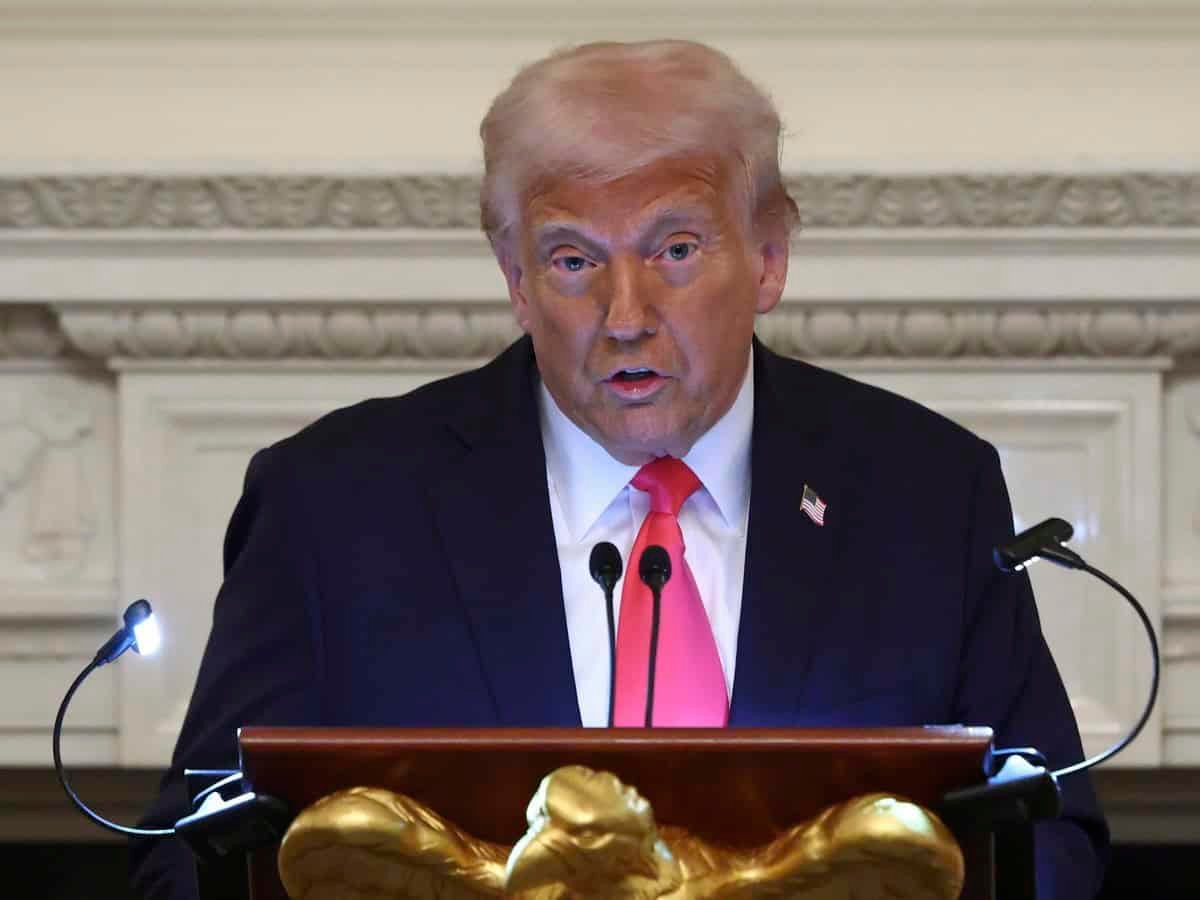
    Late Sunday, Trump reiterated his resolve on tariffs. Speaking to reporters aboard Air Force One, he said he didn’t want global markets to fall, but also that he wasn’t concerned about the massive sell-offs, adding, “sometimes you have to take medicine to fix something”.

    Tokyo’s Nikkei 225 index lost nearly 8 per cent shortly after the market opened and futures trading for the benchmark was briefly suspended. It closed down 7.8 per cent at 31,136.58.

    Among the biggest losers was Mizuho Financial Group, whose shares sank 10.6 per cent. Mitsubishi UFJ Financial Group’s stock lost 10.2 per cent as investors panicked over how the trade war may affect the global economy.

    “The idea that there’s so much uncertainty going forward about how these tariffs are going to play out, that’s what’s really driving this plummet in the stock prices,” said Rintaro Nishimura, an associate at the Asia Group.

    Asia reels from fallout

    Chinese markets often don’t follow global trends, but they also tumbled. Hong Kong’s Hang Seng dropped 13.5 per cent to 19,770.51, while the Shanghai Composite index lost 7.3 per cent to 3,096.58. In Taiwan, the Taiex plummeted 9.7 per cent.

    Markets were closed Friday in China and Kenny Ng Lai-yin, a strategist at Everbright Securities International, said the big movements might reflect some catching up from Friday’s declines.

    E-commerce giant Alibaba Group Holdings fell 9.9 per cent and Tencent Holdings, another tech giant, lost 13 per cent.

    South Korea’s Kospi lost 5.6 per cent to 2,328.20, while Australia’s S&P/ASX 200 lost 4.2 per cent to 7,343.30, recovering from a loss of more than 6 per cent.

    Asia is especially dependent on exports, and a large share go to the United States.

    “Beyond the market meltdown, the bigger concern is the impact and potential crises for small and trade-dependent economies, so it’s crucial to see whether Trump will reach deals with most countries soon, at least partially,” said Gary Ng of Nataxis.

    Oil tumbles, currencies swing

    Oil prices also sank further, with US benchmark crude down USD 2.82 at USD 59.17 per barrel. Brent crude, the international standard, gave up USD 2.93 to USD 62.65 a barrel.

    Exchange rates also gyrated. The US dollar fell to 145.56 Japanese yen from 146.94 yen. The yen is often viewed as a safe haven in times of turmoil. The euro rose to USD 1.1007 from USD 1.0962.

    Market observers expect investors will face more wild swings in the days and weeks to come, with a short-term resolution to the trade war appearing unlikely.

    Nathan Thooft, chief investment officer and senior portfolio manager at Manulife Investment Management, said more countries are likely to respond to the US with retaliatory tariffs.

    Given the large number of countries involved, “it will take a considerable amount of time in our view to work through the various negotiations that are likely to happen”.

    “Ultimately, our take is market uncertainly and volatility are likely to persist for some time,” he said.

    Heavy selling kicked in after China matched President Donald Trump’s big raise in tariffs announced last week, upping the stakes in a trade war that could end with a recession that hurts everyone. Even a better-than-expected report on the US job market, usually the economic highlight of each month, wasn’t enough to stop the slide.

    The Commerce Ministry in Beijing ordered its own 34 per cent tariff on imports of all US products beginning April 10, among other measures, in response to the 34 per cent tariffs imposed by the US on imports from China.

    The United States and China are the world’s two largest economies, and a big fear is that the trade war could cause a global recession. If it does, stock prices fall further. As of Friday, the S&P 500 was down 17.4 per cent from its record set in February.

    Americans may feel “some pain” because of tariffs, Trump has said, but he contends the long-term goals, including getting more manufacturing jobs back to the United States, are worth it.

    The Federal Reserve could cushion the blow of tariffs on the economy by cutting interest rates, which can encourage companies and households to borrow and spend. But Fed Chair Jerome Powell said Friday that the higher tariffs could drive up expectations for inflation and lower rates could fuel still more price increases.

    Much will depend on how long Trump’s tariffs stick and how other countries react. Some investors are holding onto hope he will lower the tariffs after negotiating “wins” from other countries.

    Stuart Kaiser, head of US equity strategy at Citi, wrote in a note to clients on Sunday that earnings estimates and stock values still don’t reflect the full potential impact of the trade war. “There is ample space to the downside despite the large pullback,” he said.

    The Trump administration showed no signs of relenting on the tariffs that have caused trillions of dollars in losses.

    Appearing on Fox News Channel’s “Sunday Morning Futures”, White House trade adviser Peter Navarro echoed the president when he said investors shouldn’t panic because the administration’s approach to trade would usher in “the biggest boom in the stock market we have ever seen”.

    “People should just sit tight, let that market find its bottom, don’t get shook out by the panic in the media,” Navarro said.

    (With inputs from PTI)

  • Indian stock market crashes amid US reciprocal tariff fears

    Indian stock market crashes amid US reciprocal tariff fears

    Mumbai: The Indian stock markets crashed on Monday morning over fears of US reciprocal tariffs set to come into force from April 9. The Nifty 50 and Sensex were trading 3.85 per cent and 4.16 per cent down, respectively, in early trade.

    Hyderabad Institute of Excellence

    All the sectoral indices were trading in the red with IT and metal down 7 per cent each. BSE Midcap and smallcap indices were down 6 per cent each in early trade..

    Tata Steel, JSW Steel, Tata Motors and ONGC were among major losers on the Nifty.

    MS Creative SchoolMS Creative School

    However, there was some recovery seen after the mayhem at the opening bell as buying returned.

    According to experts, equity markets were expected to open on a bearish note today, as suggested by the GIFT Nifty, which hovered around 22,090 in early trades — reflecting a significant decline of 867 points.

    “This indicates a cautious sentiment among investors, largely driven by weak global cues and the lack of strong domestic triggers. In the absence of local catalysts, market participants are likely to take cues from global market trends, crude oil prices, and institutional flows for further direction,” said experts.

    On the technical front, the Nifty 50 has formed a bearish candle on the daily chart, signaling selling pressure at key resistance levels.

    “Immediate support is seen at 22,400 and 22,000 for intraday trading, as the index has historically shown stability around these zones. These levels could potentially act as reversal points, offering buying opportunities if supported by favourable price action. On the upside, 23,000 acts as the immediate resistance level. A sustained move above this mark could pave the way for further upside toward 23,100 and 23,400,” experts noted.

    Similarly, the Bank Nifty also displayed a bearish candle on the daily chart, indicating heightened selling interest.

    In terms of institutional activity, foreign institutional investors (FIIs) remained net sellers for the fifth consecutive session on April 4, offloading equities worth Rs 3,483 crore.

    Meanwhile, domestic institutional investors (DIIs), who had been net buyers over the past five sessions, turned sellers and offloaded equities worth Rs 1,720 crore on the same day.

  • Trump says he’s not backing down on tariffs, calls them ‘medicine’ as markets reel

    Trump says he’s not backing down on tariffs, calls them ‘medicine’ as markets reel

    West Palm Beach: President Donald Trump said Sunday that he won’t back down on his sweeping tariffs on imports from most of the world unless countries even out their trade with the US, digging in on his plans to implement the taxes that have sent financial markets reeling, raised fears of a recession and upended the global trading system.

    Hyderabad Institute of Excellence

    Speaking to reporters aboard Air Force One, Trump said he didn’t want global markets to fall, but also that he wasn’t concerned about the massive sell-off either, adding, “sometimes you have to take medicine to fix something.”

    His comments came as global financial markets appeared on track to continue sharp declines once trading resumes Monday, and after Trump’s aides sought to soothe market concerns by saying more than 50 nations had reached out about launching negotiations to lift the tariffs.

    MS Creative SchoolMS Creative School

    “I spoke to a lot of leaders, European, Asian, from all over the world,” Trump said. “They’re dying to make a deal. And I said, we’re not going to have deficits with your country. We’re not going to do that, because to me a deficit is a loss. We’re going to have surpluses or at worst, going to be breaking even.”

    The higher rates are set to be collected beginning Wednesday, ushering in a new era of economic uncertainty with no clear end in sight. Treasury Secretary Scott Bessent said unfair trade practices are not “the kind of thing you can negotiate away in days or weeks.” The United States, he said, must see “what the countries offer and whether it’s believable.”

    Trump, who spent the weekend in Florida playing golf, posted online that “WE WILL WIN. HANG TOUGH, it won’t be easy.” His Cabinet members and economic advisers were out in force Sunday defending the tariffs and downplaying the consequences for the global economy.

    “There doesn’t have to be a recession. Who knows how the market is going to react in a day, in a week?” Bessent said. “What we are looking at is building the long-term economic fundamentals for prosperity.”

    U.S. stock futures dropped on Sunday evening as the tariffs continued to roil the markets. Dow Jones Industrial Average and S&P 500 futures fell nearly 4% while Nasdaq futures were down nearly 5%. Even the price of bitcoin, which held relatively stable last week, fell nearly 6% Sunday.

    Trump’s tariff blitz, announced April 2, fulfilled a key campaign promise as he acted without Congress to redraw the rules of global trade. It was a move decades in the making for Trump, who has long denounced foreign trade deals as unfair to the U.S. He is gambling that voters will be willing to endure higher prices for everyday items to enact his economic vision.

    Countries are scrambling to figure out how to respond to the tariffs, with China and others retaliating quickly.

    Top White House economic adviser Kevin Hassett acknowledged that other countries are “angry and retaliating,” and, he said, “by the way, coming to the table.” He cited the Office of the U.S. Trade Representative as reporting that more than 50 nations had reached out to the White House to begin talks.

    Adding to the turmoil, the new tariffs are hitting American allies and adversaries alike, including Israel, which is facing a 17% tariff. Israeli Prime Minister Benjamin Netanyahu is set to visit the White House and speak at a press conference with Trump on Monday, with his office saying the tariffs would be a point of discussion with Trump along with the war in Gaza and other issues.

    Another American ally, Vietnam, a major manufacturing center for clothing, has also been in touch with the administration about the tariffs. Trump said Vietnam’s leader said in a telephone call that his country “wants to cut their Tariffs down to ZERO if they are able to make an agreement with the U.S.” And a key European partner, Italian Premier Giorgia Meloni, said she disagreed with Trump’s move but was “ready to deploy all the tools — negotiating and economic — necessary to support our businesses and our sectors that may be penalized.”

    Commerce Secretary Howard Lutnick made clear there was no postponing tariffs that are days away.

    “The tariffs are coming. Of course they are,” he said, adding that Trump needed to reset global trade. But he committed only to having them “definitely” remain “for days and weeks.”

    In Congress, where Trump’s Republican Party has long championed free trade, the tariff regiment has been met with applause but also significant unease.

    Several Republican senators have already signed onto a new bipartisan bill that would require presidents to justify new tariffs to Congress. Lawmakers would then have to approve the tariffs within 60 days, or they would expire. Nebraska GOP Rep. Don Bacon said Sunday that he would introduce a House version of the bill, saying that Congress needs to restores its powers over tariffs.

    “We gave some of that power to the executive branch. I think, in hindsight, that was a mistake,” said Bacon, adding that getting a measure passed would be challenging unless the financial markets continue to react negatively and other indicators such as inflation and unemployment shift.

    Wyoming’s John Barrasso, the No. 2 member of the Senate’s GOP leadership, said Trump is “doing what he has every right to do.” But, he acknowledged, “there is concern, and there’s concern across the country. People are watching the markets.”

    “There’ll be a discussion in the Senate,” Barrasso said of the tariffs. “We’ll see which way the discussion goes.”

  • Asian markets plunge as Japan’s Nikkei 225 index dives nearly 8 pc

    Asian markets plunge as Japan’s Nikkei 225 index dives nearly 8 pc

    Bangkok: Asian shares nosedived on Monday after the meltdown Friday on Wall Street over US President Donald Trump’s tariff hikes and the backlash from Beijing.

    Hyderabad Institute of Excellence

    US futures also signaled further weakness. The future for the S&P 500 lost 4.2% while that for the Dow Jones Industrial Average shed 3.5%. The future for the Nasdaq lost 5.3%.

    Tokyo’s Nikkei 225 index lost nearly 8% shortly after the market opened and Australia’s S&P/ASX 200 tumbled more than 6%.

    MS Creative SchoolMS Creative School

    South Korea’s Kospi lost 4.4%.

    Oil prices sank further, with US benchmark crude down 4%, or $2.50, at $59.49 per barrel. Brent crude, the international standard, gave up $2.25 to $63.33 a barrel.

    On Friday, Wall Street’s worst crisis since COVID slammed into a higher gear. The S&P 500 plummeted 6% and the Dow plunged 5.5%. The Nasdaq composite dropped 5.8%.

    The losses came after China matched President Donald Trump’s big raise in tariffs announced last week, upping the stakes in a trade war that could end with a recession that hurts everyone. Even a better-than-expected report on the U.S. job market, usually the economic highlight of each month, wasn’t enough to stop the slide.

    So far there have been few, if any, winners in financial markets from the trade war. Stocks for all but 14 of the 500 companies within the S&P 500 index fell Friday. The price of crude oil tumbled to its lowest level since 2021. Other basic building blocks for economic growth, such as copper, also saw prices slide on worries the trade war will weaken the global economy.

    China’s response to US tariffs caused an immediate acceleration of losses in markets worldwide. The Commerce Ministry in Beijing said it would respond to the 34% tariffs imposed by the U.S. on imports from China with its own 34% tariff on imports of all U.S. products beginning April 10, among other measures.

    The United States and China are the world’s two largest economies.

    The central question looking ahead is: Will the trade war cause a global recession? If it does, stock prices may need to come down even more than they have already. The S&P 500 is down 17.4% from its record set in February.

    Trump seemed unfazed. From Mar-a-Lago, his private club in Florida, he headed to his golf course a few miles away after writing on social media that “THIS IS A GREAT TIME TO GET RICH.”

    The Federal Reserve could cushion the blow of tariffs on the economy by cutting interest rates, which can encourage companies and households to borrow and spend. But the Fed may have less freedom to move than it would like.

    Fed Chair Jerome Powell said Friday that tariffs could drive up expectations for inflation and lower rates could fuel still more price increases.

    “Our obligation is to keep longer-term inflation expectations well anchored and to make certain that a one-time increase in the price level does not become an ongoing inflation problem,” Powell said.

    Much will depend on how long Trump’s tariffs stick and what kind of retaliations other countries deliver. Some of Wall Street is holding onto hope that Trump will lower the tariffs after prying “wins” from other countries following negotiations.

    Trump has said Americans may feel “some pain” because of tariffs, but he has also said the long-term goals, including getting more manufacturing jobs back to the United States, are worth it.

    On Wall Street, stocks of companies that do lots of business in China fell to some of the sharpest losses.

    DuPont dropped 12.7% after China said its regulators are launching an anti-trust investigation into DuPont China group, a subsidiary of the chemical giant. It’s one of several measures targeting American companies and in retaliation for the U.S. tariffs.

    GE Healthcare got 12% of its revenue last year from the China region, and it fell 16%.

    In the bond market, Treasury yields fell, but they pared their drops following Powell’s cautious statements about inflation. The yield on the 10-year Treasury fell to 4.01% from 4.06% late Thursday and from roughly 4.80% early this year. It had gone below 3.90% in the morning.

  • Zomato’s food delivery COO Rinshul Chandra resigns

    Zomato’s food delivery COO Rinshul Chandra resigns

    New Delhi: Eternal Limited, the company formerly known as Zomato, has announced that Rinshul Chandra, the Chief Operating Officer (COO) of its food ordering and delivery business, has resigned.

    Hyderabad Institute of Excellence

    Chandra, a key part of the company’s senior leadership, submitted his resignation on April 5 and will officially step down from his role on April 7.

    In a filing to the stock exchanges, the company said that Chandra is leaving to explore new opportunities and passions that match his personal and professional goals.

    MS Creative SchoolMS Creative School

    “It has been an incredibly fulfilling journey over the past seven years, and I am truly grateful for the trust, support, and opportunities I’ve received during my time here. I wish our world-class teams at Eternal the very best,” he wrote.

    Chandra had joined the company in 2018 as Assistant Vice President of Product. Over the years, he held several important roles, including Vice President and Head of Business, before becoming the Chief Operating Officer of the food delivery division.

    However, Eternal Limited has not yet announced who will take over his responsibilities.

    This development comes at a time when the company is facing internal changes. Recently, Zomato was in the news for laying off around 600 customer support staff members within a year of hiring them, as per media reports.

    The company has also seen multiple high-level exits over the past year. Hemal Jain, the Global Head of Finance and CFO of Hyperpure, resigned.

    Co-founder and Chief People Officer Akriti Chopra also stepped down. In October last year, Independent Director Gunjan Soni resigned from her position.

    Zomato recently rebranded itself as Eternal, which now includes four major business units — Zomato, Blinkit, District, and Hyperpure — as part of its new structure.

    Informing shareholders, the company’s Chief Executive Officer (CEO) Deepinder Goyal clarified that the name change would apply only to the company and not to the Zomato brand or its app.

  • RBI MPC, CPI, tariffs and global economic data key triggers for next week

    RBI MPC, CPI, tariffs and global economic data key triggers for next week

    Mumbai: The equity market outlook for the next week will be guided by several domestic and international factors, such as RBI MPC, India’s CPI (March), industrial production data, any update on US reciprocal tariff and other global economic data.

    Hyderabad Institute of Excellence

    On the domestic level, the RBI Monetary Policy Committee (RBI MPC) decision announcement is scheduled for release on April 9, which will provide key insights into the Reserve Bank’s policy stance and India’s economic outlook.

    Further, India’s CPI (March) data and Industrial Production and Manufacturing Production data will be released on April 11.

    MS Creative SchoolMS Creative School

    On the global level, the minutes of the US Federal Open Market Committee (FOMC) meeting, US CPI data and UK GDP data are scheduled for release in the next week.

    Indian benchmark indices ended the week sharply lower, snapping a two-week winning streak, as escalating global trade tensions rattled investor sentiment. The Sensex was down 2.65 per cent at 75,364.69, and the Nifty was down 2.61 per cent at 22,904.45.

    On the sectoral front, heavy selling was witnessed in IT and Metal stocks, which emerged as the worst performers, plunging 9.15 per cent and 7.46 per cent, respectively. FMCG was the only sector to post gains, rising a modest 0.45 per cent, indicating defensive buying amid market volatility.

    The sell-off was primarily triggered by US President Donald Trump’s decision to impose steep reciprocal tariffs on key trading partners, including a 27 per cent levy on select Indian goods.

    Foreign Institutional Investors (FIIs) turned aggressive sellers, pulling out approximately Rs 13,730 crore from the cash segment, while Domestic Institutional Investors (DIIs) provided some support with net inflows of around Rs 5,632 crore.

    Puneet Singhania, Director at Master Trust Group, said, “Nifty 50 has slipped to a two-week low, weighed down by rising fears of a global trade war and recession, which have created a wave of negative sentiment.”

    “Key support levels to watch are 22,300 and 22,000. On the upside, 22,800 now acts as a strong resistance. In this environment, Nifty becomes a sell-on-rise market, and traders are advised to remain cautious and avoid aggressive long positions until stability returns,” he added.