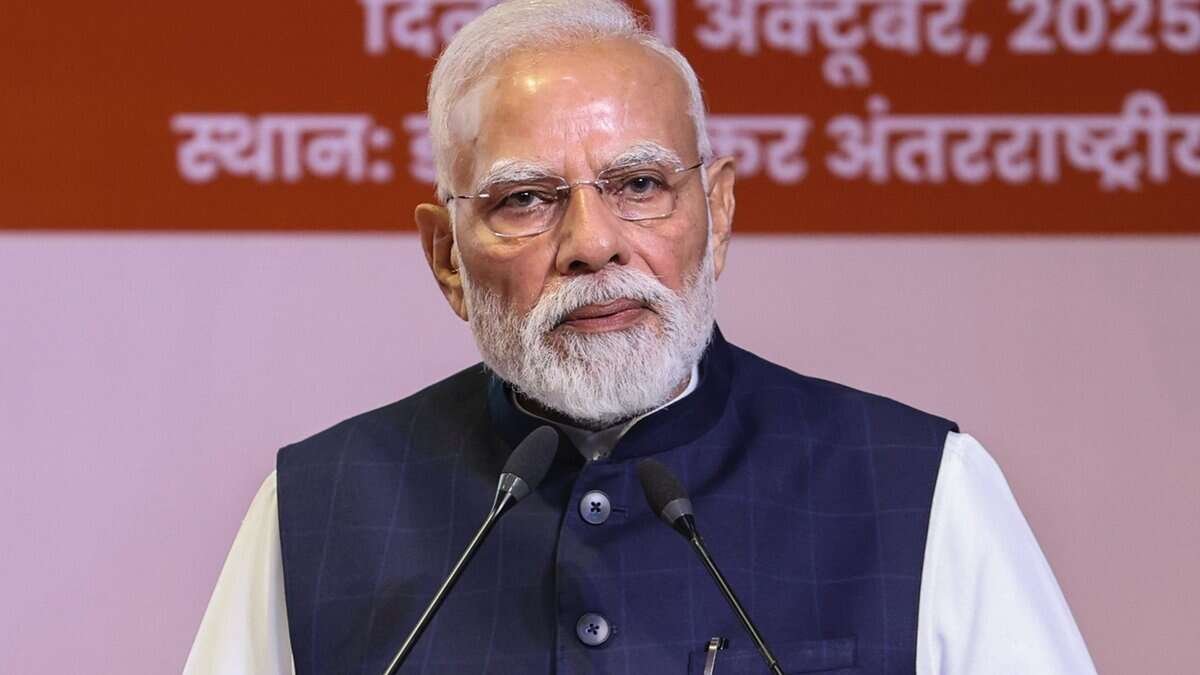
New Delhi: Asserting that India is a model of high growth and low inflation, Prime Minister Narendra Modi on Saturday said the country’s 8.2 per cent growth in the second quarter of this fiscal shows that it is becoming the growth driver of the global economy.
He also said India’s self-confidence had been shaken by the “mentality of colonialism” but now we are moving ahead of it.
Modi said that at a time when the world is full of uncertainties, India is seen in a different league.
The changes happening in India are not just about possibilities but are a saga of changing thinking and direction, he said, addressing the Hindustan Times Leadership Summit.
“We are standing at a juncture where one fourth of the 21st century has passed. The world has seen many ups and downs: financial crisis, global pandemic, technological disruptions, world falling apart, we are seeing wars; these situations, in one way or the other, are challenging the world,” Modi said.
The world is full of uncertainties, but India is being seen in a different league altogether, he said.
“India is full of self-confidence. When there is talk of a slowdown, India writes the story of growth. When there is a trust deficit in the world, India is becoming a pillar of trust; when the world is moving towards fragmentation, India is becoming a bridge builder,” Modi said.
Pointing out Q2 GDP figures being more than 8 per cent, he said it is a symbol of our pace.
“This is not just a number but is a strong macroeconomic signal. It is a message that India is becoming the growth driver of the global economy,” Modi said.
Global growth is around 3 per cent while G7 economies are growing at an average of about 1.5 per cent, he pointed out.
“At such a time, India is a model of high growth and low inflation,” Modi said.
There was a time when people, especially economists in our country, used to express concern over high inflation, but the same people now talk of inflation being low, he said in his address.
India’s achievements are not ordinary; it is not about numbers but about fundamental change brought about in the last decade, Modi asserted.
Mumbai: Indian equity benchmarks made marginal losses after hitting record highs and three weeks of consecutive gains due to profit booking. However, the market ended the week in a bullish tone after the Reserve Bank of India (RBI) delivered a 25 bps rate cut that lifted investor sentiment.
Benchmark indices Nifty and Sensex dipped 0.37 and 0.27 per cent during the week to close at 26,186 and 85,712, respectively.
Early optimism driven by strong Q2 GDP print and robust auto sales was overshadowed by persistent FII outflows, sharp rupee depreciation, and uncertainty over trade negotiations.
Broader indices underperformed, with the Nifty Midcap100 and Smallcap100 down 0.73 per cent and 1.80 per cent, respectively in a week.
Sentiment reversed on Friday after the RBI surprised markets with a 25-bps rate cut, supported by lower inflation forecasts and liquidity measures.
Gains during the week were led by auto, IT due to festive demand and favourable currency tailwinds. Banks, Finances, consumer durables, power, chemicals and oil & gas lagged.
As long as Nifty sustains above the 26,050–26,000 band, the bullish structure remains valid. Immediate resistance now lies at 26,350–26,500 zone and a break below 26,000 could lead to profit booking, said market experts.
With India’s economic growth remaining resilient despite tariff pressures and global headwinds, the Indian equity market is well-positioned to benefit if global fund flows begin to rotate back into emerging markets, market watchers said.
Investors are keen on cues from the US Federal Reserve’s monetary policy decision next week. Markets have already begun pricing in a 25 bps rate cut, supported by dovish commentary from several Fed officials and recent data pointing to softening labour market conditions.
Analysts said that shift in US Fed’s policy stance could sway currency movements and materially influence foreign portfolio investor flows into emerging markets including India.
New Delhi: The Enforcement Directorate on Saturday said it has filed a chargesheet against businessman Anil Ambani’s group company Reliance Power Ltd. and 10 others in a money laundering case linked to issuance of an alleged fake bank guarantee of Rs 68 crore for securing a tender.
The other accused named in the prosecution complaint include former Reliance Power CFO Ashok Kumar Pal, Reliance NU BESS Ltd. and Rosa Power Supply Company Ltd. (subsidiaries of Reliance Power), an Odisha-based “shell” company Biswal Tradelink Private Limited, its MD Patha Sarathi Biswal, Biothane Chemicals Pvt. Ltd. and trade financing consultant Amar Nath Dutta.
Some other accused include Ravinder Pal Singh Chadha, Manoj Bhaiyasaheb Pongde and Punit Narendra Garg, as per the agency.
The chargesheet has been filed under the provisions of the Prevention of Money Laundering Act (PMLA) at the Patiala House court in Delhi on Friday, as per officials.
The case pertains to a bank guarantee of Rs 68.2 crore submitted to secure a tender from the Solar Energy Corporation of India Limited (SECI) on behalf of Reliance NU BESS Limited, a subsidiary of Reliance Power, a listed company. The company (Reliance NU BESS) was formerly known as Maharashtra Energy Generation Limited.
Probe found, as per the agency, that Reliance Group officials were well aware that this was a “fake” bank guarantee. “Fraudulent” endorsements were being submitted to SECI from a “spoofed” email ID of SBI and when SECI detected the fraud, Reliance Group arranged a genuine Bank Guarantee from IDBI Bank within a day of intimation of the fraud by SECI.
“However, SECI refused to accept the fresh Bank Guarantee as it was submitted after the due date.
“Since Reliance NU BESS Limited had emerged as the L-2 bidder, in order to save the tender, Reliance Group officials even tried to arrange a fresh endorsement of the fake foreign Bank Guarantee from an SBI branch in Kolkata,” the ED alleged.
The Reliance Group had earlier said Anil Ambani was “not on the Board of Reliance Power Limited for more than 3.5 years and is not concerned with this matter in any manner”.
It claimed to have been a “victim of fraud, forgery and cheating conspiracy” in this case adding that it had made due disclosures in this context to the stock exchange on November 7, 2024.
The ED added that Reliance Group officials signed a “dummy” agreement and also obtained the “Certificate of Enlistment” of Reliance NU BESS Limited from Kolkata Municipal Corporation by submitting “bogus” address documents, it said.
However, when they again failed to get the fresh endorsement done, in order to shift the entire blame onto the intermediary, they filed a complaint against Biswal Tradelink Private Limited and its MD Partha Sarathi Biswal.
Biswal was arrested by the ED in this case apart from ex Reliance Power CFO Ashok Kumar Pal and Dutta. They are currently lodged in jail under judicial custody.
The money laundering case stems from a November 2024 FIR of Delhi Police’s Economic Offences Wing (EOW). It was alleged that Bhubaneswar-based shell entity Biswal Tradelink was engaged in issuing “fake” bank guarantees against commission.
Reliance Power Limited submitted this bid for a tender issued by SECI for setting up 1000 MW/2000 MWh standalone BESS projects under tariff-based competitive bidding.
The investigation has “established” the “connivance” and “mala fide” intentions of the Reliance Group in securing the SECI tender by submitting fake Bank Guarantees purportedly issued by foreign banks and their forged endorsements in the name of SBI, the ED said.
The agency also stated in the chargesheet that it has attached assets worth Rs 5.15 crore as part of this probe.
The agency added that Reliance Power, with a mala fide intent, hired the services of Biswal Tradelink to arrange a fake Bank Guarantee from FirstRand Bank, Manila, Philippines, which is a “non-existent” branch, and from ACE Investment Bank Limited, Malaysia.
“Endorsements of the fake Bank Guarantees were done by using a spoofed email ID of SBI and forged endorsement letters purportedly issued by SBI.
“A fraudulent domain, s-bi.co.in (a look-alike of genuine address sbi.co.in), was used for the said purpose,” it said.
Describing the role of other accused, the ED said Reliance Power routed funds of Rs 6.33 crore from its other subsidiary, Rosa Power Supply Company Ltd. to Biswal Tradelink under the guise of bogus transportation services, in order to meet the required funding for arranging the fake Bank Guarantee.
A “fake” work order and “fake” invoices were executed by the officials of Reliance Group in collusion with accomplice Biswal.
“After arrangement of the fraudulent Bank Guarantee by Biswal Tradelink Reliance Power also paid a hefty fee of Rs 5.40 crore to the said shell entity in order to depict the entire arrangement as a genuine commercial transaction,” the ED claimed.
Seoul: Samsung Electronics solidified its top position in the global foldable smartphone market in the third quarter this year, industry data showed on Saturday.
Samsung accounted for 64 per cent of all global shipments of foldable smartphones in the July-September period, up 8 percentage points from a year ago, according to a report from Counterpoint Research, a market tracker, reports Yonhap news agency.
The company further widened its gap with China’s Huawei Technologies Co., whose market share remained unchanged from a year ago at 15 percent during the cited period, the report said.
Motorola Mobility ranked third with a seven percent market share, followed by China’s Honor Device at 4 per cent, Vivo Mobile Communications at 4 per cent and Xiaomi at 2 per cent.
“Global shipments of foldable smartphones went up 14 percent on-year and climbed to a record quarterly high, led by the popularity of Samsung’s Galaxy Z Fold 7 series,” the report said.
Foldable smartphones accounted for 2.5 percent of all smartphone shipments made in the third quarter this year, according to the report.
Meanwhile, the market tracker expected the global foldable smartphone market to grow rapidly next year due to technical developments and increased demand for premium devices amid a potential release of foldable smartphones from Apple Inc.
Reports have said that Apple is working on a foldable phone, with its release to come as early as 2026.
Meanwhile, Samsung has showcased its first trifold smartphone, which features two folding hinges and a 10-inch display when fully unfolded, as the tech giant doubles down on its folding phone portfolio.
The Galaxy Z TriFold comes with a 6.5-inch cover display when folded, similar to its foldable sibling, the Galaxy Z Fold 7, allowing users to adapt the device for different usage situations, Samsung Electronics said.
Samsung will release a single version of the Galaxy Z TriFold with 512 gigabytes of storage in black. The price tag is set at 3.59 million won (US$2,430).
The Galaxy Z TriFold is also the slimmest device yet among Samsung’s foldable models, measuring 12.9 mm when folded and 3.9 mm when fully unfolded.
Mumbai: The rupee rebounded from its all-time low levels and appreciated by 26 paise to close at 89.89 against the greenback on Thursday, on softness in the US dollar index and on reports of the Reserve Bank of India’s supposed intervention.
Forex traders said the greenback fell after ADP non-farm payroll data came in sharply below forecast, and the softness in the US dollar index supported the rupee at lower levels.
The rupee opened weak earlier in the day and touched a fresh all-time low of 90.43 amid selling pressure from foreign investors and rising crude oil prices. The delay over the announcement of the India-US trade deal has also weighed on the rupee.
At the interbank foreign exchange market, the rupee opened at 90.36. It slipped further to a record low of 90.43 against the greenback in initial deals, registering a loss of 28 paise from its previous closing level.
At the end of Thursday’s trading session, the rupee was quoted at 89.89, up 26 paise over its last close.
On Wednesday, the rupee breached the 90-a-dollar level for the first time to settle at a fresh all-time low of 90.15 against the greenback.
Meanwhile, Chief Economic Adviser V Anantha Nageswaran on Wednesday said the falling rupee is not affecting inflation or exports.
A falling rupee helps outward shipment but makes imports costlier.
Import-dependent sectors such as gems and jewellery, petroleum and electronics may see lower benefits due to a rise in input costs, putting pressure on inflationary expectations, he said at an event on Wednesday.
Meanwhile, the dollar index, which gauges the greenback’s strength against a basket of six currencies, was trading 0.01 per cent lower at 98.84.
Brent crude, the global oil benchmark, rose 0.22 per cent to USD 62.81 per barrel in futures trade.
“We expect the rupee to trade with a negative bias on continued selling pressure from FIIs and a weak tone in the domestic markets. Elevated crude oil prices may also pressurise the rupee,” said Anuj Choudhary, Research Analyst, Mirae Asset ShareKhan.
Forex traders said multiple pressures, like foreign fund outflows from equities and lingering uncertainty over the Indo-US trade deal, are keeping investor sentiment fragile.
However, weakness in the US dollar amid a disappointing jobs report and rising odds of a rate cut by the Fed in December may support the rupee at lower levels, Choudhary said.
“Any further intervention by the central bank may also support the rupee. Traders may also take cues from weekly unemployment claims data from the US. Investors remain cautious ahead of RBI’s monetary policy decision this week,” Choudhary said, adding, “USD-INR spot price is expected to trade in a range of 89.65 to 90.50.”
On the macroeconomic front, India’s GDP has already surprised on the upside, and the latest HSBC India Services PMI — a key index that measures whether businesses are growing or slowing — rose to 59.8 in November, supported by strong new orders.
The decision of the RBI Governor Sanjay Malhotra-headed six-member rate-setting panel will be announced on Friday.
The meeting is taking place against the backdrop of falling inflation, rising GDP growth, the rupee crossing 90 against the dollar and ongoing geopolitical tensions.
Dilip Parmar, Research Analyst, HDFC Securities, said the rupee reversed its six-day losing streak, appreciating against the US dollar, due to likely intervention by the central bank and the unwinding of speculative positions.
“However, the currency’s underlying bias remains unsupportive, burdened by sustained foreign fund outflows and an elevated trade deficit. In the near term, the spot USD/INR pair faces technical resistance at 90.45 and support at 89.70,” Parmar said.
On the domestic equity market front, the Sensex climbed 158.51 points to settle at 85,265.32, while the Nifty was up 47.75 points to 26,033.75.
Foreign institutional investors sold equities worth Rs 1,944.19 crore on a net basis on Thursday, according to exchange data.
Mumbai: The rupee slumped 28 paise to an all-time low of 90.43 against the US dollar in early trade on Thursday, amid substantial foreign institutional investor outflows and restrained intervention from the Reserve Bank of India.
Forex traders said that restrained central bank intervention ahead of the crucial Monetary Policy Committee (MPC) decision and significant dollar demand from importers have exerted persistent downward pressure on the local currency.
At the interbank foreign exchange market, the rupee opened at 90.36. It slipped further to a record low of 90.43 against the greenback in initial deals, registering a loss of 28 paise from its previous closing level.
On Wednesday, the rupee breached the 90-a-dollar level for the first time to settle at a fresh all-time low of 90.15 against the greenback.
Meanwhile, Chief Economic Adviser V Anantha Nageswaran on Wednesday said the falling rupee is not affecting inflation or exports.
A falling rupee helps outward shipment but makes imports costlier.
Import-dependent sectors such as gems and jewellery, petroleum and electronics may see lower benefits due to a rise in input costs, putting pressure on inflationary expectations, he said at an event on Wednesday.
Meanwhile, the dollar index, which gauges the greenback’s strength against a basket of six currencies, was trading 0.14 per cent higher at 98.99.
Brent crude, the global oil benchmark, rose 0.49 per cent to USD 62.98 per barrel in futures trade.
Forex traders believe investors are adopting a cautious stance amid ongoing trade tensions with the US, with expectations of a settlement towards the end of the year.
“It seems that until the trade deal comes, we may see the rupee weaken further, and it may reach the levels of 91.00 soon. With a weak rupee, we do not expect the RBI to cut rates on Friday,” said Anil Kumar Bhansali, Head of Treasury and Executive Director Finrex Treasury Advisors LLP.
On the macroeconomic front, India’s GDP has already surprised on the upside, and the latest HSBC India Services PMI — a key index that measures whether businesses are growing or slowing — rose to 59.8 in November, supported by strong new orders.
“But the currency market isn’t trading on growth headlines anymore. It wants stability, clear policy guidance… and maybe a trade deal that doesn’t keep slipping away,” CR Forex Advisors MD Amit Pabari said.
Pabari further added that “now all eyes turn to RBI Governor Sanjay Malhotra on December 5. Investors aren’t just listening to rate decisions. They want to hear his voice on the rupee.”
The decision of the RBI Governor Sanjay Malhotra-headed six-member rate-setting panel will be announced on Friday.
The meeting is taking place against the backdrop of falling inflation, rising GDP growth, the rupee crossing 90 against the dollar and ongoing geopolitical tensions.
On the domestic equity market front, Sensex rose 45.99 points to 85,152.80 in early trade, while Nifty was up 14.35 points to 26,000.35.
Foreign institutional investors sold equities worth Rs 3,206.92 crore on a net basis on Wednesday, according to exchange data.
Mumbai: Equity benchmark indices Sensex and Nifty slipped in early trade on Thursday, but later bounced back to trade in positive territory, amid value buying at lower levels.
The 30-share BSE Sensex declined 156.83 points to 84,949.98 in early trade. The 50-share NSE Nifty skidded 47 points to 25,938.95.
However, later both the benchmark indices recovered their early lost ground and traded higher. The BSE benchmark quoted 146.52 points higher at 85,244.78, while the Nifty traded 36.70 points up at 26,024.80.
Both the benchmark indices were on a downtrend for the past four days.
From the Sensex firms, Hindustan Unilever, Eternal, Titan, Power Grid, UltraTech Cement and State Bank of India were among the laggards.
However, Tata Consultancy Services, HCL Tech, Bharat Electronics, Asian Paints and Tata Motors Passenger Vehicles were among the gainers.
Foreign Institutional Investors (FIIs) offloaded equities worth Rs 3,206.92 crore on Wednesday, while Domestic Institutional Investors (DIIs) bought stocks worth Rs 4,730.41 crore, according to exchange data.
“Nifty slipped below the 26,000 mark yesterday, extending its losing streak to a fourth straight session with market breadth firmly favouring the bears. A sliding rupee, and persistent FII outflows continue to weigh on sentiment, while upcoming RBI and Fed policy decisions and geopolitical developments could add fresh volatility,” Prashanth Tapse, Senior VP (Research), Mehta Equities Ltd, said.
In Asian markets, South Korea’s Kospi traded lower while Japan’s Nikkei 225 index Hong Kong’s Hang Seng index quoted in positive territory.
US markets ended higher on Wednesday.
Brent crude, the global oil benchmark, climbed 0.35 per cent to USD 62.89 per barrel.
On Wednesday, the Sensex dipped 31.46 points or 0.04 per cent to settle at 85,106.81. The Nifty skidded 46.20 points or 0.18 per cent to 25,986.
New Delhi: Crude oil prices on Thursday rose Rs 6 to Rs 5,362 per barrel in futures trade as participants increased their positions following a firm spot demand.
On the Multi Commodity Exchange, crude oil for January delivery traded higher Rs 6 or 0.11 per cent at Rs 5,362 per barrel in 13,300 lots.
Analysts said raising of bets by participants kept crude oil prices higher in futures trade.
Globally, West Texas Intermediate crude was trading 0.56 per cent higher at USD 59.28 per barrel, while Brent crude rose 0.45 per cent to USD 62.95 per barrel in New York.
Mumbai: The rupee breached the 90-a-dollar level for the first time to settle at a fresh all-time low of 90.15 on Wednesday, down 19 paise from its previous close, amid sustained foreign fund outflows and higher crude oil prices.
Uncertainty over the India-US trade deal, along with the lack of Reserve Bank of India (RBI) effort to stop the slide in the local unit, put further pressure on the rupee, according to forex traders.
At the interbank foreign exchange, the rupee opened at 89.96 against the US dollar and fell to a record intraday low of 90.30 during the session before closing at a new all-time low of 90.15, down 19 paise from its previous close.
On Tuesday, the rupee settled 43 paise down at a lifetime low of 89.96 against the US dollar, largely owing to continued short-covering from speculators and sustained importer demand for the American currency.
Speaking at an event on Wednesday, Chief Economic Adviser V Anantha Nageswaran said the government is not losing sleep over the declining rupee.
The falling rupee is not affecting inflation or exports, he said, and expressed hope that it should improve next year.
Commenting on the fall, research report from the SBI’s Economic Research Department said, a sliding rupee is not a weak rupee even as it breaches the psychological barrier of 90.
With MPC scheduled to take a call on the policy rate, a cut at this juncture can be construed as a knee-jerk reaction to protect the rupee, which would be detrimental to an otherwise fairly resilient currency, riding the domestic vigour, it said.
Foreign exchange analysts have attributed the fall in Indian currency to the intense selling of Indian stocks by foreign investors.
“The rupee hit a fresh all-time low of 90.30 amid selling pressure from foreign investors and a surge in crude oil prices. Uncertainty over the announcement of India-US trade deal has also weighed on the rupee. However, a weak US dollar index prevented a sharp fall,” Anuj Choudhary, Research Analyst, Mirae Asset ShareKhan, said.
“We expect the rupee to trade with a slight negative bias on persistent FII outflows and higher crude oil prices. However, a weak dollar and rising odds of a rate cut by the Fed in December may support the rupee at lower levels,” he said, adding that the USD-INR spot price is expected to trade in a range of Rs 89.80 to Rs 90.50.
“The rupee was easily allowed by the RBI to cross 90, and it even fell to 90.30 before the RBI stepped in,” Anil Kumar Bhansali, Head of Treasury and Executive Director, Finrex Treasury Advisors LLP, said.
Meanwhile, the seasonally adjusted HSBC India Services PMI Business Activity Index rose to 59.8 in November, from 58.9 in October, supported by new business growth.
The dollar index, which gauges the greenback’s strength against a basket of six currencies, was trading 0.20 per cent lower at 99.16.
Brent crude, the global oil benchmark, was trading 0.91 per cent lower at USD 63.02 per barrel in futures trade.
On the domestic equity market front, Sensex declined 31.46 points to settle at 85,106.81, while Nifty was down 46.20 points to 25,986.
Foreign Institutional Investors sold equities worth Rs 3,206.92 crore on Wednesday, according to exchange data.
“₹@90. The proximate reason: foreign selling of Indian stocks both FPI & PE under FDI. Indian investors buying. Time will tell who is smarter. For now foreigners seem smarter. 1 year nifty $ return is 0. But this a long game. Time for Indian business to shake out of comfort zone,” veteran banker Uday Kotak said in a post on X.
Apart from the selling pressure from foreign investors, experts said that a sudden crash in cryptocurrencies spurred the dollar demand.
“Slow export growth, uncertainty around trade deals—especially with the US—and continued foreign investor outflows have all pushed demand for the dollar higher. Escalating geopolitical tension and the sudden crash in cryptocurrencies have driven safe-haven flows into the dollar, weighing on the rupee,” said Rahul Kalantri, VP Commodities, Mehta Equities Ltd.
According to Rahul Gupta, Chief Business Officer, Ashika Group, while the RBI has stepped in periodically to smooth volatility, the broader trend reflects a recalibration of India’s external sector under tighter global financial conditions.
“In the near term, the rupee is likely to remain under pressure and could trade in the 89.50–91.20 range, especially if crude oil prices stay elevated and foreign investors remain risk-averse,” Gupta said.
Jateen Trivedi, VP Research Analyst – Commodity and Currency, LKP Securities, said that record-high metal and bullion prices have further worsened India’s import bill, while steep US tariffs continue to strain export competitiveness.
“Muted RBI intervention has also contributed to the swift depreciation. With the RBI policy announcement on Friday, markets expect clarity on whether the central bank will step in to stabilise the currency. Technically, the rupee is deeply oversold, and a move back above 89.80 is essential for any meaningful recovery,” Trivedi said.
New Delhi: Silver prices surged by Rs 3,126 to hit a fresh record of Rs 1,84,727 per kilogram on Wednesday while gold futures advanced to Rs 1,30,766 per 10 grams, tracking firm global trends.
A steep fall in the rupee, which slipped to an all-time low against the US dollar, further pushed up bullion prices, analysts said.
On the Multi Commodity Exchange (MCX), gold futures for the February 2026 contract jumped by Rs 1,007, or 0.78 per cent, to Rs 1,30,766 per 10 grams.
Silver futures also moved higher to hit an all-time high on the MCX. The white metal for March 2026 delivery zoomed by Rs 3,126, or 1.72 per cent, to Rs 1,84,727 per kilogram.
On Wednesday, the rupee breached the 90-mark for the first time, slipping 6 paise to 90.02 in the morning trade, as persistent dollar demand from banks and foreign fund outflows weighed on the sentiment.
In the global market, gold and silver futures rose amid mounting expectations of an interest rate cut by the US Federal Reserve next week.
On the Comex, gold for December delivery rose by USD 29.3, or 0.7 per cent, to USD 4,215.9 per ounce, while the February 2026 contract went up by USD 39.3, or 0.93 per cent, to USD 4,260.1 an ounce.
“Gold rose to around USD 4,220 per ounce, moving back towards a six-week high, supported by ongoing expectations of further monetary easing from the Federal Reserve,” Jigar Trivedi, Senior Research Analyst at Reliance Securities, said.
Rahul Kalantri, Vice-President, Commodities, Mehta Equities, said, expectations of further Fed easing supported sentiment as recent US data indicated mild economic softness, raising the probability of a rate cut next week to nearly 90 per cent.
“Speculation about Kevin Hassett potentially replacing Jerome Powell as Fed chair also added a dovish tone,” Kalantri added.
Comex silver for December delivery climbed 1.6 per cent to touch a lifetime high of USD 58.90 per ounce, while the March contract gained 1.62 per cent to record of USD 59.65 per ounce.
Market participants are awaiting the ADP employment report and delayed September Personal Consumption Expenditures (PCE) inflation data for further policy cues. Meanwhile, US Treasury yields eased after an earlier rise driven by a global bond sell-off, Kalantri noted.