










Udaygiri and Himgiri represent a generational leap over earlier designs.
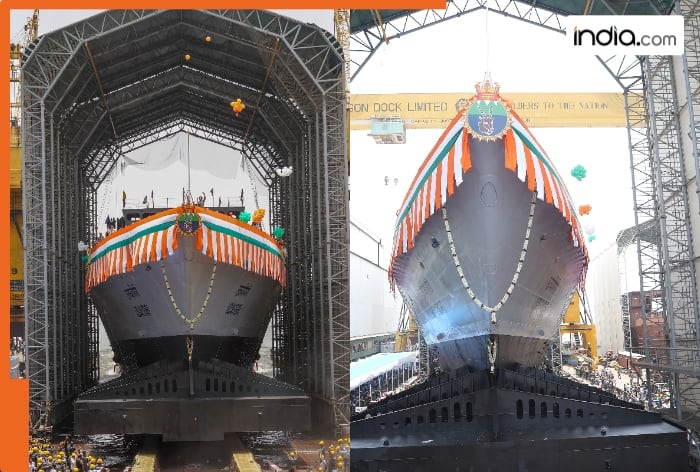
New Delhi: The Indian Navy, on Tuesday, 26 August 2025, commissioned two homemade Nilgiri-class stealth guided-missile frigates, INS Udaygiri (F35) and INS Himgiri (F34), at the Naval Base in Visakhapatnam. The ceremony was presided over by Defence Minister Rajnath Singh. These homegrown warships are built under the Project 17A (P-17A) programme.
This is the first time that two major surface combatants from two prestigious Indian Shipyards are being commissioned at the same time at Visakhapatnam. This event underscores India’s accelerating naval modernisation and its ability to deliver sophisticated warships from multiple shipyards.
Showcasing the success of Make in India and Aatmanirbhar Bharat
This milestone showcases the success of the Make in India and Aatmanirbhar Bharat initiatives in the defence sector. Udaygiri, the second ship of the Project 17A stealth frigates, has been built by Mazagon Dock Shipbuilders Limited (MDL) in Mumbai, while Himgiri is the first of the P17A ships being constructed by Garden Reach Shipbuilders & Engineers (GRSE), Kolkata. In another major milestone for the Indian Navy, Udaygiri is the 100th ship designed by the Navy’s Warship Design Bureau.
Specifications of Udaygiri and Himgiri
Stealthy, versatile and indigenous: Udaygiri and Himgiri represent a generational leap over earlier designs. Displacing about 6,700 tons, the P17A frigates are roughly five per cent larger than their predecessor Shivalik-class frigates and yet incorporate a sleeker form, with a reduced radar cross section.

They are powered by Combined Diesel or Gas (CODOG) propulsion plants using diesel engines and gas turbines that drive controllable-pitch propellers and are managed through an Integrated Platform Management System (IPMS).
Features of Udaygiri and Himgiri
The weapon suite includes supersonic Surface-to-Surface Missiles, Medium Range Surface-to-Air Missiles, 76 mm MR Gun and a combination of 30 mm and 12.7 mm Close-in Weapon Systems and the Anti-submarine/ Underwater weapon systems. Both ships are the result of an industrial ecosystem spanning over 200 MSMEs, supporting approximately 4,000 direct jobs and more than 10,000 indirect jobs.
The commissioning of Udaygiri and Himgiri underscores the Indian Navy’s commitment to self-reliance in ship design and construction.
India’s oceans are guarded by ships built, designed, and staffed by Indians
Rigorous sea trials have validated the frigates’ hull, machinery, firefighting, damage control, navigation and communication systems, ensuring they are ready for operational deployment. The ceremony at Visakhapatnam celebrated India’s journey towards a robust and self-sufficient maritime defence ecosystem.
As the nation watches the two grey hulls take their place in the fleet, the message will be clear: India’s oceans are guarded by ships built in India, designed by Indians and staffed by Indians – a true embodiment of the Make in India initiative and a beacon of the country’s rising maritime power.
(With inputs from: indiannavy.gov.in)
HIGHLIGHTS
- The Indian Navy has commissioned Nilgiri-class stealth guided-missile frigates, INS Udaygiri (F35) and INS Himgiri (F34).
- This event underscores India’s accelerating naval modernisation and its ability to deliver sophisticated warships from multiple shipyards.
- This milestone showcases the success of the Make in India and Aatmanirbhar Bharat initiatives in the defence sector.
- In another major milestone for the Indian Navy, Udaygiri is the 100th ship designed by the Navy’s Warship Design Bureau.
Stealthy, versatile and indigenous: Udaygiri and Himgiri represent a generational leap over earlier designs. Displacing about 6,700 tons, the P17A frigates are roughly five per cent larger than their predecessor Shivalik-class frigates and yet incorporate a sleeker form, with a reduced radar cross section.


