










Mumbai witnessed a landmark evening for Hindustani classical music recently as Strings & Wind played to a sold-out audience of over 1,000 patrons at the Jamshed Bhabha Theatre, NCPA. The concert marked the first-ever collaboration between legendary sitar maestro Ustad Shujaat Husain Khan and two-time Grammy Award-winning flautist Pandit Rakesh Chaurasia. The evening featured individual solo performances before culminating in a captivating jugalbandi that seamlessly blended melody, rhythm, improvisation and emotional depth.
In an exclusive interview with The Free Press Journal, Ustad Shujaat Husain Khan and Pandit Rakesh Chaurasia reflected on their debut collaboration, the role of spontaneity and innovation in tradition, global recognition, and the importance of platforms like Strings & Wind in preserving artistic integrity for future generations. Excerpts:
Ustad Shujaat Husain Khan |
This concert marked your first-ever collaboration together. What drew you to this partnership, and how did you prepare musically for the jugalbandi?
Ustad Shujaat Husain Khan: Strings & Wind. Yes, when you say it for the first ever, it gives a kind of scary feeling. But yeah, we’re both musicians and we travel the world and perform, and we got an opportunity to come together and play a little bit. So it’s just fun. The whole idea is not to prepare. How we prepared is one thing, but how we didn’t prepare is the more important thing here. The part that we will play together is something that we are absolutely unaware of, unprepared. Every time we do this, it is a whole tour. Every time we play, it will be different. We will play because we want to enjoy ourselves too.
Pandit Rakesh Chaurasia: It began with a shared curiosity and respect for each other’s musical voice. What drew me in was the idea of a true dialogue between flute and strings—not a display, but a conversation. My preparation was simple: deep listening, understanding my partner’s phrasing and layakari, and choosing ragas that allow space and flexibility. In a jugalbandi, the real music happens when you listen more than you play.
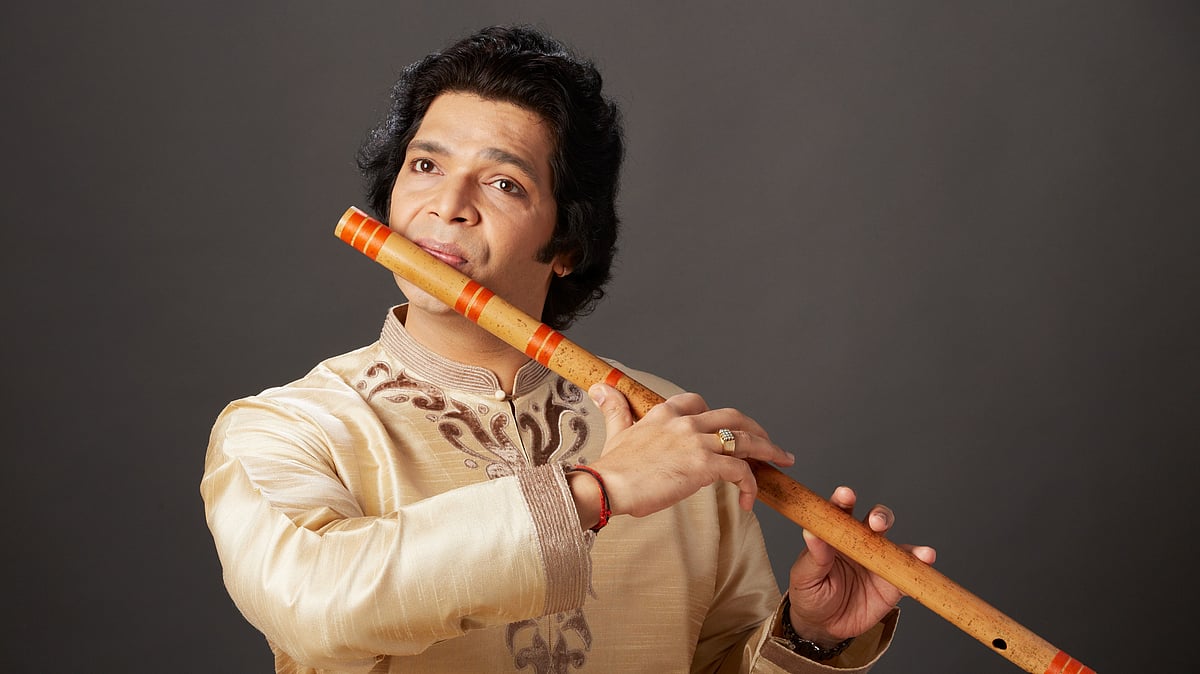
Pandit Rakesh Chaurasia |
The evening featured solo performances followed by a jugalbandi. How do you balance individual musical identity while creating a shared dialogue on stage?
Ustad Shujaat Husain Khan: That is the whole pleasure of going out in front of people—getting them to hear who we are individually, our instruments, our thoughts, our personalities, our characters that come out in our music. And then we just get together and have a picnic; we enjoy ourselves. These are our conversations that we have. So again, there’s no thought given to balancing or practicing. It’s just two musicians getting together and playing music. Yes, I come from the Imdadkhani gharana. But innovation has always been a cornerstone of every musician of our time. Even traditional great artists innovated and put their own personality into their concerts. It’s very important.
Pandit Rakesh Chaurasia: Balance comes from clarity and humility. Each solo allows the artist to establish their own musical identity and mood. When we come together for the jugalbandi, that individuality doesn’t disappear—it listens. You hold on to your voice, but you leave enough space for the other to speak. When there is mutual respect and alertness on stage, the dialogue feels natural and the music breathes as one.
Ustad Shujaat Husain Khan, coming from the illustrious Imdadkhani gharana, how do you view innovation within tradition in today’s classical performances?
Ustad Shujaat Husain Khan: Coming from a rich parampara like the Imdadkhani gharana, innovation has always existed within tradition—it’s never been outside it. Our elders constantly explored, but their roots were firm. Today too, innovation should arise from a deep understanding of raga, taal, and discipline, not from the urge to be different. When tradition is respected sincerely, new ideas emerge naturally and keep the music alive and meaningful for each generation.
Pandit Rakesh Chaurasia, as a torchbearer of the Hariprasad Chaurasia legacy and a two-time Grammy winner, how do global platforms influence your approach to Indian classical music?
Pandit Rakesh Chaurasia: Global platforms have widened the audience, but they haven’t changed my core approach. My foundation remains the same—guru–shishya parampara and the legacy of my Guruji, Pandit Hariprasad Chaurasia. International recognition brings responsibility: to present Indian classical music with honesty and depth, without diluting its essence. If we stay true to the raga and its spirit, the music speaks universally on its own.
Both of you spoke about the challenge of aligning schedules. Does this rarity make collaborations like these more meaningful?
Ustad Shujaat Husain Khan: We have different paths that we take in different careers. So of course, aligning schedules is definitely a rarity. That’s why it does make it more meaningful. I totally agree.
Pandit Rakesh Chaurasia: Absolutely. When collaborations are rare, they carry a different intensity and sincerity. Limited time together means everyone comes with deeper focus and commitment. You value each moment on stage more, listen more closely, and give your best. That rarity makes the experience—not just for us, but for the audience as well—far more meaningful.


