










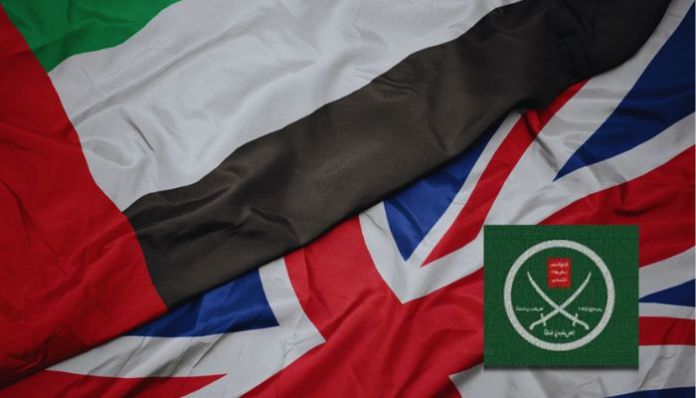
In a major move aimed at preventing Islamic radicalisation of youth, the United Arab Emirates (UAE) has slashed funding for its citizens interested in studying in the United Kingdom (UK). The UAE’s decision comes after the UK refused to ban the Islamic terrorist organisation Muslim Brotherhood.
The UAE excluded UK institutions from the list of global universities for which scholarships would be approved and qualifications certified, amidst deteriorating relations with the UK. Abu Dhabi’s decision stems from the concerns that there is a risk of Islamist radicalisation on UK campuses, a report in FT stated.
When the UK officials asked the UAE about the names of their universities missing from the revised list of overseas universities eligible for state scholarships and official recognition, the UAE officials confirmed the omission was deliberate, as per the report.
“[The UAE] don’t want their kids to be radicalised on campus,” one person privy to the discussions was quoted.
Data shows that in the academic year 2023–24, 70 students at UK universities were reported for possible referral to the Prevent deradicalisation programme for symptoms of “Islamist radicalisation”. This was almost double the number recorded in the previous academic year. This was out of a total higher education student population of around three million.
Over the past decade, the UAE has cracked down heavily on Islamists within the country, and in 2014, it designated the Muslim Brotherhood a terrorist organisation. The UAE has long advocated that the UK must proscribe the Muslim Brotherhood. However, the latter remains reluctant.
In November 2025, the US government also initiated the process of designating specific chapters of the Muslim Brotherhood (MB) as Foreign Terrorist Organisation (FTO) and Specially Designated Global Terrorists (SDGTs).
UAE blacklisted UK-based organisations linked with the Muslim Brotherhood, the UK’s nonchalance emboldening the Islamist outfit
In January 2025, the UAE blacklisted 8 United Kingdom-based organisations for their ties to the Islamic terror outfit ‘Muslim Brotherhood.’
The 8 outfits were identified as Cambridge Education and Training Centre Ltd, IMA6INE Ltd, Wembley Tree Ltd, Waslaforall, Future Graduates Ltd, Yas for Investment and Real Estate, Holdco UK Properties Limited and Nafel Capital.
Notably, the Islamist outfit Muslim Brotherhood has been banned even in Muslim-majority Arab countries such as Egypt, Saudi Arabia, and the United Arab Emirates. However, the UK, a ‘secular’ country, has neither banned the outfit nor declared it a terrorist organisation.
The United Kingdom has been grappling with rapid Islamic radicalisation and conversions to Islam. The Muslim Brotherhood is reported to have expanded its presence in the UK through students coming to study there and Islamist exiles who fled repression in their home countries. Muslim Brotherhood-linked organisations collaborate with Islamists from South Asia, established to promote the work of Abu A’la Mawdudi and representing Jama’at-e-Islami.
In 2024, former Communities Secretary Michael Gove MP named the Muslim Association of Britain (MAB) as an affiliate of the Muslim Brotherhood. Back in 2015, the UK government’s review of the MAB revealed that the outfit was “dominated” by the Muslim Brotherhood.
The review detailed how the Muslim Brotherhood gradually expanded its footprint in the UK over the past five decades. By the late 1980s, the Muslim Brotherhood began mobilising settled second-generation Muslims in the UK using the Iraq and Palestine issue.
By the 1990s, the Muslim Brotherhood established various organisations to promote their jihadist viewpoints and lure in supporters.
“None were openly identified with the Muslim Brotherhood and membership of the Muslim Brotherhood remained (and still remains) a secret. But for some years the Muslim Brotherhood shaped the new Islamic Society of Britain (ISB), dominated the Muslim Association of Britain (MAB) and played an important role in establishing and then running the Muslim Council of Britain (MCB). MAB became politically active, notably in connection with Palestine and Iraq, and promoted candidates in national and local elections. The MCB sought and obtained a dialogue with Government. MAB were active partners in a security dialogue with the police and collaborated with the police in ejecting Abu Hamza, the militant Salafist preacher, from a mosque in north London. The MAB have participated in the governance of this mosque ever since,” the 2015 report on the Muslim Brotherhood reads.

The review also found that through its various organisations, the Muslim Brotherhood has been raising funds in the UK. Muslim Brotherhood-controlled organisations like the UK Islamic Mission (UKIM), and Islamic Forum for Europe (IFE), among others, run dozens of mosques in the UK. These organisations have been open supporters of the Palestinian Islamic terror group Hamas.
The 2015 review further highlighted that while the Muslim Brotherhood in the UK has claimed to be opposed to ‘militant’ Salafism and Al Qaida, the UK government’s engagement with the Muslim Brotherhood “did not take account Muslim Brotherhood support for a proscribed terrorist group and its views about terrorism which, in reality, were quite different from our own; – aspects of Muslim Brotherhood ideology and tactics, in this country and overseas, are contrary to our values and have been contrary to our national interests and our national security.”
Despite the 2015 review tracing the Muslim Brotherhood’s jihadist proclivities, the UK government did not proceed with banning the outfit, saying that there was no evidence linking the Muslim Brotherhood to terrorist activities in Britain.
Muslim Brotherhood: History, motto and jihadist activities across the world
The Muslim Brotherhood or Ikhwan al-Muslimin was founded in 1928 in Egypt by Hassan al-Banna, a teacher and Islamic scholar. The Islamist outfit’s foundation was based on the premise of anti-Western colonialism and the supposed erosion of Islamic values in the post-Ottoman world. Al-Banna launched the Muslim Brotherhood as a pan-Islamist movement which focused on charity and Islamist advocacy.
In its early years, the Muslim Brotherhood filled gaps left by weak and nonchalant governments by building schools, hospitals and mosques for the poor and illiterate people in Egypt while also preaching Islam and ‘Tawhid’ (Allah’s oneness and supremacy) as some antidote to secularism and imperialism. The motto of the Muslim Brotherhood makes abundantly clear that though it may not have initially been linked to violence; ‘Jihad’ has always been its way.
The Muslim Brotherhood’s motto says, “Allah is our objective; the Prophet is our leader; the Quran is our law; jihad is our way; dying in the way of Allah is our highest hope.”
By the 1930s, the Muslim Brotherhood had gained thousands of members and entered politics as well. However, the Islamist outfit had a paramilitary wing called the Secret Apparatus or al-Nizam al-Khas. This wing carried out political assassinations and jihadist violence. In 1948, the Secret Apparatus members assassinated Prime Minister Mahmoud El Nokrashy Pasha for banning the Islamist outfit. In 1949, al-Banna was murdered by the Egyptian Secret Police in retaliation for Pasha’s murder.
The members of the Muslim Brotherhood’s Secret Apparatus used to undergo heavy physical and military training. They were trained to use firearms and carry out underground operations. Emphasising deception and secrecy (Taqqiya), the Jihadists belonging to the Apparatus infiltrate and subvert political parties, armies, intelligence, media, educational institutions and even NGOs. While in countries like the UK, violence may not be the go-to tactic of the Muslim Brotherhood, using media, politics, educational institutions, and charities for furtherance of the Islamic jihadist agenda continues.
In 2012, MB won the elections and picked Mohamed Morsi as President. However, in 2013, a military coup led by then-General Abdel Fattah el-Sisi ousted Morsi. The Islamist outfit was banned and declared a terrorist organisation in Egypt.
The Muslim Brotherhood continues to be seen as a threat to political stability by many authoritarian governments in the Middle East and North Africa. Recently, Texas Governor Greg Abbott announced that the Muslim Brotherhood, including the Council on American-Islamic Relations, would be considered “foreign terrorist and transnational criminal organisations.”
The UAE, Saudi Arabia, Egypt, Bahrain, and Russia have already designated the Brotherhood as a terrorist organisation. Jordan banned the group in April 2025 after arresting people linked to the movement who were accused of plotting attacks using rockets and drones.
The Muslim Brotherhood also inspired Maulana Abul Ala Maududi’s Jamaat-e-Islami in the 1940s. Banned Islamic terror outfits like the Student Islamic Movement of India (SIMI) and Popular Front of India (PFI), both of which have been involved in Jihadist attacks against Hindus and are working on plans to turn India into an Islamic nation, draw inspiration from Muslim Brotherhood tactics. Besides influencing Islamic terrorist groups active in India, the Muslim Brotherhood had launched a #BoycottIndianProducts campaign against India, targeting India’s economic interests in 2021. In 2023, the Muslim Brotherhood conspired to paint a bad picture of India under the guise of defending the honour of the Islamic prophet Muhammad.


