










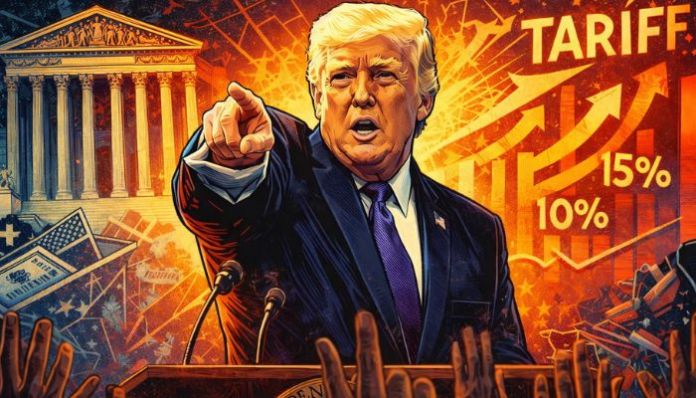
On 21st February (local time), President of the United States, Donald Trump, announced a blanket 15% tariff on goods imported into the United States for a period of 150 days. The announcement came a day after the US Supreme Court struck down reciprocal tariffs imposed by Trump, and he criticised the verdict, calling it “ridiculous, poorly written and extraordinarily anti-American”.
With the announcement, Washington has raised the levy from the 10% surcharge he had declared immediately after the judgment. Trump has signalled a fresh escalation in Washington’s trade posture with this move.
What Trump announced
In a proclamation titled “Imposing a Temporary Import Surcharge to Address Fundamental International Payments Problems”, Trump invoked Section 122 of the Trade Act of 1974 to impose a temporary import surcharge. It was initially set at 10% ad valorem and later increased to 15%. The surcharge will apply for 150 days, effective 24th February.
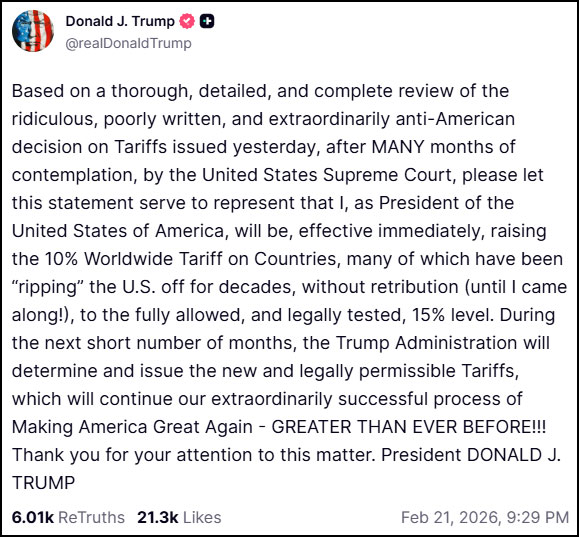
In a post on Truth Social, Trump said that after a “thorough, detailed, and complete review” of the Supreme Court’s decision, he would raise the worldwide tariff to the “fully allowed, and legally tested, 15% level”. He claimed that several countries had been “ripping” the US off for decades and asserted that the administration would soon determine fresh legally permissible tariffs.
India to face 15% tariff
The 15% rate will apply to goods from across the world, including India. For India, this represents a reduction from the earlier 18% rate that had been in effect, although US Customs had not yet formally adjusted the tariff schedule. The Commerce Ministry said it was “studying” the implications of the US announcement.
“We have noted the US Supreme Court judgement on tariffs yesterday. President Trump has also addressed a press conference in that regard. Some steps have been announced by the US Administration. We are studying all these developments for their implications,” the Ministry said in a statement.
With the Supreme Court invalidating Trump’s earlier imposition of reciprocal tariffs under the International Emergency Economic Powers Act, the dynamics of the proposed India US trade agreement, nearly a year in the making, are expected to shift. The agreement is yet to be legally signed.
Goods exempted from surcharge
According to a White House fact sheet, certain goods will be exempt from the temporary import duty, either to meet US economic needs or to ensure that the measure effectively addresses international payment concerns.
Exemptions include certain critical minerals, metals used in currency and bullion, energy and energy products, natural resources and fertilisers that cannot be produced in sufficient quantities domestically, certain agricultural products such as beef, tomatoes and oranges, pharmaceuticals and ingredients, certain electronics, passenger vehicles and specified categories of trucks and buses, parts of such vehicles, and certain aerospace products.
Trump attacks judges, defends India deal
Shortly after the 6 to 3 verdict, Trump lashed out at the judges who ruled against him, using words such as “fools” and “lapdogs”. “The Supreme Court’s ruling on tariffs is deeply disappointing, and I’m ashamed of certain members of the Court, absolutely ashamed for not having the courage to do what’s right for our country,” he said at a White House news conference.
On the proposed interim trade framework with India, Trump insisted that “nothing changes”. “They’ll be paying tariffs, and we will not be paying tariffs. So, deal with India is they pay tariffs. This is a reversal of what it used to be,” he said.


