










Indore (Madhya Pradesh): In the heart of Indore stands PC Sethi Hospital, a facility meant to protect women, newborns and children — those who depend most on a system’s compassion. But a ground investigation by Free Press reveals a shocking contradiction: a hospital intended to heal has instead become a place where neglect thrives. What should have been a refuge now feels like a maze of apathy, filth and administrative collapse.
Patients and their families arrive here hopeful, often after long journeys. What they encounter is a hospital slipping into decay, where the absence of basic hygiene and dignity isn’t an aberration — it’s the norm.
BIO-HAZARD ZONE: Eating Among the Waste
Among the most disturbing findings is the handling of biomedical waste. Instead of being stored safely and sealed, medical refuse sits openly within the campus — its stench drifting through corridors, mixing with the breath of patients already struggling with illness. It is a glaring violation of Bio-Medical Waste Management Rules and a direct threat to the health of vulnerable mothers and infants.
The situation turns almost dystopian near the temporary structures in the backyard. With no waiting hall or canteen, families of patients sit on the ground to eat their meals. Many travel from villages, carrying food in steel tiffins, hoping for a shaded corner. Instead, they end up eating just metres away from hazardous biomedical waste — a sight as heartbreaking as it is dangerous. In a place meant to prevent infections, the system seems to be manufacturing them.
Suggestions for improvement:
• Build a sealed, compliant waste-storage room away from public areas.
• Create a clean waiting and eating area for attendants.
• Enforce strict penalties for violating waste-disposal norms.
NO DIGNITY FOR PATIENTS: Floors Become Waiting Rooms
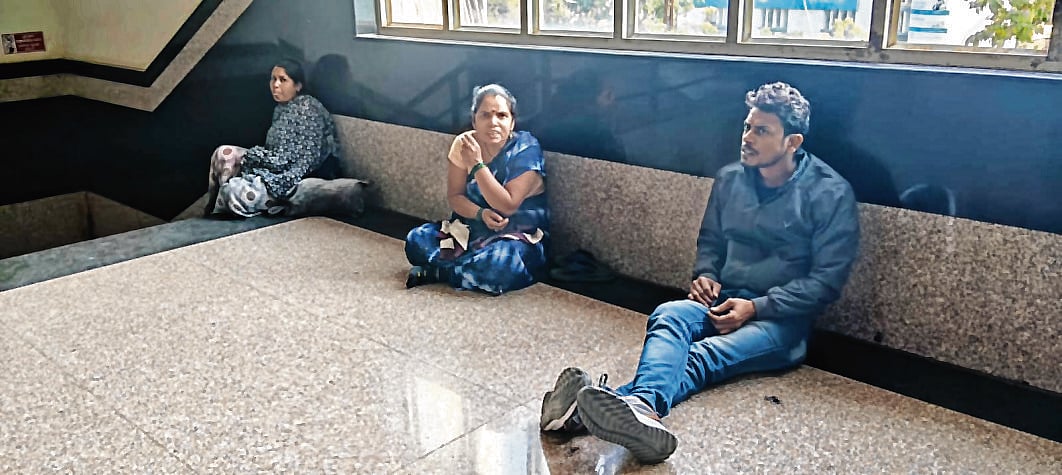
The absence of empathy is painfully evident in the seating arrangements — or rather, the lack of them. The hospital spans five floors, yet outside several critical departments there are no benches or chairs, not even a basic space where pregnant women can rest. Visitors are forced to squat on staircases, blocking stretchers and doctors. Outside, dozens huddle under trees, sitting on dusty ground as they wait for updates on their loved ones.
Inside the OPD, exhausted mothers clutching feverish children sit on cold tiles. Pregnant women lower themselves carefully onto floors because the administration cannot provide simple seating furniture.
Suggestions for improvement:
• Procure metal 3-seater chairs for all corridor waiting areas.
• Develop a dedicated waiting hall outside the main building.
THE “TIN SHED” LAB: Infrastructure in Collapse
The demolition of the old building was supposed to herald progress. Instead, it has triggered chaos. The hospital’s laboratory — the nerve centre for blood tests and diagnostics — now functions from a blue tin shed erected on what was once the parking area.
This makeshift lab now occupies the parking area forcing people to park their vehicles entirely onto the main road, causing daily gridlock in the GPO area. Residents struggle to navigate the traffic, while ambulance movement is hampered. The hospital’s internal disarray is now spilling onto public streets.
Suggestions for improvement:
• Shift the lab to a vacant room or prefabricated cabin inside the main building.
• Restore the parking area to ease road congestion.
• Deploy wardens until traffic stabilises.
SEWAGE AND DISEASE: The Aadhar Kendra Nightmare
Perhaps most alarming is the area behind the hospital, where the Aadhar Kendra stands surrounded by filth. Broken sewage lines leak continuously, forming a swamp of black water and sludge. The stench is suffocating. Mosquitoes and flies swarm the stagnant pools — a breeding ground for Dengue and Malaria right outside a hospital gate.
Citizens coming for an identity card are forced to walk through disease-ridden muck. The irony is cruel.
Suggestions for improvement:
• Begin emergency plumbing repair to replace broken sewage lines.
• Conduct immediate fogging and anti-larval treatment.
Relocate Aadhar Kendra: The centre should be moved to a cleaner, more accessible part of the building until the sewage issue is permanently fixed.
STAFF APATHY: Sleeping on Duty
As patients navigate hazards, the staff appears to be indifferent. Security guards sleep openly during duty hours. Other staff scroll on phones while anxious families wait for responses. The lack of accountability is dangerous.
Suggestions for improvement:
• No-sleeping policy with strict penalties to be enforced.
• Install CCTV cameras for corridor and duty room monitoring.
• Restrict mobile phone use during peak OPD hours.
GOVERNMENT WASTE: Junkyard Corridors
Large portions of the hospital resemble a scrapyard. A rusted Mahindra Marshal belonging to the District Family Welfare Department sits abandoned, gathering leaves and dust — a symbol of public money left to wither. Inside, corridors are choked with broken stretchers, discarded wheelchairs and unusable furniture. These obstructions narrow already crowded passageways, posing a grave hazard in emergencies.
Suggestions for improvement:
• Condemn and auction scrap vehicles and furniture.
• Clear corridors to comply with fire-safety norms.
• Conduct an inventory audit to repair salvageable items.
Dr Virandra Rajgir, Incharge of PC Sethi Hospital said, “Due to dismantling of the old building we are facing lack of space for making arrangements of patient visitors to sit. Garbage collection has been outsourced by the health department and biomedical waste is collected daily. IMC is responsible for collection of other waste but it is picked up once in 4-5 days due to which premises stinks.”
TOTAL STAFF – 200 (60 NURSING STAFF / 40-45 DOCS AND OTHER STAFF)
FACILITIES
FREE XRAY
SONOGRAPHY
ALL KIND OF BLOOD TEST


