










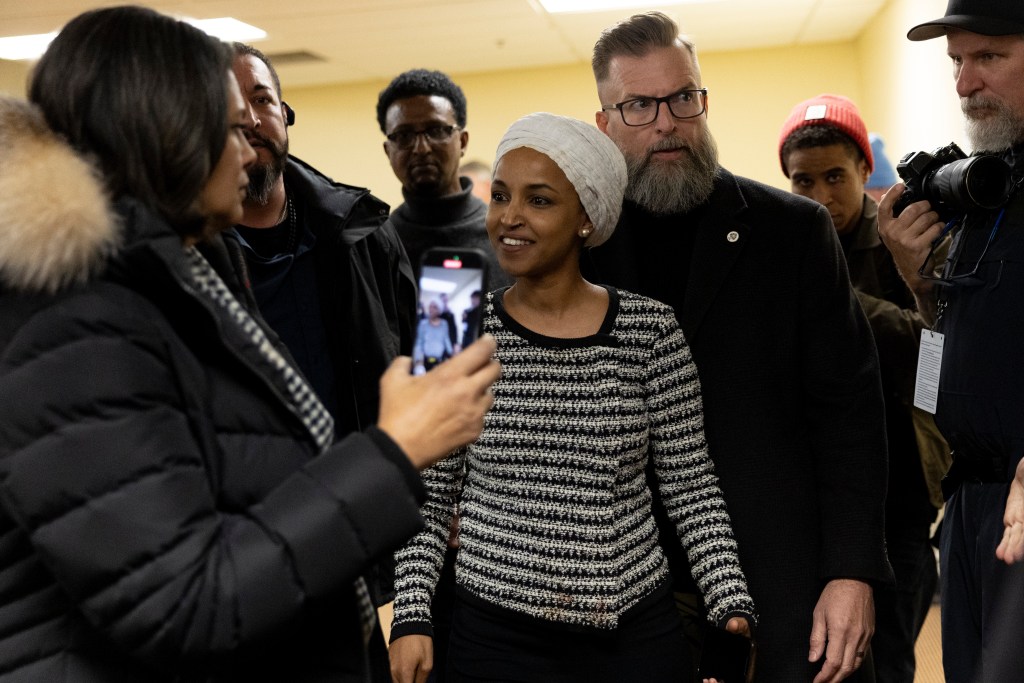
WASHINGTON – After the murders of state lawmaker Melissa Hortman and her husband last summer, members of Congress received a boost in the amount of money they can use for security.
That amount was increased again last summer. Now, U.S. House members have access to $140,000 each year to pay for personal security details, security systems on their homes and other forms of protection.
But with escalating threats and increased dangers of physical attacks, that’s not enough money for some lawmakers, including Rep. Angie Craig, D-2nd District, and Rep. Ilhan Omar, D-5th District. So these Minnesota lawmakers, and others, are tapping their campaign accounts in efforts to bolster their safety.
A recent report by the Bridging Divides Initiative at Princeton University, which monitors political violence, shows just how freighted the political environment has become.
Related: With the low-hanging fruit already picked, Capitol security focus moves to guns
The BDI report said “the past year saw a dangerous escalation in the political violence risk environment in the United States, from high-profile assassinations to aggressive federal immigration operations.”
“Threats and harassment spiked, and leading community safety practitioners reported that the demand for de-escalation support surged to new heights,” the report said.
An ‘unfortunate’ need
According to a MinnPost analysis of Federal Election Commission filings, Craig spent the most campaign money on security last year, $47,612, among Minnesota lawmakers. She is running for retiring Sen. Tina Smith’s seat and held many public events in 2025.
The lawmaker was also the victim of an assault. In 2023, Craig was attacked by a homeless man with previous assault charges in the elevator of the apartment building she lives in when she’s in Washington, D.C. She managed to escape, and call 911, after throwing hot coffee on her attacker.
“Over the past several years, we have seen an increase in the need for security both on the campaign side and when performing official duties,” Craig said in an email. “And of course, recently, we’ve seen tragic acts of political violence in Minnesota and across the country. It’s unfortunate that public officials need security to keep themselves and their families safe.”
Omar, who is a lightning rod for political attacks and one of President Donald Trump’s favorite targets, spent $25,320 for security out of her campaign funds last year.
Omar was assaulted at a town hall last month by 55-year-old Anthony Kazmierczak, who used a syringe to spray what was later identified as apple cider vinegar on the congresswoman. Security officials wrestled Kazmierczak to the ground.
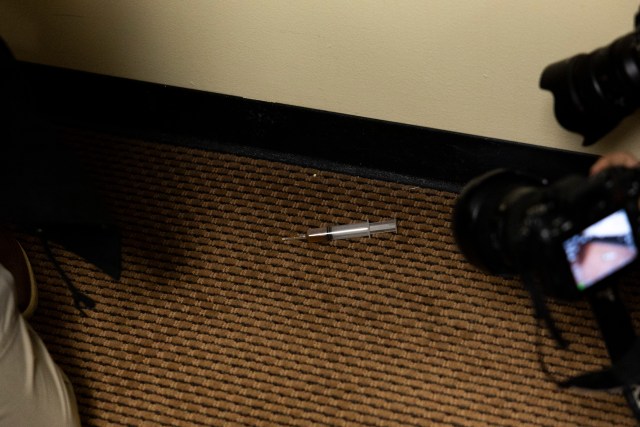
At a press conference the day after that incident, Omar said the number of threats she receives rises sharply every time Trump focuses his ire on her. Trump has called Omar and fellow Somali Americans “garbage” and most recently insinuated the lawmaker is linked to Islamic terrorists, has committed fraud, and should be jailed.
“Blame is very interesting, but facts are more important, and what the facts have shown since I’ve gotten into elected office is that every time the president of the United States has chosen to use hateful rhetoric to talk about me and the community that I represent, my death threats skyrocket,” Omar said.
Because of the attack and concerns there could be others, House Speaker Mike Johnson agreed to give Omar a U.S. Capitol Police detail for the time being.
And Omar’s campaign sent out a fund-raising appeal to help her afford the private security that is often with her when she appears in public.
Broader concerns for the safety of members of Congress have prompted other steps.
The Federal Election Commission changed its rules as of Jan. 1, 2025, to allow “a federal candidate or officeholder or their family and staff” to address “ongoing dangers or threats” through the use of their campaign funds.
window.addEventListener(“message”,function(a){if(void 0!==a.data[“datawrapper-height”]){var e=document.querySelectorAll(“iframe”);for(var t in a.data[“datawrapper-height”])for(var r,i=0;r=e[i];i++)if(r.contentWindow===a.source){var d=a.data[“datawrapper-height”][t]+”px”;r.style.height=d}}});The MinnPost analysis determined that Smith spent $10,020 on security from her campaign account, Sen. Amy Klobuchar spent $635 and Rep. Kelly Morrison, D-3rd District, spent $12,912.
The campaign money the Democratic lawmakers spent for protection was, in every case, paid to a company called Relative Intel, which is headquartered in St. Paul.
A spokeswoman for Smith said the company provided security for events the senator held in Minnesota.
Relative Intel did not respond to requests for comment.
While some Minnesota lawmakers boosted their security protocols by tapping campaign accounts, others did not.
Rep. Betty McCollum, D-4th District, and Minnesota’s Republican members of Congress – Reps. Tom Emmer, Pete Stauber, Michelle Fischbach and Brad Finstad – did not use campaign cash to bolster their personal security.
Like other members of the U.S. House leadership, Emmer, who is House Majority Whip, is entitled to a full-time Capitol Police detail, but it’s unclear if he uses one. His office did not return requests for comment.
GOP members of Congress from Minnesota have followed a trend among Republican congressmen and congresswomen in limiting the number of in-person town halls they hold, favoring instead public appearances where the audience is vetted or virtual meetings with constituents.
Last spring, Johnson encouraged Republican lawmakers to skip in-person town halls because they frequently were disrupted by protests over Trump policies.
‘A self-fullfiling prophecy’
The amount of money for security that members of the House receive in the accounts they use for travel and other work-related expenses was raised twice last year.
Congress gave House members a $20,000 allotment to pay for the security of their homes after Hortman and her husband were killed and state Sen. Mark Hoffman and his wife were critically shot last June. Authorities said those shootings, by Vance Luther Boelter, were politically motivated.
House members were also given $5,000 a month to pay for personal security. That amount was doubled, to $10,000, after conservative activist Charlie Kirk was assassinated in September and the issue of political violence moved to the forefront again.
Senators were not given a special allotment for security but were instead allowed greater flexibility to use their office accounts for protective services.
The push to give federal lawmakers more money for security comes after a spike in threats to lawmakers.
The U.S. Capitol Police recently reported that its threat assessment section investigated 14,938 “concerning statements, behaviors, and communications directed against members of Congress, their families, staff and the Capitol Complex” in 2025.
That marks a dramatic increase from 2024, when Capitol Police investigated 9,474 threats.
Capitol Police also said it strengthened its partnerships with local law enforcement agencies in efforts to protect members of Congress when they are at home.
Threats to lawmakers come in many forms — on social media, in writing and in phone calls.
After Craig was assaulted, her office voice mail system was flooded with hate-filled messages.
The audio of one of the least obscene calls released by Craig’s office said:
“Yes, Representative, Craig. I was just calling because I wanted to say I am so glad that you were attacked. I really am. I mean, I hate it in one way, but I’ve been saying probably for the last two years, at least year and a half, and until our Congress people and politicians are getting attacked, nothing is going to change. Nothing was going to happen.”
Other messages were far more menacing, using racist epithets and wishing sexual violence upon Craig.
“It will take all of us — working together — to change the tone of our political discourse and bring civility back to our nation,” Craig said.
According to a Pew Research Center poll, 85% of Americans surveyed said politically motivated violence is increasing. This includes nearly identical shares of Republicans and Republican leaners (86%) and Democrats and Democratic leaners (85%).
Richard Painter, a University of Minnesota law professor and expert on government ethics, said the increasingly violent, belligerent and abusive language on social media and from high-profile politicians, including Trump, is “a self-fullfilling prophecy.”
“The more people talk about violence, the more likely someone is going to do something crazy,” he said.
Related: The threat of political violence is keeping parents out of elected office
He said there have been times in the United States when violent language led to violent actions, including the turbulent 1960s during which Martin Luther King, Jr., John F. Kennedy and Robert Kennedy were assassinated.
“We have to tone down the rhetoric,” Painter said.
As far as spending campaign funds on security?
“I think it’s a necessary expense of the campaign,” he said, noting that one or two able security guards could have saved Robert Kennedy from being shot at a campaign event in California.
According to the Bridging Divides Initiative, it is not only federal officials who are feeling pressure to watch out for their safety. BDI documented multiple spikes in threats against local officials, with the year’s largest spike coming in September following the Kirk assassination.
Survey results for the third quarter of 2025 show that 75% of local officials are now less willing to engage in key political activities due to concerns about hostility.
The post Minnesota lawmakers are tapping campaign funds to bolster their security appeared first on MinnPost.


