










According to the firm’s 2025 analysis, Elliptic’s 2025 report confirms: 20% of complex laundering cases span 10+ blockchains, 33% cross 3+ chains.
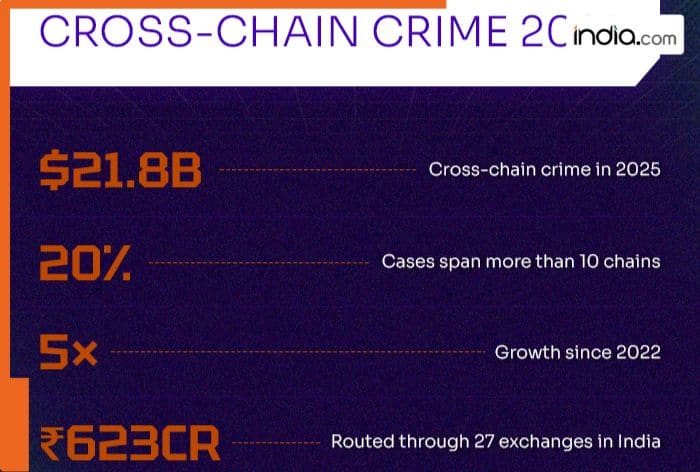
For years, regulators suspected that money launderers were no longer relying on traditional mixers (services that tumble coins to hide origins) or single-chain hiding techniques. They sensed that illicit actors were slipping between blockchains faster than compliance teams could track them. Elliptic’s latest cross-chain crime report has now confirmed those fears. According to the firm’s 2025 analysis, Elliptic’s 2025 report confirms: 20% of complex laundering cases span 10+ blockchains, 33% cross 3+ chains. Criminals laundered $21.8B via bridges/DEXs in 2025 alone, which is 3x more than 2023 levels.
This shift is not just an evolution in criminal tactics. It reveals the most important AML insight of the decade: the system is not struggling with sophistication, it is struggling with visibility. Blockchains are transparent individually, but once funds move across them, that transparency disappears. Compliance, as it exists today, was never built for a multi-chain world.
The Blindspot at the Center of Modern AML
Chain-hopping refers to rapidly moving crypto assets across multiple blockchains to break the transaction trail. Each blockchain maintains its own ledger, tools and tracing logic, and none of that information automatically carries over when assets move through a bridge. As per Elliptic’s findings, criminal actors increasingly perform these hops within minutes. By the time a compliance analyst investigates the first transaction, the funds may have already crossed five or six networks, each one stripping away more context.

This tactic has replaced classic mixers not because it is technically superior, but because it is less visible. A mixer is easy for regulators to target. A cross-chain route that touches ten blockchains , five wrapped assets and several decentralized exchanges is not. Elliptic’s report explains that single-chain analytics tools are now “blind to the majority of laundering flows” because they cannot interpret what happens after crypto assets leave the chain they monitor.
We have seen versions of this blindspot in national contexts as well. In late 2024, Indian authorities reported that approximately ₹623 crore had moved through more than two dozen domestic exchanges using multi-hop routing patterns, as documented by publications such as The Indian Express and Financial Express. Each exchange only observed a fragmented portion of the flow and therefore could not detect the larger laundering structure. The case mirrors what Elliptic is now confirming globally: fragmentation creates opacity.
This is the environment in which compliance teams are expected to operate.
Why Current Compliance Models Cannot Keep Up
Traditional AML programmes assume that investigators have clear visibility into the movement of funds and sufficient time to analyze patterns. Multi-chain laundering breaks both assumptions. Every hop increases the complexity of the transaction graph, and every bridge introduces a new layer of technical interpretation.
As Tapan Sangal, Chief Visionary at Kwala, notes, compliance teams often see only one part of a long transaction path, which makes it difficult to understand the full movement of funds. “If a compliance system cannot follow these steps across different chains within seconds, it is not protecting anyone,” he explains. “It is simply letting transactions pass without meaningful checks.” His point captures the central challenge: human investigation cannot keep pace with the speed at which funds move today.
The issue is not that compliance professionals lack skill or rigor. The issue is that the infrastructure underneath them is structurally incapable of delivering the visibility they need.
The Future Requires Architectural, Not Operational, Change
Many institutions try to respond by adding more analysts, tightening internal reviews or buying new monitoring tools for individual blockchains. These steps do not address the core problem. When criminals move fluidly across chains, tools that can see only one chain at a time will always fall short.
The real solution has to be architectural. Visibility, traceability and accountability must be built into the infrastructure itself rather than added as optional layers.
Several companies are now working toward this model. Some, like Kalp, offer permissioned blockchain frameworks where participants are tied to verified identities. Others, such as Kwala, focus on real-time cross-chain compliance by detecting movement patterns, screening transactions against sanctions lists before execution and generating automated audit trails across multiple networks.
These approaches indicate how the wider ecosystem can begin rebuilding the visibility it has lost.
A New Accountability Era for Web3
Chain-hopping is not a temporary anomaly or a niche tactic. It is the defining laundering method of 2025, and it is accelerating faster than traditional compliance models can adapt. Regulators, exchanges, and builders must recognize that accountability cannot depend solely on human oversight. It requires rails and engines that can interpret cross-chain activity with the same speed and fluidity that criminals now exploit.
The future of AML is architectural, not procedural. And the systems that endure will be the ones that treat cross-chain visibility as a foundational requirement rather than an afterthought.
By Kwala
Topics


