










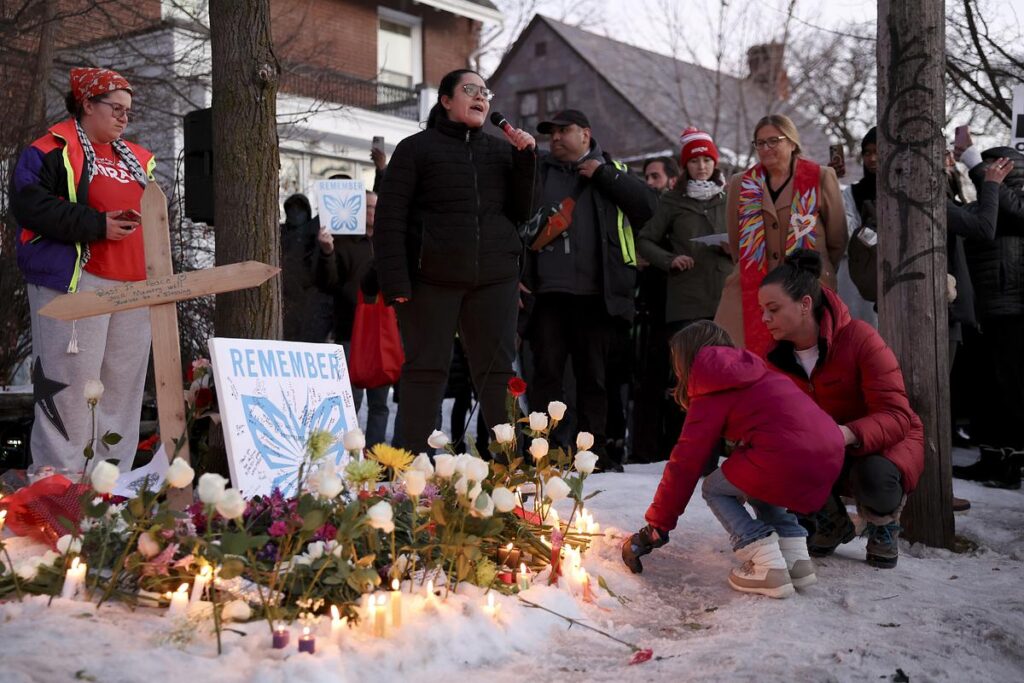
This story was originally published by The Trace, a nonprofit newsroom covering gun violence in America. Sign up for its newsletters here.
On January 7, federal immigration agents in Minneapolis shot and killed 37-year-old Renee Good. The agents claim she tried to run them over with her car, and federal officials — including President Donald Trump, Vice President JD Vance, and Homeland Security Secretary Kristi Noem — have defended the shooting as justified.
But videos appear to contradict the White House’s narrative. Before the shooting, Good’s car had been blocking traffic. After agents directed her to get out of her vehicle, she backed her car up, then drove forward, turning away from the agents as one of them opened fire.
Protests have since sprung up to demand a full and independent investigation into Good’s death. State and local leaders have said federal officials are blocking state agencies from participating in the investigation. The killing was the latest in a string of shootings by federal immigration agents since Trump returned to office. At least four people have been killed, including Good.
To better understand the policies and laws surrounding law enforcement’s use of deadly force, The Trace spoke with Kami Chavis, a professor who directs the Center of Criminal Justice and Police Reform at William & Mary Law School. The conversation has been edited for length and clarity.
What case law and policy govern use of force by law enforcement?
It does not matter whether you are state, local, or federal law enforcement; under Supreme Court precedent, your use of deadly force is governed by an “objectively reasonable” standard.
Officers should not use deadly force unless they have a reasonable belief of a threat to safety. But that belief must be objective. We have to evaluate whether they believed the suspect posed a danger, and then we have to assess that belief using objectively reasonable factors. Those factors are set out in a 1989 case called Graham v. Connor. They include the severity of the crime at issue, whether the suspect poses an immediate threat to the safety of the officers or others, and whether the suspect is actively resisting or evading arrest.
What policies govern use of force with moving vehicles and fleeing suspects?
Most police departments and federal guidance prohibit shooting at a moving vehicle unless the driver poses an imminent threat of deadly force. You are not allowed to use deadly force just because a car is leaving. The Department of Homeland Security’s policy specifically prohibits discharging firearms at the operator of a moving vehicle unless there is a threat of death or serious physical harm to agents or other people.
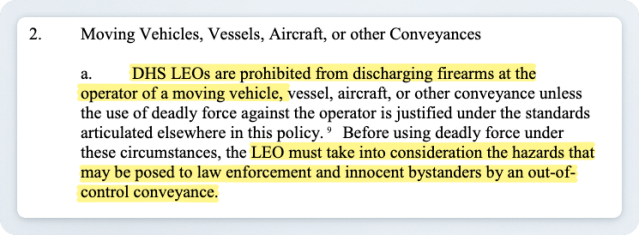
There are many reasons to have a policy that prohibits firing into cars. When an officer fires into a moving vehicle, there may be other innocent occupants inside. It is very hard to control the vehicle’s trajectory when you shoot the driver. If you kill the driver, that car is going to spin out of control. Good was on a crowded street. Her car did, in fact, crash into another car. I think that car was unoccupied, but what if it wasn’t? Firing into a moving vehicle on a crowded street with protesters is potentially more dangerous than allowing the car to leave and stopping it later.
You also cannot use deadly force solely to prevent the escape of a fleeing suspect — again, unless there is an immediate and significant danger of serious injury or loss of life. Good was trying to leave. The question is whether the agents believed she was using the vehicle in a way that posed a threat to them or others at the time. That is what all of this is going to hinge on.

Deadly force is also only allowed when no reasonable alternative exists. In the Good case, there seemed to be reasonable alternatives, like stepping out of the car’s path. Deadly force should be a last resort. You want to use the minimum non-deadly force necessary and only escalate when necessary.
As a former prosecutor and expert on use of force, how would you evaluate this shooting?
When I view the video, there are other things the agent could have done. It appears the agent is stepping into the path of the car, and Good’s wheels are pointed away. She appears to be trying to swerve away from the agent. You should not step into the path of a moving car and then shoot at the person; that is not appropriate.
In my opinion, there was an opportunity for the agent to de-escalate and back away. Let the car go. You can check the license plate, determine where she is going, set up a blockade later, or use other methods. I would also ask: What was the crime? She may have been blocking a street, but she wasn’t a murder suspect. There is a scale of severity.
Related: Yes, state and local prosecutors can charge federal law enforcement agents with crimes. But it isn’t easy
Looking at what the Supreme Court has said and the policies of the Justice Department and Department of Homeland Security, it seems the officer acted in contravention of those policies. As a result, a woman who was a mother of three is dead. People on that street exercising their First Amendment rights were traumatized and endangered.
Do the events that happened beforehand play into the agent’s potential culpability?
Yes, there is a very recent landmark 2025 case, Barnes v. Felix, which states that courts must evaluate police use of deadly force under the “totality of circumstances.” This means we must consider the events leading up to the incident, not just the split second of the threat.
Those events are relevant. You have to include the seriousness of the crime and whether the agent contributed to their own dangerous situation. In this case, I think he did.
Does it matter that these were federal agents? Could they be charged by the state, or would it have to be the federal government?
You can have a concurrent investigation. Typically, even though these were federal agents, that does not mean they didn’t violate state law. The FBI is investigating, and if they find a prosecution is justified, that would be in federal court. However, there can also be a state investigation.
Does the agent have any kind of immunity from state prosecution because he was a federal official?
You don’t have absolute immunity from state prosecution. State charges are possible if the actions are found to be a violation of federal law or clearly outside the scope of lawful federal duties. It will be a significant legal challenge because federal law takes priority over state law, but it is possible.
My concern here is that we are having a crisis of credibility. You have already had high-level politicians like the president say the agent’s actions were justified before a full investigation. It is vital for legitimacy to have a probe with integrity. I would think the federal government would want the state to do an independent investigation to provide credibility.
The agent fired multiple times. Could that fact play a role in the outcome of an investigation?
If you are justified in using deadly force, an officer is trained to extinguish the threat. If it is determined that deadly force was appropriate, you can fire as many times as necessary. The real question is whether deadly force was justified in the first place. If it wasn’t, then firing even once is inappropriate.
The Trace has been tracking uses of force by immigration agents. We have identified at least 16 shootings since June, including four fatal ones. What is your reaction to what appears to be an increasing pace of shootings?
It is logical to infer that we will see an increase in law enforcement-involved shootings given the current dynamic. You have armed people whose job is to arrest and seize undocumented immigrants, and you have a part of the population that is going to actively protest that. We have also seen cases where agents detain people who are actually citizens. If a masked person jumps out and tries to take you, you may not know what is happening.
I think the current setup will lead to increased uses of force. We are often concerned with fatalities, but we also need to pay attention to serious injuries. Many shootings do not end in death simply because of happenstance, the shooter’s poor aim, or the proximity of a hospital. Federal use-of-force policy emphasizes the sanctity of life and the goal of minimizing loss of life. The current way these operations are occurring appears inconsistent with that.
The post Immigration agents are shooting people. Is it legal? appeared first on MinnPost.


