










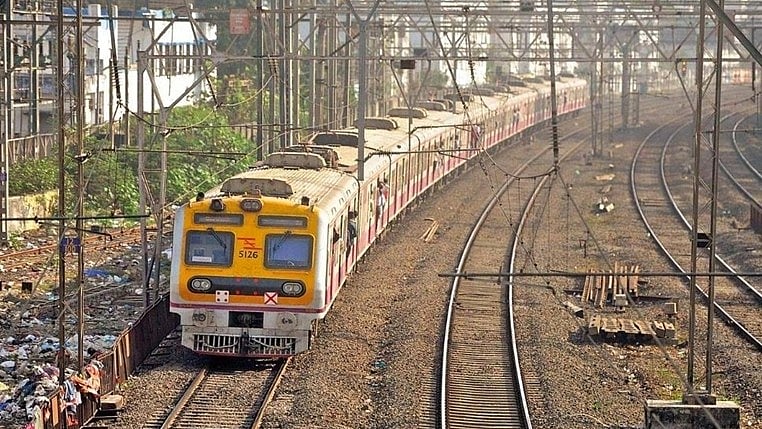
Mumbai’s overcrowded suburban trains highlight the daily risks commuters face amid safety lapses and inadequate emergency response | Representative Image
Alok Kumar Singh’s story just does not fade from the mind. At 32, he held a postgraduate degree and worked as a lecturer in mathematics at Narsee Monjee College of Commerce & Economics, Vile Parle–Juhu. He lived in Malad with his parents and wife and made the local train commute every day to work and back—like millions of us who have lived this life in Mumbai together for decades.
On the evening of January 24, Singh was returning home in a Churchgate–Borivali slow train with a colleague. He was planning, reports say, to take his wife out later in the evening to celebrate her birthday. Instead, his body lay lifeless and cold in the innards of a hospital in Kandivali, as his family struggled to come to terms with what had happened. Singh had been stabbed in his abdominal area by a co-commuter and apparently lay bleeding on the Malad platform till procedures could be completed. He was brought dead to the hospital.
Travel rage on Mumbai’s trains
What had happened is routine in Mumbai’s locals, as is well known. Jostling for space, stepping over toes, inadvertent push and pull of bags, and a shove from someone behind are enough to start fights that easily escalate into incidents of travel rage. Singh was its latest victim.
The aggressor, Omkar Shinde, 27, was caught after the railway police and other authorities identified him on CCTV cameras and lay in wait to arrest him. He confessed to stabbing Singh with a tweezer- or knife-like object because Singh had pointed out that he should not push, as there were two women waiting to alight.
“When he said, ‘Can’t you see, there are women?’ they turned to look at me, and I felt humiliated. So, I stabbed him,” Shinde told the cops.
He too worked in a small unit in South Mumbai and made the commute every day. He too lived with his family, apparently less well-to-do than Singh’s. And he had anger issues. That evening, it cost a man his life and destroyed a family. There are many threads to untangle here.
A grim tally of deaths and injuries
Singh’s is one of the nearly 2,500 deaths recorded every year on Mumbai’s suburban railway lines, which carry a daily load of a staggering 7 to 7.5 million commuters. The figures touched 3,500 annually a few years ago—an average of ten lives lost every day—but declined to 2,468 in 2024 and 2,287 last year. Another 2,500 people, on average, are injured every year in train accidents and incidents.
The most recent and among the worst was the Mumbra tragedy, in which commuters, forced to hang out of compartments in two trains going in opposite directions, brushed against each other and fell to their deaths. The Bombay High Court has called this entire situation an “alarming and disturbing” one.
Systemic failures, not isolated rage
Commuters falling off overcrowded trains is usually traced back to railway authorities; commuter rage leading to death is not. While personality traits and stressors can send anyone into a rage, is it only limited to that?
Annoyance at trains being cancelled, irritation that regular trains are replaced by air-conditioned ones that everyone cannot board, and the resulting crowding on platforms and in the next regular train that follows are all systemic railway issues. The railways must not be given a free pass on these. Scheduling has been somewhat of a mess since AC trains were introduced.
Medical neglect on platforms
Then there is the lack of prompt medical aid and inordinate procedural delays in case of accidents, which forced Singh to remain on the Malad platform when he should have been rushed to the nearest hospital.
The vintage metal box—or broken plastic box—with expired disinfectant bottles and carelessly kept bandages, along with a cold stretcher meant to carry bodies, is what passes for medical aid on most platforms. It is hard to think of any other major city in the world with a daily commuter population of 7 to 7.5 million that lacks adequate and prompt medical facilities. This is a shame on the Indian Railways, especially because the situation has persisted for decades.
Procedure over people
And the delays? Officials pass the buck, take their time noting down irrelevant details, wait for seniors, and repeat the process while the victim bleeds to death—literally. The less said about investigation and accountability, the better.
In Singh’s case, the alacrity in investigation using facial recognition technology and the arrest of Shinde can be traced back to one catalyst: Singh’s father works in Union Minister Rajnath Singh’s team. The levers of power moved in ways they would not for you and me.
A city held hostage by its own lifeline
The railways may be planning additional lines and laying them at great cost and with enviable precision while managing thousands of trains at three-minute intervals daily. But how sensitive and committed are Western and Central Railways to Mumbai’s commuters—our needs, grievances and pain points?
Why must millions who leave home to work or study not be assured of a safer and more comfortable commute? How is this not a blot on grand plans for India aspiring to be a USD 5 trillion economy by 2030, with Maharashtra aiming for USD 1 trillion and Mumbai and the larger metropolitan region pulling in most of it?
Safety is a right, not a favour
Economics should not be the reason to provide safe, reliable and comfortable public transport; it is ours by right. But even the economic argument should compel action.
The metro network is not yet a substitute; it is not a mass public transit system at this scale. The BEST bus network is being steadily but surely choked to death. Even if every other mode were to operate at peak capacity, Mumbai cannot function without its suburban locals.
Yet, to use them remains entirely—and always—at one’s own risk. It should never have to be so.
Smruti Koppikar is an award-winning senior journalist and urban chronicler. She is the Founder Editor of the online journal ‘Question of Cities’ and can be reached at smruti@questionofcities.org.


