










On Sunday, 23rd November, the Hayli Gubbi volcano in northeastern Ethiopia erupted for the first time in nearly 12,000 years.
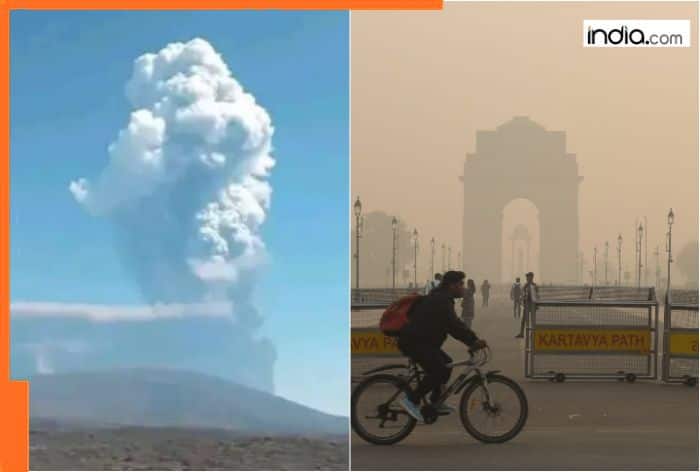
Ethiopia Volcano Eruption: Have you ever wondered what happens when a volcano that has been sleeping for thousands of years suddenly decides to wake up? Well, that’s exactly what happened last weekend in Ethiopia, and the effects reached all the way to India and beyond.
On Sunday, 23rd November, the Hayli Gubbi volcano in northeastern Ethiopia erupted for the first time in nearly 12,000 years. Just imagine that – this volcano had been quiet since the time when humans were just learning to farm and build settlements. What makes this eruption particularly fascinating is that it didn’t behave like the dramatic volcanic explosions we see in movies. There was no flowing lava or glowing magma rivers. Instead, the volcano released enormous amounts of gas and a massive cloud filled with tiny pieces of rock, glass, and dust that shot high into the sky in one powerful blast.
Now, you might be thinking, why should we in India care about a volcano erupting thousands of kilometers away in Ethiopia? The answer lies in how these volcanic materials travel. The eruption sent this huge plume of ash and gases shooting up to heights between 15 and 40 kilometers above the ground. At such heights, the air becomes incredibly hot and light, rising upward and carrying these tiny particles along with it. Once up there, strong air currents take over, pushing the cloud across continents like an invisible highway in the sky.
By Monday afternoon, 24th November, this volcanic cloud had already entered Indian airspace. The India Meteorological Department was monitoring its movement closely, initially predicting it would pass over India by Tuesday evening. However, the cloud moved faster than expected and had completely cleared Indian skies by 10:30 pm on Tuesday, heading toward China.
The real concern during those two days wasn’t about people on the ground breathing in volcanic ash. Since the plume was moving at such high altitudes, we were safe down here. The actual problem was for air travel. Most long-distance international flights cruise at heights between 10 and 14 kilometers, which is exactly where this volcanic cloud was drifting. Pilots faced reduced visibility, and more seriously, the tiny ash particles could enter airplane engines, melt inside due to the extreme heat, and cause dangerous malfunctions. This is why many flights were either rerouted or delayed as a safety precaution.
What’s truly remarkable about this eruption is how the tiny glass pieces formed. When the melted rock from deep inside the volcano was ejected into the air, it cooled down so rapidly that it didn’t have time to form proper crystals. Instead, it turned into natural glass, which then mixed with ash and dust to create this dangerous airborne cocktail. The heavier particles fell near the volcano itself, but the lightest ones traveled for thousands of kilometers.
Thankfully, volcanic plumes like this one are short-lived phenomena. Within just a few days, the particles spread out in all directions, mixing with larger volumes of air and becoming too thin to cause any harm. The gases released, mainly sulphur dioxide and carbon dioxide, can linger a bit longer in the atmosphere, but since these gases already exist naturally in our air, the extra amount from this particular eruption was too small to make any noticeable difference.
This entire episode reminds us how interconnected our world truly is. A volcano erupting on the coast of the Red Sea can affect flight schedules in Mumbai and Delhi within hours. It also shows us the importance of having global monitoring systems that track such natural events in real time and alert aviation authorities immediately.
For those of us who witnessed this event, it was a powerful reminder of nature’s unpredictable behavior and the invisible forces constantly shaping our planet. The Hayli Gubbi volcano’s awakening after 12,000 years may have caused temporary disruptions, but it also gave us a chance to appreciate the sophisticated systems we’ve developed to keep ourselves safe from nature’s occasional surprises.
(Girish Linganna is an award-winning science communicator and a Defence, Aerospace & Geopolitical Analyst. He is the Managing Director of ADD Engineering Components India Pvt. Ltd., a subsidiary of ADD Engineering GmbH, Germany.)


