










Bangladesh has outclassed its erstwhile oppressor, Pakistan, in being self-destructive. After derailing its economic progress and political stability in mid-2024, the country is witnessing a redux of Islamist mob violence, arson, vandalism and anti-India propaganda. The anti-India elements in Bangladesh have pinned the blame for the alleged “political assassination” of radical Islamist leader Sharif Osman Hadi on India.
Osman Hadi: The India-hating radical Islamist and his murder
Osman Hadi rose to prominence in the turbulent political landscape of Bangladesh as a vocal leader of the radical student protest group, Inqilab Mancha. This group emerged during the anti-Sheikh Hasina ‘uprising’ in 2024. Hadi’s ascent to popularity was largely driven by his senseless but fiery anti-India rhetoric. In the name of championing Bangladeshi sovereignty, Osman Hadi perpetually peddled anti-India narratives rooted in falsehoods and exaggerations rather than reality.
More recently, Osman Hadi accused India of meddling in Bangladesh’s internal affairs and backing the ousted Sheikh Hasina government. Hadi stretched this hatred against India to the extent that he made statements about “capturing” the Seven Sisters northeast states of India. Hadi’s rhetoric framed India, the liberator of Bangladesh, as an ‘aggressor’ intent on ‘undermining’ Bangladesh’s sovereignty and independence.
The 32-year-old Inqilab Mancha leader had recently shared maps of ‘Greater Bangladesh’ depicting India’s Bengal, Bihar and the entire North Eastern states as Bangladesh territory, and the entire Jammu and Kashmir and Punjab as Pakistani territory. While campaigning for the proposed February elections, Osman Hadi was shot in the head by unidentified assailants on 12th December in Dhaka. A week later, Hadi died while undergoing treatment at a hospital in Singapore.
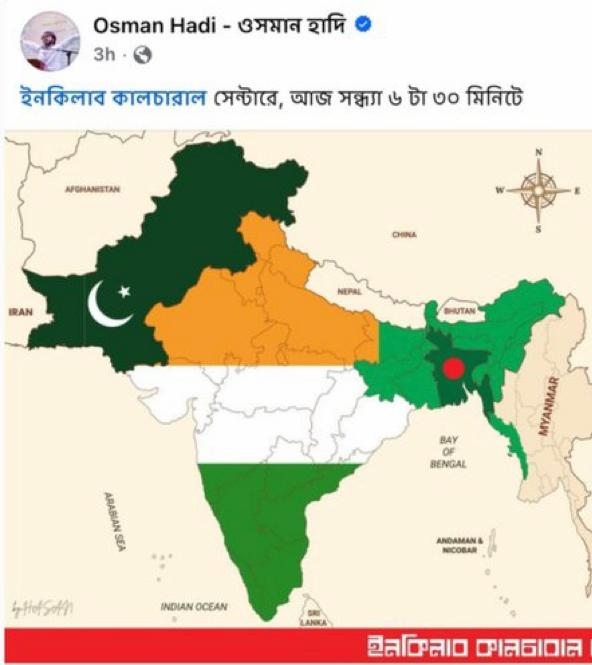
The timing of Hadi’s anti-India social media post and his assassination sparked speculations that somehow India was behind the radical Islamist’s killing; however, beyond the ‘timing’, there is no shred of evidence supporting this claim. It is suspected that Hadi was killed by local political rivals. However, Islamists and India detractors in Bangladesh do not need proofs; mere rumours and rhetoric are enough for them to hit the streets and wreak havoc in their own country.
Osman Hadi’s death triggers violence and anarchy in Bangladesh
Notably, Sharif Osman Bin Hadi was campaigning as an independent candidate ahead of the February 2026 elections. While the wounds of the August 2024 Islamist rampage are yet to heal, Hadi’s death has sparked a fresh wave of violence and anarchy across Bangladesh.
Calling Osman Hadi a ‘martyr’ of the July Uprising, his supporters across student groups and Islamist outfits have flooded the streets and carried out violence and arson in the garb of demanding justice for Hadi.
Hadi’s radical supporters, driven by mindless hatred against India, started attacking the offices of major newspapers, Prothom Alo and The Daily Star, accusing them of bias. On 18th December, the main office of Prothom Alo in Kawran Bazar in Dhaka was attacked by rioting mobs belonging to the Islamist outfit Inqilab Mancha. The mob, carrying sticks and rods, vandalised the office, breaking most of its window panes. Over 28 journalists and other staff members were trapped inside when the rioters set the Prothom Alo office building ablaze.
#WATCH | Bangladesh: Visuals of the aftermath from The Daily Star office in Dhaka, which was burned down by protesters.
After the death of Osman Hadi, a key leader in the protests against Sheikh Hasina, Bangladesh has erupted in unrest, and two newspaper offices have been set… pic.twitter.com/dpKn5h97fI
— ANI (@ANI) December 19, 2025
Similar events transpired at the nearby The Daily Star newspaper’s office, where around 25 journalists were rescued after being trapped in the office for over four hours. The anger of the radical mobs is such that even those attempting to calm them down peacefully are being attacked. Editors’ Council President and New Age Editor Nurul Kabir, along with photographer Shahidul Alam, came and attempted to calm the rioters down; they too were attacked and labelled by the mob as “Awami League agents”.
Editor of New Age Newspaper of Bangaldesh Nurul Kabir being attacked by mobsters. pic.twitter.com/gM0Bn7MJkz
— Aditya Raj Kaul (@AdityaRajKaul) December 18, 2025
Meanwhile, the ancestral residence of Bangladesh’s founding president, Sheikh Mujibur Rahman, in Dhanmondi, was vandalised by radical Islamist mobs again.
#BREAKING: Angry students set fire, vandalized Dhanmondi 32 in Dhaka. This is the ancestral place of Sheikh Mujibur Rehman. This location was attacked at least three times before and completely gutted and ransacked. Reports of attacks on Awami League offices across Bangladesh. pic.twitter.com/5uCxZcN02m
— Aditya Raj Kaul (@AdityaRajKaul) December 18, 2025
The radical Islamist mobs have also targeted India’s high commissions in Bangladesh. A group of anti-India protestors gathered outside the Indian Assistant High Commission in Bangladesh’s Chattogram after Osman Hadi’s death, to stage a sit-in protest. Earlier this week, anti-India protestors attempted to march towards Indian diplomatic missions in multiple cities to oppose the imaginary Indian ‘hegemony’.
Similar protests were staged in Dhaka, where a group under the “July Oikya” (July Unity) movement marched, demanding the extradition of deposed Prime Minister Sheikh Hasina, who fled to India in August 2024 following a mass ‘uprising’.
Disturbingly but unsurprisingly, Bangladeshi Hindus are also facing the brunt of Islamist ire. On 18th December, a Hindu youth, Dipu Chandra Das, was lynched by an Islamist mob over bogus allegations of blasphemy against Islam and Prophet Muhammad. After beating Das to death, the assailants tied his body to a tree and set it on fire, amidst slogans of “Nara-e-Takbir, Allahu Akbar”.
Gplus has continuously reported on how Bangladesh has witnessed unprecedented violence against the marginalised Hindu community following Sheikh Hasina’s forced ouster from power and her country. The opprobrious trend of Islamists targeting Hindus in the face of crisis and instability continues under the Yunus regime unchecked.
Even on 19th December, anti-India protestors are carrying out a ‘long march to border’ with India in Benapole near the Indo-Bangladesh border. On the other side is Petrapole in India’s West Bengal.
Reports say that Islamist outfit Hefazat-e-Islam and some Islamist student groups, alongside Inqilab Mancha, are behind the anti-India protests. Gplus has reported earlier that Hefazat-e-Islam is a platform of mainly teachers and students of non-government or “kawmi” madarsas or religious seminaries in Bangladesh, and it is considered an influential pressure group. The radical Islamist outfit has been demanding the strict implementation of Islamic laws in Bangladesh. This outfit was also involved in Islamist violence during PM Modi’s two-day Bangladesh visit in 2021.
Did India orchestrate Osman Hadi’s killing, or is the Yunus regime exploiting the radical Islamist’s murder for its own ambitions?
The Yunus-led interim government and its Islamist supporters have consistently and mindlessly blamed India for a wide array of Bangladesh’s self-inflicted woes. Osman Hadi’s killing is no different. While the Yunus regime has expressed solidarity with Hadi’s family and assured justice after a thorough investigation, its Islamist supporters have already declared India the culprit.
On 14th December, the Yunus administration claimed that Osman Hadi’s killers had crossed into India. The Bangladeshi interim government even summoned the Indian ambassador, asking India to arrest and hand over Hadi’s killers. This fuelled the already simmering suspicion that India, or somehow those linked with India, were behind Hadi’s assassination.
However, the Yunus regime made a villain out of India by peddling lies even as the Dhaka Metropolitan Police stated that there is no evidence that Hadi’s killers had crossed into India.
“There is no verified evidence that the attackers… have crossed into India”, Dhaka-based TV channel Jagonews24 quoted the DMP as saying.
Deputy Commissioner of the DMP Muhammad Talebur Rahman said that the police have no confirmed information that any of the suspected killers have left Bangladesh.
It must be noted that local Islamist activists, along with anti-India propaganda portals, have been making unfounded claims that Osman Hadi’s attackers, including one from the banned Awami League’s student wing Chhatra Shibir, crossed into India and are staying in Assam’s Guwahati.
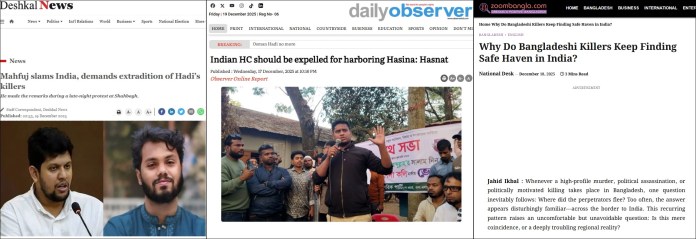
First, the Yunus regime involved India’s name in Osman Hadi’s killing, summoned the Indian Ambassador to send out a message to his Islamist and anti-India support base that the unelected regime was taking a strong stand against India, when India responded strictly through diplomatic channels, Yunus delivered a message to his nation seeking time to complete the investigation.
Yunus regime has a set pattern: Blame India for everything
This, however, has been Muhammad Yunus’s pattern: Point fingers at India, accuse India of attempting destabilisation of Bangladesh, and cry hoarse when called out. Yunus’ regime is doing what Pakistani governments have been doing for decades: blame India for their own failures, deflect attention from domestic issues by painting India as a bigger threat, gain public support by posing as defenders of the nation against the ‘India threat’, and continue to rule the ruins.
By villainising India, the Yunus regime wants to consolidate power and rally nationalist sentiments. It is a clear indication that Muhammad Yunus wants to either delay elections by stirring prolonged unrest or wants to ensure that whenever elections are held, Islamist political outfits come to power.
Dissecting Muhammad Yunus’s sinister modus operandi, a Bangladeshi professor, Rezwana Snigdha, told BBC Bangla in an interview that the Yunus regime conveniently points fingers at India for every unpleasant incident in Bangladesh to hide its own failures, including the attack on Osman Hadi.
Interestingly, several Bangladeshi political analysts and minority rights activists have repeatedly been insisting that Muhammad Yunus wants the elections not to happen or at least wants them to be delayed. Earlier this month, Gplus spoke to Dipan Mitra, the President of the Bureau of Human Rights and Justice (BHRJ), who said that Yunus is “totally aligned with Islamist groups to target Hindus. I don’t think he will even let the elections take place next year. Even if he does, he would make sure the Jamaat-e-Islami and its allies come to power. He wants to make Bangladesh an Islamic country.”
He added that after banning Sheikh Hasina’s Awami League from partaking in the coming elections next year, the interim government’s advisor is also trying to eliminate the Bangladesh Nationalist Party (BNP) from the race for power.
Not to forget, under Yunus’s watch, the outlawed anti-India and hardcore Islamist outfit Jamaat-e-Islami was unbanned, Islamist leaders were released from jail, while the crackdown on Awami League leaders intensified.
Ever since Muhammad Yunus assumed office as the Chief Advisor to the interim government in Bangladesh, he has consistently and in the most senseless fashion been blaming India for every unpleasant incident unfolding in the country. First, Yunus dismissed the anti-Hindu pogrom orchestrated by Islamists as political retribution and not religiously-motivated attacks and accused the Indian media of doing propaganda. Then, Muhammad Yunus villainised Prime Minister Narendra Modi and the Indian government for deteriorating India-Bangladesh ties over the latter’s decision to grant refuge to Sheikh Hasina.
Further, without taking India’s name, Yunus claimed that ‘big countries’ are not liking Bangladesh’s post-Hasina ‘freedom’, in the presence of leaders of different political parties, including Jamaat-e-Islami, the BNP (Bangladesh Nationalist Party) headed by former prime minister Khaleda Zia, and left-leaning outfits.
In May this year, Muhammad Yunus reportedly threw tantrums, saying that he would resign. He whipped up anti-India sentiments in the country to distract the public from his incompetence and failure to restore democracy and electoral reforms in Bangladesh. Through one of his stooges, Mahmudur Rahman Manna (Nagorik Oikya party President), Yunus sent out a message that Bangladesh was faced with a ‘major crisis due to Indian hegemony’. It is seen how the current anti-India protestors are claiming to put up resistance to ‘Indian hegemony’.
Gplus reported earlier how Yunus first attempted to ban the export of Hilsa fish to India but it was in vain. He then strategically downplayed the crucial role played by India in the 1971 Bangladesh Liberation War by distorting textbooks. With the tacit support of the Yunus regime, Islamist political and student leaders have continuously been spewing anti-India vitriol and threatening to severe India’s Seven Sister states and merge them into Bangladesh.
Sarjis Alam, a so-called ‘student activist’, issued veiled threats to Indian Prime Minister Modi. And yet again, Yunus maintained strategic silence. His own ‘adviser’, Mahfuz Alam, threatened to annex parts of India.
Former Director General of the Border Guard Bangladesh (BGB), A.L.M. Fazlur Rahman, had also threatened to occupy the 7 States of North-East India in case of war with Pakistan. He is a close aide of Muhammad Yunus.
Border Guard Bangladesh (BGB) commander Lt. Col Golam Kibria also issued threats to India’s Border Security Force (BSF). The interim government maintained stoic silence yet again.
Yunus went on a trip to China and urged the expansionist nation to use the 7 sisters of India as an extension of its economy.
Earlier this year, it was reported that during the floods and economic downturns, the Yunus regime accused India of water aggression through upstream dams, even as meteorological evidence pointed to natural causes. Even the incidents of Bangladeshi youth expressing discontent over delayed reforms by the Yunus regime were dismissed as India’s attempt to destabilise the interim government.
While Muhammad Yunus makes it seem that he is not power hungry or interested in delaying elections, his “Shuru majboori mein kiye they, ab maza aa raha hai (started out of necessity, but now enjoying it) mindset is reflected in his attempts at sidelining Bangladeshi President Mohammed Shahabuddin. Earlier in December 2025, Shahbuddin revealed how the interim administration, headed by Muhammad Yunus, degraded him. Shahabuddin mentioned that Yunus had not seen him in almost seven months. Moreover, his photos were pulled out of Bangladeshi embassies all around the world in September, and his press department was also shut down.
Yunus’s modus operandi is quite clear: tighten grip over power, legitimise and empower anti-India and Islamist elements and villainise India on hand, and stir chaos, blame it on India and posit own regime as a force resisting Indian ‘hegemony’. Apparently, for Muhammad Yunus, a known deep-state asset, chaos is a ladder, and he wants to use this ladder to further postpone elections. The Hadi assassination episode can be used by the Yunus regime as a justification to cause further delays in conducting elections, arguing that stability must precede elections to ensure their credibility.
Mohibul Hasan Chowdhary, a former Education Minister in the Hasina Government, has also asserted that Muhammad Yunus is deliberately inciting violence to postpone elections indefinitely. Speaking with ANI, Hasan stated that the attack on the residence ofthe Indian Deputy High Commissioner was “pre-planned” and “state-sponsored” to incite India.
He said that Muhammad Yunus plans to use Hadi’s political assassination to mobilise Islamic extremist elements and sympathetic political groups to engineer nationwide unrest in Bangladesh.
“Sharif Osman Hadi was a firebrand fanatic who openly called for blood. According to information available in the media, he was gunned down by someone close to him, a member of his own armed group,” Chowdhury said.
“The primary objective is to delay the elections they themselves keep talking about. The second objective is to eliminate grassroots political workers who are still active inside the country,” the former minister added.
Regarding why out of nowhere Indian High Commissions were targeted, Hasan said that the idea behind invoking India’s name was to internationalise the crisis. He added that this entire agitation is manufactured by ministers in the Yunus regime, saying that everyone was silent until Yunus’s ministers began calling for blood.
Gplus earlier analysed Muhammad Yunus’s meticulous attempts at delaying elections. In July 2024, Muhammad Yunus wanted a ‘fresh election’ when Sheikh Hasina was in power. In October, months after Hasina was forcibly removed from power, Yunus refused to put a ‘time frame’ on conducting elections. By December 2024, as Yunus faced public pressure to announce election dates, he vowed to hold elections in late 2025 or early 2026.
In March 2025, as pressure mounted, Yunus pushed the election process to next year. In May 2025, Yunus delayed the election until June 2026; however, he later said that elections would be held in February 2026. This came amidst rising frustration among the Bangladeshi populace and politicians. However, as the election time is nearing, Muhammad Yunus is quite shrewdly stirring nationwide unrest. The timing and the tactic can’t be more telling.
Going by the pattern of persistent provocation by the Yunus regime, it seems that Muhammad Yunus wants to flare things up to a point where India has to resort to a kinetic response to Bangladesh’s anti-India activities, which can then be used as a vindication of the Yunus regime’s months-long peddle-hate-against-India project, and justification to postpone elections. The question lingers: Is Muhammad Yunus trying to become South Asia’s Zelenskyy?
India responding militarily to the Yunus regime’s political game to cling to power will be a historic blunder. India has been Bangladesh’s liberator against the Pakistani oppressive forces, while Bangladesh under Yunus is becoming everything its Islamist oppressor was. India will not and should not become what it defeated in 1971. However, Yunus’s audacious attempt at using India as a scapegoat for his political ambitions cannot go unanswered.


