










Delhi air quality slipped into the ‘severe’ category on Saturday.
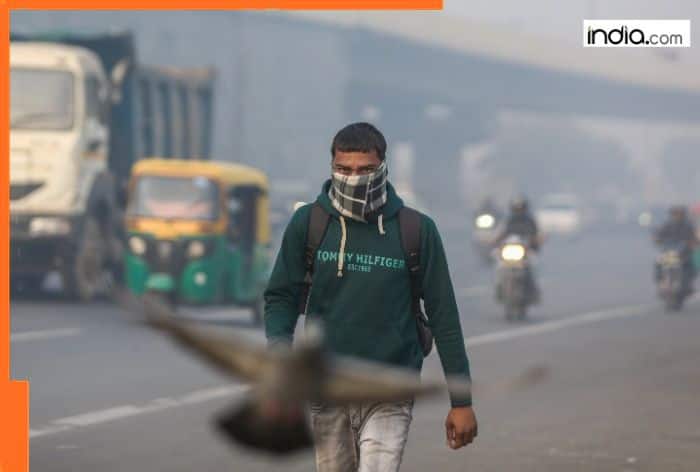
Delhi Air Quality update: The air quality in Delhi witnessed a significant decline on Saturday with the city’s average 24-hour AQI plummeting to 431, in the ‘severe’ category, prompting the Commission for Air Quality Management (CAQM) to invoke GRAP-3 restrictions to curb pollution levels in the national capital.
Delhi air quality turns hazardous
According to Central Pollution Control Board (CPCB) data, Delhi logged a 24-hour average AQI of 431 at 4 pm as the city’s air quality deteriorated further, slipping from the “very poor” to the “severe” category.
An AQI between 0 and 50 is considered ‘good’, 51 and 100 ‘satisfactory’, 101 and 200 ‘moderate’, 201 and 300 ‘poor’, 301 and 400 ‘very poor’ and 401 and 500 ‘severe’, as per CPCB standards.
In a statement, CAQM said Delhi’s air quality witnessed a sharp decline owing to slow wind speed, stable atmosphere, unfavourable weather parameters and meteorological conditions and lack of dispersal of pollutants”.

On Friday, Delhi had recorded an average AQI of 332, with 30 of the city’s 40 monitoring stations logging AQI levels in the ‘very poor’ bracket, while Jahangirpuri was sole station to breach the 400-mark, recording an AQI of 405, in the ‘severe’ category.
GRAP-3 curbs invoked in Delhi
Meanwhile, CAQM said it has decided to invoke GRAP-3 curbs in Delhi “due to the prevailing trend of air quality, and to further prevent deterioration in the region”.
“The CAQM GRAP Sub-Committee on Saturday took the call to invoke all actions under Stage-III of the Graded Response Action Plan (GRAP) ‘Severe’ Air Quality with immediate effect in the NCR,” it said adding that these restrictions are in addition to the actions under Stages I and II of GRAP already in force in NCR.
What restrictions are imposed under GRAP-3?
GRAP-3 restrictions are imposed in the Delhi-NCR region when air quality deteriorates to the ‘very poor’ category or beyond. Under Stage 3 of GRAP, all non-essential construction work is banned, while schools are required to shift classes up to grade V to hybrid mode, and parents and students have the option to choose online education wherever available, and offices may operate with 50 percent staff in Delhi-NCR.
GRAP-III restricts the use of BS-III petrol and BS-IV diesel cars (4-wheelers) in Delhi and nearby NCR districts. However, persons with disabilities are exempt from these restrictions.
During winters, the Delhi-NCR region enforces restrictions under GRAP, which categorises air quality into four stages — Stage I (Poor, AQI 201-300), Stage II (Very Poor, AQI 301-400), Stage III (Severe, AQI 401-450), and Stage IV (Severe Plus, AQI above 450).
Unfavourable meteorological conditions, combined with vehicle emissions, paddy-straw burning, firecrackers and other local pollution sources, lead to hazardous air quality levels in Delhi-NCR during winters.
Delhi doctors flag rise in respiratory ailments
Meanwhile, doctors have flagged a significant increase in respiratory ailments due to high pollution levels in Delhi, stating that hospitals in the city are witnessing a 20-30 per cent spike in respiratory patients, including many first-time cases and young adults.
According to doctors, Delhi’s severe pollution crisis has emerged as a serious public health risk rather than a seasonal inconvenience, which has resulted in a sharp increase in patients with respiratory distress, chest tightness and persistent cough.
They said that the number of people affected by poor air quality is steadily increasing as pollution levels in Delhi worsen each year, noting that outpatient departments and emergency rooms have recorded a 20-30 per cent increase in patients presenting with acute and subacute respiratory symptoms over the past few weeks, coinciding with the prolonged high pollution levels.


