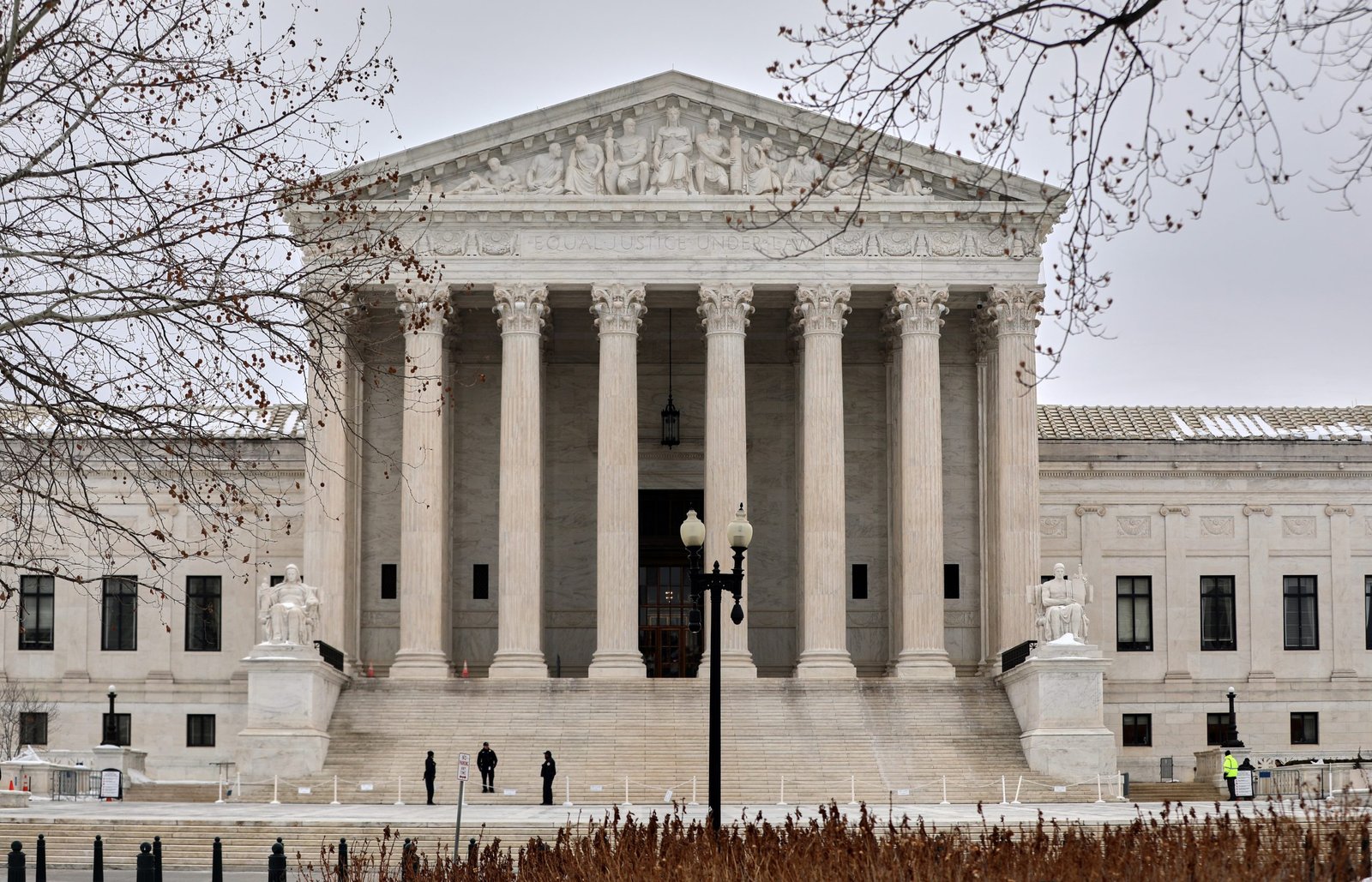
WASHINGTON – The U.S. Supreme Court’s new session began this week and the justices have already decided to hear a number of landmark cases.
Those include one that will decide whether the Constitution guarantees the right to possess AR-15s and other semiautomatic rifles and another that will rule on the constitutionality of the Trump administration’s immigrant detention policy.
But among the cases the high court has rejected is a Minnesota challenge to the Indian Child Welfare Act.
That law was approved in 1978 as an attempt to remedy what Congress called a disgraceful history in which hundreds of thousands of Native American children were removed from their homes by adoption agencies and placed with white families or Indian boarding schools.
The law requires states to give preference to Native American families and Native tribes when it comes to the adoption of Native American children. A state law, called the Minnesota Indian Family Preservation Act, also gives tribal family members placement preferences.
But these laws were challenged by a white couple that fostered Red Lake Nation twins when they were 4 months old because their mother had tested positive for methamphetamines and other drugs. The couple cared for the twins for more than a year.
Then the couple sought to retain custody of the twins after they were placed with relatives.
But they lost in court because the Indian Child Welfare Act and the state law prioritized tribal members and family for foster care placements – and adoptions – over non-Native caregivers.
The Supreme Court’s decision not to hear the case, N.R. et al. v. Keith M. Ellison, leaves the lower court rulings in place.
It was celebrated by state Sen. Mary Kunesh, DFL-New Brighton, a Standing Rock Lakota descendant, who said in a statement that the high court’s decision to not consider the challenge “is an important affirmation of Tribal sovereignty, family integrity and the protections Native children deserve.”
She added: “By declining to hear this challenge, the Supreme Court has allowed Minnesota’s decisions to stand and recognized the importance of keeping Native children connected to their families, Tribes, cultures, and communities.”
The Supreme Court has considered this issue before. In 2023, it decided on a 7-2 vote against a challenge to the Indian Child Welfare Act brought by several white couples, including one from the Twin Cities that sought to adopt Native American children.
Writing for the majority, Justice Amy Coney Barrett said that, although states are primarily responsible for adoptions, “Congress’s power to legislate with respect to Indians is well established and broad.”
“Family law is no exception,” she wrote.
Rife with fraud?
Taking a page from the White House, Minnesota’s Republican members of the U.S. House this week cast doubt on the integrity of the midterm elections.
The lawmakers wrote Gov. Tim Walz and Secretary of State Steve Simon a letter demanding more security for the Nov. 3 general election.
Why? Because the Justice Department announced last week that a federal grand jury indicted 10 people for voter fraud because they allegedly made false claims of citizenship to vote in Minnesota’s elections.
“These recent indictments are proof of what commonsense Minnesotans have known all along: Minnesota’s elections are rife with fraud,” Rep. Tom Emmer, R-6th District, said in a statement. “One noncitizen voting is one too many. It’s simple: only citizens should vote in our elections …”
The letter, also signed by Reps. Brad Finstad, R-1st District; Michelle Fischbach, R-7th District; and Pete Stauber, R-8th District, also said Minnesota “has some of the most lenient voting policies in the country” and that Simon had failed to do his job.
A main complaint concerns “vouching,” a process that has been in place in Minnesota for more than 50 years that allows a registered voter from the same precinct to accompany a potential voter to a polling place and sign an oath confirming that person’s address.
Simon had a terse response to the DOJ’s charges. In a statement, he pointed out that the 10 individuals accused of unlawfully voting in the 2022 and 2024 general election and the 2026 primary did so as 8.5 million ballots were cast in those elections. He said the “indictments affirm the fact that noncitizen voting is a vanishingly rare crime.”
“Only United States citizens are eligible to vote in Minnesota elections,” Simon said. “Throughout the process of registering to vote and voting, every voter affirms their eligibility multiple times under penalty of law. Violation of that law is a felony. When that law is violated, offenders must face justice, and our office will cooperate in any investigation.”
President Donald Trump, who maintains the 2020 presidential election was “rigged” against him, has an obsession about non-citizen voting, suspects fraud in voting by mail and will not drop the notion that voting machines had been tampered with to give former President Joe Biden illegal votes.
In other news:
▪️Associate editor Gregg Aamot, who wrote a book 20 years ago chronicling the cultural challenges of Minnesota’s newest residents, revisited some of those he spoke with to find out how things look for the state’s immigrants now.
▪️Metro reporter Trevor Mitchell writes that even as Minneapolis Mayor Jacob Frey boasts of the city’s investment in affordable housing, that program will likely take a hit.
▪️State government reporter Matthew Blake and Greater Minnesota reporter Brian Arola wrote about a state Senate seat in the Moorhead area that both the DFL and GOP have identified as one of a handful of toss-up races that will determine control of the Senate.
▪️And another story about a political campaign, this one a congressional race, describes the hurdles Democrat Trina Swanson faces in her quest to unseat Republican U.S. Rep. Pete Stauber.
Please keep your comments, and any questions, coming. I’ll try my best to respond. I can be reached at aradelat@minnpost.com.
The post D.C. Memo: High court won’t hear Native American adoption case appeared first on MinnPost.
Leave a Reply