










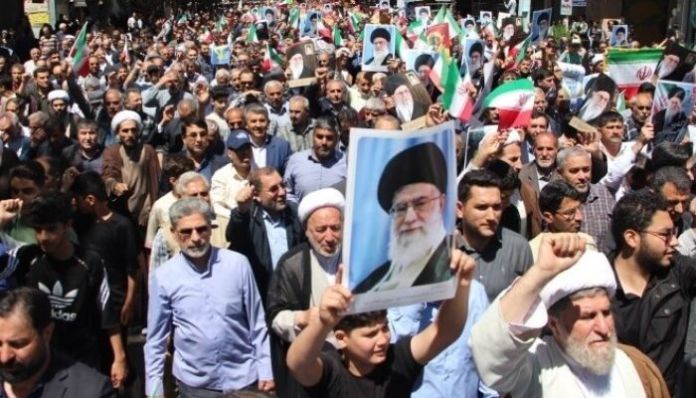
Iran is witnessing one of its most intense waves of unrest in nearly three years, with protests spreading rapidly across cities and provinces. Videos circulating on social media show massive crowds chanting anti-regime slogans, clashing with security forces, and targeting symbols of state authority. One widely shared clip shows one of Iran’s largest mosques engulfed in flames, becoming a powerful symbol of public anger.
With the internet down and phone lines cut off, gauging the demonstrations from abroad has grown more difficult. According to a report by CNN, US-based Human Rights Activists News Agecy claimed that the death toll in the protests has grown to at least 72 people killed and over 2,300 others detained. Iranian state TV is reporting on security force casualties while portraying control over the nation.
The protests reportedly began on 3rd January, triggered by rising prices, unemployment, and economic hardship. However, the anger quickly moved beyond economic issues. Protesters are openly calling for an end to Iran’s clerical system that has ruled the country since the 1979 Islamic Revolution. Slogans demanding regime change have been heard across Tehran, Mashhad, Isfahan, Shiraz, and smaller towns as well.
The exiled son of Iran’s last shah, Reza Pahlavi, who has emerged as a prominent voice in the fragmented opposition, made his strongest call yet for the protests to broaden into a revolt to topple the clerical rulers. “Our goal is no longer just to take to the streets. The goal is to prepare to seize and hold city centres,” he said in a video message on social media.
Iranian rights activist Masih Alinejad shared the mosque video on X, calling the unrest “47 years of rage.” According to her, religious institutions have long been used as tools of repression, not faith. The message resonated widely among protesters who see the regime as disconnected from everyday life.
One of Iran’s biggest mosques burned during uprising.
— Masih Alinejad
Don’t panic. This isn’t chaos.
It’s 47 years of rage.
For 47 years, after every Allahu Akbar from these minarets, innocent Iranians were executed by an Islamist regime. pic.twitter.com/oHtMpPjHQA(@AlinejadMasih) January 10, 2026
According to the Institute for the Study of War, at least 116 protests across 22 provinces have been recorded since 8th January. In response, the Iranian government has imposed a near-total internet shutdown to stop coordination and prevent images from reaching the outside world.
MORE: @criticalthreats and ISW have recorded 116 protests across 22 provinces since 3:30 PM ET on January 8. Twenty of these protests were large protests, which CTP-ISW defines as protests with more than 1,000 participants. CTP-ISW’s protest data since its last data cutoff likely… https://t.co/twjrrmP046 pic.twitter.com/4eFZgEGq9W
— Institute for the Study of War (@TheStudyofWar) January 10, 2026
Iranian security forces dig in
As protests intensified, Iran’s Army and the Islamic Revolutionary Guard Corps (IRGC) moved quickly to assert control. In statements broadcast on state television, both institutions declared security a “red line” and warned that continued unrest would not be tolerated.
The IRGC claimed that “terrorist groups” backed by foreign powers were attacking military and police installations. It said several security personnel and civilians had been killed, and public property had been damaged over the last two nights. The Army echoed this message, pledging to protect strategic infrastructure and accusing enemies such as Israel and unnamed hostile groups of exploiting unrest.
Supreme Leader Ayatollah Ali Khamenei has urged Trump to “focus on his own country” and blamed the US for inciting the protests. According to him, the aim was not reform but destabilisation and regime change.
Why Tehran says the protests are US-backed
Iran’s Supreme Leader has made it clear that it sees the unrest as part of a larger Western plan. This view gained traction after strong statements from Washington.
US President Donald Trump openly warned Iranian authorities against using force on protesters. “Iran’s in big trouble,” Trump said on Saturday, 9th January, claiming people were taking over cities “nobody thought possible.” His warning was blunt: “You better not start shooting, because we’ll start shooting too.”
Soon after, US Secretary of State Marco Rubio declared American support for Iranian protesters, saying, “The United States supports the brave people of Iran.” For Tehran, this removed any doubt that Washington was backing the unrest.
The United States supports the brave people of Iran
— Marco Rubio (@marcorubio) January 10, 2026
From Iran’s perspective, this fits a familiar pattern. The US has long sought regime change in Tehran and has never hidden its preference for a pro-Western government, similar to the Shah’s rule before 1979. Iranian leaders argue that social media amplification, sanctions pressure, and diplomatic threats are all part of a coordinated strategy to weaken the regime from within.
Trump’s bigger goal: Regime change in Iran
Trump’s statements suggest that the unrest is not just a humanitarian concern for Washington but an opportunity. The US has never accepted Iran’s current political system and sees the protests as a chance to reset the country’s leadership.
The memory of the Shah looms large here. Mohammad Reza Pahlavi ruled Iran as a Western-backed monarch until he was overthrown in the 1979 revolution. His regime was closely aligned with US interests, particularly in oil, security, and regional politics. Trump has repeatedly hinted that a return to such alignment would be beneficial for the US.
This is why Iranian leaders believe the protests are not spontaneous but encouraged and sustained by external forces. Whether or not this is fully true, the perception itself is shaping Iran’s response.
Why a US-aligned Iran is bad news for India
If Iran tilts back towards Washington, India stands to lose far more than it gains. The most immediate damage would be felt in Afghanistan, where India’s strategic space has already shrunk since the Taliban takeover in 2021.
Chabahar, India’s gateway at risk: Iran maintains control over the strategic Chabahar Port, and it is the only overland trade route for India to reach Afghanistan directly in the west without relying on Pakistan. India has also spent billions of dollars in Chabahar over the years to extend their assistance and reach Afghanistan and Central Asia.
A US-aligned Tehran could restrict India’s use of Chabahar under American pressure. This would choke India’s ability to send supplies to Afghanistan, forcing New Delhi to rely on costly airlifts or, worse, Pakistan-controlled routes.
Iran-Pakistan coordination against Indian interests: Iran and Pakistan share a common 900-kilometre border. If Iran tilts towards Washington and Islamabad, a possible Iran-Pak border cooperation mechanism could hinder Afghan resupply routes to anti-Taliban forces, such as the National Resistance Front, supported by the Indians.
Pakistan has long sought to eliminate India’s influence in Afghanistan. With Iran’s cooperation, Islamabad could isolate northern Afghan regions where India once had strong ties.
Trade corridors hijacked: The Chabahar route connecting India’s International North-South Transport Corridor through Iran to Central Asia and Russia may also be upstaged. A US-tilted Iran might divert the trade through Pakistan’s Gwadar port and the China-Pakistan Economic Corridor at the expense of India, increasing costs for Indian projects in the region.
Afghanistan: India’s biggest strategic vulnerability
Afghanistan has always been India’s bridge to Central Asia and a counterweight to Pakistan’s regional ambitions. After the Taliban returned to power in 2021, India lost its physical presence and much of its influence overnight.
A hostile alignment involving the US, Pakistan, and a compliant Iran would further squeeze India out of Afghanistan. This would not only limit India’s diplomatic reach but also reduce its ability to shape regional security outcomes.
Shah was a Western-backed ruler with a pro-Pakistan stance
There is a growing narrative that portrays the Shah of Iran as a heroic, stable ruler who kept Iran prosperous. For India, this is a dangerous myth.
The Shah was firmly aligned with the West and Pakistan. During the 1965 and 1971 wars, Iran openly backed Pakistan. It supplied arms, oil, aircraft, and ammunition, even acting as an intermediary to source weapons when Pakistan faced shortages.
In the 1971 war, Iran provided Pakistan with 12 helicopters and military equipment like artillery, ammunition and spare parts. Iran also provided Pakistan with oil during the war at cheaper rates, according to a Foreign Relations Of The United States document.
Since the 1971 Indo-Pakistani War, there have been reports that Iran may again act as an arms purchasing agent for Islamabad if Pakistan cannot obtain Western military equipment and spare parts, according to the document.
It has to be remembered that both wars were thrust upon India by Pakistan’s actions.
The Shah once warned that Iran would not allow Pakistan to be weakened and compared Iran and Pakistan to “one soul in two bodies.” India, despite its civilisational ties with Iran, found itself on the opposite side of Tehran’s strategic calculations.
“Iran has no aggressive intentions, but it will not accept any attempt to liquidate Pakistan. The Power and India must be fully aware of our resolution…. We do not want a new Vietnam on the frontier of Iran,” the Shah of Iran, Mohammad Reza Pahlavi, said during Pakistan’s war with India.
This history shows that a Western-backed Iran does not automatically align with Indian interests.
Next possible scenarios
One scenario is that the protests are crushed. While this would stabilise Iran internally, it would increase tensions with the US and could lead to more sanctions. India would be forced to balance relations carefully, especially on energy imports.
A second scenario is regime change or a weakened clerical system that leans towards Washington. This would likely strengthen Pakistan’s hand in Afghanistan and reduce India’s access to Iran and Central Asia.
A third scenario is prolonged instability. This would disrupt oil markets, affect global prices, and hurt India’s energy security while creating regional uncertainty.
Conclusion: US wins are not automatically India’s wins
The unrest in Iran highlights a hard truth for India: American strategic victories in the region do not always benefit New Delhi. While Washington speaks of democracy and freedom, democracy is invoked selectively, used as a weapon against adversaries. It continues to pressure India over Russian oil purchases and threatens sanctions.
Trump’s administration has slapped a 25% tariff on Indian imports for purchasing Russian oil, in addition to the 25% general import tariff already in place, effectively doubling duties to 50% in August. The move has strained US-India trade relations and put ongoing negotiations for a free trade agreement on hold.
At the same time, the US has a long history of siding with Pakistan when it suits its interests. A US-backed political shift in Iran could once again reshape the region in ways that marginalise India.
For New Delhi, the lesson is clear. Strategic autonomy matters. India must prepare for multiple outcomes in Iran and Afghanistan, without assuming that Western intervention will align with Indian interests.


