This came down Friday after Elon Musk basically was exiting from government. And this is part of sort of that idea of DOGE trying to cement these effects after he’s gone. It’s important.
I read through these, and these changes would have major cultural and workplace place effects in them. So let’s look through them in multiple ways. First of all, these new federal hiring rules would mean that agencies could no longer collect or give out data on the race or gender of the work force. They would be encouraged, in fact, told they should recruit from state schools, religious schools, religious groups, the military, and also some other groups like 4-H that are thought to be more rural around the country.
Now, instead of filling out the question as it is now, applications, would have to fill out four short essays. Two of those would have to deal with the Constitution, but one, every applicant would have to answer a question about how they would comply and support President Trump’s executive orders.
Finally, for senior jobs, they are saying there will be a course given that you would have to pay for if you choose to sort of fast-track yourself to become a senior executive, and that course would train people on Trump’s executive orders. So, of course, there are Republicans who say, hey, this is great, government’s too elite as it is, we need to look at state schools and others.
But there are other people who say, no, this is politicizing the federal work force in a way that career servants should not be politicized. So it is something that’s happening now, and it’s something we need to watch carefully.
LOS ANGELES (AP) — Comic and actor Marc Maron said Monday that he’s ending his popular and influential podcast “WTF with Marc Maron” after nearly 16 years.
Maron said on a newly released episode that the last of the nearly 2,000 episodes he has hosted will be released later this year.
“Sixteen years we’ve been doing this, and we’ve decided that we had a great run,” Maron said. “Now, basically, it’s time, folks. It’s time. ‘WTF’ is coming to an end. It’s our decision. We’ll have our final episode sometime in the fall.”
The 61-year-old Maron said he and producing partner Brendan McDonald are “tired” and “burnt out” but “utterly satisfied with the work we’ve done.”
Maron was a veteran stand-up comic who had dabbled in radio when he started the show in 2009, at a time when stand-ups were trying out the form in big numbers, and many listeners still downloaded episodes on to iPods.
The show early on was often about Maron talking through his beefs with fellow comedians, but it soon stood out and became a widely heard and medium-defining show with its thoughtful, probing longform interviews of cultural figures.
It became a key stop on press tours for authors, actors and musicians and reached a peak when then-President Barack Obama visited Maron’s makeshift Los Angeles garage studio for an episode in 2015.
Maron used a simple interview style to get guests to share stories they’d rarely told elsewhere. Seeking to know the biggest influences on their lives and careers, Maron would ask, “Who are your guys?”
Other memorable episodes include a 2010 personal and emotional interview with Robin Williams that was re-posted and widely listened to after Williams’ death in 2014. The episode earned a place in the National Recording Registry at the Library of Congress.
Maron kept doing standup specials and expanded his acting career while the show aired, including a three-season run on the Netflix series “GLOW.”
The show’s guitar-rock theme song opened with a clip of Maron shouting, “Lock the gates!” in his role as a promoter in the film “Almost Famous.”
The solo episode openings became a confessional space for Maron where he talked about his life, relationships, years of doing stand-up comedy and struggles with drug addiction.
Maron gave tearful tribute to his girlfriend, director Lynn Shelton, in the episode after her death in 2020.
“People who listen to the podcast know me pretty well, and it’s all good. They have a relationship with me that’s one sided, but it’s real and I try to be as gracious about that as possible,” Maron told The Associated Press in 2019. “My particular little slice of the show business world is very me specific and it’s very personal and usually that’s a good thing. But I’ve had to learn how to balance how much of my life I reveal and what I keep to myself, and try to find a little space.”
Support PBS News Hour
Your donation makes a difference in these uncertain times.
BOULDER, Colo. (AP) — A man armed with a makeshift flamethrower and other incendiary devices launched a fiery attack on demonstrators in Colorado who were calling for the release of Israeli hostages in Gaza. Eight people were injured and the FBI described the violence Sunday as a “targeted terror attack.”
The suspect, identified by the FBI as 45-year-old Mohamed Sabry Soliman, yelled “Free Palestine,” according to Mark Michalek, the special agent in charge of the FBI’s Denver field office. Authorities believe Soliman acted alone.
How did the attack unfold?
A placard states the county courthouse is closed after an attack that injured multiple people in Boulder, Colorado. Photo by Mark Makela/Reuters
Authorities said the attacker targeted volunteers with Run for Their Lives, which organizes running and walking events to call for the immediate release of Israelis being held in Gaza. The hostages were captured by militants during an incursion into southern Israel in 2023 that precipitated the latest Israel-Hamas war.
The group had gathered at the Pearl Street pedestrian mall, a four-block area in downtown Boulder frequented by tourists and students.
Witnesses said the suspect first used the flame thrower, then threw two Molotov cocktails into the crowd. Soliman was arrested at the scene.
Video from the scene shows a shirtless Soliman shouting at onlookers while holding two clear bottles containing a transparent liquid. Another video shows a witness shouting: “He’s right there. He’s throwing Molotov cocktails,” as a police officer with his gun drawn advanced on the suspect.
An FBI affidavit shows that police found at least 14 more unlit Molotov cocktails at the scene.
One witness, Alex Osante, said Soliman appeared to catch himself on fire during the attack. A booking photo shows him with a bandage over one of his ears. Police said he was taken to the hospital after he was arrested but haven’t described his injuries.
What was his motive?
Witnesses said Soliman yelled “Free Palestine” as he launched the attack.
Once in custody, he told investigators “he wanted to kill all Zionist people and wished they were all dead,” that he specifically targeted the Run for Their Lives group and that he researched and planned the attack for more than a year, according to court documents.
“This act of terror is being investigated as an act of ideologically motivated violence based on the early information, the evidence, and witness accounts. We will speak clearly on these incidents when the facts warrant it,” FBI Deputy Director Dan Bongino said in a post on X.
The Israel-Hamas war has inflamed global tensions and contributed to a spike in antisemitic violence in the United States. A week earlier, two Israeli Embassy staffers were shot to death in Washington, D.C., by a man who yelled “I did it for Palestine, I did it for Gaza” as he was led away by police.
Who is Soliman and what charge does he face?
The Justice Department — which leads investigations into acts of violence driven by religious, racial or ethnic motivations — called the attack a “needless act of violence” and charged Soliman with a federal hate crime Monday morning.
The FBI affidavit said Soliman, of Colorado Springs, confessed to the attack and told police he would do it again.
Court records show he was scheduled to appear in state court in Boulder on Monday afternoon.
The Department of Homeland Security said Soliman filed for asylum in September 2022 and has been living in the U.S. illegally since his visa expired in February 2023.
Soliman also worked as an Uber driver and had passed the company’s eligibility requirements, which include a criminal background check, according to a spokesperson for Uber.
An online resume under Suliman’s name says he was employed by a Denver-area health care company working in accounting and inventory control, with prior employers listed as companies in Egypt. Soliman listed Al-Azhar University, a historic center for Islamic and Arabic learning located in Cairo, on the resume.
Who was injured?
The people injured in the Pearl Street attack range in age from 52 to 88. Their injuries — some serious and some minor — were consistent with reports of people being set on fire, Redfearn said.
Photos from the scene showed a burning woman lying on the ground in a fetal position and a man helping to put out the flames using a jug of water.
“The immense wave of positive messages we’ve received is another signal of the health and strong spirits of our community,” Rabbi Yisroel and Leah Wilhelm, directors of the Rohr Chabad House at the University of Colorado said in a statement. “We encourage everyone to respond energetically to this attack by celebrating Shavuot joyously, by attending the reading of the Ten Commandments, and by recommitting to the heritage and traditions we hold so dear.”
Rodriguez reported from San Francisco.
Support PBS News Hour
Your donation makes a difference in these uncertain times.
DAMASCUS (AP) — Trading resumed on the Damascus Securities Exchange on Monday after a six-month closure, as Syria ‘s new leaders attempt to shore up the country’s battered economy and begin rebuilding after nearly 14 years of civil war.
The stock exchange had closed during the chaotic days leading up to the ouster of former President Bashar Assad in a lightning rebel offensive.
Syrian Finance Minister Mohammed Yisr Barnieh, who attended the reopening, said it signals that the country’s economy is beginning to recover and that the stock exchange “will operate as a private company and serve as a genuine hub for Syria’s economic development, with a strong focus on digital,” state-run news agency SANA reported.
He said the country’s new leaders plan to “facilitate business operations and open doors to promising investment opportunities.”
The move to reopen comes as international restrictions on Syria’s financial systems begin to ease. The United States and Europe both last month announced the lifting of a wide raft of sanctions that had been slapped on Syria under the Assad dynasty’s rule.
Last week, Syria inked a power deal worth $7 billion with a consortium of Qatari, Turkish and U.S. companies for development of a 5,000-megawatt energy project to revitalize much of Syria’s war-battered electricity grid.
The consortium led by Qatar’s UCC Concession Investments — along with Power International USA and Turkey’s Kalyon GES Enerji Yatirimlari, Cengiz Enerji — will develop four combined-cycle gas turbines with a total generating capacity estimated at approximately 4,000 megawatts and a 1,000-megawatt solar power plant.
Support PBS News Hour
Your donation makes a difference in these uncertain times.
LONDON (AP) — The United Kingdom will build new nuclear-powered attack submarines, get its army ready to fight a war in Europe and become “a battle-ready, armor-clad nation,” Prime Minister Keir Starmer said Monday, part of a boost to military spending designed to send a message to Moscow — and Washington.
Starmer said Britain “cannot ignore the threat that Russia poses” as he pledged to undertake the most sweeping changes to British defenses since the collapse of the Soviet Union more than three decades ago.
“The threat we face is more serious, more immediate and more unpredictable than at any time since the Cold War,” Starmer told workers and journalists at a navy shipyard in Scotland.
A new era of threats
Like other NATO members, the U.K. has been reassessing its defense spending since Russia’s full-scale invasion of Ukraine in February 2022.
The government announced military plans in response to a strategic defense review commissioned by Starmer and led by George Robertson, a former U.K. defense secretary and NATO secretary general. It’s the first such review since 2021, and lands in a world shaken and transformed by Russia’s war in Ukraine, and by the reelection of President Donald Trump last year.
Months after Britain’s last major defense review was published, then-Prime Minister Boris Johnson said with confidence that the era of “fighting big tank battles on European landmass” are over. Three months later, Russian tanks rolled into Ukraine.
Starmer’s center-left Labour Party government says it will accept all 62 recommendations in the review, aiming to help the U.K. confront growing threats on land, air sea and in cyberspace.
Submarines and weapons
The measures include increasing production of submarines and weapons and “learning the lessons of Ukraine,” which has rapidly developed its drone technology to counter Moscow’s forces and even hit targets deep inside Russia.
The government said the U.K, will invest in innovation and establish a cyber command to counter “daily” Russia-linked attacks on Britain’s defenses.
Other measures include:
Building “up to 12” nuclear-powered, conventionally armed submarines under the AUKUS partnership with Australia and the U.S.
Investing 15 billion pounds ($20.3 billion) in Britain’s nuclear arsenal, which consists of missiles carried on a handful of submarines
Increasing Britain’s conventional weapons stockpiles with six new munitions factories and up to 7,000 U.K.-built long-range weapons
Developing new airborne and land drones as well as a “hybrid Navy” of autonomous vessels and crewed ships
Committing 1 billion pounds for U.K. air defenses
A home guard to protect critical national infrastructure as part of a “whole-of-society approach” to defense. It was quickly branded a “Dad’s Army,” after the World War II-set sitcom
Starmer said rearming would create a “defense dividend” of thousands of well-paid manufacturing jobs — a contrast to the post-Cold War “peace dividend” that saw Western nations channel money away from defense into other areas.
Deterring Russia comes at a cost
Defense Secretary John Healey said the changes would send “a message to Moscow,” and transform the country’s military following decades of retrenchment, though he said he does not expect the number of soldiers — currently at a two-century low of about 74,000 — to rise until the early 2030s.
Healey said plans for defense spending to hit 2.5% of national income by 2027 a year are “on track” and that there’s “no doubt” it will hit 3% before 2034.
But Starmer said the 3% goal is an “ambition,” rather than a firm promise, and it’s unclear where the cash-strapped Treasury will find the money. The government has already, contentiously, cut international aid spending to reach the 2.5% target.
James Cartlidge, defense spokesman for the main opposition Conservative Party, said “a defense review without the funding is an empty wish list.”
Even 3% falls short of what some leaders in NATO think is needed to deter Russia from future attacks on its neighbors. NATO chief Mark Rutte says leaders of the 32 member countries will debate a commitment to spend at least 3.5% of GDP on defense when they meet in the Netherlands this month.
Bolstering Europe’s defenses
It’s also a message to Trump that Europe is heeding his demand for NATO members to spend more on their own defense.
European countries, led by the U.K. and France, have scrambled to coordinate their defense posture as Trump transforms American foreign policy, seemingly sidelining Europe as he looks to end the war in Ukraine. Trump has long questioned the value of NATO and complained that the U.S. provides security to European countries that don’t pull their weight.
Starmer said his government would make “Britain’s biggest contribution to NATO since its creation.”
“We will never fight alone,” he said. “Our defense policy will always be NATO-first.”
Matthew Savill, director of military sciences at defense think tank RUSI, said the review set out “a vision … of what the armed forces should look like in future” but lacked key details.
“This is a statement of intent,” he said. “It’s not a road map.”
Support PBS News Hour
Your donation makes a difference in these uncertain times.
A surprise Ukrainian drone attack that targeted several Russian air bases hosting nuclear-capable strategic bombers was unprecedented in its scope and sophistication for the first time reached as far as Siberia in a heavy blow to the Russian military.
Ukraine said over 40 bombers, or about a third of Russia’s strategic bomber fleet, were damaged or destroyed Sunday, although Moscow said only several planes were struck. The conflicting claims couldn’t be independently verified and video of the assault posted on social media showed only a couple of bombers hit.
But the bold attack demonstrated Ukraine’s capability to hit high-value targets anywhere in Russia, dealing a humiliating blow to the Kremlin and inflicting significant losses to Moscow’s war machine.
While some Russian military bloggers compared it to another infamous Sunday surprise attack — that of Japan’s strike on the U.S. base at Pearl Harbor in 1941 — others rejected the analogy, arguing the actual damage was far less significant than Ukraine claimed.
A look at what warplanes were reported hit:
Russia’s bomber assets
For decades, long-range bombers have been part of the Soviet and Russian nuclear triad that also includes land-based intercontinental ballistic missiles and atomic-powered submarines carrying ICBMs. The strategic bombers have flown regular patrols around the globe showcasing Moscow’s nuclear might.
During the 3-year-old war in Ukraine, Russia has used the heavy planes to launch waves of cruise missile strikes across the country.
The Tupolev Tu-95, which was code named Bear by NATO, is a four-engine turboprop plane designed in the 1950s to rival the U.S. B-52 bomber. The aircraft has an intercontinental range and carries eight long-range cruise missiles that can be equipped with conventional or nuclear warheads.
Before Sunday, Russia was estimated to have a fleet of about 60 such aircraft.
The Tupolev Tu-22M is a twin-engine supersonic bomber designed in the 1970s that was code named Backfire by NATO. It has a shorter range compared with the Tu-95, but during U.S.-Soviet arms control talks in the 1970s, Washington insisted on counting them as part of the Soviet strategic nuclear arsenal because of their capability to reach the U.S. if refueled in flight.
The latest version of the plane, the Tu-22M3, carries Kh-22 cruise missiles that fly at more than three times the speed of sound. It dates to the 1970s, when it was designed by the Soviet Union to strike U.S. aircraft carriers. It packs a big punch, thanks to its supersonic speed and ability to carry 630 kilograms (nearly 1,400 pounds) of explosives, but its outdated guidance system could make it highly inaccurate against ground targets, raising the possibility of collateral damage.
Some Tu-22Ms were lost in previous Ukrainian attacks, and Russia was estimated to have between 50 and 60 Tu-22M3s in service before Sunday’s drone strike.
The production of the Tu-95 and the Tu-22M ended after the 1991 collapse of the USSR, meaning that any of them lost Sunday can’t be replaced.
Russia also has another type of strategic nuclear capable bomber, the supersonic Tu-160. Fewer than 20 of them are in service, and Russia has just begun production of its modernized version equipped with new engines and avionics.
Russia lost a significant part of its heavy bomber fleet in the attack “with no immediate ability to replace it,” said Douglas Barrie of the International Institute of Strategic Studies, noting that Moscow’s announced plan to develop the next generation strategic bomber is still in its early phase.
“Ironically this might give impetus to that program, because if if you want to keep your bomber fleet up to size, then you’re going to have to do something at some point,” he said.
The A-50, which Ukrainian officials also said was hit in the strikes, is an early warning and control aircraft similar to the U.S. AWACS planes used to coordinate aerial attacks. Only few such planes are in service with the Russian military, and any loss badly dents Russia’s military capability.
Relocating bombers and impromptu protection
Repeated Ukrainian strikes on the Engels air base, the main base for Russian nuclear capable strategic bombers near the Volga River city of Saratov, prompted Moscow to relocate the bombers to other bases farther from the conflict.
One of them was Olenya on the Arctic Kola Peninsula, from where Tu-95s have flown multiple missions to launch cruise missiles at Ukraine. Several bombers at Olenya apparently were hit by the Ukrainian drones Sunday, according to analysts studying satellite images before and after the strike.
Other drones targeted the Belaya air base in the Irkutsk region in eastern Siberia, destroying a few Tu-22M bombers, according to analysts.
Ukraine said 41 aircraft — Tu-95s, Tu-22Ms and A-50s — were damaged or destroyed Sunday. in the attack that it said was in the works for 18 months in which swarms of drones popped out of containers carried on trucks that were parked near four air bases.
U.S. Defense Secretary Pete Hegseth was briefed on the attack, which represented a level of sophistication that Washington had not seen before, a senior defense official said on the condition of anonymity to discuss sensitive matters.
The Russian Defense Ministry said the attack set several warplanes ablaze at air bases in the Irkutsk region in eastern Siberia and the Murmansk region in the north, but the fires were extinguished.
It said Ukraine also tried to strike two air bases in western Russia, as well as another one in the Amur region of Russia’s Far East, but those attacks were repelled.
The drone strikes produced an outcry from Russian military bloggers, who criticized the Defense Ministry for failing to learn from previous strikes and protect the bombers. Building shelters or hangars for such large planes is a daunting task, and the military has tried some impromptu solutions that were criticized as window dressing.
Satellite images have shown Tu-95s at various air bases covered by layers of old tires – a measure of dubious efficiency that has drawn mockery on social media.
Associated Press Pentagon correspondent Tara Copp and Emma Burrows in London contributed.
Support PBS News Hour
Your donation makes a difference in these uncertain times.
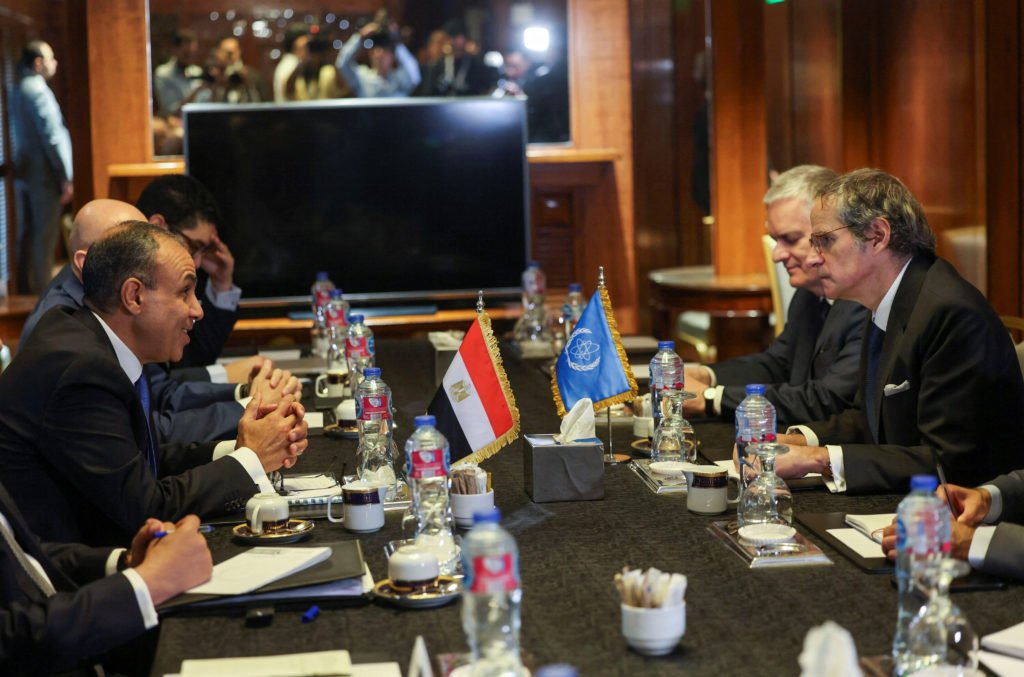
CAIRO (AP) — Iranian, Egyptian and U.N. leaders met in Cairo on Monday to discuss Iran’s nuclear program after the U.N. nuclear watchdog agency in a confidential report said Iran is further increasing its stockpile of uranium enriched to near weapons-grade levels.
The report emerged amid U.S.-Iran talks aimed at attempting to limit Iran’s nuclear program in exchange for lifting some of the crushing economic sanctions that the U.S. has imposed on the Islamic Republic, which have strained relations for almost 50 years.
Rafael Mariano Grossi, director-general of the Vienna-based International Atomic Energy Agency, said the agency compiled its report, seen by The Associated Press over the weekend, because Iranian’s uranium enrichment is an ongoing concern for the IAEA’s board of governors.
Grossi said they hoped the report would provide “an incentive for a peaceful solution and a diplomatic solution.”
Iranian Foreign Minister Abbas Araghchi met with Grossi as well as Egyptian President Abdel Fattah el-Sissi and Egyptian Foreign Minister Badr Abdelatty.
IAEA expresses ‘serious concern’
The confidential IAEA report raised a warning, saying Iran is now “the only non-nuclear-weapon state to produce such material,” something the agency said was of “serious concern.”
The IAEA report said that Iran, as of May 17, had amassed 408.6 kilograms (900.8 pounds) of uranium enriched up to 60%. That is an increase of almost 50% since the IAEA’s last report in February. The 60% enriched material is a short, technical step away from weapons-grade levels of 90%.
Iran’s leadership has said it believes the IAEA report is politically motivated by Grossi’s hopes of becoming the next U.N. secretary-general.
READ MORE: Iran increases stock of near weapons-grade uranium, UN nuclear agency says
Grossi is attempting to attract the votes of several members of the U.N. Security Council with the report, the head of Iran’s Atomic Energy Organization, Mohammad Eslami, told the official IRNA news agency late Sunday.
“He basically has chosen a political attitude, and this political attitude has led the environment to be more political rather that technical,” Eslami said.
Iranian deputy foreign minister Kazem Gharibabadi rejected many of the report’s findings. Gharibabadi noted on Sunday that out of the IAEA’s 682 inspections of 32 states, 493 were carried out in Iran alone.
“So long as a country’s nuclear activities are under the IAEA’s monitoring, there is no cause for concern,” he said. “The Islamic Republic of Iran is neither pursuing nuclear weapons nor does it possess any undeclared nuclear materials or activities.”
Questions about US transparency
Iran is concerned that the U.S. hasn’t provided enough transparency about what Iran can gain from the talks, Esmail Baghaei, Iran’s foreign ministry spokesperson, said on Monday.
“It must be crystal clear to us that how the unfair sanctions against the Iranian nation will be removed,” Baghaei said.
Omani Foreign Minister Badr al-Busaidi, who is mediating in the U.S.-Iran talks, visited Tehran on Saturday to present Washington’s latest proposal for ongoing discussions. The fifth round of talks between the U.S. and Iran concluded in Rome last week with “some but not conclusive progress,” al-Busaidi said at the time.
Araghchi said Monday that Iran will reply to the U.S. approach soon, but there will be no agreement unless Iran’s right to enrichment is respected.
“If the purpose of the talks is to attain trust that Islamic Republic of Iran will never go after nuclear weapons, I think an agreement is fully achievable,” Araghchi said. “But if there are unreasonable and unreal purposes, if the aim is depriving Iran from having peaceful activities, we will never accept any agreement.”
Lidman reported from Dubai, United Arab Emirates.
Support PBS News Hour
Your donation makes a difference in these uncertain times.
CAPE CANAVERAL, Fla. (AP) — It turns out that looming collision between our Milky Way and Andromeda galaxies might not happen after all.
Astronomers reported Monday that the probability of the two spiral galaxies colliding is less than previously thought, with a 50-50 chance within the next 10 billion years. That’s essentially a coin flip, but still better odds than previous estimates and farther out in time.
“As it stands, proclamations of the impending demise of our galaxy seem greatly exaggerated,” the Finnish-led team wrote in a study appearing in Nature Astronomy.
While good news for the Milky Way galaxy, the latest forecast may be moot for humanity.
“We likely won’t live to see the benefit,” lead author Till Sawala of the University of Helsinki said in an email.
Already more than 4.5 billion years old, the sun is on course to run out of energy and die in another 5 billion years or so, but not before becoming so big it will engulf Mercury, Venus and possibly Earth. Even if it doesn’t swallow Earth, the home planet will be left a burnt ball, its oceans long since boiled away.
Sawala’s international team relied on the latest observations by NASA’s Hubble Space Telescope and the European Space Agency’s Gaia star-surveying spacecraft to simulate the possible scenarios facing the Milky Way and next-door neighbor Andromeda. Both already collided with other galaxies in their ancient past and, according to many, seemed destined for a head-on crash.
WATCH: How a newly discovered galaxy could offer clues on how our Milky Way Galaxy formed
Past theories put a collision between the two — resulting in a new elliptical galaxy dubbed Milkomeda — as probable if not inevitable. Some predictions had that happening within 5 billion years, if not sooner.
For this new study, the scientists relied on updated galaxy measurements to factor in the gravitational pull on the Milky Way’s movement through the universe. They found that the effects of the neighboring Triangulum galaxy increased the likelihood of a merger between the Milky Way and Andromeda, while the Large Magellanic Cloud decreased those chances.
Despite lingering uncertainty over the position, motion and mass of all these galaxies, the scientists ended up with 50-50 odds of a collision within the next 10 billion years.
“The fate of our Milky Way galaxy is a subject of broad interest — not just to astronomers,” said Raja GuhaThakurta of the University of California, Santa Cruz, who was not involved in the study,
A full-on collision, he noted, would transform our home galaxy from a disk of stars seen as a milky band of diffuse light across the sky into a milky blob. A harmless flyby of the two galaxies could leave this stellar disk largely undisturbed, thus preserving our galaxy’s name.
More work is needed before the Milky Way’s fate can be predicted with accuracy, according to the researchers. Further insight should help scientists better understand what’s happening among galaxies even deeper in the cosmos.
While our galaxy’s fate remains highly uncertain, the sun’s future is “pretty much sealed,” according to Sawala. “Of course, there is also a very significant chance that humanity will bring an end to itself still much before that, without any need for astrophysical help.”
Support PBS News Hour
Your donation makes a difference in these uncertain times.
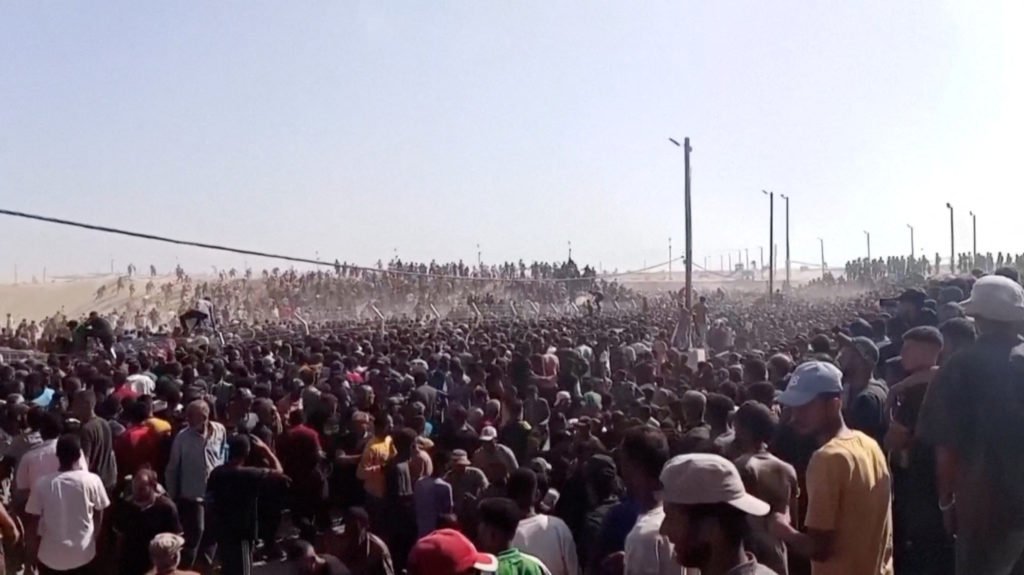
KHAN YOUNIS, Gaza Strip (AP) — Israeli forces in the Gaza Strip opened fire as people headed toward an aid distribution site a kilometer away at around sunrise on Monday, killing at least three people and wounding dozens, health officials and a witness said. The military said it fired warning shots at “suspects” who approached its forces.
The shooting occurred at the same location where witnesses say Israeli forces fired a day earlier on crowds of people heading toward the aid hub in southern Gaza run by the Israeli and U.S.-backed Gaza Humanitarian Foundation.
The Israeli military said it fired warning shots on Monday toward “several suspects who advanced toward the troops and posed a threat to them,” around a kilometer (1,000 yards) away from the aid distribution site at a time when it was closed. The army denied it was preventing people from reaching the site.
The United Nations and major aid groups have rejected the foundation’s new system for aid distribution. They say it violates humanitarian principles and cannot meet mounting needs in the territory of roughly 2 million people, where experts have warned of famine because of an Israeli blockade that was only slightly eased last month.
READ MORE: At least 31 Palestinians were killed heading to a Gaza aid site, witnesses say. Israel denies responsibility
In a separate incident Monday, an Israeli strike on a residential building in northern Gaza killed 14 people, according to health officials. The Shifa and al-Ahli hospitals confirmed the toll from the strike in the built-up Jabaliya refugee camp, saying five women and seven children were among those killed.
The military said it had struck “terror targets” across northern Gaza, without elaborating. Israel says it only targets militants and tries to avoid harming civilians. It blames civilian deaths on Hamas because the militant group is entrenched in populated areas.
Shooting in southern Gaza
A Red Cross field hospital received 50 wounded people, including two declared dead on arrival, after the shooting in southern Gaza, according to Hisham Mhanna, a Red Cross spokesperson. He said most had gunfire and shrapnel wounds. Nasser Hospital in the city of Khan Younis said it received a third body.
Moataz al-Feirani, 21, who was being treated at Nasser Hospital, said he was shot in his leg as he walked with a crowd of thousands toward the aid distribution site. He said Israeli forces opened fire as they neared the Flag Roundabout at around 5:30 a.m.
“We had had nothing, and they (military) were watching us,” he said, adding that drones were filming them.
On Sunday, at least 31 people were killed and over 170 wounded at the Flag Roundabout as large crowds headed toward the aid site, according to local health officials, aid groups and several eyewitnesses. The witnesses said Israeli forces opened fire on the crowds at around 3 a.m. after ordering them to disperse and come back when the distribution site opens.
Israel’s military on Sunday denied its forces fired at civilians near the aid site in the now mostly uninhabited southern city of Rafah, a military zone off limits to independent media. An Israeli military official, speaking on condition of anonymity in line with procedure, said troops fired warning shots at several suspects advancing toward them overnight.
The Gaza Humanitarian Foundation, which has denied previous accounts of chaos and gunfire around its sites, said it had delivered aid on both days without incident.
On Sunday night, the foundation issued a statement, saying aid recipients must stay on the designated route to reach the hub Monday, and that Israeli troops are positioned along the way to ensure their security. “Leaving the road is extremely dangerous,” the statement said.
‘Risking their lives for food’
Secretary-General Antonio Guterres said he was “appalled by the reports of Palestinians killed and injured while seeking aid in Gaza” on Sunday. “It is unacceptable that Palestinians are risking their lives for food.”
“I call for an immediate and independent investigation into these events and for perpetrators to be held accountable,” he said in a statement on Monday.
Israel and the United States say they helped establish the new aid system to circumvent Hamas, which they accuse of siphoning off assistance.
U.N. agencies deny there is any systemic diversion of aid and say the new system violates humanitarian principles by allowing Israel to control who receives aid and by forcing Palestinians to travel long distances to receive it.
Palestinians must pass close to Israeli forces and cross military lines to reach the GHF hubs, in contrast to the U.N. aid network, which delivers aid to where Palestinians are located.
No end in sight to Israel-Hamas war
The Israel-Hamas war began when Palestinian militants stormed into Israel on Oct. 7, 2023, killing some 1,200 people, mostly civilians, and abducting 251. Hamas is still holding 58 hostages, around a third of them believed to be alive, after most of the rest were released in ceasefire agreements or other deals.
Israel’s military campaign has killed over 54,000 Palestinians, mostly women and children, according to Gaza’s Health Ministry, which does not say how many of the dead were civilians or combatants. The ministry is led by medical professionals but reports to the Hamas-run government. Its toll is seen as generally reliable by U.N. agencies and independent experts, though Israel has challenged its numbers.
Hamas has said it will only release the remaining hostages in return for more Palestinian prisoners, a lasting ceasefire and an Israeli pullout.
Israel has vowed to continue the war until all the hostages are returned, and Hamas is defeated or disarmed and sent into exile. It has said it will maintain control of Gaza indefinitely and facilitate what it refers to as the voluntary emigration of much of its population.
Palestinians and most of the international community have rejected the resettlement plans, viewing them as forcible expulsion.
Shurafa reported from Deir al-Balah, Gaza Strip, and Magdy from Cairo.
Support PBS News Hour
Your donation makes a difference in these uncertain times.
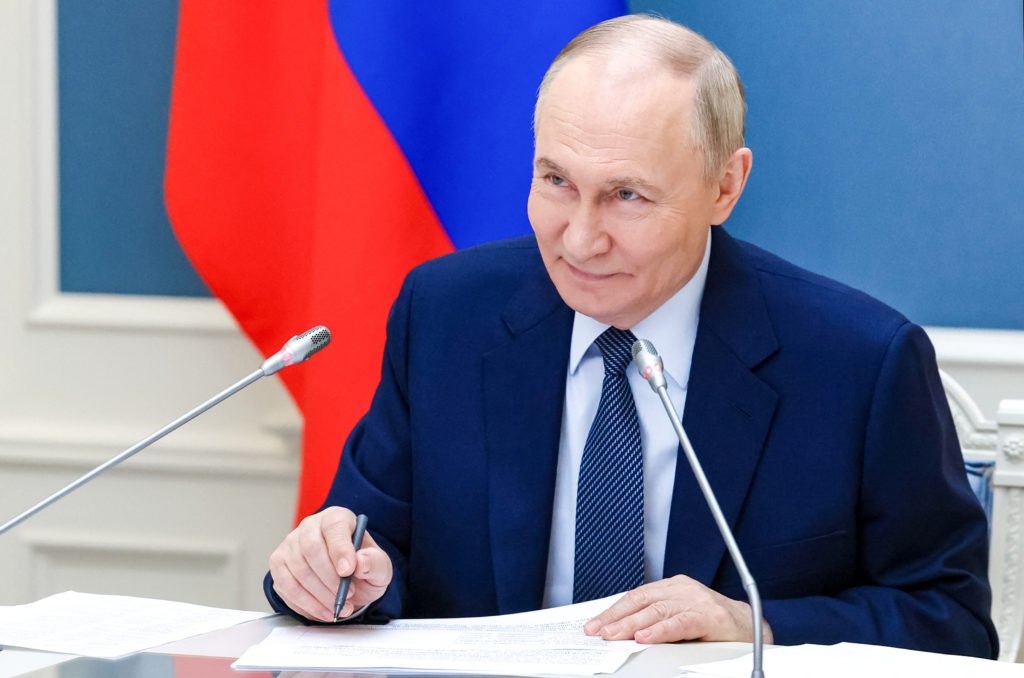
PARIS (AP) — Russian President Vladimir Putin is stalling at the peace table while preparing a new military offensive in Ukraine, two senior U.S. senators warned Sunday, arguing that the next two weeks could shape the future of a war that has already smashed cities, displaced millions and redrawn Europe’s security map.
Republican Sen. Lindsey Graham and Democratic Sen. Richard Blumenthal spoke to The Associated Press in Paris after meeting President Volodymyr Zelenskyy and touring neighborhoods shattered by what they called the worst Russian bombardments since the full-scale invasion began.
In Paris for talks with French President Emmanuel Macron — who they say is “100% aligned” with them on the war — the senators warned the window to prevent a renewed assault is closing.
A sweeping U.S. sanctions bill could be the West’s last chance to choke off the Kremlin’s war economy, they said — adding that they hope their firsthand findings will shift momentum in Washington and help bring a skeptical President Donald Trump on board.
“What I learned on this trip was he’s preparing for more war,” Graham said of Putin. Blumenthal called the sanctions proposed in legislation “bone-crushing” and said it would place Russia’s economy “on a trade island.”
“It is crunch time for Putin and for the world because Russia is mounting a new offensive,” he said.
At the heart of their push is a bipartisan sanctions bill, backed by nearly the entire U.S. Senate but still facing uncertain odds in Washington. It would impose 500% tariffs on countries that continue buying Russian oil, gas, uranium and other exports — targeting nations like China and India that account for roughly 70% of Russia’s energy trade and bankroll much of its war effort.
Graham called it “the most draconian bill I’ve ever seen in my life in the Senate.”
“The world has a lot of cards to play against Putin,” he said. “We’re going to hit China and India for propping up his war machine.”
Peace talks or stalling tactic?
With peace talks yielding little and Trump’s approach to Ukraine highly uncertain, Graham and Blumenthal have stepped into the breach — blunt emissaries on a lonely mission. Political opposites moving in lockstep, they’re crossing Europe, and the aisle, with the moral urgency of two men trying to forestall another Russian offensive before it’s too late.
Peace talks are scheduled to resume Monday in Istanbul. But Ukrainian officials say Moscow has yet to submit a serious proposal — a delay both senators described as deliberate and dangerous.
“Putin is playing President Trump,” Blumenthal said. “He’s taking him for a sucker.” The senator said Putin “is, in effect, stalling and stonewalling, prolonging the conversation so that he can mount this offensive and take control of more territory on the ground.”
READ MORE: Ukraine and Russia quickly end their latest round of direct peace talks in Istanbul
Graham added: “We saw credible evidence of a summer or early fall invasion, a new offensive by Putin. … He’s preparing for more war.”
Trump has yet to endorse the sanctions bill, telling reporters Friday: “I don’t know. I’ll have to see it.” Graham said the legislation was drafted in consultation with Trump’s advisers.
Graham backed the president’s diplomatic instincts but said, “By trying to engage Putin — by being friendly and enticing — it’s become painfully clear he’s not interested in ending this war.”
Blumenthal hoped the bipartisan support for Ukraine at least in the Senate — and the personal testimonies they plan to bring home to Congress and the Oval Office— may help shift the conversation.
“He needs to see and hear that message as well from us, from the American people,” he said of Putin.
A moral reckoning
In Kyiv, the senators said, the war’s human toll was impossible to ignore. Graham pointed to what Ukrainian officials and Yale researchers estimate are nearly 20,000 children forcibly deported to Russia — calling their return a matter of justice, not diplomacy.
Blumenthal described standing at mass grave sites in Bucha, where civilians were executed with shots to the head. The destruction, he said, and the stories of those who survived, made clear the stakes of delay. “Putin is a thug. He’s a murderer.”
Both said that failing to act now could pull the U.S. deeper into conflict later. If Putin isn’t stopped in Ukraine, Blumenthal said, NATO treaty obligations could one day compel American troops into battle.
They see resolve in Europe
After a one-hour meeting with Macron in Paris, both Graham, of South Carolina, and Blumenthal, of Connecticut, said they left convinced Europe was ready to toughen its stance.
“This visit has been a breakthrough moment because President Macron has shown moral clarity in his conversations with us,” Blumenthal said. “Today, he is 100% aligned with that message that we are taking back to Washington.”
Blumenthal pointed to the rare bipartisan unity behind the sanctions bill. “There are very few causes that will take 41 Republicans and 41 Democrats and put them on record on a single piece of legislation,” he said. “The cause of Ukraine is doing it.”
Ahead, Ukrainian military leaders are set to brief Congress and a sanctions vote could follow.
“President Trump said we’ll know in two weeks whether he’s being strung along,” Graham said. “There will be more evidence of that from Russia on Monday.”
Support PBS News Hour
Your donation makes a difference in these uncertain times.