The 2022 anti-Hindu Leicester violence orchestrated by Muslim mobs and the Islamo-leftist cabal’s propaganda campaign to paint Islamist perpetrators as victims of ‘Hindutva aggression’ have emboldened the Hinduphobic lot to continuously attack Hindus in the UK with impunity. In March 2026 alone, at least six incidents of Islamist attacks on Hindus and their businesses have been reported in Wembley.
A Somali Muslim gang attacked the Manek Chowk Restaurant
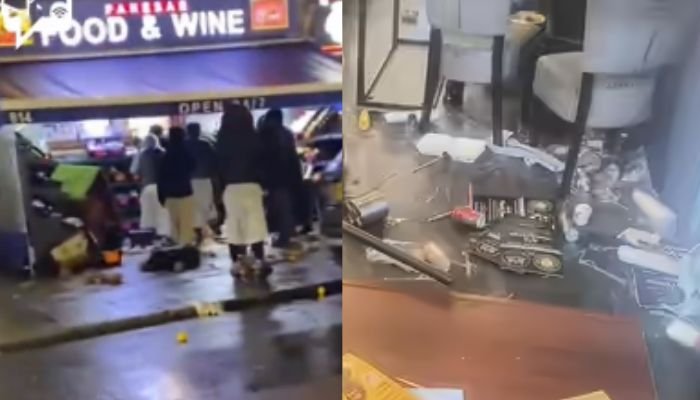
On 5th March, a gang comprising 15 to 20 masked men stormed an Indian restaurant named Manek Chowk Restaurant on Ealing Road in Wembley, smashing furniture, equipment, and windows after 8 pm. The attack was not preceded by any confrontation or provocation. The perpetrators were a gang of Somali Muslims. The visuals from the spot showed that the restaurant was badly damaged, with tables and chairs lying upside down, and food and crockery scattered.
As per a local PIO store owner, who saw the Muslim gang vandalise the Indian restaurant, said, “It started in Traders Wembley last Wednesday. Three men from Daman and Diu were beaten up in the toilets and left bleeding.”
Second attack on Manek Chowk Restaurant
In a second attack that reportedly occurred on 7th March, the same Somali Muslim gang attacked the Manek Chowk restaurant again. An eyewitness said that around 15 to 20 attackers came from the mosque side and ran riot. They were soon joined by a group of 10 to 12 youths who arrived in a bus, indicating that the attack on the Hindu Indian restaurant was preplanned. The Muslim gang vandalised restaurant furniture, damaged the cash counter, and also broke the lights.
Islamists hurl eggsat then Rangrez restaurant in Hammersmith over the Sikh owner’s strict ‘proudly non-Halal’ food serving policy.
The Rangrez restaurant, owned by Harman Singh Kapoor, was vandalised after closing hours when eggs were hurled at the premises on 7th March. Harman Singh Kapoor, who has faced constant backlash and attacks from Islamists for not serving Halal food, earlier this year announced plans to shut down the restaurant amidst Islamists threats and police negligence.
Last night’s inbreds struck back again. After I closed my restaurant, they pelted the shutter with halal eggs. Do whatever you want, but I’m not closing my restaurant and I’m not taking down the Non-Halal sign. pic.twitter.com/vapAeigUUY
Harman Singh Kapoor has been facing attacks from Khalistani and Pakistani Muslim gangs since 2023, when he posted a video on social media criticising the Khalistan movement, after which he and his family received death threats. Owner Harman Singh’s restaurant was attacked,d and he was pressured to chant “Khalistan Zindabad”. Back then, Harman Singh had alleged that despite providing CCTV footage and evidence to the London police, he was not provided adequate security, leaving his family living in constant fear.
Panesar Food & Wine Store in Wembley ransacked
On 6th March, the Panesar Food & Wine Store in Harrow Road, Wembley, came under attack, with masked men pulling fruit and vegetable boxes, throwing them down and trampling them. As per a local, “They destroy the places, video it and go. It looks like they.”
ANOTHER DAY IN LAWLESS LONDON
An Indian mini-market was attacked and ransacked by a group of Muslim men in Wembley, North West London.
It doesn’t appear that any arrests have been made.
In most of these cases, the police arrived at the spot only after the perpetrators wreaked havoc and fled the spot.
A Gujarati man was stabbed on Ealing Road
On the night of 9th March, The Times of India reports that a Gujarati-origin man was stabbed with a sharp weapon in Ealing Road after an altercation. The victim was required to be rushed to a hospital.
Hindus celebrating Holi were attacked by a Muslim mob near Harrow Civic Centre
On 3rd March 2026, a group of Muslim youths who reportedly came from a nearby mosque created unrest in the former Harrow Civic Centre parking lot in London, obstructing a Holi festival that was attended by hundreds of Hindus.
The video of the incident has gone viral on social media. The authorities have apprehended a 14-year-old regarding the attack on Hindus. The captured footage featured shoving and scuffing as tensions intensified between the attendees and the intruding group. The Muslim youths attacked Hindus when the celebration of Holika Dahan was taking place at the International Siddhashram Shakti Centre. As per an eyewitness, the Muslim perpetrators approached the Hindu event and started interrupting it by abusing Hindus and hurling trash cans.
As per a report by UK-based Hindu rights group INSIGHT UK, the Muslim attackers initially created a ruckus and left the scene, only to return with around 20 other Muslim jihadists and attack Hindus.
Islamists openly target Hindus while the UK authorities watch iin silencee
The recent attacks on Hindus, Sikhs, and their businesses in the UK are evidently isolated from a part of a continued Islamic hate campaign over the past couple of years, particularly since the 2022 anti-Hindu Leicester violence. The UK Police and the Labour government, who remained largely reluctant to act against Pakistani Muslim gangs due to the fear of appearing ‘Islamophobic’, often dismiss the incidents of Islamist attacks on Hindus as minor disputes, not treating them with the same seriousness as they do in cases involving Muslim ‘victims’.
Islamists street veto from one side and liberal propaganda machinery on the other: Hindus facing attacks after attacks in the UK while Labour prioritises not appearing ‘Islamophobic’
Over the years, the Islamo-leftist academic, activist, and media circles have been pushing a narrative painting Hindus and Hindutva as aggressors or sources of communal tensions in the UK to downplay, rather, whitewash Islamist violence against the Hindu community. Having a pliable government and law enforcement system as well as a propaganda machinery at their disposal, Islamists are openly and violently demonstrating their hatred for Hindus and Sikhs.
In Wembley, three Hindu men from Daman and Diu were attacked by Muslim men earlier this month. The attack came just days after a George Soros-funded SOAS-led Independent Commission of Inquiry report on the 2022 Leicester Violence, which villainised Daman and Diu-origin Hindus.
Even as it was Muslim leaders and Islamists like Majid Freeman who were found guilty of instigating violence against Hindus, the SOAS report claimed that Hindus from India’s Daman and Diu “were central actors in the events from May until September.”
Further villainising the Hindus, the SOAS report says, “They (Hindu Daman and Diu communities) were blamed for antisocial behaviour, unregulated religious celebrations, a culture of drinking, and harassment and provocations outside mosques.”
The report was published on 23rd February 2026, and just days after, a Muslim mob targeted and attacked three Hindu men from Daman and Diu. The dots are not too blurry to be connected. The Islamist-sympathising ‘activists’ are essentially the instigators and enablers of Islamist violence against the Hindu community in the UK. They are complicit in the Islamist anti-Hindu crimes.
Speaking at a press conference on the 10th day of U.S. and Israeli strikes on Iran, President Donald Trump evaded questions about whether the United States was at fault for a deadly Feb. 28 attack on an Iranian girls’ school.
WATCH: Trump sidesteps responsibility for deadly strike on Iranian girls’ school
Reporters pressed Trump twice about the strike, which video evidence shows was carried out by a Tomahawk cruise missile, an American-made weapon that can be launched from ships, submarines or ground launchers at targets 1,000 miles away.
Iranian media reported the air assault killed 175 people at the school, many of them children.
Trump twice declined to say that the U.S. had hit the Shajarah Tayyebeh elementary school, which was located near an Islamic Revolutionary Guards Corps facility. He instead raised the possibility that a Tomahawk could have been fired by another country, including Iran. Here’s the full exchange:
Reporter: “There’s footage that shows that an American missile strike and a Tomahawk missile likely destroyed that Iranian girls’ school. So … will the U.S. accept any responsibility for that strike?”
Trump: “Well, I haven’t seen it, and I will say that the Tomahawk, which is one of the most powerful weapons around is … sold and used by other countries. You know that. And whether it’s Iran, (which) also has some Tomahawks. They wish they had more. But whether it’s Iran or somebody else, the fact that a Tomahawk — a Tomahawk is very generic. It’s sold to other countries. But that’s being investigated right now.”
The exchange prompted a follow-up question.
Reporter: “Mr. President, you just suggested that Iran somehow got its hands on a Tomahawk and bombed its own elementary school on the first day of the war. But you’re the only person in your government saying this. Even your Defense secretary wouldn’t say that when he was asked standing over your shoulder on your plane on Saturday. Why are you the only person saying this?”
Trump: “Because I just don’t know enough about it. I think it’s something that I was told is under investigation, but Tomahawks are used by others, as you know. Numerous other nations have Tomahawks — they buy them from us. But … whatever the report shows, I’m willing to live with that report.”
Although a few countries other than the U.S. have Tomahawks, none of them is engaged in fighting Iran. Tomahawk cruise missiles are manufactured by Raytheon, a U.S. company, for use by the U.S. military and international partners.
“The only other countries using Tomahawks are Japan, the United Kingdom, Australia and the Netherlands,” said Mark F. Cancian, a senior adviser for the Center for Strategic and International Studies, a national security-focused think tank. “Iran has none, though it has lots of missiles of different kinds.”
Jeffrey Lewis, the director of the Middlebury Institute of International Studies’ East Asia nonproliferation program, agreed.
“Tehran does not have Tomahawks, and Iranian cruise missiles are visually distinct,” Lewis said.
N.R. Jenzen-Jones, director of the intelligence firm Armament Research Services, similarly told CNN that Iran does not have Tomahawk missiles like those seen in video of the strike.
Israel also isn’t known to have Tomahawks.
The White House did not respond to inquiries for this article.
WATCH: A look at evidence linking U.S. to Iranian school strike
In a March 10 floor speech, Senate Minority Leader Chuck Schumer, D-N.Y., criticized Trump’s assertion. “Iran doesn’t have Tomahawk missiles, Donald Trump,” Schumer said. “The claim is beyond asinine.”
Republican lawmakers expressed concern as well. Sen. Kevin Cramer, R-N.D., said the U.S. “ought to get to the bottom of it for sure. And admit if we know whose fault it is and do everything we can to eliminate those mistakes going forward.”
Officially, the incident remains under Pentagon investigation, as Defense Secretary Pete Hegseth said when asked on Air Force One about the strike March 7.
Analysts from the investigative group Bellingcat and The New York Times separately viewed footage and concluded that the weapon was a Tomahawk, which is about 20 feet long and has a wingspan of eight and a half feet.
Video released by the U.S. Central Command showed several Tomahawks being launched from Navy ships on Feb. 28, the day the school and nearby targets were hit.
Our ruling
Asked about evidence showing a Tomahawk missile hit an Iranian elementary school, Trump said Iran “also has some Tomahawks.”
Experts told PolitiFact that the only countries that have Tomahawks besides the U.S. are Japan, the United Kingdom, Australia and the Netherlands. Neither Iran nor Israel nor any combatant at that stage of the war is known to have Tomahawks, either, and the White House did not provide evidence to back up Trump’s statement.
We rate this claim False.
A free press is a cornerstone of a healthy democracy.
Amidst a raging war in Iran, several Indian students stuck there are appealing to the Modi government to bring them back home safely. At present, over 9,000 Indian nationals, mostly medical students from Jammu and Kashmir, are stranded in Iran’s capital, Tehran, and the city of Qom. Many stranded students are raising concerns that they are being told to travel to Armenia and then arrange flights to Delhi on their own. However, this situation would probably have never arisen had these students heeded repeated warnings and advisories issued by the Indian government urging them to leave Iran.
Multiple advisories, none heeded: Indian students in Iran ignored safety warnings
The videos and emotional appeals from Indian students stranded in Iran invoke a similar fear and panic here in India, as they might be experiencing while being stuck in a war-torn country. On 9th March, a ‘protest’ was staged in Srinagar, Jammu and Kashmir, by parents of several Indian students stranded in Iran. They requested Prime Minister Narendra Modi, the External Affairs minister, J&K LG and Chief Minister Omar Abdullah to intervene immediately to ensure the safe return of their children.
In a video message, one Kashmiri Indian student stranded in Iran said, “The situation is frightening. We are fine as of now, but we cannot be sure about our safety. Attacks are happening even at the places where students were relocated.”
One of the parents who participated in the protest in Srinagar said students have been advised by the Indian mission in Iran to stay wherever they are, or they can leave for the Armenia-Iran border at their own risk, after having pre-booked Armenia-Delhi flight tickets.
It is being made to seem as if the Modi government has gone the American way of leaving its nationals in conflict-torn countries on their own. Even students who were evacuated by the Indian embassy from the war epicentre in Iran on Indian taxpayers’ money are appealing to the Indian government to bring them back to India on an urgent basis, despite being aware that the airspace is closed. The body language, the level of entitlement, and the insinuation by several stranded Indian students that somehow the government is now doing ‘enough’ to repatriate them is enraging, to put it mildly.
These are the students who were evacuated by the Indian embassy from the war epicenter in Tehran to a safer city on taxpayers’ money.
And now they want India to evacuate them urgently to India, despite fully knowing that the airspace is closed.
It must not be forgotten how many Indian students in Iran were making videos dismissing concerns raised in India about their safety, and not taking the advisories seriously, until the sounds of American and Israeli missiles hitting civilian areas fell on their ears.
On January 14, 2026, India asked its nationals to leave Iran. Back then, Indian students insisted: “We’re safe, and the University is meeting our demands.”
Today, the same students are pleading with the Indian government to speed up evacuation.
Protests, requests, demands, and political blame-games, the situation would not have come to this if the students had gauged the seriousness of the prevailing tensions and the Indian government’s advisories issued weeks prior to the February 28 US-Israel attack on Iran.
The first advisory by the Indian Ministry of External Affairs was issued on 14th January 2026, when protests and the Iranian Mullah regime’s crackdown had begun to take a violent turn. Indian nationals were urged to defer all non-essential travel to Iran amidst escalating nationwide protests.
Advisory for Indian nationals regarding travel to Iran
This was followed by a stronger warning on 14th February, explicitly advising Indian nationals, including students, pilgrims, and traders, etc, to leave Iran by any available means. The Indian embassy also opened 24/7 helplines to assist Indians in Iran.
Just nine days later, on 23rd February, the MEA issued an advisory reiterating in starker terms the message to Indian nationals in Iran to leave the country at the earliest, terming the security environment there as deteriorating. The registration on the MEA’s portal for those still stuck in Iran was also mandated.
“In continuation of the advisory issued by the Government of India on 5 January 2026, and in view of the evolving situation in Iran, Indian nationals who are currently in Iran (students, pilgrims, business persons and tourists) are advised to leave Iran by available means of transport, including commercial flights. The 14 January 2026 Advisory is hereby reiterated that all Indian citizens and PIOs should exercise due caution, avoid areas of protests or demonstrations, stay in contact with the Indian Embassy in Iran and monitor local media for any developments,” the MEA said on 23rd February.
These were not vague suggestions or fearmongering. The MEA made clear and repeated calls to action based on real-time assessments of rising tensions, including the brewing Israel-Iran war.
Despite the advisories, Indian students chose to stay put. In fact, the MEA confirmed that even after a full-fledged war broke out, many students refused the Indian embassy’s offer for assistance.
This was confirmed by the MEA on 3rd March in a fresh advisory. “In view of the developing situation, all Indian nationals in Iran are advised to exercise utmost caution, avoid unnecessary movements and remain indoors as far as possible. Indians may also continue to monitor the news, maintain situational awareness and await any further guidance from the Embassy of India.
Due to heightened risk perception in Tehran, the Embassy of India has relocated most Indian students who were in Tehran to safer locations outside Tehran. The Embassy has made arrangements for their transportation, food, and accommodation. Only a small number of students who declined the Embassy’s offer remain in Tehran,” the Indian Embassy in Iran said, adding that while some left Iran via Armenia, many chose to stay back in the war-torn country.
The airspace is closed, the land borders are not safe, and practically no place in Iran is safe from American and Israeli airstrikes. Now, if something goes wrong with the stranded students who “chose” to stay back due to academic pressures of appearing for exams and fear of invalidation of their degree, general carelessness or whatever reason, the Indian government would get the blame. The government cannot send chartered flights to Tehran to bring Indians back home while Iranian skies are mired with Israeli missiles.
The awareness, the deliberate dismissal of the seriousness of the situation and the eventual entitlement-laden evacuation appeals when flights are cancelled, and airspace is closed, show that many, if not most, students prioritised their personal timelines and comfort over official warnings. They gambled on staying earlier but are now expecting a free pass. This entire episode comes across as a classic case of blaming the authorities for a self-inflicted predicament.
Given the Modi government’s commendable track record of evacuating Indian citizens from crisis-hit regions, the evacuation operations will continue to bring every stranded Indian back from Iran; however, the situation remains complicated due to constant attacks on Iran and the closure of air and sea routes.
WELLINGTON, New Zealand (AP) — Two more members of the Iranian women’s soccer team were granted asylum in Australia before their teammates departed, the country’s Home Affairs Minister Tony Burke said Wednesday.
The pair has been reunited with five players who were granted humanitarian visas a day earlier, Burke told reporters in Canberra on Wednesday. One of those in the later group was a player and the other a team staffer, Burke said, and both sought asylum before their teammates were transported to the airport.
READ MORE: 5 members of Iranian women’s soccer team granted asylum in Australia
The rest of the team’s departure from Sydney, Australia to return to Iran late Tuesday local time happened during fraught and outraged protest at the team’s hotel and at the airport, where Iranian Australians sought to prevent the women from leaving the country, citing fears for their safety in Iran.
Their flight departed late Tuesday.
Burke said that as the women passed through security at Australia’s border, they were each taken aside individually by Australian officials and interpreters, without minders present, and were made offers of asylum. Some called their families in Iran to discuss the offer, he added, but no further members of the delegation decided to remain in Australia.
“They were given a choice,” he said. “In that situation what we made sure of was that there was no rushing, there was no pressure.”
Those who have sought asylum received temporary humanitarian visas, which have a pathway to permanent residency in Australia, Burke said. He added that some members of the delegation were not offered asylum because they had connections to Iran’s paramilitary Revolutionary Guard.
The Iranian team arrived in Australia for the Women’s Asian Cup last month, before the Iran war began on Feb. 28. The team was knocked out of the tournament over the weekend and faced the prospect of returning to a country under bombardment.
Iranian groups in Australia had urged the government to prevent the women from leaving the country after the team drew widespread news coverage in Australia when players didn’t sing the Iranian anthem before their first match. The players didn’t speak publicly about their decision not to sing and later saluted and sang the anthem before their other games.
It was not clear exactly how many people were in the delegation, but an official squad list named 26 players, plus coaching and other staff.
Burke rejected suggestions that Australian officials should have done more to prevent the women’s departure.
“Australia’s objective here was not to force people to make a particular decision,” he said. “We’re not that sort of nation.”
The minister said he had viewed widely-published footage that appeared to show one of the women being lead by the hand from the team’s hotel on Queensland’s Gold Coast to their bus by her teammates. Whether that constituted coercion was a matter for local Australian police, Burke said.
The Iranian team became popular figures in Australia throughout the tournament. The premier football club in the city of Brisbane, the nearest major city to where the women were based for the tournament, posted to social media Wednesday inviting the women who had sought asylum in Australian to train with their club.
A free press is a cornerstone of a healthy democracy.
The Interior Ministry of Bahrain has said that the authorities have arrested five Pakistani nationals and one Bangladeshi national for allegedly filming and lauding missile and drone attacks by Iran. The action came after the video uploaded by the arrested accused went viral on social media.
The five Pakistani nationals include Afzal Khan, Mohammed Moaz Akbar, Ahmed Mumtaz, Arslan Ali Sajjad, and Abdul Rahman Abdul Sattar. The Bangladeshi national arrested by Bahraini authorities has been identified as Mohamed Israfel Meer.
#BREAKING: Bahrain has arrested 5 Pakistani nationals and 1 Bangladeshi national for filming and praising Iranian Missile and Drone attack on Bahrain, expressing sympathy with Iran’s aggression and spreading false information. pic.twitter.com/RVH46aIpvD
The accused were identified by the Anti-Cybercrime Directorate, which falls under the General Directorate of Anti-Corruption and Economic and Electronic Security, after they made videos of the attacks and shared them on social media, expressing sympathy for Iran and praising the attacks.
Officials said the social media post misled and alarmed the public, creating panic among them. Consequently, the Bahraini authorities swung into action and arrested the six accused persons.
Americans’ confidence that their elections will be run fairly has dropped to its lowest point in years, according to a new PBS News/NPR/Marist poll.
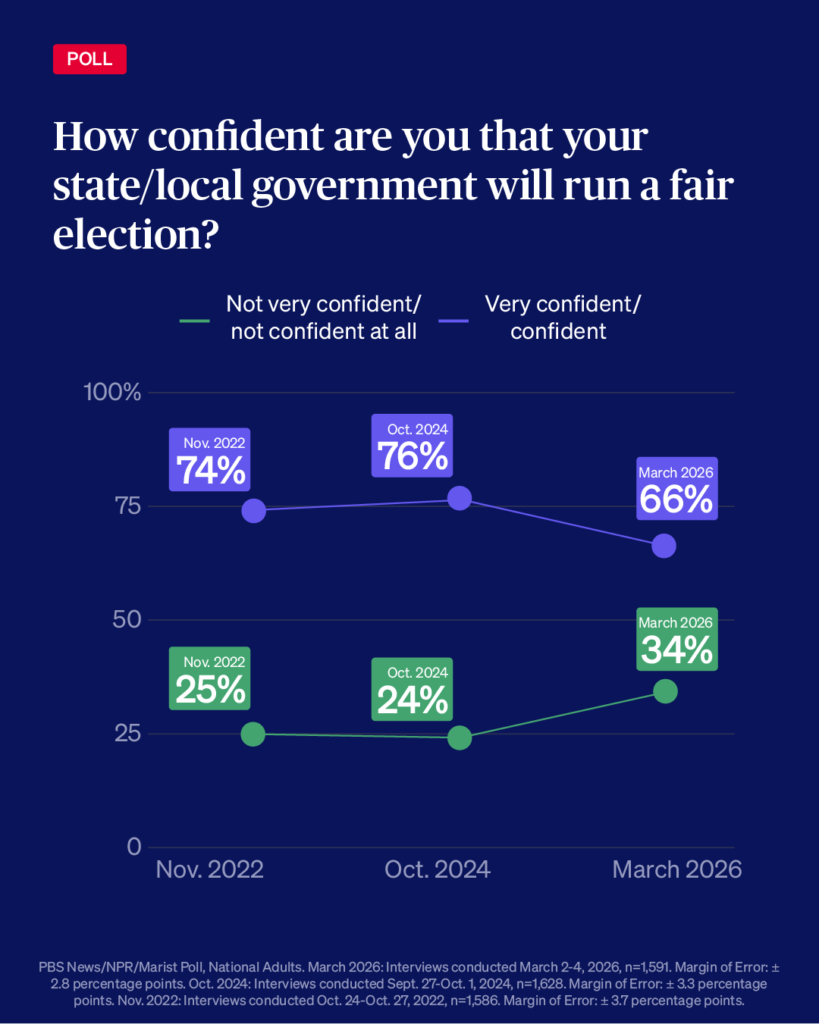
Ahead of a consequential midterm contest in November, two-thirds of Americans say they are confident their state or local government will run a fair and accurate election, a drop of 10 percentage points from the month before the 2024 presidential election. The percentage who expressed confidence is at the lowest it’s been since Marist first asked this question in 2020.
Two-thirds of Americans say they are confident their state or local government will run a fair and accurate election, according to the latest PBS News/NPR/Marist poll — a drop of 10 percentage points from the month before the 2024 presidential election. Graphic by Steff Staples/PBS News
The drop has been driven largely by Democrats and independents, whose confidence has dropped 16 and 11 percentage points respectively. Republicans, however, are 3 percentage points more confident in how elections will be run this November, within the poll’s margin of error.
The growing concern comes as President Donald Trump threatens to hold up all legislation until Congress passes a sweeping overall of federal voting rules, despite many states already holding primaries and actively preparing for the general election.
Speaking to House Republicans on Monday, Trump called the SAVE America Act, which already passed the House along party lines last month, his singular legislative priority right now. Among the bill’s components, the most controversial and complicated to implement is a requirement that Americans present proof of citizenship to register to vote in federal elections. The president claims it will prevent non-citizens from committing voter fraud – a very rare occurrence, according to experts – and that the legislation has overwhelming support from voters.
“It’ll guarantee the midterms,” Trump said. “If you don’t get it, big trouble.”
One third of Americans say voter fraud is the single biggest threat to keeping elections safe and accurate, according to the new poll. But the public’s anxieties about voting are more complicated and more divided than the president would suggest.
Another 26% cite misleading information as the biggest threat, while 24% say voter suppression. Foreign interference was named by just 8 percent, despite a recent renewed assertion from Trump, as part of his shifting justification for strikes on Iran, that Tehran tried to meddle in recent presidential elections.
Broken down by party, Republicans were most likely – at 57% – to say voter fraud is the biggest threat. Among Democrats, 41% point to voter suppression; about a third of independents are most worried about misleading information.
Overall, voter fraud and voter suppression concerns have risen 9 points and 8 points respectively since January 2020, suggesting ongoing messaging from Republican and Democratic officials have increased those fears among their base voters.
“It’s the politicians driving the cart,” said Lee Miringoff, director of the Marist Institute for Public Opinion. “It’s not being determined by court cases. It’s not been determined by evidence. It’s being shaped by a sense that the other guy’s up to no good.”
Support for voter access
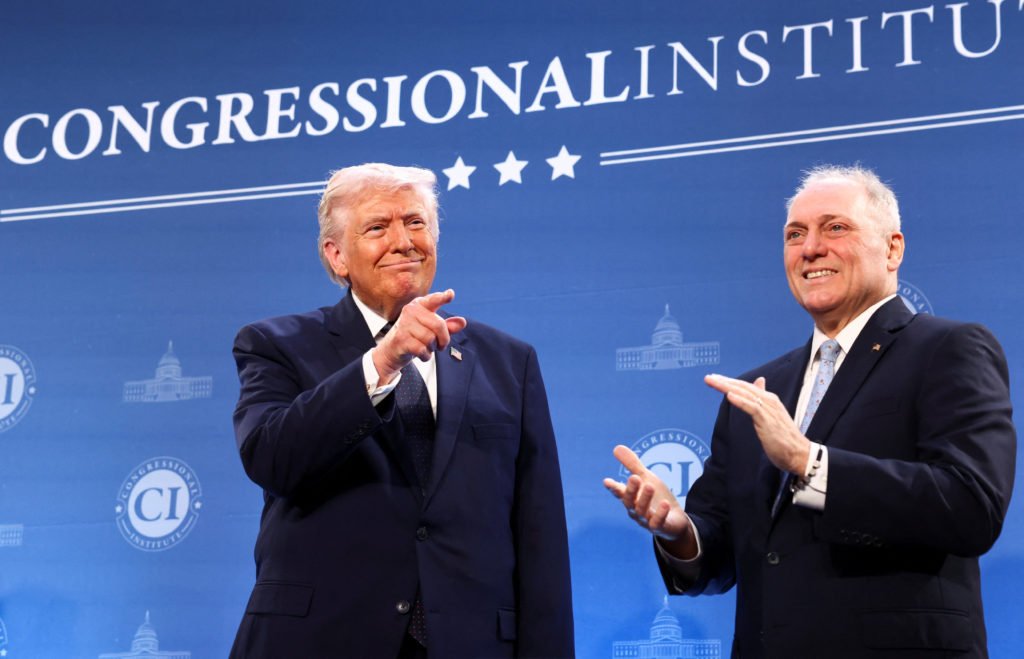
President Donald Trump gestures from the stage next to U.S. Rep. Steve Scalise, R-La., on March 9 at Trump National Doral Miami in Miami, Florida. The public’s anxieties about voting are more complicated and more divided than the president would suggest. Photo by Kevin Lamarque/Reuters
While Trump has said the SAVE America Act is an “88% issue with ALL VOTERS,” this latest survey finds Americans are more conflicted about the competing issues of voter access and preventing ineligible votes from being cast.
Nearly 6 in 10 respondents say it is more important to make sure everyone who wants to vote can do so; 41% say their bigger concern is making sure no one votes who is not eligible. The divide has remained relatively stable since 2021. Independents are 7 percentage points more likely in this poll to prioritize voter access.
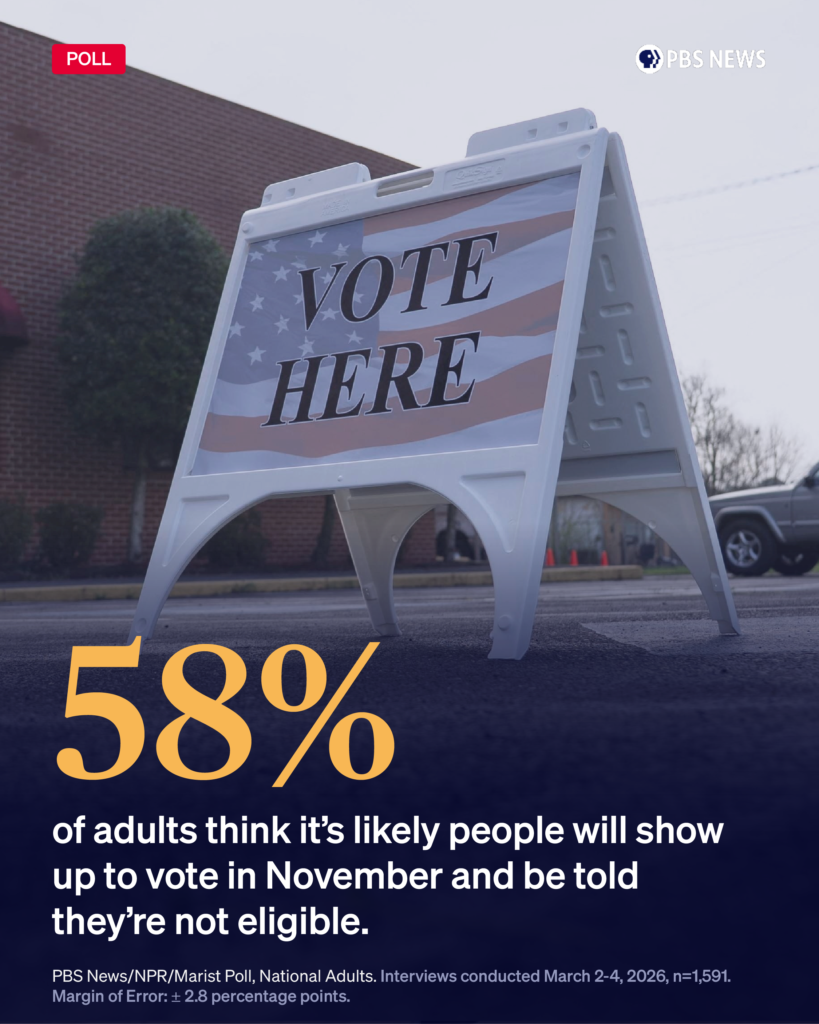
According to this latest poll, 58% of Americans are concerned that people will show up to the polls in November only to be told they are not eligible, a striking 16 percentage point jump from January 2020. Democrats are driving that concern: nearly three-quarters are worried. Among Republicans and Independents, 47% share that view.
According to the latest PBS News/NPR/Marist poll, 58% of Americans are concerned that people will show up to the polls in November only to be told they are not eligible, a striking 16 percentage point jump from January 2020. Graphic by Dan Cooney/PBS News
The poll also reveals a sharp disparity between younger and older voters. Three-quarters of Americans under 30 years old are concerned about voters being told they are not eligible; while just 43% of Americans 60 years old and above share the concern.
It is already illegal for noncitizens to vote in federal elections. Rick Hasen, director of the Safeguarding Democracy Project at UCLA School of Law, said documented cases of noncitizen voter fraud are extremely rare.
“In 2016, when Donald Trump claimed there were three million noncitizens who voted, it turned out there were 30 possible cases that were documented in the entire country. That’s a miniscule amount,” Hasen said. “We just do not see large hordes of noncitizens voting in the way that Donald Trump routinely describes it.”
David Becker, the executive director of the nonpartisan Center for Election Innovation & Research, said the administration’s own record undermines its case that voters should be concerned about ineligible voters participating in elections.
“This administration has gone out hunting for fraud with all of the tools of the federal government over the last year and they have found virtually none,” he said. “Their own Department of Homeland Security has found only a shockingly small number of noncitizens that are on the voter list. And yet, that disinformation is clearly infecting the American public to make them doubt their own elections.”
Erosion of election confidence could worsen
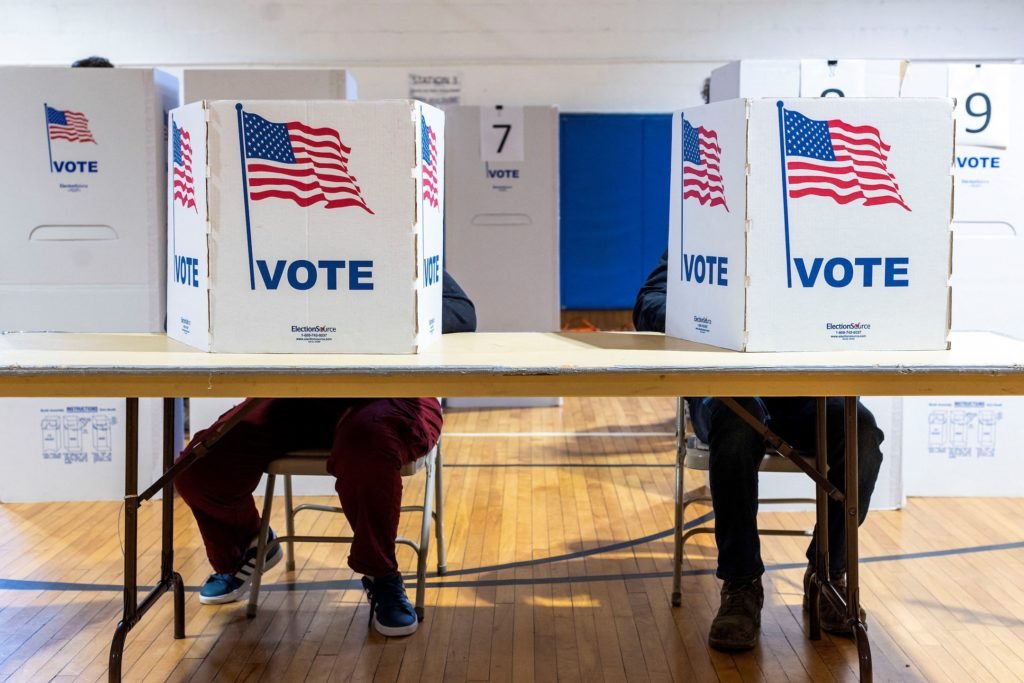
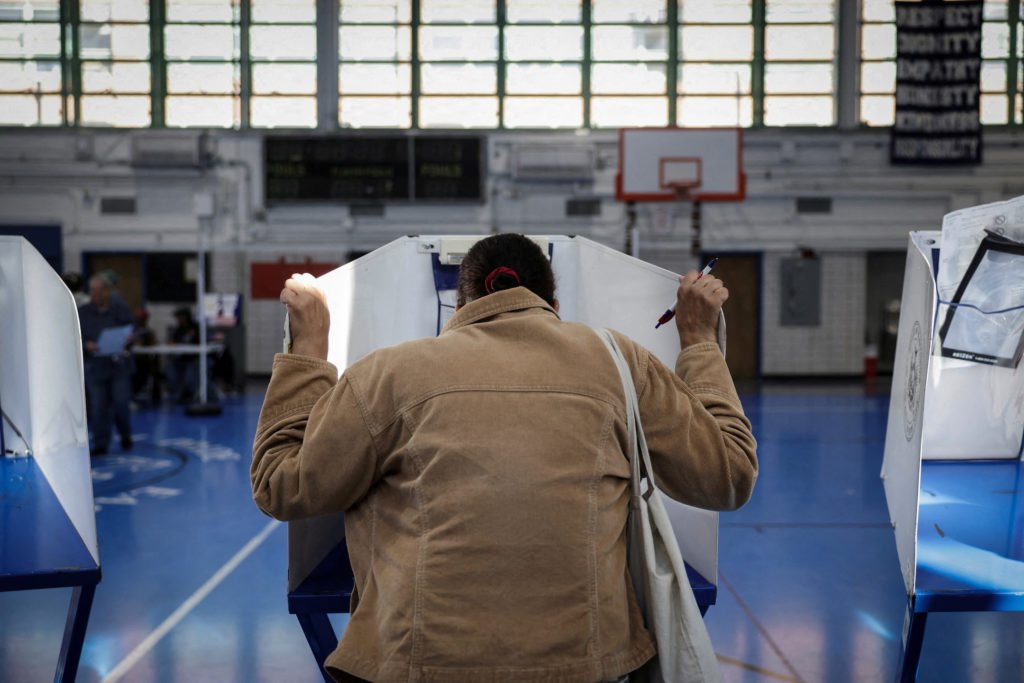
File photo: A woman holds the voting booth at an East Harlem school turned into a polling center on Nov. 5, 2024, Election Day, in Manhattan, New York City. Photo by Kent J. Edwards/File Photo/Reuters.
Miringoff described the 10-point drop in confidence since October 2024 as a “be on guard” kind of decline.
“I can only expect that the numbers may even get worse as we get closer to the midterms,” he said. “This may be just a stopping-off point to an erosion in even the state and local confidence people have.”
Already there is a significant drop in confidence among communities of color. While 72% of white Americans think their state and local governments will run elections fairly, just 63% of Black Americans and 57% of Latinos say the same.
“That’s the trust in the system. That’s a sense of history of being excluded,” Miringoff said. “Latinos have been in the spotlight right now politically. And so I’m not surprised that folks who feel they’ve been outside the system or been under a spotlight are not as comfortable and don’t have as much confidence in the system.”
Tammy Patrick, the chief executive officer for programs at The Election Center at the National Association of Election Administrators, said sustained political attacks on local election administrators have had a concrete cost. They’ve driven professionals from the field and could risk further undermining faith in elections, she said.
“It absolutely makes it more difficult to be an election professional when your day-to-day work life is justifying every action that you take, even when you’re proceeding in a lawful and legal manner,” said Patrick, a former election official in Maricopa County, Arizona.
How the SAVE America Act could ‘create chaos’ so close to an election
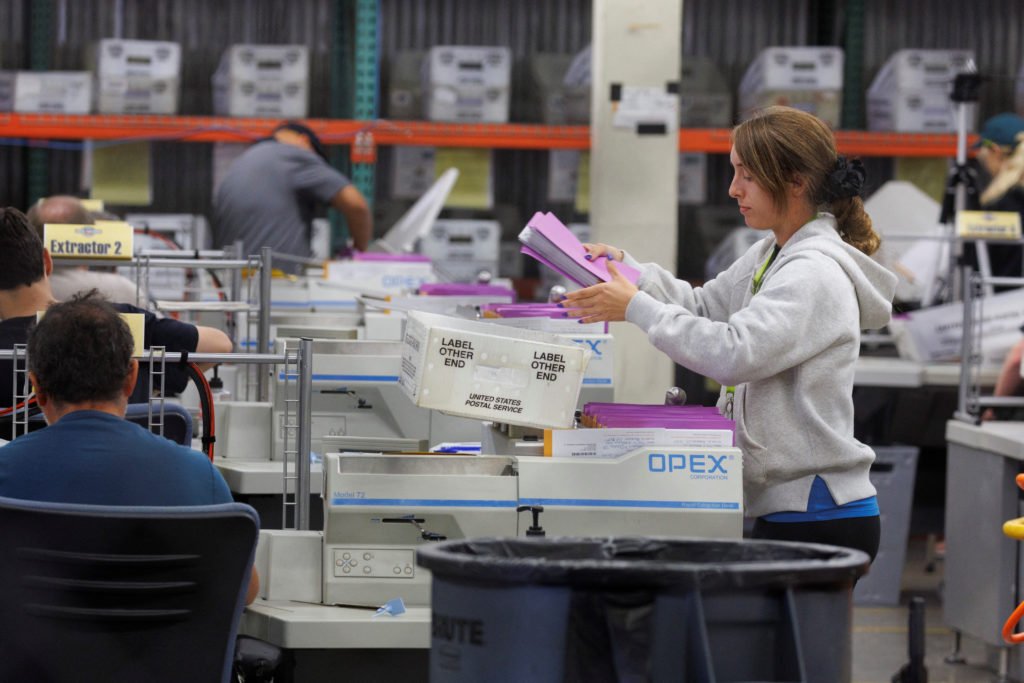
Workers sort mail-in ballots at the Orange County Registrar of Voters during a Nov. 1, 2022, media tour showing ballot security at the facility in Santa Ana, California. Photo by Mike Blake/Reuters
The timing of the president’s push to question the safety of elections and the public’s dropping confidence could hardly be more consequential. Several states have already held primary elections, and election administrators are well into planning for what will be one of the most closely watched midterm elections in modern American history.
Trump has insisted that the Senate take up and pass the SAVE America Act, getting rid of the 60-vote threshold if necessary. While Senate Majority Leader John Thune said Tuesday the chamber would take up the bill next week, he threw cold water on its chances of passing and of eliminating the filibuster to do it.
“The votes aren’t there for a talking filibuster,” Thune said. “It’s just a reality.”
Becker, a former attorney in the Voting Section of the Department of Justice’s Civil Rights Division, said he was unsurprised by the math.
“I’ve talked to Republican and Democratic election officials all over the country at the state and local level, and I’ve yet to find one of them that thinks this is a good bill,” he said. “It would create chaos this close to an election.”
READ MORE: What to know about how the SAVE America Act could change voting
Indeed, if the SAVE America Act were to be signed into law, it would likely be challenged in court. But in the meantime, election administrators across the country would be tasked with implementing sweeping new voter registration requirements in the months before November’s general election.
Patrick, who helped enact Arizona’s proof-of-citizenship requirement after voters approved it by ballot measure, said the experience should give Congress pause.
“It was a number of years before the specifics and the logistics were figured out,” she said. “We are now 20 years post, and still there are some kinks being ironed out.”
Patrick also described buyer’s remorse among voters who supported the law but were then caught up in the complicated implementation.
People “told me that they voted for it, but then they moved within the state and when they moved, they had to prove their citizenship,” she said, noting that many Americans don’t have a passport, a copy of their birth certificate or proof of name changes. “I don’t think there’s anyone that wants ineligible voters to participate in our democracy. Full stop. But what we do want to make sure is that everyone who is eligible doesn’t have obstacles that they have to overcome in order to participate.”
File photo: Voters fill out their ballots at a polling station on Tuesday, November 7, 2023. Photo by Julia Nikhinson/For The Washington Post via Getty Images.
Hasen, author of the Election Law Blog, said the proof-of-citizenship requirement at the heart of the SAVE America Act is different from the voter ID laws that see broader public support in many polls.
When Kansas implemented a similar law that required birth certificates or passports to register to vote, 30,000 people – virtually all of them eligible American citizens – were unable to register to vote because of it. The law was later put on hold by a federal court.
Patrick said the populations most affected by documentation requirements are often those already facing barriers to entry: older Americans born at home or in rural areas, women who have changed their names after marriage, Indigenous people, individuals with disabilities and young voters.
“How many young people do you know that have a printer in their home that they would have the ability to print out a document and take it into their local election office?” she asked. “At the surface level, showing ID at the polls, proving you’re a citizen, all sounds well and fine to the general population. But the devil is always in the details. And it’s in those details that we will prevent eligible Americans from participating.”
Besides changes Trump would like to make in how people vote, the president has also floated changing who is watching when they do. He has suggested that National Guard troops could be deployed to monitor polling places, particularly in Democratic cities, on Election Day. His former adviser Steve Bannon has also floated the idea of ICE agents showing up at the polls as part of the administration’s immigration crackdown. (Outgoing Homeland Security Secretary Kristi Noem recently testified that there are no plans to have immigration agents at voting locations, but she didn’t rule it out.)
READ MORE: DHS official promises that federal immigration agents won’t be at polling places during midterm elections
Fifty-four percent of Americans oppose the idea of National Guard troops being deployed to the polls, while 46% support it. Republicans are overwhelmingly supportive, while Democrats and independents are largely opposed.
Becker said the proposal conflicts with existing federal law.
“It is illegal. It is against federal law for troops or armed men – that’s the term in the statute – to appear at any voting location,” Becker said. “It is part of our culture that we vote in a safe and secure environment where we shouldn’t suffer any kind of fear of intimidation.”
Concern over AI misinformation unites Americans
While Americans are largely divided along partisan lines on the necessity and potential effect of new voting regulations, there’s one major area of agreement: artificial intelligence.
According to the latest PBS News/NPR/Marist poll, 85% of Americans say it is likely that AI-generated political content will spread misinformation about November’s elections. That includes 86% of Democrats, 81% of Republicans and 88% of independents. Graphic by Dan Cooney?PBS News
According to the latest poll, 85% of Americans say it is likely that AI-generated political content will spread misinformation about November’s elections. That includes 86% of Democrats, 81% of Republicans and 88% of independents.
“That’s a big number when you have such a new phenomenon,” Miringoff said. “The potential for AI to spread misinformation is already happening. It’s more than just potential. It’s reality.”
While the consensus on AI as a source of misinformation provides a potential opening for popular bipartisan action, Hasen said the threats of AI pose a widespread challenge for the administration of elections this year.
“We not only have to worry about the elections being run with integrity, we have to worry about the information environment,” he said. “We have to assure that voters remain with access to reliable sources of information.”
Political calculations for both parties
Worries about election integrity and potential misinformation are also met with a broader political backdrop that is complicating the calculus for both Republicans and Democrats heading into a hard-fought midterm campaign.
Trump’s push could backfire on Republicans, making it harder for some of the GOP’s most enthusiastic voters to participate, Hasen said.
“Donald Trump has been attracting infrequent voters, new voters, people who are not regularly part of the process,” he said. “Those are among the people most likely to be affected by new voting and registration restrictions. He could be shooting himself in the foot again if something like this passed.”
If the congressional election were held today, Democrats hold a 9-point advantage over Republicans among all Americans and a 14-point edge among independents. While the overall advantage has dropped 5 percentage points since November, it is still higher than the 5-point advantage Democrats had in the generic ballot in March 2018, before they went on to win 40 House seats and reclaim the majority during the midterms of Trump’s first term.
READ MORE: Fact-checking DHS Secretary Kristi Noem on her agency’s role in elections
For Republicans who are worried about defending their House and Senate majorities, Trump’s overall job approval presents an added obstacle. More than half — 57% — of Americans disapprove of the job he is doing, while 38% approve. That is relatively unchanged over the past few months but a 7-point drop since last March. His approval on the economy and immigration also hit second-term lows at 35% and 40% respectively, though those marks are within the margins of error from other recent lows.
“Democrats are in the driver’s seat,” Miringoff said.
Trump’s sagging approval rating and his concerns that Republicans may lose control of Congress in November are perhaps fueling his latest push for a revamp in how elections are conducted. He has also in recent days expanded the SAVE America Act beyond its original scope to include a ban on mail-in ballots for most voters and a prohibition on transgender athletes in women’s sports, which could boost Republican enthusiasm in November.
Trump’s efforts to sow doubts about the process of this year’s election, Hasen said, could be his way to delegitimize a potential outcome he does not like as well as any oversight of his administration that a new Democratic majority would try to enforce.
But the bigger concern, according to Hasen, is a potential that the faith in a cornerstone of the American democratic process could be irrevocably broken.
“The real danger is that we lose something that is essential to democracy, which is loser’s consent. The way democracy works is that people who are on the losing side of the election may not be happy with the results, but they accept the election as legitimate,” he said. “I hope that we will be in a period at some point past Donald Trump when we could go back to the bipartisan belief that elections should be freely and fairly conducted, where all eligible voters, but only eligible voters, can cast a ballot that will be fairly counted. It’s a pretty low bar.”
As voters prepare to cast ballots this year, Patrick hopes they’ll see past any confusion and doubts being raised on the national level and instead look to how their local elections are run.
“Voters should, in fact, have confidence in our elections. Our elections are run by professionals all across the country,” she said. “They’re run by volunteers, practically, because they don’t get paid very much – your neighbors, your family, your friends.”
“The equipment is tested and audited. Our elections are transparent and observable,” she added.
PBS News, NPR and Marist Poll conducted a survey from March 2-4, 2026, that polled 1,591 U.S. adults by phone, text and online with a margin of error of 2.8 percentage points, and 1,392 registered voters with a margin of error of 3.0 percentage points. For Democrats, the margin of error is 5.0 percentage points; Republicans, 5.2 percentage points; independents, 5.9 percentage points.
A free press is a cornerstone of a healthy democracy.
The conflict between the United States, Israel, and Iran has disrupted the global energy supply. The vital Strait of Hormuz has been seized by the Islamic Republic in an attempt to impose an unbearable economic burden on the United States and its associates. However, the fallout has reached far and wide, impacting nations with no involvement in the war, such as India. Nevertheless, there appears to be a solution to this energy crisis that has generated global concerns.
Two pipelines have been constructed specifically for this purpose, one located in Saudi Arabia and the other in the United Arab Emirates, which are designed to circumvent the strait. They are the sole means of transporting an extensive amount of Persian Gulf oil into international markets. They cannot completely replace the flows conveyed by tanker ships, but their use serves as a single factor stopping an even more dire situation from emerging.
Saudi Arabia is moving as much crude as it can through its pipeline to Yanbu, a port on the Red Sea. It was constructed 45 years ago in the early 1980s when shipping in the Persian Gulf was at risk due to the Iran-Iraq War. “While we have faced disruptions in the past, this one by far is the biggest crisis the region’s oil-and-gas industry has faced,” informed Amin Nasser, Saudi Aramco’s chief executive, as quoted by The Wall Street Journal.
He added, “The shipping blockage has made Saudi Arabia’s East-West pipeline one of the most critical pieces of infrastructure in the world economy. The state oil producer expects to send a maximum of 7 million barrels of oil through the 746-mile-long pipeline within a few days.”
Saudi Arabia has one real bypass — the Petroline, a 1,200 km pipeline across the Arabian desert that exits at Yanbu on the Red Sea. The UAE has a pipeline to Fujairah, just outside the Gulf’s mouth. But both are already running near full capacity. Together, in a pinch, they might… pic.twitter.com/iGseLJWBYO
— Markets by Zerodha (@zerodhamarkets) March 4, 2026
The pipeline takes oil from massive sources in eastern Saudi Arabia to the nation’s Red Sea Coast, winding over dunes, mountains and lava fields. Its length is similar to that of the Trans-Alaska Pipeline.
Two years after the initial shipment, in 1983, an internal Aramco newsletter stated that over 7,000 individuals worked on the four-year project, which was supervised by a subsidiary of Mobil Oil. 2,000 tonnes of explosives were used to blast a trench across the Arabian Peninsula for a parallel conduit intended for the byproducts of natural gas. The artery was designed to avoid the Persian Gulf and strengthen the proximity of Saudi goods to markets in the West.
The kingdom’s refiners use about 2 million barrels of oil every day, leaving 5 million barrels that could be sold to other countries. According to the International Energy Agency (IEA), that is equivalent to the majority of its crude shipments over the strait before the standoff. However, the pipe has never operated at maximum capacity for a prolonged period of time.
Additionally, it cannot resolve the entire issue because Aramco cannot reroute the 800,000 barrels of petroleum products that are sent via the strait every day. Furthermore, oil is also stuck in Bahrain, Iraq and Kuwait. The strait is a chokepoint for over 20 million barrels of oil and refined items each day, accounting for one-fifth of global consumption. The Saudi pipeline would not be able to counteract all of that. However, it can offer an alternative for up to 5 million barrels per day.
For 1.5 million barrels, a pipeline maintained by the United Arab Emirates provides a second bypass option. It can be employed to transfer crude from Abu Dhabi to the port of Fujairah on the Gulf of Oman. Moreover, the country could likely raise the figure to over 2 million in an emergency, reported Bloomberg.
What role can the pipelines play?
These two together can slow the skyrocketing prices of petroleum if enough tankers arrive at the loading ports. Presently, roughly 25 supertankers, each with a capacity of 2 million barrels, are headed toward the new pickup locations after diverting from their original courses.
On 8th March (Sunday), three very large crude carriers or VLCCs were loaded simultaneously at the Yanbu and Al Muajjiz terminals on the Red Sea by Saudi Aramco. Similarly, a VLCC was stocked at Fujairah by state-controlled Abu Dhabi National Oil Company (ADNOC). These three locations have been functioning at an unparalleled magnitude.
According to Vikas Dwivedi, global energy strategist at Macquarie, daily shipments from Yanbu have boosted by two million barrels per day over the previous week. He believed that the pipe was utilising between 50% and 60% of its capacity as of 9th March (Monday).
Image via The Wall Street Journal
The smaller, more recent Emirati pipeline connects Habshan in Abu Dhabi to Fujairah on the Gulf of Oman. It was primarily developed by a subsidiary of the state-run China National Petroleum Corp. The IEA pointed out that it can carry up to 1.8 million barrels per day and was already passing through roughly 1.1 million barrels before the outbreak of violence in the region.
Both Yanbu and Fujairah have experienced a surge in crude loadings. Petrobras announced that Saudi Arabia has fulfilled its obligation by pouring oil through the pipeline. It is a state-backed oil firm of Brazil. The company’s top executive highlighted that the problem is the hike in shipping expenses.
According to analytics company Sparta Commodities, an approximate evaluation suggested that around 10 million barrels are going to stay trapped in the Persian Gulf despite pipeline movements. Neil Crosby of analytics platform Sparta observed, “We’ve basically solved half of the problem.”
How reliable are the alternative pipelines
Iran has attacked energy infrastructure in the Gulf, and experts feared that these pipelines might also meet the same fate, but at least some could reach customers, as over 1,000 tankers remained stranded in the Persian Gulf.
“If you suddenly see two very large crude carriers coming out of Yanbu and one out of Fujairah, there is a psychological effect that at least some oil is coming out,” mentioned former trader Adi Imsirovic, who currently teaches at Oxford University. He then voiced, “What really worries me is that it’s not particularly difficult to target those pipelines.”
It’s not risk-free to ship oil in the Red Sea and at Fujairah, even though it’s safer than embarking into the Persian Gulf. Last week, an attempted drone strike damaged the Emirati port, leading some gasoline suppliers to cancel contracts.
While Saudi Arabia can shift oil to the port of Yanbu along the Red Sea via the East-West Pipeline, oil tankers will need to transit the Bab al-Mandeb—running Ansarallah’s proverbial gauntlet—to avoid the (very) long route around Africa via Suez and the Mediterranean to deliver… https://t.co/WAKfaZspbR pic.twitter.com/OZ5FQqbXPa
In 2024, the Houthi militants in Yemen, who have ties to Iran, attacked numerous commercial vessels. Maritime security analysts at the United Kingdom-based Ambrey are warning ships affiliated with the United States and Israel to steer clear of the Red Sea, even though they haven’t revived the offensive during the present confrontation.
House Democratic Leader Hakeem Jeffries said Friday a bipartisan coalition is working to force a vote as soon as next week on a war powers resolution that would attempt to prevent any U.S. action against Iran without approval from Congress.
READ MORE: Trump says he’s ‘not happy’ with Iran talks but will wait to see what happens in further rounds
“The American people don’t want another failed forever foreign war, particularly in the Middle East, when we know the outcome is likely to be disastrous,” Jeffries said on MSNow.
“What we’ve got to do right now, of course, is to do everything we can to prevent that from happening,” he said. “It would be reckless. It would be dangerous. It would be harmful to America’s national security interests.”
A free press is a cornerstone of a healthy democracy.
In a zoo outside Tokyo, one monkey has pulled heartstrings around the world after forming an unexpected friendship. Stephanie Sy reports.
Geoff Bennett:
And now a lighter story to end the week.
In a zoo outside Tokyo, one monkey has pulled heartstrings around the world after forming an unexpected friendship.
Stephanie Sy has the story.
Stephanie Sy:
It’s a story of rejection, vulnerability, and the animal instinct for companionship.
It helps that the central character is an terribly cute monkey, a seven-month-old macaque in Japan’s Ichikawa City Zoo named Punch. Abandoned by his own mother shortly after birth, zookeepers handed Punch a stuffed animal. Never mind that the orangutan is a different species, he’s hardly let go of it since.
Kosuke Shikano, Zookeeper (through interpreter):
This soft toy has quite long fur and several easy places to hold. And it looks like a monkey. We thought that it looking like a monkey might help Punch integrate back into the troop later on.
Stephanie Sy:
Watch as baby Punch is dragged around like a chew toy, escaping to the comfort of his protector, using him for cover.
Videos like these have sparked an outpouring of love and sympathy from the more evolved primates among us.
Woman:
Nobody wants to be a friend.
Stephanie Sy:
But he has plenty of friends on TikTok. #HangInTherePunch has gone viral.
The spectacle has drawn massive crowds to the zoo, and there’s a run on the stuffed animal at Ikea.
Miyu Igarashi, Nurse (through interpreter):
He’s become such an idol-like figure already, so I hope he stays lively and continues being an idol.
Alison Behie, The Australian National University:
It’s not by any means a replacement for a mother, and it’s not going to give the animal the attachment that it sort of needs in order to develop. But it does give sort of an avenue to retreat to that might in the moment reduce those stress responses a little bit, allowing him to feel a little bit less of that anxiety and stress.
Stephanie Sy:
Alison Behie is a primatology expert at Australian National University. She says the other monkeys’ ornery attitude toward Punch tracks.
Alison Behie:
Japanese macaques, they live in very strict matrilineal dominance hierarchies, which means there are dominant families and there are subordinate families. Dominant animals show aggression. Subordinate animals respond appropriately with sort of a subordinate signal, and then everyone stays happily in their place in the hierarchy.
So while it does look like bullying, and it looks quite confronting because it’s an infant and because their mother has rejected or abandoned them, it is just a sort of a normal part of a macaque society to have that sort of aggression as normal social behavior.
Stephanie Sy:
But there are reasons to hope. More recently, Punch seems to have made a breakthrough. He’s starting to make actual monkey friends and taking cues from adult monkeys on how to shelter from the rain.
Alison Behie:
It’s actually really reassuring that Punch is already sort of shown — being groomed, being integrated into the group’s structure, because it does suggest that hopefully any potential negative impacts of the abandonment will in fact sort of dissipate.
Stephanie Sy:
Zookeepers say Punch is showing signs of resilience.
Kosuke Shikano (through interpreter):
It depends on how Punch is confidence develops going forward. But, recently, he’s been spending less time with the stuffed toy day by day, and he’s interacting with the other monkeys more. If things carry on like this, I think there will come a day when he no longer needs his stuffed toy.
Stephanie Sy:
As cute as their relationship is, they will know Punch is really OK when he finally gives up his beloved surrogate.
President Trump is visiting Texas today, where three of his supporters are battling it out in that state Senate primary election set for next week. That’s as the president also considers military action in Iran. Lots to discuss.
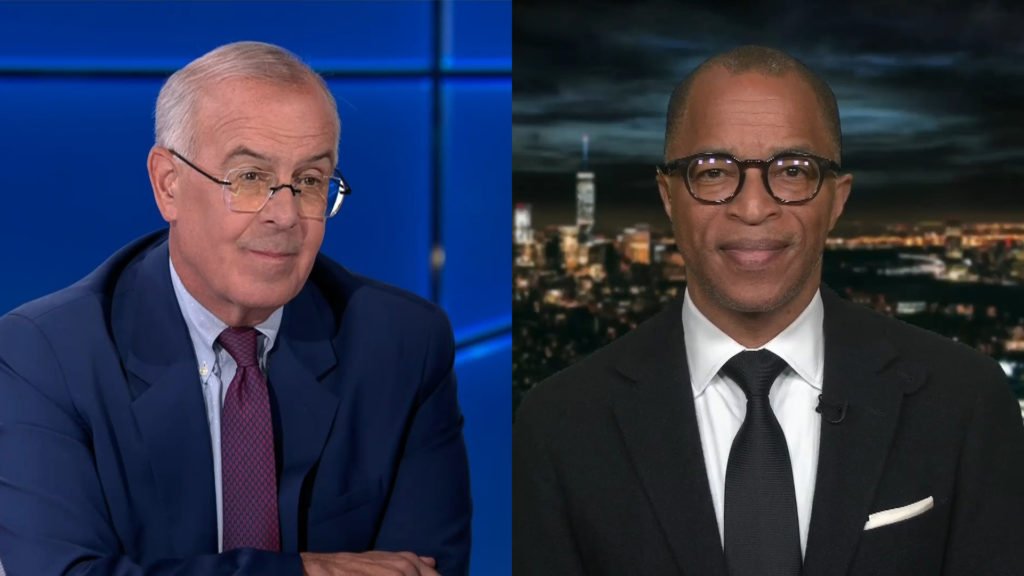
And we turn now to the analysis of Brooks and Capehart. That’s with “The Atlantic”‘s David Brooks and Jonathan Capehart of MS NOW.
It’s good to see you both.
So, as we said, President Trump in Texas, where three Republicans, to include the incumbent John Cornyn, they’re locked in this competitive GOP primary. The president has yet to make an endorsement. The fact that he’s inserting himself early and forcefully in this race, does that suggest that he’s still the GOP kingmaker or that he’s trying to demonstrate that he is?
David Brooks:
A little of both, maybe a little more of the latter.
The Texas race to me is the most interesting Senate race in both parties, because it gets at the core debate right at the middle of both parties. On the Democratic side, you have Jasmine Crockett, who’s an aggressive, progressive fighter. And then you have James Talarico, who is more moderate, is trying to revive the religious left.
And so the argument on the Democratic side is, do we want somebody who will just go to the mat and take down these Republicans, or do we want somebody who will be conciliatory and win over people from the center? And that is the core debate in the Democratic Party.
On the Republican side, you have got Ken Paxton, who has been scandal-plagued since nursery school.
(Laughter)
David Brooks:
And he’s — and then you have got John Cornyn, who is not the most exciting bulb in the Senate, but a standard-issue Republican.
And so the Paxton race in particular, and he will probably come out first, but not — but force a run-off — shows that there’s still some juice if he does really well in MAGA. If he doesn’t do really well, and if Wesley Hunt or Cornyn do well, then that’s a sign the Republican Party is beginning to move on.
Geoff Bennett:
So, Jonathan, what stands out to you in the Crockett v. Talarico matchup?
Jonathan Capehart:
Well, look, the one thing I will say is that, no matter which candidate wins the Democratic nomination, they will be infinitely better than whomever the Republicans decide to nominate. So I will just put that out there.
But, in this race, the polls seem to be a bit all over the place. There was one poll that came out from U.T. Tyler that had Congresswoman Crockett up by 12 points, but the sample size is small. And other polls that I just took a look at have state Representative Talarico up by single digits, maybe six points, eight points.
I think both candidates are trying to win in two different ways, but I think in two legitimate ways. Congresswoman Crockett, she is going for disaffected voters, African American voters, voters who may not have voted in previous elections. In a lot of ways, she’s taking a page out of Donald Trump’s book, playbook, when he ran in 2016, when he what I called fracking for votes.
He pulled people out who had not voted before. That’s who Congresswoman Crockett’s trying to go after. But then state Representative Talarico, he’s going after more middle-of-the-road, but really setting his sights on disaffected Republican voters who might not be too keen on what the president is doing, and they might be gettable.
So, on Tuesday, I’m looking to see which tactic actually won, and whether they can win enough votes to not be in a primary — in a primary run-off.
Geoff Bennett:
Well, let’s shift our focus back to this previous Tuesday, the State of the Union address.
David, was there anything in that speech that stands out to you as meaningfully changing the landscape or President Trump’s standing?
David Brooks:
Yes, I mean, the question I’m asking is, has Trump — is he losing the country? A lot of people have been waiting since 2016 for him to lose the country. But there’s clearly some sign of slippage.
My colleague Ross Douthat issued a video at The New York Times saying he’s losing the country and conservatives have to adjust. Is he losing the country, or is this just another wish fulfillment for people who don’t like him?
I think there’s evidence that he is, that if you look at particularly at independents, they have swung sharply away from him. And then if you look at Republicans, does — there’s a Pew Research, does he — does Donald Trump respect the country’s democratic values? The number of Republicans who say that is down sharply.
Should Republican members of Congress feel obligated to support Donald Trump? Sixty-one percent of Republicans say they do not have any responsibility to support Donald Trump. These are all changing numbers. And so clearly there’s a sense, whether it’s Minnesota, whether it’s just general mishegoss, which is Yiddish for crazy.
(Laughter)
Geoff Bennett:
I’m familiar.
David Brooks:
Just for the — for Jonathan.
(Laughter)
Jonathan Capehart:
No, oh, I know. Oh, come on.
David Brooks:
No, Jonathan’s a New Yorker.
Jonathan Capehart:
I know.
Geoff Bennett:
That’s right.
David Brooks:
He definitely knows what mishegoss is. OK, for…
(Laughter)
David Brooks:
And so I think that there’s signs that even Republican support, it’s not going anywhere, but it’s getting demoralized.
Geoff Bennett:
Yes. Yes.
Jonathan, I will say the contrast in that speech really stood out,the president in one way sounding like a conventional policymaker talking about making tech companies pay for their own electricity bills because of the A.I. plants that they operate, and then, in the next breath, he would be shading the Supreme Court or calling Democrats crazy. There was governance and grievance side by side.
Jonathan Capehart:
Geoff, I think you’re being charitable. I had actually forgotten about what he had said about A.I. paying its own electricity bills, because the rest of the speech was nothing but a variety show where he trotted people out, used them as prompts, handed out medals like PEZ.
Now, that’s not to take away from the people who got the medals. They deserve them. They deserve to be celebrated by the American people, but not like that, not in the way that the president did it. And, also, I thought there was a meanness to his address, and also the dabbling in just the language of violence, getting into just infinite detail about what people went through, their horrors and the trauma.
I came away from the, was it 107 minutes of that speech, just feeling worn down and wanting the 107 minutes back and longing for the days of, what, that long State of the Union address that President Bill Clinton gave in the way, way back that was just chockful of policy proposals and ideas, to the point where Washington reporters were like, my God, this guy is so boring.
I long for that kind of boring.
Geoff Bennett:
In the time that remains, I want to have you both weigh in on Warner Bros. Discovery reportedly agreeing to be acquired by Paramount Skydance. This is after Netflix walked away from the negotiations.
And if the deal closes, it means that one family, in this case, the family that has been so far deferential to President Trump, would control CBS, CNN, HBO, and TikTok. How do you see it?
David Brooks:
Yes, I have found media business incredibly boring and pointless. And I have been able to do that because I worked at Dow Jones, News Corp, New York Times, PBS. I have worked at all these agencies. And the business structure of the business had no effect on me.
There’s never been a moment in my career where I had the sense that somebody on the business side of things was going to try to influence anything I ever did. But that seems to be changing. And the malefactor here is Donald Trump. Once Trump starts playing political favorites among whether it’s Anthropic versus OpenAI or whether it’s Netflix versus paramount, then, of course, the companies have to be mindful of that.
And I’m a guy who — I don’t know Bari Weiss particularly, but I support what they’re trying to do. I think it’s time to mix up the media, that we got a little too progressive, a little too elite, and if Bari Weiss can change the mind-set, all power to her.
But if this is being done for lobbying and business, which it sure looks like it is, then that’s the real deterioration in the business we’re in.
Geoff Bennett:
How do you see it, Jonathan?
Jonathan Capehart:
Well, I would argue that the media isn’t necessarily liberal, when you look at the fact that the number one cable channel and the number one viewing channel is FOX News Channel.
This idea that there are liberals out there running around through the media indoctrinating people and changing — setting the narrative, I just think is wrong. I think bringing a FOX-like mentality and demeanor to CBS News and potentially to CNN, I think in the end makes the American people worse off.
Our job as journalists — and I’m speaking specifically of CNN in this case in this deal. Folks turn to CNN for news. They turn to them for just what is happening in the country. And if what’s happening at CBS is bound — could happen at CNN, then our country and our profession will be in worse shape.
Geoff Bennett:
David?
David Brooks:
Well, the one reason FOX exists is because all the other mainstream networks don’t have Trump supporters.
I do think we have made a mistake over decades in shutting out working-class folks and in not letting more Trump voices — and it’s hard to get Trump voices on the air. I understand that. But if you tell half the country that your voices aren’t worth heard, they will rebel.
And that’s a bit on us. Trump is not to be defended, but he’s never completely wrong.
Geoff Bennett:
David Brooks and Jonathan Capehart, thank you both.