
Bill Clinton became the first former president compelled to testify to members of Congress. At a closed-door session, the House Oversight Committee heard from Clinton about his connections to Jeffrey Epstein. The testimony comes a day after the committee questioned his wife, former First Lady Hillary Clinton, for more than 6 hours. Congressional correspondent Lisa Desjardins reports.
Category: World
-
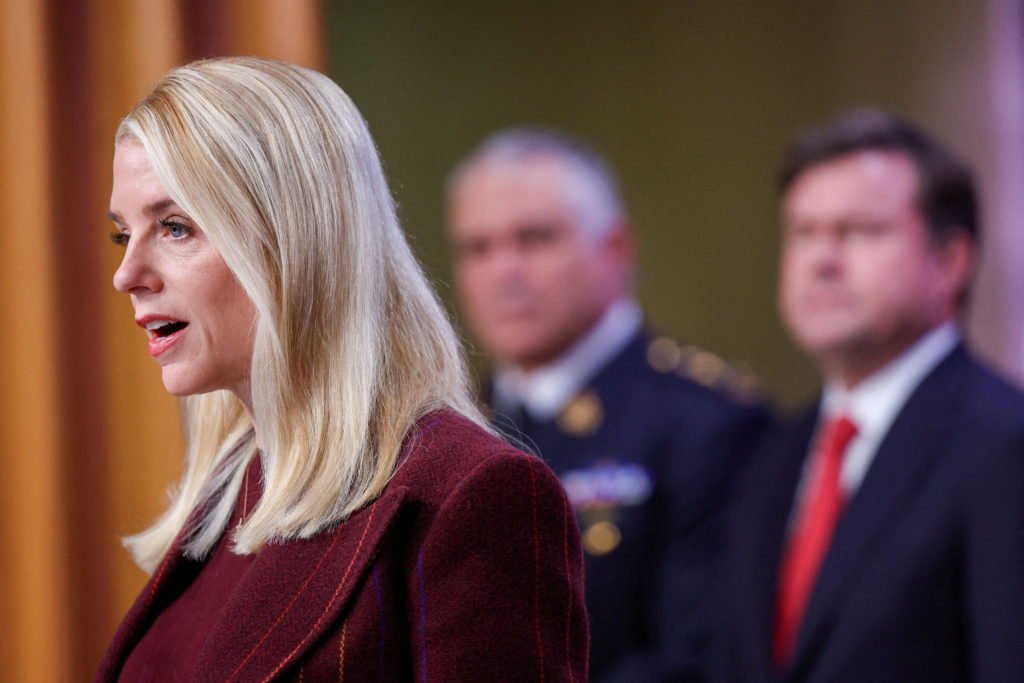
30 more people indicted over anti-ICE protest at Minnesota church, Bondi says
Attorney General Pam Bondi announced federal charges Friday against 30 more people who are accused of civil rights violations in a January protest inside a Minnesota church where a pastor works for Immigration and Customs Enforcement.
Bondi said on social media that 25 people were in custody and more arrests would follow. The new indictment comes a month after independent journalists Don Lemon and Georgia Fort and prominent local activist Nekima Levy Armstrong were charged for their alleged roles in a protest at Cities Church in St. Paul.
READ MORE: Read the full indictment against Don Lemon, Georgia Fort and others charged in Minnesota
Bondi accused the group of attacking a house of worship.
“If you do so, you cannot hide from us — we will find you, arrest you, and prosecute you,” she wrote on social media.
A livestreamed video posted on Facebook shows people interrupting services at Cities Church on Jan. 18 by chanting “ICE out” and “Justice for Renee Good,” a reference to the woman who was fatally shot by an ICE officer in Minneapolis on Jan. 7.
Protesters targeted church over its pastor
Protesters descended on Cities Church after learning that one of the church’s pastors also serves as an ICE official. The protest drew swift condemnation from Trump administration officials and conservative leaders for disrupting a Sunday service.
In total, 39 people now face charges of conspiracy against religious freedom and interfering with the right of religious freedom. The new defendants had initial court appearances and were released.
Lemon and Fort said they were at the church as journalists covering news. Levy Armstrong was the subject of a doctored photo posted by the White House showing her crying during her arrest. The three have pleaded not guilty.
WATCH: Arrests of journalists fuel backlash as anti-ICE protests spread from Minneapolis
The indictment says the “agitators” entered the church in a “coordinated takeover-style attack” and engaged in acts of intimidation and obstruction.
“Young children were left to wonder, as one child put it, if their parents were going to die,” the indictment says.
Church welcomes more arrests
A lawyer for the church praised the Justice Department for charging more people.
“The First Amendment does not give anyone — regardless of profession, prominence, or politics — license to storm a church and intimidate, threaten, and terrorize families and children worshipping inside,” Doug Wardlow said in a statement.
The revised indictment adds new allegations when compared to the original filed in January.
It says two people “conducted reconnaissance” outside the church a day before the protest and recorded their visit on video, with one saying, “My thoughts are to be able to close up this whole alleyway right here.”
The court filing quotes one protester as chanting in the church, “This ain’t God’s house. This is the house of the devil.”
Trahern Crews, who was charged in January and is lead organizer of Black Lives Matter Minnesota, said the latest arrests were a “waste of time.”
“It’s a shame that the people who have killed Alex Pretti and Renee Good or Keith Porter have not been arrested but peaceful protesters have,” Crews said. Porter was fatally shot in Los Angeles by an off-duty ICE officer.
Minnesota was hotbed for immigration blitz
Levy Armstrong defended the protest shortly after it occurred. She said critics needed to “check their hearts” if they were more concerned about a disruption than the “atrocities that we are experiencing in our community.”
WATCH: Minnesota schools and students struggle with fallout of immigration crackdown
The protest came at a tense time in Minnesota, where the Trump administration sent thousands of federal officers for Operation Metro Surge after a series of public fraud cases where the majority of defendants had Somali roots. Officers frequently deployed tear gas for crowd control in neighborhood clashes with residents, often detaining them along with immigrants.
Good, 37, was shot in Minneapolis. In another fatal shooting a week after the church protest, a federal officer killed Pretti, a 37-year-old nurse, in the same city.
Nationwide demonstrations erupted in response, followed by a change in Operation Metro Surge’s leadership and the eventual wind-down of the immigration enforcement operation. Roughly 400 ICE officers and Homeland Security agents were expected to remain in Minneapolis by early March, down from roughly 3,000 at the peak, according to a court filing.
Since then, the Twin Cities have grappled with the impact to communities and the local economy. Minneapolis said it suffered an impact of $203 million due to the operation, with tens of thousands of residents in need of urgent relief assistance.
Separately, a woman who was at the church service has filed a lawsuit against some people who were charged, alleging emotional trauma and an inability to exercise her religion that day.
Associated Press writer Ed White in Detroit contributed to this report.
A free press is a cornerstone of a healthy democracy.
Support trusted journalism and civil dialogue.
-

Democratic lawmakers say they are ‘closely’ reviewing new White House offer on DHS
As the Department of Homeland Security remains shut down, the White House and Democratic leaders are continuing to exchange proposals to end the impasse.
WATCH: Democrats pushing to ‘get ICE under control’ with DHS shutdown, Jeffries says
A White House official said Friday that the administration sent another counteroffer to Democrats on Thursday. The official, granted anonymity to discuss private negotiations, called the offer “serious.”
Aides to Senate Minority Leader Chuck Schumer and House Minority Leader Hakeem Jeffries, both New York Democrats, confirmed that the lawmakers have received the offer.
In a joint statement to reporters, aides to Schumer and Jeffries said their offices are reviewing the White House proposal “closely” and that Democrats are continuing to push for “real reforms” on the conduct of federal immigration agents.
Federal funding for DHS lapsed Jan. 30, with Democrats calling for more restrictions on the behavior of federal immigration agents in the aftermath of the death of two U.S. citizens in Minnesota.
But most of DHS provides critical governments, which means that federal employees are working — but not getting paid.
A free press is a cornerstone of a healthy democracy.
Support trusted journalism and civil dialogue.
-

Trump says he’s not mulling a draft executive order to seize control over elections. Here’s what we know
President Donald Trump said he’s not considering declaring a national emergency around the midterm elections, as a draft executive order circulating among his allies suggests.
Watch the president’s remarks to PBS News on Friday in the player above.
The 17-page proposal, a working document reviewed in full by PBS News, would give him extraordinary power over the 2026 midterm elections. It claims to address election integrity issues caused by foreign interference. By declaring a national emergency, the document hypothesizes, the president could take control over some voting mechanisms in the country, including requiring hand-counting of ballots and voter identification at the polls.
“Who told you that?” the president said in response to a question from PBS News about the proposal.
The U.S. Constitution makes clear that states administer elections, while Congress has a limited oversight role in regulating how states run federal elections. This proposal would expand federal control over elections and almost immediately be challenged in court. Since the draft was first reported by the Washington Post, experts have shared concerns that such a proposal would be unconstitutional and not within the president’s authority.
“The president cannot seize control of state-run elections by declaring an ’emergency,’” Max Flugrath, spokesperson for the left-leaning voting rights group Fair Fight Action, said in a statement Thursday. “There’s no statute that permits it.”
The proposed executive order also requires that voters nationwide must hand-mark paper ballots for them to be counted and that the hand-counting process occur in public. It also proposes that voters re-register for the 2026 election through their county, listing proof of citizenship as a requirement.
Peter Ticktin, an attorney who has known Trump since he was 15 years old, confirmed the draft executive order has been circulating “for a while now” among some of the president’s supporters. Ticktin said that if the president believes there is foreign interference in U.S. elections, he can take steps to secure the election by declaring a national emergency, adding “for anyone who has examined the evidence, we know that this emergency exists.”
“The President has power to take charge in an emergency. Frankly, no government could work with no one in charge in times when a foreign country is invading surreptitiously or with a bold attack,” he told PBS News. “Either way, our presidents have all had the power to step up and resist foreign intrusion. This is why Congress passed the National Emergencies Act (NEA), to make sure that the President is so empowered. There is no question that President Trump can invoke the NEA.”
Ticktin said he had communicated with the president about this issue. He also said he’s spoken with people at the White House and Department of Justice about the executive order but declined to say whom.
The president declared a national emergency in 2018 during his first administration to deal with the threat of foreign powers accessing critical infrastructure or interfering with elections. That was extended by former President Joe Biden for each year of his presidency. As he departed the presidency at the end of 2024, Biden pointed to this executive order as a basis for sanctions levied against Iranian and Russian actors that “aimed to stoke socio-political tensions” and influence the US elections.
A White House official told PBS News that the White House staff is regularly in communication with outside advocates who want to share policy ideas with the president but cautioned that speculation about what the president may announce is just that — speculation.
Trump signed an executive order in March 2025 that would add proof of citizenship to voter registration forms, prompting multiple lawsuits that are working their way through the courts.
The SAVE America Act, an elections bill, recently passed in the Republican-led House but faces an uphill battle in the Senate. The legislation requires documentary proof of U.S. citizenship when registering to vote and imposes stricter voter ID requirements, among other provisions.
READ MORE: What to know about how the SAVE America Act could change voting
The president hinted earlier this month that he may take unilateral action to ensure voter ID is in place ahead of the midterm elections, writing in a post on Truth Social: “There will be Voter I.D. for the Midterm Elections, whether approved by Congress or not! Also, the People of our Country are insisting on Citizenship, and No Mail-In Ballots, with exceptions for Military, Disability, Illness, or Travel.”
Thirty-six states have existing laws requiring some form of ID at the polls, according to the National Conference of State Legislatures.
News of the draft order garnered swift pushback from some Democrats, including Colorado Secretary of State Jena Griswold, who called Trump “one of the greatest threats to American elections” in a statement Thursday.
“Regardless of whether this suggested executive order ultimately materializes, every American — regardless of party or ideology — should be extremely concerned by Trump’s continued use of lies and conspiracy to justify attempts to seize the reins of election administration and hold on to power. That is not democracy, it is attempted authoritarianism. We will fight back,” she wrote.
Earlier this week, the Trump administration spoke with more than 100 top election officials from around the country, including secretaries of state, about election preparation for the November midterms.
Three people on Wednesday’s call, who discussed the meeting on the condition of anonymity because they were not authorized to share details, told PBS News that the Election Assistance Commission routinely offers resources to states to prepare both physical and cybersecurity infrastructure for elections. The Departments of Homeland Security and Justice joined the call, as well as officials from the U.S. Postal Service and the FBI.
Presenting on behalf of DHS in that meeting was Heather Honey, a conservative election activist who was hired by the Trump administration to be the deputy assistant secretary for election integrity.
One person on the call told PBS News that Honey pitched the group on using the SAVE program, or Systematic Alien Verification for Entitlements, which is a database run by U.S. Citizenship and Immigration Services that government officials use to check the citizenship status of applicants seeking benefits. The Trump administration is pushing election officials to run voter files through the SAVE system, which could check for a voter’s citizenship.
Two people on the call said that Honey also raised hand-counting ballots, which election experts say is an inaccurate way to count ballots as it is rife with human error. Hand-counting ballots is also a vastly slower process, while using machines is faster and more accurate when tabulating election results.
Officials on the call assured participants that U.S. Immigration and Customs Enforcement agents will not be stationed outside of voting locations, according to the people on the call. PBS News recently asked White House press secretary Karoline Leavitt if ICE would be outside of polling locations.
Watch the clip in the player above.“That’s not something I’ve ever heard the president consider,” Leavitt said. “No.”
She then added that she couldn’t guarantee that ICE will not be around polling locations or in November, describing our inquiry as a “very silly hypothetical question.”
“But what I can tell you is I haven’t heard the president discuss any formal plans to put ICE outside of polling locations,” she said.
A free press is a cornerstone of a healthy democracy.
Support trusted journalism and civil dialogue.
-

Europe’s worries about Trump in spotlight as Macron heads to French nuclear sub base
PARIS (AP) — They lurk in the oceans, a last resort to pulverize attackers with nuclear fire should France’s commander in chief ever make that terrible call.
French President Emmanuel Macron, the person with the power to unleash France’s nuclear arsenal, will on Monday update French thinking on the potential use of warheads carried on submarines and planes, if it ever came to that. This in the context of concerns in Europe that Russian war-making could spread beyond Ukraine, and uncertainty about U.S. President Donald Trump’s steadfastness as an ally.
READ MORE: French parliament clears way for Macron’s military spending boost in 2026 budget
For decades, Europe has lived under a protective umbrella of U.S. nuclear weapons, stationed on the continent since the mid-1950s to deter the former Soviet Union and now Russia. Lately, however, some European politicians and defense analysts are questioning whether Washington can still be relied upon to use such force if needed.
As the only nuclear-armed member of the 27-nation European Union, the questions are particularly pertinent for France.
Possible revisions to France’s nuclear deterrence policy, sure to be carefully calibrated and scrutinized by allies and potential enemies alike, could be among the most consequential decisions that Macron makes in his remaining 14 months as president, before elections to choose his successor in 2027.
That Macron feels a need to bare France’s nuclear teeth, in what will be the commander in chief’s second keynote speech laying out the country’s deterrence posture since his election in 2017, speaks to his concerns, voiced multiple times, about geopolitical and defense-technology shifts that threaten the security of France and its allies.
Those voicing doubts about Washington’s reliability include Rasmus Jarlov, chair of the Danish parliament’s Defense Committee.
“If things got really serious, I very much doubt that Trump would risk American cities to protect European cities,” he said in an interview with The Associated Press. “We don’t know but it seems very risky to rely on the American protection.”
He and others are turning to France for reassurance. In the longer term, Jarlov argues that other European nations also need to arm themselves with nuclear weapons — an almost unfathomable prospect when U.S. protection seemed absolute in European minds.
“The Nordic countries have the capacity. We have uranium, we have nuclear scientists. We can develop nuclear weapons,” he said. “Realistically, it will take a lot of time. So in the short term, we are looking to France.”
Adjusting to geopolitical risks
The world has changed dramatically since Macron’s first policy-making nuclear speech in 2020, with new uncertainties shoving old certainties aside.
The full-scale Russian invasion of Ukraine, now entering its fifth year, brought war to the EU’s door and repeated threats of possible nuclear use from Russian President Vladimir Putin.
WATCH: Expiration of U.S.-Russia nuclear weapons treaty sparks concerns of new arms race
China is expanding its nuclear arsenal. So, too, is North Korea’s nuclear-armed military. In October, Trump spoke about U.S. intentions to resume nuclear tests for the first time since 1992, although U.S. Energy Secretary Chris Wright later said that such tests would not include nuclear explosions.
Russia revised its deterrence policy in 2024, lowering its bar for possible retaliation with nuclear weapons. The United Kingdom has announced plans to buy nuclear-capable U.S.-made F-35A fighter jets, restoring a capacity to deliver nuclear airstrikes that it phased out in the 1990s, leaving it with just submarine-based nuclear missiles.
The chosen site for Macron’s speech on Monday — the Île Longue base for France’s four nuclear-armed submarines — will drive home that French presidents also have nuclear muscle at their disposal in an increasingly unstable world. They each can carry 16 M51 intercontinental ballistic missiles armed with multiple warheads.
“There are high expectations from the allies and partners, and maybe also the adversaries, about how the French nuclear doctrine could evolve,” said Héloïse Fayet, a nuclear deterrence specialist at the French Institute of International Relations, a Paris think tank.
Speaking in an AP interview, Fayet said she’s hoping for “real changes.”
“Maybe something about a greater and a clearer French commitment to the protection of allies, thanks to the French nuclear weapons,” she said.
France’s nuclear force
Macron said in 2020 that France has fewer than 300 warheads — a number that has remained stable since former President Nicolas Sarkozy announced a modest reduction to that level in 2008.
Macron said the force is sufficient to inflict “absolutely unacceptable damage” on the “political, economic, military nerve centers” of any country that threatens the “vital interests” of France, “whatever they may be.”
Nuclear specialists will be watching for any hint from Macron that he no longer considers the French stockpile to be sufficient and that it might need to grow.
The language of deterrence is generally shrouded by deliberate ambiguity, to keep potential enemies guessing about the red lines that could trigger a nuclear response. Officials from Macron’s office, speaking on condition of anonymity to discuss the nuclear policy changes that Macron might make, were extremely guarded in their wording, not least because deterrence is a strictly presidential prerogative.
“There will no doubt be some shifts, fairly substantial developments,” one of the officials said.
Protecting Europe
Again with careful wording, Macron in 2020 said the “vital interests” that France could defend with nuclear force don’t end at its borders but also have “a European dimension.”
Some European nations have taken up an offer Macron made then to discuss France’s nuclear deterrence and even associate European partners in French nuclear exercises.
German Chancellor Friedrich Merz says he’s had “initial talks” with Macron about nuclear deterrence and has publicly theorized about German Air Force planes possibly being used to carry French nuclear bombs.
European nations engaging with France are seeking “a second life insurance” against any possibility of U.S. nuclear protection being withdrawn, says Etienne Marcuz, a French nuclear defense specialist at the Paris-based Foundation for Strategic Research think tank.
“The United States are unpredictable — have become unpredictable — because of the Trump 2 administration,” he said. “That has legitimately raised the question of whether the United States would truly be prepared to protect Europe, and above all, whether they would be willing to deploy their nuclear forces in defense of Europe.”
Associated Press writers Sylvie Corbet in Paris and Kirsten Grieshaber in Berlin contributed.
A free press is a cornerstone of a healthy democracy.
Support trusted journalism and civil dialogue.
-

These refugees were already admitted to the U.S. The Trump administration is detaining and questioning them anyway
ST. PAUL, Minn. (AP) — Their family spent years opposing Venezuela’s socialist system.
The government retaliated by sending men to beat the father, a state oil company worker whom it accused of being uncooperative. Other relatives were threatened.
READ MORE: New DHS order could lead to detention of thousands of legal refugees in the U.S.
The situation became so untenable that the family fled the country for the United States in 2021 after it obtained refugee status, according to one of the daughters, a 24-year-old clothing salesperson who was interviewed by The Associated Press.
The six siblings and their parents settled in Minnesota in 2023, living peaceful lives until the Trump administration said it was casting new scrutiny on refugees. One priority is those admitted to the U.S. under former President Joe Biden, whom the government accuses of prioritizing quantity over detailed screening and vetting, with an initial focus on 5,600 refugees who settled in Minnesota and are not yet permanent residents, making them particularly vulnerable.
Last month, three masked officers got out of a black SUV with tinted windows outside a St. Paul apartment complex, handcuffed the Venezuelan woman and her mother and told them their legal status was under review, according to the woman, who asked for anonymity for fear of retaliation.
Overturning years of precedent, immigration authorities have arrested or questioned dozens of refugees in Minnesota, attorneys and advocates say, with more detentions likely to come nationwide.
READ MORE: Trump’s border czar says smaller force of ICE agents will remain in Minnesota amid drawdown
In January, a federal judge ordered a temporary halt to the arrest and detention of refugees in Minnesota while a lawsuit challenging the “revetting” continues. The judge ordered the immediate release of all refugees detained in Minnesota, and those taken to Texas.
Three refugees told The Associated Press that whatever happens, the rounds of inconclusive interviews with immigration authorities well after they thought their status was safe has them questioning their futures in the U.S. and living in constant fear.
The young woman from Venezuela hasn’t returned to her job at a clothing factory. A man who fled persecution in Myanmar won’t walk on the streets of Minneapolis without a letter from his church appealing for immigrants to “be treated humanely.” A Congolese refugee arrested in St. Paul despite her refugee status says “everything that’s happened feels like a movie.”
A change in U.S. treatment of refugees
Welcoming refugees has been a source of bipartisan agreement in the U.S. since Congress passed the Refugee Act with overwhelming support in 1980.
The act helped make refugee applications some of the immigration system’s most heavily scrutinized. Government decisions that someone was persecuted for who they are or what they believe are rarely second-guessed, and revisiting refugee status that’s already been granted is a major blow to legal tradition, advocates say.
“They’ve been heavily vetted and were admitted by the government with approval,” said Beth Oppenheim, chief executive officer of HIAS, a major refugee aid group.
Once a refugee is admitted to the U.S. through the resettlement program, the only way to strip them of their status is to prove that they should never have been admitted, Oppenheim said. That is why the Trump administration is interviewing people again, she said.
Matthew Tragesser, a spokesman for U.S. Citizenship and Immigration Services, said in a written statement refugees “are REQUIRED to be subject to a full inspection after a year within the United States.”
“This is not novel or discretionary; it is a clear requirement in law,” he wrote.
While it is correct that refugees must apply for green cards one year after admission — a change of status that brings a renewed layer of scrutiny — the administration is breaking with decades of tradition by revisiting initial decisions to admit people as refugees, and then detaining them while they are under review.
“Arresting, detaining, and rescreening refugees are all new changes which will inflict grave harm on vulnerable populations,” said Smita Dazzo, deputy director of U.S. programs at HIAS.
Venezuela to Minnesota to Houston and back
In January, U.S. Immigration and Customs Enforcement took the Venezuelan women to Houston on a flight where migrants were shackled at the wrists and ankles and forbidden from talking. The daughter said she was told she was there for green card interviews and isolated in a cold room with no food, water or anything warm to cover her. She said she refused to sign documents without an attorney present.
“They told us, ‘Your status is worthless. You’re illegal,’” she said. “What we went through is something I wouldn’t wish on anyone … We were supposed to arrive in this country with refugee status, and we thought we would be protected here. But right now, at this moment, it is quite the opposite.”
The women were released after successfully filing habeas corpus petitions in federal court, part of a flood of last-ditch attempts at freedom under a Trump policy denying bond hearings in immigration court. Friends of their attorney drove them back to Minnesota at their own expense. Since then, the younger woman has been too afraid to leave the house.
<2h>The pastor who received a letter and went to the interview
Saw Ba Mya James, a 46-year-old ethnic Karen father of three who fled military persecution in Myanmar, arrived in St. Paul last year after obtaining refugee status with help from a local church.
Despite a pending green card application, the Anglican pastor did not attend church for weeks after friends advised him to avoid going outside.
“I was told to stay at home, so I listened, and I prayed to God with my family,” James said.
James received a letter Feb. 2 ordering a “post-admissions refugee reverification” at the U.S. Citizenship and Immigration Services St. Paul field office, according to a copy reviewed by The Associated Press.
During an interview that lasted several hours, an officer pressed James with questions he said he already addressed extensively before being admitted to the U.S. The officer said the review was needed because an inexperienced employee handled James’ initial vetting.
Within two weeks of the interview, James got another letter asking that he and his family provide fingerprints, which his attorney took as a positive sign.
Still, James remains wary of being detained. He faithfully carries his church sponsors’ letter appealing for him and other immigrants to “be treated humanely as fellow image-bearers of God.”
The Congolese refugee arrested arriving at work
A Congolese woman settled in the Twin Cities area in November 2024 with refugee status, working in the hospitality business as the breadwinner for her husband and four children.
She said an immigration officer approached her parked car when she arrived for work at 7 a.m. on Jan. 14 in St. Paul, saying he knew her name and that she was a refugee. After telling her to exit the vehicle to answer questions, he handcuffed her despite her efforts to show a work authorization document and identification.
The woman, who spoke on condition of anonymity because she fears reprisals, was flown to Houston to be questioned in detail about her experiences in the Congo, Uganda and the United States. She and other refugees refused to sign documents to be sent back to their home countries. She was released Jan. 18 without any ID documents to book a flight to Minneapolis. A manager at her company flew to Houston and drove her 17 hours back home.
“If I told you I’m feeling OK, I’d be lying to you,” she said.
Salomon reported from Miami.
A free press is a cornerstone of a healthy democracy.
Support trusted journalism and civil dialogue.
-

Trump suggests U.S. could have ‘friendly takeover of Cuba’
President Donald Trump said Friday that Secretary of State Marco Rubio was negotiating at a high level with the Cuban government.
“The Cuban government is talking with us” the president said in comments to reporters as he left the White House. “They have no money. They have no anything right now.” He added: “We could very well end up having a friendly takeover of Cuba.”
READ MORE: 4 things to know about the deadly boat shooting in Cuban waters
After his administration ousted Cuban ally and Venezuelan President Nicolas Maduro, Trump for weeks suggested Cuba was on the brink of collapse economically.
He didn’t say what he meant by a “friendly takeover” but suggested that after decades “of dealing with Cuba” something could happen that’d be “very positive” for Cuban exiles living in the U.S.
A free press is a cornerstone of a healthy democracy.
Support trusted journalism and civil dialogue.
-

Trump says he’s ‘not happy’ with Iran talks but will wait to see what happens in further rounds
TEL AVIV, Israel (AP) — President Donald Trump said Friday he’s “not happy” with Iran talks so far but that he’ll wait to see what happens in additional rounds of negotiations with the Middle Eastern country over its nuclear program.
“I’m not happy with the fact that they’re not willing to give us what we have to have. I’m not thrilled with that. We’ll see what happens. We’re talking later,” Trump told reporters as he left the White House on Friday. “We’re not exactly happy with the way they’re negotiating. They cannot have nuclear weapons,” Trump said.
READ MORE: UN nuclear watchdog says it’s unable to verify whether Iran has suspended all uranium enrichment
Tensions between the United States and Iran remain high after their latest nuclear talks in Geneva on Thursday failed to reach and breakthrough, and as American forces gather in the region.
Trump has threatened military action if Iran does not agree to a far-reaching deal to constrain its nuclear program. Iran insists it has the right to enrich uranium for peaceful purposes and denies seeking a nuclear weapon.
Trump was asked about the risks of the U.S. getting involved in a drawn-out conflict in the Middle East if it launches strikes on Iran.
“I guess you could say there’s always a risk,” Trump replied. “You know, when there’s war, there’s a risk of anything, both good and bad.”
Earlier Friday, the U.S. State Department said that Secretary of State Marco Rubio would make a quick trip to Israel early next week. The U.S. Embassy in Israel had earlier urged staff who want to leave to depart, joining other nations in encouraging people to leave the region and signaling that U.S. military action might be imminent. The announcement of Rubio’s visit could indicate a longer timeline for any potential strike.
READ MORE: Rubio plans to visit Israel next week as U.S.-Iran tensions remain high after latest talks
A confidential report from the U.N. nuclear watchdog meanwhile confirmed that Iran has not offered inspectors access to sensitive nuclear sites since they were heavily bombed during the 12-day war launched by Israel last June. As a result, it said it could not confirm Iran’s claims that it stopped uranium enrichment after the U.S. and Israeli strikes.
The report was circulated to member countries and seen by The Associated Press.
Those wishing to leave ‘should do so TODAY’
The State Department said in a statement that Rubio would visit Israel on Monday and Tuesday to “discuss a range of regional priorities including Iran, Lebanon, and ongoing efforts to implement President Trump’s 20-Point Peace Plan for Gaza.” It offered no other details.
Israeli Prime Minister Benjamin Netanyahu has long urged tougher U.S. action against Iran, and has warned that Israel will respond to any Iranian attack.
The announcement of Rubio’s visit came just hours after the U.S. Embassy in Jerusalem implemented “authorized departure” status for non-essential personnel and family members, which means that eligible staffers can leave the country voluntarily at government expense.
In an email, U.S. Ambassador Mike Huckabee urged staff considering departure to do so quickly, advising them to focus initially on getting any flight out of Israel and to then make their way to Washington.
“Those wishing to take AD should do so TODAY,” Huckabee wrote, using an acronym for “authorized departure.”
“While there may be outbound flights over the coming days, there may not be,” he added, in an email that was recounted to The Associated Press by someone involved with the U.S. mission who wasn’t authorized to share details.
On a town hall meeting Friday after the email was sent, Huckabee told staff that he was encouraging airlines to keep flying.
Vance to meet with mediator
Iran and the United States on Thursday walked away from another round of nuclear negotiations in Geneva without a deal. Technical discussions are scheduled to take place in Vienna next week.
U.S. Vice President JD Vance was to meet later on Friday in Washington with Oman’s foreign minister, Badr al-Busaidi, who has been mediating the talks, according to a person with knowledge of the meeting who spoke on condition of anonymity because the meeting is private.
Earlier, al-Busaidi said that there had been significant progress made on Thursday, though officials from Iran and the United States haven’t announced steps forward.
Iranian Foreign Minister Abbas Araghchi on Thursday said “what needs to happen has been clearly spelled out from our side,” without offering specifics. Iran has long demanded relief from heavy international sanctions in return for taking steps to limit but not end its nuclear program.
The U.N. chief meanwhile urged Iran and the U.S. “to focus on the diplomatic track” even as tensions rise and a potential for a U.S. strike remains very possible.
“We’re seeing both positive messages coming out of the diplomatic tracts, which we’re continuing to encourage,” U.N. Secretary-General António Guterres said, according to his spokesperson Stephane Dujarric. “We’re also seeing very worrying military movements. throughout the region, which is extremely concerning as well.”
Flights suspended as people are urged to leave
The U.S. has gathered a massive fleet of aircraft and warships in the Middle East, with one aircraft carrier already in place and another heading to the region. Iran says it will respond to any U.S. attack by targeting American forces in the region, potentially including those stationed in U.S. bases in allied Arab countries.
Airlines such as Netherlands-based KLM have already announced plans to suspend flights out of Tel Aviv’s Ben Gurion International Airport, and other embassies have also made plans for authorized departures from Israel and neighboring countries.
Britain’s Foreign Office said that “due to the security situation, U.K. staff have been temporarily withdrawn from Iran.” It said the embassy was operating remotely.
In Israel, the U.K. said Friday it moved some diplomatic staff and their families from Tel Aviv to another, unspecified location in Israel “as a precautionary measure.” In an update to its travel advice, the Foreign Office added that the country’s embassy in Tel Aviv is operating as normal but that the situation “could escalate quickly and poses significant risks.”
British Prime Minister Keir Starmer said Thursday the U.K. was focused on “supporting the political process” between Washington and Tehran.
Australia on Wednesday “directed the departure of all dependents of Australian officials posted to Israel in response to the deteriorating security situation in the Middle East.” China, India and several European countries with missions in Iran have advised citizens to avoid travel to the country.
China’s Foreign Ministry also advised its citizens already in Iran to leave, according to a statement reported by Chinese state media.
Metz reported from Ramallah, West Bank and Lee from Washington. Seung Min Kim in Washington, Stephanie Liechtenstein in Vienna, Farnoush Amiri at the United Nations, Kareem Chehayeb in Beirut and Pangiotis Pylas in London contributed to this report.
A free press is a cornerstone of a healthy democracy.
Support trusted journalism and civil dialogue.
-

AI is key driver behind layoffs at fintech company Block, CEO says
BANGKOK (AP) — Shares in the financial technology company Block soared more than 20% in premarket trading Friday after its CEO announced it was laying off more than 4,000 of its 10,000 plus employees, reconfiguring to capitalize on its use of artificial intelligence.
“The core thesis is simple. Intelligence tools have changed what it means to build and run a company,” Jack Dorsey said in a letter to shareholders in Block, the parent company to online payment platforms such as Square and Cash App. “A significantly smaller team, using the tools we’re building, can do more and do it better,” he said.
READ MORE: Anthropic ‘cannot in good conscience accede’ to Pentagon’s demands, CEO says
Dorsey’s comments explicitly naming AI as a key driver behind the move were also posted on X, or Twitter, a company he co-founded. The assertion that the job cuts will add to Block’s profitability and efficiency led investors to jump in and buy, analysts said.
Block’s shares gained 5% Thursday to $54.53, before it reported its earnings. They shot up to nearly $69 in after-hours trading. The mobile payments services provider reported its fourth quarter gross profit jumped 24% from a year earlier.
“For years, we have debated whether AI would dent jobs at the margin. Now we have a public case study in which the CEO explicitly says that intelligence tools have changed what it means to build and run a company,” Stephen Innes of SPI Asset Management said in a commentary.
READ MORE: Entertainment industry ramps up discussions about AI, creators and innovative tech at CES
“Other large employers have announced tens of thousands of cuts in recent months. Some have downplayed the AI link. Block did not,” he said.
A global technology company founded in 2009, San Francisco-based Block operates in the United States, Canada, parts of Europe, Australia and Japan.
In a post on Twitter, Dorsey outlined various ways the company will support those laid off. For employees overseas, the terms might differ, he said.
It was unclear which employees would be laid off where.
Layoffs by American companies remain at relatively healthy levels, but the job cuts at Block are the latest among thousands announced in recent months.
A number of other high-profile companies have announced layoffs recently, including UPS, Amazon, Dow and the Washington Post.
A free press is a cornerstone of a healthy democracy.
Support trusted journalism and civil dialogue.
-

UN nuclear watchdog says it’s unable to verify whether Iran has suspended all uranium enrichment
VIENNA (AP) — Iran has not allowed the United Nations nuclear agency access to its nuclear facilities bombed by Iran and the United States during a 12-day war in June, according to a confidential report by the watchdog circulated to member states and seen Friday by The Associated Press.
WATCH: No deal reached as U.S.-Iran talks conclude, but mediator says progress made
The report from the International Atomic Energy Agency stressed that it “cannot verify whether Iran has suspended all enrichment-related activities,” or the “size of Iran’s uranium stockpile at the affected nuclear facilities.”
Iran has four declared enrichment facilities, but the report warned that because of the lack of access, the IAEA “cannot provide any information on the current size, composition or whereabouts of the stockpile of enriched uranium in Iran.”
The report stressed that the “loss of continuity of knowledge … needs to be addressed with the utmost urgency.”
Iran has long insisted its program is peaceful, but the IAEA and Western nations say Tehran had an organized nuclear weapons program up until 2003. The U.S. is seeking a deal to limit Iran’s nuclear program and ensure it does not develop nuclear weapons.
Highly enriched material should be verified regularly
The IAEA reported that Iran had informed the agency in a letter dated Feb. 2 that normal safeguards were “legally untenable and materially impracticable,” as a result of threats and “acts of aggression.”
The confidential report also said Friday that Iran did provide access to IAEA inspectors “to each of the unaffected nuclear facilities at least once” since June 2025, with the exception of a power plant at Karun that is under construction.
READ MORE: A timeline of tensions over Iran’s nuclear program as talks with U.S. approach
Iran is legally obliged to cooperate with the IAEA under the Treaty on the Non-Proliferation of Nuclear Weapons, but suspended all cooperation after the war with Israel.
According to the IAEA, Iran maintains a stockpile of 440.9 kilograms (972 pounds) of uranium enriched up to 60% purity — a short, technical step away from weapons-grade levels of 90%.
That stockpile could allow Iran to build as many as 10 nuclear bombs, should it decide to weaponize its program, IAEA director general Rafael Grossi warned in a recent interview with the AP. He added that it doesn’t mean that Iran has such a weapon.
Such highly enriched nuclear material should normally be verified every month, according to the IAEA’s guidelines.
IAEA observes activity around nuclear sites
In the absence of direct access to the nuclear sites, the IAEA turned to commercially available satellite imagery.
Observation of the Isfahan facility, some 350 kilometers (215 miles) southeast of Tehran, showed “regular vehicular activity” around the entrance to a tunnel complex used to store enriched material, the report said.
READ MORE: IAEA chief says Iran isn’t actively enriching uranium but movement detected near stockpile
Isfahan was struck by both Israel and the United States in June.
The IAEA said it also observed activity at the enrichment sites in Natanz and Fordow, but added that “without access to these facilities it is not possible for the Agency to confirm the nature and the purpose of the activities.”
IAEA joined Geneva talks
The IAEA reported on Friday that Grossi attended negotiations between the U.S. and Iran on Feb. 17 and Feb. 26 in Geneva at which he “provided advice” on the verification of Iran’s nuclear program. The report said that those negotiations are “ongoing.”
Thursday’s talks, the third round this year under Omani mediation, ended without a deal, leaving the danger of another Mideast war on the table as the U.S. has gathered a massive fleet of aircraft and warships in the region.
An Omani official said lower-level technical talks would continue next week in Vienna, the home of the IAEA. The agency is likely to be critical in any deal.
Iran says it is not pursuing weapons and has so far resisted demands that it halt uranium enrichment on its soil or hand over its stockpile of highly enriched uranium.
Similar talks last year between the U.S. and Iran about Iran’s nuclear program broke down after the start of the war in June. Before then, Iran had been enriching uranium up to 60% purity.
A free press is a cornerstone of a healthy democracy.
Support trusted journalism and civil dialogue.