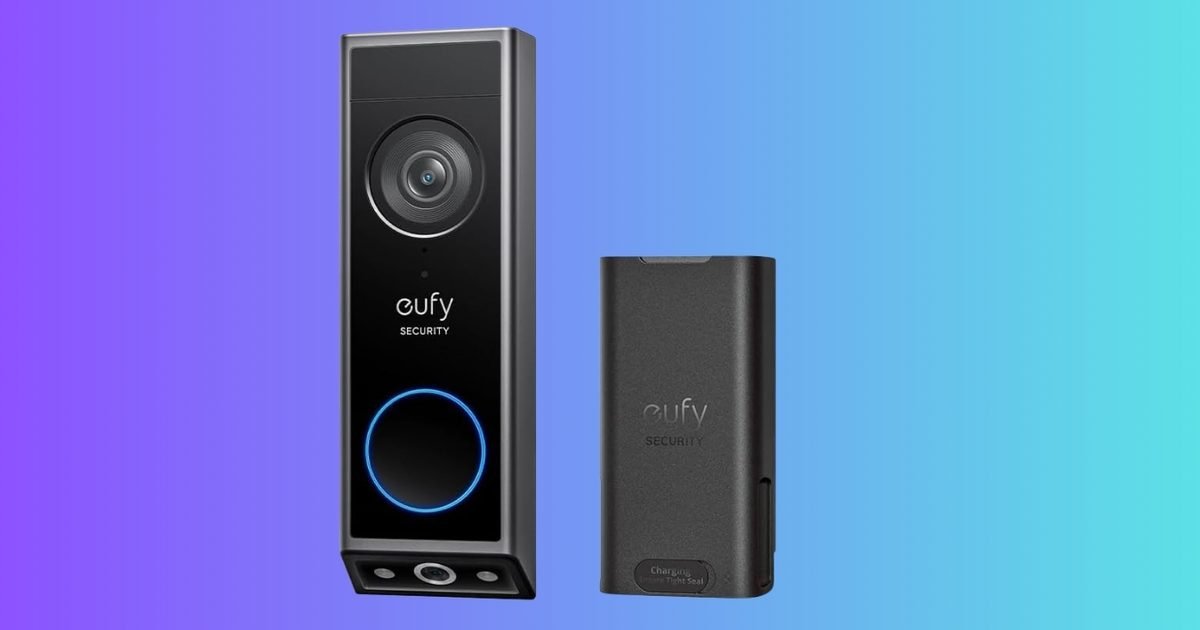
A video doorbell is one of those upgrades you appreciate the first time you miss a delivery, get a package notification, or want to see what’s happening without opening the door. The tricky part is that a lot of doorbells lock the best features behind a monthly fee. The eufy Security Video Doorbell E340 is built around the opposite idea. It’s $139.99 for a limited time, down from $199.99 for 30% off, without any monthly fees. If you want better visibility at your doorstep without committing to another subscription, this deal is worth a look.
What you’re getting
This is a battery-powered video doorbell with a rechargeable battery for easy installation and “uninterrupted use” positioning. The standout is the dual camera setup, which is typically meant to give you a better view of the full scene, including areas that single-camera doorbells can miss.
You’re also getting 2K Full HD video, which helps with clarity when you’re checking faces, reading labels, or reviewing what happened after the fact.
Why it’s worth it
The practical wins here are convenience and coverage. Battery-powered doorbells are great for renters or anyone who doesn’t want to mess with wiring. Dual cameras can be especially useful if you care about package visibility and want fewer blind spots near the ground.
The “no monthly fee” angle is also important. For a lot of people, paying $5–$10 a month forever is what turns a smart doorbell from a good idea into an annoying one. With this model, the pitch is simpler: buy it once, use it without the ongoing bill.
The bottom line
At $139.99, the eufy Video Doorbell E340 is a compelling limited-time deal if you want a dual-camera, 2K battery doorbell with a no-monthly-fee approach. If you’re fine paying ongoing subscription costs, you’ll have more brand options. But if “no monthly fee” is a priority and you want a straightforward front-door upgrade, this price cut is a good reason to move.
Valentine’s Day is around the corner, and cybersecurity experts warn that the season of love is also the peak season for romance scams. As people swipe, match, and open up online on dating apps and social media, scammers are using AI to scale fake relationships with speed and precision.
Such romance scams are spreading fast, and artificial intelligence is making them far more convincing than the awkward catfishing attempts of the past. What once felt easy to spot now looks thoughtful, emotionally tuned, and unsettlingly real scams. For victims, the damage is not just emotional. It is often financial, and sometimes life-altering.
Why romance scams are exploding
Mohammed Hassan / Pixabay
Romance scams have quietly become one of the most costly forms of online fraud. According to the US Federal Trade Commission, reported losses to romance scams totalled $1.14 billion in 2023, making them one of the most financially damaging scam categories tracked by the agency. Regulators say those losses continue to rise as scams become more sophisticated and harder to detect due to the use of AI.
What sets today’s scams apart is how quickly trust is built. Instead of manually crafting messages, scammers now use large language models (LLMs) to generate emotionally engaging conversations at scale. Messages feel attentive and deeply personal, even when they are sent to hundreds of people at once. Many victims do not realise anything is wrong until money enters the conversation.
How AI is changing the scam playbook
With the help of AI, scammers now adapt in real time, and send messages based on a target’s tone, interests, or vulnerabilities. Text-generation tools help mirror language and emotion, making conversations feel natural and responsive.
Voice cloning has added another layer of realism. With short audio samples, scammers can recreate a person’s voice to send convincing voice notes or calls.
Some groups are also experimenting with deepfake video chats, using AI-generated visuals or prerecorded footage to simulate live interaction. The result is a scam that feels authentic enough to bypass warning signs people once relied on.
The emotional hook and the money trap
Dall-E 2 / Digital Trends
Cybersecurity experts say most romance scams follow a familiar pattern. Darius Kingsley, Head of Consumer Business Practices at Chase Bank, says, “Online romantic acquaintances may approach unsuspecting victims to lure them in, either through friendly texts or on dating apps, then request money or propose an investment opportunity.”
Here is a practical checklist of warning signs you should look out for:
The person claims to live or work far away, often overseas.
Their profile looks unusually perfect or professionally curated.
The relationship escalates very quickly with intense emotional language.
Promises to meet in person are repeatedly delayed or cancelled.
Conversations shift toward money, investments, or financial emergencies.
Cryptocurrency or forex trading are mentioned early or framed as urgent.
You are pressured to use a specific payment method.
How to protect yourself before it’s too late
Digital Trends Graphic
Experts agree that prevention starts with slowing down because romance scams rely on urgency, secrecy, and emotional pressure.
According to Steve Grobman, Senior Vice President and Chief Technology Officer at McAfee, “a healthy dose of skepticism, combined with using the right tools to protect your privacy, identity, and personal information, is a good place to start.”
Here is a checklist to protect yourself from romance scams:
Take relationships slowly and be cautious of intense emotional bonding early on.
Verify identities by meeting them in person.
Ask the person to turn their head fully or wave a hand in front of their face during a video call. Many AI deepfake tools struggle with sudden or exaggerated movements.
Watch for visual glitches as faces can briefly distort, freeze, or lose alignment when the software fails to track motion correctly.
Be aware that advanced deepfakes may still pass these tests.
Never send money, gifts, or cryptocurrency to someone you have not met in person.
Reverse-image search profile photos to check for reused images.
Talk to friends or family about new online relationships.
Lock down social media privacy settings to limit misuse of your data.
Engin Akyurt / Unsplash
When people are emotionally invested, inconsistencies are easier to overlook. That is why scammers often discourage victims from discussing the relationship with friends or family, framing outside concern as jealousy or misunderstanding.
John Clay, Vice President of Threat Intelligence at Trend Micro, notes that scammers use urgency and isolation to bypass rational thinking, which is why outside perspectives of trusted family and friends are so important.
A caution for anyone dating online right now
Romance scams are not just evolving, they are becoming harder to recognise, with AI quietly doing much of the work behind the scenes. Valentine’s Day simply amplifies the risk as people seek connection and lower their guard.
While the technology driving these scams is changing fast, the core advice remains unchanged. Take your time. Verify who you are talking to. Be wary of the moment money, investments, or urgency enter the conversation, particularly if you have never met in person.
In an age where algorithms can convincingly simulate care and intimacy, trusting your instincts may still be the most important safeguard you have.
Sony has just introduced its latest flagship earbuds, the WF-1000XM6, touting better sound quality, noise cancellation performance, and an improved mic array, among other upgrades. The asking price is slightly higher at $330 this time around, while the older-gen WF-1000XM5 earbuds hit the shelves at $300 back in 2023.
As far as the changes go, Sony has updated the design with a focus on ergonomics, adjusted the ventilation structure, and delivered a slimmer body. As far as audio chops go, the new earbuds deliver 25% better noise cancellation compared to their predecessor, especially in the mid-to-high frequency range, thanks to the HD Noise Cancelling Processor QN3e. Sony says the updated earbuds also offer better passive noise isolation.
Sony
Coming to the sound quality, the dual-processor architecture levels up to 32-bit sound processing. Sony has also updated the diaphragm design to offer better bass and improved clarity. On the software side, you get perks such as Hi-Res Audio Wireless, DSEE Extreme, 360 Reality Audio compatibility, and a 10-band EQ customisable.
Another crucial upgrade is the dual-mic array and bone conduction system on each earbud. Other functionalities that round out the package include Adaptive Sound Control and an onboard voice assistant with Gemini Live support. Sony claims it has enhanced the antenna hardware on the WF-1000XM6 are 1.5 times bigger than their predecessor, to boost wireless connectivity.
Sony
The WF-1000XM6 are touted to last eight hours on a single charge, while the charging case adds another 16 hours of battery life. The charging case also offers support for wireless charging. The latest from Sony go head-to-head against the likes of Apple AirPods Pro 3 and the Bose QuietComfort Ultra earbuds. We will soon have a detailed review and side by side comparison of Sony’s latest with the best that the industry has to offer, so stay tuned for that!
Buying a new PC is getting more expensive, and Lenovo says the pressure is not easing anytime soon. The company has begun raising prices in some markets and is warning that a prolonged shortage of memory chips could continue to disrupt pricing and availability well beyond the near term.
According to Reuters, Lenovo says rising memory costs are creating real strain on the PC business. Memory chips are harder to secure, and price volatility is making it tougher to plan production.
Even where demand remains steady, shortages mean fewer parts are available at predictable prices, forcing companies to pass some of those costs on to buyers. Intel’s CEO recently echoed the same warning that the memory shortage is unlikely to ease anytime soon, sharing concerns that higher prices could stick around longer than expected.
A Bloomberg report adds important context to why the pressure is intensifying now. Lenovo’s recent sales exceeded expectations, partly because customers rushed to buy PCs ahead of anticipated memory price increases.
That rush helped boost Lenovo’s revenue in the short term, but executives warn that it does not reflect healthier long-term supply conditions.
Why memory is the real bottleneck
Harrison Broadbent / Unsplash
The core problem lies in where memory chips are going. Memory makers are prioritising supply for AI servers and data centres, where demand is booming, and margins are higher.
That has reduced the supply of standard DRAM and NAND used in laptops and desktops, reducing the availability for PC makers.
Lenovo has tried to protect itself by stockpiling memory and other key components and holding significantly higher inventory than usual. It helps keep production running, but it is not a long-term fix if shortages persist.
And it’s not just RAM prices that could stay high; experts warn that SSD storage costs might also rise, putting more pressure on overall PC pricing.
Reuters notes that analysts expect memory constraints to continue through 2026, keeping costs elevated across the hardware market. For consumers, that could mean fewer discounts and higher PC prices.
For Lenovo and other PC makers, it means navigating a market where AI demand is reshaping the economics of everyday computing. If you’re planning an upgrade, here are some better ways to optimize your existing memory.
Nvidia has started rolling out support for GeForce Now on Amazon’s Fire TV sticks, bringing the game streaming service to TVs. The shift was first announced in January earlier this year, with a beta test beginning for a select few models. Simply put, in order to enjoy PC games, you no longer need a console or PC handy at all times. Your Fire TV stick will do just fine.
What’s the big shift?
With the GeForce Now app landing on Amazon Fire TV sticks, you just need a controller and a stable internet connection to dive right into your PC games library. You can stream games at 1080p resolution with a peak 60fps frame rate, while the graphics quality is set to the standard dynamic range preset.
Nvidia
“GeForce NOW is powering up the living room with the launch of the GeForce NOW app on Amazon Fire TV streaming sticks, leveling up big-screen gaming with PC-quality performance,” says the company. The cloud-based game streaming service is now available on Fire TV Stick 4K Plus (2nd Gen), Fire TV Stick 4K Max (2nd Gen), and the Fire TV Stick 4K Max (1st Gen).
What do you need to get started?
In order to get started, just make sure that you have the following Fire TV Stick models with the right software build:
Fire TV Stick 4K Plus (2nd Gen) – Fire OS 8.1.6.0 and later versions Fire TV Stick 4K Max (2nd Gen) – Fire OS 8.1.6.0 and later versions Fire TV Stick 4K Max (1st Gen) – Fire OS 7.7.1.1 and later versions
The streamed games tap into the power of Nvidia’s GeForce RTX series GPUs for graphics rendering, and the company is promising PC-quality performance for your Fire TV setup. In addition to the Fire TV platform, Nvidia is also targeting Linux machines with a dedicated GeForce Now app. Lately, Linux has gained plenty of steam in the gaming community owing to the “Windows tax” on gaming performance.
The automobile industry is promising that autonomous vehicles will be much safer on the road with fewer errors made by human beings. However, despite being pretty advanced, self-driving cars’ interaction with human psychology hinders seamless usability. According to freshly published research, the gap is not due to a glitch in the system or the engineering, but between understanding the technology and optimizing it for human behavior behind the wheel.
Autonomous, at the cost of vigilance
Ronald McLeod, Honorary Professor of Engineering Psychology at Heriot-Watt University, writes in his book, “Transitioning to Autonomy“, that there is a massive communication gap in how self-driving systems communicate with humans. Many drivers have not felt at ease sitting behind the smart wheels, given that the car makes decisions on behalf of the human driver.
Tesl
The autonomous tech interface has often failed to clearly decipher what’s ahead, contrary to what the driver can see and perceive. For instance, the sudden appearance of an object or a person in front of the car can lead to a crash or trigger a technical error by the car, while the driver remains a front-seat spectator. The driver, unsure of the possible changes in the car’s reaction, is left questioning the system’s dependability.
Even a segment leader like Tesla hasn’t been able to figure it out, and there are numerous investigations following serious crash incidents involving cars with autopilot and full self-driving (FSD) systems engaged. Additionally, the company advises users that they should be ready to take control if they see the system going haywire.
This often adds to the anxiety about self-driving cars and how independent they truly are. Simply put, drivers can’t relax and are constantly anxious about subtle hints of danger in relying too much or being overly skeptical.
Anxious passenger in the driver’s seat
The constant stress on the human psyche with smart cars not only leads to the driver’s fatigue, but also makes them utterly sensitive to unexpected incidents with autonomous technology. It feels more like a trap of “watch and wait” for the drivers, as the driving ultimately is dependent on human supervision. Professor McLeod describes it as a vigilance task. The convenience of self-driving cars is linked to low attention by the driver, resulting in slower reaction time in emergencies.
Unsplash
Broadly, drivers face cognitive stress behind the wheel of an autonomous car. Brands like Tesla look forward to the creation of smart cars on a full swing, and this also requires focusing on bridging the gap between human psychology and self-driving systems. Expert assessments through AI models, such as Human-in-the-loop (HITL) presents a solid approach that includes human insight and their feedback related directly to autonomous driving technology. The book highlights the need for a solution to bridge this gap and create human-centric interfaces to make self-driving cars safer in the future.
Apple’s latest iOS 26 update introduces a handy new tool for anyone considering a switch from iPhone to Android. First spotted in a beta release last year, the feature lets users easily migrate data like messages, notes, photos, and contacts in just a few steps.
Previously, transferring data from an iPhone to an Android device required users to install Google’s Android Switch app. The new built-in tool makes the process far more seamless. Users only need to place their devices next to each other to get started. To connect them, they can either scan a QR code displayed on the Android phone using their iPhone or enter a session ID and pairing code.
Once connected, users can choose which data to migrate, including photos, messages, notes, apps, passwords, contacts, and more, and initiate the transfer. While easy to use and better than the app-based method, the tool does have some limitations. It does not transfer users’ health data, paired Bluetooth devices, and protected items such as locked notes. Both devices must also be running the latest software builds with Wi-Fi and Bluetooth enabled.
Breaking down ecosystem walls
The transfer tool is the result of a collaboration between Apple and Google to simplify data transfers for users switching between their ecosystems. Google has implemented a similar feature in Android, making it easier for users moving in the opposite direction to transfer their data to an iPhone.
The move is notable given how tightly Apple has historically guarded its ecosystem. Data portability has often been a point of friction for users considering switching platforms, with complicated transfer processes and cancerns about data loss acting as deterrents. It remains to be seen whether the simplified process will encourage more users to switch platforms.
RAD Intel’s Regulation A+ offering is currently open, with shares priced at $0.85. More details will be available starting February 23, ahead of a scheduled share price change on March 12 at 11:59pm PST.
RAD Intel has built an AI-enabled marketing tech that helps brands understand how people interact with content and predicts performance. The platform uses machine learning to spot patterns in audience behavior and turn them into insights teams can use to refine targeting, creative, and media strategy.
Brands want clearer signals on what is working, and RAD Intel is built to help teams create award-winning programs that mobilize their desired customers to take action. RAD Intel is raising funds through a Regulation A+ offering, which allows both accredited investors and everyday investors to participate. The company is backed by 15,000 investors including multiple Fidelity funds and early investment from insiders at Google, Meta and Amazon.
Unlike many traditional private fundraising rounds, Regulation A+ can broaden access by allowing more people to review the offering materials and decide whether the investment fits their own goals and comfort level with risk.
As with any early-stage investment, prospective investors should review the offering materials carefully, including the company’s financial disclosures and risk factors, and take time to understand the opportunity before the scheduled share price change.
Prospective investors can review the offering circular and related disclosures, including information about the company and the risks involved, before deciding whether to invest.
Disclaimer: This is a paid advertisement for RAD Intel made pursuant to Regulation A+ offering and involves risk, including the possible loss of principal. The valuation is set by the company and there is currently no public market for the company’s common stock. The Nasdaq ticker “RADI” has been reserved by RAD Intel, and any potential listing is subject to future regulatory approval and market conditions. Brand references reflect factual platform use and do not indicate an endorsement or sponsorship by the referenced companies. Please read the offering circular and related risks before investing.
Uber Eats is testing a new feature that tries to remove the most annoying part of ordering groceries, the endless searching and tapping. It’s called Cart Assistant, and it can take a typed list or an image and draft a basket for you inside the app.
It’s rolling out as a beta. You’ll see it as a purple icon on a grocery store storefront after you search for the store from the home screen.
Uber hasn’t said exactly which stores and cities get it first, or whether any devices are excluded. It frames the launch as a US release and an early step toward more agent-style help in Uber Eats, where the app handles setup and you handle decisions.
It turns notes into a basket
Cart Assistant is built for the moment you already know what you need. Paste in your grocery notes, or upload an image, including a photo of handwritten items or a screenshot of recipe ingredients, and the app translates that into shoppable picks.
As it drafts the basket, Uber says it checks store availability and surfaces store-level details like pricing and promotions. Then you can edit normally. Swap brands, adjust sizes, remove extras, or keep browsing before checkout.
Uber
Repeat orders get smarter
Uber says Cart Assistant uses your past orders to prioritize familiar staples, which should cut down the time it takes to restock the same basics each week. That’s the kind of AI that earns its keep, because it saves effort without changing how you shop.
It also hints at where Uber wants to go next. The company positions this beta as part of a broader move toward agentic AI, meaning the app can take on multi-step tasks and hand you a result you can still tweak.
Where it helps, and where it may not
You’ll notice Cart Assistant most on routine grocery runs, when you want a solid first draft and you’re happy to fine-tune the last details. It’s less about discovery and more about getting the boring part done.
There’s one catch Uber hasn’t addressed yet, image accuracy. How well it handles low light, cramped handwriting, or very specific branded ingredients will decide whether it feels like magic or like extra cleanup.
Treat it like a draft, not autopilot. If you spot the purple icon, try a short list first, then scale up once you trust its picks on sizes and brands.
Over-ear headphones have basically split into two camps: ultra-premium pairs that cost a fortune, and budget models that cut corners where you’ll notice it most (comfort, noise canceling, or battery). The Nothing Headphone (1) lands in the middle in a way that makes sense, especially with today’s price drop. It’s $239.00 for a limited time, down from $299.00 (20% off). If you want an everyday pair for commuting, work focus, and travel without paying top-shelf pricing, this deal is worth a look.
What you’re getting
These are wireless over-ear headphones with hybrid active noise canceling, six microphones, and a claimed 80 hours of playtime. That battery figure is the headline because it changes how you use them. You can treat them like a daily staple instead of something you’re constantly charging.
You’re also getting Hi-Res audio, KEF-tuned sound, and spatial sound support. Those aren’t just spec-sheet flexes. The tuning matters for how balanced the headphones feel across genres, while spatial features are there for people who like a wider, more “around you” presentation in supported content.
Why it’s worth it
This deal makes the most sense for people who wear headphones for long stretches. The combination of ANC and comfort fit is what determines whether over-ears become your default or end up in a drawer. Six mics is also a good sign for call quality, which matters if you’re taking meetings, chatting in Discord, or making quick calls on the go.
The other practical win is fast charging. You don’t need perfect habits when a quick top-up can rescue you before a commute or a flight.
The bottom line
At $239 for a limited time, the Nothing Headphone (1) is a smart pick if you want modern features (ANC, long battery life, solid mics, and audio tuning) in a comfortable daily-wear package. If you only need occasional listening, cheaper options will do. But if you live in headphones for work, travel, and downtime, this discount is a good reason to jump in.