Hyderabad: Telangana Labour and Mines Minister G Vivek Venkataswamy on Saturday, March 7, said that the state government is aiming to achieve a USD 3 trillion economy.
“To achieve this ambitious goal, the government is maintaining continuous engagement with industry leaders and stakeholders,” he said, while addressing the Confederation of Indian Industry (CII) annual meeting in Hyderabad.
Venkataswamy said the government is focused on skill development to prepare the youth for emerging industrial opportunities.
“The Employment Department has established Advanced Technology Centres (ATC) to train young people in line with the requirements of modern industries,” he said. The minister said that the Telangana government has also held discussions with the CII to identify the specific skills required for upcoming industries.
He observed that Telangana is witnessing a steady inflow of investments and several new industries are expected to be established in the state.
“In view of this, the government is making efforts to ensure the availability of a skilled workforce that can meet the future demands of industry. New training courses aligned with evolving industrial needs are also being introduced,” the minister added.
Venkataswamy stressed that while the government is committed to improving the ease of doing business, equal importance is being given to ensuring the speed of doing business so that investments can be implemented quickly.
He reminded the attendees that the industries must also comply with the regulations of the state. He urged industrial units to strictly adhere to safety guidelines and statutory norms prescribed by the Government of India and the Government of Telangana.
Referring to the recently introduced labour codes, he said that industries must ensure proper compliance to safeguard the interests of workers.
Venkataswamy added that the cost of following safety and statutory norms is minimal when compared to the losses that may arise due to negligence or non-compliance.
Recalling the contributions of former Union Minister Kaka Venkat Swamy, the minister noted that he had once proposed the introduction of pension schemes for private sector employees despite facing resistance from industries at that time.
“Today, such social security measures have proved to be highly beneficial for workers,” he said.
The minister called upon industries to actively cooperate with the government and comply with statutory regulations to ensure sustainable industrial growth and worker welfare in the state.
Hyderabad: The Telangana government is planning to levy a professional tax on the 11,000-odd private unaided schools and their teaching staff with a view to boost revenues of the state.
School Education Director Naveen Nicholas issued orders a couple of days ago to all the District Education Officers (DEO) to oversee the collection of property tax from private schools and their teaching staff, cautioning them that failure to collect the tax will attract disciplinary action.
He also warned that private unaided institutions not paying professional tax will face legal action.
Nicholas stated that as per the Telangana Professional Tax Act, 1987, all employees engaged in the education profession and various business professions need to pay professional tax. He also said that the owners of institutions and businesses engaging professionals need to deduct professional tax and deposit it with the state government.
As per reports, the Education Department has been working out the modalities of the tax initiative with the Department of Commercial Tax.
Reports state that if the professional tax is collected from private unaided institutions in the current financial year, which ends on March 31, the state’s exchequer will gain revenues.
There are also speculations about whether the state government is going to levy the professional tax in the current financial year, from the next year or retrospectively for the past few years.
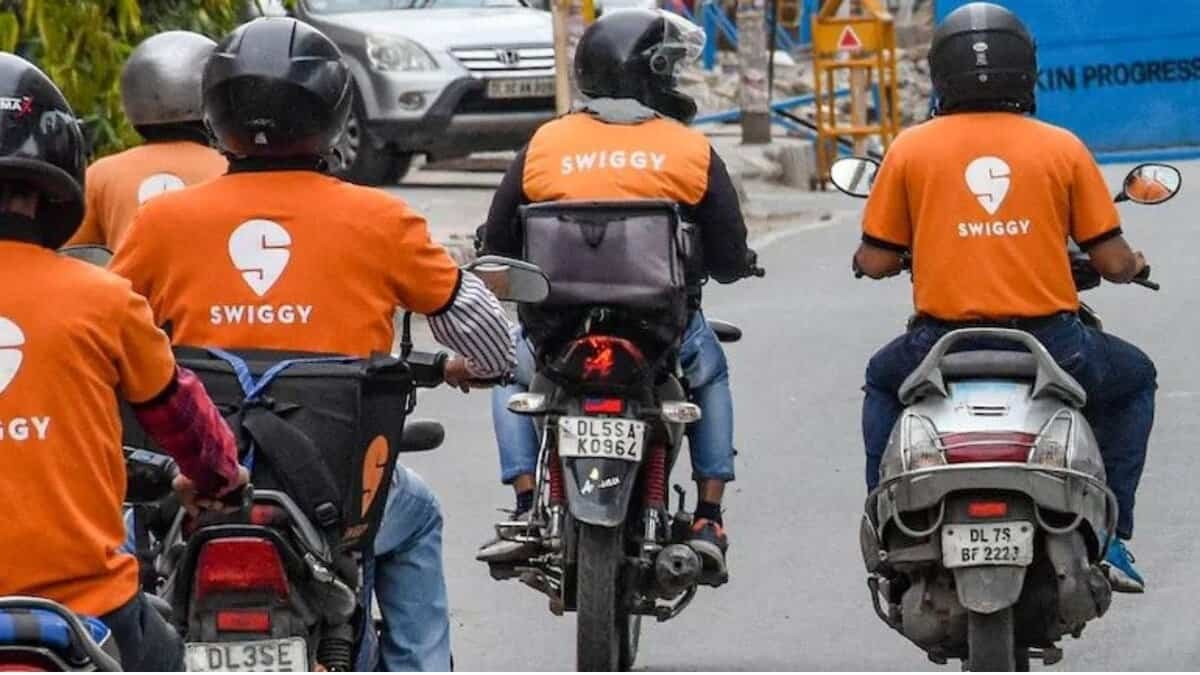
New Delhi: India’s top three food delivery players — Swiggy, magicpin and Zomato — regained growth momentum in the October-December period after a period of slower expansion, on strong order volumes led by festive demand, affordability-focused offerings and expanding user bases.
With continued investments in marketing, product innovation, and value-led propositions, industry executives said the sector expects the momentum in order growth to sustain in the coming quarters.
“It has been a phenomenal October-November-December quarter for us, marked by strong growth and sharper execution across markets. Our unit economics at an order level have improved by over 60 per cent, reflecting greater efficiency and improved monetisation,” magicpin Founder and CEO Anshoo Sharma told PTI.
While mature markets such as Delhi-NCR remained steady, the company reported more than 40 per cent growth in gross order value in cities, including Bengaluru, Hyderabad, and Mumbai.
The magicpin CEO said affordability-led consumption is a key growth driver, with an average order value of Rs 150-Rs 300 encouraging frequent ordering among users.
According to Swiggy’s Q3 FY26 shareholder letter, the company’s gross order value (GOV) grew 20.5 per cent year-on-year to Rs 8,959 crore, marking the fastest growth in the last three years.
Swiggy said the acceleration was driven by stronger adoption of new propositions across speed, selection and affordability. Its average monthly transacting user (MTU) base grew 22 per cent year-on-year to 24.3 million during the quarter from 17.8 million a year ago, while total orders rose to 294 million from 234 million during the period.
Zomato‘s food delivery business also reported improving growth trends during the quarter under review.
The company posted 16.6 per cent year-on-year net order value (NOV) growth at Rs 9,846 crore in the December quarter translating into 21.3 per cent growth in GOV.
This marked an acceleration from 13.8 per cent growth in the September quarter.
Its average monthly transacting users grew 21 per cent year-on-year to 24.9 million during the December quarter.
Executives also said the growth was increasingly coming from smaller cities as affordability-led offerings resonated strongly with consumers in tier-II and III markets.
New Delhi: The combined market valuation of eight of the top-10 most-valued firms eroded by Rs 2,81,581.53 crore last week, with the State Bank of India taking the biggest hit, in tandem with a weak trend in equities.
Last week, the BSE benchmark tanked 2,368.29 points, or 2.91 per cent.
“Markets ended the holiday-shortened week with steep losses as escalating geopolitical tensions in West Asia and a sharp spike in crude oil prices weighed heavily on investor sentiment,” Ajit Mishra, SVP, Research, Religare Broking Ltd, said.
From the top-10 pack, Reliance Industries and Infosys were the only gainers.
The market valuation of State Bank of India tumbled Rs 53,952.96 crore to Rs 10,55,567.27 crore.
ICICI Bank’s valuation eroded by Rs 46,936.82 crore to Rs 9,40,049.82 crore and that of HDFC Bank dived Rs 46,552.3 crore to Rs 13,19,107.08 crore.
The valuation of Larsen & Toubro tanked Rs 45,629.03 crore to Rs 5,43,208.36 crore.
The market capitalisation (mcap) of Bajaj Finance dropped by Rs 28,934.56 crore to Rs 5,91,136.03 crore and that of Tata Consultancy Services (TCS) diminished by Rs 28,492.44 crore to Rs 9,25,380.15 crore.
Hindustan Unilever’s mcap declined by 26,350.67 crore to Rs 5,23,042.51 crore and that of Bharti Airtel edged lower by Rs 4,732.75 crore to Rs 10,67,120.50 crore.
However, the market valuation of Reliance Industries jumped Rs 14,750.39 crore to Rs 19,01,583.05 crore.
The mcap of Infosys climbed Rs 3,459.99 crore to Rs 5,30,546.54 crore.
Reliance Industries remained the most valued domestic firm followed by HDFC Bank, Bharti Airtel, State Bank of India, ICICI Bank, TCS, Bajaj Finance, Larsen & Toubro, Infosys, and Hindustan Unilever.
New Delhi: Foreign investors pulled out Rs 21,000 crore (around USD 2.3 billion) from Indian equities over the last four trading sessions amid deteriorating global risk sentiment triggered by the West Asia crisis.
The latest sell-off comes after foreign portfolio investors (FPIs) infused Rs 22,615 crore into Indian equities in February, the highest monthly inflow in 17 months.
Prior to that, FPIs had been net sellers for three consecutive months. They withdrew Rs 35,962 crore in January, Rs 22,611 crore in December, and Rs 3,765 crore in November, according to data from the depositories.
The latest outflows occurred during March 2-6, when FPIs sold equities worth about Rs 21,000 crore in the cash market. March 3 was a trading holiday on account of Holi.
Market experts attributed the pullout primarily to the rising geopolitical tensions in West Asia. The US and Israel launched a major attack on Iran on February 28 which killed Iran’s Supreme Leader Ayatollah Ali Khamenei, triggering conflict in the region.
Vaqarjaved Khan, Senior Fundamental Analyst at Angel One, said fears of potential disruptions in the Strait of Hormuz pushed Brent crude prices above USD 90 per barrel, triggering a global risk-off sentiment.
Other factors contributing to the outflows include rupee depreciation beyond the 92-per-dollar level, elevated US Treasury yields drawing capital back to safe-haven assets, and mixed early outlook for Q4 FY26 corporate earnings, particularly margin pressures in the IT and consumption sectors, he added.
VK Vijayakumar, Chief Investment Strategist at Geojit Investments, said “uncertainty surrounding the Middle East conflict, the recent market correction, the Indian economy’s vulnerability to a sharp rise in crude prices, and the depreciation of the rupee have all contributed to sustained FPI selling in the cash market”.
Himanshu Srivastava, Principal Manager Research at Morningstar Investment Research India, noted that higher crude prices increase risks related to inflation, the current account deficit, and currency stability, which typically weigh on foreign investor sentiment toward emerging markets.
He added that global investors have also shifted towards safer assets such as the US dollar amid rising uncertainty. The recent uptick in US Treasury yields during the week further contributed to capital outflows from emerging markets.
Going ahead, Vijayakumar said FPIs are unlikely to return as buyers until there is greater clarity on the geopolitical situation and crude prices moderate.
“Brent crude trading above USD 90 per barrel is negative for the Indian economy and equity markets,” he said.
Despite the FPI selling, the market has continued to find support from domestic institutional investors (DIIs) and steady inflows through mutual fund systematic investment plans (SIPs).
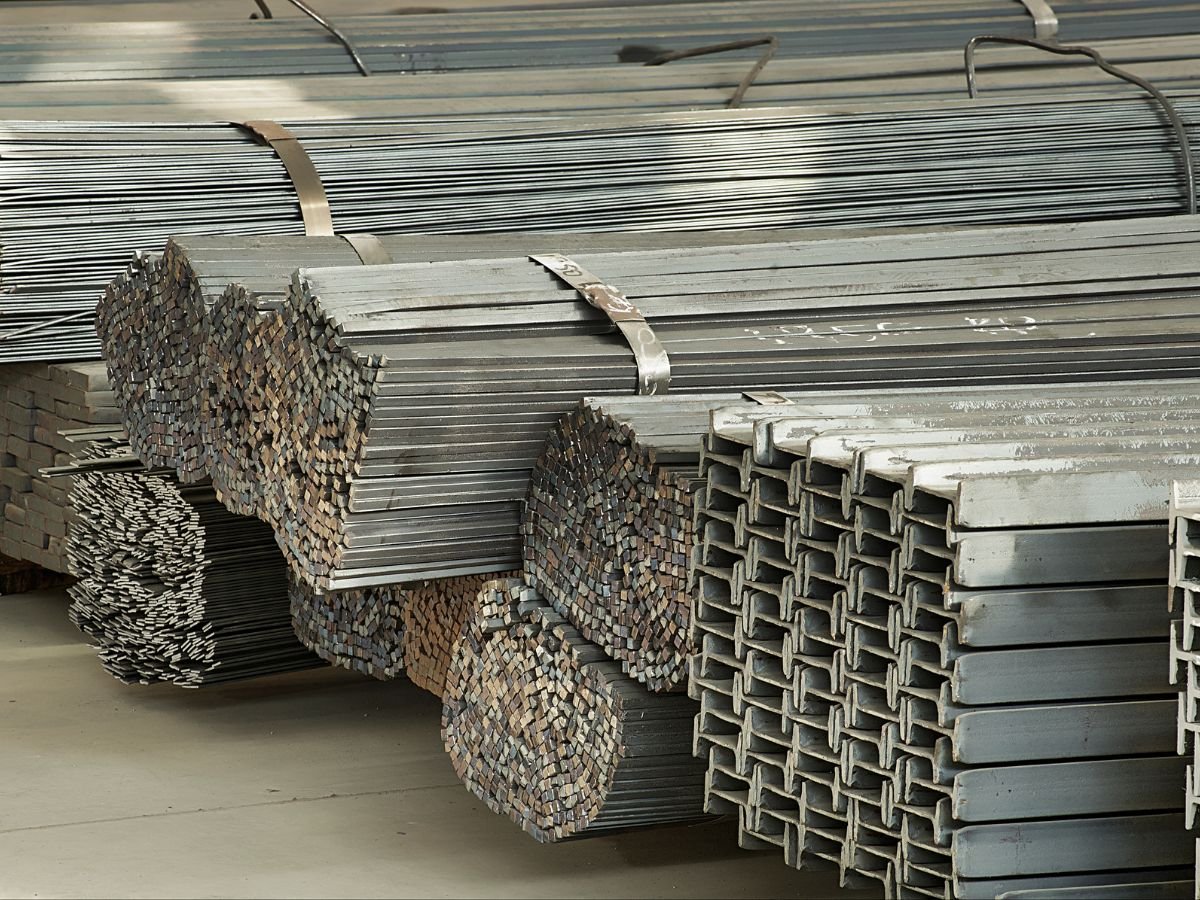
New Delhi: The global steel industry, including India, is expected to face multiple market-related issues in the coming days as the escalating crisis in the Middle East impacts fuels cost that has lead to increased freight rates, according to BigMint Research.
Military tensions in the region are increasing as both Iran, and the US, along with Israel, continue to attack each other.
BigMint analysts said crude oil, LNG, and freight costs are rising simultaneously, transmitting cost pressure directly into steel and steel-related commodity markets.
From an average of USD 70 a barrel before the war, crude oil prices have risen to about USD 90/per barrel, an analyst said, adding that the cost is expected to continue to rise in the coming days.
War has also impacted freight cost, which jumped almost 40 per cent in recent times. In the absence of insurance cover, marine operators are also offering freight at non-negotiable prices as per the availability of the vessel.
On the impact of the US-Iran conflict on steel markets, including India, they said the industry would face sustained input cost inflation across coal, scrap and ore, with freight and energy reinforcing one another.
“The players are expected to pass on the increased cost to customers. However, if market is not ready to absorb the cost, steel demand can also be affected,” an expert said.
Extended disruption could push prices of coking coal — a key steel making raw material — from major supplying markets such as Australia, Russia, and the US.
Increased input cost, coupled with higher freight cost, will also put pressure on the margins, the analysts added.
New Delhi: Gold prices are expected to remain volatile next week as investors track geopolitical developments in the Middle East and key macroeconomic data releases that could shape the sentiment in the domestic market, analysts said.
“Focus will again be on the developments in the Middle East and further escalation would be positive for gold prices, but a sign of de-escalation may trigger sharp selling,” Pranav Mer, Vice President, EBG – Commodity & Currency Research, JM Financial Services Ltd, said.
Mer added that silver is also undergoing a consolidation phase but remains highly volatile.
“Silver too is passing through a consolidation phase but trading with high volatility as gains are capped by consolidative moves in gold and industrial metals like Copper and Zinc,” he said.
During the past week, bullion futures witnessed sharp movements in the domestic market. On the Multi Commodity Exchange, silver plunged Rs 14,359, or 5.08 per cent, while gold slipped Rs 470, or 0.3 per cent.
“Gold prices consolidated in a broad range last week, in a range of Rs 1.59 lakh-1.70 lakh per 10 grams,” Prathamesh Mallya, DVP – Research, Non-Agri Commodities and Currencies, Angel One, said.
He added that geopolitical tensions, Asian demand, strong central bank purchases, elevated US Treasury bond yields and a firm dollar remain the key factors influencing price dynamics in the bullion market.
Globally, silver futures on the Comex slumped USD 8.98, or nearly 10 per cent, while gold prices fell USD 89.2, or 1.7 per cent, during the past week.
Gold has closed in the negative territory on a weekly basis amid rising demand for alternative safe-haven assets such as the US dollar, Franc, and Bonds, though the downside remains capped by ongoing geopolitical escalation in the Middle East, Mer said.
Geopolitical tensions remained elevated after the Israeli military said it is moving to the “next phase” of its campaign against Iran. Meanwhile, Defence Secretary Pete Hegseth said the amount of firepower in the region “is about to surge dramatically,” following Britain’s decision to allow the US armed forces to use its military installations.
Analysts noted that major global Exchange Traded Funds (ETFs) are witnessing outflows as traders, especially from the Middle East region, look to book profits or raise liquidity amid the escalating conflict. At the same time, surging energy prices have reduced expectations of a near-term interest rate cut by the US Federal Reserve at its June meeting.
Investors will watch key releases, including China’s inflation and trade data, and inflation readings from the US, Germany, and India. Later in the week, provisional GDP, Personal Consumption Expenditures (PCE) price index and US consumer sentiment will guide the global growth and monetary policy outlook, they added.
Mumbai: Stock market benchmark indices Sensex and Nifty tumbled nearly 3 per cent in early trade on Monday, March 9, as boiling crude oil prices and bearish trend in global equities weighed heavily on investors’ sentiment.
Besides, relentless foreign fund outflows also made investors jittery.
The 30-share BSE Sensex crashed 2,345.89 points or 2.97 per cent to 76,573.01 in early trade. The 50-share NSE Nifty tumbled 708.75 points or 2.89 per cent to 23,741.70.
All the 30-Sensex firms were trading lower. InterGlobe Aviation traded nearly 8 per cent lower. Tata Steel, Maruti, State Bank of India, Eternal, Asian Paints and ICICI Bank were also among the major laggards.
Brent crude, the global oil benchmark, jumped 23.63 per cent to USD 114.59 per barrel.
“Brent crude has spiked above $115 delivering a big oil shock to economies and markets. Big oil importers like India will be hit hard if the West Asian conflict lingers long and crude price remains high,” VK Vijayakumar, Chief Investment Strategist, Geojit Investments Limited, said.
In Asian markets, South Korea‘s Kospi tumbled over 7 per cent and Japan’s Nikkei 225 dropped 6.5 per cent. Shanghai’s SSE Composite index and Hong Kong’s Hang Seng index were also quoting lower.
The US market ended lower on Friday.
Foreign Institutional Investors (FIIs) offloaded equities worth Rs 6,030.38 crore on Friday, according to exchange data. Domestic Institutional Investors (DIIs) bought stocks worth Rs 6,971.51 crore in the previous trade.
On Friday, the Sensex tumbled 1,097 points or 1.37 per cent to settle at 78,918.90. The Nifty dropped 315.45 points or 1.27 per cent to end at 24,450.45.
Last week, the BSE benchmark tanked 2,368.29 points or 2.91 per cent, and the Nifty declined 728.2 points or 2.89 per cent.
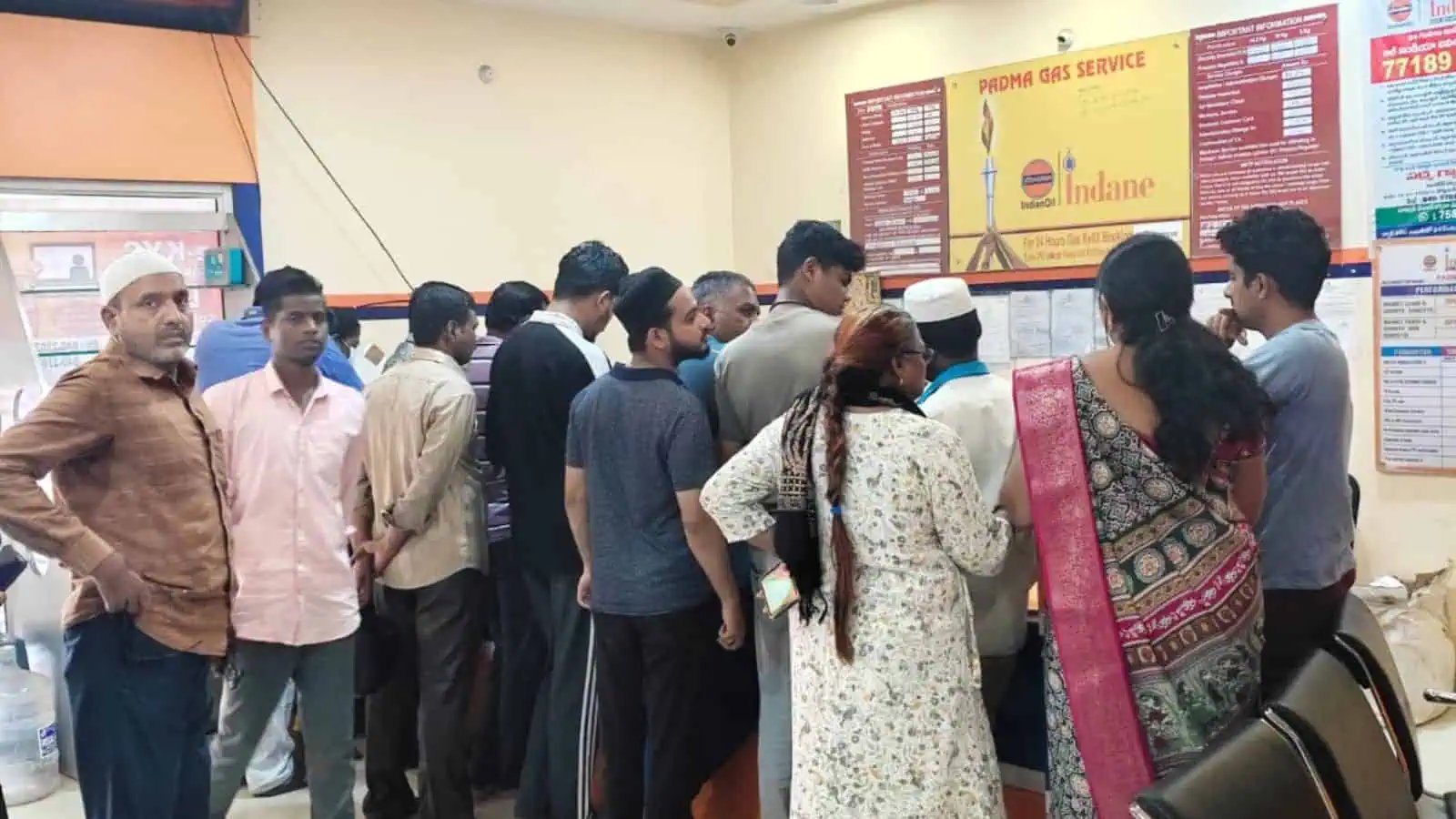
Asma Sultana and her son Faizan had been sitting at a gas agency in Warasiguda since Wednesday afternoon, March 11, looking visibly anxious. Their spare cylinder was empty, and the one in use had been booked almost a month ago. Every time they tried booking a new one, the automated call cut off before they could complete it. Around them, the agency was just as crowded, with dozens of residents, all with the same problem, getting the same unhelpful answer from the staff – network issue, please wait.
This is Hyderabad’s latest panic.
Since Tuesday evening, March 10, gas agencies across the city have been overwhelmed by domestic liquefied petroleum gas (LPG) users scrambling to stock up, driven largely by rumours circulating on social media that a shortage of cooking gas is imminent, triggered by the ongoing conflict in West Asia.
What set off the rush
Three things seem to have come together to stoke the fear. One, word spread about a 25-day waiting period being imposed between consecutive cylinder bookings. Two, there were reports of LPG supply being diverted from commercial to domestic use. And three, the spectre of a commercial cylinder shortage spooked even those with no immediate need.
The timing hasn’t helped. With only 10 days left for Ramzan to end and Eid-Ul-Fitr just around the corner, Muslim households, who account for a significant chunk of the city’s population, are particularly on edge. The kitchen is going to be working overtime for the festivities, and the last thing anyone wants is to be caught without gas.
On the ground
At the Warasiguda agency, the scenes were telling. One woman arrived lugging an empty cylinder with her son in tow. Her gas connection was registered in her mother-in-law’s name in Kazipet. When the delivery boy went to the registered address, the elderly woman couldn’t read the one-time password (OTP) off her phone, so he simply left. For the past two days, the family has been cooking on firewood, she told Siasat.com.
Her case was one of several where small, fixable problems, such as wrong registered numbers, incomplete know your customer (KYC) and OTP issues, had snowballed into genuine hardship, made worse by the panic around them.
No shortage, for now
Praveen, a representative at Padma Gas Service in Warasiguda, said categorically that as of Wednesday, there is no shortage of domestic LPG cylinders. Cylinders booked on March 7 had already been delivered. Across companies, the current wait time for domestic cylinders is three to four days, which is manageable, if not ideal.
But here’s the catch. Bookings at his agency have shot up by 50 per cent over the last few days. This, he told Siasat.com, is a direct result of social media rumours. People who still have a cylinder in use are booking spares. The demand spike is real, even if the shortage isn’t. At least not yet.
According to a gas official, who did not want to be named, if the war in Iran continues for another week, there is likely to be a domestic LPG shortage.
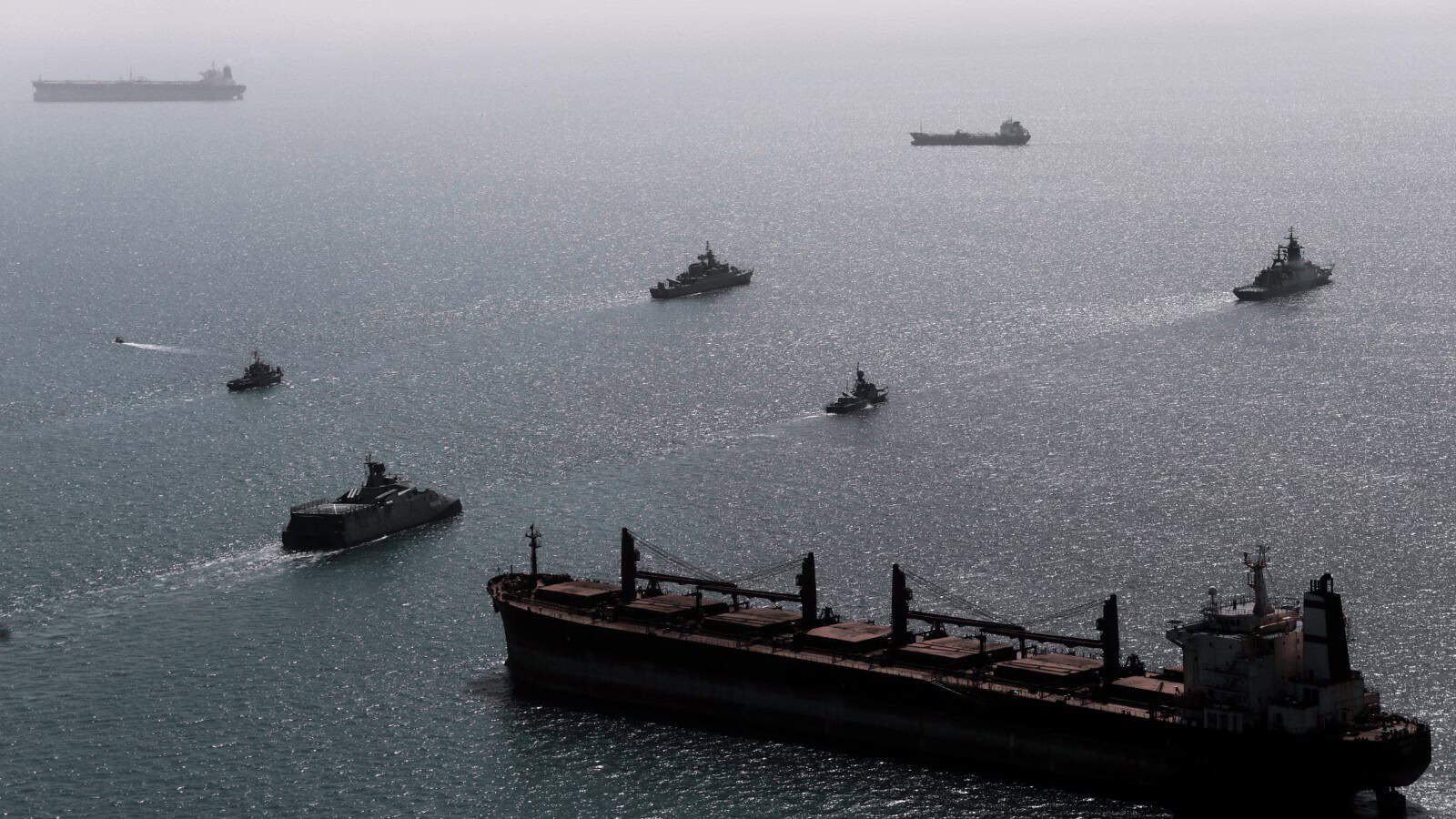
India imports most of its domestic demand of LPG from West Asian countries like the United Arab Emirates (UAE), Qatar, Saudi Arabia and Kuwait, transported through the Strait of Hormuz in Iran, which is effectively closed since February 28.
Demand-supply gap
Jagan Mohan Reddy, president of the Telangana Gas Dealers Association, offers a more sobering view. Domestic LPG accounts for 86 per cent of total usage in the state, with an annual requirement of 1.16 million metric tonnes, which is growing at 8 per cent every year. There is already a 25 to 30 per cent supply gap, with the government able to bridge only 10 to 12 per cent of it.
“The main focus remains on domestic LPG usage,” he told Siasat.com.
“Around 55 per cent of imports have been disrupted due to the conflict,” he added. “Even if the war ends tomorrow, it will take at least two to three months to restore normalcy.”
Precautionary measures
Reddy’s advice is, stretch your cylinder to last 60 days by cooking conservatively and explore alternative methods where possible. More importantly, he stresses discipline. Booking only through your registered mobile number, insisting on OTP-based delivery and getting your KYC done if you haven’t already. Non-compliance is how cylinders end up at the wrong address.
The induction stove option
Not everyone is waiting around for things to sort themselves out. At Vijay Sales in Nallakunta, sales executive Zubair said the showroom has already sold three to four induction stoves since Tuesday morning, which is unusual for a regular weekday. By Tuesday evening, interest picked up further.
On quick e-commerce platforms like Swiggy Instamart and Blinkit, induction cookware is in the “trending” list, which users say has never been the case before.
Induction stoves, which work with cookware that has a compatible base, are seeing a quiet surge as residents look for a Plan B.
It may be the most practical response to a problem that, for now, is still more rumour than reality, but one that nobody in Hyderabad’s kitchens is taking any chances with.
New York: The US has urged India to buy Russian oil already floating at sea and redirect it to Indian refineries to “tamp down” fears of supply shortages and price spikes amid the ongoing West Asia conflict, Energy Secretary Chris Wright has said.
However, the move, he said, is a short-term, pragmatic effort to stabilise the market and did not signal any change in Washington‘s policy towards Russia.
In an interview with CNN on Sunday, Wright said he, along with Treasury Secretary Scott Bessent, had spoken to Indian authorities about buying Russian crude cargoes currently waiting to be unloaded at Chinese refineries.
“India has been a great partner through this. I did call up the Indians, as did Treasury Secretary (Scott) Bessent, and said there’s a whole bunch of oil floating waiting to unload at Chinese refineries.
“Instead of having it wait six weeks to unload there, let’s just pull that oil forward, have it land in Indian refineries and tamp this fear of shortage of oil, tamp the price spikes and the concerns we see in the marketplace,” he said.
However, the US policy towards Russia has not changed at all, Wright said, adding that “India is very clear on that”.