Chennai: French automaker Renault is entering a new phase of growth in India with the re-launch of the mid-sized sports utility vehicle Duster, Renault Group Chief Growth Officer & CEO Fabrice Cambolive said on Monday, January 26.
The automaker, which currently sells models like Kwid, Kiger and Triber in the country, unveiled new Duster which would compete with the likes of Maruti Grand Vitara, Kia Seltos, Hyundai Creta, and Tata Sierra in one of the most competitive segments in the domestic passenger vehicle segment.
“Over the last few years, we have focused our presence in key regions such as Latin America, Korea, Turkey, Morocco, and, of course, India, proving that Renault can compete at the highest level internationally, and today, here in India, we are entering a new phase of acceleration within our international game plan 2027,” Cambolive stated.
He added that India is a key pillar of growth beyond Europe for the automaker.
“A few months ago, Renault group became the full owner of the Chennai manufacturing plant, a site renowned for its quality, competitiveness and operational excellence,” Cambolive said.
This step strengthens a solid ecosystem already in place and built on three pillars, a major engineering hub supporting vehicle development and adaptation for local and global markets, he said.
Renault Group has acquired the remaining 51 per cent stake in the Chennai plant (RNAIPL), previously held by Nissan. Renault Group now fully owns the plant.
Cambolive noted that the appointment of Stephane Deblaise as Chief Executive Officer of Renault Group in India will ensure strong leadership and clear alignment across all activities.
“This integration allows us to move faster, to be closer to customers and to deliver great cars for Indian consumers and around the world,” he said.
This makes India one of the most complete and powerful setups in the company’s global network, he added.
“Today, we are opening a new chapter with the unveiling of the new Duster,” he said.
Renault has always been and will continue to be a global brand, he added.
The company is a key player in hybrid and electric technologies, driving the energy transition, he said.
Renault India stopped production of the Duster at its Sriperumbudur plant in 2022, ten years after rolling out the first unit in July 2012.
New Delhi: Multiplex operator PVR INOX on Monday said it will divest its premium snacking business under the 4700BC brand to FMCG major Marico Ltd in an all-cash transaction valued at Rs 226.8 crore, a move aimed at reducing debt and sharpening focus on its core cinema operations.
PVR INOX expects this deal to “be completed within 30 days from the date of definitive agreements,” following which the leading film exhibitor will become a “negligible debt” company, its CFO Gaurav Sharma told PTI.
The company’s board has approved the sale of its 93.27 per cent stake in Zea Maize Pvt Ltd (ZMPL), which owns the 4700BC brand, according to a regulatory filing.
“This exit is in line with our strategy of strengthening the balance sheet by monetising assets or mature investments and improving capital efficiency,” he said.
Created after the merger of PVR and INOX in February 2023, the company has been pivoting towards an asset-light model over the past three years, with a focus on reducing capex intensity and debt levels.
“So post this divestment, the proceeds will be used towards further reducing the debt and redeploying the capital in our core business. We will be a negligible net debt company after this transaction is completed,” he said.
ZMPL reported a turnover of Rs 98.66 crore, contributing 1.71 per cent to PVR INOX’s consolidated topline.
However, Sharma noted that despite strong revenue growth, the subsidiary has been loss-making at both EBITDA and PAT levels.
“This subsidiary ZMPL has been doing very well in terms of revenue, but it has been a loss-making subsidiary, both in terms of EBITDA and PAT,” said Sharma, adding, “the next phase of growth for this company requires a significant amount of capital, as well as FMCG expertise in terms of wider distribution network, product expansion capabilities”.
So from PVR INOX’s perspective, this exit is in line with its strategy of strengthening its balance sheet by monetising assets.
4700BC is one of India’s leading premium gourmet snacking brands, renowned for its popcorn and range of innovative snack offerings such as popped chips, makhana, crunchy corn, and nachos.
“PVR INOX has monetised its entire investment in its subsidiary ZMPL to Marico Ltd in an all-cash transaction for a total consideration of Rs 226.8 crore,” said a joint statement from PVR INOX and Marico.
Upon completion of the said sale, ZMPL would cease to be a subsidiary of PVR Inox, it added.
“We have invested about Rs 94.6 crore as equity in 4700BC over time and this transaction has delivered a healthy return. This Rs 226.8 crore (deal size) translates to an IRR (Internal Rate of Return) of about 24.5 per cent on PBR INOX total equity investment,” he said.
Confirming the development, Marico said it has “signed definitive agreements to acquire 93.27 per cent stake” in ZMPL from PVR INOX which owns “4700BC”, one of India’s leading premium gourmet snacking brands, renowned for its popcorn and range of innovative snack offerings such as popped chips, makhana, crunchy corn and nachos.
“Going forward, 4700BC will focus on driving accelerated growth through new product launches across emerging snacking segments, strengthening its multi-channel distribution network, and building a differentiated premium brand anchored in innovation,” said Marico.
PVR INOX is monetising its non-core assets as per the ongoing strategic review by the leading cinema exhibitor to strengthen the balance sheet and reallocate resources towards its core cinema exhibition business.
It has also closed non-performing screens and, according to Sharma, the process is over now.
Moreover, “current arrangement for the sale of popcorn at 47 kiosks that are placed in some of our select locations will continue on the same terms that are there currently at an arm’s length basis,” he said, adding that this does not constitute a material share of PVR INOX’s overall F&B revenue.
PVR INOX Managing Director Ajay Bijli said this transaction represents a “natural culmination of our strategic role and enables us to monetise a non-core asset”.
“We recognised the potential in 4700BC at a very early stage and supported the brand through its formative years. From a niche gourmet popcorn offering, it has grown into a nationally recognised premium snacking brand. As it looks to scale further and broaden its ambition, the brand is well positioned under the stewardship of a scaled FMCG leader like Marico,” he said.
Marico MD and CEO Saugata Gupta said, “The investment in 4700BC aligns well with Marico’s ambition to participate in fast-growing food categories through distinctive, future-ready brands. We see immense potential in 4700BC as a premium snacking brand with deep consumer connect and proven execution.”
The company, which owns popular brands as Saffola, Parachute, and Livon, will leverage 4700BC with its “existing scale in foods to broaden the brand’s presence across channels,” he said.
Mariwala-family promoted firm is expanding its play in food and premium personal care, where it expects them to contribute 25 per cent of its domestic revenue in the next three years.
Marico operates in the growing healthy, premium, and functional foods segment with brands such as Saffola, True Elements, Plix, and others. It had crossed the milestone of becoming a Rs 10,000-crore revenue company in FY25, and now it is aiming to be a Rs 20,000-crore company by 2030, growing its revenue two-fold in the next five years.
PVR INOX operates 1,783 screens across 357 properties in 112 cities in India and Sri Lanka.
New Delhi: Adani Group and Brazilian aerospace major Embraer are set to announce next week the plan to set up a final assembly line for civilian aircraft in India, a significant push for the efforts to make planes in the country.
India is one of the world’s fastest growing civil aviation markets and air traffic demand is rising, with airlines expanding their fleets and new airports coming up.
A Memorandum of Understanding (MoU) wil be inked by executives of Adani Defence and Aerospace, and Embraer in the presence of Civil Aviation Minister K Rammohan Naidu on January 27 in the national capital. The plan is for setting up the Final Assembly Line (FAL) for making Embraer jets in the country, according to sources.
Embraer makes commercial jets with up to 150 seats.
With the FAL, Adani Group, which already has good presence in the fast-growing Indian aviation space, will be making its foray into building aircraft in India.
One of the sources said that in due course after the operationalisation of the FAL, Adani Group is also likely to start manufacturing the aircraft components.
In an invitation sent out jointly by the two companies for a media briefing in the national capital on January 27, they said “a historic development in India’s commercial aviation ‘Make in India’s journey will be announced”.
Seeking to capitalise on the huge growth opportunities in the Indian market, Embraer, in October 2025, opened its new office in the national capital.
The venture with the Adani Group will be a major fillip for the Brazilian major in India’s civil aviation space where it aims to provide cost-competitiveness with its regional jets.
Currently, Embraer, whose E-Jets began operations in India in 2005, has nearly 50 aircraft in the country serving the Indian Air Force, government agencies, business jet operators and commercial airline Star Air.
The Indian market is expected to require at least 500 aircraft in the 80-146 seat range over the next 20 years, Embraer said in a release on January 21.
In 2024, Embraer Defense & Security and Mahindra Defence Systems inked an MoU to evaluate the opportunity to jointly pursue the Indian Air Force’s Medium Transport Aircraft (MTA) programme with the C-390 Millennium.
The company is looking to strengthen its presence in the country’s commercial aviation, defence, business aviation, services and support, and urban air mobility segments.
The government is also working on ways to boost civilian aerospace manufacturing as maintenance activities in the country.
In November 2025, French major Safran said its maintenance, repair and overhaul facility for the LEAP engines will be operational this year.
New Delhi: India and the European Union are set to announce on January 27 the conclusion of negotiations and finalisation of a free trade agreement, which is aimed at boosting economic ties between the two regions amid disruptions in global trade due to US tariffs, an official said.
The pact is nearing the finishing line after 18 years. The talks started in 2007.
Commerce and Industry Minister Piyush Goyal has termed this free trade agreement (FTA) “mother of all deals” the country has signed so far.
The conclusion of talks for the agreement will be announced in the India-EU (European Union) Summit here, the official said.
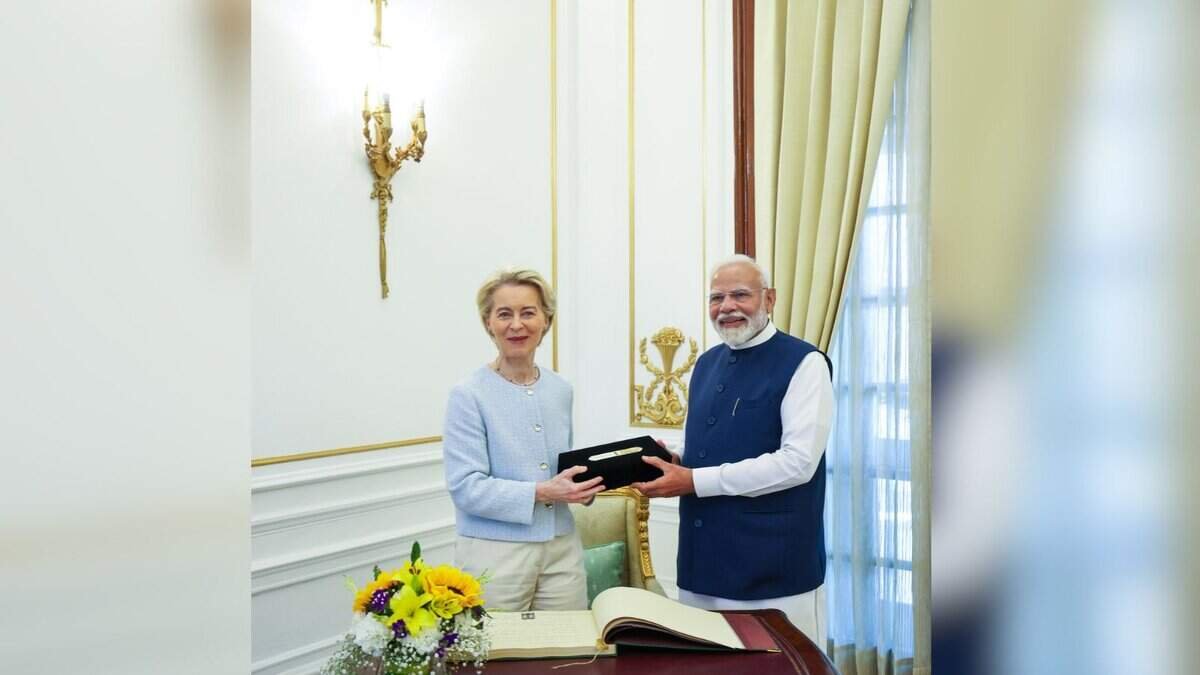
European Commission President Ursula von der Leyen landed here on January 24 for a four-day visit. President of the European Council Antonio Costa and von der Leyen will hold summit talks with Prime Minister Narendra Modi on January 27.
While India and the 27-nation bloc EU will announce closure of FTA talks this week, it will be signed after legal vetting of the text on a mutually agreed date. Implementation of the deal may take some time as it requires approval of the EU parliament. In India, it requires the nod of the Union cabinet only.
In such pacts, two sides reduce or eliminate import duties on over 90 per cent of goods traded between them. On a number of products (like from labour intensive sectors such as textiles and footwear), duties get eliminated immediately on the first day of implementation of a trade pact. On certain items, the duty gets eliminated or reduced in a phased manner over five, seven or ten years.
The two sides also provide quota-based market access for certain sectors like alcoholic beverages and automobiles (in case of trade deals with Australia and the UK), while no duty cuts are extended for sensitive goods like some agri products to protect small and marginal farmers.
Besides, an FTA also liberalises norms to promote trade in services sectors such as telecommunications, transportation, accounting, and auditing.
The NDA government has finalised seven trade pacts since 2014: Australia, the UK, Oman, New Zealand, the UAE, the EFTA bloc, and Mauritius.
Before that, several pacts were implemented, and those include the 10-nation Asean (Association of Southeast Asian Nations) bloc, Japan, South Korea, Malaysia, SAFTA (South Asia Free Trade Agreement), and Singapore.
India’s pact with the EU will be the biggest, as the bloc comprises 27 developed countries. The EU includes France, Germany, Spain, Italy, Austria, Belgium, Bulgaria, Finland, Hungary, Ireland, the Netherlands, Portugal, Poland, Denmark, and Sweden.
This pact is important, as the US’ imposition of high tariffs has disrupted global trade flows. India is facing steep 50 per cent tariffs. The FTA is expected to help Indian exporters diversify their shipments. It will also help reduce dependence on China.
The EU market accounts for about 17 per cent of India’s total exports, and the bloc’s exports to India constitute 9 per cent of its total overseas shipments.
India’s bilateral trade in goods with the EU was USD 136.53 billion in 2024-25 (exports worth USD 75.85 billion and imports worth USD 60.68 billion), making the EU India’s largest goods trading partner. The services trade in 2024 was USD 83.10 billion.
As per reports, the EU, with a GDP of about USD 20 trillion and a population of over 450 million, is the major global trade player, exporting about USD 2.9 trillion and importing more than USD 2.6 trillion annually.
India, with a population of 1.4 billion, exported USD 437 billion in goods and USD 387.5 billion in services. It imported goods worth USD 720 billion and services worth USD 195 billion in 2024-25.
India is looking at zero-duty market access for its labour-intensive sectors such as textiles, leather, handlooms, and some processed foods. The EU, on the other hand, is seeking greater access to Indian markets for its auto exports, wines, and emerging high-tech manufacturing sectors.
Sensitive agriculture issues have been kept out of the deal. The EU has been protective of its beef, sugar and rice markets.
India, on the other hand, has protected its farm and dairy sectors from competition, as the livelihoods of large numbers of small and marginal farmers depend on them.
Dairy has been excluded from all FTAs that India has signed so far.
India’s major goods exports to EU in FY2025 included petroleum products (USD 15 billion); electronics (USD 11.3 billion – smartphone USD 4.3 billion); textiles (USD 1.6 billion – garments USD 4.5 billion); machinery, computer (USD 5 billion); organic chemicals (USD 5.1 billion); iron and steel (USD 4.9 billion), gems and Jewellery (USD 2.5 billion); pharma (USD 3 billion); auto parts (USD 1.6 billion); footwear (USD 809 million); and coffee (USD 775 million).
The main imports included machinery, computer (USD 13.0 billion); electronics (USD 9.4 billion – mobile phone parts-USD 3.7 billion, ICs USD 890.5 million); aircraft (USD 6.3 billion); medical devices, scientific instruments (USD 3.8 billion); gems and jewellery (USD 3 billion – rough diamonds USD 1.7 billion); organic chemicals (USD 2.3 billion); plastics (USD 2.3 billion).
India’s key services exports to the EU were other business services, telecommunication and IT, transportation services. Imports included intellectual property services, telecommunication and IT.
The EU is also a major investor in India. India’s cumulative FDI inflows from the EU during April 2000 to September 2024 were USD 117.4 billion with 6,000 EU firms present in India. FDI from the EU represented over 16.5 per cent of the cumulative amount of FDI equity inflows from all countries.
India’s FDI outflows to the EU are valued at about USD 40.04 billion from April 2000 to March 2024.
New Delhi: Stock market is gearing up for an eventful week ahead where key triggers such as quarterly earnings from corporates, the US Fed interest rate decision and the upcoming Union Budget for 2026-27 would grab the limelight, analysts said.
Equity markets would be closed on Monday for Republic Day.
Moreover, trading activity of foreign investors, rupee-dollar trend and global trade related developments would also influence trading in the markets, experts said.
The Union Budget will be presented by Finance Minister Nirmala Sitharaman on February 1. The NSE and BSE will conduct live trading on Sunday, February 1, when the Budget is presented.
“This week is packed with important domestic and global triggers. On the domestic front, markets will track industrial production data, government budget-related fiscal indicators, and weekly foreign exchange reserves.
“The earnings season will also gain momentum, with key results from heavyweights such as Axis Bank, L&T, Maruti Suzuki, ITC, NTPC, and Bajaj Auto,” Ajit Mishra – SVP, Research, Religare Broking Ltd, said.
Globally, focus will remain on key US macroeconomic releases and, more importantly, the US Federal Reserve’s interest rate decision, along with ongoing developments in global trade policies and central bank commentary, he added.
The rupee hit a historic low of 92-a-dollar on Friday.
“FPIs not only continued their selling spree in the week ended 23rd January, but also increased the intensity of their selling. Sentiments remained very weak due to a combination of factors such as sustained rupee depreciation, lack of any finality regarding US-India trade deal and unimpressive Q3 results, so far, which are not indicating any pick up in corporate earnings,” VK Vijayakumar, Chief Investment Strategist, Geojit Investments Limited, said.
Trend in global equity markets and crude oil movement would also be tracked by investors.
“The upcoming truncated week shortened by the Republic Day holiday on Monday kickstarts a critical phase. Trading resumes Tuesday with a potentially positive trigger from the India-EU FTA developments slated for January 27th. However, geopolitical uncertainties regarding Iran and Greenland remain significant headwinds,” Santosh Meena, Head of Research at Swastika Investmart Ltd, said.
As global triggers previously took center stage, the narrative is now expected to shift toward the Union Budget. Markets will be scanning for growth-oriented measures to revive domestic and global investor sentiment, he said.
“As markets head into the pre-Budget and monthly derivatives expiry week, a mild technical rebound cannot be ruled out. Elevated FII short positions, oversold momentum indicators, and pre-Budget positioning could trigger bouts of short-covering,” Ponmudi R, CEO – Enrich Money, an online trading and wealth tech firm, said.
He further said that investor expectations from the Union Budget are anchored around fiscal prudence, with the fiscal deficit seen at around 4.2–4.3 per cent of GDP, alongside a continued thrust on capital expenditure—particularly in infrastructure, defence, and railways.
“Markets are also factoring in modest tax rationalisation, targeted sectoral incentives, and policy measures to support MSMEs and export-oriented sectors in the face of tariff-related challenges. Reforms aimed at improving capital market depth and efficiency also feature prominently on the investor wishlist, as participants look for policy clarity to anchor sentiment amid an uncertain global backdrop,” Ponmudi said.
Last week, the BSE benchmark tanked 2,032.65 points or 2.43 per cent, and the NSE Nifty declined by 645.7 points or 2.51 per cent.
Weak global cues, persistent FII outflows, a depreciating rupee, and subdued corporate earnings kept pressure elevated throughout the last week, Mishra of Religare Broking Ltd, said.
Sachin Neema, Fund Manager at Garud Investment Managers, said, while the ongoing earnings season has been a mixed bag so far, all eyes will be on the FM’s Budget speech on February 1 and its proposals for sectors given the delay in US-India trade agreement and the falling rupee.
“Beyond fiscal arithmetic, the Union Budget is expected to sustain its focus on supporting MSMEs facing tariff-related external pressures, pursue further rationalization of customs duties, maintain its emphasis on capital expenditure, and explore measures to incentivize job creation,” Namrata Mittal, CFA, Chief Economist, SBI Mutual Fund, said on Budget expectations.
Provided there are no major tax shocks, the equity market is likely to see only limited impact from this year’s Budget, Mittal added.
New Delhi: The combined market valuation of nine of the top-10 most valued firms slumped by Rs 2.51 lakh crore last week, with Reliance Industries taking the biggest hit, in line with a weak trend in equities.
Last week, the BSE benchmark Sensex tanked 2,032.65 points or 2.43 per cent.
“Markets witnessed a sharp sell-off during the week, with bears firmly in control. Weak global cues, persistent FII outflows, a depreciating rupee, and subdued corporate earnings kept pressure elevated throughout the week,” Ajit Mishra – SVP, Research, Religare Broking Ltd, said.
The combined market valuation of nine of the top-10 most valued firms, including Reliance Industries, HDFC Bank, ICICI Bank and Bharti Airtel, plunged by Rs 2,51,711.6 crore.
The market valuation of Reliance Industries tumbled Rs 96,960.17 crore to Rs 18,75,533.04 crore.
ICICI Bank’s valuation eroded by Rs 48,644.99 crore to Rs 9,60,825.29 crore.
The valuation of HDFC Bank tanked Rs 22,923.02 crore to Rs 14,09,611.89 crore and that of Bharti Airtel diminished by Rs 17,533.97 crore to Rs 11,32,010.46 crore.
Market capitalisation (mcap) of Tata Consultancy Services (TCS) dropped by Rs 16,588.93 crore to Rs 11,43,623.19 crore and that of Larsen & Toubro tanked Rs 15,248.32 crore to Rs 5,15,161.91 crore.
Mcap of Bajaj Finance declined by Rs 14,093.93 crore to Rs 5,77,353.23 crore and that of State Bank of India edged lower by Rs 11,907.5 crore to Rs 9,50,199.77 crore.
Market valuation of Infosys dived Rs 7,810.77 crore to Rs 6,94,078.82 crore.
However, mcap of Hindustan Unilever climbed Rs 12,311.86 crore to Rs 5,66,733.16 crore.
Reliance Industries remained the most valued firm, followed by HDFC Bank, TCS, Bharti Airtel, ICICI Bank, State Bank of India, Infosys, Bajaj Finance, Hindustan Unilever and Larsen & Toubro.
“The correction was fuelled by a confluence of factors: escalating geopolitical tensions, aggressive FII selling, and panic regarding the Rupee’s weakness,” Santosh Meena, Head of Research at Swastika Investmart Ltd, said on markets sell-off last week.
New York: US Treasury Secretary Scott Bessent said there is a “path” to remove the 25 per cent tariffs imposed on India for buying Russian oil, noting that such purchases by Delhi from Moscow have “collapsed”.
United States President Donald Trump has imposed 50 per cent tariffs on India, including 25 per cent for its purchases of Russian oil, leading to a strain in the bilateral ties between the two countries.
Bessent on Friday defined the sanctions imposed on India as a “success”.
“We put 25 per cent tariffs on India for buying Russian oil. And the Indian purchases by their refineries of Russian oil have collapsed. So that is a success. The tariffs are still on. The 25 per cent Russian oil tariffs are still on,” Bessent said in an interview with Politico.
“I would imagine that there is a path to take them off. So that’s a check and a huge success,” he added.
Bessent also criticised Europe for not imposing tariffs on India.
“Our virtue-signalling European allies refused to do it (impose tariffs) because they wanted to sign this big trade deal with India,” he said.
Bessent accused India of importing and refining more oil from Russia after the invasion of Ukraine.
“Before the Ukraine invasion, approximately 2 per cent or 3 per cent of Indian oil that went into their refineries came from Russia. The oil was sanctioned. It got deeply discounted and moved up into the high teens- 17,18,19 per cent was being refined. Huge profits from the refiners,” he said.
He accused Europe of funding Russia’s war by purchasing the oil refined in India.
“But in the ultimate act of irony and stupidity, guess who was buying the refined products from the Indian ….refineries made from Russian oil. the Europeans. They… are financing the war against themselves,” he added.
When asked if he called the Europeans “stupid”, Bessent said, “I said there was an act of stupidity.”
India and the EU are likely to announce the closure of negotiations for a Free Trade Agreement (FTA) soon.
India had described the US action as “unfair, unjustified and unreasonable” while maintaining that its energy policy is guided by its own national interest.
India fell to third place among buyers of Russian fossil fuels in December, after Reliance Industries and state-owned refiners sharply reduced their crude oil imports, according to the Centre for Research on Energy and Clean Air (CREA).
Speaking on a separate subject, Bessent said that the US is reordering the global economy, adding that “free trade was not fair trade. President Trump has talked about that for decades, and he’s made that one of his signature policies as he came back into the office.”
He noted that trillions of dollars of investment is flowing back into the US.
“We are seeing substantial tariff income, and we are seeing the announcement of factories coming back, manufacturing coming back. Because at the end of the day, this is really about rebalancing. It’s about rebalancing global trade,” Bessent said.
On Greenland, he said that in the run-up to the World Economic Forum (WEF) meeting in Davos and during the WEF week, “the Hysteria level” on Greenland was “just out of control, driven by the media, driven by this European hand.”
“During that period, there were some very unfortunate statements that were made by various countries. So we could actually see some of these countries took their mask off. Some of the leaders took their mask off. Others were very measured and waited to see what happens.”
Bessent said Secretary General of NATO, Mark Rutte, had a very good meeting with Trump and presented this framework that the President is willing to work toward.
On US relations with China, Bessent said the two countries have “great equanimity. I think that we have achieved a very good equilibrium. There is a chance that the leaders may meet up to four times this year,” Bessent said.
He described Trump’s relations with Chinese leader Xi Jinping as “very good”.
“So when the leaders are setting the tone for the overall relationship, then things, if there are glitches, if there are hiccups, then they can jump on phone calls and de-escalate very quickly,” he said.
Trump will be visiting Beijing in April, and Xi is expected to visit Washington DC or Mar-a-Lago “probably over the summer,” Bessent said, adding that Xi will be coming to the G20 summit that will be hosted by the US later this year.
President Trump has expressed an interest in going to the Asia-Pacific Economic Cooperation (APEC) meet, which is in Shenzhen, he said.
“So again, we have a trade agreement with them. The Chinese have implemented and have kept up their side. We’ve kept up our side. We have substantial monitoring, our technical teams speak every week,” Bessent said.
Bengaluru: The World Economic Forum (WEF) annual meeting in Davos has emerged as a catalyst for Karnataka’s economic growth, with the state securing investment commitments worth Rs 13,070 crore across sectors, including renewable energy, aerospace, data centres, food processing and advanced manufacturing, Industries Minister M B Patil said.
Addressing the media after returning from the summit, Patil said more than 45 meetings and consultations held over five days helped position Karnataka as a preferred global destination for artificial intelligence, Global Capability Centres (GCCs), research and sustainable urban development.
The discussions at Davos have not only laid the foundation for fresh investment inflows but have also accelerated projects already under implementation, the minister said, adding that global companies had praised Karnataka’s industry-friendly policies and availability of skilled manpower.
A significant portion of the commitments came from the RP-Sanjiv Goenka Group, which plans to invest Rs 10,500 crore over the next three years in Vijayapura and Ballari districts, providing a major boost to renewable energy development in north Karnataka.
Global brewer Carlsberg Group reiterated its plan to set up a Rs 350 crore bottling plant at Nanjangudu, while Schneider Electric proposed investments of Rs 1,520 crore, including in IT operations. INOX GFL, which has already invested Rs 10,000 crore in the state and commenced turbine blade manufacturing at Kushtagi, will invest an additional Rs 400 crore to manufacture wind power towers and solar panels.
Belrise Industries plans to invest Rs 300 crore to expand its Mysuru facility, which supplies components to TVS Motor Co.
Patil said discussions were held with the Singapore Economic Development Board on setting up a ‘Singapore Park’ in Karnataka to attract Singapore-based companies. The state is also seeking to attract a significant share of Coca-Cola’s proposed Rs 25,760 crore investment in India.
Several global companies expressed interest in expanding operations in Karnataka. Nokia, US-based Vast Space, UAE-based Crescent Enterprises and Voyager Technologies indicated interest in investing in the state, while Bharti Enterprises said it was keen on setting up a new data centre, adding to its existing investments of around Rs 13,000 crore.
France-based Mistral AI expressed interest in establishing a phased research and development centre in Bengaluru, while US-based Philip Morris indicated its intent to manufacture smoke-free products in Karnataka.
Bharat Forge Ltd sought details on investment opportunities, the minister said.
Nokia has shown interest in establishing a Global Capability Centre and research facilities in the state. In line with the government’s focus on developing self-sustaining urban centres beyond Bengaluru, Tech Mahindra expressed interest in expanding operations into Tier-2 cities. Sify Technologies said it would soon launch a data centre in Karnataka.
The state’s flagship ‘KWIN City’ project, planned between Dabaspet and Doddaballapur, also drew strong interest. Imperial College London has proposed setting up a research and development centre in the city, while global cybersecurity firm Cloudflare is considering becoming part of the project.
US-based Voyager Technologies and space company Vast Space have expressed interest in partnership agreements with the state government, while UAE-based Crescent Enterprises is exploring investments across multiple sectors in Karnataka. An MoU was signed at Davos to facilitate Swiss companies seeking to leverage the state’s innovation-driven ecosystem.
Patil said the engagements at Davos would help Karnataka strengthen its competitive position amid global industrial transformation and deepen bilateral trade ties with key economies.
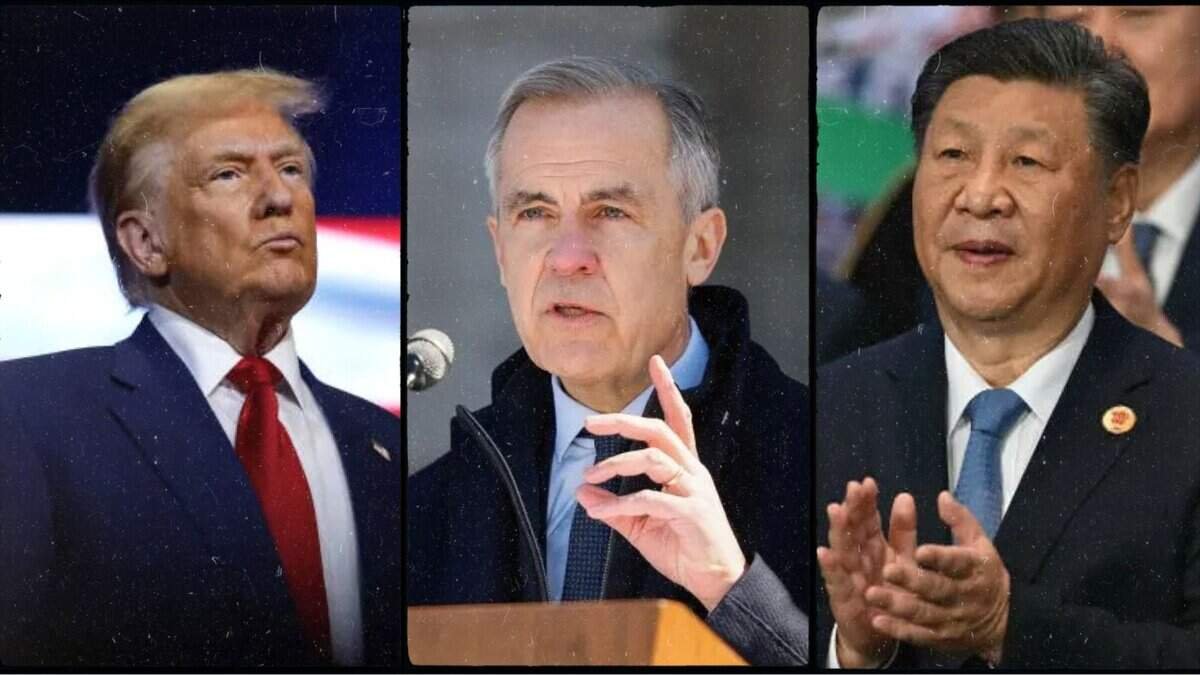
Washington: President Donald Trump on Saturday, January 24, threatened to impose a 100 per cent tariff on goods imported from Canada if America’s northern neighbour went ahead with its trade deal with China.
Trump said in a social media post that if Canadian Prime Minister Mark Carney “thinks he is going to make Canada a Drop Off Port’ for China to send goods and products into the United States, he is sorely mistaken.”
While Trump has waged a trade war over the past year, Canada this month negotiated a deal to lower tariffs on Chinese electric vehicles in return for lower import taxes on Canadian farm products.
Trump initially had said that agreement was what Carney “should be doing and it’s a good thing for him to sign a trade deal.”
Carney’s office did not immediately respond to a request for comment.
Trump’s threat came amid an escalating war of words with Carney as the Republican president’s push to acquire Greenland strained the NATO alliance. Trump had commented while in Davos, Switzerland, this week that “Canada lives because of the United States.” Carney shot back that his nation can be an example that the world does not have to bend toward autocratic tendencies.
Trump later revoked his invitation to Carney to join the president’s “Board of Peace” that he is forming to try to resolve global conflicts.
Trump’s push to acquire Greenland has come after he has repeatedly needled Canada over its sovereignty and suggested it also be absorbed the United States as a 51st state.
He resumed that this week, posting an altered image on social media showing a map of the United States that included Canada, Venezuela, Greenland and Cuba as part of its territory.
In his message Saturday, Trump continued his provocations by calling Canada’s leader “Governor Carney.” Trump had used the same nickname for Carney’s predecessor, Justin Trudeau, and his use of it toward Carney was the latest mark of their soured relationship.
Carney has not yet reached a deal with Trump to reduce some of the tariffs that he has imposed on key sectors of the Canadian economy. But Canada has been protected from the heaviest impact of Trump’s tariffs by the Canada-US-Mexico Agreement. That trade agreement is up for review this year
At least two European airlines suspended flight services to Middle East cities on Friday, January 23, with Air France citing the “geopolitical situation” in the region.
According to the news agencyAFP, Dutch airline KLM has also halted its flights to cities in the United Arab Emirates, Saudi Arabia and Israel, adding that it will not fly in the airspace of other countries in the region, including Iran and Iraq.
Air France informed that it made the changes “due to the current situation in the Middle East,” and that it has decided to “temporarily suspend its service to Dubai.”
“Air France is monitoring the situation in real time and will provide further updates on its flight schedule,” the French airline was quoted by the news agency as saying.
Meanwhile, KLM told the Netherlands’ public broadcaster NOS on Friday that it halted flights to Dubai, Tel Aviv, Dammam and Riyadh and that it would not be flying through the airspace of Israel, Iraq, Iran and other Gulf countries.
KLM, however, did not state the reason for the suspension and said it was in touch with Dutch authorities.
On Thursday, January 22, US President Donald Trump announced that a US “armada” was on its way to the Gulf and that Washington was closely monitoring Iran, while severely downplaying the prospect of military action.
“We have a massive fleet heading in that direction and maybe we won’t have to use it,” Trump said.
The US military assets include the aircraft carrier USS Abraham Lincoln and associated warships traveling with it from the South China Sea.
A US Navy official, who spoke on condition of anonymity to the Associated Press to discuss military movements, said Thursday, January 22, that the Lincoln strike group is currently in the Indian Ocean.