










Delhi air quality is likely to remain in the ‘very poor’ category in the coming days.
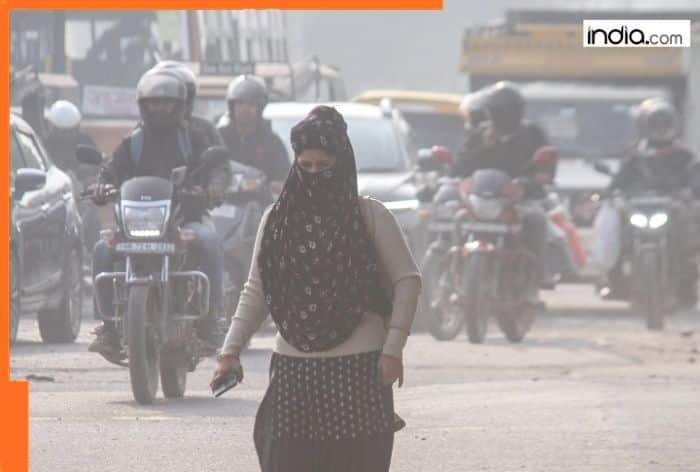
Delhi Air Quality update: Delhi will continue to breath toxic air in the coming days as air quality in the national capital is likely to remain in the ‘very poor’ category due to various factors, including heavy winter air, stubble burning and vehicular emissions.
Delhi air quality to remain ‘very poor’
According to the Air Quality Early Warning System, Delhi’s Air Quality Index (AQI) will likely remain in the ‘very poor’ (301-400 AQI) category from Monday to Wednesday, amid the onset of winter in the capital city, which has triggered a significant temperature drop over the last couple of weeks.
Delhi’s recorded an average AQI of 391 on Sunday, as the air quality continued to remain in the ‘very poor’ category in most parts of the city, according to Central Pollution Control Board (CPCB) data.
Notably, 19 monitoring stations in Delhi reported ‘severe’ air quality and the remaining 19 stations recorded ‘very poor’ air quality with readings above 300, as per data from CPCB’s Sameer app

According to CPCB, an AQI between 0 and 50 is considered ‘good’, 51 to 100 ‘satisfactory’, 101 to 200 ‘moderate’, 201 to 300 ‘poor’, 301 to 400 ‘very poor’, and 401 to 500 ‘severe’.
Temps drop as winter sets in
Meanwhile, Delhi recorded a maximum temperature of 26.7 degrees Celsius and a minimum of 10.4 degrees Celsius, a notch below the season’s average, while the humidity level was recorded at 68 percent at 5.30 pm, according to the India Meteorological Department (IMD).
IMD has forecast moderate fog for Monday, with the maximum and minimum temperatures expected to settle at 25 and 10 degrees Celsius, respectively.
Why CAQM revised GRAP schedule?
In a related development, the Commission for Air Quality Management (CAQM) on Saturday revised the Graded Response Action Plan (GRAP) measures, allowing for stricter curbs to be imposed in lower stages to prevent further deterioration of air quality in the Delhi-NCR region.
Under the revised schedule which was finalized on November 21 after consultations with stakeholders, several pollution-control measures have been shifted from higher GRAP stages to lower ones, thus stricter restriction will now be invoked at lower alert levels.
(With inputs from agencies)


