Author: News Desk

  • Trump administration demands hospitals share emergency room records

    Trump administration demands hospitals share emergency room records


    paramedics pushing a patient on a yellow stretcher into a hospital ambulance entrance

    A tiny federal agency tasked with protecting the public from injuries caused by lawn mowers and coffeemakers is demanding that some of the nation’s biggest health systems turn over detailed, personally identifiable medical records of all patients who seek help at their emergency rooms.

    The Consumer Product Safety Commission, responsible for tracking and issuing recalls of dangerous products sold in the U.S., began discreetly pressuring hospital executives this year to share personally identifiable health data with a private contractor. But hospital lawyers and other industry experts have questioned the agency’s authority to collect, its ability to safeguard such a swath of sensitive information, and whether it has followed the legal process to overhaul its surveillance system.

    After KFF Health News asked the CPSC about the new system, the agency announced the program on July 21. Left unmentioned, however, is the alarm it has raised among hospital executives, as well as the nature and extent of the agency’s data demands.

    In a stark departure from its product-focused mission, the agency’s goal is to obtain millions of Americans’ medical records from emergency room visits for most injuries, from a broken bone to a childhood vaccine reaction or even a suicide attempt, according to documents and emails obtained by KFF Health News, as well as interviews with five people involved or familiar with the discussions.

    A CPSC official also insisted in the emails that the institutions provide all ER patients’ identifiable information — such as names, addresses, diagnoses, and other personal details — to the contractor, Konza Health, for analysis. In correspondence with hospital executives, Konza representatives described participation as “mandatory” or “required.”

    As a condition of viewing the correspondence, KFF Health News agreed not to republish some of the emails it obtained.

    The CPSC wants at least 100 hospitals to start sending detailed medical records by the end of this year, according to an internal memo.

    “The whole thing is troubling,” said Sharona Hoffman, a professor of health law at Case Western Reserve University who noted that giving a private entity access to a sweeping collection of data will introduce risks to patient privacy. “If this company really is collecting identifiable information, that is worrisome for patients.”

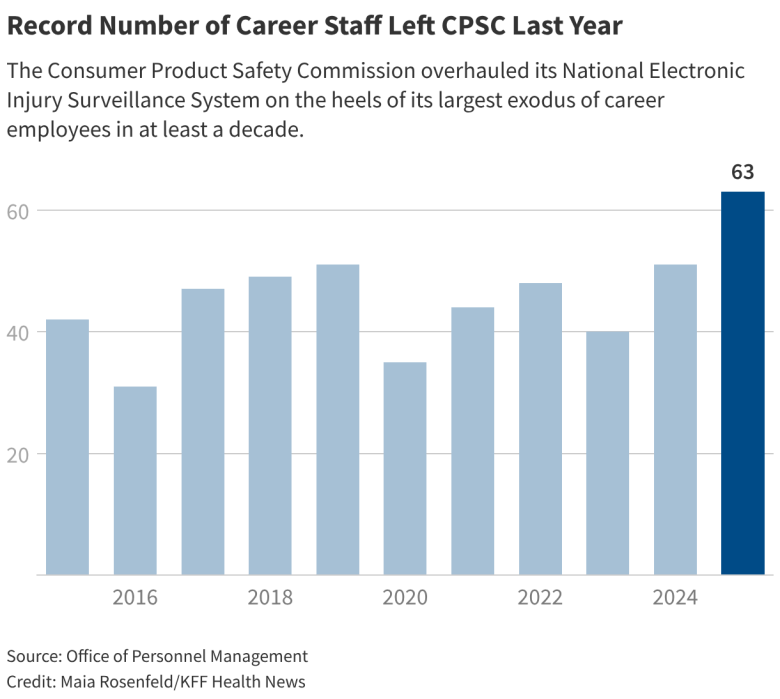
    The new project was launched amid upheaval at the traditionally independent agency, which is without a governing board since President Donald Trump fired the CPSC’s three Democratic board members. Nearly 1 in 5 career staffers left the CPSC in the first 16 months of the new administration, according to a KFF Health News analysis of federal workforce data.

    The initiative also comes as the Trump administration has sought unprecedented access to millions of Americans’ medical records, with the Office of Personnel Management requesting federal workers’ sensitive health information and Health and Human Services Secretary Robert F. Kennedy Jr. using a private organization to collect more medical records for his studies on vaccines and autism.

    Steve Roney, CPSC spokesperson, said in an emailed statement on July 10 that the CPSC is “modernizing” its surveillance system. Asked whether the CPSC will file complaints against hospitals that do not participate, he said only that while the previous system “operated as a voluntary program, the ability of hospitals to opt out limited the sample size and usefulness of the data.”

    Roney also acknowledged that the agency had not yet notified the public, as “required by law.”

    Federal law requires the agency to provide notice and a public comment period before requesting information from 10 or more entities, a step it has not taken despite plans for 100 hospitals to join the surveillance system. KFF Health News independently confirmed with over a dozen hospitals that they had been approached.

    Federal public health authorities cannot legally mandate that private health data be reported. But CPSC officials have suggested publicly and privately that if hospitals decline to share data with the new surveillance system, they could be subject to strict penalties from a data-sharing regulation known as “information blocking.”

    Yet some hospital executives say they are reluctant to share patients’ sensitive data because they’re concerned about a different violation — that of federal privacy law.

    AI Takes Over

    Dozens of ERs across the country already participate in the CPSC’s voluntary National Electronic Injury Surveillance System, or NEISS, through which trained hospital workers report injuries involving consumer products, almost always stripped of patients’ identifiable information. The system helps the CPSC identify products, such as baby loungers, toys, and household appliances, with a pattern of injuring consumers.

    The new injury surveillance program goes much further.

    At a toy industry trade event in February, acting CPSC Chairman Peter Feldman said the agency is “investing in AI-enabled workflows that improve the quality and quantity of injury surveillance data, while also building up digital infrastructure to handle a massive new volume of electronic health records.”

    Konza Health, a Kansas-based organization that runs the state’s health data exchange, will automatically pull and analyze medical records of all patient visits from ERs nationwide. Konza won a five-year contract worth up to $15.9 million with the CPSC last fall.

    In email correspondence with hospital technology officials, Konza Health President and CEO Laura McCrary also has described ERs’ participation as “required,” stipulating that they share patients’ records with identifying information.

    McCrary told KFF Health News by email that the company is not using AI to process the records it receives, saying instead that Konza will use “advanced analytic parsing and filtering capabilities.” Roney, the CPSC spokesperson, did not answer questions about the use of AI.

    For years, agency officials have discussed moving away from human contractors and automating NEISS to save time and money.

    But without workers on-site, hospital staffers may no longer receive training to determine what clinical information is important to include for the CPSC. In short, the changes could dilute the quality of the product safety data the agency collects.

    “They want to suck in as much data as possible, but I’m not sure how thoughtful they’re being about what is collected and what is actually needed by the agency,” said former CPSC chair Alexander Hoehn-Saric, one of the Democratic appointees Trump fired last year.

    Record Number of Career Staff Left CPSC Last Year (Column Chart)

    Wanted: Injuries From Vaccines and Stingrays

    The CPSC’s new data collection appears to contradict its own 214-page operating manual, which instructs hospitals not to include identifiable information “such as names, birthdates, or addresses” when reporting cases.

    The agency is supposed to receive patients’ identifying information only when needed for follow-up investigations, which happens in fewer than 1% of reported cases, according to the manual.

    The CPSC has also historically limited the records it collects to minimize privacy violations in case of a data breach.

    The risk is not hypothetical: From 2017 to 2019, the agency improperly released personal health information of around 30,000 people, a disclosure that a top Republican at the time called “concerning.”

    Konza, however, will receive even more sensitive information on many more people. McCrary said in a statement that Konza will remove patients’ names, addresses, and medical information “not needed by CPSC” before sharing records with the agency.

    Leaving a private organization to collect sensitive information introduces risks, including that it could be stolen or used for business purposes, said Hoffman, the Case Western professor.

    “Very often, they will use information for marketing because now they’re going to know what conditions people have,” she said.

    Roney said that its contract with Konza, which has not been made public, prohibits the organization from selling or marketing the data it collects.

    The CPSC’s manual also identifies types of ER visits that should not be reported to the CPSC, which has jurisdiction over only certain consumer products. Excluded injuries are those caused by food, illegal drugs, medical devices, alcohol, or plants, as well as injuries that did not involve consumer products — such as a cut from a rock or broken bones from a fall on the ground — and suicide attempts by adults.

    But in a contract offered to one hospital and reviewed by KFF Health News, Konza set no such limits on the information it would gather from ER records and said it would hold on to patient health information for at least 30 days.

    In an email sent to hospital technology officials, McCrary wrote that Konza would provide the CPSC with records when a patient is treated in the ER for any of more than 10,000 conditions. The expansive list of diagnostic codes Konza provided in the email includes injuries that do not involve consumer products.

    Child injuries resulting from “poisoning by” vaccines or contact with stingrays, neither of which is regulated by the CPSC, are included in the list.

    A limited number of hospitals once shared deidentified data on all injuries — regardless of product involvement — through the NEISS using the Centers for Disease Control and Prevention’s injury-tracking program. But the CDC halted that data collection, after funding and staffing were cut last year, and has not restarted it.

    Pressure on Hospitals

    CPSC Chief Data Officer Elizabeth Puchek, who joined the agency late last year after engineering U.S. Citizenship and Immigration Services’ data system, has told hospitals in emails that they must seek an exemption from the program if they decline to share patients’ emergency room records with Konza.

    The CPSC’s targeted outreach has included some of the nation’s largest urban and rural health systems, as well as small, publicly owned hospitals.

    Staff members at Mary Greeley Medical Center in Ames, Iowa, said that Konza and federal officials told them their participation in the new program was mandatory. The hospital, which has long participated in NEISS, signed a new contract in April to share its ER records with Konza.

    Yet the hospital is reevaluating its participation after being notified that the funds it received to participate in NEISS were “no longer available,” spokesperson Steve Sullivan said.

    Several hospital executives, lawyers, and others have raised doubts about the CPSC’s claimed authority.

    Harborview Medical Center spokesperson Susan Gregg said the Seattle hospital’s emergency room has “voluntarily submitted de-identified data for many years, but we are not obligated to report this information.”

    In Boston, Mass General Brigham has declined to participate in the new program, with spokesperson Kelly Mitchell saying that “to protect patient privacy, we are unable to provide these medical records.”

    Henry Ford Health in Detroit; St. Luke’s in Boise, Idaho; and Sanford Health based in Sioux Falls, South Dakota — which together handle over a million ER visits a year — are among the health systems that have been approached but not yet entered into an agreement with Konza, according to representatives. Several of the nation’s busiest hospital systems targeted for the program — including the Mayo Clinic in Minnesota, Yale New Haven Hospital in Connecticut, Nationwide Children’s Hospital and the Cleveland Clinic in Ohio, and Baylor Scott & White Health in Texas — declined to answer questions about whether they’re participating.

    Hoehn-Saric, the agency’s former chairman, said he was surprised that the CPSC would insist that hospitals provide identifiable records from all emergency room visits.

    “This idea that they can simply demand patient information from a hospital and that the hospital would provide it — I really don’t understand the basis for that,” he said.

    KFF Health News is a national newsroom that produces in-depth journalism about health issues and is one of the core operating programs at KFF—an independent source of health policy research, polling, and journalism. Learn more about KFF.

    This article first appeared on KFF Health News and is republished here under a Creative Commons Attribution-NonCommercial-NoDerivatives 4.0 International License.

    The post Trump administration demands hospitals share emergency room records appeared first on MinnPost.

  • D.C. Memo: House backs GOP bills to fund Iran war, create voter ID laws, but Senate says ‘wait a minute’

    D.C. Memo: House backs GOP bills to fund Iran war, create voter ID laws, but Senate says ‘wait a minute’

    WASHINGTON – The U.S. House scrambled to finish its business before it adjourned this week for a long August recess that allows lawmakers to campaign for reelection.

    In a rush of votes, Republicans made use of their slim majority to steamroll Democrats and pass a number of bills, including one that contained the SAVE America Act. That’s legislation that would require individuals to provide documentary proof of U.S. citizenship — such as a passport or birth certificate — to register to vote and government-issued photo identification to cast a ballot.

    The SAVE America Act was attached to a bill that would prohibit members of Congress and their families from trading individual stocks while allowing lawmakers to keep the shares of stocks they already own.

    Nearly all Democrats, including all four in Minnesota’s delegation to the House, voted against the legislation. All four Republicans from the state voted for it.

    Most Democrats said they opposed the stock legislation because the SAVE America Act was married to it. Some also said the legislation would not do enough to stop insider trading by lawmakers.

    Rep. Betty McCollum, D-4th District, cited both reasons for her opposition to the bill.

    “Republicans in Congress think we won’t see through their attempts to mislead Americans,” McCollum said in a post on X. “Their falsely-named Stop Insider Trading Act doesn’t stop any insider trading. Even worse, it includes the SAVE America Act, which would make it harder for you to vote.”

    Although President Donald Trump has made the SAVE America Act a legislative priority, it’s unclear whether the Senate, in session for about two more weeks, will take up the stock bill or most of the other bills the House rushed to approve this week.

    Pressuring the Senate to act on the voter ID bill, Rep. Pete Stauber, R-8th District, cited the disclosure this week that a software glitch in a voter registration system in New Jersey had improperly enrolled about 6,000 individuals and that about 400 of those registered in error cast a vote.

    “I don’t want to hear another Democrat politician tell us that non-citizens aren’t voting in our elections,” Stauber said in a post on X. “They have lied for years about this, and what happened in New Jersey is further proof. It’s time for the Senate to PASS THE SAVE AMERICA ACT.”

    Another bill in limbo in the Senate is a House GOP budget blueprint that would provide up to $95 billion in funding for the Iran war and the nation’s intelligence agencies and provide money to implement the SAVE America Act.

    The legislation, approved on a 215-213 vote with absolutely no Democratic support, would also provide the nation’s farmers with nearly $12 billion in emergency aid to counter the effects of low commodity prices, lost markets to Trump-imposed tariffs, and increases in prices for diesel and fertilizer because of Iran’s blockage of shipments through the Strait of Hormuz.

    In a statement, Rep. Angie Craig, D-2nd District, called the budget resolution “disastrous” and a “threat to our Democracy.”

    “At a time when folks across this country are reeling from the impacts of President Trump’s short-sighted economic policies and his illegal war in Iran, the last thing we should be doing is allocating more money to an administration that clearly prioritizes the president’s own political and foreign policy objectives over the livelihoods of the American people,” Craig said.

    Defense Secretary Pete Hegseth faced skeptical senators from both parties as he testified this week before the Senate Appropriations Committee on the need for $67 billion to cover the costs of the Iran War. And a handful of GOP senators have voted in recent months to rein in Trump’s war-making authority in Iran. So, approval of the budget resolution is not certain.

    Another House bill that may find itself in limbo in the Senate is a continuing resolution, or CR, the House approved this week to avoid a government shutdown on Sept. 30, the end of the federal fiscal year.

    With Congress unable to win final approval for all 12 appropriations bills that would fund the federal government, the threat of a shutdown before November’s midterm elections prompted House GOP leaders to press for approval of the short-term funding bill.

    The House approved the bill. But most Democrats – including all of those in Minnesota’s congressional delegation – opposed it.

    Democratic leaders said they did not want a shutdown but could not support the bill because it failed to block funds for Trump’s mass deportation campaign and lacks guardrails on how the White House can spend other money.

    “This continuing resolution is a premature and desperate attempt by Republicans to abdicate their responsibility to govern while there are still several months left to negotiate a bipartisan agreement,” House Minority Leader Hakeem Jeffries, D-N.Y., and other top House Democrats wrote to Democratic lawmakers. “We will be voting no.”

    Minnesota’s Republicans, meanwhile, joined their GOP colleagues in supporting the short-term bill.

    “By continuing federal funding through December 4th, this legislation prevents another costly shutdown, ensures constituents can continue to rely on essential government services, and gives Congress time to finalize full-year appropriations bills,” Rep. Brad Finstad, R-1st District, said in a statement.

    In any case, it appears lawmakers of both parties will hit the campaign trail this year without much to run on.

    Study: hunger on the rise 

    A little over a year ago, Congress approved a “big, beautiful bill” that established President Donald Trump’s legislative priorities.

    The legislation’s cuts to the food stamp program resulted in a loss of food aid for 1.5 million children from July of last year until March, according to an analysis released this week by the Center on Budget and Policy Priorities.

    The Supplemental Nutrition Assistance Program (SNAP), the official  name for the food stamp program, helps low-income people buy groceries.

    The “big, beautiful bill” changed SNAP’s work requirement, which allowed three months of benefits in a three-year period unless recipients met strict work requirements or qualified for an exemption. Historically, the restriction has never been applied to parents or caregivers of children nor adults over age 49.

    But the new qualification for SNAP applies the work requirements to all individuals over the age of 65 and to parents of children who are older than 13.

    The center determined that SNAP participation nationwide fell by more than 4.5 million, or nearly 11%.

    It dropped less in Minnesota, where participation in the program dropped by 3.52%, or about 16,000.

    In fact, the center’s study showed that in “blue” states governed by Democrats, SNAP participation dropped far less than in “red” states run by Republicans, with Arizona showing the greatest reduction, about 55%.

    The Center on Budget and Policy Priorities also determined that in the 19 states with publicly available data or that have shared unpublished data, the restrictions on SNAP have left more than 1 million children without food aid.

    The center also says that based on what it called “a conservative estimate,” the number of children receiving SNAP has dropped by more than 1.5 million since July 2025.

    In other news:

    ▪️Our new drinking water reporter, Claire Carlson, wrote that as wildfire smoke begins to lift from northern Minnesota, scientists and water managers are keeping a close eye on how smoke and falling ash could affect nearby drinking water sources.  
    ▪️Metro reporter Trevor Mitchell reported that an idea pitched by Minneapolis police – to use drones as first responders to a crime scene – crashed and burned as the City Council rejected the plan.
    ▪️As the number of uninsured Americans grows, Lt. Gov. Peggy Flanagan and other progressive Democrats have embraced “Medicare for All,” but party moderates not so much.
    ▪️Maddie Robbinson wrote about how a renovated building in downtown Minneapolis is giving children with special needs and their parents new hope.

    Please keep your comments, and any questions, coming. I’ll try my best to respond.

    The post D.C. Memo: House backs GOP bills to fund Iran war, create voter ID laws, but Senate says ‘wait a minute’ appeared first on MinnPost.

  • Trump administration says it’s deferring $199M in Medicaid payments to Minnesota

    Trump administration says it’s deferring $199M in Medicaid payments to Minnesota

    The Trump administration on Tuesday said it was deferring more than $1 billion in Medicaid payments to Minnesota and California because of “suspected fraud and noncompliance,” the latest in a series of punitive steps it has linked to allegations of fraud in mostly Democratic-led states.

    Health Secretary Robert F. Kennedy Jr. said the new actions — which come after previously announced Medicaid funding deferrals in those states — are part of the administration’s strategy to “stop the fraud before it happens” rather than claw back problematic spending after bad actors are prosecuted, as previous administrations had done.

    “We have a duty to stop the payments, demand answers and then follow the evidence wherever it leads,” Kennedy told a news conference.

    The tactic is part of the administration’s sweeping campaign to show it’s cracking down on fraud and saving taxpayers money when rising healthcare costs and other economic stressors have made affordability a top voter concern in November’s midterm elections.

    In March, Vice President JD Vance launched a new anti-fraud task force at the request of President Donald Trump, bringing together officials from various departments to use data and technology to identify and investigate suspected wrongful use of federal dollars.

    But the federal government hasn’t provided “data or explanation on how the deferral amount was calculated or what it was based on” to Minnesota, said John Connolly, the temporary commissioner and state Medicaid director for Minnesota’s Department of Human Services.

    “Today’s actions show that the federal government is acting again in unprecedented and punitive ways as part of their war on Medicaid and its recipients,” he said in a statement. “Partnership — not politics — is required to stop criminals and protect services for the people who need them.”

    Minnesota’s Democratic Gov. Tim Walz suggested the Republican administration was deferring the funds to pay for Trump’s tax cuts to wealthy Americans. California’s Democratic Gov. Gavin Newsom accused the administration of targeting it for political reasons.

    The Trump administration intensified anti-immigration efforts in Minnesota earlier this year, sending in a robust force of Immigration and Customs Enforcement officers whose actions there caused weeks of counterprotests and included the shooting deaths of two civilians. Trump himself has frequently denounced California as a badly governed state.

    States are facing obstacles because of the actions

    The strategy has led to some false starts and headaches for states.

    In April, for example, the Centers for Medicare & Medicaid Services acknowledged to The Associated Press it made a significant error in figures it used to help justify a fraud probe in New York. Last month, California’s Medicaid director told a congressional committee that CMS had not yet provided “any instances of fraud, waste or abuse” to the state in its justification of a $1.3 billion Medicaid funding deferral announced in May.

    And in Minnesota, state officials have been executing a thorough corrective action plan to defray CMS concerns that have led the agency to defer some $260 million in federal money and to threaten future cuts.

    “We have cooperated in good faith and proactively engaged the Centers for Medicare and Medicaid Services to first raise the alarm on fraud in Minnesota’s Medicaid program, to effectively investigate fraud and to institute further safeguards against future misuse of funds,” Connolly said.

    Kennedy didn’t specify in Tuesday’s announcement whether the new deferrals — $867.5 million in federal Medicaid payments to California and $199 million to Minnesota — are in addition to, or overlap with, earlier deferrals announced this year.

    CMS Administrator Dr. Mehmet Oz didn’t provide concrete examples of fraud in the two states in justifying the deferrals. He did mention some patterns the agency noticed that it found questionable, including that some providers were billing for four or more patients at the same time, or billing after the date of a Medicaid beneficiary’s death.

    Oz also highlighted a fast rate of growth in California’s home care program as a reason for concern. California officials have disputed that idea, explaining that the state’s home care program has grown because of an intentional strategy to keep people out of more expensive nursing homes.

    Flow of money could be restored — with documentation

    Kennedy and Oz said states could restart the flow of federal funding by providing documentation proving the payments in question were legitimate.

    A representative for California’s Medicaid program didn’t immediately respond to a request for comment. Officials in the state have previously acknowledged they are working with the federal government to provide the requested information.

    Oz said Minnesota had already returned documents to the federal government and they were being “reevaluated very carefully.”

    Kennedy also suggested Tuesday that he would extend the power to exclude providers from Medicaid, Medicare and other federal health programs to CMS. In the past, that authority has rested solely with his department’s Office of the Inspector General.

    “This is going to be a full force multiplier,” HHS Inspector General Thomas March Bell told a news conference. “It’s going to create additional momentum, and it’s going to exclude additional bad actors.”

    The post Trump administration says it’s deferring $199M in Medicaid payments to Minnesota appeared first on MinnPost.

  • Minnesota progressives campaign on ‘Medicare for All’ as ranks of uninsured grow

    Minnesota progressives campaign on ‘Medicare for All’ as ranks of uninsured grow


    A man stands speaking into a microphone in front of a group of people in folding chairs with signs behind him.

    WASHINGTON – Jake Johnson, a Democrat seeking to represent southern Minnesota in Congress, gingerly sidestepped a question at a town hall he hosted about whether he supported “Medicare for All.”

    Johnson, a moderate who is trying to unseat Rep. Brad Finstad, R-1st District, said at that event in New Richland that he sympathized with those who are struggling to afford health insurance and pay for medical costs. He said he supported “a strong public option to the health insurers we have now.”

    That meant Johnson would support allowing Americans to purchase a healthcare plan offered by the federal government that would compete with private insurers.

    But that proposal — aimed at countering the increasing cost of health insurance coverage that is driving up the number of uninsured — has been rejected by Democratic socialists and progressives who have notched impressive victories in primaries this year and made their mark in Minnesota through the DFL endorsement process.

    They pan the “public option” and other reforms proposed by Johnson and other party centrists as ineffective solutions that would continue to allow insurers and pharmaceuticals to unfairly profit from pain and illness.

    So, the debate over healthcare in this election year has caused a fissure in the Democratic Party in Minnesota and across the nation.

    Progressive activism has revived an effort to replace the nation’s patchwork of private insurers and government-run health plans like Medicaid and Medicare with one government-run program they are calling Medicare for All.

    Sometimes a Democratic candidate’s position on healthcare reform is based, at least in part, on how well the party has done in their district.

    A man in a white button down standing on the porch of a house.
    Matt Little, the DFL-endorsed U.S. House candidate for Minnesota’s 2nd Congressional District, poses in front of a Lakeville, Minn., residence on July 17, 2026. Credit: MinnPost photo by Ana Radelat

    The 1st Congressional District Johnson seeks to represent gave President Donald Trump 55% of the vote in 2025. 

    But in the neighboring 2nd Congressional District, former Vice President Kamala Harris won with  52% of the vote, and, unlike Johnson, the endorsed DFL candidate, Matt Little, is a vigorous proponent of Medicare for All.

    Little said he is sensitive to the problems Americans have with the nation’s healthcare system because when his mother was gravely ill, she struggled for a year to have access to a specialist who could cure her.

    “And we were lucky to have insurance,” said Little, a former state senator and former mayor of Lakeville.  

    Little said if he wins the 2nd District seat he would support a new bill, sponsored in the U.S. House by Rep. Pramila Jayapal, D-Wash., and in the U.S. Senate by Sen. Bernie Sanders, I-Vt., that would guarantee comprehensive healthcare to every U.S. resident as a human right, eliminating all premiums, deductibles and copayments.

    The legislation would end the leading role of private insurers in providing most of the nation’s healthcare coverage, although they would be allowed to sell supplemental plans. 

    Proponents say the elimination of out-of-pocket health costs and premiums will offset higher federal income taxes for most working Americans and businesses that would pay for the plan.  

    It’s not a new idea. Sanders has been promoting Medicare for All for more than a decade and the idea of establishing a national, government-run healthcare system based on Medicare’s model has been around for a few decades. With little effect.  

    But Little, who like Sanders considers himself a progressive, said the time is ripe politically to once again try to establish a “single payer” system similar to those of other industrialized nations that most Republicans decry as low- quality “socialized” medicine.

    “I think we are in a defining moment right now in the country,” he said, citing the Trump administration’s cuts to Medicaid and the GOP Congress’ failure to extend enhanced Affordable Care Act subsidies that helped many Americans, including about 90,000 Minnesotans, purchase health insurance.

    He views the public option, the alternative moderates like Johnson are embracing as “just another handout to private insurance companies” and says other reforms under discussion in the Democratic Party are just “nibbling around the edges” of a national problem.

    The public option was once going to be a part of the Affordable Care Act that former President Barack Obama breathed into life.

    The ACA created state-based “marketplaces,” like MNsure, where those who lack employer-based individual plans can purchase coverage from a health insurer. Those who qualify can receive a subsidy to pay the premium and no one can be denied coverage because of an existing medical condition.

    The initial plan was to establish a government-run option to the private insurer offerings on these ACA marketplaces. But heavy lobbying from health insurers and other politically powerful actors in the health field — and opposition by some centrist Democrats — killed the public option.

    Minnesota Dems split over Medicare for All

    Like Little, state Rep. Kaela Berg is running for the 2nd District congressional seat that is now held by Rep. Angie Craig, who is running for U.S. Senate.

    Like Little, Berg is running as a progressive.

    But unlike Little, Berg is flexible when it comes to proposed reforms to the nation’s healthcare system.

    Berg said she supports the public option “and anything that gives people more health coverage.”

    “It’s great to say Medicare for All and energize people,” Berg said. But she said that “we need to have (more) coverage now, whatever that looks like … while we continue to fight for Medicare for All.”

    Berg is a flight attendant and union activist. And organized labor is split over Medicare for All, with some unions, including the United Auto Workers and the Association of Flight Attendants, supporting the idea and others strongly opposed because healthcare has been one of organized labor’s most potent bargaining chips.

    The third Democrat running for Craig’s seat, state Sen. Matt Klein, is a  physician, an internist who works for the Mayo Clinic.

    He said he is a “firm believer that we need to get to universal healthcare” and if elected to Congress would “support whatever bill advances that.”

    But he stopped short of backing Medicare for All, saying he would prefer the implementation of the public option.

    The American Medical Association is firmly opposed to Medicare for All, saying it would limit patient choice and physician autonomy. The American Hospital Association and other powerful medical groups also strongly oppose the idea of a government-run, single payer plan.

    Still, more than 100 U.S. House Democrats, including Reps. Ilhan Omar, D-5th District, and Betty McCollum, D-4th District, are co-sponsors of  Jayapal’s Medicare for All bill and Sen. Tina Smith has co-sponsored Sanders’. But Rep. Kelly Morrison, D-3rd District, who like Klein is a physician, has not co-sponsored Medicare for All legislation.

    A defining issue in U.S. Senate race

    The Democrats running for retiring Sen. Tina Smith’s seat — Craig and Lt. Gov. Peggy Flanagan — are also split over how to achieve the goal of universal health coverage.

    “This is not working,” Flanagan said of the nation’s healthcare system. “It is broken and I think people are ready (for Medicare for All).”

    While noting the healthcare overhaul is impossible unless Democrats hold the White House and both chambers of Congress, Flanagan said defaulting to support of a public option for now with the hopes of working toward Medicare for All would not work.

    “You should not start at the bottom because you are going to get even less,” she said.

    Craig, meanwhile, last week introduced the Medicare-X Choice Act, which would create a public option in the nation’s Affordable Care Act exchanges.

    Craig said the public option would “give the insurance companies some competition,” leading to lower premiums and better coverage for all.

    But proponents of Medicare for All, like Little, say a public option would  draw the oldest and sickest Americans, benefiting private insurers who would enroll healthier, younger individuals, subsequently paying out fewer claims and increasing their profits.

    Craig also said other reforms, including a bill she introduced that would hold health insurance companies accountable for above-average denial rates and legislation aimed at lowering the cost of prescription drugs, would also give Americans relief from the escalating cost of medical care.

    Since Democrats are split over Medicare for All, there’s little chance a single-payer system will be established in the United States anytime soon.

    But a Democratic takeover of the U.S. House and/or U.S. Senate could result in a rush of Democratic healthcare legislation and a vigorous debate over how to reverse the increase in uninsured Americans, even as any substantial change would have to wait for a Democratic president.

    The post Minnesota progressives campaign on ‘Medicare for All’ as ranks of uninsured grow appeared first on MinnPost.

  • As college graduates fret over finding jobs, a record shortage of workers is projected

    As college graduates fret over finding jobs, a record shortage of workers is projected


    immigration mental health trauma Valley View Elementary

    Even as job seekers fret about artificial intelligence and tech behemoths announce massive layoffs, Matt Walsh is finding it surprisingly hard to help technology companies hire certain kinds of workers.

    That’s what Walsh’s recruiting firm, Blue Signal, does. And in specialties including semiconductor production, “the unemployment rate is probably negative 20 percent,” the CEO of the Phoenix-based search company said. “It’s ridiculous. There just aren’t enough people.”

    College graduates booed commencement speakers who hyped AI, which has steadily reduced the number of entry-level jobs available, and Meta cited AI when laying off more than 8,000 workers in May. 

    But economists are sounding alarms that the AI talk is masking a different problem. 

    It’s not that there won’t be enough jobs, these experts say — it’s that the United States is already facing what’s projected to be the biggest shortage of workers in its history.

    The problem “could hobble the American economy for years to come,” predicts the Georgetown University Center on Education and the Workforce. “The largest labor shortage the country has ever seen,” the Lightcast labor market data company calls it. JPMorganChase warns of a national security risk from “a pervasive talent deficit that constrains the nation’s capacity to build, compete, and protect its interests.” 

    And it’s not only tech workers. There will be shortages in the tens of thousands to hundreds of thousands of nurses, physicians, teachers, engineers, pharmacists, mental health counselors, construction workers and airplane mechanics, both government and independent sources project. Most are jobs AI generally can’t do.

    “All of these people who keep a society functioning are the very people we’re not going to have enough of,” said Ron Hetrick, Lightcast’s principal economist. 

    Among the trends that have been leading to this moment: a mismatch between the careers college graduates are pursuing and the kinds of jobs employers are struggling to fill. Far fewer students are majoring in healthcare fields than are needed to meet demand, for instance. 

    “We have pumped so many young people into business and finance” when what’s really in demand are graduates in other fields, Hetrick said. “It’s like a factory producing these workers like widgets, even though society is saying, ‘We really don’t need them.’ And the factory just keeps pumping them out.”

    But the principal reason for the looming workforce shortages is much more basic. It’s that a protracted decline in the birthrate is coinciding with a record wave of retirements. 

    Between 2024 and 2032, when the last baby boomers sign up for Social Security, more than 18 million college-educated workers will leave the labor force while fewer than 14 million enter it, according to the Georgetown center. Meanwhile, even as the number of people with associate and bachelor’s degrees falls, the center forecasts, the number of jobs requiring them will grow. 

    That will leave a gap of 4.6 million fewer workers than are needed. Lightcast puts the deficit at an even higher 6 million.

    These aren’t dystopian predictions. The shortages are already showing up, the U.S. Chamber of Commerce reports. In many industries, it says, even if every worker now unemployed were plugged into an open job, there would still be positions left unfilled.

    “We have a crisis in front of us in not preparing people for the world that’s coming,” said Bill Haslam, the Republican former governor of Tennessee and co-chair with Democratic former Massachusetts Governor Deval Patrick of the Bipartisan Policy Center’s Commission on the American Workforce.

    The effect of population shifts on the supply of talent, with or without degrees, has been compounded by a drop in the proportion of high school graduates choosing to go to college; a sharply reduced rate of immigration; and a growing number of Americans who have left the workforce altogether because of such things as lack of childcare, early retirement, incarceration and substance addiction.

    College and university enrollment is down by nearly two million students since its peak in 2010, the U.S. Department of Education reports. The low birthrate since around then means the number of college-age Americans is forecasted to decline by another 13 percent through 2041. 

    The Looming Workforce Cliff

    Projected shortages of workers, 2024 to 2032

    Managers2,900,000
    Teachers611,000
    Driver/sales workers and truck drivers402,000
    Nurses362,000
    Engineers210,000
    Construction workers200,000

    Projected shortages of healthcare workers by 2038

    Licensed practical nurses245,950
    Registered nurses108,960
    Mental health counselors99,780
    Addiction counselors77,050
    Primary care physicians70,610
    Physical therapists60,610
    Pharmacists30,400
    Pediatricians9,320
    OB-GYNs7,660
    Cardiologists7,270

    Projected shortages of semiconductor industry workers by 2030

    Technicians26,400
    Engineers (master’s or doctoral degrees)17,400
    Engineers (bachelor’s degrees)9,900

    SOURCES: Georgetown University Center on Education and the Workforce; U.S. Health Resources and Services Administration; Semiconductor Industry Association

    Fewer than half as many people immigrated to the United States last year as the year before, the Census Bureau says; yet 41 percent of the home health aides who will be increasingly needed to care for the nation’s aging population have historically come from somewhere else, along with a fifth of nursing assistants, dentists, pharmacists and registered nurses.

    “We’re doing a fantastic job of rolling up the welcome mat and saying, ‘We don’t want you,’ ” said Brad Hershbein, senior economist and deputy director of research at the W.E. Upjohn Institute for Employment Research.

    Walsh, at Blue Signal, has a theory about why there seems to have been little attention to the looming labor shortage, outside of the industries affected. He uses the metaphor of frogs that will jump out of a pot of boiling water if they’re dropped into it but not if the water is brought to a boil gradually. In the same way, people are only slowly becoming aware of shortages, Walsh said. 

    Already, in his small Illinois hometown, he said, he’s noticed it takes six months for people to get a doctor’s appointment because there aren’t enough doctors.

    “ ‘Everybody needs to hear this,’ ” Lightcast principal economist Ron Hetrick said an audience member implored him after he spoke at an event about the problem. But “some people really haven’t felt the pain enough to care as much as they should.”

    Besides, said Allison Shrivastava, education and labor market economist at the college search and ratings platform Niche, attention has been focused on the shrinking supply of entry-level jobs in certain fields. “When people are having trouble getting into the labor market, it’s hard to say there are going to be labor shortages soon,” Shrivastava said.

    The fact is, she said, that “we are going to be hard pressed to find a corner of the economy where labor shortages don’t have an impact.”

    Shortages of workers have already begun to slow production lines at manufacturing facilities tied to the defense industry, according to JPMorganChase. Semiconductor plants are being built faster than they can be staffed. Too few electricians, line workers and technicians mean delays in the modernization of the energy grid. 

    The semiconductor industry payroll is projected to grow by nearly 115,000 jobs by 2030, which is 67,000 more than there are workers now or projected to be in the pipeline to become technicians and engineers, the Semiconductor Industry Association estimates.

    “The semiconductor industry is not alone here,” however, said Erik Hadland, the association’s director of technology policy. “We’re a small part of a much larger issue.”

    State governments, which are closest to the problem, have been scrambling to avert it. To get college graduates to come or stay and work, some will help them pay off their student loans. A bill under consideration in Minnesota would offer in-state tuition to most public colleges and universities for children of parents who take jobs in that state, waiving the previous requirement that students have graduated from a Minnesota high school after attending for a minimum of three years.

    Several states have combined their higher education and workforce development agencies, including Missouri and Colorado. Connecticut has established both an Office of Workforce Strategy and a Career Pathways Commission. Illinois Governor JB Pritzker has formed a working group to review that state’s workforce development infrastructure and increase the number of college graduates. 

    Some states face shortages that appear more severe than others. South Dakota has just 41 workers for every 100 open jobs, for instance, while California and nine other states have more workers than jobs, the U.S. Chamber of Commerce finds. 

    In Pennsylvania, a study commissioned by the state Department of Education has projected that the state needs to increase the number of people with credentials beyond high school by more than 4 percent to fill a shortage of 218,000 such workers a year by 2032. That will be a significant challenge, considering that college enrollment there has generally been falling.

    There are also shortages in industries whose workers don’t need college and university degrees. Fewer than half as many people are entering the construction trades as are needed, for example, according to Branka Minic, CEO of the Building Talent Foundation, which represents 3,600 employers who are trying to fill that gap. 

    “There’s plenty of jobs” in the skilled trades, she said, some starting at $50 an hour. “Show me what college graduates earn that kind of rate.” As for the prospect that AI can fill those largely physical roles, she told of seeing a poster plastered on an unfinished building. “Finish this, ChatGPT,” it said, mockingly.

    That higher pay is an example of how the market will respond to shortages, said Hershbein, at the Upjohn Institute. In some industries, he said, “wages and compensation will adjust, people will find training, businesses will train people and there will be adaptations. Necessity is the mother of invention.”

    Job seekers also need more current information about where the demand is greatest, said Cheryl Oldham, former vice president of education and workforce policy at the U.S. Chamber of Commerce and now executive vice president for human capital at the Bipartisan Policy Center.

    “We’ve got to develop systems that can be much more nimble and responsive to the needs of the labor market, because the labor market is changing probably faster than it’s ever changed,” said Oldham, who also served in the George W. Bush administration.

    Some savvy workers are figuring it out for themselves.

    Seth Russell’s high school counselor nudged him toward college. Instead he learned welding and now works full-time as a fabricator.

    “I got hired straight out of high school. I have no debt. I’m just making money, paying bills,” said Russell, now 22, who lives in Torrance, California. “There’s so many jobs out there.”

    Contact writer Jon Marcus at 212-678-7556, jmarcus@hechingerreport.org or jpm.82 on Signal.

    This story about shortages of workers was produced by The Hechinger Report, a nonprofit, independent news organization focused on inequality and innovation in education. Sign up for our higher education newsletter.

    This article first appeared on The Hechinger Report and is republished here under a Creative Commons Attribution-NonCommercial-NoDerivatives 4.0 International License.

    The post As college graduates fret over finding jobs, a record shortage of workers is projected appeared first on MinnPost.

  • New U of M study says driving above the speed limit costs you — and doesn’t actually save much time

    New U of M study says driving above the speed limit costs you — and doesn’t actually save much time

    Speeding in your car to work, to pick up your children from school, or go from one errand to the next not only wastes money in gas and sends harmful emissions into the air, it barely saves you time, new research says.

    It is something to think about as gas prices stay elevated throughout the summer months and add pain to day-to-day driving and seasonal road tripping.

    Instead, abiding by posted speed limits can save U.S. drivers millions of dollars at the gas pump and eliminate millions of gallons of fuel each day, according to a study published Thursday in the Nature journal Communications Sustainability. That is fuel that, when burned, emits planet-warming gases into the atmosphere. To top it all off, changing driving habits wouldn’t even add a full minute to a driver’s commute.

    University of Minnesota researchers analyzed 120 million vehicle trips across the United States from four Wednesdays in 2021 using driving data on national road networks, speed limits and U.S. Geological Survey elevation data. The analysis included roads with speed limits of 45 mph (72 kph) and higher.

    More than 43% of the studied trips included at least one instance of speeding, and drivers spent nearly 12% of their driving time going faster than the speed limit.

    They found that if drivers of light-duty, conventional internal combustion engine vehicles actually drove at posted speed limits, it could save an average of $22 million, based on fuel costs at the time, 6.7 million gallons of fuel and 57,000 metric tonnes of carbon dioxide every day. The researchers said that is comparable to taking about 5.5 million passenger vehicles off the road.

    And while drivers say that speeding saves them precious time, researchers found that is not really the case. With an average daily driving distance of 28.6 miles (46.03 kilometers), driving at or below the posted limit corresponds only to about 54 seconds longer per day.

    “If your goal is to shave one minute off your time, then you’ve got to drive fast. If your objective is to get to your destination safely and to save fuel, then you might drive slower than the speed limit,” said William Northrop, mechanical engineering professor at the University of Minnesota and study co-author.

    The research considered battery-electric vehicle efficiency only in California given the level of EV adoption in the U.S. at that time. Based on the California modeling, “We find that driving slower is beneficial for EVs as well,” he said.

    Interestingly, the study found differences among states. Nevada saw elevated speeding prevalence as well as high speed excess. There was high speeding prevalence in Florida, Georgia and North Carolina, though those states did not necessarily exhibit high speed excess. Montana, Wyoming, Idaho and South Dakota showed both low speeding prevalence and speed excess.

    The cost of faster driving today

    Driving faster increases a vehicle’s energy use and the emissions from its engine, as well as reduces efficiency. Vehicle engines have become increasingly more efficient over the past several decades even as vehicles have gotten bigger and more powerful. But speed limits have also climbed since the Emergency Highway Energy Conservation Act was implemented, which mandated 55 mph national speed limits amid the 1970s energy crisis.

    Accounting for the average cost of gas today and more vehicle miles traveled, that increases to roughly $26 million and 7.2 million gallons of fuel that Americans collectively could save each day this year just by not putting the pedal to the metal.

    One limitation of the research is that slower driving could impact traffic patterns, which could play a role in efficiency.

    However, it is especially timely as U.S. drivers remain price-sensitive to volatile gas prices as the war in Iran has sent the cost for a gallon of fuel above $4 this year. Experts have said there are a number of ways to improve one’s gas mileage, including something as simple as slowing down. Less fuel needing to be purchased because of better efficiency could influence oil market demand, which in turn could impact pricing.

    Rob Middleton, associate research scientist of mechanical engineering at the University of Michigan who was not involved in the research, said the study was well-done. But he also noted that the fuel saved from driving more slowly still only represents a fraction of daily gasoline consumption in the U.S., which is about 375 million gallons daily.

    “It’s a big number, but it’s a small fraction,” Middleton said. “This is a ‘freebie’ in that it doesn’t really cost anyone anything to do.”

    “The market penetration of selling EVs is still small, so we still need fuel, we still need ICE (internal combustion engine) vehicles, we’re still going to have them for a very long time,” he added. “Things that we can do to either make the new ones better or to improve our fuel supply, we need to do.”

    ___

    Alexa St. John is an Associated Press climate reporter. Follow her on X: @alexa_stjohn. Reach her at ast.john@ap.org.

    ___

    Read more of AP’s climate coverage.

    The post New U of M study says driving above the speed limit costs you — and doesn’t actually save much time appeared first on MinnPost.

  • How Minnesota members of Congress use taxpayer-funded franking

    How Minnesota members of Congress use taxpayer-funded franking

    WASHINGTON – In 1775, a year before the nation declared its independence from Great Britain, the Continental Congress convened with representatives from all 12 original colonies established the congressional frank.

    The frank was a taxpayer-funded way to give members of that early American assembly a way to inform their constituents, a practice that has changed over the ensuing 250 years but remains vigorous.

    For most of the history of Congress, franking referred to free postage to send newsletters, postcards and other missives to constituents.

    Now it includes text messaging, Facebook and Google ads, robocalls and radio spots, as well as traditional mailers and other forms of communication.

    But one thing has not changed much. Sometimes these taxpayer-funded messages to voters blur the line between being totally informative and touting a lawmaker’s accomplishments in a way that boosts their chances of reelection.

    In any case, these outreaches to constituents are a privilege incumbents have over their challengers in an election year like this one, and their popularity is on the rise.

    A MinnPost review of information collected by the Clerk of the U.S. House shows these outreaches to constituents are on the rise among members of Minnesota’s delegation in this election year.

    Last year, the eight members of the delegation received approval for 264 “unsolicited mass communications.” Meanwhile, in the first quarter of this year, there were 162 franked communications, worth a total of nearly $200,000.

    Over the years, the congressional frank has been abused, including one instance in which office accounts were used to purchase stamps, then redeemed at post offices for cash for personal use. 

    Now, most messaging must be approved and the cost of these mass communications is paid from a lawmaker’s annual “representational allowance,” or the budget each lawmaker receives to hire staff and run offices. The average budget a House member received this year is about, give or take, $1.9 million.

    Even with new restrictions, messaging to constituents is on the increase in the whole Congress and not just within Minnesota’s congressional delegation.

    A recent paper published by the Legislative Studies Quarterly showed that during the 115th Congress, which covered 2017 and 2018, lawmakers sought approval for fewer than 3,000 communications. But by the 118th Congress, 2023 and 2024, there were more than 24,000 submissions for franking approvals.

    The paper also found that message content differs along party lines as Republican lawmakers have traditionally been more likely to invoke their party affiliation. It also determined that members who are electorally vulnerable — those who won their last election by small margins — send significantly more franked communications than those whose seats are secure.

    Annelise Russell, a professor at the University of Kentucky’s Martin School of Public Policy and a co-author of the paper on franking, said the mass communications are certainly an advantage for congressional incumbents but that their cost pales when compared to the money they spend on campaigns.

    “I think anything that connects lawmakers to the public is positive,” she said. “Now members can certainly use that to their advantage to talk about preferred issues or talk to preferred communities. But at the end of the day, dialogue can’t just live on Twitter and Fox News.”

    How Minnesota lawmakers use the frank

    Rep. Brad Finstad, R-1st District, issued nine communications in the first quarter of this year and 33 last year. His messages to constituents included one touting his support for a House-approved farm bill and notices about a mobile “help desk” that would travel his southern Minnesota district to help constituents with tax and Social Security issues and other problems.

    “My office uses franked communications to maintain regular contact with constituents, ensuring they stay informed and connected, and allowing my office to respond promptly to southern Minnesotans who reach out with questions, policy concerns, or requests for assistance with federal agencies,” Finstad said in an emailed statement. “Franked communications are also an effective way to share updates about my work in Washington … .”

    Rep. Angie Craig, D-2nd District, who is running for U.S. Senate, sent just 13 communications last year and 12, which cost more than $56,000, in the first quarter of this year.

    In one text message, Craig touted a bill she sponsored that would penalize health insurers that denied claims at an above-average rate. In another, Craig alerted her constituents of her early call for the impeachment of former Homeland Security Secretary Kristi Noem during last winter’s Operation Metro Surge.

    Rep. Kelly Morrison, D-3rd District, sent 46 mass emails and texts last year, her first one in office, and another 21 this year. Among her many mass communications to constituents was a survey on whether taxpayers should spend millions of dollars on a new White House ballroom that President Donald Trump has made a priority.

    Morrison also informed constituents that she had voted for a bill that would rein in Trump’s ability to continue the war in Iran and asked them if they agreed with her that “Congress must act NOW” to end that war.

    Rep. Betty McCollum, D-4th District, sent seven mass communications last year and only four in the first quarter of this year. A strong opponent of the U.S. conflict with Iran, McCollum, like Morrison, also touted her vote on the legislation that would curb Trump’s war-making authority.

    McCollum also sent out a survey asking constituents if they supported Rep. Pete Stauber’s legislation ending a 20-year moratorium on sulfide mining in Superior National Forest, mining the Democratic lawmaker said would pollute the Boundary Waters.

    Rep. Ilhan Omar, D-5th District, sent out 34 communications last year and 32 in the first quarter of this year. She favored digital ads that announced her town halls and criticized Trump’s hardline immigration policies.

    Omar also touted the money in earmarks, or special projects, she has steered to the 5th District. In a radio ad, Omar said she has sent $65 million to her district since taking office and is also “working to make ICE agents accountable.”

    Rep. Tom Emmer, R-6th District, favors reaching constituents through email. He sent 43 communications last year and another 31 – worth about $40,000 – this year.

    Emmer likes to tell constituents about the earmarks he has procured for his district, mostly transportation projects. He also highlighted for his constituents what he determined were Trump’s accomplishments during the president’s first year in office.

    Emmer has also used his franking privileges to condemn fraud in Minnesota’s social service programs.

    Rep. Michelle Fischbach, R-7th District, released more franked communications of any member of the state’s congressional delegation. She produced 55 last year and spent about $51,000 to send another 50 in the first quarter of this year.

    Fischbach made a radio ad promoting the legislation she has introduced aimed at fighting fraud and texted her constituents about her support for the “SAVE America Act,” legislation stalled in the U.S. Senate that would require individuals to provide documentary proof of U.S. citizenship to register to vote in federal elections and would mandate photo ID to cast a ballot.

    Fischbach is also a big fan of constituent surveys. One asked them if they “support revoking welfare benefits to immigrants who send taxpayer-funded benefits dollars to foreign countries?” Another, sent on Mother’s Day, asked, “Do you support increasing access and support services to expectant mothers and their families?”

    Rep. Pete Stauber, R-7th District, sent 33 franked communications last year and only seven this year.

    His mass communications include a robocall inviting constituents to a telephone town hall and a Facebook ad promoting legislation he sponsored that would strengthen penalties on those who exploit childcare assistance programs.

    In other news:

    ▪️In Capitol Conversations, state government reporter Matthew Blake takes a look at the state auditor’s race and explains what a state auditor does.

    ▪️Also, Greater Minnesota contributor Forrest Peterson writes about the northern Minnesota forest fires that are sending smoke across the state – and what might come next.

    ▪️And we shared an AP story on President Donald Trump’s endorsement of GOP candidate Mike Lindell – aka the My Pillow Guy – in the race for governor.

    Please keep your comments, and any questions, coming. I’ll try my best to respond.

    The post How Minnesota members of Congress use taxpayer-funded franking appeared first on MinnPost.

  • Minnesota bankruptcies rise as a ‘perfect storm’ of challenges roil farm country

    Minnesota bankruptcies rise as a ‘perfect storm’ of challenges roil farm country

    WASHINGTON – Trouble in farm country is spelling trouble for the Trump administration and Republicans in Congress as a loyal GOP constituency faces increased financial turmoil.

    Farm bankruptcies in the nation, and especially in Midwestern states like Minnesota, are on the rise and expected to continue to climb.

    Economic analyses, like the U.S. Department of Agriculture’s Farm Sector Income Forecast, show why farm failures are on the rise. The USDA predicts farm income will drop by $1.2 billion this year, even with the increased revenue from the only healthy sector of the farm economy – the beef cattle industry.

    The American Farm Bureau Federation determined there were 315 farm bankruptcy filings last year, 13 in Minnesota. That represents a 300% increase in farm bankruptcy filings in the state over 2024.

    Farm bankruptcies continued to grow this year, with another eight filed in the state in the first quarter of this year. No other state had more.

    The filings, all under Chapter 12 of the bankruptcy code, are efforts by Minnesota family farms to restructure their debt and stay in business.

    Chapter 12 bankruptcy protections were established after the farm crisis of the 1980s and are available to farmers who qualify and are no more than $12 million in debt.

    But the filings don’t show the entire picture of what’s happening on family farms.

    “Some people don’t do anything and just let everything go,” said David McLaughlin, an attorney in Ortonville who specializes in farm bankruptcies.

    McLaughlin said the costs of farming – including the price of inputs and land rents – has rapidly increased and farmers in the state are struggling to keep their heads above water. 

    While McLaughlin said that the farm economy is cyclical, with historic ups and downs, he predicted the trough will get deeper before there is any relief. “I think it’s going to get far worse,” he said. “There is a bad period coming.”

    Cameron Castillo, associate economist for the American Farm Bureau Federation, said increased Chapter 12 filings are an indicator of “a depressed farm economy.”

    “But it’s definitely not the whole story,” he added.

    Some farmers suffered the seizure of land, crops and machinery from banks and other creditors. Other American farmers have stopped tilling the soil and raising livestock to sell their land to suburban and exurban developers and for the construction of data centers, Castillo said.

    “Many have compared this to the dire straits the farmers were in in the 1980s,” he said.

    That crisis was the result of many factors, including high interest rates, a grain embargo on the former Soviet Union, drought and other weather conditions and plummeting commodity prices.

    Although the number of farm bankruptcies was higher in 2020 and 2021, there are fewer farms today as the nation has lost about 200,000 in recent years, the American Farm Bureau Federation says.

    Before Minnesota farmers file for Chapter 12 protection, they must, under state law, try to find an agreement with their lenders.

    The Minnesota Department of Agriculture said the total number of new mediation notices for the current fiscal year (October 2025-June 2026) has reached 1,429 cases. That is the highest fiscal year-to-date subtotal since 2020.

    A political issue 

    Lucas Sjostrom, a dairy farmer in Brooten with a herd of 180 cows, said he and other dairy farmers in the state are trying to survive the latest hard times by sending more of their herd to the slaughterhouse as beef prices have skyrocketed.

    “Normally, we sell 10% or 15% as beef, but now that has tripled or quadrupled,” Sjostrom said.

    Hardship on the farm has become a political issue in this election year.

    Democrats, including those in Minnesota, are reminding farmers of the steps President Donald Trump has taken that have roiled U.S. agriculture.

    Those would include the imposition of tariffs on countries that once purchased plenty of U.S. farm products but don’t anymore to retaliate against the U.S. levies. Tariffs also increased the cost of other farm inputs.

    The war in Iran, which resulted in blocking oil and fertilizer shipments from passing through the Strait of Hormuz, was also an unexpected blow.

    “It’s kind of a perfect storm,” Castillo said of the challenges facing American agriculture.

    He said a survey of 5,000 farmers the American Farm Bureau Federation conducted in March showed that 70% of the respondents said they could not afford to purchase all of the fertilizer they needed.

    Jake Johnson, the Democratic candidate running to unseat Rep. Brad Finstad, R-1st District, said farmers brought up tariffs and high fuel and fertilizer prices during a recent roundtable event in Fillmore County.

    “One thing was clear from the conversation: farmers are working harder than ever, but Washington keeps making their jobs more difficult,” he said in a release.

    At a Senate hearing last month, Sen. Amy Klobuchar grilled Secretary of Agriculture Brooke Rollins about the increase in farm bankruptcies in Minnesota and the nation.

    “I just think those numbers don’t lie,” said Klobuchar, who is running for governor and is the top Democrat on the Senate Agriculture Committee.  

    Rollins told Klobuchar the number of Chapter 12 bankruptcies in the nation in the past year, 315, represented “just .03% of the total farms in America.” But she conceded that “there’s no doubt the farm economy is facing headwinds.”

    Rep. Angie Craig, D-2nd District, who is running for the U.S. Senate, has also focused on farm bankruptcies.

    “Farmers are hopeful that things will work out, because they always are, but they’re also being squeezed from all sides right now,” said Craig, the top Democrat on the House Agriculture Committee, at a press conference last week.

    The event coincided with the release of a report by a political action committee known as Defend America Action on farm industry woes. The report is called “Donald Trump‘s Policies are Killing American Farmers.”

    Trump has responded to the crisis in farm country by temporarily removing tariffs on fertilizer from Morocco, a nation that dominates the phosphate fertilizer market.

    The president has also indicated he’d support the expansion of the H-2A visa program, which allows American farmers to bring foreign nationals to the United States for temporary or seasonal agricultural work.

    Meanwhile, congressional Republicans are scrambling to find ways to help the nation’s farmers, a loyal GOP voting bloc, in an election year.

    Rep. Glenn Thompson, R-Pa., has recently introduced a bill that would expand the H-2A visa program to help dairy farmers, who have historically been shut out of the program since they need year-round, not temporary, workers.

    There are also bipartisan efforts to make E-15 – a gasoline that is fortified with ethanol — available in all states year round. And Senate Agriculture Committee Chairman John Boozman and the White House are pushing for an additional $11 billion in emergency aid for U.S. farmers to cover losses from depressed commodity prices and severe weather.

    There’s also a push by congressional Republicans to finally pass a new farm bill, which is three years overdue.

    Despite concerning indicators, not everybody sees gloomy skies on the horizon. While noting that prices of corn and soybeans have decreased by roughly 40% and 30%, respectively, since 2022, economists at the Federal Reserve Bank of Kansas City contend that the U.S. agricultural sector has remained relatively stable through “unprecedented changes in global trade and geopolitical turmoil.”

    The post Minnesota bankruptcies rise as a ‘perfect storm’ of challenges roil farm country appeared first on MinnPost.

  • D.C. Memo: Craig, Flanagan battle for endorsements as well as votes

    D.C. Memo: Craig, Flanagan battle for endorsements as well as votes

    WASHINGTON – Dozens of high-profile Democrats have been pressured to  take sides in the brutal political battle between Rep. Angie Craig and Lt. Gov. Peggy Flanagan, who are both running for retiring Sen. Tina Smith’s seat.

    But their support for one candidate over the other may not have a huge impact in  this ultra-competitive race, even as the endorsements are coming from powerful, well-known and influential Democrats.

    For instance, Flanagan has won the endorsements of many of the standard bearers of the progressive movement, including Sens. Bernie Sanders of Vermont, Elizabeth Warren of Massachusetts and Chris Murphy of Connecticut.

    Flanagan has also won the support of the two most progressive U.S. House members from Minnesota — Reps. Betty McCollum, D-4th District; and Ilhan Omar, D-5th District.

    And Smith, whom Flanagan wants to replace, is also backing the lieutenant governor.

    Meanwhile, Craig, considered more moderate than Flanagan, has been endorsed by members of the Democratic leadership, including House Minority Leader Hakeem Jeffries, former House Speaker Nancy Pelosi and fellow moderates like former Transportation Secretary Peter Buttigieg and former Minnesota Rep. Collin Peterson.

    Craig also has the backing of Minneapolis Mayor Jacob Frey and St. Paul Mayor Kaohly Her and other state and local officials.

    Dozens of other Democrats in the Legislature and in local elected offices have also chosen between the Craig and Flanagan camps, creating amazingly long lists of endorsements.

    “I’m honored to have earned so much support from leaders who show up every day and serve their constituents with courage and compassion,” Craig said in a statement.  

    But political analysts say the massive number of endorsements may not make much of a difference when primary voters go to the polls Aug. 11 because informed voters have made up their minds based on what they know of a candidate’s character and record.

    There is one group of voters who could be influenced by an endorsement, however.

    Studies show that if uninformed citizens can identify endorsers who share their interests, they can simply follow their recommendations instead of investing time and energy to learn about the candidates or policy issues debated in a race.

    That’s why political candidates actively seek endorsements from well-known individuals and groups and strategically announce them at key moments during their campaigns.

    David Schultz, a political science professor at Hamline University, compares political endorsements to lawn signs that proliferate in every neighborhood before an election. 

    “There is minimal evidence that lawn signs really matter in changing people’s vote,” he said.

    But like lawn signs, political endorsements are part of the “psychological warfare” deployed during a political campaign. “When one side is doing it, the other side feels they have to retaliate,” Schultz said.

    Like the lawn signs, candidate announcements about endorsements are a reminder that an election is coming up, and that might be helpful, Schultz said.

    And the endorsements may make a difference among voters who aren’t paying that much attention to the Craig-Flanagan race, he said.

    “And if you can move this race by even just a percentage point, you might win the race,” Schultz said.

    There is one endorsement that still matters, though. The backing of President Donald Trump is still highly valued by GOP candidates.

    “The Republican Party is not divided like the Democratic Party, Schultz said. “And it’s Trump’s party.”

    Progressives flex political muscle

    The tsunami of endorsements won by Flanagan and Craig show the schism that is splitting the Democratic Party in this election year.

    Democratic primaries this year have often been heated matches between mainstream Democrats — most of them incumbents — and progressives running as political outsiders who are angered by what they view is their party’s inability to stop President Donald Trump from imposing his initiatives.

    And those progressives have flexed their political muscle.

    For instance, New York Mayor Zohran Mamdani and his allies swept a series of congressional primaries in New York City last month, defeating candidates who were backed by the city’s political establishment, including major labor unions and Speaker Jeffries.

    But sometimes the backing of outsider candidates, preferably working-class political neophytes, has backfired.

    That’s the case in Maine, where Graham Platner, an oyster farmer and military veteran, dropped out of a race for the U.S. Senate this week following a series of scandals that included a woman accusing him of sexual assault.

    Platner’s popularity soared in large part because of his plain-spoken populism and his championing of progressive policies like universal health care and affordable housing. His candidacy was bolstered by endorsements from Sanders, Warren and other progressive politicians.

    Because he had not held political office before, Platner had not undergone the media scrutiny that politicians are subjected to. And his swift climb hampered party efforts to vet him.

    But Flanagan, unlike Platner, is an experienced politician who has held political office, even as she embraces some progressive values and shuns corporate funding of her campaign.  

    This year’s progressive movement may help Flanagan next month when voters go to the polls. But Minnesota, as a whole, is not as liberal as New York or other states, including Colorado, where progressive candidates have secured primary victories.

     And polls continue to show that the Craig-Flanagan race is a real nailbiter.

    In other news:

    ▪️Matthew Blake and Brian Arola wrote about hot races – in the Twin Cities suburbs as well as on the Iron Range and in Moorhead – that could decide whether the next session of the state Legislature is controlled by Republicans or Democrats.

    ▪️In Matt’s weekly Capitol Conversations, he predicts the issues Republicans will push if they are able to win a legislative majority in the fall elections. On the list are property tax cuts and a ban on transgender women competing in women’s sports.

    ▪️Andy Steiner, meanwhile, had a piece about a reprieve – at least temporarily – for Twin Cities “clubhouses” used by people with mental illness. The centers run by Vail Communities are getting state funding for another six months as well as a $500,000 donation from retired artist Corey Sauer, who has dealt with mental issues of his own.

    ▪️And Maddie Robinson wrote about burned out Emergency Medical Technicians in Hennepin County. The emergency responders recently voted “no confidence” in the leader of the department that oversees EMTs, citing, among other things, too few workers.

    Please keep your comments, and any questions, coming. I’ll try my best to respond. Please contact me at aradelat@minnpost.com. I can be reached at aradelat@minnpost.com.

    The post D.C. Memo: Craig, Flanagan battle for endorsements as well as votes appeared first on MinnPost.

  • Minnesota’s Congress members, staffs enjoy free travel on a bipartisan basis

    Minnesota’s Congress members, staffs enjoy free travel on a bipartisan basis

    WASHINGTON – Since early last year, Minnesota’s members of the U.S. House and their staffers have taken dozens of free trips to France, Israel, Greece, Mexico and other destinations.

    A MinnPost analysis of “gift travel” filings found that both Democrats and Republicans in Minnesota’s congressional delegation have joined colleagues from all other states to take advantage of a congressional perk – trips whose every expense is paid for by special interests.

    From Jan. 1, 2025, until the end of May of this year, the eight members of Minnesota’s delegation to the House and their staffers took 74 such trips.

    Sometimes lawmakers and staff take free trips in an honest effort to learn more about an issue and meet people who will help them understand those issues. But often the sponsors of those trips have an agenda and providing free travel is a way for lobbyists and other special interests to gain favor with a lawmaker or an influential congressional aide.

    The MinnPost analysis found that Rep. Tom Emmer, R-6th District, accepted the most gift travel. That’s likely because many trips were offered to Emmer since he holds a politically powerful position as House majority whip.

    Emmer’s office did not return requests for information about the trips he accepted.

    But records show Emmer and his staffers took 29 trips during the 15-month period studied. For instance, Emmer and five of his staffers traveled to Israel last August at the expense of the American Israel Education Foundation, a non-profit established by AIPAC, the nation’s leading pro-Israel lobbying group.

    Emmer’s trip, alone, was valued at $30,921. The lawmaker took his wife, Jaqueline, along on the trip.

    The trips Emmer’s staffers took to Israel cost less. For instance, the cost of the gift trip accepted by Dennis Nalls, who has recently left Emmer’s whip office to become a lobbyist, was $17,447.

    Rep. Michelle Fischbach, R-7th District, was accompanied by her husband, Scott, on her trip to Israel. The cost of that trip, $31,542, was also paid for by the American Israel Education Foundation.

    Fischbach and Rep. Pete Stauber, R-7th District, were both on a trip to Greece hosted in April of 2025 by the Republican Main Street Partnership. That’s an organization founded to support Republican moderates that has, especially since President Donald Trump won a second term in office, shifted to the right.

    The cost of sending Stauber and his wife Jodi to Athens and other points in Greece was $15,014. Fishbach’s trip was valued at about $8,000.

    In her post-travel filing, Fischbach said the trip was necessary because she serves on the House Ways and Means Committee and “thus attending to the study of how U.S. funding is continuing to help the country.”

    The reason Stauber took the trip was that, as a member of a panel with authority over transportation and infrastructure, he hoped “to study infrastructure preservation” in Greece, he said in a filing.

    Rep. Ilhan Omar, D-5th District, also took some free foreign travel last year, to Mexico City. She was accompanied by her husband Tim Mynett. The trip, which involved meetings with Mexican officials, was valued at $1,677.

    “It is crucial for progressives in Congress to understand how U.S. policies are impacting people, from immigration policies to the lack of regulation of guns to tariffs,” Omar said in a statement about her trip to Mexico. “What I heard on the ground will be pivotal for me to take back to Minnesota and Washington to be a better legislator for our community.”

    Omar’s trip, which included a $66 fee for a translator, was funded by the PanAmerican Exchange, Inc.  

    (function(){function e(){window.addEventListener(message,function(e){if(e.data[datawrapper-height]!==void 0){var t=document.querySelectorAll(iframe);for(var n in e.data[datawrapper-height])for(var r=0,i;i=t[r];r++)if(i.contentWindow===e.source){var a=e.data[datawrapper-height][n]+px;i.style.height=a}}})}e()})();

    Even a short, one-day domestic trip can be pricey.

    Stauber took two staffers with him on a trip to Kenner, La., on March 11 that was paid for by Arena Energy, an oil and gas company.

    One of the staffers who accompanied Stauber on the trip was Shawn Rusterholz, a former lobbyist for the American Petroleum Institute.  The total cost of the trip for the three travelers was $8,919.

    The lawmaker who authorized the fewest free trips was Rep. Kelly Morrison, D-3rd District, who is a freshman Democratic  lawmaker in a chamber controlled by the GOP. 

    Morrison approved a trip to Israel for one of her staffers that was paid for by the J Street Education Fund, a organization that is linked to a pro-Israel group that, unlike AIPAC, is critical of Israel Prime Minister Benjamin Netanyahu. 

    In the past 15 months, staffers of Minnesota’s congressional delegation have accepted free trips to France, Sweden, Ireland, Thailand, Japan, the United Kingdom, Jackson Hole, San Francisco, New Orleans and other points, near and far, paid for by special interests.  

    Gift travel taken by staffers is often considered a perk for working on Capitol Hill.

    Unforeseen loopholes

    Gift travel existed in Congress for decades with few guardrails or oversight. But about 25 years ago, scandals that involved pricey outings to Scotland and elsewhere, paid for by notorious lobbyist Jack Abramoff, prodded Congress to implement tough new travel regulations.

    But after that scandal, in which Abramoff was charged with bribery, Congress approved legislation that banned trips that are “planned, organized, requested, arranged, or financed in whole or in part by a lobbyist or foreign agent, or in which a lobbyist participates.”

    Members of Congress and their staffers were required to seek permission from the House Ethics Committee to accept a free trip, provide an agenda and breakdown of expenses and file post-travel reports. And greater transparency was provided about gift travel.  

    Privately-funded travel dropped after the new restrictions were put in place. Additional restrictions were implemented in 2021. But there is evidence the popularity of gift travel is on the upswing.

    (function(){function e(){window.addEventListener(message,function(e){if(e.data[datawrapper-height]!==void 0){var t=document.querySelectorAll(iframe);for(var n in e.data[datawrapper-height])for(var r=0,i;i=t[r];r++)if(i.contentWindow===e.source){var a=e.data[datawrapper-height][n]+px;i.style.height=a}}})}e()})();

    According to LegiStorm, lawmakers took 2,455 trips, with a total value of $10.4 million, in 2024. But just in the first six months of 2025, lawmakers accepted 1,824 trips with a value of about $9.6 million.

    Craig Holman, a lobbyist for the nonprofit consumer advocacy group Public Citizen, said the restrictions on privately funded travel, which he advocated, have some unforeseen loopholes.

    The largest one was seized upon by AIPAC, which simply “set up a foundation on paper” to continue to lead all others in providing lawmakers with free trips, Holman said.

    Others involve “consultants” and other representatives of special interests who simply don’t file as lobbyists but perform the same function.

    “What we find is that many who should register as lobbyists don’t and are not subject to the same public scrutiny,” Holman said.

    He also found that while lobbyists are barred from traveling with lawmakers or their staff, they can show up at the trip’s destination.

    There is another type of trip taken by lawmakers and their staffers. Those are the congressional delegation trips, or CODELs, that are considered official business and paid for – and approved – by congressional committees and use taxpayer dollars.

    “They provide more transparency,” Holman said.

    Yet he also said privately-funded travel can help broaden the knowledge of lawmakers and their staff if done properly. “They can be valid trips if they are financed by an entity that wants to educate, not get something back,” he said.

    Many Minnesota congressional offices did not respond to requests for comment. But the office of Rep. Betty McCollum, D-4th District, sent a statement.

    “Approved travel directly relates to legislative assistants’ policy portfolios, including national security, climate policy, artificial intelligence, and the congresswoman’s leadership as co-chair of the congressional Burma caucus,” the statement said.

    It also said “sponsored congressional staff travel undergoes review and approval by the House Ethics Committee.”

    The post Minnesota’s Congress members, staffs enjoy free travel on a bipartisan basis appeared first on MinnPost.