

WASHINGTON – Democrats running for U.S. Senate across the nation seem to have the wind at their backs in this pivotal midterm election, but not in Minnesota.
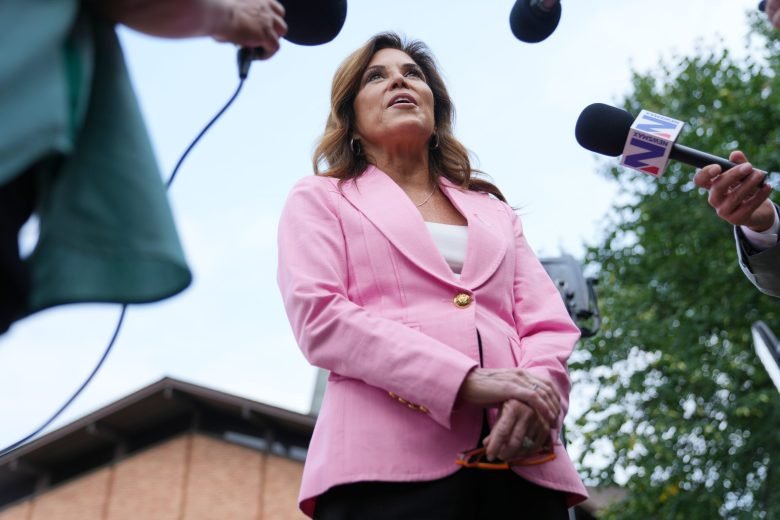
The race between Democratic Lt. Gov. Peggy Flanagan and former NFL sideline reporter Michele Tafoya, a Republican, seems to have tightened in a state where the seat of retiring Sen. Tina Smith was once considered safely Democratic.
Tafoya has been hammering Flanagan on the fraud issue, even as she has not provided evidence the lieutenant governor had knowledge of any swindles that may have occurred in state agencies.
Nevertheless, Tim Lindberg, a political science professor at the University of Minnesota Morris, said the fraud issue is the core message hurting all Democratic candidates in the state.
“That’s the prime message that Republicans are harping on and it’s working to some extent,” Lindberg said.
Flanagan told MinnPost she had little to do with policing fraud in state programs.
“I was not tasked with the fraud response,” she said. My job as lieutenant governor … is to lean on the issues that I’ve been leaning on for a long time, which is children and families.”
Flanagan said she was tasked with those issues because of her time with the Children’s Defense Fund, a non-profit advocacy group for youth, and because of her work as a member of the state House.
There is no smoking gun that would determine that Flanagan was aware of any fraud in state programs while it occurred. Even a Republican investigation by the House Oversight and Government Reform Committee that targeted Gov. Tim Walz and Attorney General Keith Ellison did not lay blame for Minnesota’s fraud at Flanagan’s feet.
But there is evidence that Tafoya’s accusations have hit their mark.
A KTSP/Survey USA poll taken earlier this month showed Flanagan and Tafoya in a dead heat — 42% to 42% — with 12% of the respondents undecided. Flanagan had a 5-point lead in a poll conducted in August.
Flanagan dismissed the latest poll results, citing a Survey USA poll taken just before August’s primary election that undercounted her support by 22 percentage points.
That poll showed U.S. Rep. Angie Craig, D-2nd District, slightly ahead of Flanagan, by 2 percentage points. Yet Flanagan crushed Craig in that primary election, 59% to 39%.
Related: How Peggy Flanagan won a chance to succeed Sen. Tina Smith
Meanwhile, the Cook Political Report said it doubted polling on the race and has upgraded it from “lean Democratic” to “likely Democratic.”
“We’re skeptical of some public polling that has shown the race close,” it said. “And Lt. Gov. Peggy Flanagan has only just now started spending after a brutal Democratic primary.”
Still, Flanagan said she is “certainly not taking anything for granted.”
“I have always run for office like I’m 10 points behind,” she said.
The Survey USA poll came out as national Democrats were broadening their map of competitive Senate races in their effort to wrest the chamber from GOP control, a goal that seems within reach. An unexpected loss in Minnesota would hinder those plans.
Carleton College political science professor emeritus Steven Schier said it may be smart for Flanagan to run as an underdog. “All the fraud revelations in the last two years have given Republicans a shot at statewide office,” he said.
Fraud was the main topic Sept. 24 at a Republican campaign headquarters rally in Willmar. U.S. Rep. Michelle Fischbach, the District 7 incumbent, said “in Washington, no one talks about Minnesota lakes anymore, all they talk about is fraud.” Noting the western Minnesota district is the “reddest district in the state,” Fischbach said Republicans “must get out the vote.”
Joining Fischbach at the rally, Lt. Gov. candidate Ryan Wilson said “for too long, we’ve been told (fraud) is racist. For too long we’ve been told that fraud doesn’t exist.”
The GOP has not won a statewide office since former Gov. Tim Pawlenty was elected in 2006.
A traditional progressive
Flanagan has positioned herself as a traditional progressive. She supports Medicare for All, a plan to provide every American with a government-run health plan, and has been very critical of Israel’s government and the war in Iran.
While Tafoya’s main campaign strategy is to cry “fraud,” Flanagan has focused on tying her GOP rival to President Donald Trump, whose popularity has plummeted. She characterizes Tafoya as a “rubber stamp” for the president’s policies and a Trump apologist.
“In Minnesota fraudsters have been prosecuted … but Michele Tafoya has nothing to say about the most corrupt administration we’ve seen in our nation’s history,” Flanagan said.
Meanwhile, in a campaign ad Flanagan says, “Michele Tafoya is all in for Trump’s forever war and these crazy gas prices.”
Tafoya’s campaign did not respond to requests for interviews or comments.
In fact, Tafoya has had little to do with most local media, preferring instead to campaign through appearances at small and highly controlled events, on conservative TV shows and podcasts and through ads and social media.
“Tafoya is obviously a very skilled media communicator and she’s very selective about what media she communicates through,” Schier said. “She’s not putting herself in a place where she is going to be asked a lot of tough questions.”
Flanagan, meanwhile, is also holding small events throughout the state. The candidates will participate in an Minnesota Public Radio debate Oct. 16 but have not agreed on a host for a second debate.
While Tafoya has won Emmys for her sports broadcasting and is extremely media savvy, she has been prone to political gaffes.
She said Americans should show their support for the Iran war with a “stiff upper lip” and offset increases in gas prices with fewer trips to Starbucks. She has also said, in 2023, that she was eager to move out of Minnesota because of its Democratic-run government.
But Tafoya’s main problem is Trump. While she supports his policies — including his efforts to “keep illegals from voting” through tough new voter identification requirements — she also backs the war in Iran and Trump’s tariff policies, which she said would result in beneficial global trade agreements.
Yet, while she said she’d welcome Trump’s endorsement, Tafoya does not mention the president on her campaign web site or in her TV ads.
She told MPR she is “an independent thinker.”
“When something is right, I will go with it,” Tafoya said. “When something is wrong, I have the spine to stand up to it.”
Tafoya, 61, was not the first choice of GOP activists in the state. They chose Adam Schwarze, a more MAGA-aligned Republican, as their endorsed candidate.
But Tafoya handily beat Schwarze in the GOP primary and, if the Survey USA poll is accurate, continues to expand her support.
At the Kandiyohi County Republican Party campaign headquarters in Willmar, party activist Paul Hoffer was upbeat about Tafoya’s candidacy.
He said Tafoya “isn’t a politician. She has name recognition, even nationally.”
Tafoya once said she was a “pro-choice” Republican and has walked that back to align herself with Trump’s stance on the issue. And she has taken up a Republican cultural issue by vigorously opposing transgender athletes in women’s sports. Hoffer said she is “not that far left” for party conservatives.
Like most Trump supporters, Hoffer did not blame the president for the price spikes in gas prices and dismissed them as temporary.
“None of us like the gas prices,” Hoffer said. “They will drop when the (Iran) war ends.”
Notching some ‘firsts’
Flanagan, 47, frequently speaks on the stump of a tough childhood in her hometown of St. Louis Park. She said her single mother worked hard but needed safety-net programs like Section 8 housing, food stamps and Medicaid to support her family.
Meanwhile Tafoya, who lives in Edina, hardly speaks of her family or upbringing, preferring to introduce herself to voters by speaking about her extensive career as a sports journalist. Her latest political ad has her cradling a football.
Tafoya’s early career included a stint as a reporter for KFAN Radio in Minneapolis, covering the Minnesota Vikings and University of Minnesota women’s basketball games. She also had a drive-time radio show on WCCO Radio.
Related: Michele Tafoya has the support of the national GOP, but winning over state activists is a challenge
She eventually became the sideline reporter for NBC’s Sunday Night Football but left that job after the 2021 season to co-chair then-gubernatorial candidate Kendall Quall’s 2022 campaign.
After Qualls quit the race, Tafoya continued to immerse herself in GOP politics with a podcast that was originally called “Sideline Sanity” and afterwards “The Michele Tafoya Podcast.” She described herself as a “political and cultural commenter.”
Flanagan, whose father is Ojibwe, often says she would be the first Native American U.S. Senator from Minnesota and the first Native American female U.S. Senator.
Tafoya would also notch some “firsts.” Raised in California as one of five children of a father who was Hispanic and a mother who was Irish- American, Tafoya would be the first Latina U.S. Senator and the first Republican Latina in the U.S. Senate.
“I’m a Hispanic woman, and my parents believed firmly in the American Dream,” Tafoya wrote in a short essay for “Our America” in 2022.
But she also wrote that “identity politics continues to slice America into all kinds of ‘marginalized’ groups,” a position she continues to hold.
A quiet race
Like most close elections, the winner of the Senate race will be determined by who turns out at the polls on Nov. 3.
Democrats seem more enthusiastic to vote than Republican voters this year, though Lindberg wondered “will that fraud message engage Republican voters so they turn out?”
He said Democratic voters in Minnesota are already angry because of Operation Metro Surge and other Trump policies and don’t need a lot of encouragement.
Meanwhile, Schier said “the DFL has a much better get-out-the-vote effort” than the state’s GOP.
Flanagan has raised more campaign cash than Tafoya, even as she has eschewed political action committee donations from corporations. As of July 22, Flanagan reported raising about $6.5 million while Tafoya had raised about $5.3 million.
That’s nearly a pittance in today’s politics. For example, the candidates in the North Carolina Senate race are expected to spend between $600 million and $800 million.
The relatively modest amount of campaign spending, and the relative lack of spending by the national parties and other third parties have made the Minnesota Senate race a comparatively low-key affair.
But if the race continues to be competitive, “we could see a lot of national party money coming in,” Schier said.
That would hurt the Democratic Senatorial Campaign Committee (DSCC) more than the National Republican Senate Committee (NRSC) since the DSCC has less cash and more ambitions than its GOP rival.
“Democrats do not want to spend money here because they have a lot of prospects elsewhere,” Schier said.
The post As Senate race tightens, Flanagan and Tafoya make their final pitches appeared first on MinnPost.
Leave a Reply