










The Trump administration has announced the end of a massive immigration crackdown in Minnesota after two and a half protest-filled months, 4,000 arrests and two fatal shootings by immigration officers.
Two U.S. citizens, Renee Good and Alex Pretti, were killed by federal officers in Minneapolis.
Here is a look at some key moments during Operation Metro Surge, which the Department of Homeland Security called the “largest immigration enforcement operation ever.”
Dec. 1:
The immigration crackdown begins after weeks of escalating rhetoric by President Donald Trump criticizing Minnesota’s Somali community.
Operation Metro Surge is focused on the Minneapolis-St. Paul area, home to the nation’s largest Somali community. Trump has claimed immigrants from Somalia were “completely taking over the once great State of Minnesota.” He later referred to Somali residents as “garbage” during a Cabinet meeting.
WATCH: Trump says he doesn’t want Somali migrants in the U.S., calls people ‘garbage’
State and local leaders pushed back. Minnesota’s Democratic Gov. Tim Walz said Trump slandered all Minnesotans and that his expressions of contempt for the Somali community were “unprecedented for a United States president.”
According to U.S. Census Bureau data, an estimated 260,000 people of Somali descent were living in the U.S. in 2024. That includes about 84,000 residents in the Minneapolis area, most of whom are American citizens.
Dec. 5:
U.S. Immigration and Customs Enforcement announces it has arrested 12 people during the crackdown, including six Mexican nationals, five from Somalia and one from El Salvador.
Dec. 9:
Federal agents use pepper spray to push through a crowd of protesters who blocked their vehicles as they checked identifications in a heavily Somali neighborhood.
When agents approached a city-owned senior housing complex, a group of protesters blew whistles to sound the alarm and confronted the agents, who responded with pepper spray.
Similar protests would become commonplace throughout the Twin Cities in the following weeks, with a widespread network of residents working to help immigrants, warn people of approaching agents or film immigration officers’ actions to share with the world.
Dec. 18:
Five new defendants are charged in connection with an ongoing Minnesota housing services fraud investigation, with authorities saying they stole money instead of helping Medicaid recipients find stable housing.
First Assistant U.S. Attorney Joe Thompson says as much as $9 billion in federal funds may have been stolen in the multilayered fraud scheme, which has resulted in charges against at least 92 people.
Trump capitalized on the fraud cases to target the Somalia diaspora in Minnesota. Eighty-two of the 92 defendants in the child nutrition, housing services and autism program schemes are Somali Americans, according to the U.S. Attorney’s Office for Minnesota.
Dec. 30:
More federal immigration officers surge to Minnesota following new allegations of fraud at Somali-run day care centers posted online by a right-wing influencers.
WATCH: Federal agents probe fraud allegations targeting Somali child care providers in Minnesota
Both Department of Homeland Security Secretary Kristi Noem and FBI Director Kash Patel announced an increase in the immigration operation in Minnesota.
Trump’s administration also announced it is freezing child care funds to the state.
Jan. 7:
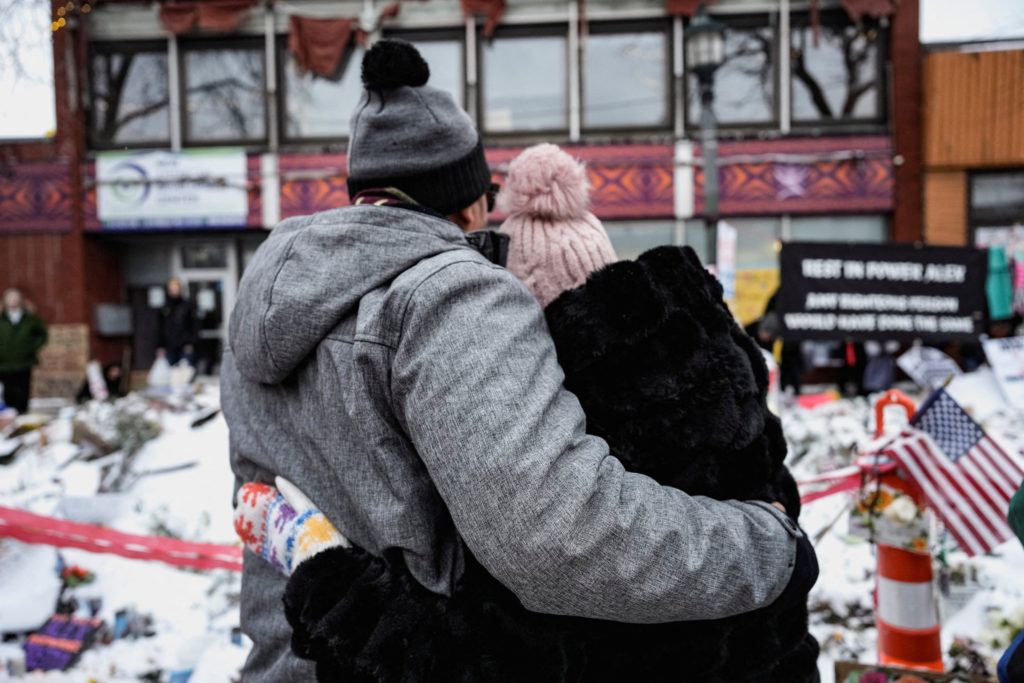
People embrace in front of the site of a memorial for Alex Pretti and Renee Nicole Good in Minneapolis, on Feb. 1, 2026. Photo by Tim Evans/ Reuters
Renee Good, a 37-year-old U.S. citizen and mother of three, is shot and killed by an Immigration and Customs Enforcement officer. Good’s killing is recorded on video by witnesses, sparking outrage nationwide.
Noem claims the incident as an “act of domestic terrorism” carried out against ICE officers, and Vice President JD Vance later claimed the officer fired in self-defense because Good was trying to hit him with her vehicle. But that explanation has been panned by Minneapolis Mayor Jacob Frey, Walz and others based on videos of the confrontation.
WATCH: Brothers of Renee Good, woman fatally shot by ICE, remember their sister with lawmakers
The videos filmed by bystanders challenged the administration’s narrative. It’s unclear in the videos if the car makes contact with the officer, who shoots first while standing in front of the vehicle and then twice more while standing at the side of the car, an arm’s length from the driver’s side window.
Jan. 11:
A new video shows the minutes before a federal immigration officer shot and killed Good.
The 3 1/2-minute-long video filmed by a bystander was posted by the Department of Homeland Security to X. It shows two officers walking toward Good’s car as it blocks part of a road.
READ MORE: ‘We had whistles. They had guns,’ says wife of Minnesota woman killed by ICE agent
Another video filmed by the officer who fired at Good shows one officer ask Good to get out of the car and another tries to open her door. The officer who is filming circles around to the front of the vehicle. Good reverses briefly — placing the filming officer in front of the driver’s side of the vehicle — and then turns her steering wheel toward the passenger side of the vehicle. An officer orders her out of the car as her wife, who is standing outside the vehicle, shouts, “drive, baby, drive!”
The vehicle pulls forward, the video veers upward and shots are heard.
Jan. 14:
A 51-year-old Venezuelan man is shot in the leg by ICE agents.
Officials say the non-fatal shooting came after the officer was attacked by two other people with a shovel and a broom handle while he was trying to arrest the Venezuelan man.
READ MORE: Prosecutors to dismiss charges against men accused of assaulting ICE officer in Minneapolis
Protesters and federal officers continued to square off near the site of the shooting, with officers firing tear gas into the crowd while protesters threw snowballs and chanted, “Our streets.”
The same day, an immigrant from Nicaragua who was also swept up in Operation Metro Surge is found dead at a Texas immigration detention facility.
WATCH: Sadness, anger and exhaustion grip Twin Cities after latest killing by federal agents
Immigration and Customs Enforcement says Victor Manuel Diaz appeared to have killed himself, but the death remained under investigation.
Another detainee at the same detention facility died earlier in January. ICE said the death occurred as staff members tried to keep him from killing himself, but a fellow detainee said at least five officers were restraining the handcuffed inmate and one had an arm around his neck. A preliminary investigation by the El Paso County Medical Examiner’s Office found Lunas Campos, 55, died from asphyxia from chest and neck compression and said the death would likely be classified a homicide.
Jan. 18:
Federal immigration agents break open the front door of a Minnesota home and detain a U.S. citizen at gunpoint without a warrant. They then lead him out into the streets in his underwear in subfreezing conditions.
The same day, the U.S. Department of Justice announces it is investigating a group of protesters in Minnesota who disrupted services at a church where a local official with U.S. Immigration and Customs Enforcement serves as a pastor.
READ MORE: Don Lemon pleads not guilty to civil rights charges in anti-ICE Minnesota church protest
A livestreamed video of the protest shows a group of people interrupting services by chanting “ICE out,” and “Justice for Renee Good.”
Jan. 20:
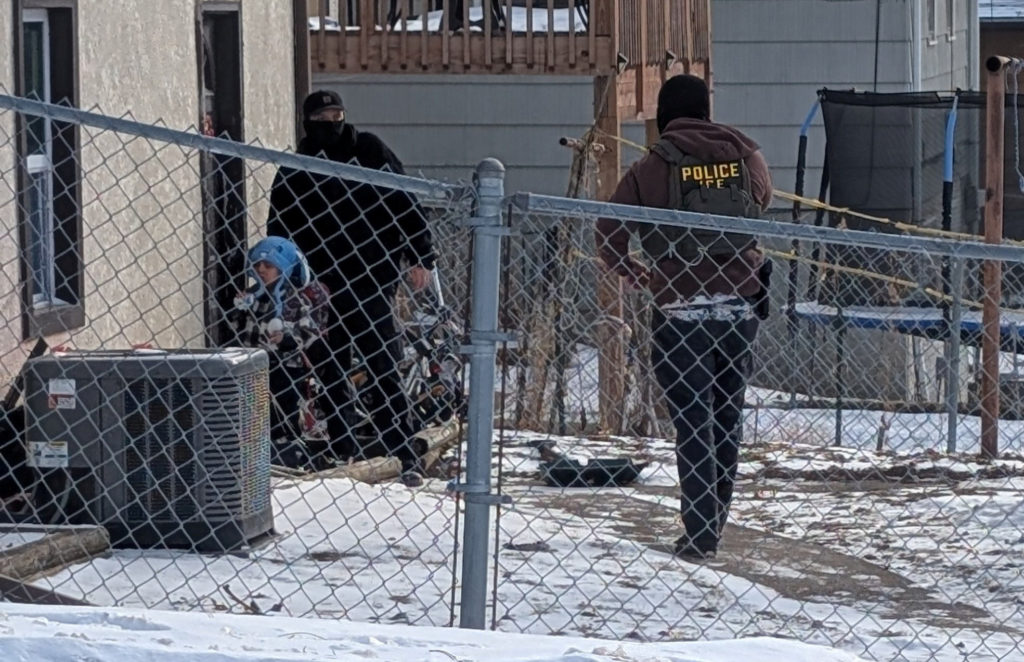
ICE agents stand next to a boy, who a witness identified as Liam Conejo Ramos, a 5-year-old that school officials said was detained in Minneapolis, Minnesota, Jan. 20, 2026. Photo provided by Rachel James/via Reuters
A 5-year-old boy arriving home from preschool is taken by federal agents along with his father to a detention facility in Texas.
Columbia Heights Public Schools Superintendent Zena Stevnik told reporters that federal agents took Liam Conejo Ramos from a running car in the family’s driveway, and then told him to knock on the door to his home to see if other people were inside, “essentially using a 5-year-old as bait.”
WATCH: ‘They are circling our schools,’ superintendent says after 5-year-old detained by ICE
The family has an active asylum case and had not been ordered to leave the country, Stevnik said.
Federal officials deny the school official’s allegations.
Jan. 22:
Trump administration officials announce that a prominent civil rights attorney and at least two others involved in the protest that disrupted a church service have been arrested.
Jan. 24:
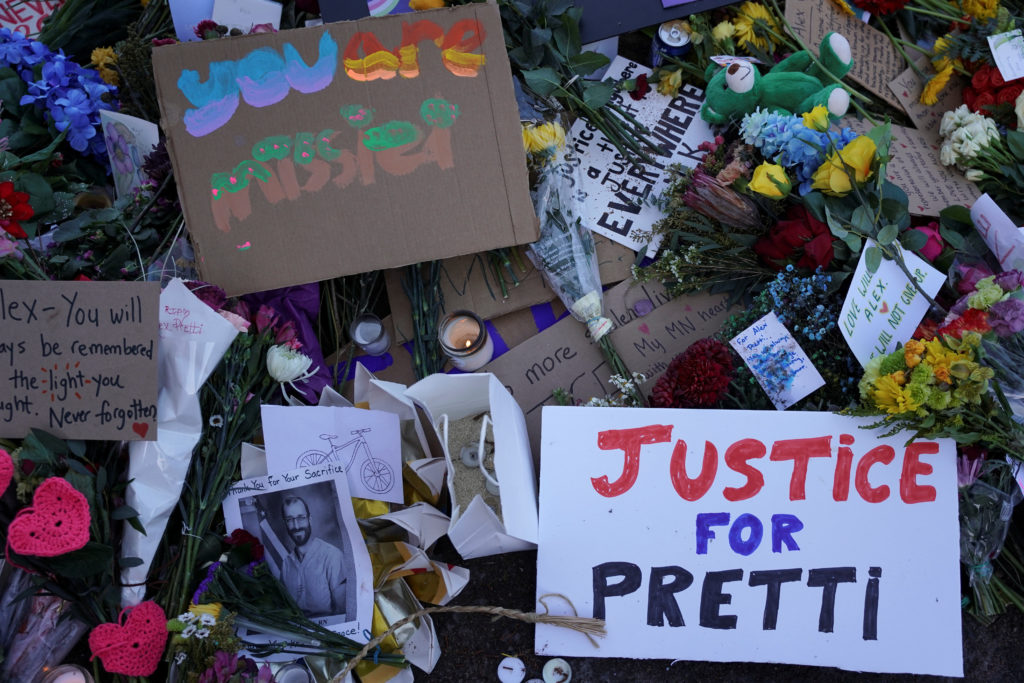
Flowers, candles and placards lie at the site of a memorial for Alex Pretti during a protest against the U.S. Immigration and Customs Enforcement (ICE) after the fatal shootings of Pretti and Renee Nicole Good by U.S. federal immigration agents, in Minneapolis on Jan. 31, 2026. Photo by Seth Herald/ Reuters
Alex Pretti, a 37-year-old intensive care nurse at a VA hospital, is shot and killed by a U.S. Border Patrol officer in Minneapolis.
WATCH: Shooting deaths climb in Trump’s mass deportation effort
Pretti was a U.S. citizen, and like Good had no criminal record. He was a licensed gun owner with a permit to carry a concealed weapon, and he was wearing a holstered gun the day he died.
Videos shot by bystanders show Pretti with only a phone in his hand as he steps between an immigration agent and a woman on the street after the agent shoved the woman. The officer shoves Pretti in the chest and pepper sprays him and the woman.
At least seven officers begin to force Pretti to the ground, bringing his arms behind his back as he appears to resist. An officer holding a canister strikes him near his head several times. Agents appear to disarm him.
WATCH: ‘You can’t have guns. You can’t walk in with guns,’ Trump says of Alex Pretti killing
A first shot is fired by a Border Patrol officer, and after a pause the same officer fires several more times into Pretti’s back.
Use-of-force experts say the bystander video undermined federal authorities’ claim that the Border Patrol officer opened fire defensively.
Jan. 26:
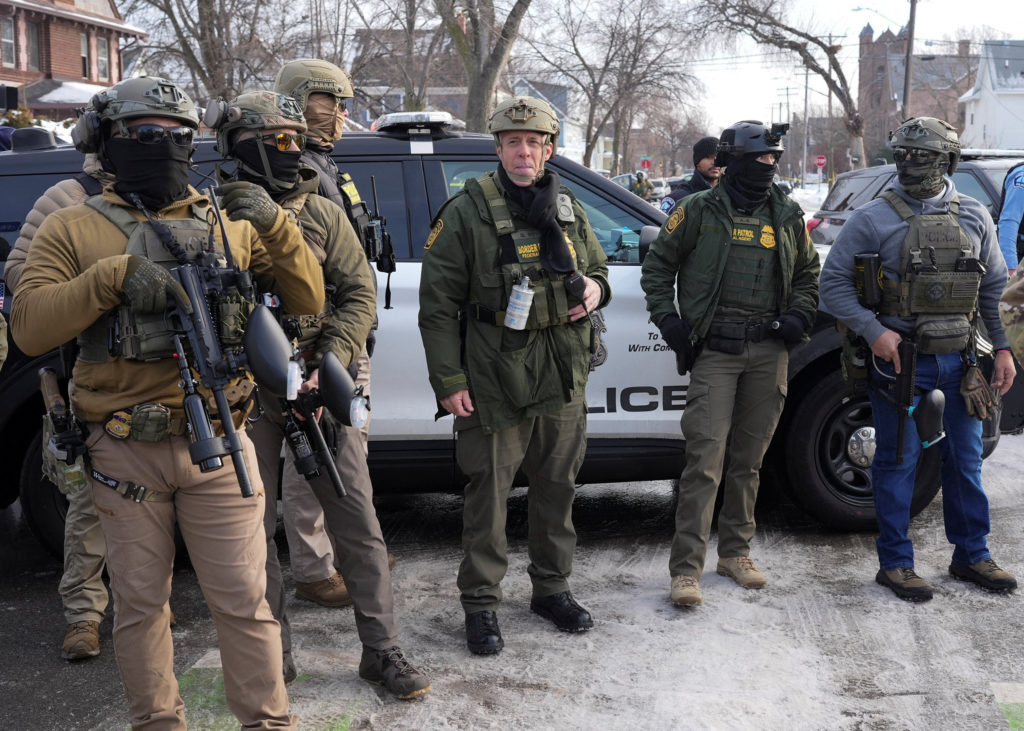
Border Patrol commander Greg Bovino stands next to members of U.S. Immigration and Customs Enforcement (ICE) after a driver of a vehicle was shot in Minneapolis on Jan. 7, 2026. Photo by Tim Evans/ Reuters
The Trump administration reshuffles leadership of Operation Metro Surge, with Border Patrol commander Greg Bovino and some agents leaving Minneapolis.
WATCH: Minneapolis residents remain skeptical after immigration enforcement leadership change
Trump’s border czar, Tom Homan, will be in charge of the crackdown, Trump announces.
Feb. 1:
Five-year-old Liam Conejo Ramos and his father are returned to Minnesota following a judge’s order.
Feb. 2:
U.S. Attorney General Pam Bondi announces more arrests in connection with the Jan. 18 protest at the Cities Church in St. Paul. Independent journalists Don Lemon and Georgia Fort are among those arrested.
Feb. 12:
Border Czar Tom Homan announces the end of Operation Metro Surge.
The announcement is unusual — immigration officials did not announce formal ends to similar operations in Chicago, Los Angeles and elsewhere.
Multiple Associated Press reporters contributed to this story.
A free press is a cornerstone of a healthy democracy.
Support trusted journalism and civil dialogue.


