










On 2nd March, the National Investigation Agency was granted permission by a special court in Jammu to issue a Letter Rogatory to the competent judicial authority in China. The request seeks assistance in identifying the purchaser and end user of a GoPro camera which was allegedly used to reconnoitre Kashmir’s Baisaran Valley ahead of the deadly Pahalgam terror attack.
The premier counter-terror agency of India had sought permission from the court to contact Chinese authorities to get information about the GoPro camera, as it was linked to a distributor in China.
The development came in connection with the 22nd April 2025 terror attack in Pahalgam, in which 26 people, including a Nepalese tourist, were killed.
Camera traced to Chinese distributor
According to the court order accessed by Gplus, a GoPro Hero 12 Black camera was identified as a “crucial electronic device” in the investigation. The court recorded, “One such crucial electronic device is a GoPro Hero 12 Black Camera, bearing serial No. C3501325471706, which is relevant for establishing pre-attack reconnaissance, movement and operational preparation of terrorist module involved in Pahalgam attack.”
The NIA had issued a notice under the Bharatiya Nagarik Suraksha Sanhita to the Netherlands-based manufacturer, GoPro BV, seeking details regarding the supply chain and activation of the device. In its official response, the manufacturer informed investigators that, “The said camera was supplied to AE Group International Limited, a distributor based in the People’s Republic of China; and the camera was activated on 30.01.2024 at Dongguan, People’s Republic of China.”

No end-user data with manufacturer
However, GoPro BV told the agency that it did not hold downstream transaction or end-user details of the device. The order noted, “The manufacturer has further stated that it does not possess downstream transaction details or end-user records of the said device.”
It further added that the “activation, initial use and commercial trail of the said device lie within the territorial jurisdiction of the People’s Republic of China, and the information necessary to trace the purchaser, end-user and associated technical records can only be obtained through judicial assistance of the Chinese authorities.”
Notably, India and China are not signatories to a Mutual Legal Assistance Treaty. The court observed that recourse was being taken to the United Nations Convention against Transnational Organized Crime, which both countries have ratified. Furthermore, the Ministry of Home Affairs has given its concurrence for issuance of the Letter Rogatory in the case.
Court allows Letter Rogatory
Allowing the application under Section 112 of the BNSS, Special Judge Prem Sagar held that the information sought was critical to the case. The court observed, “Since the information sought for is very important so far establishing the chain of custody, user, attribution and evidentiary linkage of seized device i.e. camera, GoPro BV, which was supplied to AE Group International Limited, a distributor based in the People’s Republic of China.”
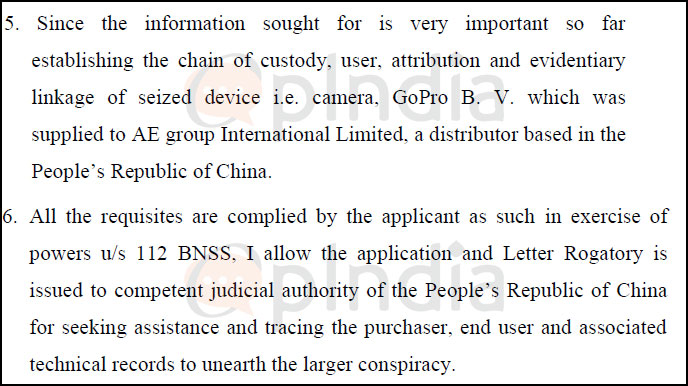
The judge ordered that the Letter Rogatory be issued to the competent Chinese judicial authority “for seeking assistance and tracing the purchaser, end user and associated technical records to unearth the larger conspiracy”.
The investigating officer has been directed to upload a soft copy of the Letter Rogatory, along with Chinese translations, to the MLAT portal, and to send three physical sets, one original and two copies, to the International Police Cooperation Unit of the Central Bureau of Investigation for onward transmission through diplomatic channels.
What is a Letter Rogatory in simple terms
A Letter Rogatory is basically a formal request sent by an Indian court to a court or authority in another country asking for help in a criminal investigation. It is used when important evidence is located outside India. For example, if a device was activated abroad or a company is based in another country, Indian investigators cannot simply demand that information. They must ask through a legal process.
Under Section 112 of the Bharatiya Nagarik Suraksha Sanhita (BNSS), the investigating officer first approaches an Indian court. If the court is satisfied, it issues a formal letter to the foreign country. That country can then question people, collect documents, or gather technical data and send it back officially. The request is sent through the Central Government and diplomatic channels.
If there is no treaty between the two countries, the process still works, but it is slower. The foreign country is not automatically bound to help. It decides under its own laws whether to cooperate. In simple terms, it is a legal way of asking another country, through courts and governments, to share evidence needed in a criminal case.
Background to the attack
On 22nd April 2025, Pakistan-backed terrorists attacked tourists at Baisaran meadow in Pahalgam. They killed 26 innocent Hindus after confirming their religious identity. The terrorist attack brought India and Pakistan to the brink of a wider conflict. In response, India launched Operation Sindoor in early May and targeted terror infrastructure in Pakistan and Pakistan-occupied Jammu and Kashmir.
Pakistan retaliated, but its missile and drone attack was neutralised. India further retaliated and attacked military infrastructure deep inside Pakistan. On 10th May, a ceasefire was announced. In July 2025, the government informed Parliament that the three terrorists involved in the attack had been eliminated in an encounter in the Dachigam forest area.
The latest development shows that investigators are now seeking to establish the full chain of custody and international trail of the camera allegedly used to carry out reconnaissance before the terrorist attack. It is being seen as part of efforts to uncover what the court described as the “larger conspiracy” behind the attack in its order.


