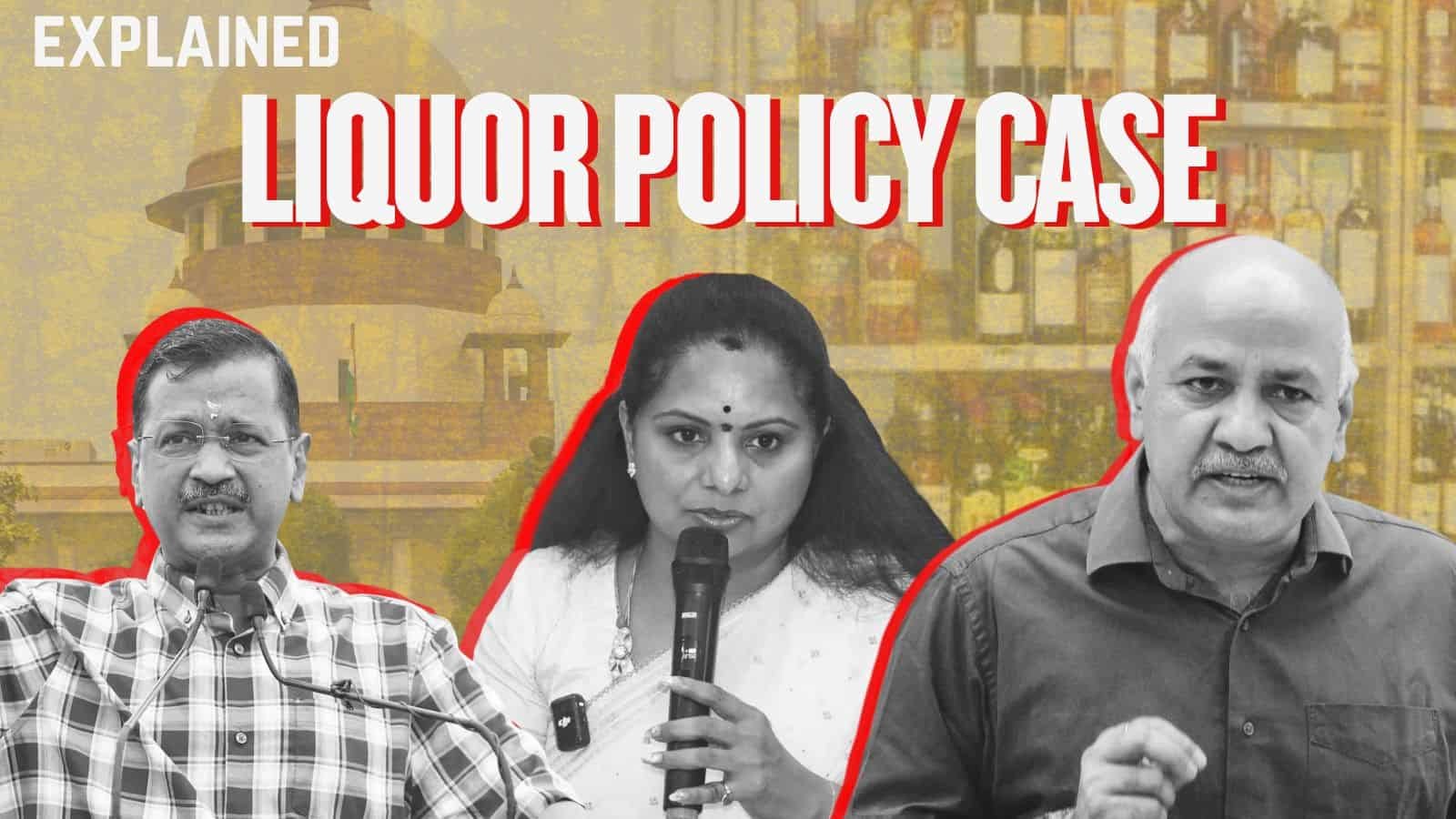
A Delhi court on Friday, February 27, discharged all 23 accused in the liquor policy case, effectively clearing the names of former Telangana Jagruthi president and former MLC K Kavitha, Delhi Chief Minister Arvind Kejriwal and former Deputy Chief Minister Manish Sisodia, who were embroiled in the controversy surrounding it.
What was the liquor scam?
The politically sensational liquor policy case dates back to 2020-2021, when the Aam Aadmi Party (AAP) government in Delhi, led by Kejriwal and Sisodia, had introduced the Delhi Excise Policy 2021–22, completely removing the state government’s involvement in liquor sales, shutting down government-run stalls and handing over the sale of liquor exclusively to private entities.
To take the state’s involvement back even further, in February 2021, a group of ministers, led by Sisodia and then Health Minister Satyendra Kumar Jain, was directed to inquire into the Delhi excise policy reforms, which also had a committee of experts on the panel. The Deputy CM, who held multiple portfolios including the Excise portfolio, introduced the Delhi Excise Policy (2021–22) bill.


The bill aimed to privatise the liquor business, boost government revenue, put an end to the liquor mafia and improve customer experience.
It not only suggested reforms in the sales, but also introduced discounts and proposed to categorise Delhi into 32 zones with further classification so that each ward or area would have around 27 outlets.
According to reports, when the final draft was sent for approval to Lieutenant Governor VK Saxena, he approved it on the condition that new liquor traders could only open in the non-confirmed areas after obtaining permission from the Municipal Corporation of Delhi. The Delhi Excise Policy 2021-22 came into effect on November 17, 2021.

However, right from the start, several complaints alleged irregularities and a “multi-crore scam,” which ultimately led to the Delhi government deciding to bring back the “old excise regime,” scrapping the new policy.
The Opposition at the time, the Congress and the Bharatiya Janata Party (BJP), accusing the government of selling all the state-owned licenses for money and handing over the Excise Department, a government body, to private players and business agencies.
Kavitha linked to ‘South Group’ that transferred Rs 100 crore to AAP govt
It snowballed into a bigger issue when Delhi Chief Secretary Naresh Kumar, in July 2022, submitted a report to L-G Saxena, pointing out alleged procedural lapses in the policy.
The report had said that “arbitrary and unilateral decisions” made by Sisodia had resulted in “financial losses” of more than Rs 580 crore to the government department handling public money. Kumar recommended that the Central Bureau of Investigation (CBI) probe the issue.
An Enforcement Directorate investigation alleged multiple claims.
It stated that the liquor wholesalers were guaranteed a 12 per cent profit margin in exchange for a six per cent kickback to AAP ministers. The ED alleged that Jain and Sisodia ignored the decisions of the expert committee during the formulation of the policy and bypassed the Lt Governor to modify it to include the six per cent profit.
Another big claim was that the AAP’s communication in-charge, Vijay Nair, was paid Rs 100 crore by a “South Group.” The group allegedly consisted of Kavitha, the daughter of then Telangana Chief Minister K Chandrashekhar Rao, her husband and other Hyderabad-based entities.
By December 15, 2022, the ED had officially named the Telangana Jagruti leader in the chargesheet and she was subsequently arrested on March 15, 2024.
Kavitha walked out of Tihar jail in Delhi on August 29 that year, after the Supreme Court granted her bail in the corruption and money laundering cases linked to the excise policy case.
Court ruling: No overarching conspiracy or criminal intent
On Friday, February 27, the Rouse Avenue court in Delhi held that no prima facie case was made out against any of the accused, including Kavitha, and ruled that there was no overarching conspiracy or criminal intent in the formulation of the excise policy.
It also observed that the prosecution’s case did not survive judicial scrutiny and that the CBI had attempted to construct a narrative of conspiracy based on conjecture. In strong remarks, Special Judge Jitendra Singh questioned the agency’s reliance on testimony from an approver to build its case.
The court said granting a pardon to an accused and then using that person’s statements to fill gaps in the investigation and implicate additional individuals was improper.
“If such conduct is allowed, it would be a grave violation of Constitutional principles,” the court observed, adding that such an approach could not form the basis of criminal prosecution.
Leave a Reply