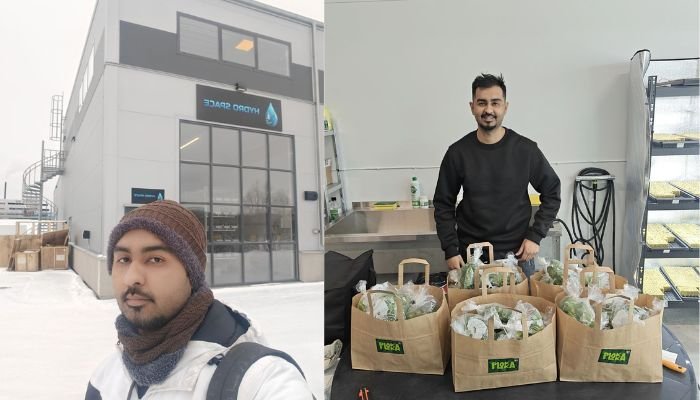
Abhijit Nag Balasubramanya, an Indian entrepreneur based in Sweden, has announced that he is stepping down as founder and CEO of his startup Hydro Space Sweden AB, a microgreens company in the Swedish city of Skellefteå. Abhijit blamed Sweden’s “hostile” and “dysfunctional” immigration process for his decision.
In a LinkedIn post published on 21st February, Abhijit Nag Balasubramanya gave a detailed account of what forced him to sell his microgreens company in Sweden and return to India.
In the post titled, Sweden: Where Innovation Goes to Die in Bureaucracy, Abhijit said that he is “officially stepping down as Founder and CEO of Hydro Space Sweden AB.” He added that this exit is not by choice, but rather forced.
“I have sold the company as I am being forced to leave the country by the end of this month. This isn’t an exit by choice. It is an eviction by an incompetent and increasingly hostile state apparatus,” he said.
The Indian entrepreneur said that while his company was making progress, Migrationsverket was busy “dismantling” is life. Abhijit Nag Subramanya further stated that his experience with the Swedish immigration authorities was not just a bureaucratic hurdle, but also “a masterclass in systemic dysfunction and unprofessionalism.”
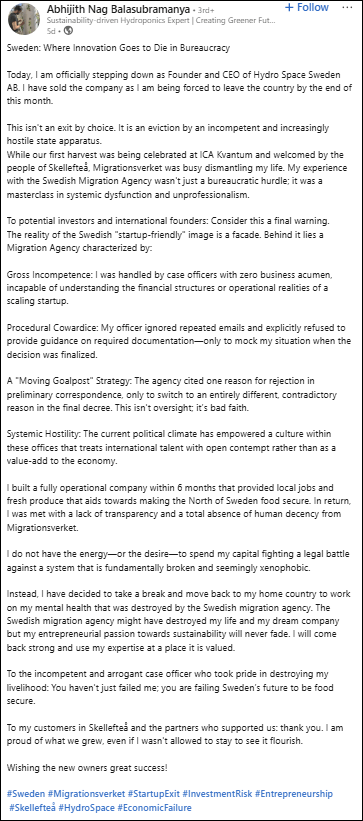
“While our first harvest was being celebrated at ICA Kvantum and welcomed by the people of Skellefteå, Migrationsverket was busy dismantling my life. My experience with the Swedish Migration Agency wasn’t just a bureaucratic hurdle; it was a masterclass in systemic dysfunction and unprofessionalism,” Balasubramanya said.
He went on to warn potential investors and international founders that Sweden’s “startup-friendly” image is a “façade”.
Gross incompetence, procedural cowardice, goalpost moving strategy and systemic hostility: How Indian entrepreneur Abhijit Nag Subramanya described Sweden’s Migration authorities
Abhijit Nag Balasubramanya described the Swedish Migration Agency as being characterised by gross incompetence, procedural cowardice, a moving goalpost strategy, and systemic hostility.
“To potential investors and international founders: Consider this a final warning. The reality of the Swedish “startup-friendly” image is a facade. Behind it lies a Migration Agency characterized by: Gross Incompetence: I was handled by case officers with zero business acumen, incapable of understanding the financial structures or operational realities of a scaling startup. Procedural Cowardice: My officer ignored repeated emails and explicitly refused to provide guidance on required documentation—only to mock my situation when the decision was finalized,” the Indian entrepreneur wrote.
“A “Moving Goalpost” Strategy: The agency cited one reason for rejection in preliminary correspondence, only to switch to an entirely different, contradictory reason in the final decree. This isn’t oversight; it’s bad faith. Systemic Hostility: The current political climate has empowered a culture within these offices that treats international talent with open contempt rather than as a value-add to the economy,” he added.
Built a company within six months to help make North Sweden food secure, got “absence of human decency” from Migrationsverket in return: Indian entrepreneur’s worrying experience with Swedish migration agency
Abhijit Nag Balasubramanya further stated that while he delivered a fully functional company within six months, it not only generated local jobs but also helped tackle Northern Sweden’s food security issue. However, in return, Sweden’s migration agency Migrationsverket offered him nothing but “a lack of transparency and a total absence of human decency.”
He also called the Swedish migration system “broken” and “xenophobic”.
“I built a fully operational company within 6 months that provided local jobs and fresh produce that aids towards making the North of Sweden food secure. In return, I was met with a lack of transparency and a total absence of human decency from Migrationsverket. I do not have the energy—or the desire—to spend my capital fighting a legal battle against a system that is fundamentally broken and seemingly xenophobic,” Subramanya wrote.
“Swedish migration agency destroyed my mental health”: Abhijit Nag Balasubramanya says he will return to India after Swedish authorities destroyed his livelihood and mental health
Devastated with the alleged disturbing experience he had with Swedish migration agency officials, Abhijit Nag Balasubramanya said that he will move back to his home country, India. He said that the Swedish migration authorities may destroyed his mental health, his dream company, but not his entrepreneurial passion.
“Instead, I have decided to take a break and move back to my home country to work on my mental health that was destroyed by the Swedish migration agency. The Swedish migration agency might have destroyed my life and my dream company but my entrepreneurial passion towards sustainability will never fade. I will come back strong and use my expertise at a place it is valued. To the incompetent and arrogant case officer who took pride in destroying my livelihood: You haven’t just failed me; you are failing Sweden’s future to be food secure,” he wrote.
As Abhijit Balasubramanya‘s story goes viral, people share their experiences of racism and discrimination in Sweden
Abhijit Nag Balasubramanya’s LinkedIn post elicited over 165 comments. Several people from diverse national and racial backgrounds shared their disappointing experiences of discrimination or racism-like treatment with the Swedish migration authorities.
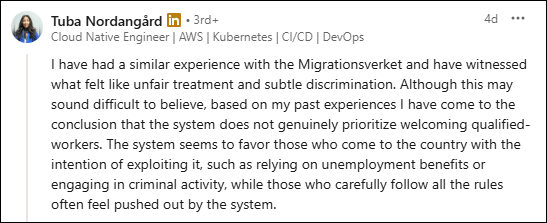
One Tuba Nordangård commented, “I have had a similar experience with the Migrationsverket and have witnessed what felt like unfair treatment and subtle discrimination. Although this may sound difficult to believe, based on my past experiences I have come to the conclusion that the system does not genuinely prioritize welcoming qualified-workers. The system seems to favor those who come to the country with the intention of exploiting it, such as relying on unemployment benefits or engaging in criminal activity, while those who carefully follow all the rules often feel pushed out by the system.”
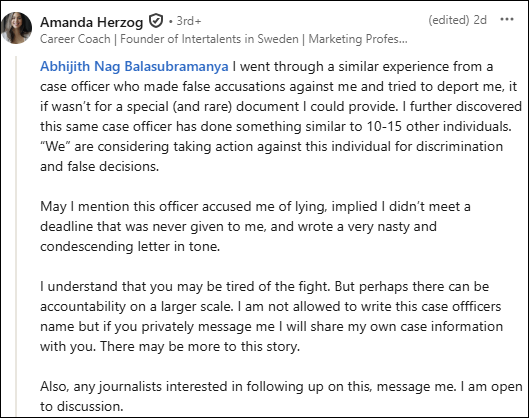
Another one, named Amanda Herzog, also shared her story and commented under Abhijit’s post that one of the officials at the Swedish migration agency allegedly levelled false accusations against her to get her deported. She added that the same officer had harassed 10 to 15 other individuals in a similar manner.
“Abhijith Nag Balasubramanya I went through a similar experience from a case officer who made false accusations against me and tried to deport me, it if wasn’t for a special (and rare) document I could provide. I further discovered this same case officer has done something similar to 10-15 other individuals. “We” are considering taking action against this individual for discrimination and false decisions.
May I mention this officer accused me of lying, implied I didn’t meet a deadline that was never given to me, and wrote a very nasty and condescending letter in tone…”
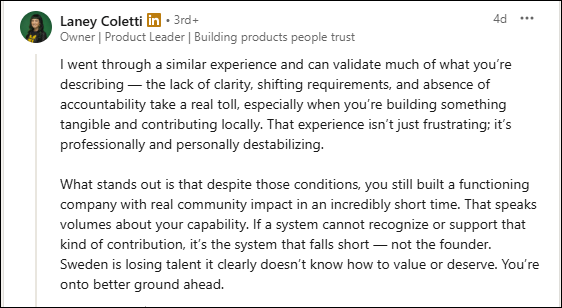
Another LinkedIn user, Lana Coletti, corroborated Abhijit’s allegations against the Swedish migration agency and wrote, “I went through a similar experience and can validate much of what you’re describing — the lack of clarity, shifting requirements, and absence of accountability take a real toll, especially when you’re building something tangible and contributing locally. That experience isn’t just frustrating; it’s professionally and personally destabilizing…”
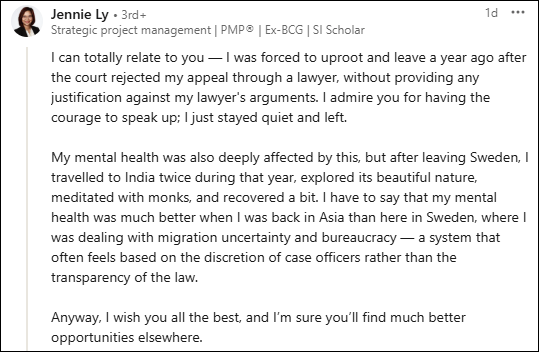
One Jennie Ly said that she could totally relate to Abhijit’s ordeal as she had a similar experience with the Swedish migration authorities that took a serious toll on her mental health.
“I can totally relate to you — I was forced to uproot and leave a year ago after the court rejected my appeal through a lawyer, without providing any justification against my lawyer’s arguments. I admire you for having the courage to speak up; I just stayed quiet and left. My mental health was also deeply affected by this, but after leaving Sweden, I travelled to India twice during that year, explored its beautiful nature, meditated with monks, and recovered a bit. I have to say that my mental health was much better when I was back in Asia than here in Sweden, where I was dealing with migration uncertainty and bureaucracy — a system that often feels based on the discretion of case officers rather than the transparency of the law,” she wrote.
There are many such comments under Abhijit Nag Balasubramanya’s original LinkedIn post, indicating that the allegations he levelled against Migrationsverket may not be an isolated case, but a larger problem.
It must be noted that Sweden has a serious racism and xenophobia problem. In 2022, the police recorded 2,695 hate crimes, with 53% classified as racist or xenophobic.
Leave a Reply