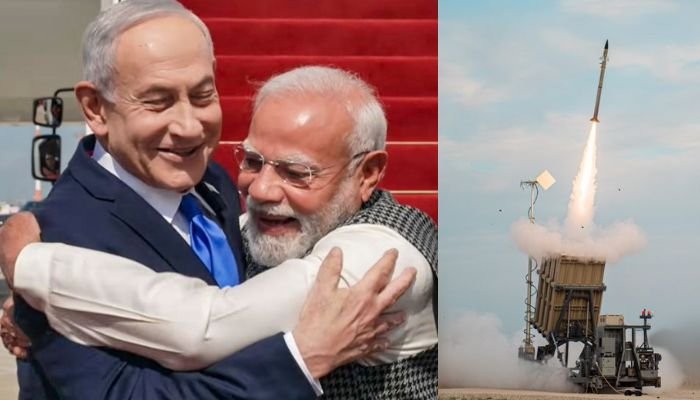
Prime Minister Narendra Modi landed in Tel Aviv, Israel, on Wednesday, 25th February, marking a significant moment in India-Israel relations. This is his first visit to Israel in nine years, and it comes at a time when both countries are looking to deepen cooperation in defence, trade and counter-terrorism.
During the visit, India and Israel are expected to move closer to signing a landmark defence agreement that could take their security partnership to the next level. Unlike previous deals that focused mainly on buying weapons, this time the emphasis is believed to be on the transfer of advanced military technologies. These are systems that Israel has reportedly not shared with any other country so far.
“A strong defence partnership is of vital importance”
Addressing the Israeli Parliament, the Knesset, PM Modi underlined how central defence ties are to the relationship between the two nations. He described defence cooperation as an “important pillar” of India–Israel ties.
“In today’s uncertain world, a strong defence partnership between trusted partners like India and Israel is of vital importance,” he said.
In today’s uncertain world, a strong defence partnership between trusted partners, like India and Israel, is of vital importance.#PMModiInIsrael pic.twitter.com/ayygRjUWgD
— MyGovIndia (@mygovindia) February 25, 2026
He also said that he and Israeli Prime Minister Benjamin Netanyahu are committed to expanding trade, increasing investment flows and encouraging joint infrastructure development. According to Modi, last year’s ceasefire in the Gaza war has opened up new opportunities for closer cooperation.
Addressing the Knesset. Do watch my speech. @KnessetENG https://t.co/a8V6Ah5HwY
— Narendra Modi (@narendramodi) February 25, 2026
His message was clear: India and Israel see each other as reliable partners in a world facing growing security threats.
What the expected defence deal may include
According to officials familiar with the discussions, PM Modi is expected to finalise a major order for Israeli-made missile systems during this visit. While the finer details are unlikely to be made public, the broad understanding is that the cooperation will have two main parts, defensive systems and offensive weapons.
In the defensive category, talks are believed to be centred around some of Israel’s most advanced air defence systems. These include systems developed by companies such as Israel Aerospace Industries, Rafael Advanced Defence Systems and Elbit Systems.
On the offensive side, discussions are likely to include advanced precision and long-range strike systems. These may involve Rafael’s SPICE 1000 guidance kits, Elbit Systems’ Rampage air-to-ground missiles, Ice Breaker naval cruise missiles, and IAI’s supersonic Air LORA missiles.
However, the Indian government’s interest in acquiring these systems is not merely for purchase but also for technology transfer. The plan is to produce these systems in India through the ‘Make in India’ program and use them in a future multi-layered missile defence system project called “Sudarshan Chakra,” which is expected to be completed by 2035.
Iron Dome and its combat record
One system that stands out in these discussions is Israel’s Iron Dome. Some of the systems being discussed include the Arrow missile defence system, David’s Sling, which has the capability of destroying medium-range missiles and drones up to 300 km, which has the capability of destroying short-range rockets between 4 and 70 km. These systems gained global attention for its performance during repeated conflicts with Hamas. During rocket attacks from Gaza, the Iron Dome system successfully destroyed thousands of incoming rockets targeting Israeli cities, thereby reducing civilian casualties and damage to a great extent.
Iron dome has quick detection and destruction capabilities for short-range rockets have made it one of the most tested air defense systems in the world. For a country like India, which has long borders and a long coastline, such a system is of immense use.
In addition to Iron Dome, India has shown a strong interest in Israel’s newer Iron Beam system. It is a laser-based platform regarded as a cost-effective, “light-speed” response to low-cost aerial threats.
The suggested partnership seeks to enhance the protection of Indian cities and critical infrastructure with a highly effective defense shield that would work in synergy with long-range systems like the S-400.
The broader objective is to create what officials describe as an “impregnable” national security canopy by 2030.
Strengthening India’s missile shield
India’s renewed push for advanced missile defence systems also comes after lessons learned from recent tensions with Pakistan. Last May, Islamabad reportedly used Turkish drones and Chinese PL-15 long-range air-to-air missiles in attempts to target Indian military and civilian assets.
India already operates Russia’s S-400 missile defence system, Israeli-developed Barak systems and the indigenous Akash system. However, officials believe that additional layers, such as Iron Dome and Iron Beam, would make the country’s air defence network stronger and more difficult to penetrate.
With a land border stretching over 15,000 kilometres and a coastline of more than 7,500 kilometres, India sees the need for a more comprehensive and integrated shield. The idea is to create a pan-India, multi-layered defence system capable of handling threats ranging from short-range rockets and drones to long-range missiles.
Possible talks on advanced strike systems
There could also be discussions on acquiring Golden Horizon, believed to be a successor to the Sparrow target missile family. This is a unique class of missile designed to be launched from aircraft. It could potentially be integrated with the Indian Air Force’s Sukhoi-30MKI jets.
With a strike range estimated between 1,000 and 2,000 kilometres and speeds reaching up to Mach 5, the system is designed to penetrate hardened military targets, including underground bunkers. At such high speeds, intercepting it becomes extremely difficult. For comparison, India’s BrahMos cruise missile travels at around Mach 3 and is widely regarded as one of the fastest operational supersonic cruise missiles in the world.
Beyond weapons: A broader security vision
Another major development could be the announcement of a broader security alliance. Prime Minister Netanyahu recently spoke about forming what he called a “hexagon of alliances” around the Middle East. This grouping, he suggested, could include India along with Arab nations, African countries, Mediterranean states, Greece, Cyprus and other Asian partners.
The idea, according to him, is to unite against what he described as “radical axes” in the region.
For India and Israel, the relationship has evolved over decades. Israel has long been one of India’s key arms suppliers. Today, the partnership goes beyond simple buyer-seller dynamics, with joint manufacturing of equipment such as drones and missile systems.
PM Modi’s visit signals that this relationship is entering a new phase, one that combines advanced defence cooperation, technology sharing and a broader strategic vision in an increasingly uncertain world.
Leave a Reply