
WASHINGTON – After he decisively won his last election, it looked like Rep. Brad Finstad had a lock on southern Minnesota’s sprawling 1st Congressional District.
A conservative Republican who served as the U.S. Department of Agriculture’s Rural Development director in the state during President Donald Trump’s first term and the operator of a family farm, Finstad reflected the ideology of a growing number of southern Minnesota voters who had steadily marched toward the Republican Party.
Living in New Ulm with his wife and seven children, Finstad has deep roots in the district and looked like a shoo-in for reelection.
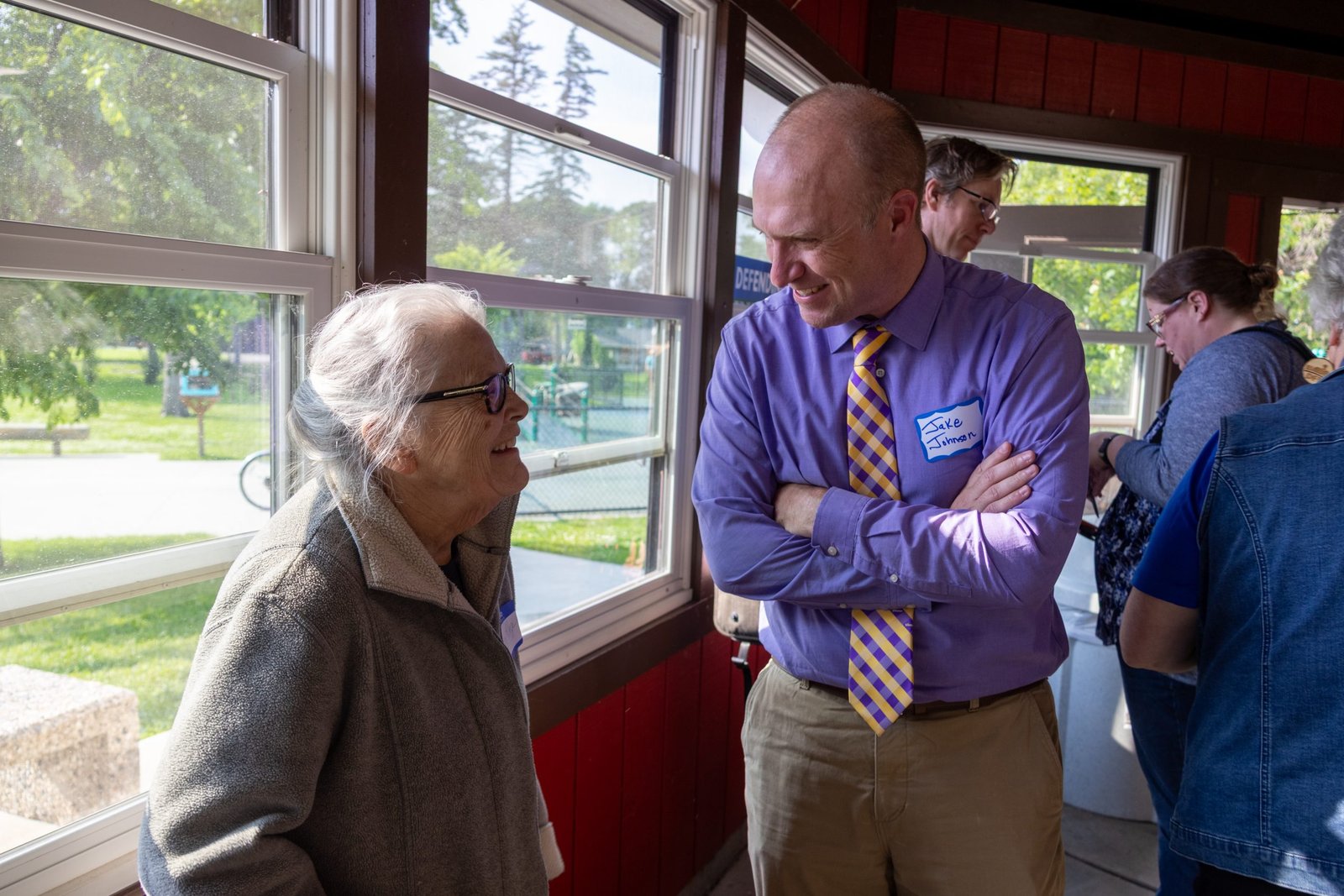
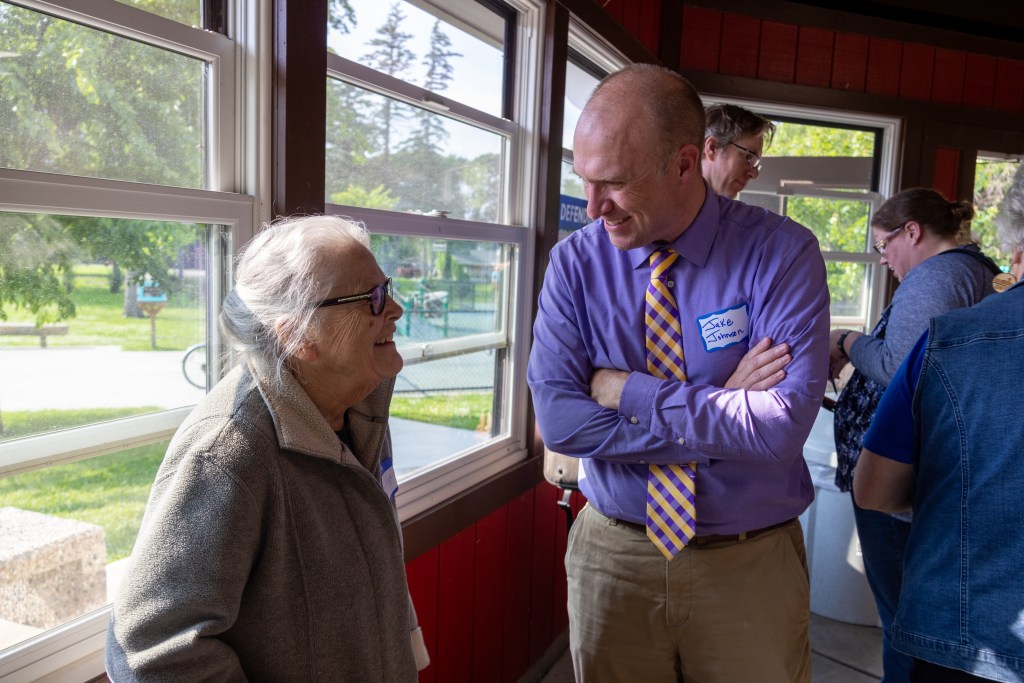
But he’s attracted a stronger-than-expected challenge this year from high school math teacher Jake Johnson, who grew up in Stewartville and still lives only about 10 miles away. Running as a centrist Democrat, Johnson has the backing of politically powerful teachers unions and has caught the attention of the national Democratic Party.
With its largest population center in Rochester, the largely rural 1st District stretches along the Iowa border from Wisconsin to South Dakota.
Trump won that district by just 1 percentage point in 2020. But the president’s margin of victory rose to more than 12 percentage points in 2024. And Finstad defeated his Democratic rival, Rachel Bohman, by 17 percentage points that year.
While Democrats are in the minority in the district, Johnson’s bid for office has been aided by political serendipity.
Trump’s favorability ratings have dropped, the U.S. economy is showing signs of weakness and the president’s signature domestic and foreign policy issue – tariffs – have pinched the district’s farmers by raising the price of inputs and prompting retaliation from some of the nations that purchased their exports.
Related: D.C. Memo: Scotus upends Trump tariffs that have roiled Minnesota farmers and state’s trade with Canada
“I’m running on affordability and tariffs,” Johnson, 42, said. “Our rural communities are hurting right now.”
Carleton College political science professor Ryan Dawkins said Trump had made gains in the 1st District in the 2024 election as part of a “generalized shift” toward the president by an electorate that was angered by high inflation.
But now, continued inflation, dropping consumer confidence levels and doubts about the strength of the economy are working against Trump, Dawkins said. That’s why he said Johnson’s call for “affordability,” a mantra widely used by Democrats this election, is likely to resonate.
“(Voters) view Trump as, at best, aloof to the problem, or at worst, complicit,” Dawkins said.
He also said “Operation Metro Surge,” the Trump administration’s massive immigration crackdown in Minnesota, may also have an impact on the race by depressing GOP voter turnout.
“But you might not see it as much in rural areas,” Dawkins added.
Finstad prefers to focus on the popular things Trump has accomplished — often with the help of Republicans in Congress.
“We have ended lawlessness on our formerly open southern border. We have delivered tax relief that Americans are starting to see this year. Most crime is on the decline,” he said in a written response to questions.
Johnson has also been able to raise a respectable amount of campaign cash — a little more than $750,000 last year — so there’s not a huge fundraising gap between his campaign and Finstad’s, which has raised a little over $1 million.
Another advantage for the Democrat is that midterm elections historically favor the party that does not control the White House. The GOP majority in the House has shrunk due to Democratic wins in several special elections and Democrats are favored to retake the chamber in November’s midterms.
“It’s not going to be whether the Democrats have a good year, but how good a year are the Democrats having,” Dawkins said.
That fight over control of the U.S. House has made the 1st District race more competitive, even as Johnson is still the underdog in the contest.
To win control of the House, Democrats need to only flip three seats. But the Democratic Congressional Campaign Committee has targeted 44 districts, including Finstad’s. That means Johnson’s campaign could be eligible for campaign cash and other types of help from the national Democratic Party.
‘Every campaign … is a little different’
Finstad, 49, has represented the 1st District since 2022, when a special election was held to fill the seat of former Republican Rep. Jim Hagedorn, who died in office.
Finstad has positioned himself well in Congress, securing a seat on the House Agriculture Committee that allows him to be at the table when issues that affect his farmers are considered. He also has seats on the House Small Business and Armed Services committees.
He has the advantages of incumbency, including name recognition and an ability to raise money from political action committees. And he has a powerful ally in Rep. Tom Emmer, R-6th District, who has a leadership position as the House Majority Whip and was a former head of the National Republican Congressional Committee.
But Finstad is also still a relatively junior member of the House, where the ability to get things done is largely based on seniority.
He’s introduced 24 bills in this term of Congress. They include a bill that would streamline the U.S. Department of Agriculture loan process and legislation that would remove a Medicaid restriction on coverage for mental health services in facilities with more than 16 beds.
While most of Finstad’s bills have not become law, his FARMER Act, which enhances crop insurance, was included in the “big, beautiful” bill.
Finstad said his campaign messaging focuses on “economic growth and lowering the cost of living, law and order on our streets and borders, security against threats from foreign nations and terrorists.”
With a focus on agricultural issues, including a long-overdue farm bill, Finstad recently founded a bipartisan “Congressional Soil Caucus” with a California Democrat.
“The soil under our feet is our nation’s most valuable resource,” Finstad said. “It grows the food we eat, the fiber we wear, and the fuel that runs our vehicles.”
As far as this year’s campaign, Finstad seemed unconcerned.
“Every campaign, every year, is a little different,” he said. But, he added “the fundamentals are the same.”
Not running against Trump
Although they are both sons of the 1st Congressional District, the candidates who want to represent southern Minnesota in the next Congress have widely different backgrounds.
Johnson had a hardscrabble childhood. One of 10 children in a blended family that struggled financially, Johnson said the household was dependent on food stamps and Medicaid – the government health program for the poor. He said his dad collected garbage and his mom went door-to-door reading meters.
Johnson said the family survived with the help of neighbors and fellow church members who allowed him and his siblings to pick vegetables from their garden, overpaid them for chores and even stepped in and helped repair their dilapidated home and clean it of mold.
“I honestly did not know as a kid we were poor” because of the help the community gave the family, Johnson said. “Later, I realized how many people wrapped their arms around us.”
He’s never run for elected office and says his bid for Congress comes from a desire to repay some of the kindness.
Perhaps because of Trump’s popularity in the district, he does not attack the president – at least not directly. “I’m not running against President Trump; I’m running against Brad Finstad,” he said.
He also said that while “there are definitely areas I do not agree with the president,” to secure the 1st District seat his campaign “needs to win some of the people who voted for Brad.”
Johnson has repeatedly attacked Finstad for his support of Trump’s signature issue – tariffs. Those levies on imports have raised the cost of inputs for the district’s farmers and retaliation by other nations against U.S. tariffs have cut off important overseas markets for their goods.
While the Supreme Court ruled last week that Trump had overstepped his authority by imposing certain tariffs, the president said he will continue to impose tariffs under the authority that he lawfully has.
Dawkins of Carleton College said farmers, who have strongly supported Trump, may be somewhat disillusioned by his tariffs. “But I’m dubious this is going to filter down to congressional races,” he said.
Juggling his job as a math teacher at Mayo High School in Rochester with campaigning, Johnson said he’s visited all 21 of the districts to meet and greet as many voters as he can at picnics, bars, government offices and all types of public places. His only campaign ad is a billboard that a supporter put up in St. James.
He has a moderate message. “I’m willing to work with anyone,” he said.
His platform includes term limits for members of Congress and the U.S. Supreme Court, a ban on the trading of stocks by lawmakers, and limiting the president’s pardon powers.
While he’s a political neophyte, Johnson has had plenty of experience with organizing, long serving as the faculty representative of his school for Education Minnesota, the state’s teachers union.
The Democrat has taken a populist approach to get his name on the ballot, preferring to collect 6,000 signatures than paying a $300 filing fee.
Supporting Trump’s agenda
Finstad, meanwhile, is a fourth-generation Minnesotan who continues to help operate the Brown County family farm on which he grew up.
Unlike Johnson, Finstad has plenty of political experience, serving in the state House before becoming the director of USDA Rural Development.
Finstad said his closest friends in Congress are Emmer and Reps. Pete Stauber, R-8th District, and Michelle Fischbach, R-7th District.
“I like to find issues where I have common ground with others and use that to connect us,” he said. “At the end of the day, we still need to govern and I believe that is what most of my colleagues are here to do.”
Even so, Finstad has also faithfully joined other GOP members of the state’s congressional delegation in supporting Trump’s agenda in the state.
For instance, he signed on to a bill sponsored by Emmer that would require the state to provide information on voting records the Trump administration has sought from Minnesota and other “blue” states or lose federal funding.
Minnesota Secretary of State Steve Simon called the legislation “an irresponsible stunt” that would “actively damage the security of our elections by threatening to starve Minnesota of critical federal funds that help protect our election infrastructure from harm or attack.”
Related: Finstad’s win in Minnesota’s 1st Congressional District explained
Finstad also joined Emmer and his other Minnesota GOP colleagues in issuing a raft of letters alleging fraud in the state’s social services program. One demanded Gov. Tim Walz turn over information about the state’s food stamp program. Others were sent to Trump administration officials, demanding investigations into other Walz administration programs.
Heeding the advice of House Speaker Mike Johnson, who told GOP lawmakers to avoid in-person town halls because of the threat of protesters, Finstad has held eight virtual town halls this year.
To Finstad, the big wins came through the Republican majority in the House, which passed Trump’s “big beautiful” bill that included an extension of the president’s first term tax cuts – and a few new ones.
Those included the limited lifting of federal taxes on tips and raising the federal tax exemption on inheritances to those valued at $15 million, helping farmers and small businesses in the district pass their operations down to the next generation, Finstad said.
But even if he wins reelection, Finstad may find himself in the minority in the next Congress.
The post In a tough election year for House Republicans, Brad Finstad faces a serious challenge appeared first on MinnPost.
Leave a Reply