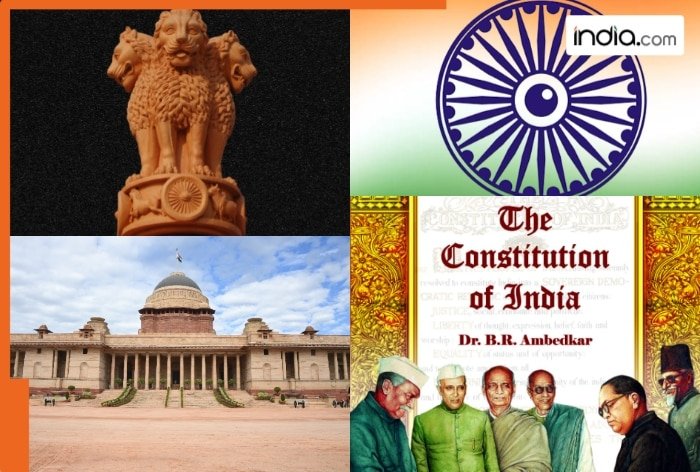
India’s national emblem features four lions, sitting next to each other, each looking in a different direction.
New Delhi: Tomorrow, on January 26, 2026, India will be celebrating its 76th Republic Day. On this day in 1950, India became a republic and adopted the constitution. Along with the Constitution, India also selected its State Emblem, the symbol of her centuries-old rich heritage, as well as the blossoming future.
Our country’s emblem is adapted from the Lion Capital of Ashoka, an ancient sculpture, a statue that dates back to more than 2 thousand years, with its roots in the Maurya Empire. The statue is a three-dimensional insignia comprising four lions. The four-lion statue was adopted as the badge of the Republic of India. From that time onwards, it is the official seal, the stamp of the Government of India, and is proudly displayed on every entity of the Republic of India.
Why did India adopt the Ashoka Pillar as its national emblem?
The badge has four lions of the Ashoka Pillar. Each lion symbolises a unique trait, namely, courage, pride, strength, and confidence. Here, we will tell you why India adopted the Ashoka Pillar as its national emblem. Across the centuries, the insignias have been used as a mark of identity for a particular state or a similar entity.
India adopted its own badge on January 26, 1950, which is the Ashoka Pillar. It was embedded with the motto ‘Satyameva Jayate,’ a Sanskrit phrase from the ancient Mundaka Upanishad, meaning “Truth alone triumphs”. It is, in a way, a statement that truth, righteousness, and justice will ultimately prevail over all evil.

Also read: From Somnath Lahiri to KT Shah: The unsung heroes who shaped the Indian constitution
Four Lions, Gautam Buddha’s life, and what they represent
For any state, country, or sovereign entity, its national emblem is its identity, not in words but in a symbolic form. It is like adorning a medal of honour on one’s chest. India’s national emblem features four lions, sitting next to each other, each looking in a different direction.
As mentioned above, these four lions represent Courage, Pride, Strength, and Confidence. The 2D representation of the national emblem shows only one Ashoka Chakra at the front. Along with this, we can see a galloping horse on its left side and a bull on its right side. It is believed that the lions, along with the other animals, represent the four stages of Gautam Buddha’s life.
The bull symbolizes Lord Buddha’s zodiac sign, Taurus, and the elephant represents his birth. The horse symbolizes his ride after leaving his home, where Lord Buddha delivered his first sermon.
The pillar was constructed in Sarnath, a small town near Varanasi, in Uttar Pradesh, in 250 BC. Lord Buddha delivered his first sermon in Sarnath. It was excavated by Friedrich Oscar Oertel in 1905-06.
Ashoka Chakra: Ashoka Chakra is an inscription that is featured on many of Emperor Ashoka’s imprints or impressions. They mostly feature a wheel, known as the Ashoka Chakra. The wheel that is inscribed on our national emblem is a symbol of the Dharma Chakra (Wheel of Dharma). It is engraved on the Lion Capital at Sarnath and on the Ashoka Pillar. The Ashoka Chakra has 24 spikes and is incorporated into the national flag of India. These 24 spikes represent the 12 stages of suffering arising from ignorance and the 12 stages leading from suffering to Nirvana (Enlightenment).
Oath of Office or affirmation by the President of India
Every President and every person acting as President or discharging the functions of the President shall, before entering upon his office, make and subscribe in the presence of the Chief Justice of India or, in his absence, the senior-most Judge of the Supreme Court available, an oath or affirmation in the following form, that is to say: “I, A.B., do swear in the name of God/solemnly affirm that I will faithfully execute the office of President (or discharge the functions of the President) of India and will to the best of my ability preserve, protect and defend the Constitution and the law and that I will devote myself to the service and well-being of the people of India.”.
Version 1: Article 49, Draft Constitution of India 1948
Every President and every person acting as President or discharging the functions of the President shall before entering upon his office make and subscribe in the presence of the Chief Justice of India an affirmation or oath in the following form, that is to say: “I, A. B., do solemnly affirm (or swear) that I will faithfully execute the office of President (or discharge the functions of the President) of India and will to the best of my ability preserve, protect and defend the Constitution and the law and that I will devote myself to the service and well-being of the people of India.”
Version 2: Article 60, Constitution of India 1950
Every President and every person acting as President or discharging the functions of the President shall, before entering upon his office, make and subscribe in the presence of the Chief Justice of India or, in his absence, the seniormost Judge of the Supreme Court available, an oath or affirmation in the following form, that is to say: “I, A. B., do swear in the name of God solemnly affirm that I will faithfully execute the office of President (or discharge the functions of the President) of India and will to the best of my ability preserve, protect and defend the Constitution and the law and that I will devote myself to the service and well-being of the people of India.”
(With inputs from www.constitutionofindia.net)
Leave a Reply