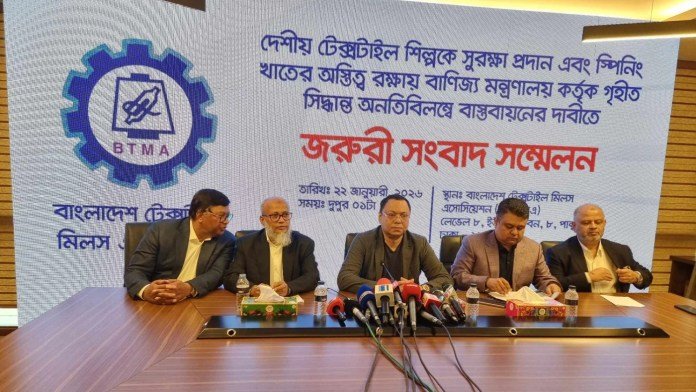
In a move that can have serious implications on Bangladesh’s economy, the Bangladesh Textile Mills Association (BTMA) has declared an indefinite closure of all textile mills across the country effective February 1, citing crippling financial losses and the interim government’s alleged inaction in protecting domestic yarn producers. BTMA President Showkat Aziz Russell made the announcement during a press conference at the association’s office in Dhaka on January 22, emphasising that the decision was based on necessity, and it is not a threat.
“We will shut down no matter what. We do not have the capacity to repay bank loans,” Russell stated. He added that the industry’s capital base has been eroded by nearly 50%, and therefore, asset sales or even liquidation have become insufficient to cover outstanding debts. “Even if we sell off all our assets, it will not be possible to clear the debts,” he said.
The association added that the spinning mills have been operating at only around 50 percent capacity for the past 30 days, and the industry has lost around Tk 12,000–15,000 crore during this period. As result, they have been unable to repay bank loans, posing risk to the entire financial system of Bangladesh.
Russell said that continued operations under current conditions are impossible, and warned that if instability arises in the banking sector due to this crisis, the government would bear full responsibility. BTMA accused the interim government of not taking the matter seriously. Shawkat Aziz Russell said, “I have gone to all the ministries and relevant departments, but everyone is shifting responsibility to others. No concrete decision is coming.”
He further alleged, “Although the textile sector contributes around 13 percent to the country’s GDP, the interim government does not even spend 13 minutes listening to our problems.”
The association’s decision came after the commerce ministry requested the National Board of Revenue to suspend duty-free yarn imports under the bonded warehouse facility. While the decision was taken to protect domestic spinning mills, the textile exporters said that it will sharply increase production costs for garment and knitwear. This has resulted in a standoff between textile millers and exporters.
At the heart of the dispute is the bonded warehouse facility, which allows duty-free imports of yarn, particularly in the 10-30 count range. BTMA argues that these imports have flooded the market, undermining local spinning mills and leading to unsold yarn stockpiles worth billions. The association has repeatedly appealed for the suspension of this facility. Without this intervention, BTMA claims, the primary textile sector faces an existential crisis.
Russell said that BTMA leaders held discussions with the Bangladesh Garment Manufacturers and Exporters Association (BGMEA) on the issue, and claimed that the BGMEA has acknowledged that continued dependence on low-cost imported yarn can lead to the collapse of the domestic industry.
BTMA claimed that local spinning mills are capable of meeting 50–70 per cent of the country’s yarn demand, and if this sector collapses due to low-cost imports, garment manufacturers will be completely dependent on imports.
However, BGMEA has disagreed with BTMA’s allegations, stating that remarks by Russell on yarn imports and bonded facilities are inconsistent with statistical data and could undermine the garment industry’s cost structure. In a statement, BGMEA emphasised the need for fact-based policy dialogue, clarifying that their positions are grounded in verified records rather than assumptions.
Garment exporters, represented by the Bangladesh Garment Manufacturers and Exporters Association (BGMEA) and the Bangladesh Knitwear Manufacturers and Exporters Association (BKMEA), strongly opposed the suspension of duty-free import of yarns, warning that such an action could inflate yarn costs by $0.30-0.60 per kilogram, eroding the competitiveness of Bangladesh’s $28 billion knitwear exports.
Bangladesh’s textile industry, valued at around $23 billion, forms the backbone of the nation’s economy, supplying yarn to the ready-made garments sector, which accounts for approximately 85% of the country’s total export earnings. The shutdown threat comes at a precarious time, just ahead of national elections, and could disrupt the entire supply chain, potentially leading to uncertain wage payments for workers and broader economic fallout. The closure could affect millions of jobs, with recent data showing that between January 2024 and March 2025, 113 RMG factories already shuttered, displacing 96,000 workers.
Government officials have recognised the gravity of the situation. Commerce Secretary Mahbubur Rahman indicated that multiple options are being explored to address the concerns of all parties involved, including textile mill owners and garment manufacturers.
Leave a Reply