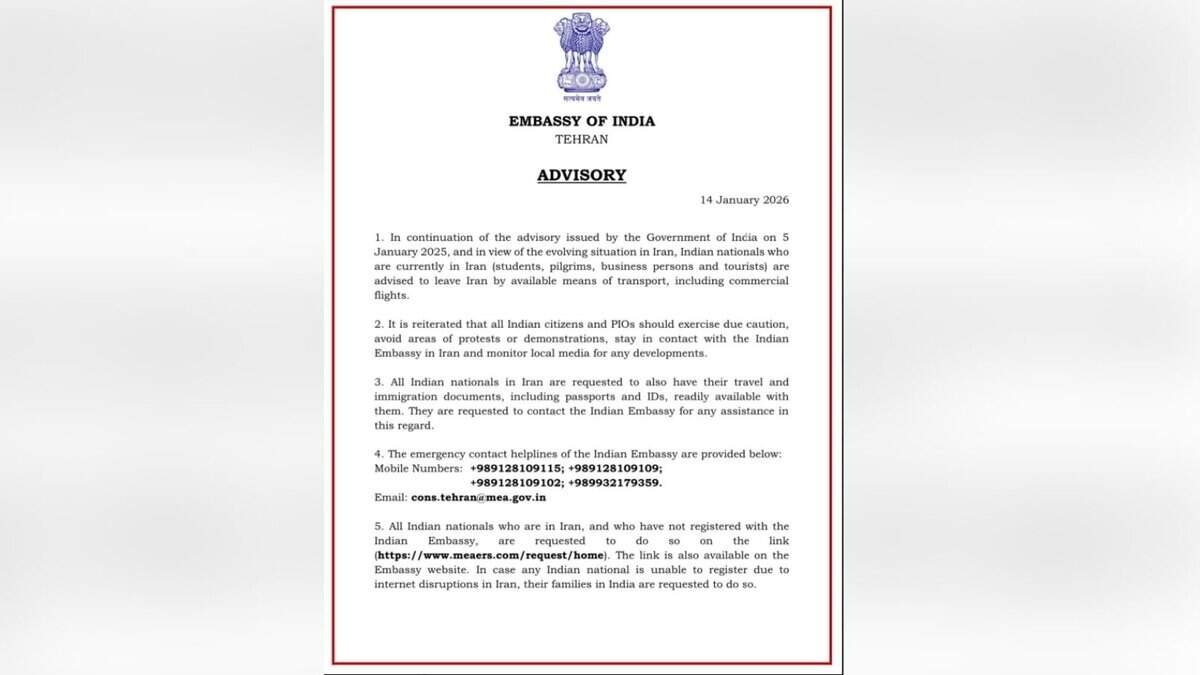
The Indian Embassy in Tehran, on Wednesday, January 14, issued an advisory asking its nationals to leave the Middle Eastern country, which is currently reeling under intense civilian protests and escalating violence.
The advisory directed Indians, including tourists, students, pilgrims and business persons, to exercise caution and leave Iran by available means of transport like commercial flights.
“It is reiterated that all Indian citizens and PIOs should avoid areas of protests and demonstrations, stay in contact with the Indian Embassy and monitor local media developments,” the statement read.


The embassy has issued emergency contact numbers: +989128109115, +989128109101, +989128109102 and +989932179359 or email: cons.tehran@mea.gov.in
The advisory also asked Indian nationals to have their travel and immigration documents, passports and IDs with them.
The embassy also asked Indian nationals not registered with them to click on this link and, if unable to do so, request their families in India to register.

As of Wednesday, the death toll has jumped to at least 2,571, according to a US-based Human Rights Activists News Agency, which has been accurate in multiple rounds of unrest in Iran in recent years.
2026 Iran protests
Iran’s leadership is under incredible pressure as the largest protests in years against the Islamic theocracy shake the country.
Tehran is struggling under heavy economic pressure, only intensified in September by the return of United Nations sanctions on the country over its atomic program. These developments have put Iran’s Rial currency into a free fall, now trading at some 1.4 million to just one dollar.
The collapse of the Rial has led to a widening economic crisis. Prices are up on meat, rice and other staples of the Iranian dinner table. The nation has been struggling with an annual inflation rate of some 40 per cent.
That anger swiftly turned into a broader challenge to the theocracy, and leaderless protests ignited in other cities.
The 86-year-old Supreme Leader Ayatollah Ali Khamenei, who has ruled since 1989 and holds ultimate power, was out of sight for days during and after the war. He has no successor, a source of further uncertainty for the theocracy and Iran’s people.
Its leadership and military were badly weakened in the 12-day war with Israel in June and by US airstrikes against the country’s nuclear facilities during the conflict. Several military leaders were killed, air defences were nearly wiped out, and the missile stockpile shrank.
Its self-described “Axis of Resistance” — a coalition of countries and militant groups backed by Tehran — has been decimated in the years since the start of the Israel-Hamas war in 2023.
Globally, Iran remains isolated. One ally, Russia, is distracted by its war in Ukraine. China, a buyer of Iranian oil, on Monday expressed hope the Iranian government and people are “able to overcome the current difficulties and maintain national stability.”
Exiled crown prince, Reza Pahlavi, also called for intensified demonstrations as several citizens shouted and rallied in the streets against the theocratic government. On January 9, Internet access and telephone lines were cut out.
Leave a Reply