










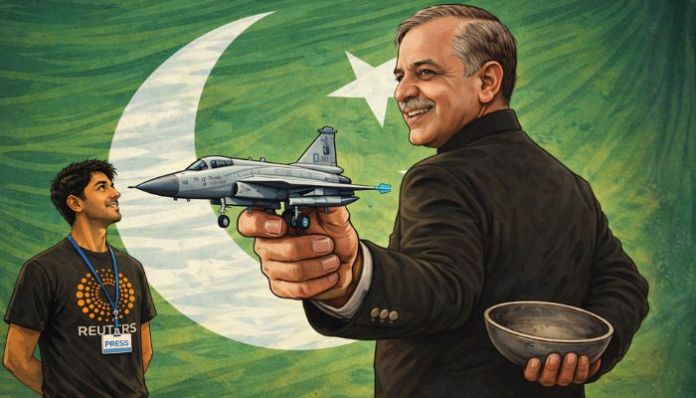
Within a span of six days, a series of “exclusive” reports by Reuters journalist Saad Sayeed have projected Pakistan as an emerging force in the global arms market. In his reports, Saad claimed Pakistan is in talks with multiple nations for multi-billion-dollar defence deals spanning South Asia, the Middle East, and Africa. Interestingly, Saad’s back-to-back Pakistan-centric bylines came almost a year after his last byline had appeared on Reuters.
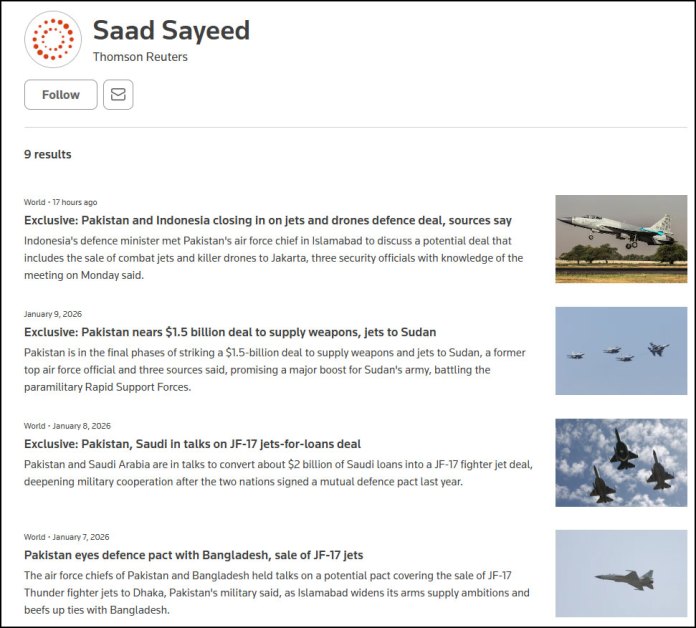
These reports, published at a questionable pace and in a uniform tone, have raised questions not only over the claims themselves but also over the sourcing practices and narrative building. Interestingly, Pakistan, a country that is neck-deep in loans and facing massive inflation, is being projected as a rising arms supplier in a region where India is increasing its dominance in military equipment exports.
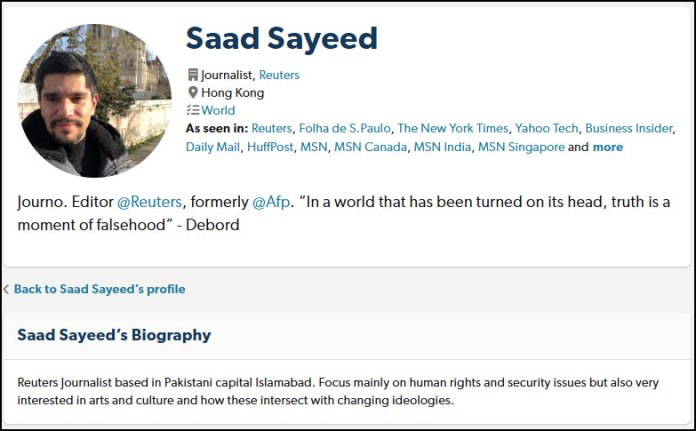
Saad’s Muck Rack profile suggests his location is Hong Kong and the bio on the website says he is based in Islamabad.
A rapid burst of defence exclusives
The sequence began on 7th January with two reports. In the first report, Saad claimed that Pakistan was in talks with Bangladesh over a defence pact involving JF-17 Thunder fighter jets and Super Mushshak trainers. The second report suggested that Saudi Arabia was considering converting existing loans into a potential $4 billion JF-17 deal.
Both reports written by Saad foregrounded the aircraft’s “combat-proven” credentials. They cited the India-Pakistan conflict of May 2025, which took place after India initiated Operation Sindoor to eliminate terrorist camps inside Pakistan and Pakistan-occupied Jammu and Kashmir (PoJK). Operation Sindoor was a military response to the Pahalgam terrorist attack, in which 26 innocent Hindu tourists were killed by Pakistan-sponsored terrorists.
Saad claimed that the jets Pakistan is trying to “sell” to Bangladesh and Saudi Arabia are combat-tested against India, a claim the hostile nation has failed to prove with evidence. He framed the negotiations as part of Islamabad’s efforts to stabilise its economy through defence exports.
In the Bangladesh report, Pakistan’s defence minister Khawaja Asif was quoted claiming that a surge in defence orders could make International Monetary Fund (IMF) assistance unnecessary within months. The statement appeared without analytical challenge or economic counterweight.
Notably, in the past few years, Pakistan has gone to the IMF multiple times with a begging bowl, seeking financial assistance to support its drowning economy. The IMF imposed several restrictions to issue loans. Apart from the IMF, Pakistan has also taken loans from China, Saudi Arabia, and other nations.
On 9th January, another “exclusive” was published in which Saad claimed that Pakistan was nearing a $1.5 billion arms deal with Sudan, involving aircraft, drones, and air defence systems. Interestingly, when India launched Operation Sindoor, Pakistan’s “air defence” could not stop even a single missile, and India not only managed to neutralise several terrorist camps but also attacked military installations after Pakistan retaliated. On the other hand, India’s air defence successfully neutralised a swarm of drones and missiles during the conflict.
On 12th January, yet another “exclusive” report was published in which Saad claimed that Indonesia was in advanced talks to acquire more than 40 JF-17 jets and Shahpar drones. Four exclusives in under a week, all reinforcing the same trajectory.
Dependence on anonymous and retired military sources
Across the reports written by Saad, the sourcing patterns remain strikingly consistent. Key details are attributed to unnamed officials described as “sources close to the military” or “sources with knowledge of the matter”. Furthermore, the reports were supplemented by commentary from “retired Pakistani air marshals” who were “informally” briefed on defence affairs.
Official confirmations, where cited, were limited to acknowledging meetings or discussions, not the scale, financial structure, or finality of the alleged deals. The substantive claims rest almost entirely on these unnamed or semi-detached figures.
When it comes to defence-related reporting, anonymity is common. However, the repeated reliance on similar categories of sources, without named independent analysts or dissenting assessments, raises questions about verification and balance.
A closed loop of internal citations
Another notable feature is the dense web of self-referencing within Reuters’ own coverage, especially to reports written by Saad himself. Each new article cited earlier reports as evidence of Pakistan’s growing defence footprint.
The Indonesia report points back to the Sudan, Saudi, and Bangladesh pieces. The Sudan article references the Saudi and Bangladesh talks, along with an earlier Libya deal. The Saudi and Bangladesh reports cross-reference each other. While some of the reports were written by Saad, co-authored with Mubasher Bukhari in the Sudan report or Ananda Teresia in the Indonesia report, others were written by Ariba Shahid and Asif Shahzad, who have produced hundreds of Pakistan-centric reports.
This internal citation loop is risky as it creates the appearance of corroboration, even when the sources behind the actual stories remain largely unchanged. Such circular reinforcement is often used to create a narrative that, in reality, does not exist, and in this case, it appears to have been done to position Pakistan as a key player in the defence sector in the Indian subcontinent.
A consistently favourable framing
Across all four reports, Pakistan’s defence ambitions were framed as economically transformative and strategically successful. Potential downsides received limited attention.
The Sudan report briefly noted the country’s civil war but focused on how Pakistani arms could “revive” the Sudanese army, offering little engagement with the ethical implications of supplying weapons amid a humanitarian crisis.
In the Indonesia-centric article, the authors acknowledged Jakarta’s wider fighter jet considerations but positioned the Pakistani option as competitively advanced. However, this was done without comparable scrutiny of performance claims or geopolitical trade-offs.
The cumulative effect is a narrative that foregrounds Pakistan’s gains while downplaying risks associated with arms proliferation, sanctions exposure, and regional instability.
Editorial responsibility and trust
These patterns sit uneasily with Reuters’ own Trust Principles, which emphasise accuracy, independence, and restraint in the use of anonymous sources.
Exclusivity may drive attention, but on sensitive defence matters with global implications, repetition without diversification of sources risks blurring the line between reporting and amplification.
The question is not whether Pakistan seeks to expand its defence exports. That is well established. The more pressing issue is whether journalism, especially from a global wire service, should appear to advance that narrative with such confidence, speed, and uniformity, without visibly testing the claims it carries.
In today’s time, information itself shapes geopolitics. How a story is built matters as much as the story itself, as it can affect decision-making processes. If these reports have been written to boost Pakistan’s position as a key player in the defence sector, it is worth exploring on whose behest this is being done, especially when India has positioned itself as a major defence exporter in the last decade.


